What Causes Lights to Flicker? A Complete House Guide
Lights flicker in a house for reasons that range from a loose bulb anyone can fix in 30 seconds to active electrical arc faults that can start a house fire within minutes. Understanding what causes lights to flicker means understanding which of these causes is operating in your specific situation, because the correct response ranges from doing nothing to calling 911.
According to the Electrical Safety Foundation International (ESFI), electrical failures and malfunctions are a leading cause of residential fires in the United States, responsible for an estimated 51,000 home fires annually. Not every flickering light is a crisis, but some patterns of flickering are a direct early warning of exactly that kind of failure.
This guide covers all 16 major causes of residential light flickering, explains the actual electrical mechanism behind each one, tells you which patterns are genuinely dangerous, and gives you a clear framework for deciding whether to change a bulb, call a licensed electrician, or call 911.
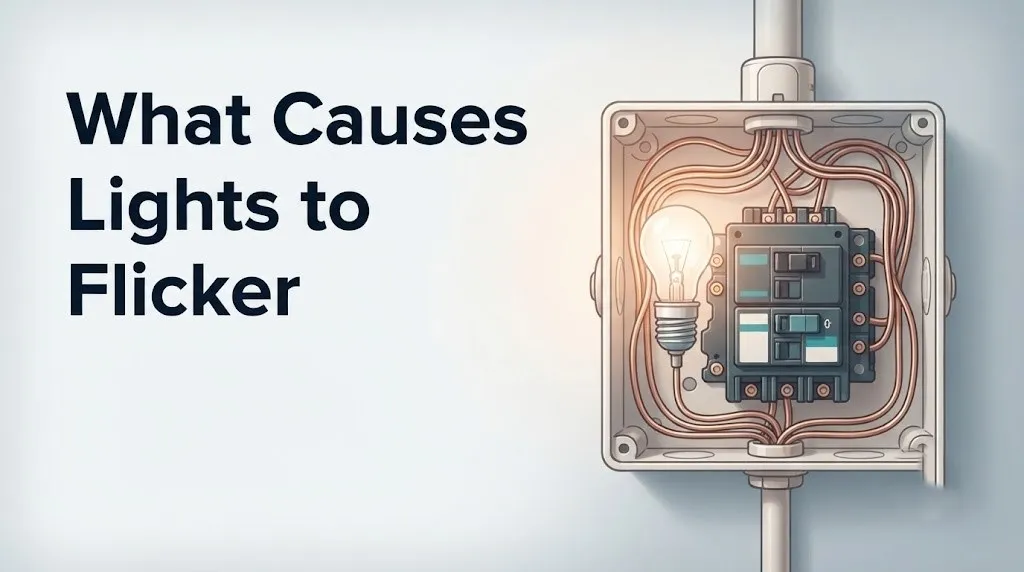
What Causes Lights to Flicker
Lights flicker when the electrical voltage delivered to a bulb drops, spikes, or fluctuates rapidly enough to produce visible changes in light output.
Every light bulb, regardless of type, converts electrical energy into light. That conversion depends on a stable supply of voltage. When that supply varies, output varies. The eye detects light fluctuations faster than most people expect: human photoreceptors in the retinal cone system can perceive flicker at rates up to approximately 80 Hz under some conditions, which is why even brief, rapid voltage changes register as a visible flicker rather than a smooth consistent glow.
The physics underneath this is straightforward. According to Ohm’s Law, voltage equals current multiplied by resistance (V=IR). Any increase in resistance along a circuit, whether from a loose connection, a degraded wire, an overloaded circuit, or a failing component, reduces effective voltage delivery at the bulb end. That voltage reduction translates directly into reduced light output.
The key clinical point here is that flicker is a symptom, not a diagnosis. A loose bulb and a deteriorating service entrance cable both produce flicker. The electrical mechanism in each case is the same voltage fluctuation at the bulb end, but the source is radically different and so is the risk.
| Flicker Type | Likely Source Tier | Risk Level |
|---|---|---|
| Single bulb, one fixture | Bulb or fixture | Low |
| Multiple lights, one circuit | Circuit wiring or breaker | Moderate |
| Lights dim when appliance starts | Normal inrush current | Usually low |
| Whole house flickers | Panel or service entrance | High |
| Flicker with burning smell | Arc fault or overheating | Emergency |
What Causes Flickering Lights in a House
The causes of flickering lights in a house fall into four categories: bulb and fixture issues, wiring and connection problems, circuit and panel issues, and utility-side voltage problems.
Bulb and fixture issues are the most common and lowest-risk category. A bulb that is not fully seated in its socket creates intermittent contact. The filament or LED driver receives inconsistent voltage and the output flickers. This accounts for a large proportion of single-bulb flicker reports and resolves entirely when the bulb is tightened or replaced.
Wiring and connection problems are more serious. Every electrical connection in a house, from the terminal screws on a light switch to the wire-nut connections inside a junction box, is a potential point of increased resistance. Over years of thermal cycling (the expansion and contraction of metal under heating and cooling), connections loosen. A loose connection increases resistance at that point, drops voltage, and produces flicker in every fixture downstream of that connection.
The most frequently searched follow-up question about flickering lights is whether the problem is dangerous. The honest answer is: it depends entirely on which cause is active. A loose bulb is not dangerous. A loose main panel connection with signs of arcing is. The remainder of this article is designed to help you identify which category your situation falls into.
- Bulb and fixture issues: self-resolvable, low risk
- Dimmer switch incompatibility: self-resolvable if bulb type is corrected
- Overloaded circuit: low to moderate risk, professional evaluation recommended
- Loose wiring connection: moderate to high risk, licensed electrician required
- Panel or breaker fault: high risk, licensed electrician urgent
- Arc fault: high risk, potential fire hazard, immediate professional evaluation
- Utility-side voltage fluctuation: low personal risk, report to utility provider
House Lights Flickering Causes: A Severity Guide
Not all flickering lights carry the same risk, and the pattern of the flickering reveals which cause is most likely to be operating.
The National Fire Protection Association (NFPA) classifies certain electrical wiring conditions as inherently fire-hazardous, particularly those involving intermittent arcing at loose connections. The challenge for a homeowner is that arcing at a wiring connection looks identical from the living room to a loose bulb, both produce brief visible flicker. The distinction requires knowing when the flicker occurs, where it occurs, and what else happens at the same time.
A pattern guide for diagnosing cause category:
| Pattern | When It Occurs | Location | Likely Cause |
|---|---|---|---|
| Brief flicker, then stable | On/off of large appliance | Whole house or one area | Inrush current draw, usually normal |
| Random flicker, single bulb | Unpredictable | One fixture only | Loose bulb, failing bulb |
| Consistent flicker at a fixture | Constant | One fixture | Failing dimmer, wrong bulb type |
| Multiple lights, one room | Unpredictable | One room or one circuit | Loose connection on that circuit |
| Flicker plus dimming | Large appliance runs | Multiple areas | Overloaded circuit or panel issue |
| Whole house flicker | Unpredictable or constant | Entire home | Main service panel or utility |
| Flicker plus smell or buzzing | Any time | Any location | Arc fault: call a licensed electrician immediately |
Renters in older apartment buildings face a specific variation of this problem. Shared electrical systems in multi-unit buildings mean that voltage fluctuations from another tenant’s high-load appliance can produce flicker in your unit. A renter who notices flickering only at certain times of day, correlated with building-wide activity, should report to their building manager and request an electrical inspection of the shared service panel.
Key Takeaway: Flickering lights range from a loose bulb anyone can fix to an arc fault that requires urgent licensed electrician attention. The pattern of when, where, and how the flicker occurs is the first step in identifying which situation you are in.
Loose Wiring and Flickering Lights
Loose wiring is one of the most common serious causes of house lights flickering, and it operates through a specific electrical mechanism that explains why it is genuinely dangerous.
Every electrical connection in a residential wiring system is a mechanical joint: two conductors held together by a screw terminal, a wire nut, or a push-in connector. Metal expands when heated by current flow and contracts when it cools. Over years and decades, this thermal cycling gradually loosens those mechanical joints. A loose connection increases electrical resistance at that specific point on the circuit. By Ohm’s Law, increased resistance at any point in a series circuit reduces the voltage available downstream of that point. That voltage reduction is what produces the visible flicker at every light on that circuit.
The deeper concern is that increased resistance at a loose connection also generates heat. According to the Consumer Product Safety Commission (CPSC), loose electrical connections that arc and heat over time are a primary initiating factor in residential electrical fires. The wire insulation immediately surrounding a consistently loose, hot connection can char over months and eventually ignite.
Loose connections can occur at any point in a circuit: the terminal screws on a light switch, the wire connections inside a junction box, the connections at the circuit breaker itself, or the connections on the neutral bus bar inside the main service panel. A loose neutral connection is particularly problematic because it can cause voltage imbalances that affect multiple circuits simultaneously and can produce dangerously elevated voltages on circuits that share the neutral return path.
To describe a loose wiring issue accurately to a licensed electrician:
- Note which lights are flickering and map them to specific rooms or areas
- Identify whether the flicker occurs on multiple lights in the same room or across rooms
- Note whether the flicker is random or occurs at a specific time or with specific events
- Check whether the flickering began recently or has been present for months or years
- Note any associated sounds (buzzing, crackling) or smells near outlets or switches
Any flickering you suspect is caused by wiring rather than a loose bulb requires evaluation by a licensed electrician, not a home improvement store consultation. Wiring faults inside walls, junction boxes, or panels cannot be safely diagnosed or repaired without professional training and proper tools.
Overloaded Circuit Causing Lights to Flicker
An overloaded circuit causes lights to flicker by pulling more current than the circuit’s wire gauge can efficiently carry, which drops voltage across the circuit and reduces available power to the lighting fixtures on it.
Every residential branch circuit has a rated amperage, typically 15 or 20 amps for general-use circuits in most homes built after 1975. That rating reflects the maximum continuous current the circuit’s wiring can carry without generating dangerous heat in the conductors. When the total load on a circuit exceeds its rated capacity, current through the wire increases, which increases resistive heating in the wire itself and drops the voltage available to end-load devices like light fixtures.
The practical result is that lights on a heavily loaded circuit dim or flicker when other high-draw devices on the same circuit, such as a space heater, hair dryer, or small kitchen appliance, are running simultaneously. According to the ESFI, circuit overloads are particularly common in older homes where the original wiring was designed for far fewer electrical devices than a modern household uses.
A reliable self-test: if a light fixture on a circuit stops flickering when you unplug a high-draw appliance sharing that circuit, circuit overload is a likely contributing cause. That circuit should be evaluated by a licensed electrician to determine whether a dedicated circuit for the high-draw appliance is warranted.
| Circuit Load Level | Observable Effect | Action Required |
|---|---|---|
| Under rated capacity | No flicker, stable operation | None |
| At rated capacity | Minor dimming under peak load | Monitor, reduce simultaneous load |
| Slightly over capacity | Noticeable flicker or dimming with appliance use | Licensed electrician evaluation |
| Significantly over capacity | Breaker trips, persistent flicker | Licensed electrician: dedicated circuit needed |
| Extreme overload | Breaker trips repeatedly, wire heating | Emergency: stop using circuit, call licensed electrician |
Older homes built before 1975 are disproportionately at risk for circuit overload because their original 60-amp or 100-amp service panels were designed for households using significantly fewer electrical devices than a 2026 home.
Can a Bad Breaker Cause Lights to Flicker
Yes, a faulty circuit breaker can cause lights to flicker by failing to maintain a stable electrical contact between the breaker’s internal mechanism and the hot bus bar inside the main service panel.
A circuit breaker performs two functions: it connects a branch circuit to the electrical panel’s hot bus bar to deliver power, and it disconnects that circuit automatically when current exceeds the breaker’s rated amperage. The connection between the breaker and the bus bar is mechanical. Over time, that connection can loosen, corrode, or degrade, producing intermittent resistance at the panel level. The result is voltage fluctuation on that entire circuit, which every light on that circuit registers as flicker.
A bad breaker has a specific and distinguishing characteristic: the flicker it produces is confined to lights on one circuit only and is not reproduced by any appliance startup or external event. It is random in its timing and consistent in its location.
According to electrical safety professionals and NFPA 70 (National Electrical Code) standards, certain breaker brands have documented reliability problems. Panels manufactured by Federal Pacific Electric (FPE) and Zinsco have been associated with breaker failures and panel fire risks. If your home has one of these panels, an evaluation by a licensed electrician is appropriate regardless of whether you are currently experiencing flicker.
Quick Tip:
- A breaker that feels loose when touched from the front panel face, or that can be toggled with unusual ease, may have lost its firm connection to the bus bar
- A breaker that trips repeatedly without an obvious overload may be failing internally
- Never attempt to open a main service panel to examine breakers yourself; the bus bars inside are energized even when all individual breakers are switched off, and contact with them is lethal
Key Takeaway: A bad circuit breaker produces circuit-specific, random flicker with no appliance correlation. Panels from Federal Pacific Electric or Zinsco warrant licensed electrician evaluation even without active symptoms.
Why Do Lights Flicker When Appliances Turn On
Lights that flicker briefly when a large appliance starts up are usually responding to a normal electrical phenomenon called inrush current, which is a temporary surge in current demand that momentarily drops voltage across the entire circuit or service panel.
Motors in large appliances, including refrigerators, washing machines, dishwashers, and air conditioning compressors, require significantly more current at the moment of startup than they need during steady-state operation. This startup current spike is called inrush current. In a 240-volt central air conditioning compressor motor, the inrush current at startup can briefly reach 6 to 8 times the motor’s normal running current. That spike draws more power than usual from the circuit, temporarily reducing the voltage available to other devices on shared circuits.
The result is a brief, noticeable dimming or flicker in nearby lights that lasts one to two seconds and then resolves completely as the motor reaches operating speed and its current demand drops to its normal running level. This pattern, specifically one to two seconds of flicker coinciding exactly with appliance startup followed by immediate stabilization, is normal in most households and does not indicate a wiring problem.
The ESFI notes that the key distinction is between brief inrush-related flicker that is time-locked to appliance startup and flicker that continues, worsens, or extends beyond the startup period. The second pattern suggests the appliance’s motor or the circuit wiring has a problem that warrants attention.
| Flicker Pattern with Appliance | Duration | Likely Meaning |
|---|---|---|
| 1-2 seconds at startup, then stable | Very brief | Normal inrush current |
| Flicker continues while appliance runs | Ongoing | Circuit overload or wiring issue |
| Flicker worsens over months | Progressive | Motor failing or wiring degrading |
| Lights stay dim while appliance runs | Sustained | Circuit may be inadequate for load |
Homeowners in older homes with 100-amp service panels are more likely to notice inrush-related flicker because the total panel capacity is closer to its limit, making individual motor startup events a larger proportional draw against available power.
Lights Flickering When AC Turns On
Lights that flicker when the air conditioning turns on reflect a specific version of the motor inrush current principle, but the scale of a central AC compressor makes this effect more pronounced than most other household appliances.
A central air conditioning compressor operates on a dedicated 240-volt double-pole circuit rated at 20 to 60 amps depending on the system’s size. Despite that dedicated circuit, the compressor’s inrush current at startup is large enough to cause a momentary voltage sag across the entire home’s service panel, not just on the AC circuit itself. That momentary sag is visible as a brief whole-house flicker.
Brief flickering at AC startup, resolving within one to two seconds, is generally considered normal particularly in homes with high-efficiency variable-speed compressors, which have higher startup inrush profiles than older single-speed units. However, several conditions can transform what should be a mild normal event into a more noticeable or concerning pattern.
A failing capacitor in the AC compressor motor is one of those conditions. The capacitor provides the initial electrical boost that starts the compressor motor. When the capacitor degrades, the motor struggles to start, draws elevated inrush current for a longer period, and produces a more dramatic and prolonged lighting flicker. This pattern, specifically flicker that is more pronounced than it was one or two seasons ago, is a sign that the AC system itself needs service, not the electrical panel.
- Flicker lasting longer than 3 seconds at AC startup: AC capacitor may be failing; contact an HVAC technician
- Flicker at AC startup plus tripped breaker: compressor may be drawing excessive current; HVAC and electrical evaluation needed
- Flicker at AC startup that has worsened over a season: progressive sign of compressor or capacitor degradation
- Residents with 100-amp service panels who have added a large high-efficiency AC unit in the past five years are particularly likely to notice this effect
Why Do LED Lights Flicker
LED lights flicker for reasons distinct from incandescent or fluorescent bulbs, because their method of converting electricity to light depends on an internal electronic component called an LED driver that is sensitive to voltage quality and dimmer switch compatibility.
An LED driver is a small electronic circuit that converts standard household AC current (alternating current) into the regulated DC current (direct current) that the LED diode array requires. The driver is designed to accept a stable voltage input within a specific range. When the input voltage fluctuates even mildly, some LED drivers cannot compensate quickly enough, and the output flicker is visible. Incandescent bulbs, by comparison, have thermal inertia: the tungsten filament stays hot enough between AC cycles to maintain glow, smoothing out minor voltage variations. LED drivers do not have that thermal buffer.
Dimmer switch incompatibility is the single most common cause of LED flicker in households that have switched from incandescent to LED bulbs without changing their dimmer switches. Most dimmer switches sold before approximately 2015 were designed specifically for the resistive (non-reactive) electrical load of incandescent bulbs. LED drivers present a different electrical load profile, called an inductive/capacitive reactive load. When an incompatible dimmer tries to regulate an LED driver’s current, the result is persistent flicker, buzzing, or both, particularly at low dimmer settings.
According to Underwriters Laboratories (UL) testing standards, LED bulbs and dimmer switches must both be rated for LED dimming compatibility for the combination to work without flicker. Checking that both the LED bulb package and the dimmer switch label specify “LED compatible” or “LED/CFL” resolves the majority of LED dimmer flicker cases.
- Use only LED-rated dimmer switches when dimming LED bulbs
- Check that the LED bulb’s wattage equivalent falls within the dimmer’s rated LED load range
- Not all LED bulbs are dimmable: non-dimmable LED bulbs in a dimmer circuit will flicker regardless of dimmer type
- Older adults may find LED flicker more perceptible at higher frequencies due to changes in visual processing with age
Key Takeaway: Most LED flicker in modern homes is caused by dimmer switch incompatibility and resolves completely when both the bulb and the dimmer switch are rated for LED dimming.
Why Do Fluorescent Lights Flicker
Fluorescent lights flicker primarily because of a failing or aging ballast, the internal component that regulates the electrical current flowing through the fluorescent tube to sustain the gas discharge arc that produces light.
A fluorescent tube produces light through a fundamentally different mechanism than an incandescent or LED bulb. Inside the tube, an electrical arc excites mercury vapor atoms. Those excited atoms emit ultraviolet light, which then strikes a phosphor coating on the inside of the tube and re-emits as visible white light. This entire process requires a sustained, regulated electrical arc maintained by the ballast.
Two ballast types are in common residential and commercial use. The older magnetic ballast operates at the frequency of the AC power supply, typically 60 Hz in North America. Because AC current reverses direction 120 times per second (twice per 60-Hz cycle), and because a magnetic ballast tracks this cycle directly, a fluorescent light with a magnetic ballast technically flickers at 120 Hz. At this frequency, most people perceive no visible flicker under normal conditions. However, as the magnetic ballast ages and its core components degrade, it can no longer maintain the arc consistently across the full voltage cycle. The result is visible flicker at 60 Hz or lower, which the human eye perceives easily.
The electronic ballast, which replaced magnetic ballasts in most residential fluorescent fixtures from the 1990s onward, operates at 20,000 Hz or higher. At that frequency, flicker is imperceptible. When an electronic ballast fails, it produces irregular, often intermittent flicker rather than the cycling flicker of a degraded magnetic ballast.
A cold environment accelerates fluorescent flicker. At temperatures below approximately 10 degrees Celsius (50°F), mercury vapor pressure inside the tube drops, making it harder to sustain the arc. Fluorescent fixtures in unheated garages, basements, or outdoor-adjacent areas commonly flicker in winter for this reason alone and often stabilize after 5 to 10 minutes of warm-up time.
Lights Flickering in One Room Only
Lights flickering in only one room typically point to a problem localized to a single branch circuit: either a loose connection at a fixture, switch, or junction box within that room, or a failing circuit breaker supplying that room’s circuit.
A residential home is wired with multiple branch circuits, each serving a specific area or set of rooms. Each circuit originates at a dedicated breaker in the main service panel, runs through the wall and ceiling framing as insulated copper (or in older homes, aluminum) wire, and connects to every outlet, switch, and fixture it serves. A problem anywhere along that single circuit’s path produces symptoms on every fixture connected to it. A problem confined to one room, however, narrows the suspect zone considerably.
The most common single-room flicker cause is a loose connection at the light fixture itself, either at the wire-nut connections inside the canopy or at the terminal screws on the fixture’s mounting hardware. The second most common is a loose connection at the wall switch controlling that circuit’s lighting. Both of these are inside-the-wall or inside-the-box problems that require a licensed electrician to diagnose and repair safely.
To accurately describe a single-room flickering problem to a licensed electrician:
- Identify every light fixture in the room that is flickering and note whether all fixtures flicker simultaneously or independently
- Check whether outlets in the same room have shown any abnormality such as intermittent power loss
- Note whether the flicker began suddenly or gradually worsened over time
- Check whether a single circuit breaker serves the room or whether the room draws from multiple circuits
- Note the age of the home and, if known, the type of wiring (copper or aluminum, identified by the wire color under insulation if safely visible at an outlet)
Renters who notice single-room flickering should document the issue in writing to their landlord and request an electrical inspection. In many jurisdictions, a landlord’s failure to address documented electrical faults constitutes a habitability violation.
Whole House Lights Flickering Causes
Whole-house light flickering points to a problem at the point where the electrical supply enters the home or at the main service panel itself, not at any individual fixture or circuit.
The electrical supply to a residential home arrives via two insulated service entrance cables that run from the utility company’s transformer on the street (or from a pole-top transformer) to the home’s main service panel. Each cable carries 120 volts, and together they supply 240 volts for large appliances. Inside the panel, a neutral cable returns current to complete the circuit. A loose or degraded connection on any one of these three conductors at the point of entry to the panel, or at the main breaker itself, can affect every circuit in the house simultaneously.
According to the U.S. Fire Administration (USFA), main service panel problems including loose connections, failed main breakers, and degraded service entrance cables are associated with a subset of serious residential electrical fires. Whole-house flickering that has no correlation to appliance startup events, that appears spontaneously and resolves without any change in household behavior, and that has been progressive over weeks or months warrants priority evaluation by a licensed electrician.
A specific scenario to recognize: if the whole house lights are not just flickering but also dimming significantly while large appliances run, and this is new behavior that was not present previously with the same appliances, this pattern can indicate a degrading connection at the neutral service entrance conductor. A degraded neutral can create voltage imbalances that damage electronic equipment and appliances and can represent a fire risk at the panel.
Whole-house flickering always warrants a licensed electrician evaluation. It is not a situation to monitor for weeks or months.
Key Takeaway: Whole-house flickering points to the main service panel or service entrance cable, not individual fixtures, and always warrants a licensed electrician evaluation rather than watchful waiting.
Utility Company Causing Lights to Flicker
Flickering lights can originate entirely outside your home, caused by fluctuating voltage from the utility company’s electrical grid that enters the home through the service entrance without any internal electrical fault.
The utility grid operates at a nominal voltage of 120 volts per leg at the residential service entrance, but actual delivered voltage varies within a range. The American National Standards Institute (ANSI) standard C84.1 specifies that utility supply voltage at the service entrance should remain between 114 and 126 volts for normal operation. Voltage outside this range that the utility delivers is called a utility-side voltage fluctuation and is the utility company’s responsibility to address.
Common utility-side causes of residential flicker include a loose connection at the utility company’s transformer serving the neighborhood, a utility transformer that is overloaded during peak demand periods, a damaged utility conductor between the transformer and the home, or a line fault affecting the wider neighborhood grid. In each case, the problem exists upstream of the home’s service entrance and cannot be resolved by any electrical work inside the home.
To determine whether flickering is utility-side versus house-side:
- Ask neighbors on the same street whether they are experiencing similar flickering at the same times
- Contact the utility company and report the flickering, specifying the times of day it occurs and its duration
- If the utility company can remotely monitor voltage at your meter, request that they do so during the flickering period
- A licensed electrician can install a power quality monitor at the main panel that logs voltage levels over time, providing objective documentation for the utility company
- Keep a log of flicker episodes with date, time, duration, and whether neighbors reported the same issue
Utility-caused flickering is common in neighborhoods during summer peak demand periods when multiple high-load air conditioning systems are running simultaneously. Residents served by aging distribution transformers are disproportionately affected.
Old Wiring and Flickering Lights
Old wiring systems in homes built before approximately 1972 present specific and elevated flickering and fire risks because of the materials used, the installation methods of that era, and the simple fact of age-related deterioration.
Two legacy wiring systems deserve specific attention. Knob-and-tube wiring, the dominant residential wiring method from approximately 1880 to 1940, uses individual insulated wires run separately through ceramic knob insulators and ceramic tube insulators where they pass through framing members. This system has no ground conductor, no cable sheathing, and insulation made of cloth-wrapped rubber compounds that have in many cases dried, cracked, or crumbled over a century of thermal cycling. Damaged knob-and-tube insulation creates the conditions for both flickering (increased resistance at degraded insulation contact points) and fire (exposed conductors in contact with insulation-stuffed wall cavities).
Aluminum branch circuit wiring, used in many homes built between approximately 1965 and 1973, presents a different but equally serious problem. Aluminum wiring expands and contracts under thermal cycling approximately 40% more than copper wiring. Over decades, this differential movement loosens terminal screw connections significantly faster than copper wiring does. The CPSC has documented that homes with aluminum branch circuit wiring are approximately 55 times more likely to have one or more connections reach a fire-hazard temperature than comparable homes with copper wiring.
Flickering in a home built before 1975 should always be evaluated by a licensed electrician familiar with legacy wiring systems, not treated as a likely loose-bulb problem. The National Electrical Code (NFPA 70) provides specific remediation standards for both knob-and-tube and aluminum wiring systems.
- Homes with knob-and-tube wiring typically cannot be safely insulated without first removing or remediating the wiring
- Aluminum branch circuit connections can be made safer with specific anti-oxidant compounds and CO/ALR-rated devices, but rewiring is the definitive solution
- Any home purchased in the past five years without a full electrical inspection, particularly if built before 1975, warrants that inspection now
Is Flickering Lights a Fire Hazard
Flickering lights are a fire hazard when they indicate arc faulting, loose connections that are generating heat, or overloaded wiring, but they are not a fire hazard when caused by a loose bulb, dimmer incompatibility, or utility-side voltage fluctuation.
The NFPA reports that electrical fires cause approximately 1.3 billion dollars in residential property damage each year in the United States. A subset of those fires begins with exactly the kind of persistent, wiring-related resistance and arcing that can produce light flicker. The distinction between hazardous and non-hazardous flickering requires understanding which cause is active.
The specific physiological mechanism by which a loose connection becomes a fire hazard: a loose mechanical connection increases electrical resistance at that point. Increased resistance generates heat proportional to current squared times resistance (P=I²R). A connection that is warm to the touch under normal operation is normal. A connection that becomes hot enough to char surrounding wire insulation, dry wood, or building materials is a fire initiator. The progression from intermittent resistance to arc faulting to sustained arc to fire can occur over months or years, which is why early flicker symptoms matter.
| Flicker Cause | Fire Hazard? | Urgency |
|---|---|---|
| Loose bulb | No | None |
| Dimmer incompatibility | No | None |
| Normal appliance inrush | No | None |
| Utility voltage fluctuation | No | Report to utility |
| Overloaded circuit | Potential | Electrician evaluation within weeks |
| Loose wiring connection | Yes, if arcing | Electrician evaluation within days |
| Arc fault wiring | Yes | Electrician evaluation immediately |
| Old knob-and-tube wiring | Yes | Electrician evaluation immediately |
| Main panel loose connection | Yes | Electrician evaluation immediately |
| Flicker with burning smell | Yes, actively | Call 911 and evacuate |
Key Takeaway: Flickering lights become a fire hazard when they indicate loose connections generating heat or arc faulting. A burning smell combined with flickering is an active emergency requiring immediate evacuation and a call to 911.
Arc Fault and Flickering Lights
Arc fault is the single most dangerous electrical cause of residential light flickering, because it represents electricity jumping an unintended air gap between conductors and generating temperatures that exceed 35,000 degrees Fahrenheit in the immediate arc zone, hot enough to ignite wire insulation, wood framing, and surrounding building materials.
An arc fault occurs when a break or gap in a conductor’s continuity forces the electrical current to arc across the gap through the air. This happens most often at damaged wire insulation, at pinched or compressed wires behind baseboards or inside walls, at improperly connected terminals where a wire strand has broken from the bundle, or at severely deteriorated connections. The arc itself is brief and intermittent, which is exactly why it produces flickering light output. Each arc event is a moment where current flow is interrupted and then violently restored through the plasma arc pathway.
Arc fault circuit interrupters (AFCIs), also called AFCI breakers, are designed to detect the specific electrical signature of arc faulting, which is different from the simple overcurrent that a standard circuit breaker detects. The National Electrical Code (NFPA 70) has required AFCI breakers in residential bedroom circuits since 1999, and has progressively expanded that requirement to include most living areas in homes built or significantly renovated since 2014. However, the majority of existing homes in the United States were built before these requirements applied and have no AFCI protection.
Flickering that is accompanied by any of the following is a potential arc fault signature and requires immediate evaluation by a licensed electrician:
- A buzzing, crackling, or popping sound from an outlet, switch, or wall
- A burning or hot plastic smell from anywhere in the electrical system
- Outlets or switch plates that feel warm to the touch
- Discoloration, scorch marks, or melting near any outlet, switch, or panel
A licensed electrician can install AFCI breakers in an existing home’s panel as a retrofit upgrade. This is one of the highest-value electrical safety upgrades available for homes built before 2000.
Emergency Warning Signs: When to Call 911 or Evacuate
Certain patterns of flickering lights combined with specific additional signs indicate an active electrical emergency. Do not wait to see if these resolve on their own.
Call 911 and evacuate your home immediately if you experience:
- Flickering lights combined with a burning smell anywhere in the home, particularly near outlets, switches, or the electrical panel
- Flickering lights combined with visible smoke from an outlet, switch, or wall
- Visible sparking or arcing from any outlet, switch, junction box, or the main service panel
- Scorch marks, melted plastic, or discoloration around any outlet or switch that has appeared recently
- Flickering accompanied by a repeated loud crackling or popping sound from inside a wall, ceiling, or electrical panel
- Any fire, even small, originating from an electrical outlet, switch, or appliance junction
- Flickering that is accompanied by another person in the home receiving an electrical shock
Call a licensed electrician for urgent evaluation (within 24 hours) if you experience:
- Whole-house flickering with no utility outage explanation
- Flickering that persists after changing the bulb and cannot be explained by appliance startup
- Flickering that has progressively worsened over weeks or months
- Outlets or switches that feel warm, make sounds, or have visible darkening around them
- A circuit breaker that has tripped more than once without an obvious overload explanation
These presentations can indicate arc faulting, a degraded service entrance connection, or an overheating electrical panel, all of which require professional evaluation. An urgent care appointment or a phone call to a handyman is not an appropriate response to these signs.
Frequently Asked Questions About What Causes Lights to Flicker
What is the most common cause of lights flickering in a house?
The most common cause of lights flickering in a house is a loose or improperly seated light bulb creating intermittent contact in the socket.
Tightening or replacing the bulb resolves this in the majority of single-fixture flicker cases.
If flicker continues after replacing the bulb, the cause is likely within the wiring, the fixture, or the circuit, and a licensed electrician should evaluate the situation.
Is it dangerous if my lights flicker occasionally?
Occasional flickering caused by a loose bulb, LED dimmer incompatibility, or brief appliance startup is not dangerous.
Flickering that is persistent, unpredictable, affects multiple lights simultaneously, or is accompanied by sounds or smells from outlets or walls may indicate arc faulting or a loose wiring connection, both of which carry fire risk.
Any flicker accompanied by a burning smell or warm outlets requires a licensed electrician evaluation immediately, not watchful waiting.
Why do my lights flicker only when I turn on an appliance?
Lights that flicker briefly at appliance startup are responding to inrush current, the temporarily elevated current an electric motor draws when it first turns on.
This momentary current spike drops voltage briefly across the panel, and nearby lights respond by dimming or flickering for one to two seconds before stabilizing.
If the flicker lasts longer than a few seconds or has worsened progressively, the appliance’s motor, capacitor, or the circuit wiring warrants professional evaluation.
Can flickering lights cause a fire?
Flickering lights caused by arc faulting or loose connections generating heat can precede a residential electrical fire if the underlying cause is not corrected.
The NFPA reports that electrical failures including arc faulting are responsible for tens of thousands of residential structure fires annually in the United States.
Flickering caused by a loose bulb, a compatible dimmer issue, or normal appliance inrush current does not carry fire risk.
Should I be worried if my whole house lights are flickering?
Whole-house flickering always warrants evaluation by a licensed electrician because it points to a problem at the main service panel, the service entrance cable, or the utility connection, not at an individual fixture.
A degraded neutral connection at the service entrance is a particularly serious cause that can damage electronics and appliances and create fire risk.
Contact a licensed electrician for evaluation within 24 hours of noticing whole-house flickering that cannot be explained by a known utility outage in your area.
How do I know if flickering lights are a wiring problem?
Flickering that affects multiple lights on the same circuit, occurs without appliance startup correlation, is random in timing, or is accompanied by sounds, smells, or warm outlets is consistent with a wiring problem rather than a bulb issue.
Flickering that resolves completely when the bulb is tightened or replaced was almost certainly a bulb-level fault.
A licensed electrician can use a thermal imaging camera and power quality monitor to identify resistance-generating loose connections and arc fault signatures that are not visible to the naked eye.
The Pattern Is the Diagnosis
Flickering lights tell a story if you know how to read the pattern. A single bulb flickering randomly almost always resolves with a tighter socket or a new bulb. The same flicker pattern on every light in a room points to a loose connection or a failing breaker on that circuit. Whole-house flicker points further upstream to the panel or service entrance. Flicker plus a burning smell or warm outlets is an emergency, not a troubleshooting exercise.
The two most actionable things anyone reading this article should do: first, map the flicker pattern using the severity framework above to identify which category of cause is most likely. Second, do not treat persistent, unexplained, or worsening flicker as a background nuisance. A licensed electrician’s inspection costs a fraction of what an electrical fire costs.
Specific next step: if your flickering does not resolve immediately after tightening or replacing the bulb, contact a licensed electrician for a circuit evaluation. If your home was built before 1975, if you have an ungrounded or two-prong outlet system, or if your panel brand is Federal Pacific Electric or Zinsco, that evaluation is appropriate even without active flickering. Your electrical system’s condition right now determines the risk level in your home right now.