Prodromal Labor Symptoms: What They Feel Like in 2026
Prodromal labor symptoms are real, painful uterine contractions that occur in the weeks or days before active labor begins, but do not produce the progressive cervical dilation that marks the transition to true labor. Unlike Braxton Hicks contractions, prodromal labor can feel genuinely labor-like, often arriving in patterns, lasting for hours, and then stopping without delivering the baby.
According to the American College of Obstetricians and Gynecologists, the distinction between the latent phase of labor and prodromal labor is one of the most commonly misunderstood and underexplained experiences in late pregnancy. Contractions can feel identical to early active labor while the cervix changes minimally or not at all during the same episode.
This article covers every clinically recognized symptom of prodromal labor, the anatomical and hormonal mechanisms that produce each one, how to differentiate prodromal labor from active labor and Braxton Hicks contractions, and the specific thresholds that mean you need to contact your care team or go to the hospital immediately.
What Is Prodromal Labor
Prodromal labor is a pattern of recurring, painful uterine contractions in the final weeks of pregnancy that stop before full labor begins and do not produce consistent cervical dilation, despite feeling and timing like early active labor.
The word “prodromal” comes from the Greek word meaning “precursor” or “running before.” In obstetrics, it describes a preparatory phase where the myometrium (the smooth muscle wall of the uterus) begins practicing the coordinated contractions it will need for birth, but the full hormonal cascade required to drive active labor has not yet completed its activation sequence.
Prodromal labor is real labor activity. It is not imaginary, not exaggerated, and not simply discomfort. The contractions involve genuine myometrial contraction, real physiological work, and can produce measurable changes in cervical effacement (thinning) even when dilation (opening) remains limited.
The clinical challenge is that prodromal labor overlaps in feel with both early latent-phase labor and preterm labor. Before 37 weeks of gestation, any recurring contraction pattern requires the same evaluation approach as threatened preterm labor, regardless of prior experience with prodromal episodes.
Key anatomical facts about prodromal labor:
- The lower uterine segment is the region most active during prodromal episodes, generating sporadic rather than fundal-dominant waves
- The cervical stroma (connective tissue of the cervix) may soften and thin during prodromal labor while the internal os remains closed or only minimally open
- The process is hormonally driven and represents a real preparatory phase, not a malfunctioning one
Prodromal Labor Symptoms
The core prodromal labor symptoms are painful, rhythmic uterine contractions that feel stronger and more organized than Braxton Hicks, occur in episodes lasting one to several hours, and resolve without producing progressive cervical change.
The full clinical symptom picture includes more than just contractions. Prodromal labor activates multiple body systems simultaneously, which is why the experience can feel almost indistinguishable from the real thing.
Primary symptoms recognized in clinical obstetric practice:
- Recurring uterine contractions that may time at 5 to 15 minutes apart during an episode
- Lower abdominal tightening that is painful rather than merely uncomfortable
- Low back ache that worsens with each contraction, particularly in the lumbar and sacral regions
- Pelvic pressure, often described as the baby “dropping lower” or bearing down
- Mild cramping similar to menstrual pain between contractions
- Difficulty sleeping, particularly in the late evening and early morning hours
- Episodes that stop with position change, walking, or rest, then restart hours or days later
- Increasing frequency and intensity of episodes in the days preceding active labor
According to the Mayo Clinic, prodromal labor contractions often develop a detectable pattern but do not follow the progressive shortening of intervals and lengthening of duration that characterizes advancing active labor.
For people with a history of anxiety, fibromyalgia, or chronic pelvic pain, the intensity of prodromal contractions may be perceived as more severe than in people without those histories, due to central sensitization affecting pain perception pathways.
What Does Prodromal Labor Feel Like
Prodromal labor feels like early active labor: a tightening wave that begins in the lower back or uterine fundus, wraps around to the front of the abdomen, peaks in intensity, and releases, often leaving a dull ache in its wake.
Most people describe the sensation as a hardening of the entire uterus from the outside (it becomes firm like a clenched fist) while internally feeling a cramping, squeezing, or bearing-down pressure. The sensation is meaningfully different from Braxton Hicks, which most people describe as a tightening without significant pain.
Three key sensory features that distinguish prodromal labor from Braxton Hicks contractions, based on how people consistently describe it:
- Pain: prodromal contractions hurt. They may not be unbearable, but they are not painless pressure.
- Pattern: they seem to be coming at intervals, though those intervals are inconsistent and may not shorten over time.
- Duration: each contraction typically lasts between 30 and 70 seconds, which is longer than most Braxton Hicks episodes.
The emotional experience is also part of the symptom picture. Many people feel genuine excitement followed by frustration when episodes stop without delivering the baby. A 2021 survey discussed in the Journal of Maternal-Fetal and Neonatal Medicine noted that prodromal labor is a leading contributor to unplanned labor and delivery unit visits in the third trimester, reflecting how closely it mimics early active labor in both its physical and temporal presentation.
For people who have given birth before, the sensations of prodromal labor may be even more convincing, because their frame of reference for early labor is based on prior real labor contractions, which can feel very similar at the same intensity.
Prodromal Labor Contractions: Timing, Duration, and Pattern
Prodromal labor contractions typically arrive at intervals of 5 to 20 minutes, last between 30 and 70 seconds each, and maintain that pattern for hours before stopping or significantly slowing.
The timing pattern is one of the most useful diagnostic tools available to a pregnant person assessing their own contractions at home. The key distinguishing feature is that prodromal contractions do not shorten their intervals over time the way active labor contractions do. Active labor follows the 5-1-1 rule (contractions 5 minutes apart, lasting 1 minute, for 1 hour) as a threshold for hospital evaluation. Prodromal labor may appear to approach that threshold but stalls or resolves before crossing it consistently.
| Contraction Feature | Prodromal Labor | Active Labor | Braxton Hicks |
|---|---|---|---|
| Pain level | Moderate to significant | Significant to severe, worsening | Mild to moderate, rarely painful |
| Interval | 5 to 20 min, inconsistent | Progressively shortening to 3 to 5 min | Irregular, no consistent pattern |
| Duration | 30 to 70 seconds | Progressing to 60 to 90 seconds | Under 30 seconds typically |
| Change with position | May ease with position change | Does not resolve with position change | Often resolves with position change |
| Cervical change | Minimal or absent during episode | Progressive dilation and effacement | None |
| Pattern over time | Stops and restarts over days | Continuously intensifies | Random, no escalating pattern |
Quick Tip:
- Start timing contractions when they feel painful enough to interrupt activity
- Record the time from the start of one contraction to the start of the next (the interval)
- Record how long each contraction lasts from first tightening to full release
- Track whether the interval is getting shorter over 30 to 60 minutes
- If intervals remain inconsistent or begin lengthening, prodromal labor is the more likely pattern
For people at 36 weeks or earlier, contact your obstetrician-gynecologist or midwife anytime contractions occur more frequently than every 10 minutes, regardless of whether they appear to be prodromal or active. The gestational age threshold changes what is safe to monitor at home.
Prodromal Labor Back Pain and Pelvic Pressure
Back pain is one of the most consistent and physically demanding prodromal labor symptoms, affecting the lumbar spine at the L4-L5 vertebral level, the sacroiliac joint, and the sacral region, with pain that intensifies during each contraction and eases partially between them.
This back pain has a specific anatomical source. During uterine contractions, the myometrium compresses the lower uterine segment and pushes the fetal head downward into the pelvic brim. This increased fetal head pressure against the sacrum (the curved bone at the base of the spine) activates nociceptive fibers in the posterior pelvic ligaments and sacroiliac joint capsule. The result is a deep, aching, sometimes throbbing pain in the lower back that runs from hip to hip.
Pelvic pressure during prodromal labor is produced by a combination of fetal descent, softening of the pelvic floor musculature under the influence of relaxin, and increased weight of the engaged fetal head on the pelvic inlet. People often describe it as pressure downward, as though the baby is about to fall out, even when the cervix is not dilated.
Think of the pelvic floor like a hammock stretched between the pelvic bones. Near term, relaxin loosens the connective tissue holding that hammock taut. When the fetal head presses down during a contraction, the hammock stretches further, producing pressure, heaviness, and sometimes sharp shooting pain into the vagina or inner thighs via the pudendal nerve branches.
Red flags associated with prodromal back pain that require same-day evaluation:
- Back pain that does not ease at all between contractions (continuous pain may indicate placental abruption)
- Severe back pain accompanied by vaginal bleeding of any amount
- Back pain with numbness or tingling running down one or both legs (may involve nerve root compression)
- Pain in the right upper abdomen alongside back pain (potential sign of preeclampsia with severe features or HELLP syndrome)
People carrying a baby in an occiput posterior (OP) position experience significantly more intense back pain during prodromal episodes, because the fetal occiput (back of the skull) presses directly against the sacrum with each contraction rather than facing away from it.
How Long Does Prodromal Labor Last
Prodromal labor can last anywhere from a single evening to several weeks, with most people experiencing recurring episodes of one to five hours over the final two to four weeks of pregnancy before active labor begins.
There is no precise clinical timeline for prodromal labor, which is one of the most frustrating aspects of the experience. The National Institute of Child Health and Human Development notes that the preparatory phase of uterine activity near term is hormonally complex and varies considerably based on cervical ripeness, fetal position, parity, and the timing of progesterone withdrawal at the individual level.
Most people who experience prodromal labor report a pattern of episodes intensifying in frequency and duration over successive days, with each episode slightly more convincing than the last, before active labor finally takes over. That said, some people experience a single extended night of prodromal contractions before labor begins, while others have on-and-off episodes for three weeks.
Individual factors that affect how long prodromal labor lasts:
- Nulliparous (first-time) mothers tend to have longer prodromal phases because the cervical stroma is less conditioned to the effacement and dilation process
- People with a posterior-positioned baby often have extended prodromal labor until the baby rotates to an anterior position
- Maternal hydration and rest level affect contraction frequency, with dehydration and fatigue amplifying episode frequency
- Gestational age matters: people who begin having prodromal contractions at 36 weeks may have two weeks or more of episodes before term
Key Takeaway: Prodromal labor is not a malfunction of the uterus. It is hormonally driven preparatory work by the myometrium, and the back pain, pelvic pressure, and contraction pattern it produces are real physical symptoms that deserve acknowledgment and careful monitoring rather than dismissal.
Prodromal Labor vs Active Labor
The single most reliable clinical distinction between prodromal labor and active labor is cervical change: active labor produces measurable, progressive dilation of the cervical os, while prodromal labor does not, despite contractions that can feel almost identical.
Without a cervical examination, the best home-based distinguishing features are the progression of contraction intervals and the response to activity. Active labor contractions get closer together, last longer, and become more intense over time regardless of what you do. Prodromal labor contractions may slow or stop when you change position, take a warm bath, or rest, and they do not consistently shorten their interval over a one-to-two-hour period.
| Clinical Feature | Prodromal Labor | Active Labor |
|---|---|---|
| Cervical dilation | Minimal or no change during episode | Progressive change with each exam |
| Cervical effacement | May increase slowly over days | Increases progressively within hours |
| Contraction interval trend | Stays irregular or plateaus | Consistently shortens over time |
| Response to rest or bath | May decrease in frequency | Does not resolve with rest |
| Bloody show | May be absent | Often present as labor advances |
| Breaking of waters | Does not occur | May occur (PROM) |
| Ability to talk through contractions | Often possible | Becomes impossible as labor advances |
Active labor in a nulliparous person is clinically defined by the American College of Obstetricians and Gynecologists as regular, painful contractions with cervical dilation of 6 centimeters or more. The transition from prodromal to active labor often happens quickly once it begins, which is why people with prolonged prodromal episodes sometimes arrive at the hospital closer to delivery than expected.
For people with prior rapid deliveries (precipitous labor), or those who have delivered in under three hours previously, the prodromal-to-active transition can occur very fast. These individuals should establish a lower personal threshold for hospital contact with their obstetrician-gynecologist during the prodromal phase.
Prodromal Labor vs Braxton Hicks Contractions
Prodromal labor contractions are painful, patterned, and physiologically similar to early active labor. Braxton Hicks contractions are typically painless or mildly uncomfortable, irregular, and do not represent meaningful myometrial preparation for imminent labor.
Braxton Hicks contractions, first described by English physician John Braxton Hicks in 1872, are sporadic, low-intensity tightenings of the myometrium that can begin as early as the second trimester. They do not involve the coordinated prostaglandin-mediated and oxytocin-receptor-driven activity that characterizes prodromal and active labor. They are essentially the uterus maintaining baseline myometrial tone rather than rehearsing coordinated contractile waves.
The physiological difference is this: during a Braxton Hicks contraction, the connexin-43 gap junctions between myometrial smooth muscle cells remain sparse and uncoordinated. During prodromal and active labor, rising estrogen and prostaglandin activity increases connexin-43 expression significantly, allowing electrical impulses to propagate more effectively between cells. That coordination is what makes prodromal contractions feel more powerful and more rhythmic.
Key differentiating features for home assessment:
- Braxton Hicks: tightening without significant pain, random timing, eases immediately with movement or hydration, rarely lasts more than 30 seconds
- Prodromal labor: tightening with real pain, approximate pattern (even if irregular), does not always resolve with hydration or movement, lasts 30 to 70 seconds
People who have experienced Braxton Hicks throughout pregnancy sometimes find the shift to prodromal labor unmistakable. Others, particularly those with a lower baseline pain tolerance or heightened uterine sensitivity from conditions like endometriosis or prior uterine surgery, may find the transition harder to distinguish. If you are unsure, contact your midwife or obstetrician-gynecologist’s after-hours line with your contraction timing log.
Prodromal Labor Causes: The Uterine Physiology Behind It
Prodromal labor occurs when rising oxytocin receptor density and increasing prostaglandin E2 and F2-alpha activity in the lower uterine segment begin driving localized myometrial contractions before the full coordinated hormonal cascade of active labor has activated throughout the entire uterine wall.
Think of the uterus near term like a stadium where the crowd is starting to stand up section by section before the main event starts. Individual sections (regions of the myometrium) respond to hormonal signals and begin contracting, but the synchronized “wave” that characterizes active labor requires the entire stadium standing together at once. Prodromal labor is the stadium standing up in patches.
The specific hormonal triggers include:
- Progesterone functional withdrawal: near term, the ratio of progesterone receptors in the myometrium shifts, reducing the muscle-relaxing effect of circulating progesterone even though blood progesterone levels remain elevated
- Estrogen surge: rising estriol in the final weeks increases oxytocin receptor upregulation in the myometrium and promotes prostaglandin synthesis in the decidua (uterine lining)
- Prostaglandin synthesis: prostaglandin E2 and F2-alpha, released by the decidua and fetal membranes, directly stimulate myometrial smooth muscle cells and promote cervical softening via collagen remodeling
- Fetal cortisol: the fetal adrenal gland increases cortisol production near term, signaling to the placenta and decidua to shift prostaglandin production toward labor-initiating subtypes
- Mechanical stretch: the physical weight and position of the fetus, particularly the pressure of a well-engaged fetal head on the lower uterine segment and cervix, creates a mechanical stimulus (the Ferguson reflex) that amplifies oxytocin release from the posterior pituitary gland
According to research published in the American Journal of Obstetrics and Gynecology, the timing of these cascades varies among individuals based on genetic variation in prostaglandin receptor sensitivity, cervical collagen composition, and placental hormone production rates, which explains why some people experience weeks of prodromal labor and others transition directly from minimal symptoms to active labor.
Key Takeaway: The back pain, pelvic pressure, and contraction patterns of prodromal labor are driven by real hormonal and mechanical forces in the uterus near term, specifically the prostaglandin and oxytocin receptor cascade that precedes full active labor, and the specific pattern depends on fetal position, parity, and individual hormonal timing.
Prodromal Labor at Night: Why Symptoms Worsen After Dark
Prodromal labor symptoms reliably intensify during the evening and nighttime hours because oxytocin secretion from the posterior pituitary gland follows a circadian rhythm, peaking in the late evening and early morning.
This is not coincidental and not anxiety-driven. Oxytocin release is regulated in part by suprachiasmatic nucleus activity (the brain’s circadian clock), which drives higher-amplitude oxytocin pulses during sleep-associated hours. Near term, when the myometrium has upregulated oxytocin receptors to near-maximum density, these nighttime oxytocin pulses are far more effective at triggering contractions than the same-sized pulses earlier in the day.
The practical result: prodromal labor typically begins in the early evening, intensifies between midnight and 4 a.m., and then eases or stops by morning. This pattern repeats across successive nights, often for days before active labor begins.
This nighttime pattern is clinically recognized by labor and delivery nurses and midwives, who frequently assess people presenting overnight with prodromal labor only to see contractions slow significantly by early morning. The pattern itself can be reassuring when it is consistent: onset at night, resolution by morning, without cervical change, is a recognizable prodromal signature.
People who work night shifts or have disrupted circadian rhythms may not notice the same daytime-night distinction. The NICHD has noted in reproductive physiology research that circadian disruption in late pregnancy can alter the timing of hormonal labor signals, potentially contributing to both prolonged prodromal phases and preterm labor risk in shift workers.
Quick Tip:
- Use a contraction timing app at night to document the pattern accurately
- Note the time episodes start, peak, and resolve across several nights
- Share this log with your obstetrician-gynecologist or midwife at your next appointment
- Avoid the assumption that “it stopped by morning” means nothing is progressing
Prodromal Labor in First-Time Mothers vs. Experienced Mothers
First-time mothers (nulliparous individuals) experience longer and more physically demanding prodromal labor phases because the cervical stroma has not previously undergone the collagen remodeling process of labor, making cervical effacement slower and more gradual despite repeated myometrial contraction.
The cervix of a person who has never delivered vaginally is firmer, longer, and more tightly structured than a cervix that has previously dilated to ten centimeters. The collagen fibers in the cervical stroma are more densely packed and less conditioned to the enzymatic remodeling triggered by prostaglandins and relaxin. This means the cervix responds more slowly to the hormonal signals of impending labor, producing a longer latent and prodromal phase during which contractions are doing real work but not yet producing visible dilation.
For experienced mothers (multiparous individuals), the situation differs in two important ways:
- The cervix has previously remodeled and tends to efface and dilate more readily in response to the same hormonal signals, potentially shortening the prodromal phase
- Labor can progress from prodromal to active and even to delivery more quickly, sometimes within one to two hours of the first active-labor-quality contraction
This speed difference has safety implications. A multiparous person experiencing increasing prodromal labor intensity should contact their obstetrician-gynecologist or midwife at a lower threshold than a first-time parent, because the window between “this is getting serious” and “the baby is here” can be remarkably short.
Research published in BJOG: An International Journal of Obstetrics and Gynaecology has found that multiparous women have a statistically shorter latent phase of labor than nulliparous women, which directly correlates with the shorter and less pronounced prodromal phase many experienced mothers report.
Prodromal Labor With Posterior Fetal Position
Prodromal labor is significantly more frequent, more painful, and longer-lasting when the baby is in an occiput posterior (OP) position, meaning the back of the baby’s head faces the mother’s sacrum rather than her abdomen.
In an anterior fetal position (the more typical head-down orientation), the smooth rounded back of the baby’s skull rests against the mother’s abdomen. In the posterior position, the knobby occiput (back of the skull) presses directly into the sacrum and sacroiliac joint with every contraction. This produces the intense, relentless back pain that people often call “back labor.”
The posterior position also contributes to prodromal labor by disrupting the optimal mechanical engagement of the fetal head on the cervical os. Even pressure from a well-positioned fetal head stimulates the Ferguson reflex, triggering more consistent oxytocin release. A posterior head creates uneven cervical pressure, which produces contractions that are real but less mechanically efficient at opening the cervix.
Estimates from clinical observation data suggest that approximately 15 to 30 percent of babies are in the occiput posterior position at the onset of labor, with the majority rotating to anterior during labor itself. People whose babies remain posterior throughout have a higher rate of prolonged prodromal labor, longer active labor, and higher rates of instrumental delivery.
Steps to encourage fetal rotation out of the posterior position:
- Spend time on hands and knees (tabletop position) for 15 to 20 minutes, twice daily, which uses gravity to encourage the heavier fetal back to rotate anteriorly
- Avoid prolonged reclined or supine sitting, which encourages the fetal back to fall posteriorly toward the mother’s spine
- Use a birth ball (exercise ball) for sitting, tilting the pelvis forward and allowing the pelvic inlet to open
- Ask your midwife or obstetrician-gynecologist about optimal fetal positioning exercises and whether your baby’s position can be confirmed by abdominal palpation or ultrasound
Key Takeaway: Prodromal labor with a posterior-positioned baby is physiologically explainable: the occiput presses on the sacrum during contractions, producing intense back pain, and inefficient cervical engagement prolongs the prodromal phase until the baby rotates or labor advances.
Preterm Prodromal Labor: What Changes Before 37 Weeks
Prodromal labor before 37 weeks of gestation is not a reassuring benign pattern. It requires the same urgent evaluation as threatened preterm labor because the clinical presentation is identical and only cervical examination and, in some cases, fetal fibronectin (fFN) testing or cervical length measurement can distinguish one from the other.
Preterm labor is defined as regular uterine contractions occurring before 37+0 weeks that produce cervical change. The challenge is that the same contractions before that change is confirmed look exactly like prodromal labor. You cannot determine from home whether contractions at 34 weeks are “just prodromal” or the beginning of preterm birth.
The stakes of underestimating preterm contractions are clinically serious. A baby born before 34 weeks faces significant risk of respiratory distress syndrome, intraventricular hemorrhage, and neonatal intensive care unit admission. Between 34 and 37 weeks, outcomes are generally better but still carry elevated risk compared to term birth.
What changes at the clinical level before 37 weeks:
- Fetal fibronectin testing: a swab of cervicovaginal secretions checks for fFN, a protein that normally appears when the fetal membranes begin separating from the uterine wall. A negative fFN result before 34 weeks is highly reassuring that delivery is unlikely within the next 7 to 14 days.
- Cervical length measurement by transvaginal ultrasound: a cervical length below 25 millimeters before 34 weeks is associated with significantly increased preterm birth risk
- Corticosteroid administration: if preterm labor is confirmed or strongly suspected between 23 and 34+6 weeks, a course of betamethasone is given to accelerate fetal lung maturity
According to the American College of Obstetricians and Gynecologists clinical practice bulletin on preterm labor, any pregnant person experiencing more than 6 contractions per hour before 37 weeks should be evaluated by an obstetrician-gynecologist or midwife at a labor and delivery facility. This threshold does not change based on a prior history of prodromal episodes.
Prodromal Labor and Fetal Movement: What to Watch
Fetal movement does not stop during prodromal labor, and any perceived decrease in fetal movement during a prodromal episode requires evaluation by an obstetrician-gynecologist or midwife the same day, without exception.
A common and understandable concern during prodromal labor is whether the baby is okay. The short answer: the baby continues to move during prodromal labor. You may feel the baby squirm, kick, or shift position between and even during contractions. The uterine tightening during a contraction may make it harder to feel individual movements, but active movement should resume when the contraction releases.
The American College of Obstetricians and Gynecologists does not endorse a single universal kick-count protocol but generally considers fewer than 10 movements in 2 hours (using a dedicated counting session after 28 weeks) a threshold warranting evaluation. During a prodromal labor episode, the best approach is to perform a kick count during a quiet period between contractions.
Movement patterns to be aware of during prodromal labor:
- Normal: the baby continues to move between contractions, may move during contractions, activity may slow during the baby’s natural sleep cycle (typically 20 to 40 minutes of reduced movement)
- Concerning: no perceptible movement for 2 consecutive hours despite position changes and cold water or juice to stimulate the baby
- Urgent: complete absence of movement, a sudden change from a previously active movement pattern, or movement that feels weaker or less frequent than your established baseline
Fetal well-being during a prodromal episode can be confirmed with a non-stress test (NST) at a labor and delivery unit or outpatient fetal monitoring center. The NST records fetal heart rate accelerations in response to fetal movement. A reactive NST (two or more accelerations of 15 beats per minute lasting 15 seconds, within a 20-minute window) is a reliable short-term indicator of fetal well-being.
People with reduced amniotic fluid (oligohydramnios), placental dysfunction, or intrauterine growth restriction should establish a lower personal threshold for reporting decreased movement to their care team, because these conditions reduce the physiological reserve available to the fetus during uterine contractions.
When to Go to the Hospital With Prodromal Labor Symptoms
Go to the hospital or labor and delivery triage when contractions have been 5 minutes apart, lasting at least 60 seconds, for 1 continuous hour, or immediately if any of the emergency warning signs below are present.
The 5-1-1 rule is the most widely used clinical guideline for when to seek in-person evaluation at or after 37 weeks of gestation. Below that gestational age, the threshold is lower: contact your care team for any contraction pattern more frequent than every 10 minutes.
| Symptom | What to Do | When |
|---|---|---|
| Contractions 5 min apart, 60 sec long, for 1 hour | Go to labor and delivery triage | At or after 37 weeks |
| Any regular contractions before 37 weeks | Call OB or midwife immediately | Before 37+0 weeks |
| Vaginal bleeding beyond light spotting | Go to the ER or labor and delivery | Immediately |
| Gush or continuous leaking of fluid | Go to labor and delivery | Immediately |
| Decreased fetal movement (under 10 in 2 hours) | Call OB or go to triage | Same day |
| Severe headache with visual changes or swelling | Go to the ER | Immediately |
| Pain in right upper abdomen with contractions | Go to the ER | Immediately |
| Contractions preventing all speech or movement | Go to labor and delivery | Immediately |
What to bring to labor and delivery triage for a prodromal labor evaluation:
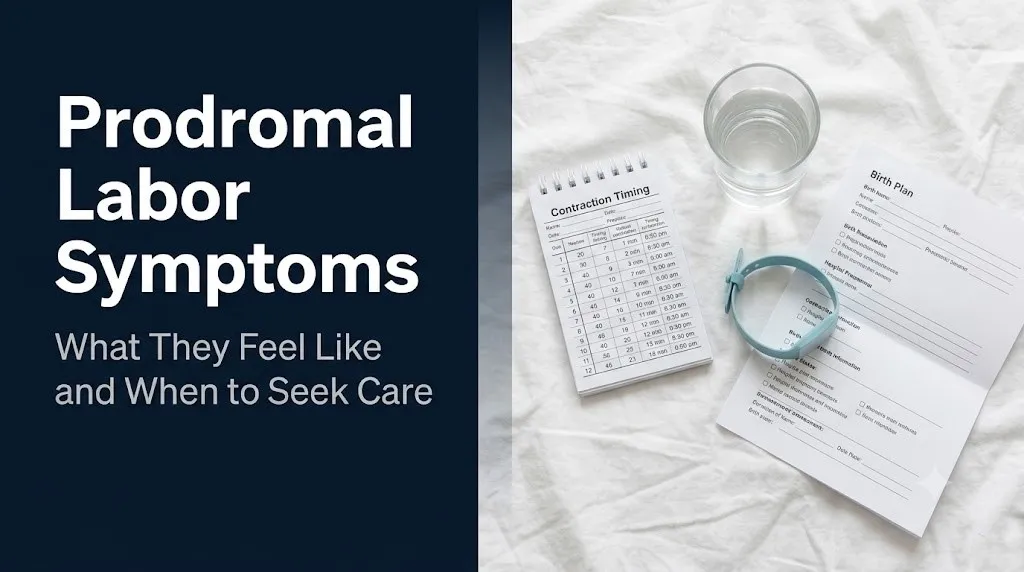
- Your contraction timing log (start time, duration, and interval for each contraction over the past hour or longer)
- Your prenatal records or hospital pre-registration information
- Your GBS (group B Streptococcus) status if known from a recent culture
- A list of any current medications, including supplements
- Your birth plan if you have one
Triage nurses and obstetricians evaluate prodromal labor with an external fetal monitor (cardiotocography), a cervical examination to check dilation and effacement, and sometimes a fetal fibronectin test or cervical length ultrasound. Being sent home after triage with a diagnosis of prodromal labor is not a failure or an overreaction. It is a confirmation that your baby is well and your cervix is not yet in active labor.
Emergency Symptoms: When to Call 911 or Go to the ER
Certain symptoms during a prodromal labor episode require immediate emergency evaluation. Do not wait to see if these resolve on their own.
Call 911 or go to the nearest emergency room immediately if you experience:
- Vaginal bleeding beyond light pink spotting, or any bright red bleeding, which may indicate placental abruption or placenta previa
- A sudden gush of clear or pinkish fluid, or continuous leaking from the vagina, which may indicate premature rupture of membranes (PROM) and requires immediate evaluation regardless of gestational age
- Complete absence of fetal movement for 2 or more hours despite position changes and attempts to stimulate the baby with cold water
- Severe headache that does not respond to acetaminophen, accompanied by visual changes (blurring, flashing lights, spots), facial or hand swelling, or sudden weight gain, which may indicate severe preeclampsia
- Pain in the right upper abdomen or shoulder tip alongside contractions, which may indicate HELLP syndrome
- Contractions so intense that you cannot speak, move, or breathe through them, arriving faster than every 3 minutes
- Any regular contraction pattern before 37+0 weeks gestation, which requires triage evaluation, not home monitoring
These presentations can indicate placental abruption, severe preeclampsia, premature rupture of membranes, or preterm birth, and require emergency medical assessment at a hospital labor and delivery unit, not an urgent care center or a scheduled office appointment.
How to Manage Prodromal Labor: Rest, Positioning, and Clinical Support
Managing prodromal labor symptoms focuses on conserving energy, optimizing fetal position, maintaining hydration, and using pain-relieving strategies that support rest, because the uterus is doing real work and your body is approaching labor.
The most evidence-supported home management strategies for prodromal labor at term:
- Hydration: dehydration amplifies myometrial irritability by increasing the sensitivity of oxytocin receptors. Drinking 2 to 3 liters of water throughout the day can reduce the frequency of prodromal contractions in some people.
- Warm bath or shower: warmth promotes peripheral vasodilation and parasympathetic nervous system activity (rest-and-digest response), which can reduce contraction frequency temporarily. This is also useful for differentiating prodromal from active labor: if contractions slow significantly in a warm bath, prodromal labor is more likely.
- Position changes: side-lying (particularly left lateral) reduces vena cava compression, improves placental blood flow, and may ease contraction frequency. Hands-and-knees position can encourage anterior fetal rotation.
- Rest between episodes: fatigue amplifies pain perception. During daytime prodromal episodes, rest lying down rather than walking, which can increase contraction frequency.
- Breathing techniques: slow diaphragmatic breathing during contractions activates the parasympathetic nervous system via the vagus nerve, reducing the perception of contraction intensity without requiring medication.
For pain management that goes beyond these strategies, contact your obstetrician-gynecologist or midwife about options appropriate for your gestational age and clinical situation. In some cases, a short course of tocolytic medications may be appropriate before 37 weeks. At term, pain management during prodromal labor is typically addressed in the context of a hospital admission for labor support.
According to the Cleveland Clinic, people experiencing emotionally exhausting prodromal labor for more than a week benefit from direct conversations with their obstetric provider about realistic timelines, comfort measures, and, when clinically appropriate, membrane sweeping or other interventions to nudge the cervix toward active labor at or after 39 weeks.
People with a history of perinatal anxiety or prior traumatic birth experience may find prodromal labor particularly distressing. Speaking with your obstetrician-gynecologist about your anxiety level is as important as reporting your contraction pattern. A referral to a perinatal mental health specialist may be appropriate if the emotional burden of prolonged prodromal labor is affecting sleep, eating, or daily function.
Key Takeaway: Managing prodromal labor at home requires hydration, rest, position optimization for fetal rotation, and a clear, pre-discussed plan with your obstetrician-gynecologist for when to call, when to come in, and what to expect from triage if contractions intensify.
Frequently Asked Questions About Prodromal Labor Symptoms
What does prodromal labor feel like compared to real labor?
Prodromal labor feels nearly identical to early active labor: painful, rhythmic contractions that tighten the entire uterus, with aching in the lower back and pelvic pressure.
The key difference is that prodromal contractions do not progressively shorten their intervals or increase consistently in intensity over time the way active labor contractions do.
Active labor contractions become impossible to talk or move through as labor advances, while prodromal contractions often remain manageable and may ease with rest, hydration, or a warm bath.
How long can prodromal labor last before active labor starts?
Prodromal labor can last anywhere from one night to several weeks before active labor begins, with most people experiencing recurring episodes over the final two to four weeks of pregnancy.
The duration depends on parity, fetal position, cervical ripeness, and individual hormonal timing of the prostaglandin and oxytocin cascade.
A first-time parent with a posterior-positioned baby typically experiences the longest prodromal phase.
Can prodromal labor cause cervical dilation?
Prodromal labor can produce gradual cervical effacement (thinning) and occasionally minimal dilation (one to two centimeters) over many days, but it does not produce the consistent progressive dilation of active labor.
The cervix may be noticeably softer and thinner after days of prodromal labor even when dilation has not advanced beyond one or two centimeters.
This preparation is real and meaningful: the cervical work done during prodromal labor shortens the active phase once true labor begins.
How do I know if I’m in prodromal labor or preterm labor?
Before 37 weeks of gestation, you cannot determine from home whether recurring contractions are prodromal or preterm labor, and this distinction requires a clinical evaluation.
An obstetrician-gynecologist or midwife at a labor and delivery triage unit will perform a cervical examination, external fetal monitoring, and possibly a fetal fibronectin test or cervical length ultrasound to differentiate the two.
Contact your care team immediately if you experience any regular contraction pattern before 37+0 weeks.
Does prodromal labor always lead to real labor?
Yes. Prodromal labor always precedes labor in those who experience it, because it represents the hormonal and myometrial preparation phase that leads to active labor, though the timing of that transition varies widely.
Prodromal labor does not indicate that anything is wrong or that labor will not progress normally when it does begin.
The cervical softening and uterine conditioning accomplished during prodromal episodes typically shortens the active phase of labor once it begins.
What helps stop or ease prodromal labor contractions?
Drinking 500 to 700 milliliters of water, taking a warm bath, and resting in a left lateral (left-side-lying) position can reduce the frequency of prodromal contractions at term by lowering myometrial irritability and promoting parasympathetic nervous system activity.
These measures differentiate prodromal from active labor, because active labor contractions do not respond to hydration, rest, or position changes.
If contractions intensify or meet the 5-1-1 threshold (5 minutes apart, 60 seconds long, for 1 hour), contact your obstetrician-gynecologist or go to labor and delivery triage rather than continuing home management.
Closing
Prodromal labor is physically and emotionally demanding, and the symptoms are real, hormonally driven, and deserve specific clinical attention rather than vague reassurance. If you are timing contractions that stop before morning, aching through nights of back pain, and wondering how much longer this can last, the answer is grounded in the uterine physiology outlined above: your body is doing preparation work that will matter when active labor begins.
The single most practical thing you can do right now is document your contraction pattern, note the time, duration, and interval, and share that log with your obstetrician-gynecologist or midwife at your next appointment or on your after-hours call line. Also monitor your baby’s movement. If you are before 37 weeks and contractions are coming every 10 minutes or more, do not apply any of the home management strategies above. Call your care team and go to triage.
You understand your body. You also have a care team who can confirm what is happening at the cervical level. Use both.