Blown Head Gasket Symptoms: 16 Warning Signs (2026)
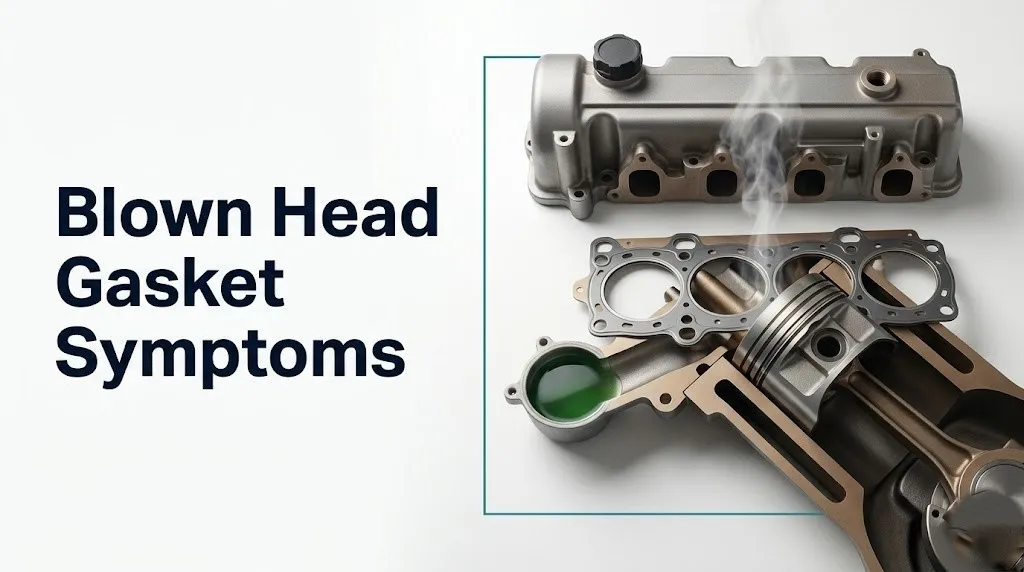
Blown head gasket symptoms range from white steam pouring from the exhaust to a subtle milky residue under the oil filler cap, and knowing which warning signs you are looking at can be the difference between a manageable repair and a destroyed engine. The head gasket is the highest-stress sealing component in your engine, and when it fails, the consequences move fast.
According to the Society of Automotive Engineers (SAE), the head gasket must simultaneously seal combustion pressure peaks that can exceed 1,000 psi in a standard gasoline engine, while also maintaining the integrity of adjacent coolant passages operating at 13 to 16 psi and oil galleries running at 25 to 65 psi. When that sealing system breaks down, every symptom you observe directly maps to a specific breach point in that pressure architecture.
This article covers all 16 recognizable blown head gasket symptoms with the mechanical explanation behind each one, a progressive timeline showing which symptoms appear first and which mean the engine is nearly done, and a clear triage guide for whether you should keep driving, call a shop today, or pull over right now.
Blown Head Gasket Symptoms
Blown head gasket symptoms include white or gray exhaust smoke, milky or foamy oil, unexplained coolant loss, a bubbling coolant reservoir, persistent engine overheating, rough idle, sudden loss of power, and a sweet or acrid smell from the engine bay.
Not every vehicle will show all of these signs at once. The symptom pattern depends on exactly which part of the gasket has failed and how severely. A small breach in the fire ring around one cylinder bore might produce only an intermittent rough idle and a slight temperature rise before progressing. A catastrophic full failure will produce multiple symptoms simultaneously.
The critical point most drivers miss is that some symptoms appear weeks before the engine reaches a crisis state. Recognizing them early changes the repair trajectory entirely.
| Symptom | Failure Location | Severity Level |
|---|---|---|
| White exhaust smoke (steam) | Coolant entering combustion chamber | High: stop driving soon |
| Milky foamy oil | Coolant-to-oil gallery breach | High: stop driving soon |
| Coolant loss, no visible leak | Coolant consumed in combustion | Moderate to High |
| Bubbling coolant reservoir | Combustion gas pressurizing coolant | Moderate to High |
| Engine overheating | Coolant system compromised | High to Emergency |
| Rough idle or misfire | Combustion pressure leak between cylinders | Moderate |
| Sweet smell from engine | Coolant vaporizing near exhaust | Moderate |
| External oil or coolant seepage | Perimeter gasket seal breach | Low to Moderate |
Older vehicles with deferred coolant maintenance tend to show subtler early symptoms longer before acute failure. High-mileage diesel trucks, by contrast, can present with sudden severe overheating as a first symptom due to the much higher combustion pressures involved.
What Does a Head Gasket Do and Why Failure Matters
The head gasket is a multi-layer steel (MLS) sealing plate clamped between the cylinder head and the engine block, responsible for sealing the combustion chamber, coolant passages (water jacket), and oil galleries simultaneously at the same mating surface.
Think of it like a single wall in a building that separates three rooms: a high-pressure explosion chamber, a water pipe room, and an oil pipe room. Punch a hole through that wall and the highest-pressure room (combustion) immediately starts forcing its way into the lower-pressure rooms. That is the mechanical reality of every blown head gasket symptom you will observe.
The multi-layer steel (MLS) gasket is constructed of two to five thin steel layers embossed with raised sealing beads. The outermost bead around each cylinder bore, called the fire ring, takes the most extreme stress from repeated thermal expansion and contraction cycles. The torque-to-yield head bolts that clamp the assembly stretch to a precise specification during installation, creating the compressive force that activates the gasket’s sealing beads. Per SAE technical documentation, head bolt clamp load directly determines sealing bead contact pressure, and any reduction in clamp load (from bolt fatigue, block warping, or repeated overheating) reduces the gasket’s ability to maintain the pressure differentials it was designed to contain.
For older vehicles with aluminum cylinder heads mated to cast iron engine blocks, differential thermal expansion rates compound this stress. Aluminum expands roughly 40% more per degree of temperature rise than cast iron, meaning repeated heating and cooling cycles progressively work the gasket sealing surface in ways they do not occur in same-material assemblies.
White Smoke From the Exhaust
White or gray smoke from the exhaust pipe that appears after the first minute of engine warm-up and does not clear is the most visually dramatic blown head gasket symptom, caused by coolant entering the combustion chamber through a breached fire ring or head gasket coolant passage seal and vaporizing under combustion heat.
The distinction between normal condensation steam and symptom-level white smoke is specific: condensation evaporates within 60 to 90 seconds of startup on a cold morning and stops entirely. Coolant combustion smoke is continuous, often has a slightly sweet odor, and may intensify under acceleration or when the engine reaches full operating temperature.
The combustion temperature inside a gasoline cylinder at the moment of peak pressure reaches approximately 4,000 to 5,000 degrees Fahrenheit. Any coolant that enters the combustion chamber at that moment flash-vaporizes into a dense white steam cloud. Small amounts produce a thin white haze from the tailpipe. Larger intrusions produce billowing white clouds visible from a distance.
Drivers with turbocharged engines should note that white smoke can also indicate a failing turbocharger oil seal, not solely a head gasket breach. The distinction matters mechanically. Turbo-related smoke typically appears more blue-tinged and coincides with hard acceleration, while coolant combustion smoke appears more uniformly white and is often worst at idle or light throttle.
Quick Check:
- Hold a white cloth near the tailpipe while the engine is warm.
- If the cloth shows a colorless wet spot: likely condensation or coolant steam.
- If the cloth shows a light oily film: turbo or piston ring issue, not necessarily head gasket.
- Sweet smell at the tailpipe: strong indicator of coolant combustion.
Milky or Foamy Oil Under the Oil Cap
Milky, creamy, or mayonnaise-textured residue under the oil filler cap or on the dipstick indicates coolant has crossed into the engine’s oil gallery system through a failed head gasket oil-coolant passage seal, creating a water-in-oil emulsion that cannot lubricate engine bearings or moving components.
Water-in-oil emulsification is not a gradual, benign process. The lubricating film strength of engine oil depends on its viscosity and film-forming capacity. Water contamination at concentrations above 0.1 to 0.2 percent degrades oil viscosity, strips the protective film from crankshaft main bearings and connecting rod bearings, and accelerates metal-on-metal wear that cannot be reversed.
The emulsion forms because coolant (primarily a water/ethylene glycol mixture) and engine oil do not mix into a solution but instead form a dispersion: tiny water droplets suspended throughout the oil, giving it the milky brown or tan foamy appearance. Heat, turbulence inside the crankcase, and the oil pump’s mechanical action accelerate this dispersion.
An important nuance for short-trip drivers: condensation inside a cold engine can produce a thin milky film under the oil cap that clears after the engine reaches full operating temperature and circulates for 15 to 20 minutes. This is not the same as coolant contamination. Coolant-contaminated oil will remain milky regardless of how long the engine runs and will often show a visible milky discoloration in the oil on the dipstick rather than just under the cap.
- Brown or tan foamy residue under oil cap: indicates active coolant-to-oil contamination
- Dipstick showing oil lighter in color than normal and slightly foamy: consistent with coolant contamination
- Oil level rising on the dipstick over several days without adding oil: coolant entering the crankcase, raising total fluid volume
- Any of these findings warrant immediate cessation of driving and professional evaluation by an ASE-certified technician
Coolant Loss With No Visible Leak
Unexplained coolant loss with no puddle under the car, no visible weeping at hoses or radiator seams, and no wet spots on the engine exterior is a classic internal head gasket leak symptom, where coolant is being consumed inside the combustion chamber and expelled as exhaust steam.
The coolant system is a closed-loop pressurized circuit. Any coolant that disappears from the coolant reservoir or radiator without appearing on the ground has gone somewhere internal. On a vehicle with a compromised head gasket fire ring or coolant passage seal, that somewhere is the combustion chamber, where it vaporizes and exits through the exhaust.
The rate of coolant loss gives a rough sense of severity. According to ASE diagnostic training curriculum, coolant loss of more than half a quart per week in a vehicle showing no external drips and no heater core leak (which would produce fogged windows and a wet carpet smell) is considered a strong indicator of internal combustion-path coolant consumption. Loss of a full quart or more per week in this presentation warrants treating the situation as active head gasket failure until ruled out by testing.
A note for drivers of high-mileage vehicles: coolant inhibitor depletion accelerates corrosion inside the water jacket, and corrosion byproducts can temporarily plug small internal seepage points, masking coolant loss. This means the first time coolant loss becomes obvious, the underlying gasket damage may be more advanced than the symptom duration suggests. Vehicles older than 10 years that have not had coolant system service every 30,000 to 50,000 miles per OEM specification are at elevated risk for this masking pattern.
Bubbling Coolant Reservoir
A coolant overflow/expansion reservoir that shows active bubbling, gurgling, or turbulent fluid movement when the engine is running (rather than calm fluid circulation) indicates combustion gases are entering the cooling system through a breach in the head gasket fire ring, pressurizing the water jacket, and forcing gas bubbles up through the coolant.
The coolant system is designed to operate at a controlled pressure of 13 to 16 psi, maintained by a calibrated radiator cap pressure relief valve. Combustion gas intrusion adds pressure above that design limit, overwhelming the cap and pushing coolant up into the overflow reservoir. This is why you may also notice the reservoir slowly overfilling or coolant spraying from the cap area during hard use.
Think of it like a carbonated drink bottle being shaken: the gas forces fluid upward rather than allowing it to circulate normally. The bubbling in the reservoir is combustion gas, not normal coolant circulation.
Bubbling also has a diagnostic signature. Normal coolant circulation produces smooth laminar flow visible as a gentle swirl in the reservoir when the thermostat opens. Combustion gas intrusion produces irregular, sustained bubbling that does not stop when the thermostat opens or closes. Some technicians describe it as the coolant looking like it is boiling even when the temperature gauge reads normal.
According to ASE diagnostic standards, bubbling coolant reservoir combined with a temperature gauge reading at or above the upper third of the normal range constitutes a high-probability indicator of combustion gas intrusion into the cooling system, which is one of the findings a block test (combustion leak test) is specifically designed to confirm.
Key Takeaway: Milky oil under the oil cap, coolant loss with no ground puddle, and bubbling in the coolant reservoir are the three internal head gasket failure symptoms that appear while the engine can still be started and driven, but only briefly before compounding damage begins.
Engine Overheating and Temperature Fluctuations
Engine overheating in the context of a blown head gasket is not simply the temperature gauge reading high. It is specifically a pattern of temperature rise that does not respond normally to the cooling system’s regulatory mechanisms, caused by combustion gas contamination of the coolant reducing its heat transfer capacity and by internal coolant loss leaving the system unable to carry heat away from the cylinder head.
The thermostat opens at a calibrated temperature (typically 195 to 220 degrees Fahrenheit in most modern gasoline engines) to allow hot coolant to circulate to the radiator for cooling. When combustion gases enter the coolant system, they form a compressible gas pocket that displaces liquid coolant in the cylinder head’s water jacket passages. Liquid coolant transfers heat effectively; gas bubbles do not. The cylinder head runs hotter as a result, regardless of whether the temperature gauge reflects it immediately.
This is why temperature fluctuation rather than a steady high reading is often the earlier warning sign. The temperature gauge may rise toward the red zone, then partially recover as coolant partially reestablishes circulation, then rise again. This cycling pattern is mechanically distinct from a simple thermostat failure (which produces a steady reading at one extreme) and is a recognized diagnostic indicator per ASE curriculum.
For drivers of vehicles with aluminum cylinder heads: overheating above 240 to 250 degrees Fahrenheit risks warping the cylinder head at the machined sealing surface, which is called cylinder head warpage. A warped head cannot be re-sealed with a new gasket alone. It must be measured with a precision straightedge and feeler gauges and, if warped beyond OEM tolerances, resurfaced on a milling machine before reinstallation. This is why a single severe overheating event can escalate a repair that would have cost $1,500 into one that costs $3,000 or more.
Rough Idle and Loss of Engine Power
Rough idle and reduced power output in the context of a blown head gasket occur because combustion pressure is escaping from the affected cylinder or cylinders through the failed sealing bead, reducing the pressure available to push the piston down during the power stroke, and because a misfiring cylinder sends unburned fuel and combustion byproducts into the exhaust and intake systems.
The combustion chamber in a functioning cylinder seals completely at the moment of ignition. The expanding combustion gases have nowhere to go except down against the piston crown, generating the mechanical force that drives the engine. When the head gasket fails between two adjacent cylinders or at the outer edge of a cylinder bore, that high-pressure gas finds an escape path into the adjacent cylinder or into the cooling system rather than pushing fully against the piston. The result is a power loss from that cylinder that the driver feels as a rough, uneven idle, a sensation of reduced throttle response, or an outright misfire.
A 2019 technical review published by Motor Age noted that head gasket failures involving inter-cylinder leaks (where combustion gas escapes from one cylinder into an adjacent one) frequently trigger OBD-II misfire codes in the P0300 to P0308 range. These codes alone do not diagnose a head gasket failure (spark plugs, ignition coils, and fuel injectors cause the same codes), but misfire codes that persist after tune-up components have been confirmed good are a recognized red flag pointing toward compression loss from a sealing failure.
Loss of power across all cylinders rather than one isolated cylinder suggests the head gasket failure is affecting the overall cooling system’s ability to maintain engine operating temperature, creating a heat-related power reduction, rather than indicating a single-cylinder combustion leak.
Quick Tip:
- A rough idle that is worst when the engine is cold and improves as it warms suggests ignition or fuel system issues, not head gasket.
- A rough idle that worsens as the engine reaches operating temperature suggests a compression or sealing issue.
- Rough idle combined with any other blown head gasket symptom raises the probability of gasket involvement significantly.
Key Takeaway: Engine overheating combined with a rough idle that worsens as the engine warms up is a two-symptom combination that points strongly toward combustion pressure loss through a head gasket breach rather than ignition or fuel system causes.
Sweet or Burning Smell From the Engine Bay
A sweet, slightly sickly smell from the engine bay, particularly when the engine is warm or when you first open the hood after driving, is caused by ethylene glycol, the primary active ingredient in most engine coolants, vaporizing on hot engine surfaces when coolant escapes from a breached head gasket and contacts the exhaust manifold or other high-temperature components.
Ethylene glycol’s combustion and partial oxidation produce a characteristic sweet, almost candy-like odor that is distinct from the sharp acrid smell of burning oil or the sulfurous smell of a catalytic converter running rich. Most drivers describe it as smelling like antifreeze being boiled, which is precisely what is happening when coolant contacts exhaust components at temperatures exceeding 1,300 to 1,500 degrees Fahrenheit.
A burning plastic smell in combination with the sweet coolant odor can indicate coolant is tracking onto wiring harnesses or plastic intake components near a breach point. This matters beyond the diagnostic question: coolant contaminating wiring insulation can cause secondary electrical faults that complicate diagnosis by generating unrelated fault codes.
Note for drivers who also smell something sweet inside the car cabin: coolant vapor entering the HVAC system through the cabin air intake can produce the sweet smell at the dashboard vents. This typically indicates a heater core leak rather than a head gasket breach, but both possibilities warrant investigation by a qualified shop. A fogged windshield that clears slowly and an oily film on the interior glass are additional signs pointing toward heater core involvement rather than head gasket.
External Head Gasket Leak Symptoms
An external head gasket leak appears as visible oil seepage, coolant staining, or a combination of both along the seam where the cylinder head meets the engine block, typically visible as a brown or dark trail of dried oil or a greenish, orange, or pink residue from coolant, depending on coolant color and age.
External seeps from the perimeter of the head gasket are generally the least mechanically severe presentation. The outer edge of the MLS gasket seals oil and coolant passages that run close to the block-to-head mating surface perimeter. When these outer seals degrade before the central fire ring, fluid escapes outward to atmosphere rather than inward into the combustion chamber or across internal galleries. The engine continues to function, but loses fluid slowly and may produce visible staining on the engine block.
The location of the seep matters for identifying which passage has been breached:
| Seep Location | Likely Fluid | Passage Involved |
|---|---|---|
| Along head/block seam, front or rear | Engine oil | Outer oil gallery seal |
| Along head/block seam near coolant hose outlets | Coolant | Perimeter coolant passage seal |
| Between head and exhaust manifold | Slight whitish staining | Combustion or coolant path |
| Uniform seepage along full seam | Mixed oil and coolant | Multiple outer seal failure |
External leaks tend to worsen with mileage and thermal cycling but often do not require emergency vehicle shutdown. An ASE-certified technician can evaluate whether the seepage is active, measure its rate, and advise whether repair is needed immediately or can be scheduled. Coolant seeps near the exhaust manifold warrant higher urgency than oil seeps at the front of the block, given the fire risk from coolant on a hot exhaust surface.
Early vs. Advanced Head Gasket Failure Symptoms
Early head gasket failure symptoms are subtle and easy to dismiss as unrelated issues. Advanced failure symptoms are unmistakable and indicate the engine is sustaining compounding damage with every minute it continues running.
The progressive timeline follows the mechanical physics of the failure. A small breach in a single sealing bead produces minimal cross-contamination. A large, multi-point breach produces simultaneous symptoms across multiple systems.
| Stage | Symptoms Present | Engine Status | Recommended Action |
|---|---|---|---|
| Early (small breach) | Slight coolant loss, intermittent slight temp rise, faint sweet smell | Drivable but deteriorating | Schedule shop visit within 1 to 3 days |
| Mid-stage | Consistent temp fluctuations, milky residue under oil cap, white exhaust smoke starting | Drivable only briefly | Do not drive more than necessary; tow if possible |
| Advanced | Active overheating, bubbling reservoir, strong white smoke, rough idle with power loss | Not safely drivable | Stop driving; tow to shop |
| Terminal | Temperature gauge in red, steam from engine bay, sudden power loss, possible knocking | Engine at risk of seizure | Stop immediately; do not restart |
The jump from early to mid-stage often happens faster than drivers expect. A 2021 technical analysis by ASE educational publications noted that many gasket failures that present as “small seeps” on initial inspection have already progressed to mid-stage internally because combustion pressures continue to erode the compromised sealing bead with every engine cycle.
Older vehicles with cast iron block and aluminum head assemblies tend to progress through these stages faster than same-material assemblies because differential thermal expansion forces work the sealing surface continuously.
Key Takeaway: A head gasket failure caught at the early stage (subtle coolant loss, intermittent temp rise only) is a straightforward repair; the same failure caught at the advanced stage often requires cylinder head resurfacing and sometimes block machining, doubling or tripling the repair cost.
Failed Head Gasket Symptoms in Diesel and Turbocharged Engines
Diesel and turbocharged engines produce distinct blown head gasket symptom patterns because both operate at significantly higher peak cylinder pressures than naturally aspirated gasoline engines, which changes both the failure mode and the urgency of each symptom.
Diesel engines typically operate at compression ratios of 16:1 to 23:1 compared to 8:1 to 12:1 in standard gasoline engines. Peak cylinder pressures in a diesel can reach 1,800 to 2,500 psi at maximum load. When a diesel head gasket fails, these extreme pressures produce more aggressive combustion gas intrusion into the cooling system, often resulting in a much faster progression from subtle to severe symptoms. Diesel head gasket failures more often present with sudden, severe overheating as an early prominent symptom rather than the gradual temperature creep common in gasoline engines.
Turbocharged gasoline engines add another variable: the turbocharger itself forces pressurized air into the combustion chamber, raising peak cylinder pressure above naturally aspirated levels. This elevated pressure accelerates fire ring fatigue. Per engineering literature on forced induction systems, turbocharged engines running on poor-quality fuel, with delayed oil change intervals, or operated with boost pressure above OEM specification face a disproportionately higher head gasket failure rate than their naturally aspirated counterparts.
A specific diagnostic distinction for turbocharged vehicles: white smoke on a turbo engine may indicate a turbocharger compressor seal failure rather than a head gasket breach. Turbo-related smoke is typically more intermittent, often appears most heavily during deceleration after hard driving, and does not typically accompany coolant loss. Head gasket-related smoke on the same vehicle is more sustained and correlates with coolant level drops.
For owners of popular diesel trucks (such as the Ford Power Stroke, GM Duramax, or Ram Cummins platforms): these engines have published histories of specific head gasket stress patterns, and OEM-updated head bolt specifications or multi-layer gasket upgrades exist for many production years. An ASE Master Technician familiar with the specific platform is the appropriate person to evaluate these vehicles, as repair specifications differ from generic passenger car standards.
What Causes a Head Gasket to Fail
Head gasket failure has four primary causes: engine overheating, detonation (engine knock), cylinder head warpage or block deck imperfections, and coolant system corrosion inhibitor depletion in high-mileage vehicles, each of which compromises the sealing bead integrity through a distinct mechanical pathway.
Engine overheating is the most common cause. According to ASE technical training documentation, a single severe overheating event (temperature gauge in the red zone for more than 2 to 3 minutes) can reduce the clamp load of torque-to-yield head bolts sufficiently to allow sealing bead deformation. Torque-to-yield bolts are a single-use fastener by design: they are engineered to stretch to a precisely calibrated tension during installation, and that tension is their sealing force. Overheating-induced bolt stress changes cannot be corrected by retorquing; the bolts must be replaced with every head gasket service.
Detonation (uncontrolled combustion, commonly called engine knock) generates pressure spikes inside the combustion chamber that exceed the fire ring’s design load tolerance. These repetitive pressure spikes work the sealing bead in a mechanical fatigue cycle that eventually causes microscopic cracks and loss of sealing integrity. Running lower-octane fuel than the engine requires, ignition timing errors, and carbon deposit accumulation are the primary detonation triggers.
Coolant system corrosion is the underrecognized cause in high-mileage vehicles. Coolant contains corrosion inhibitors (phosphates, silicates, or organic acid additives depending on the coolant type) that degrade with use and mileage. Depleted inhibitors allow the aluminium surfaces of the cylinder head and water jacket to corrode, creating surface pitting that prevents the gasket from seating uniformly. Per OEM documentation for most modern vehicles, coolant service intervals are 30,000 miles for conventional green coolant and up to 150,000 miles for long-life OAT (organic acid technology) coolant, but only if the vehicle has never overheated and the system has been properly maintained.
How to Test for a Blown Head Gasket
Testing for a blown head gasket requires three confirmatory steps that a qualified mechanic performs in order: a coolant system pressure test, a cylinder compression test or cylinder leakdown test, and a combustion leak test (block test), with each test designed to identify a different breach point in the gasket’s sealing architecture.
- Coolant system pressure test: The mechanic attaches a calibrated pressure pump to the coolant system, pressurizes it to the radiator cap’s rated pressure (typically 13 to 16 psi), and monitors for pressure drop over 10 to 15 minutes. A rapid pressure drop with no external coolant seep indicates internal loss into the combustion chamber. This is the primary screening test.
- Compression test: A calibrated gauge is threaded into each spark plug port and the engine is cranked. OEM service manuals specify minimum acceptable compression values (typically 150 to 180 psi for most gasoline engines in good condition). Two adjacent cylinders reading 20 to 30 percent below specification relative to each other suggest inter-cylinder combustion gas leakage through a failed fire ring between those cylinders.
- Cylinder leakdown test: Air is introduced into each cylinder at TDC (top dead center) with both valves closed. The percentage of air pressure lost per cylinder indicates seal integrity. A 20 percent leakdown is generally considered acceptable; leakdown above 30 percent in any cylinder indicates significant sealing loss. Bubbles appearing in the coolant reservoir during this test confirm the combustion-to-coolant breach point.
- Block (combustion leak) test: A test fluid that changes color (typically from blue to yellow-green) when exposed to combustion hydrocarbons is held over the open coolant reservoir with the engine running. Color change confirms combustion gas contamination of the coolant, which is the definitive positive indicator for internal head gasket failure.
Home mechanics with basic tools can perform a compression test. The coolant pressure test, leakdown test, and block test require specific equipment and are best performed by an ASE-certified technician to ensure accurate results and correct interpretation.
Is It Safe to Drive With a Blown Head Gasket
Driving with a confirmed or strongly suspected blown head gasket is not safe beyond the minimum distance required to reach a qualified repair facility, because continued operation accelerates cooling system failure, promotes engine bearing wear from oil contamination, and risks complete engine seizure or hydrolock within a driving session of as little as 10 to 30 minutes under moderate load.
Hydrolock occurs when enough coolant accumulates in one or more cylinders that the engine cannot complete a compression stroke, because liquid, unlike air and combustion gases, is not compressible. The connecting rod attempts to push the piston against an incompressible liquid column and either bends or fractures. This is a catastrophic failure that typically means the entire engine requires replacement, not just the head gasket.
The risk of hydrolock is highest after the vehicle sits overnight. Coolant that has been seeping into the combustion chamber through a failed gasket pools in the cylinder with the engine off. When the driver cranks the engine the following morning, the starter motor forces the pistons against the accumulated coolant before combustion has a chance to clear it. This is the specific scenario where a drivable car one evening becomes a destroyed engine the next morning.
For drivers who have only mild suspected symptoms (slight temperature rise, faint sweet smell, no oil discoloration, no smoke): driving to a shop the same day with the temperature gauge monitored continuously is a reasonable decision if the trip is short (less than 5 miles) and the temperature stays in the normal range. If the gauge rises above the normal range at any point during that drive, pull over immediately, turn off the engine, and call for a tow. The moment the temperature crosses into the upper range, the cylinder head is at risk of warping, which transforms the repair cost from a gasket replacement into a head replacement or machine shop job.
Emergency Symptoms: When to Stop Driving Immediately
Certain observable symptoms associated with a failed head gasket require an immediate vehicle stop. Do not continue driving, do not pull into a parking lot two blocks away, and do not try to make it to the shop.
Pull over safely, turn off the engine, and do not restart it if you observe any of the following:
- Temperature gauge needle entering the red zone or warning light illuminating: the cylinder head is reaching temperatures that cause irreversible warping within minutes
- White steam or vapor billowing from the engine bay (not the exhaust pipe): coolant is contacting hot engine surfaces externally, indicating a major internal breach and potential fire risk from coolant on the exhaust manifold
- Sudden severe loss of engine power combined with temperature spike: combustion chamber may be flooding with coolant, and continued cranking risks hydrolock damage
- Loud knocking or banging from the engine combined with temperature gauge rising: bearing failure from oil contamination is occurring in real time
- Engine refusing to crank normally on startup (heavy resistance or metal grinding): hydrolock may have already occurred in one or more cylinders; forcing the engine to crank in this state will bend connecting rods
- Coolant spraying from the hood area or visible fluid loss while driving: the pressurized cooling system has lost containment at multiple points
After stopping safely off the road, turn on your hazard lights, exit the vehicle safely, and call for a tow truck. Do not attempt to add coolant to a hot, overheated engine: the temperature differential between a cold liquid and a hot engine block can crack the block or cylinder head. Allow the engine to cool for at least 30 to 45 minutes before adding any fluid.
These presentations indicate the engine is at or near the threshold of irreversible mechanical damage that a head gasket replacement alone will not resolve.
Frequently Asked Questions About Blown Head Gasket Symptoms
What is the most obvious sign of a blown head gasket?
White or gray smoke continuously coming from the exhaust pipe after the engine is fully warmed up is the most visually obvious symptom of a blown head gasket.
This smoke is caused by coolant entering the combustion chamber through a failed gasket seal and vaporizing under combustion heat, producing a thick, continuous steam that has a faintly sweet odor.
This symptom is distinct from normal cold-morning condensation, which clears within 60 to 90 seconds of startup.
Can a blown head gasket fix itself?
A blown head gasket cannot repair itself, and no commercial chemical additive (sodium silicate sealers, copper-based sealers, or similar products) can reliably restore long-term structural sealing integrity to a mechanically failed multi-layer steel gasket.
Chemical sealers may temporarily slow small external coolant seeps or minor internal leaks in some cases, but they do not address the underlying sealing bead failure, and the breach typically continues to enlarge with continued engine operation.
The only reliable repair for a confirmed head gasket failure is mechanical removal of the cylinder head, inspection of the sealing surfaces, and installation of a new OEM-specification gasket by an ASE-certified technician.
How long can you drive on a blown head gasket?
There is no safe mileage or time limit for driving with a confirmed blown head gasket, because the rate of engine damage depends entirely on which seal has failed, how severely, and what the operating conditions are.
A minor external seep at the perimeter of the gasket may allow cautious, short-distance driving (less than 5 miles) to reach a shop with the temperature gauge closely monitored.
Any symptom involving coolant entering the combustion chamber (white smoke, coolant loss without visible leak) or coolant contaminating the oil (milky oil) means the engine should not be driven at all, because continued operation risks hydrolock, bearing failure, and complete engine seizure.
What does a blown head gasket smell like?
A blown head gasket often produces a sweet, slightly sickly smell caused by ethylene glycol (engine coolant) vaporizing on hot exhaust or engine surfaces near the breach point.
This sweet smell is chemically distinct from burning oil (which smells acrid and sharp) or a rich-running fuel system (which smells of raw gasoline).
A sweet smell inside the car cabin from the dashboard vents is more likely to indicate a heater core leak than a head gasket failure, though both require professional evaluation.
Can a blown head gasket cause a car not to start?
A blown head gasket can prevent a car from starting if coolant has accumulated in one or more cylinders overnight, creating a hydrolock condition where the incompressible liquid blocks piston travel during cranking.
The symptom presents as the starter motor turning very slowly or the engine making a heavy, grinding resistance during cranking rather than spinning freely.
Forcing the engine to crank against a hydrolocked cylinder risks bending or fracturing the connecting rod. If you suspect hydrolock, do not attempt to start the engine: call for a tow and inform the mechanic before they attempt diagnosis.
How much does it cost to fix a blown head gasket in 2026?
Head gasket replacement on a typical four-cylinder gasoline passenger car in 2026 ranges from approximately $1,200 to $2,500 in parts and labor at an independent repair facility, based on current ASE labor rate benchmarks and parts pricing.
Six-cylinder and V8 engines, vehicles with aluminum cylinder heads that require machine shop resurfacing, and engines that have sustained secondary damage from overheating can push repair costs to $3,000 to $5,000 or higher.
The total cost depends on whether the cylinder head is warped (requiring resurfacing or replacement), whether the head bolts must be replaced (torque-to-yield bolts are single-use), and whether bearing damage from oil contamination has occurred.
Closing
The most important thing to take away from all of this: a blown head gasket does not announce itself with a sudden catastrophic failure in most cases. It starts small, with subtle coolant loss, a faint sweet smell, or a temperature gauge that climbs a little higher than it used to. Those early signs are the window where a repair stays manageable. Miss them, and the same engine that cost $1,500 to fix last month costs $4,000 this month.
If your vehicle is showing two or more of the symptoms covered here, specifically any combination of unexplained coolant loss, milky oil residue, white exhaust smoke, or persistent temperature fluctuations, schedule a diagnostic evaluation with an ASE-certified technician within the next 24 to 48 hours. Ask specifically for a coolant system pressure test and a combustion leak (block) test. Those two tests together give a clear, confirmatory answer.
You now have a more complete mechanical picture of what a head gasket failure looks like, why each symptom happens, and exactly when stopping the car is the only right decision. Trust the temperature gauge above everything else.