Valve Cover Gasket Leak Symptoms and Warning Signs 2026
Valve cover gasket leak symptoms include a burning oil smell, visible oil residue around the top of the engine, a rough idle, engine misfires, and a steadily dropping oil level with no sign of leakage beneath the car. These signs range from a mild nuisance at early stages to a genuine fire hazard when an active leak allows oil to contact a hot exhaust surface.
A failing valve cover gasket is among the most common oil leak sources in high-mileage vehicles. Consumer Reports vehicle reliability data consistently shows oil leaks appearing in vehicles above 80,000 miles, with gasket-related failures accounting for a large share of reported engine oil loss in that mileage range. The condition is rarely an overnight emergency, but it never improves on its own.
This article covers every recognized symptom of a leaking valve cover gasket with the specific mechanical reason each symptom occurs, a clear severity and urgency framework, a comparison to head gasket leak signs, and a direct answer to whether you can keep driving or need to stop now. The information here applies to both overhead camshaft and overhead valve engine designs, with specific notes where engine architecture changes the picture.
Valve Cover Gasket Leak Symptoms: The Full Picture
Valve cover gasket leak symptoms include burning oil odor, external oil residue on or around the valve cover, engine misfires, rough idle, blue or grey smoke from the engine bay, and gradual oil level loss without a visible puddle beneath the vehicle.
These symptoms do not always appear together. The specific combination depends on where the gasket has failed, how far the leak has progressed, and whether the engine’s spark plug wells are exposed to oil intrusion.
The table below gives a structured overview of the full symptom picture, severity tier, and mechanical source of each sign:
| Symptom | Severity Tier | Mechanical Source |
|---|---|---|
| Faint burning oil smell at startup | Low | Oil dripping onto warm exhaust surface |
| Visible oil residue on valve cover exterior | Low to Moderate | External gasket seal failure at cover flange |
| Oil-soaked spark plug wells | Moderate | Internal gasket failure at plug tube seals |
| Engine misfire or rough idle | Moderate to High | Oil-saturated ignition coil boot arcing |
| Visible blue or grey smoke from engine bay | High | Oil contacting hot exhaust manifold |
| Rapid oil level drop between changes | Moderate to High | Active leak rate exceeding normal consumption |
| Visible flames or sustained engine fire | Emergency | Oil ignition on exhaust surface above 400°F |
Older vehicles with cork gaskets are typically affected earlier in their service life than newer vehicles using molded silicone gaskets. According to SAE International engineering standards, silicone elastomer gaskets maintain sealing pressure over a wider thermal range than cork composites, making cork-gasketed engines more likely to show symptoms earlier and progress faster.
What Does a Valve Cover Gasket Do
The valve cover gasket seals the joint between the removable valve cover (also called a rocker cover or tappet cover) and the top surface of the cylinder head, preventing engine oil from escaping the top of the engine.
The valve cover itself is a stamped steel or cast aluminum housing that protects the valvetrain components sitting on top of the cylinder head. These components include the camshaft, rocker arms, and valve stems in overhead camshaft designs, or the pushrod tips and rocker arms in overhead valve engines. All of these parts require constant oil lubrication during engine operation.
Engine oil circulates from the oil pump through internal passages in the cylinder block and head, lubricating the camshaft bearings and valve gear before draining back down through oil return ports in the cylinder head. Without the valve cover gasket forming a tight seal, pressurized oil mist and liquid oil can escape at the cover flange during normal engine operation.
The positive crankcase ventilation (PCV) system runs through this same enclosed space. The PCV valve routes blow-by gases (combustion gases that pass the piston rings) back into the intake manifold for reburning. When the PCV system is functioning correctly, it also slightly depressurizes the crankcase. A stuck or blocked PCV valve causes crankcase pressure to build, which accelerates gasket extrusion and leak development.
Vehicles with aluminum cylinder heads experience different thermal expansion rates compared to the steel or aluminum valve cover, creating a mechanical flexing cycle at the gasket interface with every heat-and-cool cycle. This repeated compression-and-release is a primary reason gaskets eventually lose their sealing ability regardless of material.
Leaking Valve Cover Gasket Symptoms: Oil Smell and Visible Residue
The first symptom most drivers notice from a leaking valve cover gasket is either a faint burning oil smell or a visible oil stain on or around the top of the engine.
Visible residue appears as a dark, greasy film along the perimeter of the valve cover where it meets the cylinder head. In many overhead cam engines, this residue accumulates along the rear of the cylinder head near the firewall, where oil tends to pool before dripping. On V6 and V8 engines with two valve covers, the leak may appear on one side only, reflecting localized gasket failure at that bank.
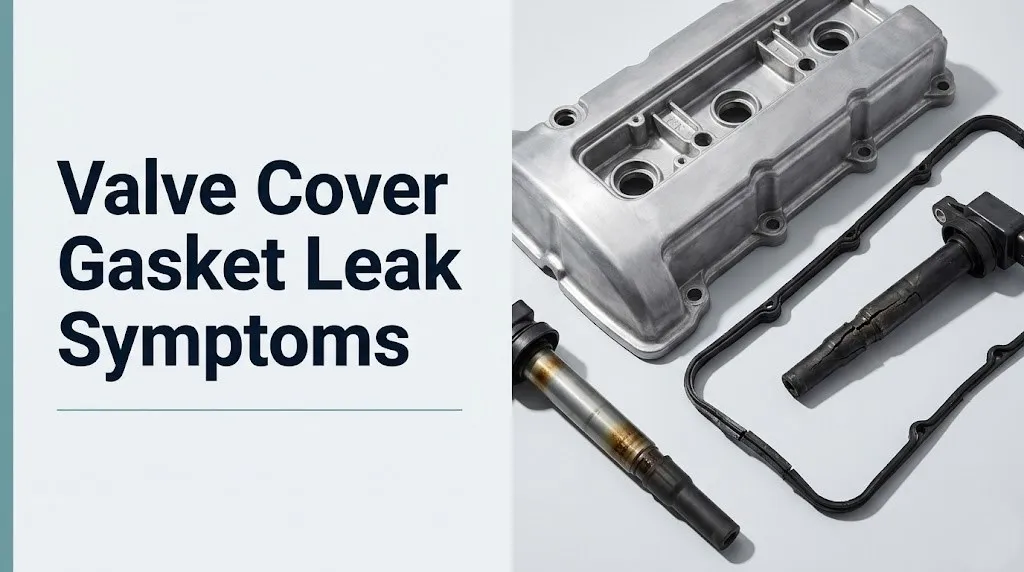
Key observations to make when checking for external oil residue:
- A moist, shiny residue directly at the valve cover flange edge indicates an active seep
- Dried, baked-on brown or black crust along the cover perimeter indicates a slower, older seep that has partially dried between driving sessions
- Oil tracking down the side of the cylinder head below the valve cover suggests the leak has been present long enough for oil to run down the head
- Oil mist coating nearby vacuum lines, wiring harnesses, or the air intake box suggests the PCV system is involved alongside the gasket failure
Residue that appears on the underside of the hood directly above the engine is worth noting separately. This pattern can indicate oil mist escaping during engine operation rather than a drip at the flange, suggesting PCV system overpressure as a contributing factor.
High-mileage vehicles above 120,000 miles are more likely to show simultaneous PCV system degradation alongside gasket failure. The two conditions share a common pressure-related mechanism, and ASE-certified technicians recommend evaluating both the valve cover gasket and the PCV valve together during diagnosis.
Burning Oil Smell From Valve Cover Gasket
A burning oil smell from the engine bay is one of the most reliable early warning signs of a valve cover gasket leak, and it has a specific and identifiable mechanical source.
When engine oil escapes past the gasket and contacts the outer surface of the exhaust manifold, the heat of the manifold (which reaches temperatures between 300 and 700 degrees Fahrenheit during normal operation) vaporizes the lighter hydrocarbon fractions in the engine oil. This vaporization produces the sharp, acrid, slightly sweet odor that most drivers associate with “burning oil.”
The smell is typically strongest at engine startup after an overnight park, when cold oil has dripped down onto the manifold during shutdown and then vaporizes immediately as the engine warms. The smell often fades during highway driving, not because the leak has stopped, but because airflow through the engine bay disperses the vapor before it reaches the passenger cabin.
A burning smell that enters the passenger cabin through the HVAC fresh air intake is worth paying attention to separately. This typically means the leak point is positioned near the cowl area at the base of the windshield, where the HVAC system draws outside air. Drivers in this situation often describe the smell as coming from the vents even with the windows closed.
Drivers with gasoline direct injection (GDI) engines should note an additional consideration. GDI engines run significantly hotter at the cylinder head surface than port-injected engines, which accelerates both gasket material degradation and the vaporization of any leaked oil. The burning smell in GDI-equipped vehicles tends to present earlier in the leak progression and intensifies faster.
Oil on Spark Plugs From a Valve Cover Gasket Leak
Oil on spark plugs from a valve cover gasket leak is one of the most mechanically consequential symptoms, because it directly compromises the ignition system rather than simply creating an external mess.
Modern overhead camshaft (OHC) engines use a valve cover design that incorporates deep cylindrical wells for each spark plug. These plug wells sit directly inside the valve cover, surrounded by oil. The gasket that seals each plug well is a separate rubber ring, sometimes called a spark plug tube seal or camshaft plug seal, and it is distinct from the outer perimeter gasket.
When these tube seals fail, engine oil from the valvetrain area flows down into the spark plug well and surrounds the upper end of the spark plug and the ignition coil boot. Think of these wells like a test tube with a leaky bottom stopper. Over time, oil fills the well and the coil boot sits in a bath of contaminated oil.
The oil saturates the rubber dielectric insulation of the ignition coil boot, which is the high-voltage insulating sleeve that prevents electrical arcing between the coil terminal and the plug tube wall. Once the dielectric strength of the boot is compromised by oil saturation, voltage arcs to the tube rather than firing reliably through the spark plug electrode.
What you will typically find during inspection:
- Oil visible in the spark plug well when the coil is removed, often as a dark pooled residue
- Oil coating or streaking along the ignition coil body
- A faint ozone-like smell near the affected plug wells from electrical arcing
- White or grey deposits on the spark plug ceramic insulator from oil combustion at the plug tip
Pushrod (OHV) engines, such as the General Motors LS family or Chrysler Hemi V8 designs, do not have enclosed plug wells in the same way. On these engines, the outer perimeter gasket fails rather than the plug tube seals, and oil contamination of plugs is less direct but still possible through external drip onto the plug boots.
Engine Misfire From Valve Cover Gasket Leak
An engine misfire from a valve cover gasket leak occurs because oil-saturated ignition coil boots fail to deliver the high-voltage pulse needed to fire the spark plug reliably in the affected cylinder.
The ignition coil generates a voltage spike between 12,000 and 45,000 volts to fire the spark plug. The coil boot must maintain electrical isolation between this voltage and the surrounding metal plug tube. When oil soaks the boot material, the boot’s dielectric insulation drops below the threshold needed to prevent voltage from escaping sideways into the tube wall rather than discharging cleanly across the spark plug gap.
The result is a cylinder that fires intermittently or not at all. Intermittent firing produces a misfire that appears and disappears with engine load. Complete failure to fire produces a consistent, single-cylinder misfire. Both will trigger a check engine light and store a diagnostic fault code, typically OBD-II code P0300 (random multiple misfire) or a cylinder-specific code such as P0301 through P0308 depending on which cylinder is affected.
To assess whether a misfire is oil-related:
- Remove each ignition coil from its spark plug well.
- Inspect the tip of each coil boot for oil residue, discoloration, or a slick film.
- Look down into each spark plug well with a flashlight for pooled oil or a wet surface.
- Note whether the misfire code corresponds to a cylinder in which the well shows oil contamination.
- If the coil shows oil contamination, replacing the coil alone without addressing the gasket will produce a repeat failure within weeks.
Vehicles with cylinder deactivation systems, including some Honda, GM, and Chrysler engines, may show additional complications. Deactivated cylinders do not fire during light-load driving, but they still accumulate oil in their plug wells if the tube seals are compromised. The misfire may not appear until the cylinder reactivates under heavier throttle load.
Key Takeaway: Oil in the spark plug wells degrades the ignition coil boot’s dielectric insulation, causing arcing and cylinder-specific misfires that will store a check engine code and will not resolve until both the gasket and the affected coil are replaced.
Rough Idle and Low Oil Level From a Valve Cover Gasket Leak
A rough idle from a valve cover gasket leak is almost always the downstream result of the ignition disruption described in the previous section, though a failing PCV system associated with gasket deterioration can contribute independently.
The idle is rough because one or more cylinders are contributing less power or none at all during the low-RPM engine cycle. At idle, the engine runs at its lowest combustion efficiency threshold. Any reduction in cylinder contribution, whether from a misfire, a lean condition from an air leak, or a combustion imbalance from oil fouling of the plug tip, produces a noticeable shake or stumble.
The rough idle from a valve cover gasket issue typically gets worse on cold starts and improves slightly as the engine reaches operating temperature. This is because cold oil has lower viscosity and flows more readily into the plug wells before the engine reaches normal operating temperature and PCV suction partially clears the system.
Low oil level is the other symptom in this section, and it follows a distinct pattern worth recognizing. A leaking valve cover gasket does not always produce a puddle under the car. Oil that seeps from the cover may:
- Evaporate immediately on contact with a hot exhaust surface
- Burn off during the combustion process in affected cylinders
- Accumulate slowly in engine underbody insulation or on the transmission bellhousing
This means a vehicle can lose one quart of oil per 1,000 miles from a valve cover gasket leak without leaving a detectable puddle on the garage floor. If your oil level drops consistently between scheduled changes without an obvious drip below the car, a valve cover gasket leak is one of the first sources to investigate.
Drivers of turbocharged engines should pay closer attention to oil level drops. Turbochargers use engine oil for both lubrication and cooling of the turbo shaft bearing. A low oil level in a turbocharged engine creates a higher risk of turbo bearing damage than the same oil level would in a naturally aspirated engine.
Smoke Coming From the Engine With a Valve Cover Gasket Leak
Smoke from the engine bay associated with a valve cover gasket leak is a more urgent presentation than the previous symptoms and signals that leaked oil is making direct contact with a sufficiently hot surface to produce visible combustion byproducts.
The smoke is typically blue-grey or light white-grey in appearance and rises from the engine bay rather than from the exhaust pipe. This distinguishes it from blue exhaust smoke (which indicates oil burning inside the cylinders from worn piston rings or valve stem seals) and from white exhaust smoke (which indicates coolant entering the combustion chamber from a head gasket failure).
Engine bay smoke from a valve cover leak appears because oil that drips onto the exhaust manifold reaches temperatures above 300 degrees Fahrenheit. At this temperature, the lighter hydrocarbon fractions in engine oil undergo thermal decomposition, producing visible aerosol particulate and acrolein vapor. This is the smoke you see rising from the manifold surface.
If you see smoke from the engine bay:
- Find a safe location to pull off the road as soon as possible.
- Turn off the engine immediately.
- Do not open the hood if you can see visible smoke rising from the hood gaps, as this could introduce oxygen and accelerate a potential fire.
- Wait at least 10 to 15 minutes before attempting to inspect under the hood.
- If smoke continues to rise or you detect a burning plastic smell (indicating wiring harness involvement), move away from the vehicle and call for roadside assistance.
Drivers of older domestic V8 engines with cast iron exhaust manifolds (common in trucks and SUVs from the 1990s and 2000s) may notice that the manifold surface becomes visually discolored or shows a bluish-grey baked residue over time. This is dried and carbonized oil from repeated contact. It is a diagnostic indicator that oil has been reaching the manifold surface for an extended period.
Key Takeaway: Smoke rising from the engine bay, not the exhaust pipe, indicates oil from the valve cover area is contacting a hot surface, and the situation requires pulling over safely and turning off the engine before continuing any further.
How Serious Is a Valve Cover Gasket Leak
The seriousness of a valve cover gasket leak depends entirely on the leak rate, the specific failure location on the gasket, and whether the leaked oil is approaching any ignition or fire risk.
At one end of the spectrum, a slow seep at the outer perimeter of the cover with no smoke, no misfires, and no plug well contamination is a low-urgency maintenance item. It will get worse over time and should be addressed within the next several hundred to a few thousand miles, but it is not an emergency.
At the other end, an active drip from the rear of the valve cover on a V6 or inline-4 engine, where the exhaust manifold runs close to the back of the engine, is a different situation. Active oil contact with a hot manifold presents a legitimate fire risk that moves this from a maintenance item to a same-day service need.
The table below shows how severity scales with specific observable signs:
| Observable Sign | Severity | Recommended Action Timeline |
|---|---|---|
| Faint smell only, no visible oil | Low | Schedule service within 1,000 miles |
| Oil residue on cover exterior only | Low to Moderate | Service within 500 miles |
| Oil in spark plug wells, no misfire yet | Moderate | Service within 200 miles |
| Active misfire with check engine light | Moderate to High | Service within this week, no extended driving |
| Visible smoke from engine bay | High | Pull over. Do not continue driving. |
| Any sign of engine fire | Emergency | Exit vehicle. Call 911. |
According to data published by the National Highway Traffic Safety Administration, vehicle fires most commonly originate from fuel and oil systems. Any oil leak that places flammable fluid near an ignition source, including a hot exhaust manifold, should be treated with appropriate caution rather than deferred indefinitely.
Valve Cover Gasket Leak Fire Risk
The fire risk from a valve cover gasket leak is real but not universal. It depends on the proximity of the leak point to the exhaust manifold and the rate of oil escape.
Engine oil has an auto-ignition temperature of approximately 600 degrees Fahrenheit under standard atmospheric conditions. Exhaust manifold surface temperatures on gasoline engines range from 300 to 700 degrees Fahrenheit depending on load, engine design, and whether the manifold has a catalytic converter integrated into it (as many modern four-cylinder engines do). Integrated exhaust manifold-catalytic converter units, now common on turbocharged inline-4 engines, run significantly hotter than separate cast manifolds and represent a higher fire risk when contacted by leaked oil.
The fire risk pathway works like this: oil escapes the gasket, runs along the engine block exterior, and drips onto the exhaust manifold or exhaust pipe. At manifold temperatures above the oil’s auto-ignition threshold, the oil can ignite without any spark being required. The resulting fire spreads rapidly if it contacts plastic intake components, rubber hoses, or wiring harnesses in the vicinity.
Vehicles with transversely mounted four-cylinder engines, where the exhaust manifold faces directly toward the firewall and is partially obscured from view, are especially prone to undetected oil-to-manifold contact. The rear of the engine bay is often hidden by the firewall insulation, meaning a driver may not see visible baked oil residue that would be obvious on a longitudinally mounted engine.
If you notice a burning smell that suddenly intensifies while driving, or see any smoke rising from the hood:
- Activate your hazard lights immediately.
- Move to the right shoulder or the nearest safe pullout.
- Shut off the engine.
- Call 911 if you see any visible flame from the engine bay. Do not delay.
Regular visual checks under the hood, taking 30 seconds to scan the valve cover perimeter and the exhaust manifold surface for oil residue, can catch a developing leak before it reaches fire-risk territory.
Can I Drive With a Leaking Valve Cover Gasket
Whether you can drive with a leaking valve cover gasket depends on the severity of the leak and the specific symptoms present.
For a slow seep with no misfires, no smoke, and no active drip approaching the exhaust manifold, driving for a limited period with close oil level monitoring is generally considered acceptable by most ASE-certified technicians. “Limited period” means driving to the nearest repair shop, not continuing a 2,000-mile road trip.
The conditions under which continuing to drive is not appropriate:
- There is visible smoke from the engine bay
- A check engine light with a misfire code is active
- Oil level has dropped more than one quart below the full mark
- You can see an active drip from the valve cover area, not just a dry residue
- The burning oil smell is strong and persistent rather than faint and intermittent
Checking oil level before every drive is the single most useful thing you can do if you suspect a gasket leak and are managing the situation before a repair appointment. An engine running more than a quart low on oil loses measurable oil film pressure at the camshaft bearings, increasing wear rate on the camshaft lobes and follower surfaces.
Drivers of turbocharged vehicles face a stricter standard. The turbocharger center housing and shaft bearing require a consistent oil supply for both lubrication and heat dissipation. Running a turbocharged engine more than half a quart low on oil significantly increases the risk of turbo bearing failure, which is a far more expensive repair than a valve cover gasket replacement.
Key Takeaway: Driving with a slow valve cover gasket seep is manageable for a short distance with daily oil level checks, but any active drip, engine smoke, or misfire requires stopping driving and arranging a repair before the vehicle is driven further.
What Causes a Valve Cover Gasket to Leak
A valve cover gasket leaks primarily because the gasket material has lost its ability to maintain a compressive seal against the cylinder head mating surface, a process driven by thermal cycling, material aging, oil chemical degradation, and mechanical fastener loosening.
The dominant cause in high-mileage vehicles is compression set, a material science term describing the permanent deformation of an elastomer (rubber or silicone) after sustained compressive load. Each time the engine heats up and cools down, the gasket compresses slightly and then partially rebounds. Over tens of thousands of heat cycles, the material loses its elastic memory and remains permanently compressed below the threshold needed to seal the joint.
Secondary and contributing causes include:
- PCV system failure: A stuck-closed PCV valve causes crankcase pressure to build above the normal operating range. This overpressure pushes against the gasket from the inside, accelerating extrusion and failure.
- Engine sludge: Oil that has not been changed at appropriate intervals oxidizes and forms thick sludge deposits. This sludge accumulates along the gasket interface and can physically distort the seal or create channels through which oil escapes.
- Overtightened or undertightened valve cover bolts: Overtightening crushes the gasket beyond its design compression limit immediately. Undertightening allows the cover to flex slightly during operation, which breaks the seal progressively.
- Thermal expansion mismatch: Aluminum cylinder heads expand at a different rate than steel valve covers during heating and cooling. This dimensional change creates microscopic movement at the gasket interface on every heat cycle.
- Chemical degradation from extended oil change intervals: Oil that is left in service beyond its change interval becomes acidic from combustion byproduct accumulation. This acidic oil attacks the polymer chains in the gasket material, accelerating hardening and cracking.
Cold climate vehicles experience accelerated gasket failure from an additional mechanism. Extreme cold causes rubber and silicone to temporarily stiffen and lose elasticity. Repeated cold-start compressive loading on a stiffened gasket cracks the surface layer of the material, creating micro-fissures that propagate into full leaks over subsequent heat cycles.
Valve Cover Gasket Seeping vs Active Leak
The distinction between a valve cover gasket seep and an active leak matters because these two presentations carry different urgency levels and different practical consequences for driving and repair timing.
A seep is characterized by a slow oil migration through a partially compromised gasket seal. It produces moist residue, a slight sheen of oil on the valve cover exterior, and possibly a faint burning smell after highway driving when the engine has been at full operating temperature for an extended period. Oil loss from a seep is typically less than half a quart per 1,000 miles, often much less.
An active leak produces a visible drip or run of oil. The oil runs down the engine exterior in a traceable stream, creates a residue trail on components below the leak point, and may produce an audible sizzle if it contacts the exhaust manifold. Oil loss from an active leak can reach one to two quarts per 1,000 miles or more depending on leak rate.
The practical test to distinguish the two:
- Clean the valve cover area and the surrounding cylinder head surface thoroughly with a shop towel or degreaser spray.
- Drive normally for 24 to 48 hours, then inspect the cleaned area under a bright light or a UV light if UV dye has been added to the oil.
- A seep will show a thin, even moisture film or a very slight residue at the gasket edge.
- An active leak will show a defined oil run, droplets on components below the cover, or a visible pool accumulating on the intake manifold below.
UV dye detection, available as an additive that is introduced into the engine oil and made visible under a black light, is the most precise method for identifying a small or intermittent seep that cannot be located visually. Many independent repair shops offer this service as part of an oil leak diagnostic. According to ASE diagnostic standards, UV dye inspection is the recommended first-line tool for tracing ambiguous oil leaks that do not produce an obvious visible residue.
Valve Cover Gasket vs Head Gasket Leak Symptoms
Understanding the difference between valve cover gasket and head gasket leak symptoms prevents a significant misdiagnosis, because the repair complexity and cost between the two conditions differs by a factor of five to ten.
A valve cover gasket failure is an external oil leak affecting the top of the engine. It does not compromise the combustion chamber, does not allow coolant and oil to mix, and does not affect compression. A head gasket failure compromises the sealed boundary between the cylinder head and the engine block, allowing combustion gases, coolant, and oil to cross-contaminate.
The table below shows the key distinguishing features:
| Symptom or Sign | Valve Cover Gasket | Head Gasket |
|---|---|---|
| Oil on top of engine exterior | Yes, common | Possible but less typical as primary sign |
| Burning oil smell | Yes | Possible |
| White or sweet-smelling exhaust smoke | No | Yes, from coolant in combustion chamber |
| Coolant level dropping without visible leak | No | Yes |
| Oil appearing milky or frothy on dipstick | No | Yes (oil-coolant mixing) |
| Coolant appearing in oil cap residue | No | Yes |
| Engine overheating | Not caused by valve cover leak | Common, especially if coolant is lost |
| Loss of compression in one or more cylinders | No | Yes, measurable with compression test |
| Bubbles in coolant reservoir at idle | No | Yes, from combustion gas entering coolant |
| OBD-II misfire codes | Possible (from oil in plug wells) | Possible (from compression loss or lean condition) |
The most reliable field indicators of a head gasket failure that are never produced by a valve cover gasket issue: milky or frothy oil on the dipstick or inside the oil cap (from coolant mixing with oil), white exhaust smoke with a sweet antifreeze odor, and coolant reservoir bubbling at idle from combustion gas entering the cooling system.
If any of these three signs are present alongside what appears to be a valve cover leak, the situation requires immediate evaluation by an ASE-certified technician. A head gasket failure that is actively losing coolant can lead to engine overheating and catastrophic engine damage within a short driving period.
What Happens if You Ignore a Valve Cover Gasket Leak
Ignoring a valve cover gasket leak allows a progression of mechanical consequences that become increasingly expensive the longer the leak continues unchecked.
The progression typically follows this sequence. First, the external oil residue builds up on engine components, accumulating heat-baked deposits on the exhaust manifold, intake manifold, and wiring harnesses. These baked deposits are difficult to remove completely and can cause permanent surface damage to rubber and plastic components in the engine bay.
Second, if the plug tube seals are involved, oil continues to accumulate in the spark plug wells. Oil-saturated ignition coil boots eventually fail completely, requiring coil replacement in addition to gasket replacement. A complete set of ignition coils on a V6 or V8 engine represents a significant additional cost that a timely gasket replacement would have prevented.
Third, the sustained loss of engine oil without supplementation leads to low oil level operation. Engines running consistently below the full mark experience elevated wear at the camshaft bearings, lifters, and rocker arm contact surfaces. According to published research from SAE International on engine tribology, oil film thickness at critical bearing surfaces drops non-linearly once oil level falls below the halfway mark on the dipstick, accelerating metal-to-metal contact.
Fourth, and most consequentially, the fire risk described in the earlier section does not remain static. A slow seep can become an active drip as the compromised gasket area expands. An active drip onto the exhaust manifold that is left unaddressed long enough will eventually contact the manifold surface with enough frequency to present a genuine ignition risk.
The repair cost difference between addressing the issue early and addressing it after downstream damage has occurred is substantial. A valve cover gasket replacement on most four-cylinder engines costs between 150 and 350 dollars at an independent shop in 2026 pricing. Adding ignition coil replacement for four or six cylinders brings that to 400 to 700 dollars. Engine bearing damage from chronic low oil adds repair costs that can reach into the thousands.
When to Get a Valve Cover Gasket Replaced
Valve cover gasket replacement is appropriate as soon as the symptom pattern indicates an active leak rather than a residual seep, or when the leak, regardless of rate, is creating downstream mechanical consequences such as oil in the spark plug wells.
The decision point is not primarily about mileage, because gasket lifespan varies enormously by engine design, gasket material, oil change discipline, and climate. Some modern silicone gaskets perform reliably for 150,000 miles. Some older cork or composite gaskets fail by 60,000 miles. Mileage is a context clue, not a reliable replacement trigger on its own.
The specific circumstances that make replacement the right action:
- Any misfire code (P0300 through P0308) alongside visible oil in the spark plug wells
- Oil level dropping more than half a quart between monthly checks
- Visible smoke from the engine bay on any occasion
- An active drip (not just residue) from the valve cover flange
- The burning oil smell has progressed from faint and occasional to strong and consistent
- A professional inspection with UV dye confirms an active leak at the gasket interface
When arranging a repair, ask the technician to inspect and replace the spark plug tube seals at the same time as the outer perimeter gasket. On most overhead camshaft engines, these seals are serviced as part of the same job. Ask whether the PCV valve should be replaced during the same service visit, as a clogged or failing PCV valve is a documented contributing factor to gasket failure and is an inexpensive part to address at the same time.
Replacement interval guidance from vehicle manufacturers is typically listed in the factory service manual under “fluid and seal maintenance.” Most manufacturers do not specify a discrete replacement interval for valve cover gaskets but do specify the torque value for valve cover fasteners and the approved gasket material for reinstallation. An ASE-certified technician should reference manufacturer torque specifications when reinstalling the cover, as overtightening is a primary cause of premature repeat failure.
Emergency Safety: When to Stop Driving and Call for Help
Certain signs associated with a valve cover gasket leak indicate an immediate safety concern that requires stopping the vehicle rather than completing the drive.
Pull over immediately and shut off the engine if you observe any of the following:
- Visible smoke rising from the engine bay (not the exhaust pipe)
- A sudden intensification of burning oil smell while driving at highway speed
- Any orange glow or visible flame visible from the engine area
- An oil pressure warning light that illuminates and stays on (indicating critically low oil pressure from rapid oil loss)
- Steam or smoke combined with a temperature gauge rising into the red zone (which may indicate a separate but concurrent cooling system issue)
Call 911 immediately if you see any visible flame from the engine compartment. Do not attempt to open the hood to investigate a fire. Do not continue driving the vehicle. Move to a safe distance from the vehicle and wait for emergency services.
For non-fire emergency situations where you have safely pulled over and the engine is off, call for roadside assistance or a tow. Do not restart the engine to “just get to the next exit.” An oil fire that starts inside an engine bay can become uncontrollable within seconds.
These presentations indicate a risk that is not appropriate for urgent care timing and cannot be evaluated safely from the driver’s seat.
Frequently Asked Questions About Valve Cover Gasket Leak Symptoms
What are the first signs of a valve cover gasket leak?
The first sign is usually a faint burning oil smell at engine startup, followed by visible oil residue or a greasy film along the edge of the valve cover where it meets the cylinder head.
These early signs typically appear before any misfire, smoke, or oil level drop becomes noticeable, which is why they are worth acting on before the leak progresses.
An ASE-certified technician can confirm the source with a UV dye leak detection test during a routine inspection.
Can a leaking valve cover gasket cause an engine misfire?
Yes, a leaking valve cover gasket can directly cause an engine misfire by allowing oil to enter the spark plug wells and saturate the ignition coil boot insulation.
When the dielectric strength of the coil boot drops from oil contamination, voltage arcs to the plug tube wall rather than firing through the spark plug, producing a cylinder-specific misfire and triggering an OBD-II fault code such as P0301 through P0308.
Replacing only the ignition coil without addressing the gasket will result in repeat coil failure within a short time.
Is it safe to drive with a valve cover gasket leak?
Driving is acceptable for a short distance with a slow seep if there is no smoke, no misfire, and the oil level is checked daily.
Any active drip, visible smoke from the engine bay, illuminated check engine light with a misfire code, or oil level more than one quart below full makes continued driving inadvisable.
Turbocharged engines have a lower tolerance for low oil and require immediate attention when any valve cover gasket leak is confirmed.
How do I know if I have a valve cover gasket leak or a head gasket leak?
A valve cover gasket leak produces external oil residue and burning smell but will never cause milky oil on the dipstick, white exhaust smoke with a sweet odor, or coolant level loss.
Those three signs, milky or frothy oil, sweet-smelling white exhaust smoke, and a coolant reservoir that drops without any visible external leak, are specific to head gasket failure and should be evaluated immediately.
An ASE-certified technician can confirm the distinction with a compression test, a combustion leak test using a chemical indicator kit, and a UV dye oil leak inspection.
How much does it cost to fix a valve cover gasket leak in 2026?
Valve cover gasket replacement costs between 150 and 350 dollars at an independent repair shop for most four-cylinder engines in 2026, with V6 and V8 engines typically ranging from 250 to 500 dollars depending on labor time.
Vehicles where the valve cover is difficult to access due to engine bay packaging, such as certain transverse V6 designs, can cost more due to increased labor hours.
If ignition coils require replacement alongside the gasket because of oil contamination, add approximately 80 to 120 dollars per coil to the total.
How long does a valve cover gasket last before it needs replacing?
Valve cover gasket lifespan depends on the gasket material and engine design, with modern molded silicone gaskets typically lasting 80,000 to 150,000 miles and older cork or composite gaskets commonly requiring replacement by 60,000 to 80,000 miles.
Regular oil changes at manufacturer-specified intervals are the most effective way to extend gasket life, because fresh oil maintains appropriate acidity levels that do not attack the gasket polymer material.
Cold climates, turbocharged engines, and vehicles with stuck PCV valves tend to show gasket failure at the lower end of the lifespan range.
Closing
Valve cover gasket leak symptoms follow a recognizable progression from minor seep to fire-risk failure, and the difference between each stage is specific and identifiable without specialized equipment. The burning oil smell, the visible residue, the oil-filled plug wells, the misfire codes, and the engine bay smoke are all telling you something precise about where the leak is and how far it has progressed.
The practical step from here is a clean-and-inspect: wipe down the valve cover area, drive for 24 to 48 hours, and look again. If residue returns to the gasket edge or you find oil in a spark plug well when you pull a coil, you have confirmed the source and have a clear picture of urgency. From there, an ASE-certified technician can complete the repair in a few hours on most engines.
What you know now that the top Google results do not tell you: a valve cover gasket leak that enters the spark plug wells will keep destroying ignition coils until the gasket is replaced, and a seep near the exhaust manifold has a real fire ceiling. Act on the specific symptom you have, not on a vague sense that it will probably be fine for a while.