Bad Transmission Mount Symptoms and Warning Signs 2026
Bad transmission mount symptoms include cabin vibration, loud clunking sounds during gear changes, visible powertrain movement under the hood, and a noticeable change in how your vehicle shifts. These signs appear because the rubber or hydraulic isolator inside the mount has degraded to the point where it can no longer absorb the rotational forces your transmission generates during acceleration, deceleration, and gear engagement.
Transmission mount failures are among the most commonly overlooked powertrain maintenance items, partly because the symptoms can mimic other drivetrain problems. According to data compiled by ASE-certified automotive service centers, most vehicles show measurable mount degradation between 75,000 and 100,000 miles, with high-mileage vehicles, those frequently exposed to road salt, and vehicles with adjacent oil leaks showing failure considerably earlier.
This guide covers every recognized symptom of a failing transmission mount, explains the specific mechanical reason each symptom occurs, distinguishes early-stage wear from advanced failure, compares transmission mount symptoms to engine mount symptoms, and tells you clearly which symptoms mean your vehicle should not be driven until it is inspected.
Bad Transmission Mount Symptoms: The Complete 2026 Overview
Bad transmission mount symptoms range from subtle vibration at idle in early failure to severe clunking, powertrain rocking, and adjacent component damage in advanced failure. The specific set of symptoms your vehicle produces depends on the mount type, the severity of degradation, your powertrain configuration, and how aggressively the vehicle is driven.
The transmission mount has one job: hold the transmission in the correct position relative to the engine and chassis while absorbing the mechanical energy it produces. When it fails, that energy goes somewhere it should not. The result shows up as noise, vibration, and eventually physical damage to surrounding components.
Here is a broad overview of the symptom spectrum before each is covered in detail:
| Symptom | Typical Failure Stage | Safety Risk Level |
|---|---|---|
| Increased cabin vibration at idle | Early | Low |
| Vibration during acceleration | Early to moderate | Low to moderate |
| Clunking noise on gear change | Moderate | Moderate |
| Visible transmission movement under hood | Moderate to severe | Moderate |
| Harsh or delayed gear shifts | Moderate to severe | Moderate |
| Exhaust rattle or contact noise | Severe | High |
| Coolant hose or wiring harness contact | Severe to complete failure | High |
| Inability to select gears correctly | Complete failure | High: stop driving |
Older vehicles and those with automatic transmissions tend to show vibration symptoms first. Manual transmission vehicles often present with clunking during clutch engagement before vibration becomes notable.
What Is a Transmission Mount and What Does It Do
A transmission mount is a bracketed rubber or hydraulic isolator assembly that physically connects the transmission case to the vehicle chassis or subframe, restraining the powertrain against both gravity and the rotational torque forces generated during normal operation.
Think of the transmission mount like the handle grip on a power drill. The drill generates rotational force and vibration constantly. Without the rubber grip, every bit of that energy travels directly into your hand. The rubber absorbs and redirects the force. A worn grip lets everything through and makes the tool shake harder with every use. Your transmission mount works exactly the same way.
The mount serves three simultaneous functions. First, it bears the weight of the transmission, which in most passenger vehicles ranges from 100 to over 400 pounds depending on transmission type and drivetrain configuration. Second, it resists the torque reaction force: when the transmission delivers torque to the driveline, an equal and opposite force tries to rotate the entire transmission case in the opposite direction. Third, the rubber or hydraulic element inside the mount isolates the chassis from the vibrations the transmission and drivetrain generate during normal operation.
According to Society of Automotive Engineers literature on noise, vibration, and harshness (NVH) management, elastomeric mounts in drivetrain applications are specifically engineered to attenuate vibration frequencies between approximately 5 Hz and 200 Hz, covering the range generated by engine firing pulses, gear meshing, and driveline torsional oscillations. When that isolation capacity degrades, frequencies that were previously absorbed begin transferring directly into the chassis and cabin.
High-performance vehicles and trucks used for towing place substantially higher torque loads on transmission mounts than standard passenger sedans. This accelerates rubber compression set and shortens service life. Vehicles used primarily for short trips in cold climates face accelerated rubber oxidation from thermal cycling.
Transmission Mount Symptoms: The Full Clinical Picture
Transmission mount symptoms appear across four main physical domains: sound, vibration, movement, and shift quality. Understanding which domain is affected first helps identify how far the degradation has progressed.
The rubber element inside a conventional mount does not fail uniformly. It degrades through a combination of rubber polymer oxidative chain scission (the oxygen-induced breakdown of the molecular chains that give rubber its elasticity), compression set (permanent deformation from repeated compressive load), and direct contamination from oil, coolant, or road chemicals. Each failure mode produces a subtly different symptom character, though in practice, most real-world mounts fail through a combination of all three.
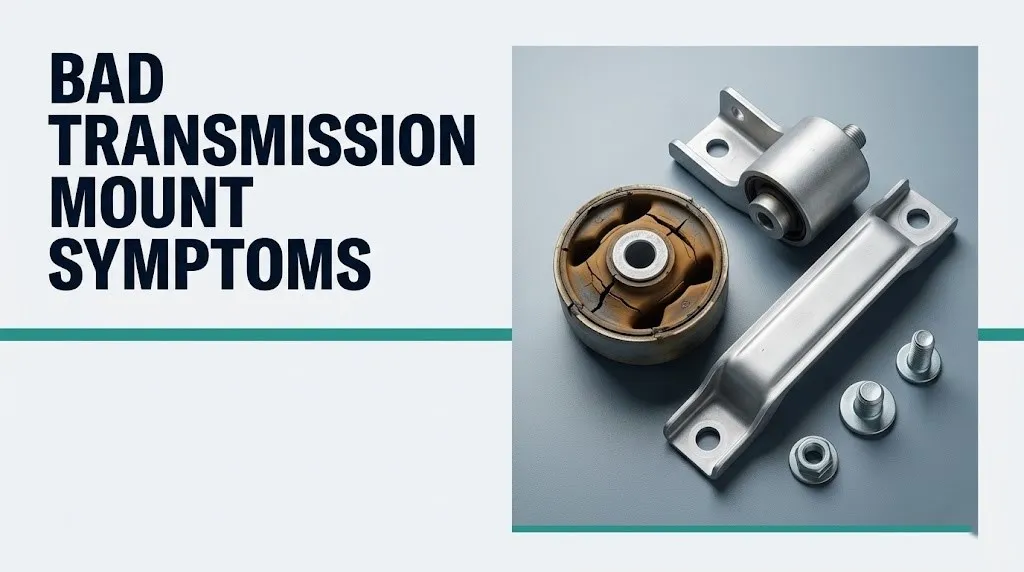
Key symptoms across the full spectrum:
- Noticeable vibration felt through the floor, seat, or steering column at idle or low speed
- A dull thudding or sharp clunking sound when engaging Drive or Reverse from Park
- A clunking or banging noise during aggressive acceleration, particularly from a stop
- Visible rocking or lurching of the engine and transmission assembly when revving from under the hood
- Rattling from the exhaust system, particularly where it passes near the transmission tunnel
- A change in how firmly or smoothly the transmission shifts between gears
- Noise or vibration that worsens under load and improves slightly when the vehicle is coasting
Drivers who use their vehicles primarily for highway driving may notice mount degradation later than city drivers, because highway driving produces more consistent torque loads rather than the repeated acceleration and deceleration cycles that accelerate rubber fatigue in urban use.
Symptoms of a Bad Transmission Mount by Failure Stage
Symptoms of a bad transmission mount follow a recognizable progression from early rubber fatigue through partial separation to complete mount collapse, with each stage producing a distinct and increasingly serious symptom set.
Early Stage: The rubber element has lost elasticity but retains its basic structural integrity. At this stage, the vehicle produces slightly increased vibration that owners often attribute to tire imbalance or road surface changes. The vibration is most noticeable at idle in Park or Neutral and may diminish somewhat once the vehicle is moving. There is no audible clunking yet. The transmission remains in approximately correct position. Mileage: typically first appears between 75,000 and 100,000 miles in standard vehicles.
Moderate Stage: The rubber has progressed to partial separation from the metal bracket on one or both bonding surfaces. This is where clunking sounds appear, particularly during gear engagement. The powertrain can now move slightly beyond its intended range of motion. Adjacent components including exhaust heat shields, wiring looms, and coolant hoses may begin to contact the transmission case or brackets intermittently.
Severe Stage: The rubber element has fully separated on one side or has collapsed structurally. The transmission sits visibly lower or shifted from its intended position. Clunking is constant and loud during any gear change. Shifting quality deteriorates because the transmission linkage or cable geometry is now altered by the mount’s inability to hold position. The exhaust system may contact the driveshaft tunnel continuously, generating a metallic rattle at all speeds.
| Failure Stage | Primary Symptoms | Drive or No Drive |
|---|---|---|
| Early | Mild vibration at idle, no noise | Drive with monitoring; schedule inspection |
| Moderate | Clunking on shifts, increased vibration | Drive to shop promptly; avoid hard acceleration |
| Severe | Constant clunking, transmission movement, exhaust rattle | Do not drive; have vehicle towed |
| Complete failure | No gear control, adjacent damage, powertrain contact | Do not drive under any circumstances |
Key Takeaway: A transmission mount that produces clunking on every gear change has progressed past the early stage and should be inspected by an ASE-certified technician within days, not weeks.
What Does a Bad Transmission Mount Sound Like
A bad transmission mount most commonly sounds like a sharp clunk or thud originating from beneath the vehicle’s center floor, directly under the gearshift area, most pronounced when the transmission transitions between Drive and Reverse or during hard acceleration from a stop.
The specific sound character tells you something about the type and extent of failure. A dull, low-frequency thud that occurs once per gear engagement typically indicates partial rubber separation where the metal bracket is now making intermittent contact with the crossmember or subframe. A sharper, higher-pitched clank suggests the mount hardware, such as the through-bolt or mounting studs, has become loose and is allowing metal-to-metal impact directly.
A continuous metallic rattle at highway speeds that correlates with engine RPM rather than vehicle speed usually indicates the exhaust system is now contacting the transmission tunnel because mount failure has allowed the powertrain to shift position. This is a different sound from the shift-correlated clunk, and recognizing the distinction helps a technician identify how far the failure has progressed before they put the vehicle on a lift.
According to SAE NVH engineering standards, the frequency at which powertrain mounts transmit force into the chassis is measurable through vibration analysis equipment. In diagnostic practice, though, most technicians rely on the audible character and a physical movement test to confirm mount failure without specialized equipment.
Drivers with hearing loss or who regularly drive with loud music may not notice the clunking until it becomes severe. For those drivers, the first noticeable symptom is often the physical vibration felt through the floor mat or seat rather than the audible impact sound.
Transmission Mount Vibration Symptoms
Transmission mount vibration symptoms present as low-frequency vibrations transmitted through the floor, seat cushion, and center console, typically strongest at idle and during low-speed acceleration, and distinguishable from tire-related vibration by their character and the conditions under which they appear.
Tire imbalance vibration typically peaks at a specific speed range, usually between 55 and 70 miles per hour on most passenger vehicles, and diminishes above and below that range. Transmission mount vibration does not follow a speed-dependent pattern. It correlates with engine load and gear engagement. It is strongest when the transmission is under torque, such as during initial acceleration, and typically softens or disappears entirely at highway cruise when the transmission is in a steady-ratio gear with minimal torque demand.
The vibration mechanism works like this: the rubber in the mount no longer absorbs the torsional oscillations the transmission generates during the firing and torque delivery cycles of the engine. Those oscillations, occurring several times per engine revolution, travel through the transmission case, through the now-compromised mount, and into the crossmember and floorpan, where they radiate into the cabin as a buzzing or shaking sensation.
In vehicles with continuously variable transmissions (CVTs), mount vibration symptoms can present differently than in stepped-ratio automatics. CVTs maintain a continuous variation in gear ratio under load, generating a different torsional oscillation profile. CVT mount vibration often presents as a sustained buzz or drone during acceleration rather than the discrete thud pattern more common in planetary automatic transmissions.
Older adults and individuals who routinely drive vehicles with high ambient cabin noise, such as older trucks without sound deadening, are less likely to notice the early vibration stage before it progresses to audible clunking. Annual powertrain inspection is a practical preventive step for any vehicle past 80,000 miles.
Transmission Mount Clunking When Shifting
Transmission mount clunking when shifting is one of the most specific and diagnostically reliable indicators of mount failure, occurring because a degraded mount allows the transmission case to move beyond its designed range of motion during gear engagement, producing a direct impact between the transmission housing or bracket and the vehicle’s crossmember or subframe structure.
Every gear change in an automatic transmission involves a rapid change in the torque direction and magnitude delivered by the transmission. In Drive, the drivetrain is being pushed forward. In Reverse, it is being pushed backward. When you shift from Park into Drive, or from Drive into Reverse, the torque reaction in the mount reverses direction almost instantly. A healthy mount absorbs that reversal smoothly. A worn mount lets the transmission snap from one end of its available travel to the other, and the impact produces the characteristic clunk.
The clunk is not the sound of internal transmission damage. It is the sound of a structural component striking something it should not reach. That distinction matters because many drivers assume the clunking indicates a failing transmission, which leads either to unnecessary anxiety or unnecessary transmission replacement, when mount replacement at a fraction of the cost would resolve the symptom.
According to ASE drivetrain diagnostic guidelines, a clunk that occurs specifically during gear engagement and disappears when the vehicle is in motion and under stable load is a high-probability indicator of mount failure rather than internal transmission or differential damage.
Common situations that produce the clunk:
- Shifting from Park to Drive in an automatic transmission
- Shifting from Drive to Reverse while still moving slowly
- Releasing the clutch quickly in a manual transmission from first gear
- Hard acceleration from a stop, particularly with a loaded vehicle or on an incline
- Sudden throttle release at speed, which reverses the torque direction abruptly
Key Takeaway: A clunk specifically on gear engagement that disappears during steady cruising is almost always a powertrain mount problem, not an internal transmission problem, but only a physical inspection can confirm which mount has failed.
Does a Bad Transmission Mount Affect Shifting
A bad transmission mount does affect shifting, and the mechanism is more direct than most drivers realize: the mount holds the transmission in a precise geometric position relative to the engine, the shifter cable or linkage, and the driveshaft, and when that position changes, the transmission’s ability to select gears accurately and smoothly changes with it.
In vehicles with cable-operated shifters, which include the majority of modern automatic and CVT-equipped vehicles, the shift cable runs from the gear selector on the steering column or floor console to a lever on the transmission case called the manual valve lever or range selector. That cable is routed and tensioned at the factory to move through an exact arc corresponding to each gear position. When the transmission drops out of position because the mount has collapsed, the cable geometry changes. The result can be imprecise gear selection, a gear position that does not engage as expected, or in advanced cases, a gear indicator that shows Drive when the transmission is actually engaged in a different range.
In vehicles with manual transmissions, the shift linkage connects to the gearbox externally. Mount failure that allows the gearbox to move also changes the alignment of the linkage rods or cables, which can create difficulty selecting specific gears, a rubbery or vague shifter feel, or false neutral positions.
The effect on shift quality, meaning how smoothly the transmission changes ratios during normal driving, is secondary but real. The transmission control module in modern vehicles uses accelerometer and speed sensor data to time gear changes. When the transmission physically rocks during a shift due to mount failure, the control module receives inconsistent data, which can cause shift timing errors that feel like harsh, delayed, or unexpected downshifts.
Drivers of older vehicles with higher mileage and worn shift cables may notice shifting symptoms before mount failure is suspected, because the two problems compound each other. An inspection that includes checking mount condition alongside linkage adjustment covers both possibilities efficiently.
Bad Transmission Mount vs Bad Engine Mount
Distinguishing bad transmission mount symptoms from bad engine mount symptoms is one of the most common diagnostic challenges in powertrain NVH complaints, because both mounts serve similar isolation functions and both produce vibration and clunking when they fail.
The single most reliable differentiator is load direction. Engine mounts primarily resist the vertical weight of the engine and the lateral rocking motion produced by engine combustion torque. Transmission mounts primarily resist the longitudinal torque reaction force transmitted through the drivetrain during acceleration and braking. This difference in load direction produces a difference in when and where each symptom type occurs.
| Feature | Bad Engine Mount | Bad Transmission Mount |
|---|---|---|
| Primary symptom trigger | Engine RPM change, idle, revving in neutral | Gear engagement, acceleration load, throttle reversal |
| Clunk timing | Often present during cold start or aggressive revving in Park/Neutral | Most pronounced on Drive/Reverse engagement and hard acceleration |
| Vibration character | Engine rock visible when revving with hood open | Transmission movement visible during gear changes with hood open |
| Location of vibration felt in cabin | Often felt in steering wheel or dashboard | Often felt through floor and center console |
| Effect on gear shift | Indirect, minimal in most cases | Direct: can affect shift cable geometry and shift quality |
| Most affected vehicle configuration | Both FWD and RWD | FWD particularly sensitive due to mount serving as torque arm |
The clearest way to distinguish them without a lift is the rev-in-neutral test. With the vehicle safely parked and the parking brake firmly engaged, have a helper rev the engine in Park or Neutral while you look at the engine and transmission assembly from the open hood. Excessive engine rock that is not accompanied by transmission case movement points to an engine mount. Movement concentrated at the transmission case points to a transmission mount. If the entire powertrain rocks as a unit, both mounts may be compromised.
Key Takeaway: Engine mount symptoms peak during RPM changes in neutral; transmission mount symptoms peak during gear engagement and acceleration load. If both symptoms are present, both mounts need inspection on the same service visit.
Worn Transmission Mount Symptoms Over Time
Worn transmission mount symptoms develop gradually over thousands of miles and driving cycles, and the rate of progression depends heavily on material type, driving patterns, geographic climate, and whether adjacent fluid leaks have accelerated rubber degradation.
Rubber degrades through three primary mechanisms in this application. Oxidative hardening caused by repeated heat cycles from the adjacent exhaust system and engine heat soak causes the rubber to lose elasticity and develop surface cracking. Compression set from the constant bearing of the transmission’s weight causes the rubber to permanently deform, reducing its effective height and moving the transmission into a lower position than designed. Oil contamination from transmission fluid leaks, engine oil leaks, or power steering fluid contamination causes rapid rubber swelling and delamination, which can accelerate failure from a slow-developing process into a rapid one.
According to the Rubber Manufacturers Association, elastomeric automotive components exposed to petroleum-based fluids lose 30 to 50 percent of their tensile strength within months of sustained contamination. This means a vehicle with an adjacent transmission fluid leak is not simply losing fluid: it is actively degrading its own mount at an accelerated rate.
The time-based progression:
- Miles 75,000 to 90,000: Rubber begins losing peak elasticity. Mild idle vibration may appear. No visible damage.
- Miles 90,000 to 110,000: Compression set becomes measurable. Vibration increases. First occasional clunk on sharp gear engagement may appear.
- Miles 110,000 to 130,000: Partial rubber-to-metal separation. Consistent clunking on gear changes. Possible shift quality changes.
- Miles 130,000 and beyond: Potential complete separation or mount collapse. All symptoms are now consistent and severe. Adjacent component contact probable.
Vehicles operated in northern regions where roads are salted heavily during winter develop corrosion of the metal bracket and crossmember hardware, which can cause the mount to fail from mechanical bracket fracture rather than rubber degradation alone, sometimes at lower mileages than rubber-dominated failure would suggest.
Hydro-Mount vs Rubber Transmission Mount Failure Symptoms
Hydro-mount transmission mount failure produces a distinctly different symptom pattern than conventional solid-rubber mount failure, and knowing which type your vehicle uses helps you interpret what you are experiencing more accurately.
A hydraulic transmission mount (hydro-mount) contains a sealed chamber filled with a glycol-based or silicone-based hydraulic fluid separated from a second chamber by a rubber diaphragm. When the transmission generates vibration, the fluid transfers between chambers through a calibrated orifice, converting mechanical energy into heat via fluid viscosity. This design provides dramatically better NVH isolation than solid rubber at low frequencies, which is why it is specified in many luxury vehicles, sports sedans, and front-wheel-drive crossovers with larger displacement engines.
When a hydro-mount fails, it typically fails through seal rupture or diaphragm cracking, allowing the hydraulic fluid to leak out. Once the fluid is gone, the mount behaves like an ordinary solid rubber mount, but one that was designed for a thinner, less stiff material than would normally be used in that application. The result is a sudden and dramatic increase in low-frequency vibration that feels as though something has fundamentally changed in the vehicle. Drivers often describe it as the car suddenly feeling like a much older, rougher vehicle overnight.
This is the key distinction: solid rubber mount failure is gradual. Hydro-mount failure often presents as sudden onset of severe vibration because the hydraulic damping function disappears rapidly once the fluid has leaked out. Looking under the vehicle at the mount for evidence of oily staining or wetness around the mount body is a simple first diagnostic step for hydro-mount failure.
Hydro-mount replacement cost is higher than solid rubber mount cost, typically 40 to 80 percent more for the part alone, and some hydro-mounts are position-specific and not interchangeable between mounting locations on the same vehicle.
Front-Wheel-Drive vs Rear-Wheel-Drive Transmission Mount Symptoms
The symptom pattern of bad transmission mount symptoms differs meaningfully between front-wheel-drive and rear-wheel-drive vehicle configurations because the mount plays structurally different roles depending on powertrain layout, and failure in each configuration stresses different adjacent components.
In a front-wheel-drive vehicle, the transmission is typically transversely mounted alongside the engine in the engine bay. The transmission mount, often called a torque strut or torque arm in this configuration, serves as the primary resistance against the powertrain’s tendency to rotate toward the front of the vehicle under acceleration torque. Because the transmission mount in FWD applications carries a disproportionately high share of the torque reaction load, it tends to fail earlier than the engine mounts in the same vehicle. Failure produces pronounced powertrain rocking visible through the open hood during hard acceleration, aggressive clunking on gear engagement, and vibration that is felt strongly through the floor near the firewall.
In a rear-wheel-drive vehicle, the transmission is longitudinally mounted behind the engine with a tailshaft mount at the rear of the transmission case resting on a transmission crossmember. This mount controls the transmission’s rear position and, critically, sets the driveshaft angle between the transmission output shaft and the rear differential. When this mount fails or collapses, the driveshaft angle changes measurably. The result is vibration that varies with vehicle speed rather than engine load, because driveshaft vibration caused by incorrect universal joint angle is speed-dependent rather than RPM-dependent. This is a critical distinction from FWD mount failure symptoms.
| Configuration | Mount Type | Primary Symptom Pattern | Adjacent Risk |
|---|---|---|---|
| Front-wheel drive | Torque strut or upper transverse mount | Powertrain rock, clunk on acceleration, floor vibration | CV axle, wiring harness, coolant hoses |
| Rear-wheel drive | Tailshaft mount on crossmember | Speed-dependent vibration, driveshaft angle change, rear exhaust contact | Driveshaft U-joints, exhaust system, fuel lines |
| All-wheel drive | Multiple mounts: front trans + transfer case | Combination of FWD and RWD symptoms depending on which mount fails | Transfer case, front driveshaft, rear driveshaft |
Four-wheel-drive and all-wheel-drive vehicles have additional transfer case mounts that can produce similar symptoms, making accurate diagnosis of which specific mount has failed more important before any parts are replaced.
Key Takeaway: Speed-dependent vibration in a rear-wheel-drive vehicle with a worn transmission mount is often caused by a changed driveshaft angle, not just looseness, and requires correct mount replacement height to restore proper driveline geometry.
How to Tell If Your Transmission Mount Is Bad
You can tell if your transmission mount is bad through a combination of observable symptom assessment, a simple visual inspection from under the vehicle, and a physical movement test that any person with access to a safe vehicle lift or securely positioned jack stands can perform.
Here is a step-by-step diagnostic sequence:
- Symptom correlation check: Confirm that clunking or vibration occurs specifically during gear engagement or hard acceleration, not at a specific vehicle speed. Symptoms that are speed-correlated point to tires, wheel bearings, or driveshaft problems. Symptoms that are load-correlated or gear-change-correlated point to mounts.
- Under-hood visual with a helper: With the vehicle safely parked on a flat surface and the parking brake firmly applied, have a helper place the transmission in Drive with their foot on the brake while you observe the engine and transmission from the open hood with hands kept clear. Apply throttle gently. Powertrain movement greater than half an inch in any direction indicates mount failure. Normal mounts allow minimal visible movement under this test.
- Visual inspection from below: On a level surface with the vehicle safely elevated on a lift or properly rated jack stands, visually examine the transmission mount from below. Look for: visible cracks or tears in the rubber element; complete separation of rubber from the metal bracket on either side; the transmission sitting noticeably lower than the crossmember bracket; evidence of oily fluid around a hydro-mount body; rust or fracture at the mount bracket or crossmember hardware.
- Pry bar movement test: With the transmission safely supported, use a pry bar to gently apply upward pressure to the transmission case near the mount. Healthy mounts resist movement firmly. A mount with failed rubber separation allows the transmission to move more than approximately half an inch under light pry bar pressure. This test requires mechanical knowledge and should be performed by or with an ASE-certified technician if you are unfamiliar with drivetrain work.
- Compare against engine mounts: Repeat the movement test at the engine block near each engine mount. This establishes whether movement is isolated to the transmission mount or distributed across multiple mounts.
Can You Drive with a Bad Transmission Mount
Whether you can safely drive with a bad transmission mount depends entirely on the severity of the failure, and there is a meaningful threshold between early-stage degradation and advanced failure that changes the answer from “yes, with monitoring” to “no, have it towed.”
Early-stage transmission mount wear, characterized by mild vibration and occasional light clunking on gear changes, does not present an immediate safety hazard. The transmission remains in approximately correct position. Shifting functions normally. Adjacent components are not yet at risk. Vehicles in this stage can be driven, but the condition should be addressed within 2 to 4 weeks. Hard acceleration and aggressive driving that maximizes torque loads on the mount should be avoided during that window.
Moderate-stage failure, where clunking is consistent and the transmission shows measurable movement during the under-hood visual test, warrants prompt repair within days rather than weeks. Continued driving under hard acceleration repeatedly impacts whatever structure the transmission is now contacting, which can damage the transmission case bracket, the crossmember, or adjacent components. Keep driving distances and load levels minimal until the vehicle is repaired.
Severe or complete mount failure falls into a different category entirely. At this stage, the vehicle presents a genuine safety risk. According to the National Highway Traffic Safety Administration’s vehicle safety inspection framework, components that compromise the positional integrity of drivetrain elements or allow contact between moving powertrain parts and static chassis components are classified as safety-critical failures.
Red flags that mean you should not drive the vehicle at all:
- Transmission visibly contacting the chassis, crossmember, or firewall
- Coolant hoses or wiring harnesses showing signs of contact damage from a displaced transmission
- Total inability to select specific gear positions
- Complete loss of mount structure visible on inspection (rubber fully absent or bracket fractured)
- Driveshaft vibration severe enough to feel at the steering wheel at all speeds
If any of these are present, the correct action is a tow to an automotive service facility, not a slow drive to the nearest shop.
What Happens If a Transmission Mount Completely Fails
A completely failed transmission mount allows the transmission to move freely against gravitational load and torque reaction forces with no effective damping or positional restraint, and the consequences progress rapidly from noise and vibration to structural and electrical damage and potentially to a safety-critical drivetrain failure.
The sequence of damage in complete mount failure follows a consistent pattern. First, the transmission drops or shifts from its designed position. In rear-wheel-drive vehicles, this changes the driveshaft angle immediately. In front-wheel-drive vehicles, the transmission moves toward the firewall or downward. Second, the displaced transmission begins making intermittent then continuous contact with adjacent structures. The exhaust system is typically the first component affected, developing a persistent metallic rattle or heat shield contact that can eventually cause exhaust system damage. Third, wiring harnesses that were routed with clearance around the transmission lose that clearance. Repeated contact abrades the harness insulation, creating electrical shorts that can range from instrument cluster errors to a complete loss of transmission control module communication.
Fourth and most serious: coolant hose contact with a displaced transmission or its brackets can produce coolant line chafing that leads to sudden coolant loss and rapid engine overheating. Engine overheating from a failed transmission mount is not commonly discussed in general automotive content, but it is a real and documented consequence of severe mount failure in tightly packaged front-wheel-drive engine bays.
In rear-wheel-drive vehicles with a failed tailshaft mount, the worst-case scenario is driveshaft angle exceeding the operating range of the universal joints. A driveshaft operating at too steep an angle produces progressive vibration, accelerated U-joint wear, and in extreme cases, U-joint failure that allows the driveshaft to drop from the vehicle while moving, a genuine road hazard.
Do not allow a vehicle with a confirmed complete transmission mount failure to be driven. Arrange towing and request that the inspecting technician check all adjacent components, including wiring harnesses, coolant hoses, exhaust system clearances, and U-joint or CV axle condition, at the same visit.
Key Takeaway: A completely failed transmission mount does not just cause noise. It creates a sequence of secondary damage to electrical systems, cooling systems, and the driveshaft that costs far more to repair than the mount itself.
Emergency Symptoms: When to Stop Driving and Seek Immediate Service
Certain symptoms associated with transmission mount failure indicate a safety-critical drivetrain condition. Do not continue driving if any of the following are present.
Stop driving and arrange a tow immediately if you observe:
- A loud bang or crack from underneath the vehicle followed by severe vibration at all speeds: this pattern indicates structural mount bracket fracture or complete rubber separation with immediate powertrain displacement
- The transmission physically visible touching or resting against the firewall, crossmember, or chassis rail when you look under the hood
- Coolant temperature gauge rising rapidly combined with any of the above drivetrain symptoms: the combination suggests a coolant hose has been compromised by powertrain contact
- Complete loss of gear selection: the transmission will not engage Drive, Reverse, or any forward range reliably: this indicates shift cable geometry has been compromised beyond safe operating range
- A new, intense burning smell from under the vehicle combined with drivetrain noise: this can indicate wiring harness insulation burning from contact with a displaced hot exhaust or transmission component
- Severe steering wheel vibration at low speeds in a rear-wheel-drive vehicle that was not present before: this can indicate driveshaft universal joint failure secondary to mount collapse and incorrect driveline angle
- Any visible damage to coolant hoses, wiring, or fuel lines visible from the engine bay associated with powertrain movement
Call a tow service and do not drive the vehicle further. These presentations can indicate a safety-critical drivetrain failure that a brief drive to a shop can worsen into a far more expensive and dangerous situation.
Transmission Mount Replacement Cost and Repair Urgency
Transmission mount replacement cost in 2026 ranges from approximately $150 to $450 for most passenger vehicles when parts and labor are combined, making it one of the more affordable powertrain repairs relative to the damage it prevents when addressed at the correct stage.
The part itself ranges from $30 to $150 for a standard solid rubber OEM-specification mount on most common domestic and import passenger vehicles. Hydro-mounts range from $80 to $250 or more depending on vehicle application. Labor time for mount replacement ranges from 0.5 to 2 hours depending on access difficulty, with front-wheel-drive applications that require engine support equipment taking longer than rear-wheel-drive tailshaft mounts that are accessible from beneath the vehicle.
Total repair cost by vehicle category:
| Vehicle Type | Mount Type | Parts Cost Range | Labor Range | Total Estimated Range |
|---|---|---|---|---|
| Compact FWD sedan (e.g., Honda Civic, Toyota Corolla) | Solid rubber torque strut | $40 to $90 | $70 to $150 | $110 to $240 |
| Mid-size FWD sedan or crossover | Solid rubber or hydro-mount | $60 to $140 | $90 to $200 | $150 to $340 |
| RWD sedan or coupe (tailshaft mount) | Solid rubber crossmember mount | $30 to $80 | $60 to $130 | $90 to $210 |
| Full-size truck or SUV | Heavy-duty rubber mount | $50 to $120 | $80 to $180 | $130 to $300 |
| Luxury or performance vehicle | Hydro-mount | $90 to $250 | $120 to $250 | $210 to $500 |
The repair urgency decision depends on failure stage. Early-stage: schedule repair within 30 days. Moderate-stage: schedule within 1 to 2 weeks and limit hard acceleration. Severe-stage: do not drive; tow to service.
Choosing an aftermarket polyurethane mount over the OEM rubber specification is a common option for performance-oriented drivers. Polyurethane mounts provide less vibration isolation than OEM rubber because they are stiffer, which means more NVH transmission into the cabin. For daily-driven vehicles, OEM-specification rubber or hydro-mount replacement is generally the better choice.
Transmission Mount Inspection and Diagnosis
Transmission mount inspection and diagnosis by a qualified technician involves a combination of a lift-assisted visual examination, a physical movement assessment, and in some cases, vibration frequency analysis to confirm that the mount is the source of the symptom rather than a related component.
Here is what a professional diagnostic process for this complaint typically involves:
- Road test with symptom documentation: The technician drives the vehicle and replicates the reported symptom. They note whether the clunk or vibration is load-correlated, speed-correlated, or gear-change-correlated, and assess approximate cabin location of the primary symptom.
- Lift inspection of mount condition: With the vehicle elevated, the technician visually examines all powertrain mounts including engine mounts, transmission mount, and transfer case mount if applicable. They look for rubber cracking, separation, collapse, fluid contamination, bracket fracture, and hardware looseness.
- Physical movement test: Using a pry bar with the drivetrain unloaded, the technician assesses how much movement the transmission exhibits under applied force. Excessive movement confirms mount failure.
- Adjacent component check: A thorough inspection notes any contact marks on adjacent wiring, coolant hoses, exhaust components, or chassis structures that indicate the transmission has already been moving beyond its designed range.
- Differential diagnosis: If mount condition alone does not fully explain the symptoms, the technician considers U-joint wear, CV axle wear, differential mount condition, and shift linkage integrity as contributing factors.
According to ASE drivetrain diagnostic training standards, confirming which specific mount is the primary failure source before ordering parts reduces unnecessary replacement of serviceable components. Replacing an engine mount when the transmission mount is the actual cause of the clunk is a common and avoidable diagnostic error in shops that skip the movement test.
Bringing a clear symptom description to your appointment saves diagnostic time. Specifically, tell the technician whether the clunk is worst on: (a) engaging Drive from Park, (b) hard acceleration from a stop, (c) releasing the throttle at speed, or (d) a specific vehicle speed range. That specificity steers the diagnostic toward the correct component from the start.
Frequently Asked Questions About Transmission Mount Symptoms
What are the most common signs of a bad transmission mount?
The most common signs of a bad transmission mount are a clunking noise when shifting between Drive and Reverse, increased vibration felt through the floor or seat, and visible powertrain movement when the engine is revved with the vehicle in Park.
Vibration that is strongest at idle and during low-speed acceleration, rather than at a specific highway speed, is particularly characteristic of mount failure rather than tire or wheel bearing problems.
A confirmed diagnosis requires a lift-assisted physical inspection by an ASE-certified technician, who can assess rubber condition and measure powertrain movement directly.
What does a bad transmission mount sound like when driving?
A bad transmission mount most commonly sounds like a sharp clunk or thud from beneath the floor, centered under the gearshift area, occurring most strongly during gear engagement or aggressive acceleration from a stop.
A separate continuous metallic rattle at highway speeds that correlates with engine RPM rather than vehicle speed typically indicates the exhaust system is contacting the transmission tunnel due to powertrain displacement from mount failure.
The clunk on gear change is the single most recognizable sound of a failing transmission mount and distinguishes it from most other drivetrain noise sources.
Can a bad transmission mount cause rough shifting or hard shifts?
A bad transmission mount can cause rough or imprecise shifting by changing the geometry of the shift cable between the gear selector and the transmission case manual valve lever.
In vehicles with cable-operated automatic transmissions, mount collapse moves the transmission out of the position the shift cable was designed to reach, producing delayed engagement, incomplete gear selection, or a gear indicator that does not accurately reflect the engaged range.
If rough shifting coincides with clunking on gear engagement or visible powertrain movement, mount condition should be assessed before any internal transmission diagnosis or repair is considered.
How do you test a transmission mount to see if it is bad?
The most reliable basic test is the under-hood visual test: with the parking brake firmly applied and a helper pressing the brake while engaging Drive, observe the engine and transmission for excessive movement, greater than approximately half an inch, during gentle throttle application.
A lift-assisted pry bar test, in which a technician applies upward pressure near the mount with the transmission supported, confirms whether rubber separation is allowing movement beyond design limits.
A visual inspection from below checking for cracked, oily, or fully separated rubber and for contact marks on adjacent components completes the basic assessment.
Is it safe to drive with a bad transmission mount?
Early-stage transmission mount wear with mild vibration and no consistent clunking presents a low immediate safety risk, and the vehicle can be driven carefully while a repair appointment is scheduled within a few weeks.
Moderate to severe failure, particularly any symptoms involving consistent clunking on gear changes, visible powertrain movement, coolant hose or wiring contact, or loss of reliable gear selection, means the vehicle should not be driven until the mount is inspected and replaced.
A completely failed mount that allows the transmission to contact the chassis or compromise adjacent fluid or electrical lines is a safety-critical condition that warrants towing rather than driving to a shop.
How much does it cost to replace a transmission mount in 2026?
Transmission mount replacement costs range from approximately $90 to $500 total in 2026, depending on vehicle type, mount type, and labor time required.
Standard solid-rubber mounts on common compact and mid-size passenger vehicles typically fall in the $110 to $250 range for parts and labor combined, while hydraulic hydro-mounts on luxury or performance vehicles can reach $300 to $500 or more.
Addressing the repair promptly at the early or moderate failure stage prevents secondary damage to wiring harnesses, exhaust systems, and coolant hoses that would add significantly to the total repair cost.
Closing
Bad transmission mount symptoms follow a clear progression, and the specific combination of sounds, vibrations, and behavioral changes your vehicle is producing tells you exactly where in that progression the failure sits. A mild vibration at idle with no clunking means you have time to schedule a repair. Consistent clunking on every gear change means that window is narrowing. A loud bang, a visible collapse, or contact between the transmission and adjacent components means the vehicle should not be driven further.
The single most practical step from here: describe your symptoms specifically when you contact an ASE-certified technician. Whether the noise is worst on Drive engagement, on hard acceleration, or during coasting, and whether the vibration is load-correlated or speed-correlated, takes the diagnostic process from guesswork to a targeted physical inspection. That specificity saves time and money.
A transmission mount replacement addressed at the right stage costs a few hundred dollars. Addressed after secondary damage to wiring, exhaust, or cooling components, the same problem costs several times more and takes several times longer to fix correctly.