Bad Transmission Mount Symptoms and Health Effects
Bad transmission mount symptoms go well beyond noise and rough shifting: they include measurable physical effects on your lumbar spine, peripheral nervous system, muscles, and inner ear. A degraded or failed transmission mount allows unfiltered mechanical vibration and drivetrain shock to transmit directly through your vehicle’s floor, seat, and steering column into your body, and the health consequences of chronic exposure are documented in occupational medicine research.
The National Institute for Occupational Safety and Health (NIOSH) classifies whole-body vibration above specific acceleration thresholds as an occupational health hazard, with documented links to intervertebral disc degeneration, lumbar radiculopathy, and musculoskeletal fatigue. Drivers who regularly operate vehicles with degraded powertrain mounts are exposed to vibration levels that can fall within or exceed these hazardous thresholds during normal driving conditions.
This article covers every physical symptom a bad transmission mount can produce, from the immediate mechanical sensations you feel on the road to the progressive musculoskeletal and neurological effects of cumulative vibration exposure. It also covers who is at highest risk, when symptoms require medical evaluation, and the difference between symptoms you can monitor and symptoms that need a physician’s attention.
Bad Transmission Mount Symptoms: What You’re Actually Feeling
Bad transmission mount symptoms are the combined mechanical and physical sensations you experience when the rubber or polyurethane isolator in your transmission mount has cracked, collapsed, or separated, allowing unfiltered drivetrain forces to travel through the vehicle frame into your body.
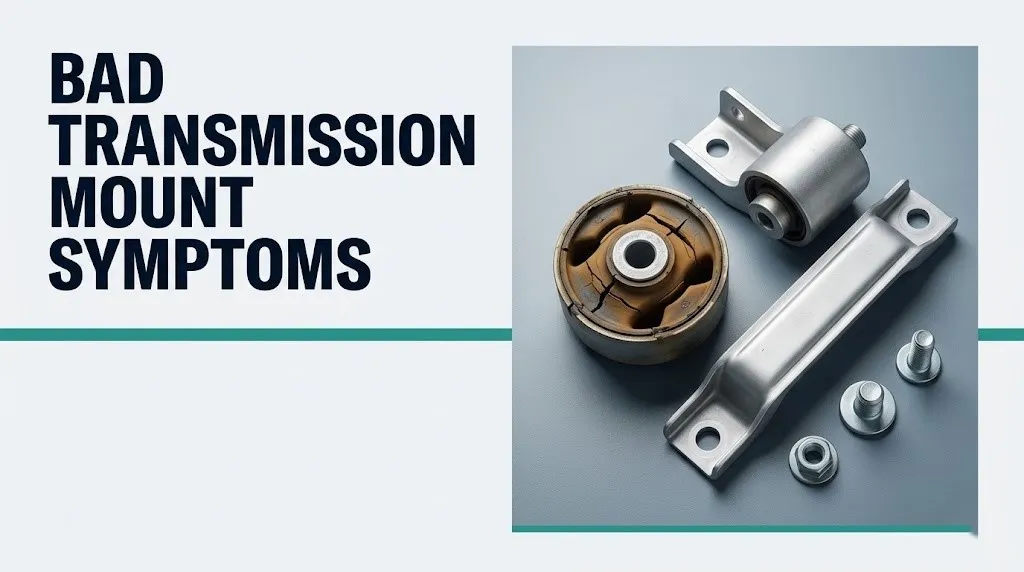
The transmission mount is a component that connects the transmission housing to the vehicle’s crossmember or engine cradle using rubber or polyurethane bonded to metal brackets. Its primary job is vibration isolation: it absorbs the rotational torque pulses and vibration generated by the transmission and prevents them from transmitting to the passenger cabin. When the isolating material deteriorates, that filter is gone.
What you feel immediately is a combination of increased cabin vibration at idle and while moving, clunking or thudding sensations during gear changes, harder or jerkier gear engagement, and sometimes a subtle shimmy through the seat and floor at certain vehicle speeds. These are the mechanical symptoms. What matters for your health is what that vibration is doing to your body at the same time.
The physical symptoms you’ll experience depend on how far the mount has degraded, how long you’ve been driving with it in that state, and how much time per day you spend in the vehicle. A commuter driving 30 minutes each way experiences a very different cumulative dose than a truck driver covering 400 miles daily.
Key physical symptoms associated with bad transmission mount exposure:
- Increased lower back stiffness and fatigue after driving
- Muscle aching in the lumbar and thoracic spine
- Tension at the base of the skull and across the upper trapezius
- Tingling or numbness in the hands during or after extended driving
- Difficulty concentrating after long drives, related to vestibular and proprioceptive overload
- Feeling physically shaken or unsettled after stopping the vehicle
Symptoms of a Bad Transmission Mount: The Full Clinical Picture
The symptoms of a bad transmission mount span two categories: the mechanical symptoms you notice in the vehicle and the physical health symptoms you feel in your body during and after driving.
Mechanical symptoms tell you the mount has failed. Physical symptoms tell you the failure is affecting your health. Most online sources cover only the first category. The second category is where the real clinical picture lives.
Mechanical symptoms you notice in the vehicle:
| Symptom | When It Occurs | Clinical Significance |
|---|---|---|
| Cabin vibration at idle | Engine running, vehicle stationary | Mount no longer absorbing torque reaction |
| Clunking on acceleration or deceleration | Throttle application or release | Transmission shifting position without restraint |
| Vibration through seat and floor at speed | Highway or high-RPM driving | Unfiltered drivetrain frequency reaching cabin |
| Hard or jerky gear engagement | Automatic or manual gear changes | Transmission moving excessively during shift |
| Vibration through steering wheel | Linked if motor mount also affected | Vibration path reaching upper extremities |
| Burning smell in some cases | Severe failure with contact | Heat from drivetrain components contacting body |
Physical health symptoms you experience as the driver or passenger:
A 2019 review published in the Journal of Occupational and Environmental Medicine found that drivers regularly exposed to whole-body vibration in the 4-8 Hz frequency band report significantly higher rates of lumbar fatigue, paraspinal muscle soreness, and difficulty with sustained concentration compared to workers in non-vibrating environments. The transmission mount is the primary component filtering drivetrain vibration from reaching those frequencies in the passenger cabin.
People with pre-existing lumbar disc disease at L4-L5 or L5-S1 typically notice physical symptoms more rapidly and more severely than those with healthy discs. The cyclic loading that WBV imposes on already compromised disc material accelerates degenerative processes that might otherwise progress slowly.
What Does a Bad Transmission Mount Feel Like to Your Body
What a bad transmission mount feels like to your body is a sustained, low-frequency vibration entering through the seat, floor, and sometimes the steering wheel, combined with intermittent sharp jolts during gear changes, all of which your postural muscles respond to continuously whether you are consciously aware of them or not.
The experience varies by vehicle speed and driving condition. At idle, you may feel a subtle buzz or shudder through the seat. At low speeds in city driving, the clunking sensation during gear changes feels like a muffled thud or a push from behind. On the highway, the sensation shifts to a persistent vibration through the seat base and lumbar area of the car seat, sometimes accompanied by a shimmy through the steering wheel.
Your body responds to these inputs automatically. The erector spinae (a group of muscles running along both sides of the thoracic and lumbar vertebrae) and the multifidus (a deep stabilizing muscle running along the spine from the sacrum to the cervical vertebrae) both activate involuntarily to protect the spine against the incoming vibration. This involuntary isometric contraction is identical in mechanism to holding a static plank for the entire duration of your drive.
Think of it this way: your spinal muscles are doing the equivalent of a low-intensity workout every time you drive. With a properly functioning transmission mount, that workout is minimal. With a failed mount, the muscles are fighting unfiltered vibration the entire time, and they fatigue accordingly.
After a long drive in a vehicle with a bad transmission mount, your lower back, mid-back, and shoulder muscles will typically feel heavier and more fatigued than after a comparable drive in a well-maintained vehicle. That difference is the direct physical signature of WBV exposure.
Quick Tip:
- If your lower back feels more sore after driving than after sitting in an office chair for the same duration, unfiltered vehicle vibration is a likely contributor
- The fatigue tends to build over the drive rather than being present immediately at the start
- Older adults over 60 may notice the physical fatigue more quickly due to reduced paraspinal muscle mass and intervertebral disc hydration
Transmission Mount Vibration and Physical Symptoms Explained
Transmission mount vibration produces physical symptoms through a well-understood biomechanical mechanism: the failed mount allows vibration energy in the 4-12 Hz frequency range to reach the cabin, and the human lumbar spine has a natural resonance frequency of approximately 4-8 Hz.
The concept of resonance matters here. When an external vibration frequency matches the natural resonant frequency of a structure, energy transfer into that structure is maximized. Your lumbar spine resonating with drivetrain vibration at 5-7 Hz means the discs, facet joints, and surrounding musculature absorb far more mechanical energy than they would from ambient vehicle vibration filtered by a functioning mount.
According to ISO 2631-1 (the international standard for evaluating human exposure to whole-body vibration), the frequency range of greatest risk to the lumbar spine and internal organs falls between 1-80 Hz, with peak sensitivity in the 4-8 Hz band. This is precisely the frequency band that a degraded transmission mount fails to attenuate.
The physical symptom pathway works like this:
- Transmission mount rubber isolator cracks or separates
- Drivetrain vibration at 4-12 Hz transmits through the crossmember to the vehicle floor and seat
- Vibration enters the occupant’s body through the ischial tuberosities (sitting bones) and lumbar contact area of the seat
- Lumbar intervertebral discs undergo cyclic compressive and shear loading at resonance frequency
- Erector spinae and multifidus activate continuously in isometric contraction, consuming glucose and producing lactate
- After 20-60 minutes, paraspinal muscle fatigue becomes symptomatic as aching and stiffness
- With repeated daily exposure, disc dehydration, micro-annular tears, and facet joint irritation begin to accumulate
Pregnant women are at particular risk from vibration in this frequency range because research published in the European Journal of Applied Physiology has found that the uterus and pelvic floor musculature are also sensitive to WBV in the 5-10 Hz range, with potential consequences for pelvic ligament strain and uterine discomfort during sustained exposure.
Key Takeaway: A failed transmission mount allows drivetrain vibration at precisely the frequency that maximizes energy transfer to your lumbar spine, turning every drive into an involuntary spinal loading session that your postural muscles have to compensate for.
Can a Bad Transmission Mount Cause Back Pain
A bad transmission mount can cause back pain by removing the vibration isolation that prevents drivetrain frequencies from reaching your lumbar spine, producing cyclic mechanical loading of the intervertebral discs and sustained isometric contraction of the erector spinae and multifidus muscles throughout the drive.
The back pain associated with WBV exposure has two distinct patterns. The first is acute postural fatigue: aching and stiffness in the lumbar and thoracic regions that develops during or immediately after driving and resolves with rest. The second is chronic progressive: disc degeneration and facet joint irritation that accumulates over months to years of repeated exposure and does not fully resolve between drives.
Research published in the journal Spine has consistently found associations between occupational WBV exposure and accelerated lumbar intervertebral disc degeneration, particularly at L4-L5 and L5-S1. These are the discs that bear the greatest compressive load during seated posture and are most exposed to the resonant vibration frequencies transmitted through a vehicle seat.
The pain pattern is typically:
- Dull, aching lumbar pain that worsens as driving time increases
- Paraspinal muscle tightness running from the sacrum to the mid-thoracic region
- Pain that eases within an hour of stopping and stretching in early-stage exposure
- Pain that begins earlier in the drive and takes longer to resolve with repeated exposure
- In advanced cases, pain that persists throughout the day regardless of activity
People with pre-existing disc herniation at L4-L5 or L5-S1 are at heightened risk because the cyclic compressive loading from WBV applies direct mechanical stress to a disc that already has compromised annular integrity. This can accelerate the progression of the herniation and worsen radicular symptoms (pain, numbness, or tingling radiating into the leg along the path of the sciatic nerve).
Clunking Noise from a Transmission Mount and Physical Jolt Risk
The clunking noise from a failed transmission mount is produced when the transmission housing shifts position abruptly during torque changes because the degraded isolating material no longer prevents this movement, and the physical jolt risk to vehicle occupants is real and underappreciated.
When the transmission mount is functioning, torque reaction forces during gear changes are absorbed by the rubber isolator. The transmission stays in its designed position relative to the drivetrain. When the mount has failed, the transmission physically moves, often several millimeters or more, before being stopped by contact with surrounding components. That contact produces the audible clunk.
The health significance is in the jolt. Each clunking event transmits a brief, sharp impulse through the vehicle structure into the occupant’s body. This is qualitatively different from the sustained low-frequency vibration discussed above. It’s an impulsive load: short duration, higher peak force, applied to the lumbar spine and cervical spine without warning.
The startle reflex (a hardwired brainstem response) causes involuntary muscle contraction at the moment of each jolt. In a vehicle context, this means the cervical and lumbar paraspinal muscles contract suddenly against the incoming force, then immediately relax. Repeated impulsive loading of this type, according to research in the Journal of Biomechanics, produces microtrauma in paraspinal muscle fiber and contributes to chronic myofascial pain in the cervical and lumbar regions.
Older adults over 65 face elevated risk from each jolt event because age-related reductions in bone mineral density (osteopenia and osteoporosis) mean that sudden impulsive spinal loading carries a greater risk of vertebral body micro-fracture, particularly in the thoracic vertebrae where osteoporotic compression fractures most commonly occur.
Red flags following a sharp vehicle jolt:
- Sudden severe back or neck pain that is distinctly worse than your usual driving discomfort
- New leg weakness, foot drop, or inability to walk normally after a jolt
- Loss of bladder or bowel control following a significant impact
- Sharp pain radiating down one arm after a steering wheel jolt
Hard Shifting and Transmission Mount Failure: What Your Body Feels
Hard shifting caused by transmission mount failure subjects vehicle occupants to abrupt deceleration and acceleration forces during each gear change, and the physical experience is a brief but repetitive mechanical stress to the cervical and lumbar spine with every shift event.
A properly functioning automatic transmission manages gear changes smoothly partly because the transmission mount holds the transmission in precise alignment with the driveshaft. When mount integrity is lost, the transmission can yaw (rotate on its vertical axis) or pitch (tip forward or backward) during the shift, producing the sensation of being pushed or pulled in the seat. Manual transmission drivers experience this as a sudden jerk during clutch engagement.
The physical response in your body during each hard shift involves brief but measurable cervical flexion-extension loading as your head and neck are carried forward or backward by the impulse. The cervical vertebrae (C1 through C7) and their supporting musculature, particularly the trapezius, levator scapulae, and deep cervical flexors, absorb this force. In a low-speed driving context, a single event is harmless. Repeated across hundreds of gear changes per day, the cumulative loading of the cervical facet joints and paraspinal muscles becomes clinically relevant.
According to the Mayo Clinic, tension in the trapezius and suboccipital muscles is one of the most common triggers for tension-type headache, which is the most prevalent headache type worldwide. The repetitive cervical loading from hard shifting in a vehicle with a failed transmission mount creates exactly the sustained trapezius tension pattern that the Mayo Clinic describes as a tension headache trigger.
People with cervical spondylosis (age-related cervical disc and facet joint degeneration) should pay particular attention to this symptom pattern, as the cervical spine in this population has reduced capacity to absorb repetitive impulsive loading without producing symptoms.
Key Takeaway: Hard shifting from a bad transmission mount is not just a comfort issue: it applies repetitive impulsive loading to your cervical and lumbar spine that, over time, produces the same postural muscle fatigue pattern as tension headache and myofascial neck pain.
Headaches and Neck Pain from Vehicle Vibration
Headaches and neck pain from vehicle vibration produced by a bad transmission mount develop through sustained isometric contraction of the trapezius, suboccipital, and sternocleidomastoid muscles, which in turn sensitizes the trigeminal nucleus caudalis in the brainstem and produces the referred pain pattern of tension-type headache.
The mechanism is not complicated once you understand the anatomy. The suboccipital muscle group (four small muscles at the base of the skull connecting the upper cervical vertebrae to the occiput) contracts continuously when you brace against vibration while driving. This group is responsible for fine head positioning and stabilization. Sustained contraction of these muscles compresses the greater occipital nerve, which runs between the C2 vertebra and the base of the skull, producing occipital pain that can radiate forward over the scalp toward the forehead and temples.
Simultaneously, the upper trapezius (the muscle running from the cervical vertebrae and occiput to the shoulder blade and clavicle) contracts against the postural demand of vibration stabilization. According to research published in Cephalalgia (the journal of the International Headache Society), sustained trapezius contraction activates trigger points in the muscle belly that refer pain directly to the temples and the area behind the eye, mimicking the distribution of a tension-type headache.
The vestibular system contributes a separate mechanism. The vestibular apparatus in the inner ear (including the semicircular canals and otolith organs) detects continuous low-frequency motion signals from sustained vehicle vibration. Prolonged input from a vibration source outside the normal range of expected motion produces mild vestibular fatigue and the sensation of still feeling motion after the drive has ended. In some drivers this manifests as mild dizziness, a feeling of unsteadiness when first standing after a long drive, or low-grade nausea that persists after parking.
People who already experience migraine should note that sustained sensory input from vibration, particularly at irregular frequencies produced by a deteriorating mount, is a recognized environmental trigger for migraine attack onset, according to clinical guidelines from the American Headache Society.
Whole Body Vibration Health Effects in Drivers
Whole body vibration (WBV) health effects in drivers are among the best-documented occupational health consequences of sustained vehicle operation, and a failed transmission mount meaningfully increases the WBV dose a driver receives above what a properly maintained vehicle would generate.
NIOSH defines whole-body vibration as mechanical vibration that enters the body through the seat, floor, or back support when a person is in a seated, standing, or recumbent position. Transmission mounts are specifically designed to reduce the amplitude of vibration reaching these contact points. When a mount fails, it stops performing that function.
The ISO 2631-1 standard provides the most widely used framework for evaluating WBV health risk. It quantifies exposure using a daily vibration dose value (VDV) that accounts for vibration amplitude, frequency weighting (with greatest weight given to the 4-8 Hz lumbar-sensitive band), and exposure duration. Research applying this framework to vehicle operators has consistently found:
| WBV Exposure Level | Documented Health Effect | Evidence Quality |
|---|---|---|
| Low (occasional short drives) | Mild postural fatigue, resolves with rest | Well-established, epidemiological |
| Moderate (daily commuting, degraded vehicle) | Paraspinal muscle soreness, early disc fatigue | Well-established, controlled studies |
| High (occupational driving, 4+ hours daily) | Intervertebral disc degeneration, chronic low back pain | Well-established, Spine journal |
| Very high (heavy vehicle, failed mount) | Radiculopathy, disc herniation, HAVS progression | Supported by occupational research |
A 2021 systematic review published in the Journal of Occupational and Environmental Medicine found that workers exposed to high WBV levels had approximately 1.8 times the risk of developing lumbar disc herniation compared to unexposed workers, with dose-response relationships clearly established across occupational categories.
Older adults over 60 face amplified effects because intervertebral disc hydration decreases with age (a process called disc desiccation), reducing the disc’s ability to distribute compressive loads. In a desiccated disc, WBV-induced cyclic loading produces greater stress concentration at the annulus fibrosus and is more likely to initiate or worsen annular tears.
Key Takeaway: Whole-body vibration from a failed transmission mount is not a minor comfort issue: NIOSH and ISO standards classify the vibration levels involved as an occupational health hazard, with dose-response evidence linking sustained exposure to lumbar disc degeneration.
Hand-Arm Vibration Symptoms from Steering Wheel Transmission
Hand-arm vibration (HAV) symptoms from steering wheel transmission occur when mechanical vibration travels from the drivetrain through the steering column and into the driver’s hands, wrists, and forearms, producing progressive effects on the digital blood vessels and peripheral nerves of the upper extremities.
A transmission mount failure can contribute to steering wheel vibration, particularly in front-wheel-drive vehicles where the transmission is physically closer to the steering assembly, or in vehicles where the motor mount and transmission mount have both degraded, creating a broader vibration transmission pathway through the vehicle structure to the steering column.
The condition produced by sustained hand-arm vibration is called hand-arm vibration syndrome (HAVS). It has three recognized components:
- Vascular component: Episodic vasospasm of the digital arteries (the small arteries supplying each finger), producing blanching, numbness, and tingling in the fingers that is worsened by cold temperatures. This is also called vibration white finger (VWF) or a form of secondary Raynaud’s phenomenon.
- Neurological component: Progressive demyelination of the ulnar nerve and median nerve in the hand and forearm, producing persistent numbness, tingling, and reduced grip strength.
- Musculoskeletal component: Damage to the tendons, joints, and bones of the hand and wrist, producing pain and reduced range of motion in the fingers and wrist.
According to the Health and Safety Executive (HSE) in the United Kingdom, which maintains some of the most comprehensive HAVS research databases in the world, symptoms of HAV neurological damage can appear after as little as one year of regular high-amplitude vibration exposure without adequate protective breaks.
Drivers in the early stage of HAV exposure notice intermittent tingling or numbness in the fingers during driving, particularly in the ring finger and little finger (the distribution of the ulnar nerve). This symptom pattern during steering wheel vibration exposure warrants evaluation by an occupational medicine physician or neurologist, who can assess nerve conduction velocity to determine whether peripheral nerve demyelination has begun.
Symptoms of a Bad Transmission Mount Getting Worse
The symptoms of a bad transmission mount get progressively worse as the rubber or polyurethane isolating material continues to deteriorate, and the physical health consequences escalate along a predictable progression from mild vibration fatigue to acute injury risk.
Mount deterioration typically follows this trajectory: rubber oxidation and cracking begin at the edges of the isolator where stress concentration is highest, progressing toward the center until the mount can no longer absorb torque reaction forces at all. In the final stage, the transmission may contact surrounding vehicle structures directly, producing severe jolts and the risk of drivetrain component damage.
The physical symptom escalation mirrors this mechanical progression:
| Mount Condition | Mechanical Symptoms | Physical Health Symptoms |
|---|---|---|
| Early degradation (surface cracking) | Slight increase in idle vibration | Mild post-drive lumbar fatigue |
| Moderate degradation (50% isolator loss) | Noticeable clunking, cabin vibration | Persistent lumbar soreness, early hand tingling |
| Severe degradation (near-complete failure) | Loud clunking, hard shifts, visible mount sag | Significant back pain, headaches, hand numbness |
| Complete failure (metal-to-metal contact) | Severe jolts, potential drivetrain misalignment | Acute injury risk, severe spinal loading from jolts |
One critically underappreciated aspect of symptom progression is that the human body partially habituates to sustained vibration exposure. This habituation means you may stop consciously noticing the vibration while continuing to accumulate the tissue damage it produces. Research on occupational WBV exposure, cited in EU-OSHA reports, has noted that workers who have driven the same deteriorating vehicle for many months often underreport the degree of vibration because they have normalized the sensation, while objective measurements confirm the vibration is well above safe thresholds.
People who drive the same vehicle every day should ask a passenger who doesn’t normally ride in the car to assess the vibration level. Fresh perception is a more reliable detector of abnormal vibration than habituated assessment.
How Long Can You Drive with a Bad Transmission Mount
Driving with a bad transmission mount for any extended period increases your cumulative whole-body vibration dose beyond what occupational health standards consider acceptable, and the safe answer is that the mount should be replaced before continuing regular driving, not because the vehicle will necessarily stop immediately but because the physical health effects accumulate with every additional hour behind the wheel.
From a purely mechanical standpoint, how long you can continue driving depends on the severity of the degradation. A mount with early surface cracking may hold for weeks or months before becoming severe. A mount with a fully separated isolator may reach metal-to-metal contact rapidly, at which point drivetrain misalignment and secondary component damage become risks.
From a health standpoint, the calculation is different. The ISO 2631-1 daily vibration dose value (VDV) framework makes clear that there is no “safe” lower limit of WBV exposure below which lumbar disc effects are guaranteed absent. The risk is dose-dependent and cumulative. Every day of driving with increased vibration from a bad mount adds to a running total that determines long-term outcome.
The specific physical risks of continuing to drive with a bad mount include:
- Accelerated intervertebral disc degeneration at L4-L5 and L5-S1 with each additional month of exposure
- Progressive HAVS neurological changes in the ulnar and median nerves with sustained steering wheel vibration
- Acute cervical or lumbar injury risk from a severe jolt if the mount reaches complete failure while driving at speed
- Vestibular fatigue and reaction time effects that can impair driving safety, especially on long highway drives
Pregnant women should treat a failed transmission mount as requiring immediate repair. Research from the European Agency for Safety and Health at Work has specifically identified WBV exposure during pregnancy as a risk factor for preterm birth and low birth weight, and any avoidable source of WBV should be eliminated during pregnancy.
Key Takeaway: There is no safe number of hours you can continue driving with a bad transmission mount before health effects begin to accumulate: the damage is dose-dependent, and every drive without repair adds to the total.
Bad Motor Mount vs Bad Transmission Mount Symptoms
Bad motor mount and bad transmission mount symptoms overlap significantly because both components serve the same isolating function for different drivetrain elements, and distinguishing between them based on physical symptoms alone requires knowing which symptoms occur under which specific driving conditions.
The motor mount (also called the engine mount) connects the engine block to the vehicle’s frame or subframe and absorbs the torque reaction forces and vibration produced by the engine. The transmission mount connects the transmission housing to the crossmember and absorbs vibration and torque generated downstream of the engine, specifically at the gearbox.
The overlap in symptoms comes from their shared role: both mounts, when functioning, prevent drivetrain vibration from reaching the cabin. When either fails, vibration increases.
| Feature | Bad Motor Mount | Bad Transmission Mount |
|---|---|---|
| Vibration at idle | Prominent, engine rock visible in some vehicles | Mild to moderate, less obvious at idle |
| Vibration under acceleration | Prominent, especially at low RPM | Prominent during and after gear changes |
| Clunking character | Clunk on throttle tip-in and lift-off | Clunk specifically during gear shifts |
| Steering wheel vibration | Common, especially in FWD vehicles | Less common unless motor mount also involved |
| Visible drivetrain movement | Engine rocks visibly in engine bay | Transmission shifts position in tunnel |
| Physical symptoms in occupant | Lumbar fatigue, hand tingling | Lumbar fatigue, jolt at gear changes |
| Torque steer in FWD | Can occur with severe failure | Less typical |
The most reliable physical distinction is timing: motor mount failure produces symptoms most prominently during engine torque changes (throttle in and out at constant speed), while transmission mount failure produces the most noticeable clunk and jolt at the moment of actual gear engagement. In many older or high-mileage vehicles, both mounts deteriorate simultaneously, and the combined vibration picture is more severe than either alone.
An occupational medicine physician or a primary care physician evaluating a driver for WBV-related symptoms should be told whether both mounts have been assessed, as combined failure produces meaningfully higher WBV amplitude than a single failed component.
Transmission Mount Symptoms in Occupational Drivers
Transmission mount symptoms in occupational drivers (truck drivers, delivery drivers, rideshare and taxi drivers, bus drivers, and other commercial vehicle operators) represent a clinically distinct situation because occupational drivers accumulate WBV dose at rates many times higher than typical commuters, and the health consequences are correspondingly more severe and faster to develop.
Where a typical commuter might drive 45-60 minutes per day, an occupational driver may accumulate 6-10 hours of seat time daily. At moderate WBV amplitudes from a deteriorating mount, this translates to a daily vibration dose that may exceed the action value defined by the European Physical Agents Directive (2002/44/EC), above which employers are required by European law to take protective action. While this directive applies to European workers, the underlying biomedical research that informed the threshold is directly applicable to any driver regardless of jurisdiction.
NIOSH has published similar guidance for U.S. workers, noting that long-haul truck drivers have among the highest documented rates of lumbar disc herniation and chronic low back pain of any occupational group, with WBV identified as a primary contributing factor.
For occupational drivers, specific health monitoring is warranted:
- Annual lumbar spine evaluation by a primary care physician, with referral to an orthopedic spine specialist or physiatrist (physical medicine and rehabilitation physician) if symptoms are progressive
- Periodic peripheral nerve assessment for HAVS symptoms, including nerve conduction velocity testing ordered by an occupational medicine physician or neurologist if hand tingling or numbness is present
- Evaluation of vehicle maintenance records as part of occupational health assessment, with documentation of known mount degradation
Rideshare and gig-economy drivers are a particularly vulnerable population because they often operate personal vehicles that they own and maintain independently, without the fleet maintenance programs that commercial carriers use. A rideshare driver with a failed transmission mount in their personal vehicle may accumulate occupational-level WBV doses without any institutional oversight of the vehicle’s mechanical condition.
Key Takeaway: Occupational drivers with failing transmission mounts face WBV exposure that can exceed internationally recognized action values within a single workday, making vehicle maintenance a direct occupational health concern, not just a mechanical one.
When to Replace Your Transmission Mount
The transmission mount should be replaced when any of the following mechanical or physical signs are present, and the health rationale for prompt replacement is as strong as the mechanical rationale.
Transmission mounts typically last 60,000 to 100,000 miles in normal driving conditions, but this varies widely based on driving style, road conditions, climate (extreme cold and heat accelerate rubber oxidation), and whether the vehicle is regularly subjected to high torque loads such as towing or aggressive acceleration.
Signs that warrant immediate transmission mount evaluation and replacement:
- Visible cracking, splitting, or separation of the rubber isolator when inspected from below the vehicle
- The transmission housing is visibly tilted or sitting lower on one side than the other
- Clunking or banging noises that occur at every gear change without exception
- Vibration in the cabin that is noticeably worse than six months ago under the same driving conditions
- Driveshaft angle appears abnormal during inspection, indicating transmission has moved from its designed position
- Physical symptoms in the driver (lumbar pain, hand tingling) that began or worsened around the same time the vehicle noises started
From a vehicle safety standpoint, complete transmission mount failure can result in drivetrain misalignment that affects gear engagement, produces driveshaft angle errors that can cause driveshaft failure, and in extreme cases, creates road handling instability at speed.
From a health standpoint, replacement removes the primary source of elevated WBV exposure in the vehicle. Research from the Society of Automotive Engineers (SAE) has documented that properly functioning powertrain mounts reduce cabin vibration amplitude by 40-70% compared to deteriorated mounts, depending on frequency band and vehicle type. That reduction translates directly to reduced lumbar disc loading and reduced HAVS risk per hour of driving.
When to See a Doctor for Vibration-Related Driving Symptoms
You should see a doctor for vibration-related driving symptoms when the physical effects of your driving exposure persist beyond the drive itself, worsen progressively over weeks, affect your hands or feet with persistent numbness or tingling, or involve back pain that radiates into your leg.
These symptoms indicate that the biological effects of WBV exposure have moved from the recoverable stage (acute muscle fatigue that resolves with rest) into the potentially progressive stage (early disc, nerve, or vascular changes that require clinical evaluation).
See your primary care physician within 1-2 weeks if:
- Lower back pain that is consistently worse after driving and takes more than 2 hours to improve
- Upper back, neck, or shoulder stiffness that correlates with your driving schedule
- Headaches that occur during or after driving but not on days when you don’t drive
- Mild intermittent tingling in the fingers during long drives, especially in the ring and little fingers
See an occupational medicine physician, physiatrist, or orthopedic spine specialist within 1-2 weeks if:
- You are an occupational driver with daily WBV exposure and any of the above symptoms
- Your lower back pain is accompanied by morning stiffness lasting more than 30 minutes
- Hand or finger numbness persists after you stop driving and exit the vehicle
See a neurologist for evaluation of nerve conduction velocity if:
- You have persistent numbness or tingling in specific fingers that corresponds to the ulnar or median nerve distribution
- You have noticed reduced grip strength or difficulty with fine motor tasks in the dominant hand
- Your hand or finger tingling is accompanied by color changes (blanching, blue, or red) in the fingers, especially in cold weather (suggesting vascular HAVS component)
When preparing for your appointment, bring specific information: how many hours per day you drive, how long the vehicle vibration symptoms have been present, whether the symptoms improve on days you don’t drive, and whether you have noticed the symptoms worsening as the vehicle’s mechanical condition has changed.
Emergency Symptoms: When to Call 911 or Go to the ER
Certain situations involving a bad transmission mount and its physical consequences require immediate emergency evaluation. Do not wait to see if these resolve on their own.
Call 911 or go to the nearest emergency room immediately if you experience:
- Sudden severe back pain with loss of bladder or bowel control following a vehicle jolt: this combination suggests spinal cord or cauda equina compression, which is a surgical emergency with a narrow treatment window
- Sudden leg weakness, foot drop, or inability to bear weight after a sharp jolt in a vehicle with a bad mount: acute disc herniation from impulsive spinal loading can produce emergency nerve compression
- Loss of vehicle control due to catastrophic mount failure at speed: exit the vehicle safely and call emergency services
- Sudden severe chest or abdominal pain during driving that began following severe vibration: high-amplitude WBV has documented associations with internal organ displacement in rare extreme cases, and sudden visceral pain during driving warrants emergency evaluation to rule out serious internal pathology
- Sudden numbness or weakness in one arm following a hard steering wheel jolt: acute cervical nerve root injury requires same-day emergency evaluation to rule out cervical fracture or cord compression
These presentations can indicate serious acute spinal injury, nerve compression, or cardiovascular emergency and require emergency medical assessment, not an urgent care appointment or a phone call.
Frequently Asked Questions About Bad Transmission Mount Symptoms
Can a bad transmission mount cause back pain and body aches?
A bad transmission mount can directly cause back pain by allowing unfiltered whole-body vibration to reach the lumbar spine, producing cyclic compressive loading of the intervertebral discs at L4-L5 and L5-S1 and sustained isometric contraction of the erector spinae and multifidus muscles.
The body aches are produced by the same mechanism: involuntary muscle guarding against continuous vibration input during driving consumes energy and produces lactic acid accumulation in the paraspinal muscles, which the body experiences as fatigue and diffuse muscular soreness.
Research published in the Journal of Occupational and Environmental Medicine has documented these effects in workers and drivers at WBV exposure levels consistent with driving in a vehicle with degraded powertrain mounts.
What does a bad transmission mount feel like when you are driving?
A bad transmission mount feels like increased vibration through the seat and floor during normal driving, combined with a distinct clunking or thudding sensation during gear changes in both automatic and manual transmissions.
At highway speeds, the feeling is often described as a persistent shimmy or buzz through the seat base and lumbar area of the seat, sometimes with intermittent steering wheel vibration if the motor mount is also affected.
Over the course of a drive, the physical feeling shifts from background vibration awareness to increasing lower back fatigue and sometimes a mild headache or neck tightness at the end of longer trips.
How long can you drive with a bad transmission mount before it becomes dangerous?
From a mechanical safety standpoint, a severely failed transmission mount can reach a dangerous condition without warning if the transmission housing contacts surrounding vehicle structures or if drivetrain misalignment affects road handling.
From a health standpoint, there is no safe minimum driving time with a bad mount because the cumulative whole-body vibration dose begins accumulating from the first minute of exposure, and ISO 2631-1 standards indicate that the frequency range affected is the most biologically damaging for the lumbar spine.
The practical answer is that the mount should be replaced before regular driving continues, regardless of whether acute mechanical failure feels imminent.
What are the symptoms of bad transmission mount vibration affecting my health?
The health symptoms of bad transmission mount vibration include lower back and paraspinal muscle aching that worsens with driving duration, tension headaches developing during or after long drives, tingling or numbness in the fingers during highway driving, and post-drive fatigue and physical unsettledness.
These symptoms occur because the failed mount allows vibration in the 4-12 Hz frequency range to reach your body, with the lumbar spine resonating most strongly at 4-8 Hz and the peripheral nerves of the hand responding to the higher-frequency components transmitted through the steering wheel.
Symptoms that persist after driving ends or worsen progressively over weeks represent a transition from acute vibration fatigue to potential early-stage tissue damage that warrants medical evaluation.
Can driving with a bad transmission mount cause nerve damage?
Driving with a bad transmission mount can contribute to nerve damage through two mechanisms: sustained whole-body vibration loading of the lumbar spine that may aggravate or accelerate disc herniation and secondary nerve root compression, and hand-arm vibration transmitted through the steering wheel that can produce early changes in the ulnar and median nerves consistent with hand-arm vibration syndrome.
The nerve damage risk from hand-arm vibration is best established in occupational health research, where workers using vibrating tools develop measurable nerve conduction velocity changes after months to years of regular high-amplitude exposure.
A neurologist can evaluate hand or foot symptoms with nerve conduction velocity testing and electromyography (EMG) to determine whether peripheral nerve demyelination has occurred.
What is the difference between a bad motor mount and a bad transmission mount in terms of how they feel?
A bad motor mount produces vibration most prominently at idle and during engine torque changes, such as when accelerating from a stop or lifting off the throttle, while a bad transmission mount produces its most distinctive symptom as a clunk or jolt specifically at the moment of gear engagement or disengagement.
Both conditions increase whole-body vibration transmitted to the occupant and contribute to lumbar fatigue and musculoskeletal soreness, but transmission mount failure produces a more pronounced impulsive jolt pattern with each shift, while motor mount failure tends to produce a more persistent background vibration.
In many older vehicles both mounts deteriorate together, producing a combined symptom picture that is more severe than either failure alone and that produces higher WBV doses per hour of driving.
Closing
Bad transmission mount symptoms are not just mechanical inconveniences. They are the entry point to a well-documented set of physical health consequences that range from post-drive muscle fatigue to progressive intervertebral disc loading, peripheral nerve changes, and tension-type headache patterns that researchers and occupational physicians have studied for decades.
The single most practical step you can take is to get the mount inspected and replaced promptly, and to tell your primary care physician about any lumbar pain, hand tingling, or headache patterns that consistently correlate with your driving schedule. A physiatrist or occupational medicine physician can assess whether your WBV exposure history warrants formal nerve conduction testing or spinal imaging.
If you drive for work and your vehicle’s mount is in question, that maintenance issue is directly your occupational health. Treat it that way