Clogged Catalytic Converter Symptoms in 2026: Know the Warning Signs
A clogged catalytic converter produces specific, progressive symptoms starting with subtle power loss and advancing to complete engine stall if the blockage becomes severe. The earlier you identify these warning signs, the less likely you’ll face a dangerous on-road failure, a catalytic converter fire hazard, or costly engine damage from sustained exhaust backpressure. This article explains exactly what happens inside your exhaust system when a converter restricts, what each symptom tells you about the blockage severity, and when continuing to drive becomes genuinely unsafe. You will also learn how to distinguish converter failure from a faulty oxygen sensor, what diagnostic trouble codes like P0420 actually mean, and how a qualified technician confirms the diagnosis before you authorize an expensive repair.
Catalytic converter failure is among the most commonly misdiagnosed vehicle problems because its symptoms overlap with fuel system, ignition system, and sensor failures. According to the National Institute for Automotive Service Excellence (ASE), a restricted exhaust system can silently reduce fuel economy by 10 to 15 percent before most drivers notice any drivability change. Understanding the mechanical mechanism behind each symptom gives you the knowledge to describe the problem accurately to a technician and avoid unnecessary parts replacement.
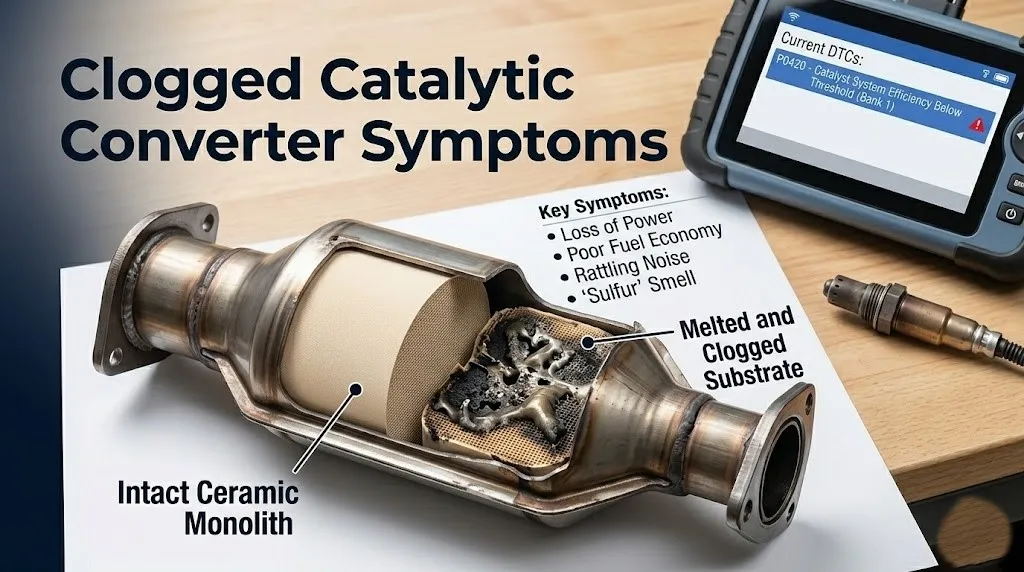
The catalytic converter sits between your engine and the muffler. It contains a ceramic honeycomb substrate coated with precious metals, platinum, palladium, and rhodium, that chemically convert harmful exhaust gases into less toxic emissions. When that honeycomb becomes coated, melted, or physically broken, exhaust flow chokes. The engine becomes unable to expel combustion gases efficiently. Every symptom that follows flows directly from that single mechanical failure. Here is exactly what to watch for, listen for, and smell, organized from the earliest subtle indicators to full emergency.
Clogged Catalytic Converter Symptoms
A restricted catalytic converter produces a characteristic progression of symptoms that build in severity as exhaust backpressure increases inside the engine’s exhaust system. The symptoms begin with reduced power under heavy load, advance to constant hesitation and check engine light illumination, and can culminate in engine stall and fire risk if the converter becomes completely blocked.
Think of your engine’s exhaust system like a breathing tube. A healthy catalytic converter is an open airway that allows combustion gases to exit freely after each power stroke. When that airway begins to restrict, the engine cannot exhale completely. Residual exhaust gas remains inside each cylinder, contaminating the next intake charge of fresh air and fuel. The powertrain control module detects the resulting oxygen sensor irregularities and adjusts fuel delivery, sometimes making the problem worse.
The symptoms you experience correspond directly to the degree of restriction. A converter with 20 to 30 percent flow restriction typically produces symptoms only noticeable under high engine load, like highway passing or steep hill climbing. At 50 percent restriction, symptoms appear during normal driving. Above 70 percent restriction, the vehicle may become undrivable, stalling at idle or failing to start entirely. Each stage produces distinct warning signs a driver can identify before the situation becomes dangerous.
| Restriction Severity | Typical Symptoms | Driving Safety |
|---|---|---|
| Mild (20-30% blockage) | Subtle power loss under heavy load, slight fuel economy reduction | Generally safe for short-term driving to a repair facility |
| Moderate (30-50% blockage) | Noticeable acceleration loss, check engine light possible, exhaust odor | Drive directly to a repair facility, avoid highway speeds |
| Severe (50-70% blockage) | Constant hesitation, poor idle quality, P0420 code likely, excessive heat | Minimal driving only, tow recommended |
| Critical (70%+ blockage) | Engine stall at idle, hard starting, extreme exhaust heat, potential no-start | Do not drive. Tow immediately. |
The National Institute for Automotive Service Excellence advises that any persistent drivability symptom accompanied by an illuminated check engine light should receive professional diagnosis within a few days of onset. Delaying diagnosis allows a partially restricted converter to progress to complete blockage, which carries genuine safety risks beyond repair cost.
Key Takeaway: Catalytic converter symptoms escalate from subtle power loss to dangerous engine stall as the internal ceramic honeycomb becomes progressively restricted. The severity of symptoms directly reflects the percentage of exhaust flow blockage.
Early Signs of Catalytic Converter Clogging
Early-stage catalytic converter restriction typically manifests as intermittent power loss that occurs only under specific high-load driving conditions and may disappear during gentle driving. The restriction at this stage is usually partial, affecting less than 30 percent of the converter’s internal flow capacity, which means the engine can still move exhaust gas adequately during low-demand operation.
The first symptom many drivers notice is a subtle reduction in passing power on the highway. You press the accelerator to merge or overtake, and the engine responds with less urgency than you expect. This happens because the restricted exhaust flow creates elevated exhaust backpressure that reduces the engine’s ability to draw in fresh air on the intake stroke. At high RPM with the throttle wide open, the engine needs to move a large volume of exhaust gas quickly. A partially clogged converter creates a bottleneck that limits peak power output even though low-speed driving still feels normal.
Another early indicator is a slight but persistent drop in fuel economy without any change in driving habits or routes. The engine control module compensates for altered oxygen sensor readings by adjusting the fuel trim, often enriching the air-fuel mixture. The EPA notes that even a moderately restricted catalytic converter can reduce fuel efficiency by up to 10 percent. Tracking your fuel economy over several tanks provides an objective data point. A consistent drop of more than 2 to 3 miles per gallon that persists across multiple fill-ups warrants investigation.
You may also notice the engine runs slightly rougher than normal during the first minute or two after a cold start. Cold engines run with a richer fuel mixture, and a restricted converter struggles to process the additional unburnt hydrocarbons efficiently. This can produce a brief rough idle or slight hesitation that clears as the engine reaches operating temperature.
- Power loss felt primarily during highway passing or hill climbing, not during gentle acceleration
- Fuel economy decline of 2 to 3 MPG or more sustained across multiple tanks
- Slight cold-start roughness or hesitation that clears within minutes of driving
- Intermittent symptom pattern that comes and goes depending on engine load
Key Takeaway: Early catalytic converter restriction is often intermittent and load-dependent. If you notice reduced passing power or a fuel economy drop that persists, schedule a diagnostic evaluation before the restriction worsens.
Loss of Power and Poor Acceleration From a Clogged Converter
Loss of engine power from a restricted catalytic converter occurs because elevated exhaust backpressure prevents complete cylinder scavenging during the exhaust stroke, leaving residual combustion gases that dilute the incoming air-fuel charge. This mechanism directly reduces the engine’s volumetric efficiency, the measure of how effectively the engine fills its cylinders with fresh air.
When the piston rises on the exhaust stroke, it pushes spent combustion gases out through the exhaust valve into the exhaust manifold and onward through the catalytic converter. If the converter honeycomb restricts flow, some exhaust gas remains trapped in the cylinder at the top of the exhaust stroke. When the piston descends on the next intake stroke, the trapped exhaust gas occupies cylinder volume that should be filled with fresh air and fuel. The result is a weaker combustion event and reduced power output at the crankshaft.
This power loss follows a predictable pattern. You will notice it first during high-demand driving situations that require the engine to process large volumes of air: hard acceleration from a stop, passing at highway speeds, climbing steep grades. During gentle cruising or light-throttle driving, the engine may feel completely normal because the exhaust gas volume is low enough to pass through the partially restricted converter without creating problematic backpressure.
A related symptom is poor throttle response. When you press the accelerator, the engine should respond immediately with increased RPM and vehicle speed. A restricted converter creates a perceptible delay between throttle input and engine response. This lag happens because the engine cannot rapidly increase its air processing rate when the exhaust exit path is constricted. Imagine trying to exhale forcefully through a drinking straw versus a wide tube. The restriction limits how quickly gas can exit, which limits how quickly new gas can enter.
| Driving Condition | Normal Converter Response | Restricted Converter Response |
|---|---|---|
| Gentle acceleration from stop | Smooth, linear power delivery | May feel normal or slightly sluggish |
| Full-throttle acceleration | Strong pull, RPM climbs quickly | Noticeable lag, engine feels “held back” |
| Highway passing 50-70 mph | Responsive, adequate power | Engine strains, downshift may not help |
| Steep hill climb at speed | Maintains speed with moderate throttle | Requires near full throttle to maintain speed |
| Cruising at steady speed | Smooth, consistent | May feel normal until grade changes |
A Society of Automotive Engineers (SAE) technical paper on exhaust system design confirms that backpressure exceeding manufacturer specifications by more than 30 percent measurably reduces peak engine power output. A backpressure test performed by a qualified technician provides objective confirmation of whether converter restriction is the cause of your power loss.
Key Takeaway: Power loss from a clogged converter is most pronounced during high-load driving because the engine cannot expel exhaust gases fast enough to draw in fresh air. Light-throttle cruising may mask the problem.
Check Engine Light and Catalytic Converter Codes
The check engine light illuminates when the onboard diagnostic system detects catalytic converter efficiency below a programmed threshold, most commonly triggering diagnostic trouble code P0420 (Bank 1 catalyst efficiency below threshold) or P0430 (Bank 2 catalyst efficiency below threshold). These codes indicate that the downstream oxygen sensor readings suggest the converter is no longer adequately processing exhaust emissions.
Your vehicle’s OBD-II system monitors catalytic converter performance using two oxygen sensors per converter. The upstream sensor, located before the converter in the exhaust stream, measures the air-fuel ratio of exhaust gas leaving the engine. The downstream sensor, mounted after the converter, measures the air-fuel ratio of exhaust that has passed through the catalyst substrate. A healthy converter stores and releases oxygen as it processes hydrocarbons, carbon monoxide, and nitrogen oxides. This chemical activity produces a relatively steady downstream oxygen sensor signal.
When the converter substrate becomes clogged, coated with contaminants, or thermally damaged, its oxygen storage capacity diminishes. The downstream oxygen sensor signal begins to mirror the upstream sensor’s fluctuations rather than remaining stable. The engine control module calculates a catalyst efficiency ratio by comparing the two sensor signals. When that ratio falls below the threshold programmed by the vehicle manufacturer, the ECM stores a P0420 or P0430 code and illuminates the check engine light.
According to the Environmental Protection Agency (EPA), OBD-II catalyst monitoring is required on all light-duty vehicles sold in the United States since 1996. The P0420 code is the single most common catalyst-related diagnostic trouble code across all vehicle makes and models. However, the code itself does not confirm that the converter needs replacement. A faulty downstream oxygen sensor, an exhaust leak between the two sensors, or an engine running excessively rich or lean can all produce the same code.
- P0420: Bank 1 catalyst system efficiency below threshold (most common)
- P0430: Bank 2 catalyst system efficiency below threshold (V6, V8, V10 engines with dual exhaust)
- P0421: Warm-up catalyst efficiency below threshold (some vehicles)
- Additional codes for specific manufacturer-defined thresholds
A thorough diagnostic approach begins with code retrieval, followed by live data analysis of the upstream and downstream oxygen sensor waveforms, a visual inspection of the exhaust system for leaks, and often a backpressure test. The ASE recommends that technicians rule out upstream causes including misfire, rich fuel condition, and exhaust leaks before condemning the catalytic converter.
Key Takeaway: A P0420 or P0430 code indicates the ECM has detected reduced catalyst function, but it does not automatically mean the converter is clogged. Proper diagnosis rules out oxygen sensor faults and exhaust leaks first.
What Does a Clogged Catalytic Converter Sound Like
A clogged catalytic converter produces distinct audible symptoms that change as the internal ceramic substrate degrades from partial restriction through physical breakup to complete blockage. The sounds come from two sources: exhaust gas struggling to pass through a restricted honeycomb and loose substrate fragments rattling inside the converter housing.
The most characteristic sound of a partially restricted converter is a hissing or high-pitched whistle from the exhaust system under acceleration. This noise occurs because exhaust gas velocity increases dramatically as it squeezes through the narrowed passages within the partially melted or coated substrate. The sound resembles air escaping from a compressed air nozzle. You will hear it most clearly when standing near the rear of the vehicle while someone gently revs the engine, or when driving next to a wall or barrier that reflects exhaust sound back toward the vehicle.
If the ceramic honeycomb substrate has physically broken apart, you will hear a rattling noise from underneath the vehicle. This sound is most noticeable at idle, during low-speed driving over bumps, or when the engine is first started. The rattling comes from loose chunks of ceramic substrate bouncing inside the metal converter housing. Tapping the converter case lightly with a rubber mallet, performed only by a qualified technician on a cooled exhaust system, can confirm substrate integrity. A solid, dull thud suggests an intact substrate. A sharp rattling sound indicates internal breakup.
As restriction becomes severe, the exhaust note changes character entirely. The engine sounds muffled, labored, or choked, particularly under load. The normal rhythmic pulse of the exhaust becomes uneven. In extreme cases of near-complete blockage, the engine may produce a wheezing sound as it struggles to push exhaust past the obstruction. The engine may sound like it is working far harder than the vehicle speed suggests.
| Sound | What It Indicates | When You’ll Hear It |
|---|---|---|
| Hissing or high-pitched whistle | Partial restriction, gas forced through narrowed passages | Under acceleration, near exhaust outlet |
| Rattling from under vehicle | Broken ceramic substrate, converter internal failure | At idle, over bumps, during startup |
| Muffled, choked exhaust note | Significant restriction, engine struggling to expel gas | Under load, during acceleration |
| Wheezing or labored engine sound | Near-complete blockage | At all engine speeds, worsening under load |
| Loud exhaust leak sound | Converter housing cracked from internal pressure | Under vehicle, may be constant |
The ASE advises that any new or worsening exhaust noise warrants immediate inspection. A rattling converter that dislodges substrate material downstream can obstruct the muffler or tailpipe, compounding the restriction and creating an exhaust system blockage that affects the entire system from manifold to tailpipe.
Key Takeaway: A hissing exhaust under acceleration or a rattling sound from beneath the vehicle are the most common audible indicators of catalytic converter restriction or internal failure.
Exhaust Smell Changes and Sulfur Odors
A failing catalytic converter often produces a distinctive rotten egg smell caused by the release of hydrogen sulfide gas when the converter can no longer properly process sulfur compounds present in gasoline. This odor is among the most recognizable sensory warnings of converter malfunction.
All gasoline contains trace amounts of sulfur. During normal combustion, sulfur compounds in the fuel convert to sulfur dioxide. A healthy catalytic converter further processes these compounds within its precious metal washcoat. When the converter becomes restricted, coated with contaminants, or thermally damaged, its ability to complete this chemical processing diminishes. The result is hydrogen sulfide production, which produces the unmistakable rotten egg odor most noticeable at the tailpipe during idle or immediately after engine shutdown.
The odor intensity often correlates with driving conditions. You may notice the smell most strongly after hard acceleration or prolonged highway driving, when exhaust system temperatures are highest and the engine processes the largest volume of fuel. The smell may be barely noticeable during gentle around-town driving and become pronounced after a highway exit ramp or mountain grade climb.
A sulfur smell from the exhaust is not always caused by a failing converter. Using gasoline with unusually high sulfur content, a persistent engine misfire sending unburnt fuel into the converter, or an excessively rich fuel mixture can also produce the same odor. However, the combination of a sulfur smell with any other symptom on this list, power loss, check engine light, or rattling sounds, strongly points to converter failure.
- Rotten egg or sulfur smell – Most characteristic converter failure odor, indicates hydrogen sulfide production
- Strong fuel smell from exhaust – Suggests converter is not processing unburnt hydrocarbons, often accompanied by P0420
- Sweet, acrid smell – Possible coolant entering combustion chamber and contaminating converter, a separate serious engine issue
- Burning smell from under vehicle – Overheated converter housing, severe restriction, potential fire hazard
The EPA regulates sulfur content in U.S. gasoline under the Tier 3 Motor Vehicle Emission and Fuel Standards. Most gasoline sold since 2017 contains no more than 10 parts per million of sulfur on an annual average. If you smell sulfur persistently despite using Tier 3-compliant fuel, the catalytic converter is the probable source. Any exhaust odor that enters the vehicle cabin requires immediate attention. Carbon monoxide exposure from exhaust leaks presents an acute health hazard regardless of converter condition.
Key Takeaway: A persistent rotten egg smell from the exhaust is one of the most specific indicators of catalytic converter malfunction. Combined with power loss, it strongly suggests converter restriction.
Reduced Fuel Economy With a Failing Catalytic Converter
A restricted catalytic converter reduces fuel economy through two distinct mechanisms: the engine control module enriches the fuel mixture in response to altered oxygen sensor readings, and the engine works harder to overcome exhaust backpressure during every combustion cycle. The combined effect typically reduces fuel efficiency by 10 to 20 percent depending on restriction severity.
When exhaust backpressure increases, the engine’s volumetric efficiency drops. The engine must consume more fuel to produce the same power output because each combustion event is less efficient. Imagine trying to run while breathing through a narrow snorkel. You can still move forward, but every step costs more energy than it should. The engine faces the same thermodynamic penalty when it cannot freely expel exhaust gases.
The ECM compounds this efficiency loss through fuel trim adjustments. The downstream oxygen sensor signal becomes erratic as the converter loses oxygen storage capacity. The ECM interprets the unstable signal as a lean condition and responds by adding fuel, a corrective action that enriches the air-fuel mixture beyond the ideal stoichiometric ratio of 14.7 parts air to 1 part fuel. This enrichment wastes fuel, increases exhaust temperature, and accelerates converter deterioration by introducing unburnt hydrocarbons into an already compromised substrate.
A Bosch automotive technology reference on OBD-II fuel trim explains that long-term fuel trim values exceeding plus or minus 10 percent indicate a condition the ECM is actively compensating for. A technician viewing live data can observe fuel trim values that climb progressively higher as the driver operates the vehicle under load. This real-time data, combined with a backpressure reading, provides strong evidence of a restricted converter causing the fuel economy decline.
- Track fuel economy manually for 3 to 5 tanks to establish a reliable baseline
- Compare current MPG to the vehicle’s EPA-rated fuel economy for your driving mix
- Note whether the decline correlates with the onset of other symptoms like power loss
- A drop of 15 percent or more without other explanation strongly suggests exhaust restriction
- Fuel economy that improves briefly after the check engine light resets, then declines again, points to an intermittent sensor or converter issue
The EPA publishes fuel economy ratings for all vehicles sold in the United States. While real-world fuel economy varies from EPA estimates, a persistent drop of 15 percent or more from your personal baseline, sustained across multiple tanks and not explained by winter fuel blends or driving pattern changes, indicates a mechanical issue requiring diagnosis.
Key Takeaway: A restricted converter reduces fuel economy by decreasing combustion efficiency and causing the ECM to enrich the fuel mixture. Track your fuel economy objectively to detect this symptom early.
Engine Overheating and Excessive Exhaust System Heat
A restricted catalytic converter generates abnormally high exhaust system temperatures because the engine works harder to push exhaust through the blockage and because partially processed fuel burns inside the converter rather than exiting cleanly. Sustained extreme temperatures can melt the ceramic substrate, warp the converter housing, and create a fire hazard if the converter contacts flammable material under the vehicle.
The catalytic converter normally operates between 400 and 900 degrees Fahrenheit during typical driving. When exhaust flow restricts, temperatures inside the substrate can spike beyond 1,200 degrees Fahrenheit. At these temperatures, the ceramic honeycomb can begin to melt, fusing individual cells together and worsening the restriction. This creates a destructive feedback loop: more restriction causes higher temperatures, which cause more melting, which causes more restriction.
You may notice elevated heat from the vehicle floor, particularly on the passenger side where the exhaust system routes through the floor pan on most vehicles. The carpet or floor mat may feel unusually warm to the touch after extended driving. This is not a normal condition in any vehicle and warrants immediate investigation. The exhaust system includes heat shields specifically designed to prevent this heat transfer. When a converter’s internal temperature far exceeds normal operating range, even intact heat shields may not provide adequate protection.
An infrared temperature gun provides an objective diagnostic measurement. A technician points the gun at the converter inlet and outlet pipes. A properly functioning converter typically shows an outlet temperature 30 to 100 degrees Fahrenheit hotter than the inlet, reflecting the exothermic chemical reactions occurring inside the substrate. A restricted converter often shows the opposite: the inlet runs hotter than the outlet because exhaust gas backs up at the restriction rather than flowing through efficiently.
| Temperature Pattern | What It Indicates |
|---|---|
| Outlet 30-100°F hotter than inlet | Normal converter operation, exothermic catalyst reaction occurring |
| Inlet hotter than outlet | Exhaust flow restriction, gas backing up before converter |
| Converter case above 500°F at idle | Excessive internal temperature, possible restriction |
| Converter case visibly glowing red | Extreme restriction, severe overheat, immediate fire hazard |
According to the National Fire Protection Association, vehicle fires caused by mechanical failure or malfunction account for a meaningful percentage of highway vehicle fires annually. An overheating catalytic converter parked over dry grass, leaves, or other flammable material can ignite a fire even after the engine is shut off. This is not a theoretical risk. It is a documented cause of vehicle fires that occurs when converter restriction is ignored.
Key Takeaway: A catalytic converter operating above its normal temperature range indicates restriction and creates a genuine fire hazard. Unusual floor heat or a glowing converter housing requires immediate towing, not continued driving.
Engine Misfire and Hesitation From Exhaust Backpressure
Engine misfire caused by a restricted catalytic converter occurs when elevated exhaust backpressure disrupts the normal combustion cycle, preventing complete cylinder evacuation and contaminating the fresh air-fuel charge with residual exhaust gas. This misfire is typically most noticeable under load and can trigger the check engine light with misfire-specific codes in addition to catalyst efficiency codes.
The mechanism works through cylinder-to-cylinder contamination. When a cylinder fires and its exhaust valve opens, the piston pushes combustion gases into the exhaust manifold. If the converter restricts flow, that exhaust gas does not exit cleanly. The resulting pressure pulse in the exhaust manifold can push residual gas into an adjacent cylinder whose exhaust valve is still closing or whose intake valve is beginning to open during valve overlap. That adjacent cylinder receives contaminated charge air for its next combustion event, producing an incomplete or weak combustion cycle the ECM registers as a misfire.
Hesitation during acceleration is the drivability expression of this misfire mechanism. When you press the accelerator, the engine control module commands the fuel injectors to deliver additional fuel and the throttle body to admit more air. If exhaust backpressure prevents clean cylinder filling, the engine stumbles momentarily before the increased exhaust flow eventually, partially overcomes the restriction and power delivery resumes unevenly. This hesitation feels different from a transmission slip or a fuel delivery problem. It feels like the engine is momentarily choked.
According to OEM technical service bulletins from multiple manufacturers, persistent misfire due to any cause, including exhaust restriction, must be diagnosed and repaired promptly. A misfiring cylinder sends unburnt fuel directly into the catalytic converter. Raw fuel ignites inside the converter substrate, producing the extreme temperatures that melt the ceramic honeycomb. A converter damaged by misfire-induced overheating can transition from functional to completely blocked within a single extended driving event.
- Misfire that occurs primarily under heavy throttle or at higher RPM
- Hesitation that feels like the engine is being choked or held back, not a stumble from a lean fuel mixture
- Misfire codes (P0300 through P0308) stored in addition to P0420 or P0430
- The misfire improves or disappears at light throttle and low RPM
- Raw fuel smell from the exhaust accompanies the misfire episodes
The ASE diagnostic protocol for misfire diagnosis includes ruling out ignition system faults, fuel delivery issues, and mechanical compression problems before attributing misfire to exhaust restriction. However, misfire that occurs only under high load and correlates with other restricted converter symptoms points strongly toward an exhaust flow problem rather than an ignition or fuel issue.
Key Takeaway: Misfire caused by exhaust backpressure is load-dependent and dangerous to ignore. Each misfire event sends unburnt fuel into the converter, accelerating the damage through extreme internal temperatures.
Hard Starting and Stalling With a Restricted Converter
Hard starting and engine stalling occur when catalytic converter restriction reaches a severity that prevents the engine from establishing or maintaining stable combustion at low RPM. At this stage, the restriction has typically exceeded 50 percent of the converter’s flow capacity and the engine can no longer manage exhaust evacuation during starting or idle conditions.
The starting problem manifests because the engine must overcome exhaust backpressure from the very first combustion event. During cranking, the starter motor turns the engine at a relatively low RPM. The low exhaust gas velocity at cranking speed means gas moves slowly through the restricted converter passages. Backpressure builds immediately in the exhaust manifold. The engine’s first few combustion cycles occur against this elevated pressure, making it difficult for the engine to achieve the clean intake charge needed to sustain combustion and reach idle speed. You may experience extended cranking times, the engine briefly catching and then dying, or the need to apply throttle during starting to raise exhaust gas velocity enough to push through the restriction.
Stalling occurs most commonly when coming to a stop or during idle. As the engine returns to idle RPM after deceleration, exhaust gas velocity drops. A restricted converter cannot maintain adequate flow at low gas volume. Exhaust pressure builds between the engine and the converter, the combustion chambers fill with a progressively higher percentage of residual exhaust gas, and the engine eventually stalls due to insufficient oxygen in the intake charge. This stalling is often preceded by a rough, loping idle that deteriorates over 10 to 30 seconds before the engine dies.
A vehicle that stalls due to converter restriction will typically restart after sitting for a few minutes. This temporary recovery happens because exhaust pressure equalizes through the restricted passages while the engine is off. However, the restart is temporary. The stalling will recur, often more quickly on each subsequent restart, as backpressure rebuilds. This pattern of stall, rest, restart, stall again is highly characteristic of advanced converter restriction.
- Extended cranking time before engine starts, longer than 3 to 4 seconds
- Engine starts briefly then dies immediately unless throttle is applied
- Stalling when coming to a stop or during idle after normal driving
- Rough, deteriorating idle quality over 10 to 30 seconds before stall
- Temporary restart possible but stalling recurs, often more quickly each time
The Society of Automotive Engineers has documented the relationship between exhaust backpressure and idle stability in internal combustion engine research. Backpressure exceeding a threshold specific to each engine design disrupts the precise air-fuel ratio control required for stable idle combustion. A vehicle exhibiting hard starting or stalling along with other catalytic converter symptoms has reached a severity level that requires immediate professional evaluation.
Key Takeaway: Hard starting and stalling indicate the converter restriction has progressed to a point where the engine cannot manage exhaust flow at low RPM. This is an advanced symptom that demands immediate professional diagnosis.
Severe Clogged Catalytic Converter Symptoms and Engine Stall
Severe catalytic converter restriction produces engine stall under load, extreme exhaust system temperatures, and the potential for complete engine shutdown while driving, which is a genuine safety emergency that can strand a vehicle in moving traffic. At this stage, the converter’s internal flow capacity has typically fallen below 30 percent of its original specification.
Stalling under load is the most dangerous severe symptom. Unlike stalling at idle, which occurs at low speed, a stall under load can happen at highway speeds when exhaust flow demand is highest. The engine suddenly loses power as backpressure overwhelms the combustion cycle, and the vehicle decelerates rapidly without warning. Power steering and power brake assist diminish immediately when the engine stops, making vehicle control more difficult. This is the point at which a clogged converter transitions from a repair concern to a safety emergency.
The complete blockage scenario represents the end stage of progressive converter restriction. The ceramic substrate has melted into a nearly solid mass, physically broken and wedged itself sideways in the converter housing, or collapsed into a pile of fragments that completely obstructs exhaust flow. The engine will not start or will start briefly and die within seconds because exhaust gas has no exit path. Cranking the engine against a completely blocked exhaust can cause additional damage as combustion pressure finds the path of least resistance, potentially through a gasket, seal, or even a cracked cylinder head.
A converter housing that glows visibly red, even in daylight, indicates internal temperatures exceeding 1,400 degrees Fahrenheit. This is a fire hazard. The converter is mounted in close proximity to the vehicle floor, fuel lines, and in some vehicles, the fuel tank. Sustained temperatures at this level can ignite undercoating, sound deadening material, or wiring harness insulation in contact with or near the converter housing.
- Engine stall at any speed: pull over safely, do not attempt to restart repeatedly.
- Converter housing glowing red or showing visible heat discoloration
- Extreme heat radiating from the vehicle floor, carpet hot to the touch
- Engine will not start despite normal cranking speed
- Smoke from under the vehicle, particularly with a burning odor
Do not continue driving a vehicle exhibiting any of these severe symptoms. Arrange towing to a qualified repair facility. The combined risks of sudden stall in traffic, engine damage from extreme backpressure, and fire from an overheating converter make continued operation unsafe for the driver, passengers, and other road users.
Key Takeaway: Severe converter restriction that causes stall under load or produces visible exhaust system overheating is a safety emergency. Tow the vehicle immediately. Do not attempt to drive to a repair facility.
Can You Drive With a Clogged Catalytic Converter
You can drive a short distance with a mildly clogged catalytic converter to reach a repair facility, but driving with moderate to severe restriction risks complete engine stall while in traffic, progressive engine damage, and fire from an overheating exhaust system. The answer depends entirely on your specific symptom severity, not on a one-size-fits-all guideline.
Mild restriction produces symptoms noticeable only during hard acceleration. In this scenario, driving directly to a repair facility at moderate speeds on surface streets is generally reasonable. Avoid highway speeds, hard acceleration, and prolonged driving. The goal is to reach a repair facility before the restriction worsens, not to postpone the repair while continuing normal vehicle use. Even mild restriction will progress to a more severe stage over days to weeks of continued driving because the underlying cause, whether unburnt fuel from a misfire, coolant contamination, or substrate aging, remains active.
Moderate restriction produces symptoms during normal driving including noticeable power loss, check engine light illumination, and possible exhaust odor. At this stage, limit driving to the minimum distance necessary to reach a repair facility. Avoid highways where a sudden stall would create a dangerous situation. Do not tow trailers, carry heavy loads, or drive in mountainous terrain that places high demand on the exhaust system. Consider towing if the nearest qualified repair facility is more than 10 to 15 miles away.
Severe restriction produces hard starting, stalling at idle, or stalling under load. Do not drive. The risk of a stall in an intersection, on a highway, or in any situation where losing engine power creates immediate danger is unacceptable. A stall at speed means loss of power steering assist, making steering suddenly heavy, and loss of power brake assist after one or two pedal applications. Arrange towing. The towing cost is insignificant compared to the potential cost of an accident or engine damage.
| Symptom Severity | Drive to Shop? | Precautions |
|---|---|---|
| Mild: symptoms only under hard acceleration | Yes, directly to repair facility | Surface streets, moderate speeds, no heavy loads |
| Moderate: symptoms during normal driving, CEL on | Yes, absolute minimum distance | Avoid highways, steep grades, and heavy throttle |
| Severe: stalling, hard starting, extreme heat | No. Tow required. | Do not attempt to drive |
| Critical: no-start, glowing converter, smoke | No. Tow immediately. | Fire hazard, do not attempt to start engine |
Key Takeaway: Mild restriction allows a short, careful drive to a repair facility. Moderate restriction limits you to minimal essential driving. Severe or critical restriction requires towing. Do not gamble with a stall at highway speed.
What Causes a Catalytic Converter to Clog
Catalytic converter clogging results from physical or chemical contamination of the ceramic honeycomb substrate, most commonly caused by unburnt fuel entering the exhaust system, engine oil or coolant leaking into the combustion chambers, or the use of incompatible fuel additives and engine sealants. Understanding the root cause is essential because replacing the converter without fixing the underlying condition will result in repeat failure.
Unburnt fuel reaching the converter is the single most common cause of substrate melting and clogging. When an engine misfires, the air-fuel mixture in that cylinder does not ignite. The raw fuel exits through the exhaust valve and enters the converter. Inside the hot converter, the fuel ignites spontaneously, producing a temperature spike that can exceed 2,000 degrees Fahrenheit. At this temperature, the ceramic honeycomb melts. The melted cells fuse together, blocking exhaust passages. Common sources of unburnt fuel include worn spark plugs, faulty ignition coils, leaking fuel injectors, and engine control sensor failures that produce an excessively rich fuel mixture.
Engine oil entering the combustion chamber coats the converter substrate with a layer of ash and phosphorus compounds from oil additives. This coating physically blocks the microscopic pores in the catalyst washcoat, preventing exhaust gases from contacting the precious metal catalysts. Over time, the ash layer thickens until it restricts gas flow through the substrate. Oil consumption can result from worn piston rings, leaking valve stem seals, a failed positive crankcase ventilation (PCV) valve, or turbocharger seal leakage in turbocharged engines. Any vehicle consuming more than one quart of oil every 1,000 miles should be evaluated for oil contamination of the catalytic converter.
Coolant entering the combustion chamber through a leaking head gasket, cracked cylinder head, or failed intake manifold gasket introduces silicate compounds and glycol into the exhaust stream. These compounds form a glassy coating on the converter substrate that is chemically different from oil ash but equally effective at blocking the catalyst washcoat. Coolant contamination often produces a sweet, acrid exhaust odor and may cause white smoke from the tailpipe, symptoms that distinguish it from other causes of converter failure.
- Unburnt fuel from engine misfire – Most common cause, melts ceramic substrate
- Engine oil consumption – Coats substrate with ash and phosphorus deposits
- Coolant leakage into combustion chamber – Forms silicate glaze on substrate
- Use of non-approved fuel additives or sealants – Can deposit on and block substrate
- Physical impact damage – Road debris or collision damage collapses substrate
- Normal aging and thermal cycling – Gradual substrate degradation over very high mileage
The EPA requires that replacement catalytic converters meet the same performance specifications as original equipment. A replacement converter installed without correcting the underlying misfire, oil consumption, or coolant leak will fail again, often within months rather than years. A thorough diagnosis identifies and corrects the root cause before the new converter is installed.
Key Takeaway: The catalytic converter itself did not cause its failure. An upstream engine problem, most commonly misfire, oil consumption, or coolant leakage, created the conditions that damaged the converter. Fix the cause first.
How to Tell If Catalytic Converter Is Clogged vs O2 Sensor Failure
Distinguishing a restricted catalytic converter from a faulty oxygen sensor requires analyzing symptom patterns, live OBD-II data, and physical exhaust system measurements because both conditions can illuminate the check engine light and trigger the same P0420 diagnostic trouble code. Relying solely on the code to decide which component needs replacement leads to unnecessary parts expense.
A faulty downstream oxygen sensor typically produces no drivability symptoms. The engine runs normally, acceleration feels unchanged, and fuel economy remains at baseline. The only indicator is an illuminated check engine light with a P0420 code. The sensor has simply lost its ability to report accurately, and the ECM interprets the inaccurate signal as a catalyst efficiency problem. In contrast, a genuinely restricted converter produces the power loss, hesitation, and exhaust sound changes described throughout this article. The presence or absence of drivability symptoms is the single most useful differentiator for a vehicle owner.
Live OBD-II data viewed by a technician provides the definitive distinction. A healthy downstream oxygen sensor produces a relatively steady voltage signal, typically hovering near 0.45 to 0.7 volts, with slow, small fluctuations. A failing downstream sensor often produces a flatlined signal stuck at a single voltage, a signal that drops to zero intermittently, or a signal that swings rapidly in a pattern inconsistent with normal operation. A downstream sensor behind a genuinely failing converter produces a signal that increasingly mirrors the upstream sensor’s rapid fluctuations, indicating the converter has lost its oxygen storage capacity.
| Diagnostic Factor | Clogged Converter | Faulty O2 Sensor |
|---|---|---|
| Power loss under load | Present, often progressive | Not present |
| Exhaust odor change | Often present, sulfur smell | Not present |
| Rattling from converter area | Possible if substrate broken | Not present |
| Drivability symptoms | Yes, progressive | Typically none |
| Downstream O2 sensor waveform | Mirrors upstream sensor, steady to rapid swings | Flatlined, erratic dropout, or stuck voltage |
| Backpressure test result | Elevated above specification | Normal |
| Converter temperature pattern | Abnormal inlet vs. outlet differential | Normal temperature pattern |
| Fuel economy change | Measurable decline | Typically unchanged |
A backpressure test performed by a technician provides objective confirmation. The technician removes the upstream oxygen sensor and installs a pressure gauge in its port. With the engine running, exhaust backpressure at idle should typically measure below 1.5 psi. At a steady 2,500 RPM, backpressure should remain below 3 psi on most vehicles. A reading significantly above these thresholds, particularly a reading that climbs as RPM increases, confirms exhaust restriction downstream of the test point, usually the catalytic converter.
The ASE recommends that technicians perform both an O2 sensor functional test and an exhaust backpressure measurement before recommending catalytic converter replacement. A P0420 code with normal backpressure and an abnormal O2 sensor waveform points to sensor replacement. A P0420 code with elevated backpressure and a characteristic converter-mirroring waveform pattern confirms converter failure.
Key Takeaway: O2 sensor failure rarely causes drivability symptoms beyond the check engine light. Restricted converters cause progressive performance decline. A backpressure test provides the objective confirmation no symptom checklist can match.
Catalytic Converter Backpressure Testing and Diagnosis
Exhaust backpressure testing provides the most direct, objective measurement of catalytic converter restriction and is the diagnostic procedure that confirms or rules out a clogged converter when symptoms and codes suggest possible restriction. The test uses a pressure gauge connected to the exhaust system upstream of the converter to measure the pressure exhaust gas creates as it pushes against the restriction.
The technician removes the upstream oxygen sensor or, on some vehicles, a dedicated test port plug, and threads in a pressure gauge adapter. With the engine warmed to normal operating temperature, backpressure readings are taken at idle, at a steady 2,500 RPM, and during a brief snap-throttle acceleration. On most production vehicles, idle backpressure should measure below 1.5 psi. At a steady 2,500 RPM, backpressure should remain below 3 psi. A snap-throttle test that causes the pressure gauge needle to swing rapidly past 8 psi or continue climbing throughout the test indicates significant restriction.
A vacuum gauge test provides a complementary diagnostic approach on engines where the oxygen sensor is difficult to access for a backpressure test. The technician connects a vacuum gauge to an intake manifold vacuum source. At idle, the technician notes the steady vacuum reading, typically 17 to 21 inches of mercury on a healthy engine. The technician then holds the engine at approximately 2,500 RPM. On a healthy engine, vacuum drops briefly then stabilizes near the original reading. On an engine with a restricted exhaust, vacuum drops progressively lower and does not recover as RPM holds steady. The dropping vacuum indicates that exhaust backpressure is preventing the engine from drawing in fresh air.
- Backpressure test: Direct measurement upstream of converter, most definitive test
- Vacuum gauge test: Indirect measurement at intake manifold, useful when O2 sensor access is difficult
- Infrared temperature measurement: Inlet vs. outlet temperature differential indicates flow restriction
- OBD-II live data analysis: Fuel trim values, O2 sensor waveforms, calculated load
- Visual inspection with borescope: Direct camera view of substrate condition through O2 sensor port
The Society of Automotive Engineers publishes technical papers on exhaust system diagnostic methodology that establish the relationship between measured backpressure and engine performance degradation. These engineering standards inform the diagnostic thresholds used in professional repair facilities. A technician following ASE diagnostic protocols will typically perform a backpressure or vacuum test before recommending converter replacement, even when a P0420 code is stored.
Key Takeaway: Exhaust backpressure testing is the gold standard diagnostic procedure for confirming catalytic converter restriction. No symptom checklist can replace this objective measurement performed by a qualified technician.
Emergency Signs of Complete Catalytic Converter Blockage
Complete catalytic converter blockage is a vehicle safety emergency that produces three unmistakable warning signs: the engine will not start or stalls immediately after starting, the converter housing glows visibly red or produces smoke, and extreme heat radiates through the vehicle floor. These signs demand immediate towing to a repair facility. Do not continue attempting to drive.
The no-start or immediate-stall condition occurs because exhaust gas has zero exit path. When you crank the engine, the first combustion cycle produces exhaust gas that cannot escape. Pressure builds instantly in the exhaust manifold and backs up into the cylinders. Subsequent intake strokes fill with exhaust gas rather than fresh air. The engine either fails to start entirely or starts momentarily and dies within seconds. Repeated cranking attempts against a fully blocked exhaust can force combustion pressure through gaskets or seals designed to contain much lower pressures, creating additional damage to the engine.
A converter housing that glows red is operating at temperatures exceeding 1,400 degrees Fahrenheit. At this temperature, the metal housing itself begins to weaken. The radiant heat can ignite any flammable material within several inches of the converter, including undercoating, sound deadening material, wiring harness insulation, or dry vegetation if the vehicle is parked off-road. Vehicle fires caused by catalytic converter ignition of ground cover are a documented phenomenon. The National Fire Protection Association has recorded numerous incidents of converter-ignited fires, particularly in areas with dry grass or leaf accumulation.
Smoke from under the vehicle with a burning odor indicates that material in contact with or near the converter has already begun to combust. This is an active fire hazard. Pull over immediately if safe to do so, turn off the engine, exit the vehicle, and move a safe distance away. Call for towing. Do not attempt to drive the vehicle further under any circumstances.
If you experience any of the following, arrange towing immediately:
- Engine will not start despite normal cranking speed
- Engine starts and stalls within seconds, repeats identically on each attempt
- Converter housing or surrounding exhaust components glowing red
- Smoke from under the vehicle with burning odor
- Extreme heat radiating through floor, carpet too hot to touch
- Sudden total power loss while driving with loud exhaust noise change
Complete catalytic converter blockage is not a diagnosis you negotiate with or postpone. It is a mechanical failure that has progressed past the point of safe vehicle operation. The repair requires converter replacement and diagnosis of the upstream engine condition that caused the failure.
Key Takeaway: Complete blockage means the engine cannot run and the exhaust system is a fire hazard. Do not attempt to start or drive the vehicle. Tow to a repair facility immediately.
Emergency Signs of Complete Catalytic Converter Blockage
Certain symptoms associated with catalytic converter restriction indicate complete exhaust blockage and require immediate towing, not continued driving. These symptoms represent a vehicle safety emergency.
Arrange towing immediately and do not attempt to restart the engine if you experience:
- Engine will not start despite normal cranking speed, indicating exhaust gas has no exit path
- Engine starts momentarily and dies within seconds, repeating identically on each attempt
- Converter housing or surrounding exhaust components glowing visibly red
- Smoke from under the vehicle accompanied by a burning odor
- Floor carpet or floor pan too hot to touch on the passenger side or transmission tunnel area
- Sudden complete power loss while driving followed by inability to restart
Complete catalytic converter blockage presents a fire hazard from extreme exhaust system temperatures and a safety hazard from sudden engine stall in traffic. These conditions require emergency towing to a qualified repair facility, not an attempt to limp the vehicle to a shop.
Frequently Asked Questions About Clogged Catalytic Converter Symptoms
What are the first signs of a clogged catalytic converter?
The first signs include subtle power loss during highway passing or hill climbing and a slight but persistent drop in fuel economy of 2 to 3 MPG or more.
These symptoms appear first because high-load driving demands the highest exhaust gas flow rate, which a partially restricted converter cannot accommodate.
A sulfur or rotten egg odor from the exhaust may also appear early as the converter loses its ability to process fuel sulfur compounds.
Can a clogged catalytic converter cause engine damage?
Yes, a severely clogged catalytic converter can cause engine damage from extreme exhaust backpressure that forces combustion pressure through gaskets, seals, or cylinder head castings.
Sustained high exhaust temperatures can also damage exhaust valves and the exhaust manifold itself.
Engine damage risk increases significantly once the converter restriction exceeds 70 percent of its flow capacity.
What does a clogged catalytic converter sound like?
A partially restricted converter produces a hissing or high-pitched whistle from the exhaust under acceleration as gas squeezes through narrowed passages.
A converter with a broken internal ceramic substrate creates a rattling noise from under the vehicle, most noticeable at idle or over bumps.
A severely restricted converter makes the engine sound muffled, choked, or labored, particularly under load.
Is it safe to drive with a clogged catalytic converter?
Mild restriction with symptoms only during hard acceleration allows a short, careful drive directly to a repair facility using surface streets at moderate speeds.
Moderate restriction producing symptoms during normal driving limits you to the absolute minimum distance necessary to reach a repair facility, and highways should be avoided.
Severe restriction causing stalling, hard starting, or extreme exhaust heat requires towing. Do not drive a vehicle in this condition.
How does a mechanic diagnose a clogged catalytic converter?
A mechanic performs an exhaust backpressure test by installing a pressure gauge at the upstream oxygen sensor port and measuring exhaust pressure at idle and at 2,500 RPM.
Backpressure readings above manufacturer specification, typically above 3 psi at 2,500 RPM on most vehicles, confirm exhaust restriction.
The mechanic will also diagnose and correct the underlying cause of converter failure, such as engine misfire or oil consumption, before replacing the converter.
What causes a catalytic converter to become clogged?
The most common cause is unburnt fuel from engine misfire melting the ceramic honeycomb substrate inside the converter.
Engine oil entering the combustion chamber coats the substrate with ash and phosphorus deposits that block exhaust flow passages over time.
Coolant leaking into the cylinders through a failed head gasket or cracked head also deposits a glassy silicate coating on the converter substrate.
Your catalytic converter is a downstream component that reveals upstream engine health. The symptoms it produces, power loss, exhaust odor, rattling, heat, and ultimately stall, are the language of a component that has been asked to process fuel, oil, or coolant it was never designed to handle. When you recognize these symptoms early, you catch the problem while the repair remains a converter diagnosis rather than an engine rebuild.
If you are experiencing mild symptoms, schedule a diagnostic appointment with an ASE certified technician at a qualified repair facility within the next few days. Describe exactly when the symptoms appear, highway passing, hill climbing, cold starts, and whether you have noticed a fuel economy change or exhaust odor. If your symptoms include stalling, extreme exhaust heat, or a no-start condition, arrange towing immediately. Do not attempt to drive.
A restricted catalytic converter is a solvable problem when addressed at the right time. The solution starts with recognizing what the symptoms are telling you and acting before the restriction reaches the point where continued driving becomes a genuine safety risk.