Bad Thermostat Symptoms Car: Signs, Causes, and Actions
Bad thermostat symptoms car owners experience include engine overheating, a temperature gauge that reads too high or too cold, loss of cabin heat, a check engine light, poor fuel economy, and extended warm-up times. The specific symptom pattern depends on which of the two failure modes has occurred: a thermostat stuck closed produces a rapid overheating emergency, while a thermostat stuck open produces the opposite problem of an engine that never fully warms up.
The car thermostat is a small but mechanically precise component. It controls when hot coolant flows from the engine to the radiator for cooling, and the difference between a properly functioning thermostat and a failed one can determine whether your engine reaches normal operating temperature at all. According to the National Highway Traffic Safety Administration, engine overheating is a leading cause of vehicle breakdown on US highways, and thermostat failure is one of the primary contributors to preventable overheating events.
This guide covers every bad thermostat symptom with the mechanical mechanism behind it, explains the critical difference between stuck-closed and stuck-open failure modes, provides the specific temperature thresholds at which overheating becomes an engine-destroying emergency, and gives you a clear framework for deciding what to do next.
Bad Thermostat Symptoms Car: Overview and Triage
Bad thermostat symptoms in a car encompass two distinct clinical pictures depending on whether the thermostat has failed in the closed position (blocking coolant flow to the radiator) or the open position (allowing constant coolant flow through the radiator regardless of temperature).
Recognizing which failure mode you are dealing with determines whether you have an immediate stop-driving emergency or a drive-to-the-shop situation that can be addressed over the next few days. This distinction is the single most practically useful piece of information any thermostat symptom article can provide, and it is missing from most available content on this topic.
| Symptom | Stuck Closed Thermostat | Stuck Open Thermostat | Urgency Level |
|---|---|---|---|
| Temperature gauge reading | Rapidly climbs into red zone | Stays low or fluctuates below normal | Emergency vs. non-emergency |
| Engine overheating | Yes, rapidly | No | Stop immediately vs. monitor |
| Cabin heat output | Initially normal, then fails as engine overheats | Lukewarm or inconsistent, rarely hot | N/A vs. comfort issue |
| Fuel economy | Worsens as engine protection systems activate | Worsens due to cold engine fuel enrichment | Moderate vs. moderate |
| Check engine light | May activate via temperature correlation codes | Often activates via P0128 code | Diagnose soon vs. diagnose soon |
| Immediate driving risk | High: engine damage risk within minutes | Low: drivability issue, not emergency | Stop vs. drive to shop |
High-mileage vehicles, typically those over 100,000 miles, account for a disproportionate share of thermostat failures because the wax pellet inside the thermostat body degrades with repeated heat cycling over years of service. Turbocharged engines also experience accelerated thermostat wear due to higher sustained underhood temperatures.
How a Car Thermostat Works and Why It Fails
A car thermostat works by using a thermally sensitive wax pellet to open and close a valve that controls coolant flow between the engine and the radiator, maintaining the engine within its optimal operating temperature range of approximately 195 to 220 degrees Fahrenheit in most modern gasoline engines.
Inside the thermostat body sits a brass cylinder filled with a specially formulated wax. When the engine is cold, the wax is solid and a spring holds the thermostat valve firmly closed. Coolant circulates through the engine block, heater core, and back to the water pump inlet through the coolant bypass circuit, but none reaches the radiator. This allows the engine to warm up quickly.
Think of the thermostat like a heat-activated gate valve at the entrance to a water treatment plant. Until the water reaches a specific temperature threshold, the gate stays shut and water recirculates within the plant. Once the threshold is crossed, the gate opens and hot water flows out for treatment. The thermostat gate opens between approximately 180 and 205 degrees Fahrenheit, depending on the specific thermostat rating for that engine application.
As coolant temperature reaches the thermostat’s rated opening temperature, the wax expands, pushing a metal rod against the spring and opening the main valve. Hot coolant flows through the upper radiator hose to the radiator, where ambient airflow and the radiator fan cool it before it returns via the lower radiator hose to the water pump inlet.
Thermostats fail through two primary mechanisms: wax pellet degradation over time (more common in high-mileage vehicles) and thermal cycling fatigue of the spring and valve mechanism. Vehicles with coolant system leaks that allow air pockets to form near the thermostat accelerate this degradation because partial air exposure allows the wax to dry and crack rather than cycle smoothly through repeated expansions and contractions.
Engine Overheating as a Bad Car Thermostat Symptom
Engine overheating from a bad car thermostat occurs specifically when the thermostat has failed in the stuck closed position, completely blocking hot coolant from flowing to the radiator so that heat accumulates in the engine with no dissipation pathway.
This is the more dangerous of the two thermostat failure modes. When the thermostat valve fails to open as the engine temperature rises, the coolant in the engine block absorbs heat continuously but has no route to the radiator for cooling. The temperature rises steadily until the coolant reaches its boiling point (elevated above 212 degrees Fahrenheit in a pressurized cooling system, typically to approximately 265 degrees Fahrenheit at 15 psi system pressure). Beyond that point, steam formation begins, cooling efficiency collapses, and mechanical damage to engine components accelerates rapidly.
The driver observes this as the temperature gauge needle moving steadily upward from its normal midpoint position, continuing past the normal operating zone, and entering the upper portion of the gauge where the red zone begins. The rate of temperature rise depends on engine load: at highway speed under load, a stuck-closed thermostat can bring a modern engine from normal operating temperature to the red zone in as little as 5 to 10 minutes.
Overheating from a bad thermostat differs from overheating due to coolant loss in one diagnostically useful way: with a stuck thermostat, the coolant level is typically normal (no leak present). With coolant loss overheating, the coolant reservoir will be low or empty and there may be visible coolant on the ground under the vehicle or a sweet coolant smell from under the hood.
Older vehicles with older rubber upper radiator hoses should be checked when overheating symptoms occur, as a failing upper radiator hose that collapses under vacuum can mimic stuck thermostat overheating by restricting coolant flow to the radiator even when the thermostat itself is functioning.
Key Takeaway: A temperature gauge needle climbing rapidly toward the red zone while driving indicates a thermostat stuck closed, which is an immediate stop-driving emergency. Pull over safely, shut the engine off, and call for roadside assistance.
Temperature Gauge Fluctuations from a Bad Car Thermostat
A bad car thermostat causes temperature gauge fluctuations when the thermostat valve is failing intermittently, sticking partially, or oscillating erratically between open and closed positions rather than having completely failed in one direction.
Normal thermostat operation produces a temperature gauge that climbs steadily from cold to the normal operating range midpoint (approximately 195 to 220 degrees Fahrenheit), then remains essentially stable at that midpoint under varying driving conditions. The thermostat continuously modulates between slightly open and slightly closed to maintain this stable temperature. A driver may notice minor needle movement at idle versus highway driving, but the gauge should not swing dramatically.
An intermittently failing thermostat produces erratic needle movement. The gauge may climb normally to the midpoint, then rise suddenly toward the upper range, then drop back to normal as the thermostat briefly opens under pressure. This oscillating pattern distinguishes intermittent thermostat failure from a completely stuck-closed thermostat (which shows steady, continuous rise) and from a stuck-open thermostat (which shows the gauge sitting below the normal midpoint consistently).
Erratic temperature gauge behavior in cold weather specifically requires additional diagnostic consideration. Cold ambient temperatures can temporarily refreeze a thermostat that is beginning to fail or cause a partially open thermostat to close more completely, producing symptoms only in winter driving conditions that disappear when the ambient temperature rises.
Diesel engine owners should note that diesel engines typically operate at a lower normal temperature than gasoline engines, with most diesel thermostat opening temperatures calibrated between 170 and 180 degrees Fahrenheit. A diesel temperature gauge sitting at what appears to be “low” for a gasoline engine may be perfectly normal for that diesel application, making diesel thermostat diagnosis more nuanced than gasoline engine diagnosis.
Car Thermostat Stuck Closed: Symptoms and Urgency
A car thermostat stuck in the closed position is the more urgent failure mode, producing rapid engine overheating that can destroy the cylinder head, head gasket, and other internal engine components within minutes of the temperature gauge entering the red zone if driving continues.
The symptom pattern of a stuck-closed thermostat is distinct: the temperature gauge climbs consistently and continuously during driving rather than oscillating. The cabin heater may initially produce normal heat because coolant is still circulating through the heater core via the bypass circuit. As the engine temperature exceeds approximately 240 to 250 degrees Fahrenheit, the heater output may actually become excessively hot briefly before cooling system pressure failure begins. The driver may notice steam from under the hood in severe cases, a sweet coolant smell, or hear a gurgling sound from the coolant system as pressurized coolant seeks release.
Symptoms specific to a stuck-closed thermostat in order of progression:
- Temperature gauge begins climbing above the normal midpoint zone within 10 to 20 minutes of driving
- Gauge continues climbing toward the upper range or red zone despite reducing speed or stopping
- Engine may produce knocking sounds at very high temperatures as oil viscosity breaks down under heat stress
- Steam or vapor from under the hood hood if coolant begins to overflow through the pressure cap
- Temperature warning light activates (distinct from the check engine light) on vehicles equipped with a dedicated overheat warning indicator
Do not open the radiator cap or coolant reservoir cap when the engine is hot. Pressurized coolant at elevated temperatures will spray violently when the cap is released, causing severe burns. Allow the engine to cool completely before inspecting the coolant level.
Vehicles with plastic thermostat housings (common on many European and Asian-manufactured vehicles) are prone to housing cracking from heat stress during a stuck-closed overheating event. In these cases, both the thermostat and the housing require replacement, which affects the total repair cost and labor time.
Car Thermostat Stuck Open: Symptoms and Fuel Economy Impact
A car thermostat stuck in the open position causes the engine to run continuously below its normal operating temperature by allowing coolant to circulate through the radiator at all times, cooling the engine regardless of how cold the weather is or how recently the vehicle was started.
This failure mode is less urgent than a stuck-closed thermostat but creates its own set of problems. The engine control module (ECM) uses engine temperature data to manage fuel injection timing, spark advance, and exhaust gas recirculation. A cold-running engine causes the ECM to operate in an enriched fuel delivery mode (more fuel, less efficient combustion) for a prolonged or permanent period, wasting fuel and increasing emissions.
The SAE International thermostat performance standard establishes that engines running below their calibrated operating temperature show measurably degraded fuel combustion efficiency due to incomplete fuel vaporization in the combustion chamber and suboptimal cylinder wall clearances from insufficient thermal expansion.
Symptoms specific to a stuck-open thermostat include:
- Temperature gauge remaining in the lower portion of its range even after extended driving
- Cabin heater producing only lukewarm air even on full heat setting, because the heater core receives insufficiently heated coolant
- Noticeably worse fuel economy compared to normal operation, particularly in cold weather
- Extended time before the engine reaches normal operating temperature (may never fully reach it in very cold climates)
- Check engine light activation with a P0128 code (coolant temperature below thermostat regulating temperature)
- White exhaust vapor that persists longer than normal during cold starts, from incomplete combustion in an under-temperature engine
Drivers in very cold climates (ambient temperatures below 20 degrees Fahrenheit) experience amplified stuck-open thermostat symptoms compared to drivers in temperate climates, because the radiator dissipates heat more aggressively in cold air, making it harder for the engine to reach operating temperature even with a functioning thermostat.
No Heat from the Cabin Heater as a Thermostat Symptom
Loss of cabin heater heat is a reliable symptom of a thermostat stuck in the open position, because the heater core (the small heat exchanger located behind the dashboard that warms cabin air) requires hot coolant from the engine to function, and a thermostat that continuously routes coolant through the radiator keeps that coolant insufficiently heated.
The heater core is essentially a miniature radiator. Hot coolant from the engine flows through it, cabin air passes over it, and the air picks up heat before being distributed through the dashboard vents. When the coolant temperature stays below approximately 170 degrees Fahrenheit due to a stuck-open thermostat, the heater core never receives coolant hot enough to produce comfortable cabin warmth, resulting in air from the vents that feels cool or only mildly warm regardless of the temperature setting.
It is worth noting that no heat from the cabin heater is not exclusively a thermostat problem. A clogged or blocked heater core (from coolant scale deposits or debris), an air pocket in the cooling system preventing coolant from reaching the heater core, a faulty heater control valve, or a blend door actuator malfunction can all produce the same symptom. The distinguishing feature that points toward the thermostat rather than these other causes is the combination of inadequate heater heat plus a temperature gauge that reads below the normal midpoint zone simultaneously.
To describe heater symptoms accurately to a mechanic:
- Note whether the temperature gauge is low (below the normal midpoint), normal, or high when the heater fails to produce heat.
- Note whether the problem is consistent regardless of outside temperature or whether it is worse in cold weather only.
- Note whether any coolant odor is present in the cabin, which would suggest a leaking heater core rather than a thermostat issue.
- Note whether the heater was working normally before this symptom appeared or whether it has gradually degraded over time.
- Note whether the coolant level in the reservoir is normal, low, or empty, as low coolant can cause heater core air pockets that mimic thermostat failure.
Key Takeaway: No cabin heat combined with a temperature gauge that sits below the normal midpoint zone is a reliable indicator of a thermostat stuck open, while no cabin heat combined with an overheating engine points to a stuck-closed thermostat as the cause.
Check Engine Light and OBD-II Codes from a Bad Car Thermostat
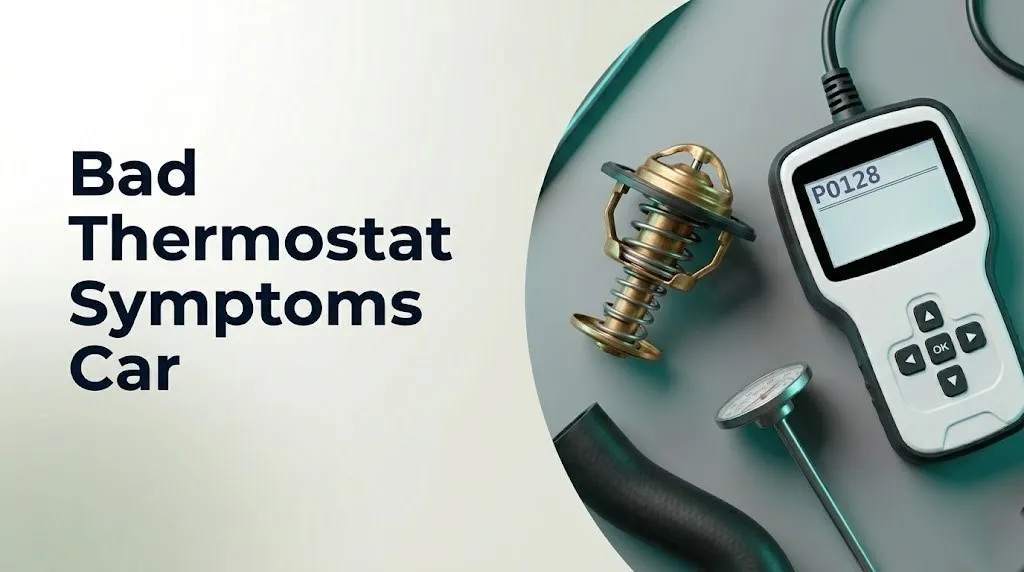
A bad car thermostat commonly triggers a check engine light through the storage of OBD-II diagnostic trouble code P0128 (coolant temperature below thermostat regulating temperature), which the ECM generates when the coolant temperature sensor confirms that the engine has not reached its target operating temperature within the expected warm-up time window.
The ECM monitors the coolant temperature sensor signal continuously. It knows how quickly a properly functioning thermostat should allow the engine to reach operating temperature based on ambient conditions and engine load. If the coolant fails to reach the thermostat’s calibrated temperature within a defined time window after startup, the ECM concludes that the thermostat has failed in the open position and stores the P0128 code.
| OBD-II Code | Definition | Thermostat Implication |
|---|---|---|
| P0128 | Coolant temperature below thermostat regulating temperature | Thermostat stuck open (most common thermostat code) |
| P0125 | Insufficient coolant temperature for closed-loop fuel control | Engine not reaching operating temperature; thermostat likely stuck open |
| P0116 | Engine coolant temperature circuit range/performance | CTS sensor or thermostat correlation issue; both should be tested |
| P0118 | Engine coolant temperature circuit high input | CTS sensor failure (not thermostat), high voltage signal |
| P0117 | Engine coolant temperature circuit low input | CTS sensor failure (not thermostat), low voltage signal |
A stuck-closed thermostat causing overheating may not immediately trigger a specific thermostat code. Instead, the ECM may store codes related to the secondary consequences of overheating, such as oxygen sensor performance codes (from heat damage), misfire codes (from pre-detonation at high temperature), or engine protection mode codes that activate when the ECM detects temperature-related danger.
Pre-1996 vehicles use OBD-I diagnostic systems that are manufacturer-specific and do not use the standardized P01xx code family. An ASE-certified mechanic with the appropriate proprietary scan tool is required for OBD-I thermostat-related diagnosis.
Poor Fuel Economy and Extended Warm-Up from a Bad Thermostat
A bad thermostat stuck in the open position reduces fuel economy by forcing the ECM to maintain an enriched fuel delivery strategy intended for cold-engine operation across an extended warm-up period or indefinitely, resulting in fuel consumption that can be 10 to 20 percent higher than normal during the affected period.
Modern engines use a closed-loop fuel control strategy once the coolant temperature reaches approximately 170 to 180 degrees Fahrenheit. In closed-loop mode, the ECM uses oxygen sensor feedback to continuously adjust the fuel-to-air ratio for maximum combustion efficiency. Below that temperature threshold, the ECM operates in open-loop mode, delivering a pre-calibrated enriched fuel mixture that provides reliable starting and warm-up performance but is deliberately fuel-rich for safety margin.
A stuck-open thermostat keeps the engine in or near open-loop mode longer than designed, or prevents it from fully entering efficient closed-loop operation. The practical consequence is measurably worse fuel economy particularly in short-trip driving, where the engine never has enough time to reach full operating temperature even with a functioning thermostat, and the stuck-open thermostat makes this worse.
The SAE J1979 OBD-II standard specifies that the ECM must store a P0128 code when the engine fails to reach 75 percent of its thermostat’s nominal temperature within a defined warm-up window. This threshold was established specifically because the fuel economy and emissions impact of below-temperature engine operation is measurable and regulated.
Drivers with manual transmissions who observe poor fuel economy alongside a low-reading temperature gauge have a particularly reliable symptom pattern for stuck-open thermostat diagnosis, because manual transmission drivers typically have a better-calibrated sense of normal fuel consumption from their driving habits compared to drivers whose automatic transmissions adjust shift points to compensate for below-temperature conditions.
Bad Thermostat vs Bad Water Pump vs Bad Head Gasket Symptoms
Distinguishing a bad car thermostat from a failing water pump or a blown head gasket is the most practically important differential diagnosis in cooling system troubleshooting, because all three conditions can produce engine overheating but require completely different repairs at very different cost levels.
The water pump circulates coolant through the entire cooling system. When the water pump fails (from impeller blade erosion, shaft bearing failure, or seal leakage), coolant flow through the entire system is reduced regardless of thermostat position. Overheating from water pump failure tends to be more gradual than thermostat failure and is often accompanied by coolant leakage from the pump housing or a squealing noise from the pump bearing.
A blown head gasket allows combustion gases to enter the coolant passages, contaminating the coolant and causing the cooling system to overpressurize. The distinctive signs of head gasket failure include white exhaust smoke with a sweet smell (from coolant burning in the combustion chamber), bubbles visible in the coolant reservoir when the engine is running (from combustion gas infiltration), coolant mixing with engine oil (producing a milky, cappuccino-colored substance on the oil dipstick), and rapid coolant loss without any visible external leak.
| Feature | Bad Thermostat | Bad Water Pump | Blown Head Gasket |
|---|---|---|---|
| Coolant level | Normal (stuck closed) or normal (stuck open) | Low if leaking externally | Drops without visible external leak |
| Exhaust smoke | Normal | Normal | White smoke with sweet smell |
| Oil appearance | Normal | Normal (unless seal leak) | Milky or frothy from coolant contamination |
| Noise | None specific | Squealing, grinding, or hissing from pump | None specific initially |
| Coolant reservoir | Normal | May show external leakage | Bubbles visible when engine runs |
| Repair cost range | $150 to $400 | $300 to $700 | $1,500 to $4,000 or more |
Vehicles with aluminum cylinder heads (which includes the vast majority of modern engines) are more susceptible to head gasket failure as a secondary consequence of thermostat-caused overheating because aluminum expands and contracts at a higher rate than the steel head bolts, distorting the head surface at elevated temperatures. This is why thermostat-caused overheating that is not stopped promptly can escalate from a $200 thermostat repair to a $3,000 head gasket and cylinder head resurfacing repair.
Electronically Controlled Thermostat Failure Symptoms in Modern Cars
Modern vehicles from manufacturers including BMW, Volkswagen Group (Audi, VW, Porsche), Ford (particularly EcoBoost engines), and several others use electronically controlled thermostats (also called map-controlled or variable thermostats) that can be actively controlled by the ECM rather than relying solely on wax pellet passive actuation, and these components fail differently from traditional thermostats.
An electronically controlled thermostat contains a heating element powered by the ECM. By activating this element, the ECM can force the thermostat to open earlier than its passive opening temperature, allowing the engine to run cooler during high-load conditions or warmer during low-load conditions for improved fuel efficiency. At full passive mode, the thermostat behaves like a traditional unit.
When an electronically controlled thermostat fails, the failure can be electrical (the control circuit fails, leaving the thermostat to operate in passive mode only) or mechanical (the wax pellet fails as in a conventional thermostat). Electrical failures may not produce dramatic temperature gauge symptoms because the passive mechanism still functions. Instead, the driver may notice:
- A check engine light with manufacturer-specific fault codes related to the thermostat heater circuit
- Loss of the engine’s ability to reach the higher temperature targets used for maximum fuel efficiency in light-load conditions
- Slightly reduced fuel economy compared to expected values without dramatic temperature gauge changes
- Specific OBD-II codes including P0128 alongside manufacturer-specific codes (not readable by basic consumer OBD-II readers)
Diagnosing an electronically controlled thermostat failure typically requires a professional-grade scan tool capable of reading both generic OBD-II codes and manufacturer-specific enhanced codes. Consumer code readers may not detect the manufacturer-specific codes that distinguish electronically controlled thermostat failure from other cooling system faults.
Vehicles under factory warranty or extended powertrain warranty coverage should have electronically controlled thermostat failures addressed by the dealership service department, where the repair may be covered. Out-of-warranty repairs should be performed by an ASE-certified mechanic familiar with the specific make and model’s enhanced diagnostic protocols.
Key Takeaway: A check engine light with P0128 is the single most consistent diagnostic indicator of a thermostat stuck open, while rapid temperature gauge rise toward the red zone with no coolant loss is the most consistent indicator of a thermostat stuck closed. These two patterns require completely different levels of urgency.
Engine Damage Thresholds: When to Stop Driving Immediately
A bad thermostat that causes overheating produces engine damage that escalates with both temperature reached and duration of continued driving above safe limits, and understanding the specific thresholds at which different types of damage begin determines whether a situation is manageable or catastrophic.
Modern gasoline engines are designed to operate between approximately 195 and 220 degrees Fahrenheit. The cooling system pressure cap raises the boiling point of the coolant from 212 degrees Fahrenheit at atmospheric pressure to approximately 265 degrees Fahrenheit at 15 psi system pressure. This pressurized boiling threshold represents the last line of defense before the cooling system’s efficiency collapses.
At sustained temperatures above approximately 240 to 260 degrees Fahrenheit:
- Head gasket failure begins to occur, particularly at the cylinder-to-cylinder fire rings where combustion pressure and heat are greatest
- Head gasket failure allows combustion gases to enter coolant passages and allows coolant to enter combustion chambers
- The repair cost escalates from a thermostat replacement to a head gasket replacement requiring cylinder head removal
At sustained temperatures above approximately 250 degrees Fahrenheit:
- Cylinder head warpage begins in aluminum cylinder heads, which are used in virtually all modern engines
- A warped cylinder head cannot be simply replaced along with the gasket; it must be resurfaced (machined flat) or replaced entirely
- Total repair cost can reach $3,000 to $5,000 depending on the extent of damage
At temperatures approaching 300 degrees Fahrenheit (indicating catastrophic cooling system failure):
- Piston ring distortion and cylinder bore scoring can occur from thermal expansion beyond design tolerances
- Engine oil viscosity breakdown from heat produces inadequate lubrication of bearing surfaces
- Engine seizure becomes possible if bearing surfaces lose oil film entirely
If your temperature gauge needle enters the red zone or a temperature warning light activates: pull over to a safe location immediately, activate your hazard lights, shut the engine off, and call for roadside assistance. Do not attempt to drive to a shop. Do not open the radiator or coolant reservoir cap on a hot engine.
How to Test and Diagnose a Bad Car Thermostat
Testing a car thermostat involves four sequential diagnostic steps: reading OBD-II fault codes, performing a visual inspection of the cooling system, using an infrared thermometer for a non-invasive temperature test, and performing a traditional hot water bench test on the removed thermostat.
To diagnose a bad car thermostat systematically:
- Read OBD-II codes with a scan tool. Connect a scan tool to the OBD-II port and check for codes in the P0125 to P0128 range. A P0128 code strongly indicates a thermostat stuck open. The absence of codes does not rule out a stuck-closed thermostat, as those may produce secondary codes rather than a primary thermostat code.
- Perform a visual inspection of the cooling system. Check the coolant level in the reservoir when the engine is cold. Check the upper radiator hose temperature while the engine warms up: a properly functioning thermostat will keep the upper hose cool until the thermostat opens, at which point the hose becomes hot suddenly. If the upper hose is hot from engine start, the thermostat may be stuck open. If the hose remains cool and the engine overheats, the thermostat is likely stuck closed.
- Use an infrared thermometer for a non-contact temperature test. Aim an infrared thermometer at the upper radiator hose and the thermostat housing as the engine warms. Record when the hose temperature increases sharply. Cross-reference this temperature with the thermostat’s rated opening temperature (found in the vehicle service manual or on the thermostat packaging). A thermostat that opens at 150 degrees Fahrenheit when rated for 195 degrees Fahrenheit is stuck open. A thermostat housing that reaches 220 degrees Fahrenheit while the radiator remains cool confirms stuck closed.
- Perform a hot water bench test on the removed thermostat. Remove the thermostat from the engine. Place it in a pot of water on a stove with a thermometer. Heat the water slowly while watching the thermostat. It should remain closed until the water reaches the thermostat’s rated temperature, then open within a few degrees of that temperature. A thermostat that opens early, opens late, or does not open fully during this test confirms failure.
Older vehicles with coolant that has not been serviced according to the manufacturer’s interval (typically every 2 to 5 years depending on coolant type) may have internal corrosion deposits in the thermostat housing that can cause the thermostat to stick. In these cases, a complete cooling system flush is appropriate alongside thermostat replacement.
Is It Safe to Drive with a Bad Car Thermostat
Whether it is safe to drive with a bad car thermostat depends entirely on which failure mode is present: driving with a thermostat stuck open is generally safe in the short term, while driving with a thermostat stuck closed is not safe and risks progressive, irreversible engine damage.
With a thermostat stuck open: The engine runs cold, fuel economy decreases, and cabin heat is reduced. None of these conditions create immediate mechanical danger in the short term. The vehicle can typically be driven to a shop for diagnosis and repair within a few days without risking major damage, though continued operation in very cold climates may cause additional problems from chronically under-temperature operation including increased engine wear from incomplete warm-up.
With a thermostat stuck closed: Every mile driven risks compounding engine damage proportional to the temperature reached and the duration. This is not a drive-to-the-shop situation. The safe decision is to stop driving immediately when the temperature gauge rises into the upper portion of its range, even before the red zone is reached, and arrange transport or roadside assistance.
Quick Tip:
- Carry a 50/50 pre-mixed coolant bottle in your vehicle. If you have a stuck-closed thermostat and must move the vehicle a very short distance to safety, turning the heater to maximum heat and maximum blower speed provides a small amount of additional heat dissipation through the heater core. This does not replace stopping and calling for help; it provides a small margin while you locate a safe place to stop.
- Never add cold water to an overheated engine immediately after shutdown. Allow the engine to cool for at least 30 minutes before adding any coolant. Adding cold liquid to a hot aluminum engine block can cause thermal cracking of the block or head.
- Older vehicles (pre-2000) with original cooling systems are at higher statistical risk for concurrent water pump and thermostat failure, making simultaneous replacement of both components during a thermostat service a cost-effective precaution in many cases.
Frequently Asked Questions About Bad Thermostat Symptoms in a Car
What are the most common symptoms of a bad car thermostat?
The most common symptoms of a bad car thermostat are engine overheating (stuck closed failure), engine running below normal operating temperature with a low-reading gauge (stuck open failure), no cabin heat, a check engine light with P0128 code, poor fuel economy, and erratic temperature gauge readings.
The specific symptoms depend on which of the two failure modes has occurred: stuck closed produces overheating and is an immediate emergency, while stuck open produces chronic under-temperature operation and is a non-emergency that should still be repaired promptly.
Identifying which failure mode is present by observing the temperature gauge behavior is the most practically useful first diagnostic step before any other testing.
Can a bad thermostat cause a car to overheat immediately?
A thermostat stuck in the closed position can cause a car to overheat within 10 to 20 minutes of driving under normal load conditions.
The engine reaches its normal operating temperature quickly, but with the thermostat valve blocked, no hot coolant can flow to the radiator for cooling, so temperature continues rising without limit.
A temperature gauge needle that climbs continuously above the normal midpoint zone during driving requires immediate safe stopping and engine shutdown to prevent head gasket or cylinder head damage.
What does a bad thermostat do to fuel economy?
A thermostat stuck open reduces fuel economy by keeping the engine below its normal operating temperature, forcing the ECM to maintain an enriched cold-start fuel delivery strategy for a prolonged period or indefinitely.
The ECM cannot enter its fuel-efficient closed-loop mode until coolant temperature reaches approximately 170 to 180 degrees Fahrenheit, and a stuck-open thermostat prevents or delays this threshold.
Fuel economy reduction from a stuck-open thermostat is particularly noticeable in short-trip driving and cold-weather conditions, where it can reduce efficiency by 10 to 20 percent compared to normal operation.
What OBD-II code does a bad thermostat throw?
A bad thermostat stuck in the open position most commonly triggers OBD-II code P0128, which stands for coolant temperature below thermostat regulating temperature, as defined by the SAE J1979 OBD-II diagnostic standard.
Code P0125 (insufficient coolant temperature for closed-loop fuel control) may also appear alongside or instead of P0128 depending on the vehicle’s specific ECM calibration.
A thermostat stuck closed causing overheating may not trigger a specific thermostat code; it more commonly triggers secondary codes related to the consequences of overheating, making professional scan tool diagnosis important when both overheating and check engine light occur simultaneously.
How much does it cost to replace a car thermostat?
A car thermostat replacement typically costs between $150 and $400 at an independent shop, including parts and labor, though this varies by vehicle make, model, and whether the thermostat housing requires replacement.
The thermostat itself typically costs between $15 and $80 for the part, with electronically controlled thermostats and OEM parts for European vehicles costing significantly more; labor is generally 1 to 2 hours.
Vehicles with plastic thermostat housings that have cracked from overheating stress will require housing replacement in addition to the thermostat, adding $50 to $150 to the total parts cost.
Can I drive with a bad car thermostat?
Driving with a thermostat stuck open is generally safe in the short term, as the primary consequences are poor fuel economy and inadequate cabin heat rather than mechanical emergency.
Driving with a thermostat stuck closed is not safe once the temperature gauge rises above the normal midpoint zone, because continued driving risks head gasket failure and cylinder head warpage that can turn a $200 repair into a $3,000 or more repair.
Any vehicle with a temperature gauge reading consistently above normal or approaching the red zone should not be driven; arrange roadside assistance or towing to avoid irreversible engine damage.
The most actionable thing you can take from this guide is the distinction between two failure modes. If your temperature gauge is rising toward the red zone, that is not a “get it checked soon” situation. That is a pull-over-now situation. If your gauge is sitting low and your heater is lukewarm, that is a schedule-a-repair-soon situation.
The P0128 check engine code is your early warning system for a stuck-open thermostat. If that code appears before any dramatic symptom develops, you have the best possible diagnostic head start. Take it to an ASE-certified mechanic with that specific code and ask for a thermostat inspection before additional damage occurs.
You now know enough about how a car thermostat works, how it fails, and what the specific consequences are to make a confident and accurate decision about your vehicle right now.