Bad Catalytic Converter Symptoms: Full 2026 Guide
Bad catalytic converter symptoms include a rotten egg smell from the exhaust, a check engine light triggered by a P0420 diagnostic code, rattling noises under the vehicle, noticeable power loss during acceleration, and worsening fuel economy. These symptoms reflect real chemical and mechanical failures inside the converter that affect engine performance, air quality, and in severe cases, the safety of everyone in the vehicle.
According to the U.S. Environmental Protection Agency (EPA), the catalytic converter is one of the most consequential emissions control devices ever installed on a production vehicle. A failing unit does not just cause you to fail a smog inspection. It can allow unburned carbon monoxide, unburned hydrocarbons, and nitrogen oxide compounds to escape into the air around and inside your vehicle at concentrations that carry real toxicological risk.
This article explains every major bad catalytic converter symptom with the specific chemical and mechanical reason each one occurs, how to distinguish between different types of converter failure, which symptoms mean you need to stop driving today, and exactly what a mechanic will check to confirm the diagnosis.
Bad Catalytic Converter Symptoms: The Complete Picture
The most common bad catalytic converter symptoms are a check engine light (often with a P0420 OBD-II trouble code), a sulfur or rotten egg odor from the exhaust, a rattling or metallic shaking sound from under the vehicle, sluggish acceleration and reduced engine power, and declining fuel economy. These symptoms can appear individually or in combination, and their severity ranges from barely noticeable to severe enough to prevent the engine from starting.
Not every symptom appears at the same stage of failure. A converter in early decline may trigger only the check engine light, with no perceptible driving difference. A severely clogged converter can create so much exhaust backpressure that the engine stalls repeatedly and cannot maintain idle.
The specific symptom cluster a driver notices depends heavily on the type of failure occurring inside the converter. Efficiency decline from thermal aging produces different symptoms than physical clogging from substrate melt, substrate contamination from oil or coolant intrusion, or mechanical fracture from road impact damage.
| Symptom | Failure Mode Most Likely Associated | Urgency Level |
|---|---|---|
| Check engine light, P0420 code | Efficiency decline, thermal aging | Moderate: Schedule evaluation within 1 to 2 weeks |
| Rotten egg / sulfur smell | Sulfur compound conversion failure | Moderate: Evaluate soon, especially with other symptoms |
| Rattling under vehicle | Broken or fragmented substrate | High: Evaluate within days; debris can damage other components |
| Severe power loss, stalling | Severe clogging or melt | High: Avoid highway driving; evaluate immediately |
| Failed emissions test | Any failure mode, at any stage | Required: Vehicle cannot be legally registered until addressed |
| Headache or dizziness in cabin | CO intrusion from severe failure with exhaust leak | Emergency: Exit vehicle immediately, call 911 |
Older vehicles (generally over 120,000 miles) are more likely to present with multiple symptoms simultaneously because thermal aging of the substrate compounds progressive efficiency loss over time. Drivers of turbocharged vehicles may notice power loss symptoms earlier than drivers of naturally aspirated engines because turbo systems are more sensitive to exhaust backpressure changes.
What Does a Catalytic Converter Do?
The catalytic converter is an exhaust aftertreatment device that converts three categories of harmful engine combustion byproducts into less harmful compounds through simultaneous oxidation and reduction reactions occurring across a coated ceramic or metallic honeycomb substrate. Without it functioning correctly, raw carbon monoxide, unburned hydrocarbon fuel fragments, and nitrogen oxides exit directly through the tailpipe.
Think of the converter’s ceramic honeycomb like an extraordinarily dense sponge with millions of tiny passages coated in a layer of precious metals. Every exhaust gas molecule that passes through those passages has a chance to be chemically transformed. When the sponge degrades, those transformation reactions become incomplete, and the byproducts that should have been neutralized pass straight through.
The three simultaneous reactions the converter performs are:
- Oxidation of carbon monoxide (CO) to carbon dioxide (CO2): CO + ½O2 → CO2
- Oxidation of unburned hydrocarbons (HC) to carbon dioxide and water: CxHy + O2 → CO2 + H2O
- Reduction of nitrogen oxides (NOx) to nitrogen gas and oxygen: 2NO + 2CO → N2 + 2CO2
The precious metals responsible for these reactions are palladium (Pd) and platinum (Pt) for the oxidation reactions, and rhodium (Rh) for the NOx reduction reaction. These metals are embedded in a thin washcoat (an aluminum oxide base layer) applied to the surface of the ceramic honeycomb substrate.
The converter operates at temperatures between approximately 400°C and 900°C (750°F to 1650°F). It requires this heat to reach catalytic light-off temperature, the minimum operating threshold at which the chemical reactions proceed efficiently. Cold starts are the period of highest emissions production because the converter has not yet reached operating temperature.
Hybrid vehicle drivers should note that their converters cycle between cold and warm states more frequently than conventional vehicles due to intermittent engine operation. The California Air Resources Board (CARB) has documented that hybrid-specific converter designs account for this thermal cycling, but a failing hybrid converter may show symptoms more variably than one in a conventionally powered vehicle.
Symptoms of a Failing Catalytic Converter vs. a Fully Failed One
A failing catalytic converter produces early and intermittent symptoms, while a fully failed catalytic converter produces consistent, severe symptoms that directly impair driveability. Understanding where on this spectrum you are determines how urgently you need to act.
Early-stage failure typically means the converter’s efficiency has dropped below the threshold the engine control unit (ECU) considers acceptable, but it is still converting some proportion of exhaust gases. At this stage, you may notice the check engine light, a slight smell, or marginally worse fuel economy, but the car drives reasonably normally.
Late-stage failure, particularly from physical substrate clogging or melt, means the exhaust path through the converter is partially or fully obstructed. The engine cannot expel combustion gases efficiently, which creates exhaust backpressure that works against the engine’s ability to draw fresh air into the cylinders on each intake stroke.
| Stage | Observable Symptoms | Driveability Impact | Action Required |
|---|---|---|---|
| Early (efficiency declining) | Check engine light, P0420 code, faint sulfur smell | Minimal; may notice slight sluggishness | Schedule evaluation within 1 to 2 weeks |
| Moderate (partial failure) | Stronger smell, occasional hesitation, fuel economy drop of 10 to 15% | Noticeable under load (hills, passing) | Evaluate within days; avoid extended highway driving |
| Severe (severe clog or melt) | Strong power loss, stalling at idle, engine heat buildup, possible strong sulfur smell | Significant; may not maintain highway speed | Evaluate immediately; do not drive on highway |
| Complete failure (total blockage) | Vehicle may not start or immediately stalls, extreme heat from catalytic area | Unable to drive normally | Tow to shop; do not attempt to drive |
Drivers over the age of 65 or those with pre-existing cardiovascular or respiratory conditions face a higher health risk from prolonged exposure to increased exhaust emissions in the vehicle cabin during any stage of converter failure, not only at the complete failure stage. A licensed ASE-certified automotive technician can perform a backpressure test to precisely locate where on this spectrum your converter currently sits.
Check Engine Light and Catalytic Converter Symptoms
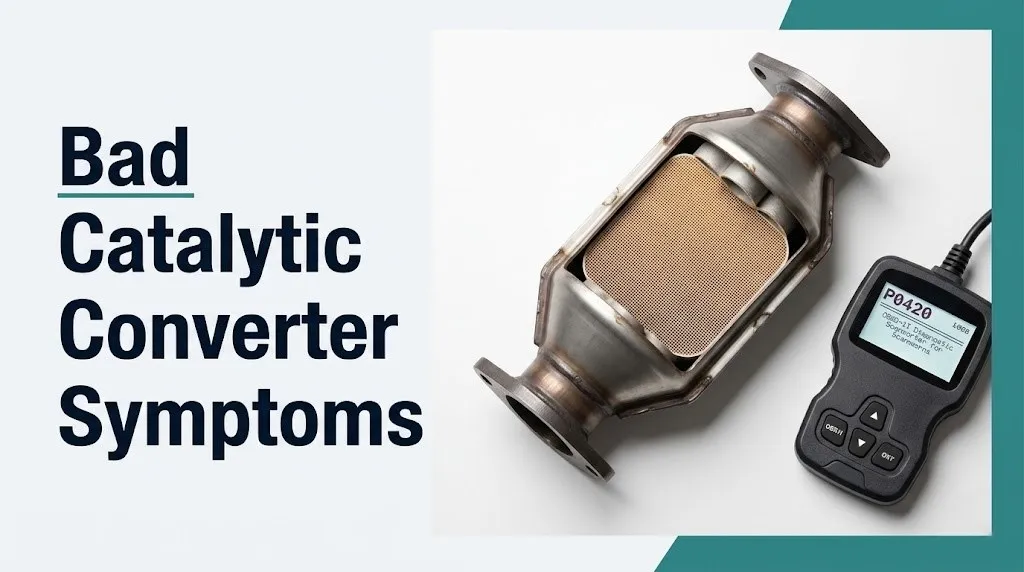
A check engine light triggered specifically by catalytic converter inefficiency appears when the ECU detects that the downstream oxygen sensor’s output pattern is too similar to the upstream oxygen sensor’s output pattern, indicating the converter is no longer processing exhaust gases effectively. This triggers the OBD-II diagnostic trouble code P0420 (or P0421, P0422 for related variants), which reads as “Catalyst System Efficiency Below Threshold, Bank 1.”
Here is how the oxygen sensor monitoring system works in plain terms: the upstream sensor, positioned before the converter, oscillates rapidly between lean and rich voltage readings as it tracks combustion variation cycle by cycle. The downstream sensor, positioned after the converter, should read a stable, relatively flat voltage because the converter has smoothed out and chemically transformed the exhaust stream. When the converter’s efficiency drops, the downstream sensor starts mimicking the upstream sensor’s rapid oscillation, telling the ECU that the conversion process is failing.
According to the Society of Automotive Engineers (SAE) standard SAE J1979, which governs OBD-II diagnostic protocols in the United States, the P0420 threshold is calibrated to detect converter efficiency loss that would cause tailpipe emissions to exceed 1.5 times the applicable federal emission standard. This means the light triggers before the converter has completely failed, which gives drivers a window to address the problem before more serious damage or health risks develop.
Quick Tip:
- A check engine light alone does not confirm converter failure. A licensed technician should read all stored and pending codes before diagnosis.
- Other issues (failing oxygen sensors, exhaust leaks upstream of the converter, engine misfires) can mimic a P0420 code without the converter itself being faulty.
- Vehicles with dual exhaust systems have two converters, Bank 1 and Bank 2, and may show P0420 and P0430 codes simultaneously.
Drivers of vehicles with high sulfur fuel exposure (older fuel infrastructure regions) may see P0420 codes intermittently even with a functional converter, because sulfur temporarily poisons the oxygen sensor’s ability to read accurately. A technician familiar with this pattern will typically ask about recent fuel sources before recommending converter replacement.
Key Takeaway: A P0420 check engine light is a calibrated early warning from your vehicle’s diagnostic system, not a confirmation that the converter has failed completely, but it always warrants a professional evaluation rather than being ignored or cleared without diagnosis.
Rotten Egg Smell from Exhaust
A rotten egg or sulfur smell from the exhaust is one of the most recognizable bad catalytic converter symptoms, and it occurs because a failing converter can no longer fully process sulfur dioxide (SO2) present in exhaust gases, allowing hydrogen sulfide (H2S) to pass through the exhaust stream instead.
Here is the chemistry: gasoline contains trace amounts of sulfur compounds. During normal combustion, these compounds oxidize to SO2. A healthy, functioning catalytic converter converts SO2 into sulfur trioxide (SO3) or processes it in ways that prevent H2S formation. When converter efficiency drops, particularly during rich fuel conditions (when the air-fuel mixture has excess fuel), SO2 can be reduced to H2S instead of being fully oxidized. H2S has the characteristic rotten egg odor detectable at concentrations as low as 0.5 parts per billion by most people.
A brief sulfur smell during a cold start that clears within 30 to 60 seconds of driving is typically not a sign of converter failure. It often reflects a transient rich-running condition during engine warm-up. A persistent or worsening sulfur smell throughout a drive, or a smell that becomes stronger when decelerating or idling, is a more meaningful indicator of converter efficiency decline.
A sulfur smell that appears suddenly and strongly after an extended idle period or a period of hard acceleration can indicate that the converter has overheated and begun to physically degrade, which is a more urgent situation than gradual efficiency decline.
Drivers with a heightened sensitivity to chemical odors, including those with asthma, allergic rhinitis, or reactive airways disease, may perceive the H2S smell at lower concentrations and experience respiratory irritation before other vehicle occupants notice anything. If you have a respiratory condition and notice persistent exhaust odor inside the cabin, have the vehicle evaluated promptly and ensure the cabin air intake is set to recirculation mode while driving.
Rattling Noise from the Catalytic Converter
A rattling, shaking, or metallic chattering sound from underneath the vehicle, particularly noticeable during cold starts and on acceleration, is a symptom of physical substrate fracture inside the catalytic converter. It occurs when the ceramic honeycomb structure inside the converter cracks, breaks apart into fragments, or collapses.
Think of the ceramic honeycomb substrate as a delicate grid of thousands of thin-walled passages, held in place inside a metal canister by a compression mat. When that grid cracks from thermal stress, road vibration, physical impact from road debris, or the structural damage caused by a prior overheating event, the broken fragments are free to move inside the canister. Every time the engine produces exhaust pulses, those fragments rattle against the canister walls.
This is one of the more mechanically serious bad catalytic converter symptoms because broken substrate fragments can be drawn backward or forward through the exhaust system. Forward migration is particularly problematic: fragments can be aspirated back through the exhaust valve into the combustion chamber, causing piston, cylinder wall, or valve seat damage. Even without migration, the broken substrate dramatically increases exhaust flow restriction because the collapsed structure blocks the passage openings.
The rattling sound from a broken substrate is distinct from two other common vehicle noises:
- Heat shield rattle: The heat shield surrounding the converter can loosen or corrode and rattle independently. Heat shield rattle tends to occur at a specific engine speed range (often 1,500 to 2,500 RPM) and resolves above that range. Substrate rattle is more consistent.
- Exhaust pipe rattle: Loose exhaust hangers or a loose pipe joint rattle with a lower, duller tone. Substrate fragments produce a drier, more metallic, gravel-like sound.
A vehicle with an audible substrate rattle should not continue to be driven long distances, particularly at highway speeds. A licensed ASE-certified automotive technician can distinguish substrate fracture from other sources of exhaust noise with a visual inspection and a tap test. If substrate fragments have already migrated, a compression test and combustion chamber inspection may also be warranted.
Poor Acceleration and Power Loss Symptoms
Poor acceleration, a feeling of the engine “straining” or “running out of steam” under load, and a noticeable reduction in the vehicle’s ability to maintain speed are among the most physically apparent symptoms of a bad catalytic converter, and they occur directly because of increased exhaust backpressure caused by a restricted or clogged converter.
The engine’s ability to produce power depends on its ability to complete four distinct strokes: intake, compression, power (combustion), and exhaust. During the exhaust stroke, the piston moves upward to push burned gases out through the exhaust valve. When a clogged converter restricts this exit path, the piston must work against elevated backpressure to expel those gases. This reduces the engine’s volumetric efficiency: its ability to completely fill the cylinder with fresh air-fuel mixture on the following intake stroke.
Less fresh charge in the cylinder means less oxygen available for combustion, which means less energy released per combustion event, which means less power delivered to the drivetrain. The result is a car that feels sluggish from a stop, hesitates when merging onto a highway, struggles to maintain speed on grades, and may experience the engine revving higher than normal for a given road speed.
According to engineering data reviewed by the SAE, even a modest restriction causing a backpressure increase of 5 to 10 kilopascals above normal can produce a measurable reduction in engine output. Severe restriction can reduce power output by 25% or more, depending on engine displacement and design.
Drivers of turbocharged vehicles may notice power loss symptoms from a partially clogged converter earlier than drivers of naturally aspirated engines. This is because the turbocharger itself depends on exhaust gas flow to spin the turbine. A restricted exhaust flow reduces turbine speed and boost pressure, compounding the power reduction beyond the backpressure effect alone.
Key Takeaway: Power loss and sluggish acceleration from a catalytic converter are caused by exhaust backpressure mechanically limiting combustion efficiency, not a vague “performance issue,” and they can worsen rapidly once the substrate begins physically collapsing.
Reduced Fuel Economy and the Catalytic Converter
A noticeable drop in fuel economy is a common but often underrecognized symptom of catalytic converter failure because drivers tend to attribute it to other causes (fuel quality, driving habits, tire pressure) before considering the exhaust system.
The fuel economy connection happens through two pathways. First, the same exhaust backpressure that reduces power also forces the engine to consume more fuel to maintain speed. The ECU responds to the power deficit by enriching the fuel mixture (adding more fuel relative to air) to try to recover performance. More fuel per combustion event means more fuel consumed per mile.
Second, a failing converter often forces the oxygen sensors and ECU into a compensatory feedback loop. The downstream oxygen sensor sends signals indicating poor conversion efficiency, and the ECU may adjust fuel trim (long-term and short-term fuel delivery adjustments) in ways that increase fuel consumption. According to the U.S. Environmental Protection Agency, a poorly maintained or failing emissions control system, including a degraded catalytic converter, can reduce fuel economy by 4% to as much as 40% depending on the severity of the failure.
Tracking fuel economy is actually one of the more practical self-monitoring tools available to a driver concerned about converter health. Most modern vehicles display average fuel economy on the instrument cluster. A sustained drop of 10% or more over several tanks of fuel, particularly when combined with any other symptom on this list, is a meaningful data point to bring to a technician.
Older drivers and those on fixed incomes should be aware that fuel economy decline from a converter issue compounds financially: the cost of extra fuel burned while delaying repair often approaches or exceeds the cost of addressing the problem earlier in its progression.
Clogged Catalytic Converter Symptoms
A clogged catalytic converter produces a specific and more severe symptom cluster than simple efficiency decline: extreme power loss at highway speeds, repeated stalling at idle, a vehicle that starts and then dies, engine overheating from trapped exhaust heat, and in some cases a noticeable smell of hot metal from under the vehicle. These symptoms reflect near-total exhaust flow restriction.
Clogging occurs through two distinct mechanisms. The first is substrate melt: when the converter overheats (from engine misfires sending unburned fuel through the exhaust system, from excessively rich running conditions, or from an extended period of driving with an engine problem), the ceramic substrate can partially or fully melt. The molten material resolidifies and blocks the honeycomb passages. The second mechanism is ash accumulation: motor oil that enters the combustion chamber (from worn piston rings, valve seals, or other sources of oil consumption) burns incompletely and deposits a layer of metalite ash on the converter substrate over time, progressively narrowing the flow passages.
A useful way to think about a severely clogged converter is to imagine trying to breathe through a straw that is half-blocked with hardened debris. The engine is essentially in the same situation during every exhaust stroke: pushing against a wall that barely moves.
To distinguish a clogged converter from other causes of severe power loss:
- Note whether symptoms appeared suddenly (suggesting a thermal event or melt) or gradually over thousands of miles (suggesting progressive ash accumulation).
- Check whether the check engine light is on and whether misfire codes (P0300 through P0308) accompany any catalyst efficiency code.
- Ask a technician to perform a backpressure test using a pressure gauge installed at the oxygen sensor port upstream of the converter. Normal exhaust backpressure at idle is typically below 1.5 PSI (10 kPa). Values above 3 PSI (20 kPa) at idle indicate meaningful restriction.
- Note whether the vehicle runs better when cold and progressively worse as the engine and exhaust system reach operating temperature, which is a hallmark pattern of thermal restriction that worsens as metal expansion further narrows already-restricted passages.
- Report any prior history of severe engine misfire, coolant consumption, or blue smoke from the exhaust, all of which are risk factors for converter clogging.
Catalytic Converter Failure Symptoms from Engine Misfires
Engine misfires and catalytic converter failure have a two-way relationship that most vehicle owners and even some online resources miss entirely. A failing catalytic converter can contribute to misfire-like symptoms, but more importantly, pre-existing engine misfires are one of the most common causes of accelerated converter failure, and the two conditions often present together.
An engine misfire occurs when one or more cylinders fail to complete a normal combustion event. The result is that a cylinder’s worth of unburned air-fuel mixture enters the exhaust system. That raw fuel then ignites inside the catalytic converter, where combustion temperatures are already high. The additional combustion inside the converter can cause localized temperatures to spike above 1,000°C (1,832°F), far exceeding the converter’s design operating range. Repeated or sustained misfire events are one of the primary causes of substrate melt.
According to published guidance from the Society of Automotive Engineers, even a misfire rate of 1 to 2% of combustion events can cause measurable thermal damage to the catalytic substrate over a period of extended driving. A severe misfire (a condition where an entire cylinder is consistently misfiring) can cause substrate melt within a single extended drive.
The symptom overlap between misfires and converter failure can make diagnosis confusing:
- Rough idle (present in both misfire and severe backpressure from converter)
- Hesitation on acceleration (present in both)
- Check engine light with both P0420 and P030X codes simultaneously
A technician will typically address any confirmed misfire codes before condemning the catalytic converter, because replacing a converter without fixing the underlying misfire will destroy the replacement unit through the same mechanism.
Younger vehicles (under 50,000 miles) presenting with converter failure symptoms should be specifically evaluated for active misfires, as premature converter failure in low-mileage vehicles almost always indicates an underlying engine management problem rather than normal thermal aging of the substrate.
Key Takeaway: Engine misfires destroy catalytic converters by causing internal combustion inside the converter at temperatures far above its design limit, which is why fixing a misfire before replacing a converter is not optional; it is the only sequence that prevents immediate repeat failure.
Catalytic Converter Poisoning Symptoms
Catalytic converter poisoning refers to chemical contamination of the precious metal washcoat by substances that permanently deactivate the palladium, platinum, and rhodium catalyst sites. The symptoms of a poisoned converter often appear more gradually than a clogged or broken converter, and they may initially look identical to normal thermal aging before worsening more rapidly.
The most common poisoning agents are:
- Phosphorus from motor oil: Phosphorus is used as an anti-wear additive in engine oils (particularly older oil formulations). When an engine consumes oil, phosphorus enters the combustion chamber, burns, and deposits on the converter washcoat, permanently bonding to and blocking the active catalyst sites. Vehicles that consume a quart or more of oil per 1,000 miles are at elevated risk.
- Sulfur from fuel: High-sulfur fuels can temporarily and reversibly deactivate catalyst sites through sulfur adsorption, producing the P0420 code. Unlike phosphorus, sulfur poisoning can partially reverse when the converter is run at high temperatures with low-sulfur fuel.
- Silicone from gasket sealants or coolant: Improper use of silicone-based sealing compounds near intake or exhaust components, or coolant entering the combustion chamber from a failing head gasket, introduces silica that deposits on and permanently blocks active catalyst sites.
- Lead from contaminated or mislabeled fuel: Though leaded gasoline is no longer sold for on-road use in the United States, misfueling with leaded aviation fuel or contaminated fuel destroys the converter substrate immediately and irreversibly.
The EPA has established that motor oil formulations meeting current API service designations are required to limit phosphorus content to levels below 0.08% (800 ppm) specifically to reduce catalytic converter poisoning rates. Using non-API-certified oils or ignoring an oil consumption problem accelerates poisoning significantly.
A poisoned converter will typically show a P0420 code and declining performance that does not improve after clearing the code, combined with a history of oil consumption or coolant loss. A skilled technician may use exhaust spectrometry or cross-pipe temperature differential measurement to distinguish poisoning from other failure modes.
Failed Emissions Test and the Catalytic Converter
Failing a smog check or state emissions inspection is a direct and consequential outcome of catalytic converter failure because the converter is the primary mechanism by which a vehicle reduces CO, HC, and NOx tailpipe emissions to within legally permitted levels.
In states with mandatory emissions testing programs (currently 34 states plus the District of Columbia, per the EPA’s National Vehicle and Fuel Emissions Laboratory records), a failed emissions test prevents vehicle registration renewal. The test measures actual tailpipe concentrations of CO, HC (total unburned hydrocarbons), and NOx using a dynamometer and exhaust gas analyzer or, for OBD-II equipped vehicles (all gasoline-powered vehicles from 1996 onward), reads the OBD-II system’s readiness monitors and stored trouble codes directly.
A vehicle with a stored P0420 code will fail an OBD-II emissions inspection automatically, regardless of whether actual tailpipe emissions at that moment exceed the standard. This is because the P0420 code indicates the vehicle’s own self-monitoring system has determined converter efficiency is below the legal threshold.
The California Air Resources Board (CARB), which operates the nation’s most stringent emissions inspection program, uses a tiered standard: CARB-certified catalytic converters must meet tighter emissions limits than federal EPA standards. Residents of California and states that have adopted California’s emissions standards (currently 17 states as of CARB’s 2024 documentation) must use CARB-compliant replacement converters, not federal EPA-only converters, to pass inspection after repair.
Drivers who clear a P0420 code without repairing the underlying problem before an emissions test should be aware that OBD-II readiness monitors take a specific number of drive cycles to complete after a code is cleared. An incomplete readiness status also results in an automatic test failure in most states.
OBD-II P0420 Code and Catalytic Converter Diagnosis
The OBD-II P0420 diagnostic trouble code is titled “Catalyst System Efficiency Below Threshold, Bank 1” and is the most specific electronic indicator of catalytic converter failure available without specialized shop equipment. Understanding what it means and what diagnostic steps follow it helps drivers communicate accurately with technicians and avoid unnecessary or premature part replacement.
P0420 is set by the ECU when the downstream oxygen sensor’s switching frequency (how often its voltage crosses the stoichiometric threshold) exceeds a calibrated limit relative to the upstream sensor. The downstream sensor in a healthy system should switch slowly or hold a relatively stable voltage, indicating that the converter has smoothed and transformed the exhaust stream. When it switches rapidly (mimicking the upstream sensor), the converter is not doing its job.
The P0420 code alone does not confirm that the converter needs replacement. According to diagnostic guidance published by the National Institute for Automotive Service Excellence (ASE), a complete P0420 diagnostic sequence should include:
- Scan for all codes, including misfire codes, oxygen sensor codes, fuel trim codes, and EGR codes, before forming any conclusion.
- Inspect for exhaust leaks upstream of the catalytic converter. A leak near the upstream oxygen sensor can cause it to read incorrectly, falsely triggering P0420.
- Evaluate the upstream and downstream oxygen sensor waveforms on a live scan tool. A failed oxygen sensor can mimic a P0420 pattern without any converter defect.
- Check long-term and short-term fuel trims for evidence of a running condition (rich or lean) that would stress or degrade the converter.
- Perform a snap throttle exhaust temperature test using an infrared thermometer to measure the converter’s inlet and outlet temperatures. A functional converter should show a higher temperature at the outlet than the inlet (indicating exothermic chemical reactions occurring inside). A failed converter may show equal or lower outlet temperatures.
- If all other causes are ruled out and the converter is confirmed defective, select a replacement unit that meets the required certification standard for the vehicle’s state of registration.
Drivers should bring a printed OBD-II code readout and a record of any recent repairs (oxygen sensor replacement, spark plug replacement, head gasket work) to a technician appointment. This information directly accelerates the diagnostic process.
Can You Drive with a Bad Catalytic Converter?
Whether you can safely drive with a bad catalytic converter depends entirely on the stage and type of failure: a converter in early efficiency decline with only a P0420 code presents a different situation than a severely clogged, physically damaged, or carbon-monoxide-leaking unit.
For a converter showing only a P0420 code with no performance symptoms, no physical damage, and no smell inside the cabin, most vehicles can be driven for a limited period while awaiting a scheduled repair appointment. The engine will run, fuel economy will decline, and the vehicle cannot legally pass an emissions inspection. The EPA notes that driving with a failing converter accelerates its degradation and increases exposure to elevated tailpipe emissions for other road users.
For a converter showing severe power loss, repeated stalling, strong exhaust odor inside the cabin, or a physical rattling sound from substrate fracture, continued driving carries meaningful risks:
- Severe exhaust backpressure from a nearly-complete blockage can cause engine overheating, valve damage, and in extreme cases, engine failure.
- A physically fractured substrate can migrate fragments into the engine or exhaust system.
- A converter producing CO intrusion into the cabin poses a direct health risk to all occupants.
- An overheated converter, particularly one near combustible materials (accumulated leaves, roadside vegetation during parking), poses a vehicle fire risk.
Drivers with heart disease, anemia, chronic obstructive pulmonary disease (COPD), pregnancy, or other conditions that reduce their physiological tolerance for carbon monoxide exposure face a lower safety margin with any stage of converter failure that involves increased CO output. A licensed ASE-certified technician can assess the specific failure stage and give a direct answer about continued drivability specific to that vehicle’s condition.
Key Takeaway: A P0420 code alone rarely requires immediate towing, but a catalytic converter producing cabin odor, severe power loss, stalling, or audible substrate rattling should be evaluated within days, not weeks, to prevent compounding damage and protect occupant health.
Carbon Monoxide Risk from a Faulty Catalytic Converter
The most serious health risk associated with a severely failed catalytic converter is carbon monoxide (CO) intrusion into the vehicle cabin. This risk is highest when converter failure is accompanied by an upstream exhaust leak that allows CO-rich exhaust gases to enter the cabin through gaps in the firewall, HVAC ducting, or body seams.
Carbon monoxide is colorless, odorless, and tasteless. It cannot be detected by human senses at any concentration. It binds to hemoglobin in the bloodstream with approximately 200 to 250 times greater affinity than oxygen, forming carboxyhemoglobin (COHb), which cannot carry oxygen. Simultaneously, CO inhibits cytochrome c oxidase, the enzyme at the terminus of the mitochondrial electron transport chain responsible for cellular energy production. The result is oxygen deprivation at both the blood-transport level and the cellular-metabolism level simultaneously.
According to the Centers for Disease Control and Prevention (CDC), CO poisoning causes more than 400 deaths annually in the United States from non-fire-related exposures. Vehicle exhaust is one of the most common sources.
The Occupational Safety and Health Administration (OSHA) sets the permissible exposure limit for CO at 50 parts per million (ppm) over an 8-hour workday. At 200 ppm, a healthy adult will experience headache within 2 to 3 hours. At 400 ppm, headache, dizziness, and nausea appear within 1 to 2 hours. At 1,600 ppm, symptoms of severe poisoning (confusion, rapid heart rate, loss of coordination) appear within 20 minutes.
Early CO poisoning symptoms in vehicle occupants that may be mistakenly attributed to other causes include:
- Frontal headache (often described as “pressure” across the forehead)
- Dizziness or lightheadedness, particularly when the vehicle is idling with windows closed
- Nausea without an obvious gastrointestinal cause
- Unusual fatigue or cognitive slowing while driving
- Symptoms that improve when the driver exits the vehicle and steps into fresh air
Children, pregnant women, older adults, and individuals with heart disease or anemia are physiologically more vulnerable to CO exposure at lower concentrations than healthy adults. The Mayo Clinic notes that children and fetuses are at particular risk because of their higher metabolic oxygen demand and the sensitivity of developing neurological tissue to hypoxia.
Installing a CO detector in a vehicle is an inexpensive but meaningful safety measure for any driver experiencing symptoms of a failing converter. Portable plug-in vehicle CO detectors are widely available and sound an alarm at concentrations between 70 and 400 ppm depending on model.
Emergency Symptoms: When to Call 911 or Go to the ER
Certain symptoms associated with carbon monoxide exposure from a severely failing catalytic converter or exhaust leak require immediate emergency evaluation. Do not wait to see if these symptoms resolve on their own or after the vehicle is parked.
Exit the vehicle immediately and call 911 if you or any passenger experience:
- Sudden, severe headache that began while driving and improves within minutes of stepping outside the vehicle
- Dizziness, loss of coordination, or difficulty walking after time in the vehicle cabin
- Nausea or vomiting without a prior gastrointestinal illness
- Confusion, disorientation, or difficulty thinking clearly while driving
- Chest pain or a feeling of tightness in the chest while in the vehicle
- Loss of consciousness or near-fainting inside the vehicle (do not attempt to drive in this state)
- A child, infant, or elderly passenger who becomes unusually lethargic or unresponsive during a drive
If you suspect CO exposure:
- Pull over and stop the vehicle immediately.
- Exit the vehicle with all passengers and move to fresh air, away from the tailpipe.
- Call 911. Report that you suspect carbon monoxide exposure from vehicle exhaust.
- Do not re-enter the vehicle for any reason until emergency personnel have cleared the scene and the vehicle has been assessed.
- Accept medical evaluation even if you feel better after fresh air exposure. COHb levels must be measured by a blood test. Symptoms that resolve in fresh air do not confirm that poisoning has not occurred.
These presentations can indicate acute carbon monoxide poisoning, a toxicological emergency that requires oxygen therapy and emergency medical assessment, not an urgent care appointment or a phone call to a mechanic.
When to Replace a Catalytic Converter
The decision to replace a catalytic converter depends on a confirmed diagnosis of the failure mode, the vehicle’s overall condition, applicable state emissions requirements, and whether the underlying cause of failure has been identified and corrected. Replacing a converter without addressing the root cause of its failure will result in premature failure of the replacement unit, often within months.
According to the EPA, original equipment manufacturer (OEM) catalytic converters are typically designed to last 100,000 miles under normal operating conditions. The actual service life varies substantially based on:
- Engine oil quality and consumption rate (phosphorus poisoning risk)
- Fuel sulfur content and fuel quality
- History of engine misfires or overheating events
- Exposure to physical impact from road debris
- Whether the vehicle has been driven with the check engine light on for extended periods
The correct replacement sequence is:
- Confirm the converter as the source of failure through a complete OBD-II diagnostic scan, oxygen sensor waveform analysis, backpressure test, and temperature differential test.
- Identify and repair any underlying engine problems (misfires, oil consumption, coolant leaks, EGR malfunction, fuel trim abnormalities) before or simultaneously with converter replacement.
- Select a replacement converter certified to meet the emissions standard for your specific state of registration (EPA-compliant for most states; CARB-compliant for California and states that have adopted California standards).
- Verify oxygen sensor function before and after replacement, as worn sensors are frequently responsible for P0420 codes that are incorrectly attributed to converter failure.
- After replacement, complete the required OBD-II readiness drive cycle (specific to your vehicle make and model) before presenting for emissions testing.
Aftermarket converter options vary widely in quality. A licensed ASE-certified technician or dealership service center can recommend a converter with an appropriate warranty (typically 50,000 miles minimum for a quality aftermarket unit) and confirm fitment and emissions certification before installation.
Frequently Asked Questions About Bad Catalytic Converter Symptoms
What are the first signs of a bad catalytic converter?
The earliest signs are typically a check engine light with a stored P0420 OBD-II code and a faint sulfur or rotten egg smell from the exhaust during or after driving.
These early symptoms may appear without any noticeable change in driveability because the converter is still partially functional.
A licensed ASE-certified technician can confirm whether the code reflects true converter degradation or another cause (such as a failing oxygen sensor or exhaust leak) through a complete diagnostic evaluation.
Can a bad catalytic converter cause a misfire?
A bad catalytic converter does not directly cause engine misfires, but severe exhaust backpressure from a clogged converter can cause rough idle and hesitation that resembles misfire symptoms.
More importantly, engine misfires are a primary cause of catalytic converter failure, because unburned fuel igniting inside the converter generates temperatures that can melt the ceramic substrate.
A vehicle showing both misfire codes and a P0420 code requires the misfire to be diagnosed and repaired first, before converter replacement is performed.
What does a bad catalytic converter smell like?
A bad catalytic converter typically produces a sulfur or rotten egg smell from the exhaust, caused by hydrogen sulfide (H2S) passing through the exhaust system when the converter’s sulfur-processing reactions are incomplete.
This smell is distinct from the brief, transient sulfur odor that some vehicles produce during a cold start.
A persistent sulfur smell throughout a drive, particularly during deceleration or at idle, is a meaningful indicator of converter efficiency decline and warrants professional evaluation.
How do I know if my catalytic converter is clogged or just failing?
A clogged converter produces more severe symptoms than simple efficiency decline: extreme power loss under load, repeated stalling at idle, a vehicle that starts and immediately stalls, and possible engine overheating from trapped exhaust heat.
A backpressure test, performed by a technician using a pressure gauge at the upstream oxygen sensor port, is the most direct way to confirm physical restriction.
A converter showing only a P0420 code with normal driving performance is more likely in an efficiency-decline stage than a physically clogged one.
Is it safe to drive with a bad catalytic converter?
Driving with a catalytic converter showing only an efficiency code and no performance symptoms is generally possible for a short period, but it is not indefinitely safe and it accelerates converter degradation.
Driving with a severely clogged converter risks engine damage from chronic backpressure; driving with a converter that allows CO intrusion into the cabin is a health emergency, not a drivability inconvenience.
Any catalytic converter symptom involving cabin odor, severe power loss, audible substrate rattling, or occupant symptoms (headache, dizziness, nausea while driving) requires immediate professional evaluation and should not be driven on the highway.
What is the P0420 code and does it always mean I need a new catalytic converter?
The P0420 code means the vehicle’s ECU has detected that the downstream oxygen sensor’s output pattern indicates converter efficiency has dropped below the federally mandated threshold.
It does not automatically confirm that the converter itself has failed: a defective downstream oxygen sensor, an upstream exhaust leak near the sensor, engine misfires, or high-sulfur fuel can all produce a P0420 code without the converter being the primary cause.
A complete diagnostic sequence (full code scan, oxygen sensor waveform analysis, exhaust leak inspection, fuel trim review, and backpressure and temperature differential testing) is required before a converter replacement is justified.
Closing
Every bad catalytic converter symptom on this list has a specific chemical or mechanical cause inside the converter’s substrate, washcoat, or sensor feedback system. When you understand what is actually happening at the level of the palladium and rhodium catalyst sites, the exhaust backpressure against the piston, or the hydrogen sulfide passing through an inefficient oxidation stage, these symptoms stop being mysterious warning signs and start being accurate diagnostic data.
The single most actionable step for any driver noticing more than one symptom from this list: have the OBD-II codes read, request a complete diagnostic sequence (not just a code scan), and ask specifically about oxygen sensor waveform analysis and backpressure testing before authorizing any repair. That sequence will tell you whether you need a converter, an oxygen sensor, a misfire repair, or a combination of all three.
If you or anyone in your vehicle has experienced headache, dizziness, or nausea that improved after stepping outside, bring that information to your mechanic and to an emergency physician. Carbon monoxide exposure leaves no visible trace, but it leaves a measurable one in your bloodstream. A carboxyhemoglobin blood test takes minutes and gives a definitive answer.