Intake Manifold Gasket Symptoms: 16 Warning Signs 2026
Intake manifold gasket symptoms range from a rough, unstable idle and persistent check engine light to active coolant loss, white exhaust smoke, and engine overheating, each produced by a distinct failure mode in the gasket’s sealing function. Recognizing which specific symptom pattern you are dealing with tells you not just what is wrong, but how urgently you need to stop driving.
Failed intake manifold gaskets are among the more consequential mechanical failures in modern engines because a single gasket seals three separate systems simultaneously: the air induction path, the engine coolant circuit, and in many designs, the engine oil gallery. According to the National Highway Traffic Safety Administration’s technical service bulletin database, specific engine families, particularly General Motors V6 engines using Dexcool extended-life coolant in the 1990s through mid-2000s, generated tens of thousands of intake manifold gasket failure complaints, making this one of the most documented sealing failures in modern automotive history.
This article covers all 16 recognizable symptom patterns in mechanistic detail, explains what each one means about which part of the gasket is failing, distinguishes upper from lower and plenum failures, and tells you precisely when pulling over immediately is the only correct decision.
Intake Manifold Gasket Symptoms: What This Failure Feels Like
Intake manifold gasket symptoms present differently depending on which sealing zone of the gasket has failed, and many drivers experience one symptom for weeks before a second, more serious one appears.
The gasket sits between the intake manifold and the cylinder head sealing surface. It must maintain three separate seal types simultaneously: an air pressure seal along the intake port openings, a liquid seal around coolant passages that pass through the manifold on many engine designs, and sometimes an oil seal around the valley or lifter area on V-type engines. When any one of those three seal zones fails, it produces a specific and recognizable cluster of symptoms.
Think of the intake manifold gasket like a triple-layer sandwich wrapper sealing three different fillings at once. If the wrapper tears near the air section, your engine runs rough. If it tears near the coolant section, your temperature gauge climbs and fluid disappears. If it tears near the oil section, you find contamination. The tear location determines the symptom pattern.
Older vehicles with high mileage or aluminum manifolds on cast iron heads are more vulnerable, because the two metals expand at different rates under heat. This differential thermal expansion compresses and eventually fatigues the gasket material over thousands of heat cycles. Vehicles with plastic composite intake manifolds, common on many 1990s and early 2000s V6 and V8 designs, are particularly prone to gasket groove degradation over time.
Key warning signs that intake manifold gasket failure is the likely cause:
- Symptoms that appeared gradually over weeks rather than suddenly overnight
- Rough idle that worsens when the engine is cold and slightly improves once fully warmed
- Coolant level drops without any visible puddle under the vehicle
- A sweet or antifreeze smell from the exhaust or engine bay
- Check engine light with lean mixture codes (P0171 or P0174) and misfire codes
What Is an Intake Manifold Gasket and What Does It Do?
The intake manifold gasket is a precision-engineered sealing component that creates an airtight, liquid-tight junction between the intake manifold and the cylinder head, allowing the engine to control exactly how much air enters each combustion chamber.
The intake manifold itself is the plenum and runner assembly that routes incoming air from the throttle body to each individual intake port in the cylinder head. On most modern four-cylinder engines, the manifold is a single-piece plastic or aluminum casting bolted to the top of the engine. On V6 and V8 engines, it sits across the valley between the two cylinder banks and connects to both heads.
The gasket creates two critical sealing environments at once. On the air side, it prevents atmospheric air from entering the intake stream anywhere except through the controlled throttle opening. On the coolant side, most V6 and V8 intake manifolds have coolant passages running through them to heat the base of the manifold and prevent icing in cold climates, and those passages need a liquid-tight seal identical in reliability to a head gasket.
The gasket material matters. Early designs used cork and rubber composite gaskets. Later designs moved to multi-layer steel (MLS) gaskets and fiber composite gaskets impregnated with rubber bead sealing rings around critical ports. The rubber bead, while effective when new, is precisely the component that fatigues earliest under years of thermal cycling.
For older or high-mileage vehicles, particularly those exceeding 100,000 miles:
| Engine Design | Common Gasket Type | Primary Failure Risk |
|---|---|---|
| Cast iron block, aluminum manifold | Fiber composite | Differential thermal expansion causing air leak |
| Aluminum block, plastic manifold | Rubber-edged composite | UV and heat degradation of plastic groove |
| V6/V8 with coolant-through manifold | Multi-layer or O-ring | Coolant seal failure, internal leak |
| Modern direct injection 4-cylinder | MLS gasket | Lower failure rate, higher repair cost |
Bad Intake Manifold Gasket Symptoms: The Full Clinical Picture
A bad intake manifold gasket produces up to nine distinct recognizable symptoms, and most vehicles with a failing gasket will show at least three of them simultaneously.
The symptom cluster depends on which sealing zone fails first. Air seal failures produce lean-running drivability symptoms. Coolant seal failures produce thermal and fluid symptoms. Oil seal failures produce contamination and oil consumption symptoms. In many cases, especially on higher-mileage engines, more than one zone fails simultaneously, producing a mixed symptom picture that can initially confuse diagnosis.
According to ASE-certified diagnostic standards, a thorough intake manifold gasket evaluation looks for all of the following in combination rather than in isolation:
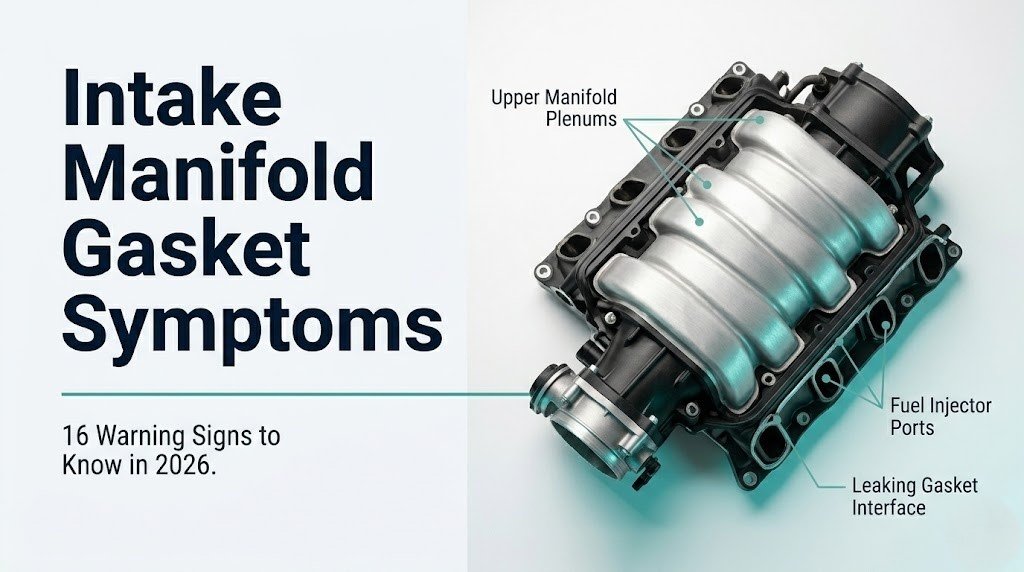
Complete symptom inventory for a failing intake manifold gasket:
- Rough or unstable idle, particularly pronounced when cold
- Engine misfires on one or more cylinders, often intermittent
- Hesitation or stumbling under light acceleration
- Poor fuel economy, typically a 10 to 20% reduction from baseline
- Check engine light illuminated, often with lean codes (P0171, P0174) or misfire codes (P0300-P0308)
- Coolant level dropping without an external puddle under the car
- White or sweet-smelling exhaust smoke, particularly noticeable when cold
- Engine overheating or temperature gauge running higher than normal
- Milky, frothy oil visible on the dipstick or under the oil cap
Vehicles with turbocharged engines show a slightly different symptom pattern. A vacuum or air leak downstream of the turbocharger but upstream of the throttle body on a boosted engine can produce boost pressure loss under hard acceleration rather than simply a lean idle condition.
Key Takeaway: A failing intake manifold gasket almost always produces at least two or three simultaneous symptoms across different engine systems, and a single isolated symptom is less likely to be the gasket than a combination of rough idle, lean codes, and unexplained coolant loss together.
Intake Manifold Leak Symptoms: Three Distinct Failure Modes
Intake manifold leak symptoms divide cleanly into three mechanically distinct failure categories, and each category produces a different set of observable signs.
Failure Mode 1: Air/Vacuum Leak
The gasket fails along the intake port sealing surface, allowing atmospheric air to enter the intake stream downstream of the mass airflow sensor (MAF sensor). The MAF sensor has already measured a specific air volume entering the throttle body. But now additional, unmeasured air is entering through the leak point. The engine control module (ECM) calculates injector pulse width based on the MAF reading and doesn’t account for the extra air. The result is a lean air-fuel mixture in the affected cylinder or cylinders.
Failure Mode 2: Coolant Leak (Internal)
The gasket fails around a coolant passage, allowing pressurized coolant to enter the intake port, the combustion chamber, or the engine oil. Internal coolant leaks are particularly serious because coolant entering the combustion chamber produces the classic white exhaust smoke and a sweet smell from the exhaust. Coolant mixing with engine oil creates a milky contamination that breaks down bearing film protection rapidly.
Failure Mode 3: External Leak
The gasket fails along its outer sealing edge, allowing coolant or oil to leak externally onto the engine block, manifold, or ground. External leaks are often visible as crusty residue or active dripping and are generally easier to diagnose than internal leaks.
| Failure Mode | Primary Symptoms | Diagnostic Priority |
|---|---|---|
| Air/vacuum leak | Rough idle, lean codes, poor fuel economy | Moderate, can worsen gradually |
| Internal coolant leak | White smoke, coolant loss, oil contamination | High, engine damage risk present |
| External leak | Visible fluid, smell, low coolant or oil | Moderate to high depending on rate |
| Combined | Multiple symptoms from above | High, assess immediately |
Air Intake Leak Symptoms: What Unmetered Air Does to Your Engine
Air intake leak symptoms from a failed intake manifold gasket are produced by a precise and measurable disruption of the engine’s air-fuel metering system, and understanding the mechanism explains exactly why the symptoms feel the way they do.
A modern fuel-injected engine maintains a stoichiometric air-fuel ratio of 14.7 parts air to 1 part fuel for complete, efficient combustion. The MAF sensor measures the mass of air entering the throttle body and sends that data to the engine control module (ECM). The ECM calculates exactly how much fuel each injector needs to deliver to hit 14.7:1.
When a vacuum leak develops through a failed gasket, unmetered air enters the intake stream after the MAF sensor’s measurement point. The ECM now sees the correct air mass reading from the MAF sensor but the actual mixture going into the cylinder is leaner than 14.7:1 because of the extra air. The ECM detects this through the oxygen sensor (O2 sensor) feedback signal, which reports a lean exhaust condition. The ECM responds by commanding positive fuel trim corrections, essentially adding extra fuel to try to reach the target mixture.
Think of it like a coffee machine calibrated to put one scoop of grounds per cup of water. Someone secretly adds an extra half cup of water after the machine has already measured. The coffee comes out weak, and no matter how many times the machine runs its cycle at the same settings, the result stays too diluted.
The ECM can adapt fuel trim up to approximately plus 10 to 15% on most systems. If the leak is large enough that even a 15% fuel enrichment correction cannot bring the mixture back to stoichiometric, the system goes into a persistent lean condition and sets a diagnostic trouble code.
Observable air intake leak symptoms in order of typical appearance:
- Rough or hunting idle (ECM cannot stabilize fuel trim at idle speed)
- Stumbling hesitation when transitioning from idle to light acceleration
- Slightly higher idle speed than normal (ECM commanding more fuel, engine responds)
- Decreased fuel economy of 10 to 20% in normal driving
- Occasional engine stall, particularly when coming to a stop
- Check engine light with P0171 (lean, bank 1) or P0174 (lean, bank 2)
Symptoms of a Bad Intake Manifold: Drivability vs. Fluid Loss Signs
Symptoms of a bad intake manifold, meaning the manifold body itself rather than just the gasket, overlap significantly with gasket failure symptoms but include several additional physical signs that a gasket failure alone does not produce.
The distinction matters for repair planning. A failed gasket requires gasket replacement and possibly resurfacing the mating surfaces. A cracked or warped intake manifold requires manifold replacement, which is a more expensive repair. The good news is that the symptom patterns, while overlapping, have several distinguishing features.
Drivability symptoms (produced by both gasket failure and manifold failure):
- Rough idle and stumbling
- Engine misfires and hesitation
- Check engine light with lean and misfire codes
- Poor fuel economy
Fluid loss symptoms (produced by both when sealing surfaces are compromised):
- Unexplained coolant level drop
- External coolant or oil residue on the engine block
- Milky oil contamination
Symptoms more specific to manifold body failure (crack or warp):
- A hissing or whistling sound from the engine bay that changes with engine speed
- A vacuum leak that cannot be resolved by gasket replacement
- Visible crack lines in the manifold body, most often near heat-stressed port openings
- Warping of the sealing surface measurable with a straight edge
Plastic composite intake manifolds, common on many 1990s and 2000s V6 engines, are prone to cracking at the base near the coolant crossover outlet. On aluminum manifolds, warping is a more common failure mode than cracking outright.
Key Takeaway: If a vehicle continues showing intake leak symptoms after a gasket replacement, the manifold body itself should be inspected for cracks and measured for flatness before any further gasket work is done.
Rough Idle and Engine Misfire from Intake Gasket Failure
Rough idle from a failed intake manifold gasket is produced by a lean air-fuel imbalance across one or more cylinders, and engine misfires represent the point at which that imbalance becomes severe enough that combustion fails entirely in affected cylinders.
At idle speed, the throttle plate is nearly closed. The engine relies almost entirely on intake vacuum to draw air and fuel into the cylinders. Intake manifold vacuum at idle typically runs between negative 15 and negative 22 inches of mercury on a healthy engine. This strong vacuum is precisely what makes a gasket air leak most damaging at idle: the leak point is at peak vacuum differential, drawing in the largest volume of unmetered air relative to throttle input.
As the throttle opens during acceleration, manifold vacuum drops significantly. The proportion of unmetered air entering through the leak becomes a smaller fraction of total airflow. This is why a gasket air leak often causes a rough idle that partially improves as engine speed increases, a pattern that can mislead drivers into thinking the problem is minor.
Engine misfire (registered as OBD-II codes P0300 through P0308) occurs when the air-fuel mixture in a cylinder is too lean to sustain reliable ignition. A single misfire event means the spark plug fired but combustion did not propagate completely through the mixture. Repeated misfires from the same cylinder under the same conditions point to a localized lean condition, which a gasket leak near that cylinder’s intake port produces reliably.
Identifying the idle and misfire pattern:
- Note whether the rough idle is present immediately at cold start (suggests lean condition from air leak rather than cold start enrichment problem)
- Observe whether idle smoothness improves slightly after 3 to 5 minutes of warm-up (typical of gasket air leak, because thermal expansion partially closes the gap)
- Check if idle quality worsens under electrical load such as headlights or air conditioning (suggests the ECM cannot maintain idle stability even with load compensation)
- Read live OBD-II fuel trim data: positive STFT values greater than plus 8% at idle confirm a lean condition requiring investigation
- Note any cylinder-specific misfire code alongside lean codes: this combination strongly suggests a localized gasket failure near that cylinder’s port
Vehicles with variable valve timing systems, such as many Honda, Toyota, and BMW engines, may display additional symptoms if intake manifold vacuum disruption interferes with oil pressure-controlled variable cam timing actuators, producing cam timing faults alongside the lean codes.
Check Engine Light and Fuel Trim Symptoms of Intake Manifold Leak
A check engine light triggered by an intake manifold leak follows a predictable pattern in the OBD-II diagnostic data stream, and reading that pattern correctly can confirm a gasket failure before any physical disassembly.
The malfunction indicator lamp (MIL), commonly called the check engine light, illuminates when the ECM stores a diagnostic trouble code (DTC) indicating a system has operated outside its normal parameters for two consecutive drive cycles. Intake manifold gasket failures most commonly generate the following codes:
| OBD-II Code | Meaning | Relationship to Intake Gasket Failure |
|---|---|---|
| P0171 | System lean, bank 1 | Air leak into bank 1 cylinders via gasket breach |
| P0174 | System lean, bank 2 | Air leak into bank 2 cylinders (V engines) |
| P0300 | Random multiple misfire | Lean condition causing inconsistent combustion |
| P0301-P0308 | Cylinder-specific misfire | Localized lean condition near specific gasket breach |
| P0507 | Idle control system high RPM | ECM raising idle to compensate for lean condition |
The fuel trim data is the most diagnostically precise indicator. Short-term fuel trim (STFT) reflects real-time ECM fuel adjustments in the current driving moment. Long-term fuel trim (LTFT) reflects the ECM’s learned compensation over time. According to ASE diagnostic standards, LTFT values consistently above plus 10% strongly indicate an air induction system leak, and values above plus 20% indicate a large, diagnostically unambiguous leak.
The pattern that most reliably points to an intake manifold gasket as the source, rather than another vacuum leak, is when lean codes and elevated fuel trims worsen at idle and improve noticeably at higher engine speeds. This idle-specific lean condition is a hallmark of intake manifold area leaks because, as explained in the previous section, manifold vacuum differential is highest at idle.
Drivers should be aware that a cleared check engine light does not repair the underlying problem. Codes will return within one to two drive cycles if the underlying gasket failure remains. Repeated code clearing without repair accelerates the ECM’s difficulty in maintaining adaptive fuel trim within its correction limits.
Key Takeaway: Positive long-term fuel trim values above plus 10% combined with lean codes and a rough idle that improves with engine speed represent a textbook intake manifold gasket vacuum leak signature in OBD-II diagnostic data.
Engine Overheating and Coolant Loss from Intake Manifold Gasket
Engine overheating caused by a failed intake manifold gasket is a mechanically distinct and more serious symptom pattern than the drivability symptoms produced by air leaks, because it indicates that the coolant passage seals within the gasket have failed.
Many V6 and V8 engines route engine coolant through passages cast into the intake manifold itself. The purpose of this design is to warm the base of the intake manifold during cold starts, preventing fuel condensation on cold manifold surfaces and improving cold-start emissions. The gasket must seal these coolant passages against both the intake air path and the engine block external surface simultaneously.
When the coolant passage seal fails, one of three coolant pathways opens: coolant leaks internally into the intake air stream and then into the combustion chamber; coolant leaks internally into the engine oil; or coolant leaks externally down the side of the engine block. Each pathway produces a different observable symptom.
Internal coolant loss into the combustion chamber is the most mechanically dangerous pathway. Coolant in the combustion chamber produces white or grey exhaust smoke with a distinctly sweet smell from the burned ethylene glycol. The coolant level in the reservoir drops without any puddle under the vehicle because the fluid is being consumed internally. On a cold start especially, a brief cloud of white smoke that clears after the engine warms is a characteristic early sign of this failure.
The overheating itself occurs because the coolant loss reduces the volume of coolant circulating through the radiator. The cooling system’s heat rejection capacity depends on adequate coolant volume and flow. As coolant volume drops, the system reaches a point where heat rejection can no longer match engine heat production, and the temperature gauge climbs toward the red zone.
Coolant-related symptom progression without intervention:
- Coolant reservoir level drops intermittently over several weeks
- Slight temperature gauge elevation, especially in stop-and-go traffic
- Intermittent white smoke on cold starts, clearing after warmup
- Sweet exhaust smell detectable outside the vehicle
- Temperature gauge entering the high normal or warning range consistently
- Active overheating event with temperature gauge in red zone
For older adults who drive infrequently and may not notice gradual coolant level drops between weekly checks, this progression can reach stage 5 or 6 before any symptom is recognized. Checking coolant reservoir level monthly is the single most effective early detection step for this failure mode.
Upper Intake Manifold Gasket Leak Symptoms
Upper intake manifold gasket leak symptoms are predominantly drivability-related and are produced by air and vacuum seal failures rather than coolant leaks, because the upper portion of the intake manifold system on most engine designs does not carry engine coolant.
The upper intake manifold refers to the plenum chamber and runner assembly that sits above the lower intake manifold or, on single-piece manifold designs, the upper portion of the combined assembly. On many V6 and V8 engines from the 1990s through 2010s, a two-piece intake manifold design was used: an upper plenum that bolted to a lower manifold. The gasket between these two pieces is the upper intake manifold gasket or plenum gasket.
Because the upper section primarily carries pressurized or vacuum air rather than coolant, an upper intake manifold gasket failure presents as a pure vacuum leak with the following characteristic symptoms:
- Rough or hunting idle
- Lean codes (P0171, P0174) in OBD-II data
- Hesitation on light throttle application
- Hissing sound from the engine bay, audible with the hood open and engine at idle
- Elevated positive fuel trim values
The hissing sound deserves specific attention. A vacuum leak through an upper intake manifold gasket produces an audible hiss at idle because the strong manifold vacuum at idle draws air through the leak point at velocity, creating a high-frequency sound. The hiss typically diminishes as engine speed increases and manifold vacuum drops, which distinguishes it from other mechanical noises that worsen with engine speed.
On Ford Triton V8 engines (the 5.4-liter used in F-150 trucks through 2010) and various General Motors V6 engines, the upper intake manifold gasket has a documented failure pattern noted in multiple technical service bulletins. A licensed ASE-certified technician evaluating an engine with lean codes should always inspect this specific sealing surface before replacing more expensive components.
Lower Intake Manifold Gasket Leak Symptoms
Lower intake manifold gasket leak symptoms tend to be more severe and mechanically consequential than upper gasket symptoms, because the lower intake manifold gasket on most V-type engines seals coolant passages in addition to intake air ports.
The lower intake manifold on a V6 or V8 engine sits in the valley between the two cylinder banks and bolts directly to both cylinder heads. It is the component most deeply integrated with the engine’s thermal management system. The gasket sealing this component, the lower intake manifold gasket, must simultaneously seal intake air ports (typically six or eight port openings), multiple coolant passages that transfer coolant between the engine block and the manifold, and on some designs, oil passages as well.
When the lower intake manifold gasket fails on a coolant-passage-containing design, the symptoms are frequently more serious than an upper gasket failure because coolant can now reach the combustion chamber or the engine oil. The General Motors 3800 Series V6 engine, used in millions of Buick, Chevrolet, Oldsmobile, and Pontiac vehicles from the 1990s through mid-2000s, became the most widely documented example of this failure pattern. The use of Dexcool extended-life coolant in these engines was associated with accelerated composite gasket degradation, and NHTSA records include thousands of consumer complaints and multiple manufacturer technical service bulletins addressing this specific failure.
Symptom comparison: upper vs. lower intake manifold gasket failure
| Symptom | Upper Gasket Failure | Lower Gasket Failure |
|---|---|---|
| Rough idle | Common | Common |
| Lean codes | Common | Common |
| Coolant loss | Rare | Common |
| White exhaust smoke | Rare | Common |
| Milky engine oil | Absent | Possible if oil passage fails |
| Engine overheating | Rare | Common without intervention |
| External fluid residue | Absent | Common, visible on engine block |
Owners of high-mileage V6 or V8 vehicles, particularly those with GM engines and Dexcool coolant, should prioritize inspection of the lower intake manifold gasket at or after 100,000 miles even without obvious symptoms, as the failure can begin with very small internal leaks that produce no visible external signs for weeks before becoming serious.
Key Takeaway: Lower intake manifold gasket failure presents a fundamentally different and more urgent threat than upper gasket failure because it directly risks engine cooling system integrity and, in worst cases, engine oil contamination with coolant.
Intake Plenum Gasket Symptoms
Intake plenum gasket symptoms are a specific subset of upper intake manifold gasket symptoms and present primarily as a pure air leak with drivability consequences rather than any fluid-related signs.
The intake plenum is the large air-collection chamber that receives air from the throttle body and distributes it to the individual intake runners leading to each cylinder port. On many V-type engines using a two-piece intake manifold, the plenum sits as the upper half and connects to the lower half via a flat gasket surface. On single-throttle-body four-cylinder engines, the plenum is typically integral to the single-piece manifold.
When the plenum gasket fails, the air leak it creates is typically a large, diffuse leak rather than a localized per-cylinder leak. This means the lean condition it produces tends to affect all cylinders relatively equally, unlike a port-area gasket breach that may preferentially affect one or two cylinders.
The symptom pattern of a failed plenum gasket:
- Pronounced rough idle that may feel like the engine is “floating” or surging rhythmically
- Lean codes on both banks (both P0171 and P0174 simultaneously)
- High idle speed as the ECM commands increased idle to maintain RPM stability
- Fuel trim values elevated across both banks simultaneously
- Audible hiss or whistling from the center of the engine, above the throttle body
- Throttle response that feels vague or “mushy” at small throttle openings
The audible hiss from a plenum gasket leak is often the most distinctive symptom a driver or technician notices first. With the hood open and the engine at idle, placing a hand near the manifold-to-plenum sealing surface while listening carefully often reveals the leak source. A propane enrichment test, a diagnostic method in which a small amount of propane gas is directed toward suspect leak areas while monitoring the engine’s fuel trim and idle quality response, is a reliable method for locating plenum gasket leaks without disassembly.
Cracked Intake Manifold Symptoms
Cracked intake manifold symptoms overlap almost entirely with failed gasket symptoms but include several additional physical signs, and a cracked manifold produces a vacuum or coolant leak that persists even after a new gasket is installed.
A crack in the intake manifold body can develop from thermal stress (repeated heating and cooling cycles), impact damage, or structural fatigue in plastic composite manifolds that have become brittle with age. The most common crack locations are around the port openings where manifold wall thickness is thinnest, near the coolant outlet fitting or crossover passage on manifolds that carry coolant, and along the mounting flange area where bolt clamping stress concentrates.
Symptoms that suggest a cracked manifold rather than, or in addition to, a failed gasket:
- A vacuum leak that returns shortly after new gaskets are installed
- A visible crack line on the manifold body surface, often appearing as a hairline with dark residue around it
- Coolant loss that continues after gasket replacement
- A lean condition or drivability symptom that cannot be resolved despite thorough gasket replacement
- Plastic manifold discoloration or deformation near heat sources
The diagnostic confirmation step for a cracked manifold is a smoke test applied to the intake system with the manifold installed: smoke emerging from the manifold body itself rather than the gasket sealing surface confirms a crack. Alternatively, a visual inspection of the manifold after removal, including inspection of internal passages with a flashlight and hand mirror, can reveal crack paths not visible externally.
According to repair data compiled by professional automotive diagnostic resources, plastic composite intake manifolds on V6 engines from the late 1990s and 2000s have a failure rate that climbs significantly after 120,000 miles, with cracking most commonly noted near the EGR passage inlet and the coolant crossover outlet. Replacing a cracked manifold with an updated design, rather than attempting adhesive repair of a plastic crack, is the standard professional recommendation.
How to Diagnose an Intake Manifold Gasket Leak
Diagnosing an intake manifold gasket leak accurately requires a systematic sequence of tests, moving from the simplest no-tool checks to equipment-based confirmation, and each step narrows the differential between a gasket failure and other possible causes.
The diagnostic sequence used by ASE-certified technicians:
- Read OBD-II fault codes and live fuel trim data. A consumer OBD-II scan tool connected to the diagnostic port (typically under the left side of the dashboard) will display stored codes and live fuel trim values. Positive LTFT values above plus 10% combined with P0171 or P0174 codes provide the initial pointer toward a lean air-induction system fault.
- Check coolant level and condition. Pull the coolant reservoir cap (when cold) and inspect the level. Inspect the underside of the engine oil cap for white frothy residue, which indicates coolant mixing with oil. Pull the dipstick and examine oil color: normal oil is amber to dark brown; oil contaminated with coolant appears tan, frothy, or milky.
- Inspect the intake manifold sealing surfaces externally. Look for coolant staining (white crystalline deposits), oil residue, or carbonized buildup along the gasket seam between the manifold and cylinder head. A UV dye added to the coolant system and inspected with a UV lamp can reveal slow external coolant seeps.
- Perform a smoke test. A shop smoke machine introduces low-pressure smoke into the intake system through the air inlet. Smoke emerging from the gasket sealing surface, plenum joint, or manifold body confirms a leak location. This is the most reliable single test for locating air and vacuum leaks in the intake system.
- Perform a cooling system pressure test. A pressure tester applied to the coolant reservoir pressurizes the system to the rated cap pressure (typically 15 to 16 psi). If pressure drops without any visible external leak, an internal coolant leak through the intake manifold gasket is strongly indicated.
- Perform a block test for combustion gases in coolant. A combustion gas detector (block test tool) is used at the coolant reservoir opening with the engine running. A color change from blue to yellow indicates the presence of combustion gases in the coolant, which can indicate either head gasket or intake manifold gasket failure where coolant passages communicate with combustion chambers.
Individuals without access to a smoke machine or block test kit should bring their vehicle to an ASE-certified technician with intake manifold diagnostic experience. The smoke test and block test together provide definitive confirmation that no visual inspection alone can match.
Can You Drive with a Bad Intake Manifold Gasket?
Whether you can safely drive with a bad intake manifold gasket depends entirely on which failure mode is present, and the answer ranges from “briefly, to a shop” to “stop immediately and do not restart the engine.”
The decision framework turns on one critical question: is coolant involved?
If the failure is a pure air/vacuum leak (rough idle, lean codes, no coolant loss, no temperature gauge change), the engine is not in immediate danger of severe damage. A vacuum leak makes the engine run poorly and increases fuel consumption, but it does not risk catastrophic failure in the short term. Driving the vehicle briefly to a repair facility is generally acceptable. Driving it for days or weeks without repair is not acceptable, because the lean condition accelerates combustion temperature and can cause valve and catalytic converter damage over time.
If the failure involves any coolant loss (dropping coolant level, white smoke, sweet exhaust smell, rising temperature gauge), the situation is fundamentally different. A coolant leak through the intake manifold gasket can accelerate rapidly from a slow seep to an active loss. An engine that has lost enough coolant to begin overheating can suffer cylinder head warping in minutes of sustained high-temperature operation. Warped cylinder heads require machining or replacement, turning a gasket repair into a multi-thousand-dollar engine rebuild.
| Symptom Pattern | Driving Safety Assessment | Recommended Action |
|---|---|---|
| Rough idle only, normal temperature | Brief driving acceptable | Schedule repair within days |
| Lean codes, no coolant change | Brief driving acceptable | Schedule repair within a week |
| Any coolant level drop | Do not drive long distances | Repair immediately, monitor closely |
| White smoke, sweet smell | Do not drive | Tow to shop |
| Rising temperature gauge | Pull over, stop engine | Do not restart until inspected |
| Red zone temperature gauge | Emergency, stop immediately | Call for tow, do not restart |
High-mileage vehicles (over 150,000 miles) with one failed gasket seal should be evaluated for the condition of all adjacent gaskets simultaneously, because when one seal on an aged engine fails, neighboring seals are often at similar fatigue levels.
Key Takeaway: A pure vacuum leak from a failed intake manifold gasket allows brief careful driving to a shop, but any sign of coolant involvement, including a single unexplained coolant level drop, changes the calculation to “repair before driving further.”
Intake Manifold Gasket Replacement: When It Becomes Urgent
Intake manifold gasket replacement becomes urgent the moment coolant loss, overheating, or oil contamination enters the symptom picture, because those failure modes carry a risk of cascading engine damage that grows with every additional mile driven.
A vacuum-only air leak from a failed gasket can theoretically be monitored over a short period, but there is no way to predict when a deteriorating gasket will transition from a pure air leak to a coolant or oil seal failure. The same thermal cycling, material fatigue, and sealing surface degradation that caused the air seal to fail is simultaneously weakening the coolant and oil seals in the same gasket. Once one zone fails, the others are statistically at elevated risk.
The practical urgency thresholds for scheduling intake manifold gasket replacement:
- Within 48 hours: Any coolant level drop without external puddle; any white smoke on startup; any sweet exhaust smell
- Within one week: Persistent rough idle with confirmed lean codes; positive LTFT greater than plus 15%; recurring misfire codes alongside lean codes
- Schedule at next available appointment: Mild rough idle with lean codes within normal adaptive range; periodic hesitation under light load only
The repair itself varies substantially in complexity and cost depending on engine design. On many four-cylinder engines with a simple single-plane intake manifold, gasket replacement is a two- to four-hour job at standard labor rates. On V6 and V8 engines where the intake manifold sits in the valley between the heads and requires significant accessory removal, labor time can run eight to twelve hours, and parts often require replacement of ancillary seals and sensors disturbed during disassembly.
When scheduling gasket replacement, a vehicle owner should ask the technician specifically whether the cylinder head sealing surfaces will be inspected for flatness (a warped head requires resurfacing), whether the coolant will be fully flushed and replaced (contaminated coolant accelerates new gasket failure), and whether the manifold torque specifications will be followed in sequence per the OEM specification (improper torque is a leading cause of new gasket failures within the first year after repair).
Emergency Symptoms: When to Pull Over Immediately
Certain symptoms associated with intake manifold gasket failure require immediate action. Do not wait to see if these resolve on their own.
Pull over safely, shut off the engine, and do not restart if you experience:
- Temperature gauge entering the red zone or warning light activating (active overheating indicates coolant loss has reached a critical level; continued driving risks cylinder head warping within minutes)
- Steam or white smoke rising from under the hood while driving (indicates coolant is contacting hot engine surfaces, which means coolant level is critically low)
- A sudden sweet or burning smell inside the cabin combined with any temperature gauge elevation (coolant is entering the combustion chamber or heating system)
- A sudden loss of engine power accompanied by a loud knocking sound (indicates possible hydrolock, a condition in which coolant has filled a combustion chamber and the piston cannot complete its stroke, which causes connecting rod damage or crankshaft damage)
- Frothy milky substance visible on the dipstick upon roadside check (engine oil has been contaminated with coolant, meaning bearing lubrication is compromised and continued operation risks catastrophic bearing failure)
Do not attempt to add coolant to an overheated engine. Adding cold coolant to a thermally stressed engine can cause thermal shock cracking of the cylinder head or block. Allow the engine to cool completely, at least 30 to 45 minutes, before opening the coolant reservoir.
Call for a tow. A vehicle with an actively overheating engine, visible steam, or confirmed coolant-in-oil contamination should not be restarted and driven to the shop. These presentations indicate engine damage risk that a tow prevents and continued driving guarantees.
Frequently Asked Questions About Intake Manifold Gasket Symptoms
What are the most common intake manifold gasket symptoms?
The most common intake manifold gasket symptoms are rough or unstable idle, a check engine light with lean codes (P0171 or P0174), unexplained coolant level drop, and hesitation under light acceleration.
Most vehicles show at least two or three of these simultaneously rather than just one, and the combination of a lean code with rough idle and coolant loss is particularly strong evidence of gasket failure.
An ASE-certified technician can confirm the diagnosis with a smoke test and fuel trim analysis before any disassembly.
How do I know if I have a vacuum leak or a coolant leak from my intake manifold gasket?
A vacuum leak produces rough idle, lean OBD-II codes, and hesitation with no change in coolant level or exhaust color.
A coolant leak produces white exhaust smoke with a sweet smell, a dropping coolant reservoir level without any puddle under the car, and often a rising temperature gauge.
Both failure modes can coexist on a severely degraded gasket, which is why a full diagnostic including a cooling system pressure test and OBD-II fuel trim scan is the most reliable approach.
Can a bad intake manifold gasket cause overheating?
A bad intake manifold gasket can absolutely cause engine overheating when the coolant passage seals within the gasket fail, allowing coolant to leak internally or externally and reducing the volume of coolant available for engine heat rejection.
This failure mode is most common on V6 and V8 engines where coolant passages run through the intake manifold body, and it is particularly well-documented on General Motors 3800 V6 engines per NHTSA technical service bulletin records.
Any overheating event should be treated as an emergency: pull over, shut off the engine, and arrange a tow rather than attempting to drive to a shop.
What does a bad intake manifold gasket sound like?
A failing intake manifold gasket with a vacuum leak often produces an audible hissing or whistling sound from the engine bay, most noticeable at idle with the hood open.
The sound is produced by atmospheric air being drawn through the leak point at velocity by the strong manifold vacuum at idle, and it typically diminishes as engine speed increases and manifold vacuum drops.
Some vehicles also produce a slight suction sound near the manifold sealing surface that a technician can detect by slowly moving their hand along the sealing edge with the engine running.
How much does it cost to replace an intake manifold gasket?
Intake manifold gasket replacement cost ranges from approximately $300 to $900 for most four-cylinder engines and from $600 to $2,000 or more for V6 and V8 engines where the intake manifold requires extensive disassembly to access.
Labor is the primary cost driver: a straightforward four-cylinder job may take two to three hours, while a valley-mounted V8 intake manifold replacement can require eight to twelve labor hours at standard shop rates.
Additional costs apply if the sealing surface requires resurfacing due to warping, or if coolant contamination requires a full cooling system flush and thermostat replacement.
Is it safe to drive with a bad intake manifold gasket?
Driving safety with a bad intake manifold gasket depends entirely on the failure mode: a pure vacuum/air leak allows brief careful driving to a repair facility, but any coolant involvement makes continued driving risky.
A rising temperature gauge, white exhaust smoke, sweet exhaust smell, or dropping coolant level means the engine is losing coolant, and overheating damage can occur within minutes of the temperature gauge entering the red zone.
The safest course with any coolant-related intake manifold symptom is to stop driving and arrange repair or towing rather than monitor the situation while continuing to use the vehicle.
What to Do When You Recognize These Symptoms
The single most actionable step after recognizing intake manifold gasket symptoms is to read your OBD-II codes and check your coolant level before driving further. Those two pieces of information, available in under five minutes with a $30 consumer scan tool and a quick look at the coolant reservoir, tell you whether you are dealing with a pure vacuum leak or a coolant system failure.
If the coolant level is normal and you have only lean codes with rough idle, schedule a repair appointment within the week and monitor the coolant level daily in the meantime. If the coolant level is low, white smoke is present, your exhaust smells sweet, or your temperature gauge has climbed above normal, stop driving the vehicle and contact an ASE-certified technician for towing and assessment.
The engines most vulnerable to the serious coolant-pathway version of this failure are high-mileage V6 and V8 designs, especially those in vehicles with 100,000 or more miles and Dexcool-type coolant. If your vehicle matches that profile and you have noticed any one of the warning signs described in this article, have the intake manifold gasket inspected proactively. Catching this failure before it becomes an active coolant loss is the difference between a straightforward gasket repair and a warped head.