Crankshaft Sensor Symptoms: 16 Warning Signs (2026)
Crankshaft sensor symptoms include engine misfires, rough idle, intermittent stalling, hard starting, and in advanced failure, a complete no-start condition. These problems appear because the crankshaft position sensor (CKP sensor) is the component your engine’s computer relies on to know exactly where the crankshaft is at every moment of engine rotation.
According to the Society of Automotive Engineers (SAE), the CKP sensor is one of the most fundamental inputs to any modern engine management system. Without an accurate, continuous signal from this sensor, the engine control module cannot calculate when to fire ignition coils or when to pulse fuel injectors. A survey of ASE-certified technician training data consistently identifies CKP sensor failure as one of the top 10 causes of intermittent no-start and highway stalling complaints in vehicles with more than 75,000 miles.
This article covers every symptom a failing CKP sensor produces, explains exactly why each symptom occurs in mechanical terms, distinguishes early from advanced failure, and tells you precisely when a failing sensor creates a genuine road safety emergency.
Crankshaft Position Sensor Function and What It Controls
The crankshaft position sensor monitors the exact rotational position and speed of the crankshaft, the central rotating shaft inside your engine that converts the up-and-down motion of pistons into rotational power. Without this signal, the engine control module is essentially flying blind.
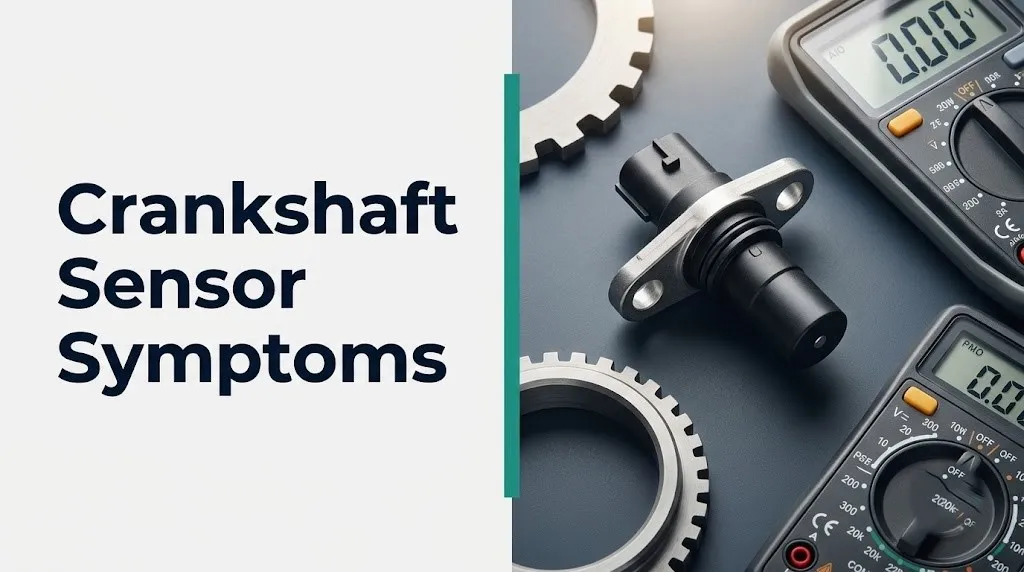
Here’s how the signal chain works. As the crankshaft rotates, it carries a reluctor wheel (also called a tone ring or toothed ring). This ring has evenly spaced teeth machined into it, plus one or more missing-tooth gaps that create reference points. The CKP sensor reads the teeth passing by and generates a precise electrical signal that tells the ECM both the rotational speed (engine RPM) and the angular position of the crankshaft at every moment.
The ECM uses this data for at least four simultaneous functions:
- Ignition timing: Firing each cylinder’s ignition coil at precisely the right crankshaft angle, measured in degrees before top dead center
- Fuel injection timing and pulse width: Opening each fuel injector at the correct moment and for the correct duration, measured in milliseconds
- Idle speed control: Adjusting the idle air control valve to maintain stable idle RPM
- Variable valve timing commands: In engines equipped with VVT systems, the ECM cross-references CKP and CMP signals to adjust camshaft timing
Think of the CKP sensor like the timing conductor in an orchestra. Every section, brass, strings, woodwinds, fires at a specific cue. Remove the conductor’s signal, and the sections start firing out of sequence. The result is not silence; it’s chaotic, damaging noise. In engine terms, that noise shows up as misfires, rough idle, and stalling.
Vehicle age note: In vehicles manufactured before 1996, pre-OBD-II systems may handle CKP sensor failure differently, often with fewer warning codes and more abrupt failure. Vehicles from 1996 onward follow standardized OBD-II protocols under EPA regulations (40 CFR Part 86), which require the ECM to log and report specific diagnostic trouble codes when CKP signal integrity falls outside calibrated thresholds.
| CKP Signal Function | Engine System Affected | Symptom When Signal Fails |
|---|---|---|
| Crankshaft position reference | Ignition coil firing | Engine misfire, rough running |
| Crankshaft RPM calculation | Fuel injector timing | Stumble, hesitation, stall |
| Idle reference point | Idle air control | Rough or unstable idle |
| Cam-crank correlation | Variable valve timing | Power loss, rough running |
| Tachometer signal source | Dashboard RPM gauge | Erratic or dead tach needle |
Crankshaft Position Sensor Location on Your Engine
The CKP sensor is typically mounted at the lower front, lower rear, or side of the engine block, positioned close enough to the reluctor wheel on the crankshaft to read the tooth pattern accurately. Its exact location varies by vehicle manufacturer, engine configuration, and model year.
On most inline-4 and inline-6 engines, the sensor sits near the crankshaft pulley at the front of the engine or near the transmission bell housing at the rear. On V6 and V8 engines, it is often mounted near the lower engine block on either the front or driver’s side. Some rear-wheel-drive vehicles with longitudinal engine mounting place the sensor at the rear of the block near the flywheel.
The air gap between the CKP sensor tip and the reluctor wheel teeth is critical. Manufacturer specifications typically call for a gap of 0.5 to 1.5 millimeters, though exact tolerances are engine-specific. If the sensor moves due to a loose mounting bolt, or if the reluctor wheel develops a damaged tooth, the signal quality degrades even before the sensor itself fails.
Finding the sensor on your specific vehicle matters for two reasons. First, it lets you visually inspect the sensor’s wiring harness and connector for damage, which is a common failure point. Second, it tells you whether an oil seal leak nearby could be contaminating the sensor with engine oil, another documented cause of premature failure.
Engine configuration note: On transversely mounted engines (front-wheel-drive vehicles with the engine oriented sideways), the CKP sensor is often buried behind engine components and is significantly harder to access. This affects replacement labor time and cost. Longitudinally mounted engines (most rear-wheel-drive and all-wheel-drive vehicles) typically offer easier access, reducing labor time.
Quick Tip:
- Look for a sensor body with a single or dual-wire connector near the bottom third of the engine block
- A wiring harness that runs toward the engine mount area, showing cracks or heat damage, is a common early failure sign
- On high-mileage vehicles, always inspect the connector for corrosion before assuming the sensor itself has failed
Symptoms of a Bad Crankshaft Position Sensor
The most recognizable symptoms of a bad crankshaft position sensor are engine misfires, rough idle, intermittent stalling, difficulty starting, a check engine light with a P0335 or related code, and erratic RPM gauge behavior. These symptoms can appear individually or in combinations depending on whether the sensor is failing intermittently or has reached complete failure.
What makes CKP sensor failure confusing is that its symptoms overlap heavily with other engine problems, including failing ignition coils, bad fuel injectors, and worn spark plugs. The key distinguishing feature of CKP sensor failure is its relationship to engine load and temperature: symptoms often appear, disappear, and reappear rather than presenting as a steady, worsening mechanical problem.
Here is the complete symptom picture, from earliest presentation to complete failure:
Early-stage symptoms (sensor degrading but still functional):
- Occasional rough idle that smooths out after a few minutes
- Subtle hesitation during acceleration from a stop
- Intermittent check engine light that may clear on its own
- Slightly reduced fuel economy with no other obvious cause
- Mild tachometer needle flutter at idle
Mid-stage symptoms (signal dropout becoming regular):
- Consistent engine misfires under load
- Stalling at idle or immediately after cold start
- Hard starting that improves after the third or fourth crank attempt
- Check engine light stays on with a stored P0335, P0336, P0337, or P0338 code
- Noticeable RPM drop or surge at idle
Advanced-stage symptoms (signal lost or near-lost):
- Engine cranks continuously but will not start
- Stalling at highway speed without warning
- Engine shuts off immediately after starting
- Complete tachometer failure (gauge reads zero while engine cranks)
Older vehicle note: In vehicles with distributor-based ignition systems (generally pre-1990s), the crankshaft position function may be handled by the distributor pickup rather than a dedicated CKP sensor. Symptoms of distributor pickup failure overlap closely with modern CKP sensor failure symptoms, but the diagnostic approach differs.
Engine Misfires and Rough Idle from a Failing CKP Sensor
Engine misfires caused by a failing CKP sensor happen because the engine control module receives a degraded or intermittent position signal and fires the ignition coil for each cylinder at the wrong crankshaft angle. The result is incomplete combustion in one or more cylinders, producing the rough, shaking sensation drivers feel as a misfire.
The ECM calculates the correct ignition firing angle in degrees before top dead center (BTDC) using the CKP signal as its reference. On a healthy engine, this firing angle is calculated and applied individually for each cylinder firing event, happening hundreds of times per minute. When the CKP signal drops out even briefly, the ECM either defaults to a generic timing value or skips a firing event entirely. Both outcomes produce a misfire.
Rough idle from CKP sensor failure has a specific character that experienced technicians recognize. It tends to be irregular rather than rhythmic. A failing ignition coil typically causes a consistent single-cylinder misfire that produces a rhythmic shake. A failing CKP sensor causes unpredictable multi-cylinder timing errors, producing a rougher, more random shudder.
According to ASE technical training documentation, misfires that are logged across multiple cylinders simultaneously (misfire codes P0300 through P0308, especially P0300 random/multiple cylinder misfire) in conjunction with a CKP-related code are a strong indicator that the CKP sensor, rather than the individual ignition components, is the root cause.
High-mileage vehicle note: In engines with more than 100,000 miles, CKP sensor-related misfires often coincide with worn spark plugs, which can make the misfire worse and the diagnosis more complex. An ASE-certified technician should evaluate whether both the CKP sensor and the ignition service items need addressing simultaneously.
| Misfire Cause | Misfire Pattern | Associated Code(s) | Key Differentiator |
|---|---|---|---|
| Failing CKP sensor | Random, multiple cylinders | P0335 + P0300 | Worse when hot, improves when cold |
| Failing ignition coil | Single cylinder, consistent | P030X (specific cylinder) | Same cylinder every time |
| Worn spark plug | Single cylinder, gradual onset | P030X (specific cylinder) | Consistent under load |
| Lean fuel condition | Multiple cylinders | P0171, P0174 | Fuel trim data elevated |
Engine Stalling and Intermittent Shutdown Symptoms
Engine stalling from a bad CKP sensor occurs when the signal loss is severe enough that the ECM can no longer maintain the sequential ignition and injection commands needed to sustain combustion. When the ECM receives no crankshaft position reference, it has no choice but to cut fuel and spark. The engine shuts off.
What makes CKP-related stalling particularly dangerous is its unpredictability. Unlike an engine that stalls only at idle, a partially failing CKP sensor can drop the signal at any engine speed. Stalling at idle is inconvenient. Stalling at 65 miles per hour on a highway is an immediate safety emergency.
The stalling pattern associated with CKP sensor failure has a recognized profile. The engine typically shuts off without warning, with no prior rough running in that specific moment. The tachometer drops to zero simultaneously. On most vehicles, the power steering assist (if electric) and brake booster function are maintained briefly by stored system pressure, but driver reaction time is compressed significantly. Restarting after a stall may work immediately, or the engine may not restart for several minutes, particularly if heat is involved.
Intermittent stalling that resolves when the engine cools and returns when the engine is hot again is the classic signature of thermal failure in a CKP sensor. The internal components of the sensor expand with heat, changing the magnetic field characteristics and degrading signal quality. When the engine cools and the sensor contracts, the signal may temporarily restore.
Older driver safety note: Drivers over age 65, or any driver with reduced physical reaction time or strength, face elevated risk from unexpected highway stalling, as quickly navigating to the shoulder requires rapid response. If intermittent stalling at highway speed has occurred even once, the vehicle should not be driven at highway speed until the CKP sensor has been evaluated by an ASE-certified technician.
Hard Starting and No-Start Condition from CKP Sensor Failure
A CKP sensor that has failed completely will produce an engine that cranks but does not start, because the ECM cannot establish the crankshaft position reference required to begin fuel injection or ignition sequencing. The starter motor turns the engine, you hear the engine cranking, but no combustion event initiates.
This symptom is one of the most commonly misdiagnosed presentations in automotive repair. A no-start condition can also be caused by a failed fuel pump, a dead ignition system, a security system fault, or a failed camshaft position sensor. What distinguishes a CKP sensor no-start is the behavior of the tachometer: if the RPM gauge shows zero during cranking (when it should show 100 to 250 RPM), the ECM is not receiving a CKP signal, pointing directly to CKP sensor failure rather than a fuel or security issue.
Hard starting is the earlier presentation on the same spectrum. The engine cranks for several seconds before starting, or requires multiple key-turn attempts before firing. This happens because the ECM is receiving a signal from the CKP sensor, but the signal is weak or intermittent. The ECM eventually gets enough position reference data to initiate the first combustion event, but the process takes longer than normal.
According to the National Institute for Automotive Service Excellence (ASE), a no-crank, no-start condition and a crank, no-start condition are two fundamentally different diagnostic pathways. A no-crank, no-start points to the starter circuit or battery. A crank, no-start points to the ignition, fuel, or sensor circuit, with CKP sensor failure being a primary suspect when the tachometer reads zero during cranking.
Security system interaction note: Some vehicles with passive anti-theft systems (PATS) will produce a crank, no-start condition that mimics CKP failure. Check that no security indicator light is flashing on the dashboard before assuming the CKP sensor is the cause. A scan tool connected to the OBD-II port can distinguish between a security system lockout code and a genuine CKP sensor code.
Key Takeaway: A tachometer that reads zero while the engine is cranking is the single most specific indicator of a failed CKP sensor rather than a fuel, security, or other no-start cause.
Crankshaft Sensor Symptoms That Appear Only When the Engine Is Hot
Heat-related CKP sensor failure is the most diagnostically frustrating symptom pattern: the engine runs normally when cold, develops symptoms after 10 to 30 minutes of driving, and the problem disappears again after the engine cools. This thermal failure mode is caused by physical changes inside the sensor as temperature rises.
Most CKP sensors use one of two detection technologies. Hall effect sensors use a semiconductor that changes its electrical output based on magnetic field proximity. Variable reluctance (VR) sensors use a permanent magnet and wire coil that generate voltage as reluctor teeth pass by. Both types contain components that respond to heat. In a sensor that is aging or has developed microscopic internal damage, thermal expansion of these components changes the air gap effective measurement or alters the internal resistance of the sensor winding, degrading or interrupting the signal.
The practical result: the engine starts and runs fine from a cold start. After 15 to 30 minutes of normal driving, symptoms appear. Rough idle, intermittent stalling, hesitation, or even a stall and no-restart condition occur. When the driver pulls over, opens the hood, and waits 20 minutes, the engine restarts normally. This cycle, which repeats identically each day, is textbook heat-soak CKP sensor failure.
A 2019 technical analysis published in SAE International’s technical paper library on engine management sensor degradation noted that thermally induced failure in position sensors disproportionately affects vehicles in high-ambient-temperature climates (consistent daily temperatures above 90 degrees Fahrenheit) and vehicles that experience frequent short trip cycles where the engine does not fully cool between uses.
Climate note: In regions with hot summers (the U.S. Southwest, Southeast, and similar climates), heat-soak CKP sensor failure is reported at higher rates. Drivers in these regions experiencing the “runs when cold, fails when warm” pattern should prioritize diagnostic evaluation before summer driving conditions worsen the failure rate.
| Failure Pattern | When Symptoms Appear | When Symptoms Resolve | Diagnostic Clue |
|---|---|---|---|
| Heat-soak failure | After 15 to 30 min driving | After engine cools 20 min | No codes when tested cold |
| Complete failure | At any temperature | Rarely resolves | Codes stored, no-start |
| Intermittent connector fault | Random, vibration-related | Temporarily with movement | Wiggling harness triggers symptom |
| Oil-contaminated sensor | Gradual, worsening over weeks | Partially after cleaning | Oil visible on sensor body |
Check Engine Light and Crankshaft Sensor Diagnostic Trouble Codes
The check engine light illuminates when the ECM detects that the CKP sensor’s signal falls outside the calibrated threshold for acceptable signal quality. This threshold is defined by OBD-II standards mandated by the EPA under 40 CFR Part 86 and standardized by SAE protocol J1979.
Critically, the check engine light is not always the first symptom. A CKP sensor in early degradation may produce misfires and rough idle before its signal has degraded to the point the ECM logs a stored fault code. This means a code reader showing “no codes” does not rule out a failing CKP sensor in a vehicle with early-stage symptoms.
When codes do appear, they are stored in the ECM’s fault memory and can be retrieved with any OBD-II scan tool or code reader connected to the standardized diagnostic port under the driver’s side dashboard. Code readers available at auto parts stores allow vehicle owners to retrieve stored codes at no cost in many locations. The codes associated with CKP sensor failure are specific: P0335, P0336, P0337, and P0338, each describing a different aspect of the signal failure.
An important distinction: the check engine light can be triggered by dozens of different fault codes. A check engine light alone is not a symptom of CKP failure. It becomes diagnostically relevant to the CKP sensor only when the specific P0335-series codes are retrieved, or when check engine codes co-occur with the driving symptoms described in the sections above.
Electric and hybrid vehicle note: In hybrid and plug-in hybrid vehicles, the crankshaft position function may be handled differently, with some systems using resolver sensors integrated into the motor-generator rather than a standalone CKP sensor. The diagnostic approach in these vehicles differs from conventional internal combustion engine diagnosis and typically requires manufacturer-specific scan software rather than a generic OBD-II code reader.
OBD-II Codes P0335, P0336, P0337, and P0338 Explained
OBD-II code P0335 means the ECM detected that the crankshaft position sensor A circuit signal was absent or out of range during engine operation, which is the most common CKP-related fault code and typically indicates either a failed sensor, a broken wire in the sensor harness, or a damaged reluctor wheel.
Each code in the P0335 series identifies a progressively specific aspect of the failure:
- P0335: Crankshaft Position Sensor A Circuit (signal absent or implausible)
- P0336: Crankshaft Position Sensor A Circuit Range/Performance (signal present but intermittent or out of specification)
- P0337: Crankshaft Position Sensor A Circuit Low Input (signal voltage too low, suggests wiring fault or weak sensor)
- P0338: Crankshaft Position Sensor A Circuit High Input (signal voltage too high, suggests short circuit in the wiring)
P0335 and P0336 are the two most common codes retrieved in actual shop diagnoses. P0335 typically indicates the signal was completely absent at some point during the drive cycle. P0336 indicates the signal was intermittent or fell outside the calibrated performance window. P0336 is particularly associated with the heat-soak failure pattern described earlier.
The presence of these codes confirms the ECM detected a problem. It does not automatically confirm the sensor body itself is the failed component. According to ASE technical guidelines, approximately 30 percent of P0335 diagnoses in experienced hands point to a wiring harness fault, a corroded connector, or a damaged reluctor wheel tooth rather than the sensor body itself. Replacing the sensor without inspecting the wiring and reluctor wheel first can result in a repeat code after the replacement.
Multiple code scenario: If a P0335 code appears alongside camshaft position sensor codes (P0340, P0341), the ECM may be detecting a loss of cam-crank correlation signal, which can occur from timing chain stretch or VVT system issues as well as individual sensor failure. This multi-code scenario requires a comprehensive evaluation by an ASE-certified technician, not a single sensor replacement.
Key Takeaway: P0336 is the code most closely associated with heat-soak CKP sensor failure; if your check engine light appears after the engine is warm and symptoms also appear when warm, P0336 is the specific code to look for.
How to Test a Crankshaft Position Sensor at Home and at a Shop
Testing a crankshaft position sensor at home is possible with basic tools, but a definitive diagnosis requires the equipment and expertise of an ASE-certified technician. Here is what each level of testing involves:
At-home testing options:
- Connect an OBD-II code reader to the diagnostic port (under the driver’s side dashboard) and retrieve all stored and pending fault codes. Record every code present, not only the CKP codes.
- Clear the codes and perform a normal drive cycle including city driving, highway speed, and idle periods that replicate when the symptoms appear.
- Check whether the codes return and note the driving conditions when they do. A code that returns only after the engine is warm confirms the heat-soak failure pattern.
- Visually inspect the CKP sensor’s wiring harness for cracked insulation, melted areas near exhaust components, or a connector that appears corroded or poorly seated. Disconnect and reconnect the connector firmly.
- For variable reluctance sensors: use a digital multimeter set to ohms (resistance) and measure across the sensor’s two signal terminals. Most VR-type CKP sensors have a specified resistance range of 200 to 1,000 ohms depending on the manufacturer. A reading outside this range indicates sensor winding failure.
Shop-level testing (requires professional equipment):
- Oscilloscope waveform test: The most definitive test. An oscilloscope connected to the CKP sensor output shows the actual signal waveform as the engine cranks or runs. A healthy CKP sensor produces a clean, regular waveform with consistent tooth-gap signals. A failing sensor produces waveform dropout, signal amplitude reduction, or missing-tooth errors not corresponding to the actual reluctor wheel pattern.
- Live data scan: A professional scan tool monitors live RPM data from the CKP sensor during cranking and running. Zero RPM on the scan tool during cranking, when the actual engine is turning, confirms total CKP signal loss.
- Reluctor wheel inspection: A physical inspection for damaged, bent, or missing teeth on the reluctor ring, which can produce the same signal errors as a failed sensor.
DIY caution note: Resistance testing alone is insufficient to rule out a CKP sensor failure in a Hall effect sensor type. Hall effect sensors require a reference voltage test (typically 5 volts from the ECM) and an output voltage check during cranking. This test requires a multimeter capable of reading DC voltage while a second person cranks the engine, and knowledge of the specific sensor’s signal specifications from the manufacturer service documentation.
Crankshaft Sensor Symptoms Versus Camshaft Sensor Symptoms
Crankshaft sensor symptoms and camshaft position sensor (CMP) symptoms overlap considerably because both sensors provide position data to the ECM, and both are required for sequential fuel injection and precise ignition timing. Distinguishing between them matters because they are different parts with different locations, different diagnostic codes, and different impacts on engine behavior.
The CKP sensor is the primary position reference. The CMP sensor provides supplementary data confirming which cylinder is on its compression stroke (as opposed to its exhaust stroke), a distinction the ECM needs for sequential injection. If the CKP sensor fails, the ECM loses its primary reference and the engine typically stalls or refuses to start. If the CMP sensor fails, many engines can still run using the CKP signal alone, often by defaulting to a simultaneous or batch fuel injection mode rather than sequential mode.
The practical difference in symptoms:
| Feature | CKP Sensor Failure | CMP Sensor Failure |
|---|---|---|
| No-start condition | Common, especially complete failure | Less common; engine may start with extended cranking |
| Engine stalling | Frequent, can occur at any speed | Less frequent; mainly at start-up |
| Rough idle | Yes, with misfires | Mild to moderate rough running |
| Check engine light | P0335, P0336, P0337, P0338 | P0340, P0341, P0342, P0343 |
| RPM gauge behavior | Erratic or zero during failure | Usually unaffected |
| Acceleration response | Poor, hesitation | Mild hesitation, reduced power |
| Heat-related failure | Common | Less common |
A key diagnostic rule: if the RPM gauge drops to zero during a stalling event, the CKP sensor is the primary suspect. If the RPM gauge holds steady during a rough-running event and the engine restarts easily every time, the CMP sensor is a more likely contributor than the CKP sensor.
Vehicles with both codes stored note: When both CKP and CMP codes appear simultaneously, timing chain wear is a possible underlying cause. A stretched timing chain alters the phase relationship between the crankshaft and camshaft, causing the ECM to see apparent errors in both sensor signals. An ASE-certified technician should inspect timing chain stretch before replacing either sensor in this scenario.
Key Takeaway: If the RPM gauge goes to zero during a stall or a no-start, the CKP sensor is the primary suspect; if the RPM gauge holds a reading throughout the problem event, the CMP sensor or ignition system is a more likely cause.
Loss of Engine Power and RPM Gauge Erratic Behavior
Loss of engine power from a failing CKP sensor occurs because the ECM, receiving a degraded signal, reduces fuel injection pulse width and retards ignition timing to protect the engine from uncontrolled combustion events. This is a protective response built into the ECM’s logic, but it results in the driver feeling a significant reduction in throttle response and available power.
On vehicles equipped with variable valve timing (VVT) systems, CKP signal degradation has an additional effect. VVT systems use the cam-crank correlation (the phase relationship between the camshaft and crankshaft signals) to adjust camshaft timing for optimal power or efficiency. A degraded CKP signal produces false cam-crank correlation readings, causing the VVT system to misadjust camshaft position. The result is power loss, increased engine noise, and sometimes a grinding or rattling sound from the valvetrain.
RPM gauge erratic behavior is a specific symptom that most vehicle owners find alarming and that directly indicates a CKP signal problem. The tachometer in most modern vehicles receives its RPM signal directly from the ECM, which sources that data from the CKP sensor. When the CKP signal drops, the ECM stops updating the RPM calculation. The tachometer needle drops suddenly, bounces, or returns to zero. The engine may or may not stall at the same moment, depending on whether the CKP dropout is momentary or sustained.
According to technical training resources from the National Institute for Automotive Service Excellence (ASE), an erratic tachometer needle at stable idle (where engine speed is not actually changing) is one of the most reliable observable indicators of CKP sensor signal noise, distinguishable from a faulty instrument cluster or gauge malfunction by the simultaneous presence of engine performance symptoms.
Turbocharged engine note: In turbocharged engines, the ECM relies heavily on accurate CKP signal data to manage boost pressure relative to engine position. A degraded CKP signal in a turbocharged vehicle can cause the ECM to enter limp mode, restricting boost and throttle response dramatically. What the driver experiences is a sudden, dramatic loss of power far greater than would occur in a naturally aspirated engine with the same level of CKP signal degradation.
Fuel Economy Drop Linked to CKP Sensor Failure
A declining CKP sensor signal causes measurable fuel economy decreases because the ECM, working from imprecise position data, cannot calculate optimal fuel injection pulse width and ignition timing for each individual combustion event. The engine burns more fuel to produce the same power output.
In a properly functioning engine, the ECM calculates the exact injection duration for each cylinder individually, in microseconds, based on crankshaft position, engine load, throttle position, air temperature, and manifold pressure. This calculation depends on a clean, accurate CKP signal as its foundation. When that signal degrades, the ECM falls back on less precise calculations, and fuel consumption increases as efficiency drops.
The fuel economy reduction from early-stage CKP sensor failure is typically modest, in the range of 1 to 3 miles per gallon for most vehicles, and may not be immediately obvious without careful tracking. However, in combination with other early CKP symptoms like slight rough idle and occasional hesitation, a noticeably worse fuel economy figure is a useful supporting indicator.
Research published in SAE International on engine management system efficiency confirms that ignition timing errors as small as 2 to 3 degrees of crankshaft angle produce measurable fuel consumption increases, with larger timing errors producing proportionally larger efficiency losses. A failing CKP sensor routinely introduces timing errors of 5 degrees or greater during signal dropout events.
Driving pattern note: Drivers who primarily use their vehicle for short urban trips may notice a greater proportional fuel economy impact from CKP sensor degradation than highway drivers, because urban driving involves more throttle transients, more idle time, and more stop-start events, all of which stress the ECM’s real-time CKP signal processing more heavily than steady-state highway cruising.
Quick Tip:
- Track fuel economy using the trip odometer and fill-up receipts over two to four consecutive fill-ups
- A 5 to 10 percent fuel economy decline with no change in driving habits is worth investigating diagnostically
- Fuel economy loss alone is insufficient to diagnose CKP failure; look for it as a supporting symptom alongside rough idle, hesitation, or a stored code
Emergency Symptoms: When to Pull Over or Call for Assistance
Certain symptoms associated with a failing crankshaft position sensor create immediate road safety emergencies. Do not attempt to continue driving if you experience these.
Pull over safely and call for roadside assistance immediately if:
- The engine stalls while driving at highway speed, with no warning and no prior rough-running episode in that moment
- The engine shuts off and will not restart, leaving you without power steering or full braking assistance (brake boosters lose vacuum assist within one to two pump applications after engine shutdown)
- The RPM gauge drops to zero while the vehicle is in motion and the engine simultaneously loses power
- The engine shuts off in traffic, particularly in an intersection or on a curve
What to do if the engine stalls at speed:
- Stay calm. Do not brake abruptly.
- Apply firm, steady pressure to the brake pedal. Braking will require more pedal force without power assist.
- Signal and steer to the right shoulder using whatever steering effort is needed; steering will be heavier without power assist.
- Activate hazard lights as soon as the vehicle is safely stopped.
- Do not attempt to restart and continue driving at highway speed if the engine restalled once in that driving session.
- Call roadside assistance. Do not walk on the highway shoulder if traffic is moving at speed.
These presentations can indicate complete CKP sensor signal failure and the vehicle should not be driven further until evaluated by an ASE-certified technician. An urgent care appointment analogy applies here: stalling at idle is like a mild symptom you can monitor. Stalling at 65 miles per hour is the equivalent of a medical emergency that requires immediate response, not a scheduled appointment next week.
Can You Drive With a Bad Crankshaft Position Sensor
Whether you can safely drive with a bad crankshaft position sensor depends entirely on which stage of failure the sensor is in and which symptoms you are currently experiencing. The answer ranges from “yes, briefly to reach a shop” to “absolutely not.”
Here is the honest risk stratification:
Driving is generally manageable (with caution) if:
- Symptoms are limited to a slight rough idle that smooths out quickly
- You have a stored P0336 code but no active stalling or no-start events
- The check engine light is on but symptoms are mild and consistent, not escalating
- You are traveling only short distances at low speeds to reach an automotive shop
Driving is not advisable if:
- The engine has stalled even once at highway speed in the recent past
- The no-start problem has occurred away from home or a shop, stranding you
- Symptoms appear suddenly and severely rather than gradually
- The RPM gauge is dropping to zero intermittently while driving
Do not drive under any circumstances if:
- The engine has stalled at highway speed and restarted; the same failure is likely to recur
- The engine shuts off immediately after starting
- You are about to enter a highway, freeway, bridge, tunnel, or any high-speed, no-shoulder driving environment
The National Institute for Automotive Service Excellence (ASE) advises that any vehicle exhibiting intermittent stalling at operating speed represents a hazard to the driver, passengers, and other road users. The appropriate response is towing the vehicle to a repair facility rather than driving it.
Teen driver and new driver note: Drivers with less experience handling unexpected mechanical events have a significantly reduced margin for safe response when a vehicle stalls unexpectedly at speed. A vehicle with known intermittent stalling symptoms should not be driven by an inexperienced driver under any circumstances until the fault is repaired.
| Symptom Severity | Safe to Drive? | Recommended Action |
|---|---|---|
| Slight rough idle, no codes | Cautiously, short distance | Schedule diagnostic appointment soon |
| Check engine light, P0336, no stall | Cautiously, short distance | Get evaluated within days |
| Intermittent stalling at idle | Minimize driving | Tow or have evaluated immediately |
| Stalling at highway speed | No | Stop driving, call roadside assistance |
| Engine cranks, will not start | No (vehicle immobile) | Tow to ASE-certified shop |
Key Takeaway: One highway-speed stall from a suspected CKP sensor failure is enough to make the vehicle unsafe to drive until repaired; tow it to a shop rather than risk a second stall at speed.
Crankshaft Position Sensor Failure Causes
CKP sensors fail for several distinct reasons, and understanding the cause matters because some failure patterns suggest the sensor body is the only thing that needs replacement, while others indicate a wiring, reluctor wheel, or engine oil sealing problem that must also be addressed.
The primary causes of CKP sensor failure:
- Normal wear and age: Most CKP sensors have a service life of 80,000 to 150,000 miles under normal conditions. The sensor’s internal electronic components degrade over time with repeated heat cycling. This is the most common cause.
- Heat damage: Sensors mounted near exhaust components or in poorly ventilated engine bays experience accelerated thermal degradation. The sensor’s internal resin potting compound can crack with repeated extreme heating and cooling.
- Engine oil contamination: A leaking crankshaft oil seal or rear main seal allows engine oil to migrate along the crankshaft and contact the CKP sensor body. Oil contamination disrupts the sensor’s magnetic field and can destroy the internal wiring.
- Wiring harness damage: The sensor’s wiring harness runs through the engine bay and is subject to heat, vibration, and chafing against engine components. Cracked insulation or a broken wire inside the harness produces the same codes as a failed sensor body.
- Connector corrosion: Moisture intrusion into the sensor connector causes corrosion on the electrical terminals, increasing resistance in the signal circuit. This is particularly common in vehicles operating in high-humidity climates or road salt environments.
- Reluctor wheel damage: A cracked, bent, or missing tooth on the reluctor ring produces signal errors that appear identical to a CKP sensor failure. This is caused by engine impact events, improper flywheel or flexplate removal, or extreme engine over-rev events.
- Aftermarket sensor quality: Aftermarket replacement CKP sensors vary significantly in manufacturing tolerance and internal component quality. Research cited in SAE International technical forums has documented that some low-quality aftermarket sensors fail within months due to substandard internal potting materials and wiring quality.
High-mileage diesel vehicle note: Diesel engines, which operate at much higher cylinder pressures than gasoline engines, subject the reluctor wheel to greater mechanical stress. Reluctor wheel tooth damage is reported at higher rates in high-mileage diesel trucks than in gasoline vehicles, making reluctor inspection a standard step in diesel CKP diagnostics.
Crankshaft Position Sensor Replacement Cost and What to Expect
Crankshaft position sensor replacement cost typically ranges from $150 to $400 at an independent automotive shop, with dealer service departments charging $250 to $550 or more for the same repair, primarily due to higher labor rates. The sensor part itself costs $20 to $100 for most vehicles; labor is the primary variable.
Labor time is the largest cost driver and varies significantly by vehicle:
- Easy access (most rear-wheel-drive vehicles, front-mounted CKP sensor): 0.5 to 1 hour of labor
- Moderate access (many front-wheel-drive vehicles, sensor behind engine components): 1 to 2 hours of labor
- Difficult access (transversely mounted engines, sensor near bell housing or requiring partial component removal): 2 to 4 hours of labor
What to expect during the repair process:
- The technician retrieves stored codes and performs a full diagnostic to confirm the CKP sensor is the root cause, not the wiring or reluctor wheel.
- The sensor’s wiring harness and connector are inspected for damage before the sensor is replaced.
- The old sensor is removed (typically one or two mounting bolts) and the new sensor is installed to the manufacturer’s air gap specification where adjustable.
- The new sensor’s connector is secured firmly and the harness is routed away from heat sources.
- Stored fault codes are cleared from the ECM.
- A post-repair drive cycle is performed to confirm the codes do not return and engine performance is restored.
OEM versus aftermarket sensor note: ASE-certified technicians generally recommend OEM (original equipment manufacturer) sensors for CKP replacement when the vehicle is under 10 years old or has a complex engine management system. For older, high-mileage vehicles where cost is the priority, a reputable-brand aftermarket sensor from manufacturers with established quality records (such as Bosch, Delphi, or Standard Motor Products) is widely considered acceptable. Budget-priced, unbranded sensors from online marketplaces have a documented higher early-failure rate.
Warranty consideration: Most independent shop repairs carry a parts and labor warranty of 12 months or 12,000 miles. Ask for this warranty in writing before authorizing the repair. Dealer service departments often offer 24 months or 24,000 miles on parts and labor.
Frequently Asked Questions About Crankshaft Sensor Symptoms
What are the first signs of a bad crankshaft position sensor?
The earliest signs of a failing crankshaft position sensor are a slight rough idle that smooths out after a few minutes, occasional hesitation during acceleration, and subtle fuel economy decline without any obvious cause.
These early symptoms appear before the check engine light activates because the ECM may not yet detect a signal quality problem severe enough to log a fault code.
If early symptoms are present, scheduling a diagnostic scan with a code reader that displays live data (not just stored codes) can reveal intermittent CKP signal dropout before it progresses to stalling or no-start.
Can a bad crankshaft sensor cause a car not to start?
Yes, a completely failed crankshaft position sensor will prevent an engine from starting even when the starter motor cranks normally.
The ECM requires the CKP signal to establish crankshaft position before it initiates fuel injection or ignition; without that signal, no combustion event can begin.
The most reliable indicator of a CKP-related no-start is the tachometer reading zero during cranking, when it should show 100 to 250 RPM as the starter motor turns the engine.
What does a crankshaft position sensor code P0335 mean?
P0335 means the engine control module detected that the crankshaft position sensor A circuit signal was absent or implausible during the engine’s operation or startup cycle.
This code can be caused by a failed sensor body, a broken wire in the sensor harness, a corroded connector, or a damaged tooth on the reluctor wheel.
Replacing the sensor without first inspecting the wiring and reluctor wheel risks a repeat code after the repair; an ASE-certified technician should diagnose the specific fault source.
How do I know if it’s my crankshaft sensor or my camshaft sensor?
If the RPM gauge drops to zero during a stall or shows zero while the engine is cranking but not starting, the crankshaft position sensor is the more likely cause.
If the engine runs but runs roughly and restarts easily every time with the RPM gauge holding a reading throughout, the camshaft position sensor is a more likely contributor.
A scan tool showing codes in the P0335 to P0338 range confirms CKP involvement; codes in the P0340 to P0343 range confirm CMP sensor involvement; both ranges appearing together suggests a timing chain or cam-crank correlation problem requiring a more thorough evaluation.
Can I drive my car with a bad crankshaft position sensor?
Driving with a bad CKP sensor is safe only for very short, low-speed trips to a repair facility when symptoms are limited to a mild rough idle and a stored code, without any history of stalling.
Any vehicle that has stalled at highway speed, or that stalls and fails to restart, should not be driven; it should be towed to an ASE-certified shop.
The risk of a sudden stall at highway speed, with the associated loss of power steering assist and brake booster effectiveness, makes an untreated stalling CKP sensor a genuine road safety hazard.
How much does it cost to replace a crankshaft position sensor?
Crankshaft position sensor replacement typically costs $150 to $400 at an independent automotive shop, including parts and labor, for most passenger vehicles.
Vehicles with difficult sensor access locations, such as transversely mounted engines with the sensor near the transmission bell housing, can push labor time to two to four hours, increasing total cost to $350 to $550 or more at a dealer service department.
Always ask for a written parts and labor warranty of at least 12 months or 12,000 miles, and confirm the technician inspected the sensor wiring harness and reluctor wheel before installing the replacement.
A Closing Word on Crankshaft Sensor Symptoms
A failing crankshaft position sensor almost always signals itself before it fails completely, through rough idle, intermittent hesitation, or an early heat-related stall that resolves when the engine cools. The window between those first hints and a stranded vehicle is usually weeks, not days, which means early diagnosis is genuinely valuable. An OBD-II scan at any auto parts store costs nothing and takes five minutes.
The one symptom that changes the timeline entirely is highway-speed stalling. If the engine has shut off once at speed, treat the vehicle as unsafe to drive until the CKP sensor and its wiring have been evaluated by an ASE-certified technician. That single symptom removes all discretion about timing. Everything else about this repair is schedulable. That is not.
Take what you have read here to the shop with you. Tell the technician exactly which symptoms appeared, under which conditions (cold or warm engine), and whether the RPM gauge moved during the events. That information cuts diagnostic time and leads to a faster, more accurate repair