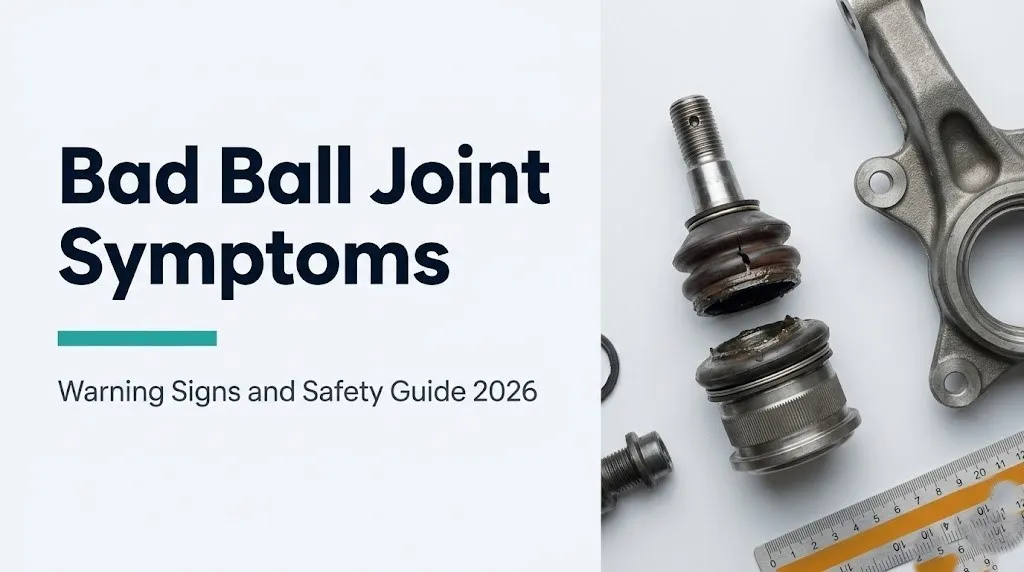
Bad Ball Joint Symptoms: All Warning Signs and Guide 2026
Bad ball joint symptoms include clunking or knocking sounds from the front suspension, vibration in the steering wheel, uneven or accelerated tire wear, pulling or drifting to one side while driving, and squeaking during slow-speed maneuvers, with the specific combination of symptoms and their severity indicating whether the joint is in early wear, moderate wear, or approaching the structural failure point where wheel separation becomes a real road safety risk. The most dangerous aspect of ball joint failure is that symptoms can progress from subtle to catastrophic within a relatively short mileage span once the grease seal has failed and the bearing surface begins wearing unprotected.
The National Highway Traffic Safety Administration (NHTSA) has documented numerous vehicle safety recalls related to ball joint failure across multiple manufacturers, reflecting the direct crash causation potential of complete ball joint separation, which causes immediate loss of steering control and wheel position. Ball joint failure represents one of the few automotive component failures that can cause a vehicle crash without any prior warning in the final moments before separation.
This article covers every named symptom of bad ball joints with the specific mechanical mechanism behind each, explains the critical difference between lower and upper ball joint failure patterns, identifies the grease boot as the most actionable early warning sign, provides the measurement thresholds that define replacement-required wear, and gives you a clear severity framework for deciding whether to drive carefully to a shop, call for a tow, or pull over immediately.
What Is a Ball Joint and What Does It Do
A ball joint is a spherical pivot bearing in a vehicle’s front suspension that connects the wheel knuckle (steering knuckle) to the control arm, allowing the wheel assembly to steer left and right while simultaneously traveling up and down through the suspension’s range of motion.
The ball joint’s design mirrors the anatomy of a human hip or shoulder joint: a rounded steel stud (the “ball”) sits inside a precision-machined steel housing (the “socket”), lined with a Teflon-coated or hardened polymer bearing surface that allows smooth multi-axis movement. The stud extends through the housing and inserts into a tapered bore in the wheel knuckle, where it is secured by a castellated nut and cotter pin. The rubber or polyurethane boot that surrounds the joint at the socket entry point seals in the grease lubricant and keeps road grit, water, and road salt out.
Think of the ball joint like the pivot point in a gooseneck lamp. The lamp arm can swing in any direction because the pivot allows rotation on multiple axes simultaneously. The ball joint does exactly this for the wheel: it lets the wheel steer left and right (rotating on the vertical steering axis), bounce up and down over road surface variations (rotating on the lateral axis), and accommodate minor compliance movements in all directions during braking and cornering forces. Without this multi-axis pivot, the wheel would bind and the suspension could not function.
Most front-wheel-drive and rear-wheel-drive passenger vehicles with independent front suspension use a MacPherson strut design with a single lower ball joint per corner, while trucks, SUVs, and performance vehicles often use double wishbone (A-arm) suspension with both an upper and lower ball joint per corner. This architectural difference determines how many ball joints need inspection and which failure patterns are possible.
According to SAE International’s J490 specification for automotive ball joints, ball joints are rated for specific axial and radial load capacities and expected to achieve defined service lives under standardized cyclic load testing. Real-world service life varies substantially based on vehicle weight, road surface quality, driving pattern, and maintenance history.
Bad Ball Joint Symptoms: The Full Picture
The full picture of bad ball joint symptoms ranges from subtle early-warning signs detectable only by visual inspection to obvious drivability problems that are unmistakable while driving, with the most dangerous presentation being a joint that has progressed past all warning signs to the point of imminent structural separation.
No single symptom definitively identifies ball joint failure without additional diagnostic confirmation, because clunking, vibration, pulling, and uneven tire wear all have multiple possible causes within the steering and suspension system. Tie rod ends, sway bar links, sway bar bushings, strut mounts, and worn control arm bushings all produce overlapping symptoms. The ball joint becomes the primary suspect when symptoms are specifically correlated with steering input and wheel travel rather than with braking or powertrain operation, and when the clunking or vibration is most pronounced during slow-speed cornering and parking lot maneuvers.
The severity spectrum of ball joint symptoms by stage:
| Stage | Primary Symptoms | Urgency | Driver Action |
|---|---|---|---|
| Early (boot failed, minimal play) | Visual: cracked or missing boot, grease smear on knuckle | Low: inspect and schedule repair | Schedule inspection within 2 to 4 weeks |
| Early-moderate (slight play, occasional clunk) | Occasional clunk over bumps, no vibration or pull | Moderate: repair within 1 to 2 weeks | Drive carefully, avoid rough roads, schedule promptly |
| Moderate (measurable play, consistent symptoms) | Consistent clunking, slight vibration, mild pull, developing tire wear | Moderate-high: repair within days | Drive minimally; take to shop within 2 to 3 days |
| Severe (significant play, pronounced symptoms) | Loud clunking, steering shimmy, pronounced pull, rapid tire wear | High: do not drive on highways | Drive only to immediate repair appointment; no highway speeds |
| Critical (near-separation, maximum play) | Lurching during cornering, clunking and grinding, unstable steering feel | Emergency: stop driving | Pull over; call for tow; do not drive |
Vehicles regularly towing trailers or carrying heavy payloads accumulate ball joint wear at a substantially faster rate than the same vehicle used for light commuting, because cyclic loading during towing places sustained vertical and lateral forces on the ball joint far above those encountered in normal unloaded operation.
Clunking and Knocking Noise From a Bad Ball Joint
A clunking or knocking noise from a bad ball joint is produced when the worn stud, which now has measurable clearance within its socket due to bearing surface wear, impacts the walls of the socket during suspension travel or steering inputs, creating the audible metal-on-metal impact that drivers hear from the front suspension area.
The sound characteristics help identify which joint is producing the noise and under what loading condition it is most pronounced. A clunk that occurs specifically when driving over a pothole, speed bump, or dip in the road surface indicates that the vertical suspension travel during bump absorption is causing the stud to impact the socket walls, most commonly pointing to the lower ball joint (which carries the primary vertical load in most suspension designs). A clunk that occurs specifically when turning the steering wheel at slow speed during parking lot maneuvers, with no simultaneous bump, indicates that the lateral steering rotation is causing the stud to move within its socket, which can involve either the lower or upper ball joint.
The frequency and intensity of the clunking correlates with the degree of play in the joint. An early-stage worn ball joint may produce an occasional single knock when hitting a significant pothole or aggressive curb drop. A severely worn joint produces a persistent, rhythmic clunking on every minor road surface variation at any speed.
According to ASE Suspension and Steering (A4) certification curriculum, ball joint-specific clunking can be distinguished from sway bar link clunking by vehicle behavior during a slow-speed steering sweep: sway bar link noise is typically most pronounced during the initial wheel turn from center, while ball joint noise intensifies throughout the full arc of steering travel and during simultaneous bump compression. This is a practical differentiation that a driver can make without any tools.
Drivers of older trucks and SUVs with solid front axles (pre-2001 Ford F-Series trucks, older Dodge Ram pickups with solid front axles) should note that the death wobble phenomenon, a violent steering oscillation that develops during highway driving, has a documented association with worn lower ball joints combined with worn track bars and steering components, representing a distinct and more dramatic symptom pattern than the clunking typical of passenger car ball joint wear.
Key Takeaway: A clunk specifically when turning slowly in a parking lot with no road surface variation is more specific to ball joint wear than a clunk that occurs only over large bumps. If both are present together, the joint wear is likely more advanced.
Vibration in the Steering Wheel From a Failing Ball Joint
Vibration in the steering wheel from a failing ball joint is produced when the worn joint’s play allows the caster and camber angles of the wheel to fluctuate dynamically at speed, causing the tire to run at a slightly variable angle to the road surface with each rotation and transmitting that instability through the wheel knuckle, tie rod, and steering rack up to the steering wheel.
In a properly functioning suspension with tight ball joints, the wheel geometry is fixed by the rigid control arm geometry. Caster, camber, and kingpin inclination angles are constant values set by the vehicle manufacturer. The tire runs in a consistent, predictable path at all speeds. When the ball joint develops play, these geometry values are no longer fixed: under the alternating vertical and lateral forces of road travel at speed, the stud moves slightly within its socket with each suspension oscillation, causing the wheel to experience micro-variations in camber (the lean of the wheel from vertical) and caster (the steering axis tilt). At highway speeds, these micro-variations compound into a perceptible vibration that the driver feels through the steering wheel.
Ball joint-related steering wheel vibration differs from tire imbalance vibration in one practically useful way: tire imbalance vibration is typically speed-sensitive, appearing at a specific speed range (commonly 55 to 70 mph) and diminishing at higher or lower speeds. Ball joint vibration tends to be more consistent across a wider speed range and is often combined with a vague, wandering steering feel rather than the more purely oscillatory feel of tire imbalance. Combining both conditions, which is possible in a high-mileage vehicle, makes the distinction harder, and a professional inspection is the most reliable differentiator.
The American Automobile Association (AAA) notes in its vehicle safety research that suspension-related vibrations are among the most frequently misdiagnosed vehicle symptoms, with steering wheel vibration from worn suspension components commonly mistaken for tire imbalance or wheel bearing issues before a thorough suspension inspection identifies ball joint play as the root cause.
Drivers who are pregnant, elderly, or operating the vehicle with passengers including children should treat persistent steering wheel vibration with greater urgency than drivers in other circumstances. The reduced reaction time available in these situations makes the handling degradation from a worn ball joint more consequential if the joint approaches structural failure.
Uneven Tire Wear as a Ball Joint Symptom
Uneven tire wear caused by a bad ball joint results from sustained deviation in wheel alignment, specifically in camber (the lean of the wheel from vertical) and toe (the angle of the tire pointing inward or outward relative to the vehicle centerline), which develops when the worn ball joint allows the wheel to sit at a geometry angle the vehicle manufacturer did not intend.
A normally functioning suspension maintains the tire contact patch flat against the road surface, distributing wear evenly across the full width of the tread. When ball joint wear allows the wheel to adopt a negative camber lean (top of wheel leaning inward toward the vehicle), the inner edge of the tire bears disproportionate load and wears faster than the outer edge, producing a pattern where the inner shoulder of the tire is visibly more worn than the rest of the tread. The reverse occurs with positive camber deviation. When ball joint wear also disrupts toe angle, the tire may develop a diagonal or feathered wear pattern across the tread face.
The practical test a driver can perform at home is to look at the front tires from the front of the vehicle and compare tread depth at the inner and outer shoulders. Uneven wear visible to the naked eye across one tire but not the other, in the absence of a recent impact or alignment adjustment, suggests that the suspension geometry has been altered by component wear. Ball joint wear is one of several possible causes, alongside worn control arm bushings, a bent control arm, or an impact-damaged knuckle.
The key distinction between ball joint-related tire wear and simple alignment-related tire wear is that ball joint wear produces progressive and accelerating tire degradation because the geometry deviation worsens over time as the joint continues to wear. An alignment adjustment without repairing the worn ball joint will provide temporary improvement but the alignment will drift back out of specification as the joint continues to develop play.
Pulling or Drifting From Bad Ball Joints
Pulling or drifting to one side while driving caused by bad ball joints occurs when the worn joint on one side of the vehicle allows that wheel’s caster or camber angle to deviate from the opposite side’s geometry, creating an asymmetric force distribution across the front axle that biases the vehicle toward the side with the geometry deviation.
In a properly aligned vehicle, the front wheels generate equal and symmetric lateral forces during straight-ahead driving. Any asymmetry in these forces produces a net lateral force on the vehicle that the driver must counteract with continuous steering input to maintain a straight path. Ball joint wear causes this asymmetry by allowing one wheel’s caster angle to fall below the other side’s value. Caster difference (called cross-caster) between the two front wheels is the suspension geometry measurement most directly responsible for steering pull. A difference of more than approximately half a degree in cross-caster is typically sufficient to produce a noticeable pull in most passenger vehicles.
Ball joint-related pull differs from brake-related pull in one practical way: brake pull occurs only during braking (the vehicle pulls toward the side with greater braking force), while ball joint geometry pull is constant during straight-ahead driving regardless of braking. Brake pull that also exists during normal driving suggests something other than a brake issue, and suspension geometry deviation from ball joint wear is a common explanation.
According to NHTSA vehicle safety data, pulling and drifting complaints from steering and suspension wear are among the most frequently cited pre-crash conditions in run-off-road incidents, reflecting the safety significance of addressing handling deviation promptly rather than adapting to it as a new normal.
Drivers of rear-wheel-drive trucks and SUVs with independent front suspension may experience pull that changes character with load in the cargo bed: adding rear weight shifts the vehicle’s center of gravity rearward, slightly unloading the front suspension and changing the effective geometry, which can temporarily reduce or increase ball joint-related pull depending on how the geometry changes with load transfer.
Key Takeaway: A pulling that is constant during straight driving (not just during braking) in a vehicle with no recent tire rotation or brake work points toward suspension geometry deviation from ball joint wear rather than a tire or brake issue.
Squeaking and Squealing From a Worn Ball Joint
Squeaking or squealing sounds from a bad ball joint are produced when the grease lubricant in the ball joint socket has been contaminated, washed out, or degraded to the point where the stud’s bearing surface rubs against the socket liner without adequate lubrication, generating the characteristic squeak of metal or polymer friction under load.
Unlike clunking, which indicates mechanical play (clearance) in the joint, squeaking can appear at an earlier stage when the joint still has adequate mechanical tightness but has lost its lubrication. A ball joint that had its grease fitting serviced annually throughout its service life, and whose boot is still intact, will not squeak in service. A ball joint with a cracked boot that admitted water and road salt over one winter season may develop a squeak from contaminated grease while still mechanically tight, representing an intermediate failure stage between a healthy joint and a worn, loose joint.
Ball joint squeaking is most noticeable during slow-speed maneuvers, parking lot turns, and when the suspension goes through full steering lock in a tight turn, because these are the conditions under which the greatest angular displacement occurs within the ball joint socket and the greatest frictional demand is placed on the bearing surface. At highway speeds, road and wind noise typically masks the squeak, which is why many drivers first notice ball joint squeaking in quiet parking garage or residential street driving.
Quick Tip:
- A squeak that disappears temporarily after a wheel rotation at a shop where a technician applies spray lubricant to the chassis but returns within one to two weeks indicates the squeak is coming from a non-serviceable sealed ball joint that cannot retain grease and should be scheduled for evaluation and probable replacement.
- Older trucks with Zerk grease fittings on their ball joints should have those fittings pumped with chassis grease at every oil change interval. A ball joint squeak in a vehicle with neglected Zerk fittings may respond temporarily to lubrication if the boot is still intact, but this is not a substitute for inspection.
- Drivers of vehicles with polyurethane aftermarket suspension bushings should note that polyurethane bushings commonly squeak under articulation even when in perfect mechanical condition, and this bushing squeak can be confused with ball joint squeak during self-diagnosis.
Bad Lower Ball Joint Symptoms vs. Bad Upper Ball Joint Symptoms
The symptoms of a bad lower ball joint differ from those of a bad upper ball joint primarily in severity, safety consequence, and the specific handling behaviors they produce, because the lower ball joint in most suspension designs is the compression-loaded, load-bearing joint that carries the full corner weight of the vehicle, while the upper ball joint is a tension-loaded, non-load-bearing pivot.
In a double wishbone (A-arm) front suspension, the vehicle’s corner weight is transferred through the coil spring or torsion bar, which typically connects to the lower control arm. This load path means the lower ball joint is in compression: the weight of the vehicle pushes down through the lower arm and directly through the lower ball joint stud. The upper ball joint, by contrast, is in tension: it pulls the upper end of the wheel knuckle inward toward the upper arm. When the lower ball joint fails and the stud separates from its socket, the load path is severed. The wheel has no compression support and collapses inward and downward beneath the vehicle almost instantaneously. The loss of wheel position causes immediate loss of steering control and often results in the wheel contacting the inner wheel arch, which can lock the wheel and cause the vehicle to rotate unpredictably.
Upper ball joint failure in the same system is less immediately catastrophic, because the lower ball joint still provides compression support and maintains the load path. The wheel tilts outward at the top (extreme negative camber at the upper wheel position), creating severe camber deviation and pull, but the wheel remains in contact with the ground and the vehicle remains partially controllable.
In MacPherson strut suspension (the most common design in front-wheel-drive passenger vehicles), there is no upper ball joint. The upper pivot is the strut mount bearing at the top of the strut. The single lower ball joint is both the compression-loaded and the steering pivot joint, making it the only ball joint in the system and making its failure just as catastrophic as lower ball joint failure in a double wishbone system.
Ball Joint Boot Failure: The Earliest Warning Sign
Ball joint boot failure is the earliest actionable bad ball joint warning sign and the one most likely to be caught before audible or handling symptoms develop, because the rubber or polyurethane dust seal (boot) that protects the grease and excludes contaminants visibly cracks, tears, or collapses long before the bearing surface inside has worn to the point of producing play.
The ball joint boot is a flexible accordion-style seal that stretches and compresses as the ball joint moves through its range of motion. It retains the grease lubricant within the socket and prevents road debris, water, and road salt from reaching the bearing surface. Boot material degrades from three primary causes: ultraviolet radiation from sun exposure (which embrittles rubber over time), repeated thermal cycling between cold ambient temperatures and the elevated temperatures of engine and brake heat (which causes rubber to harden and crack at flex points), and physical damage from road debris impacts.
Once the boot is torn or cracked, even partially, the grease begins to fling outward during wheel rotation and contaminants enter the socket inward during the same process. A grease smear on the wheel knuckle or steering knuckle, or a visible accumulation of grey-black grease mixed with road grit at the ball joint location, is the observable sign of a failed boot. This contaminated grease cannot lubricate effectively and grit particles act as an abrasive that accelerates bearing surface wear.
According to ASE Suspension and Steering (A4) curriculum, inspecting the ball joint boots at every tire rotation (every 5,000 to 7,500 miles in most rotation schedules) is the single most effective preventive measure for avoiding unexpected ball joint failure. A driver who catches a torn boot early, replaces the boot and re-packs the joint with fresh grease (on serviceable joints), or replaces the entire ball joint before wear begins, avoids all of the subsequent symptom stages entirely.
Key Takeaway: A cracked or torn ball joint boot that is repaired or triggers joint replacement before any mechanical play develops is a maintenance success. The same torn boot ignored for one winter in a road-salt environment can allow complete bearing surface destruction within 10,000 to 15,000 miles.
Worn Ball Joint Symptoms: Early vs. Severe Stages
Worn ball joint symptoms follow a progression from subtle and intermittent in the early wear stage to persistent and severe in the advanced stage, with the rate of progression determined by how quickly bearing surface wear advances once the lubrication system has been compromised.
Early-stage ball joint wear, typically when axial play is below 0.030 inch in non-pre-loaded joints (a threshold below NHTSA replacement specification), may produce only occasional symptoms: an intermittent single knock when hitting an unusually sharp pothole, a barely perceptible vagueness in the steering return-to-center feel, or tire wear that is only detectable by comparing inner and outer tread depth with a tread depth gauge rather than by naked-eye inspection.
Moderate-stage wear, typically when play approaches 0.050 inch (approaching or at the NHTSA replacement threshold for non-pre-loaded joints), produces consistent drivability symptoms: clunking on nearly every significant road surface change, noticeable vibration at highway speeds, visible tire wear asymmetry, and a slight but definite pull that requires constant correction. At this stage, the driver can no longer dismiss the symptoms as road noise or minor irregularities.
Severe-stage wear, with play beyond the replacement threshold, produces the full symptom complex at maximum intensity: loud multi-impact clunking, pronounced steering shimmy at speed, rapid tire wear that visibly consumes tread within thousands of miles, and a steering feel that is unpredictable and requires sustained physical effort to maintain direction. In pre-loaded (spring-loaded) ball joints, there may be no measurable play even in a severely worn joint, because the spring pre-load keeps the stud compressed against the socket. The symptom pattern from pre-loaded joints at severe wear is clunking and vibration without detectable play, which requires a pre-loaded joint-specific test protocol rather than standard play measurement.
Broken Ball Joint Symptoms and Separation Risk
A broken ball joint, meaning the stud has completely separated from the socket or the socket has cracked and lost its structural integrity, produces immediate, unmistakable symptoms: a sudden grinding or scraping from one wheel, immediate loss of steering control for that wheel, and a sudden drop in vehicle height at the affected corner as the wheel collapses inward or outward depending on which joint has failed.
This is the catastrophic endpoint of ball joint failure progression. The stud pulls free of its taper seat in the wheel knuckle, which requires that both the ball joint socket has worn to the point of maximum play and the taper connection has loosened. Once separation occurs, the wheel is no longer constrained by the control arm geometry. In lower ball joint separation with a compression-loaded design, the wheel moves inward and the tire contacts the wheel well. The vehicle loses the ability to steer that wheel, and the corner of the vehicle may drop as the knuckle loses its lower pivot.
According to NHTSA recall documentation for multiple vehicle models with ball joint-related separation failures, the crash pattern from sudden ball joint separation during highway driving typically involves the vehicle veering sharply to the side of the failed joint with insufficient time for driver correction, followed by a road departure or rollover event. NHTSA’s investigation data consistently shows that ball joint-related crashes occur predominantly in older, high-mileage vehicles where the maintenance history is incomplete or where symptoms were present but not acted upon.
The specific driving conditions that most stress a near-failure ball joint and precipitate final separation are high-speed cornering (which places combined lateral and vertical loads on the joint), hitting a significant pothole or road obstacle at speed (which creates a sharp impact load), and heavy braking during a turn (which combines deceleration forces with lateral cornering forces). These conditions should be specifically avoided in any vehicle where ball joint wear is suspected.
How to Test a Ball Joint and What the Measurements Mean
Testing a bad ball joint follows a three-step process from visual inspection through physical manipulation to measurement, with the measurement step requiring a dial indicator gauge to produce the specific numbers that correspond to NHTSA and OEM replacement specifications.
To test a ball joint through all three stages:
- Visual inspection (no tools required, with vehicle on the ground): position yourself in front of the wheel with a flashlight and inspect the ball joint boot for cracks, tears, collapsed shape, or grease smear on the surrounding knuckle. A clean, intact, flexible boot means lubrication is intact. Any cracking, tearing, or grease evidence means the boot has failed.
- Physical manipulation check (vehicle on jack stands, with load removed or applied depending on joint type): for non-pre-loaded lower ball joints in double wishbone suspension, position a floor jack under the lower control arm and raise it until the spring is compressed to its ride height position (loading the ball joint as it would be during driving). Then attempt to move the wheel top-to-bottom by gripping the tire at the 12 o’clock and 6 o’clock positions and pushing and pulling. Any perceptible play at the wheel rim in this loaded position indicates ball joint play rather than wheel bearing play, which is confirmed by having an assistant watch the ball joint while you manipulate the wheel.
- Dial indicator measurement (for confirming play against specification): mount a magnetic-base dial indicator on a fixed reference point (the lower control arm or brake caliper bracket) and position the indicator plunger against the bottom of the wheel rim (for axial play) or the side of the rim (for radial play). Apply upward force under the tire and note the total indicator travel. NHTSA specifications for non-pre-loaded ball joints typically allow a maximum of 0.050 inch of axial play. Readings beyond this threshold require replacement before further driving. Pre-loaded (spring-loaded) ball joints do not develop measurable play until the spring preload is overcome by bearing surface wear; these require manufacturer-specific test procedures.
According to SAE J490 standard for automotive ball joints, the actual replacement threshold varies by joint design, vehicle model, and whether the joint is pre-loaded. OEM specifications in the vehicle’s service manual are the authoritative source for the specific vehicle being tested.
Bad Ball Joint Symptoms in Different Suspension Types
Bad ball joint symptoms differ in their presentation and the number of joints involved depending on the suspension architecture, with MacPherson strut systems producing a specific single-lower-ball-joint symptom pattern and double wishbone systems capable of producing symptoms from either upper or lower joints independently or simultaneously.
MacPherson strut front suspension (standard on most front-wheel-drive passenger vehicles and many rear-wheel-drive sedans from European and Asian manufacturers) uses a single lower ball joint as the only ball joint in each front corner. The upper pivot is the strut mount bearing, which is a different component type with different wear characteristics. When the single lower ball joint in a MacPherson system fails, all of the symptoms described throughout this article apply to one joint per corner. Because there is no upper ball joint, any clunking from the upper suspension area in a MacPherson vehicle is more likely from the strut mount bearing than from a ball joint.
Double wishbone (A-arm) suspension, used primarily on trucks, SUVs, and performance vehicles, provides both an upper and lower ball joint per corner. This gives four ball joints total on the front axle. Symptoms can develop from any combination of these four joints, and the upper joints typically wear more slowly than the lower joints because they carry a lower load fraction. However, in vehicles regularly driven off-road or over severely rough roads, upper ball joints can wear at similar rates to lower joints from the repeated impact loads transmitted during axle articulation.
Trucks with solid front axles (body-on-frame trucks with a front solid axle rather than independent suspension) use kingpins rather than ball joints in some older designs, but many post-1980 solid axle designs use ball joints on the steering knuckle. The death wobble phenomenon in these vehicles, a violent steering oscillation at highway speed, is specifically associated with worn lower ball joints combined with worn steering components in solid axle designs and requires a complete front-end inspection rather than ball joint replacement alone to resolve.
Key Takeaway: In a MacPherson strut vehicle, any clunk from the upper suspension area is more likely the strut mount bearing than a ball joint, but the single lower ball joint is the only pivot between the wheel and the car’s frame, making its condition the primary safety concern.
Can You Drive With Bad Ball Joints
Whether you can drive with bad ball joints depends entirely on the stage of wear: early-stage wear with only boot failure and no measurable play can be driven carefully for days to schedule a repair, while moderate-to-severe play requires limiting driving to essential trips at reduced speed, and critical wear with near-maximum play or recent rapid progression requires stopping and towing immediately.
The core risk of driving on bad ball joints is not the noise or vibration but the possibility of complete stud separation from the socket, which can occur without additional warning once play reaches the critical stage. The rate at which a worn joint progresses from measurable play to complete separation is not predictable, because it depends on the specific condition of the bearing surface, the loading profile of upcoming driving (highway cornering vs. gentle city driving), and environmental factors (wet pavement, potholes).
Specific guidance by symptom severity:
- Visible boot damage only, no play or noise: drive normally for up to two to four weeks to schedule a repair appointment; avoid sustained highway driving until repaired
- Occasional clunk, no measurable play confirmed: drive carefully at moderate speeds for one to two weeks; schedule prompt repair; avoid aggressive driving
- Consistent clunking with slight play: drive minimally and only to reach a repair facility within two to three days; avoid highways and rough roads
- Pronounced clunking with measurable play beyond NHTSA threshold: drive only to an immediate repair appointment at low speed; call ahead to confirm a same-day appointment
- Severe play, lurching, or grinding: do not drive; call for tow
A driver who has been told their ball joint needs replacement but has been driving on it for weeks without repair should have the joint re-inspected before resuming high-speed or long-distance driving, because wear can progress substantially during the interval between initial diagnosis and eventual repair.
Emergency Warning Signs: When Ball Joint Failure Becomes a Road Safety Crisis
Certain symptoms associated with severe ball joint wear require immediate vehicle shutdown. Do not continue driving if these conditions appear.
Pull over immediately and stop the vehicle if you experience any of the following while driving:
- A sudden change in steering feel or vehicle direction without any steering input: this can indicate ball joint stud separation beginning; continued driving at any speed after this symptom appears risks complete wheel collapse
- A sudden scraping, grinding, or clunking that is dramatically louder than previous noise and does not stop when the road surface changes: this can indicate that the ball joint stud has separated and the wheel knuckle is contacting the control arm or inner wheel arch
- A visible sudden drop in vehicle height at one front corner while moving: the coil spring is no longer supported at the lower arm because the ball joint has separated; the wheel is not constrained and steering control is lost
- A sudden violent pull or lurch to one side during normal driving without hitting a road obstacle: this represents asymmetric wheel geometry loss from ball joint separation in progress
- A grinding that gets worse when turning but disappears when driving straight: in later stages, a nearly separated ball joint may only produce symptoms under lateral loading from cornering, representing the final warning before complete separation
Have the vehicle towed to an ASE-certified Suspension and Steering technician rather than attempting to drive further under any of the above conditions. These presentations indicate ball joint stud separation is occurring or imminent, which can cause immediate loss of vehicle directional control and represents a road safety emergency.
Frequently Asked Questions About Bad Ball Joint Symptoms
What does a bad ball joint feel like while driving?
A bad ball joint typically feels like clunking or knocking from the front suspension area over bumps or during slow-speed turns, combined with vibration in the steering wheel at highway speeds and vagueness in steering response.
In more advanced stages, the vehicle may pull consistently to one side during straight-ahead driving, and the steering may feel loose or require constant correction to maintain a straight path.
In the most severe stage before separation, the driver feels lurching or sudden direction changes during cornering that cannot be explained by road surface conditions alone.
Can I drive with a bad ball joint?
Driving with a bad ball joint is acceptable only for early-stage wear with a damaged boot and no measurable play, and only for a short period while arranging a repair appointment.
Any ball joint with play at or beyond the NHTSA replacement threshold (approximately 0.050 inch axial play in non-pre-loaded joints) should not be driven except for the minimum distance needed to reach a repair facility at reduced speed.
A ball joint with severe play, recent rapid progression of symptoms, or any episode of sudden steering deviation while driving should not be driven; the vehicle should be towed to an ASE-certified Suspension and Steering technician immediately.
What is the most dangerous symptom of a bad ball joint?
The most dangerous symptom of a bad ball joint is sudden loss of steering control or a sudden change in vehicle direction without any driver input while driving, which indicates the ball joint stud is separating from its socket.
This symptom, particularly in a lower ball joint of a compression-loaded suspension system, precedes complete wheel collapse and loss of wheel position control, which can cause the vehicle to veer off the road without sufficient time for driver correction.
Any driver who experiences this symptom must pull over immediately and not resume driving; the vehicle requires towing and immediate inspection by an ASE-certified Suspension and Steering technician.
How do I know if it is my lower or upper ball joint that is bad?
In a double wishbone suspension, lower ball joint wear typically produces clunking and vibration that is most pronounced when hitting bumps, while upper ball joint wear produces pulling and camber deviation that is most visible as severe one-sided tire wear and extreme wheel lean.
The practical test is to manipulate the wheel at the 12 o’clock and 6 o’clock positions (for lower joint axial play) and at the 3 o’clock and 9 o’clock positions (for upper joint radial play) while a second person watches which joint is moving.
In MacPherson strut vehicles, there is no upper ball joint, so all ball joint symptoms originate from the single lower ball joint per corner.
How much play in a ball joint is too much?
For non-pre-loaded ball joints, NHTSA specification limits axial play to a maximum of approximately 0.050 inch (1.27 mm) measured at the wheel rim using a dial indicator gauge with the suspension loaded to ride height.
Play beyond this threshold requires replacement before the vehicle is driven, according to NHTSA Federal Motor Vehicle Safety Standards, and the specific threshold for your vehicle should be confirmed against the OEM service manual specification, which may be more conservative.
Pre-loaded (spring-loaded) ball joints do not develop measurable play until wear exceeds the spring preload capacity and must be tested using manufacturer-specific procedures rather than standard play measurement.
How long do ball joints last and when should they be replaced?
Ball joints in passenger cars and light trucks typically last between 70,000 and 150,000 miles under normal driving conditions, with serviceable joints that have Zerk grease fittings regularly lubricated lasting toward the higher end and sealed non-serviceable joints on vehicles with high mileage or rough road use lasting toward the lower end.
Trucks that regularly tow trailers or carry heavy payloads, and vehicles driven frequently on unpaved or rough roads, experience ball joint wear rates two to three times faster than equivalent vehicles driven exclusively on smooth pavement, per automotive engineering and fleet maintenance industry documentation.
Any ball joint with a damaged boot should be inspected immediately regardless of mileage, because the rate of wear after boot failure can compress the remaining service life from years to months depending on road salt and contaminant exposure.
Closing
The most practically important thing to take from this article is the boot inspection habit. If you check the ball joint boots at every tire rotation, a torn or cracked boot triggers an early repair that costs a fraction of a ball joint replacement performed after the joint has worn to measurable play. Most drivers never look at their ball joint boots until a mechanic points them out at a service visit.
If you are already at the stage of consistent clunking, vibration, and pulling, schedule a ball joint inspection with an ASE-certified Suspension and Steering (A4) technician this week, not next month. Ask them to measure the axial play with a dial indicator gauge and report the actual measurement against the NHTSA specification for your vehicle. A number gives you the information you need to make an urgent vs. routine repair decision with confidence.
A ball joint that separates at highway speed does not give you a second chance to act on the warning signs.