What Causes Termites? The Real Science Behind Infestations
What causes termites to invade a home comes down to three core biological drivers: access to cellulose (the structural carbohydrate in wood), adequate moisture, and a structural entry point that lets foraging workers reach their food source. When those three conditions align, a termite colony can establish itself quietly for years before any visible damage appears.
According to the National Pest Management Association (NPMA), termites cause an estimated $5 billion in property damage across the United States annually, and the vast majority of that damage occurs well before homeowners realize there is an infestation. That figure reflects the hidden nature of termite activity, not just its scale.
This article covers the complete biology behind why termites infest structures, how each major species operates differently, which specific home conditions create the highest risk, and how the moisture that attracts termites can produce a parallel health problem through mold. You’ll also find guidance on when professional pest management is the only appropriate path forward.
What Causes Termites
Termites are caused, in the most direct biological sense, by the presence of cellulose-rich material, moisture, and warmth in or around a structure, conditions that trigger foraging workers or reproductive swarmers to establish a colony nearby.
Termites are not random invaders. They are highly organized social insects in the order Isoptera whose entire evolutionary purpose is to break down dead plant material. Wood, paper, cardboard, and plant debris all contain cellulose, a complex carbohydrate polymer that termites can digest because of specialized microorganisms living in their gut. Your home is, from a termite’s perspective, an enormous and conveniently stable food source.
The mistake most homeowners make is thinking termites “appear” suddenly. In reality, infestation typically develops over 3 to 5 years before producing visible damage signs. A mature colony of Reticulitermes flavipes (the Eastern subterranean termite, the most common termite species in the United States) contains between 60,000 and one million workers. According to research published in the Journal of Economic Entomology, a single mature Eastern subterranean termite colony can consume approximately 2.3 linear feet of a 2×4 pine stud per year under optimal conditions.
The conditions that cause termites are specific, measurable, and largely preventable when identified early.
Key risk conditions:
- Wood moisture content above 19 percent (the threshold where cellulose becomes easily digestible)
- Direct wood-to-soil contact at the structure’s foundation or perimeter
- Cracks, gaps, or utility penetrations in the foundation allowing underground worker access
- Landscape features that maintain moisture adjacent to the structure
- Previous nearby infestation history, which indicates established colony pressure in the soil
Termite Infestation Causes: The Full Picture
A termite infestation is caused by either a reproductive swarming event that founds a new colony near your structure or by an established underground or hidden colony that extends its foraging range into your home.
There are two distinct infestation pathways, and understanding which one applies to your situation changes how urgently you need to respond.
Pathway 1 — New Colony Establishment: Winged reproductive termites called alates leave a mature parent colony during a nuptial flight, typically triggered by warm temperatures, rainfall, and increased humidity in spring. They pair, land, shed their wings, and excavate a founding chamber. If this happens in or near your home’s structure, foundation soil, or wood debris piles, a new colony begins. It will be small initially, but it grows exponentially.
Pathway 2 — Existing Colony Expansion: A subterranean colony already established in your yard’s soil extends its foraging tunnels. Workers follow pheromone trails toward any cellulose source. Your home’s wood framing, subfloor, or support beams become accessible if a foraging gallery reaches the foundation perimeter. The USDA Forest Service Forest Products Laboratory documents that a single subterranean colony can maintain foraging tunnels extending 150 feet or more from the central nest site.
| Infestation Type | Trigger | Timeline to Damage | Primary Entry Route |
|---|---|---|---|
| New colony (alate swarm) | Spring nuptial flight, humidity spike | 3 to 7 years to structural damage | Foundation soil, wood debris, expansion joints |
| Existing colony expansion | Colony maturation, food source depletion | 1 to 3 years to reach structure | Underground foraging galleries, mud tubes |
| Drywood direct entry | Alate flight into exposed wood joints | 2 to 5 years to visible damage | Window frames, eaves, attic vents, wood siding |
Homeowners in the southeastern United States, Gulf Coast states, California, Hawaii, and Texas face the highest ambient colony pressure in their surrounding soil, meaning pathway 2 is a continuous, year-round risk rather than a seasonal one.
Termite Biology and Colony Formation
Termites can infest structures because their biological system is purpose-built for finding and consuming cellulose, with a colonial social structure that makes them remarkably efficient at sustaining that activity over years or decades.
A termite colony functions as a superorganism, a group of individuals whose collective behavior and physiology operates as a single biological unit. Every colony contains three functional castes: workers (sterile males and females responsible for foraging, feeding, and nest construction), soldiers (defending the colony against predators, particularly ants), and reproductives (the queen, king, and seasonal alates). Workers are the termites doing the damage to your structure.
The key to understanding termite infestation is the worker’s digestive system. Workers of lower termite species (including all Reticulitermes and Coptotermes species) harbor flagellate protozoa in a specialized hindgut chamber. These protozoa, particularly Trichonympha and Mixotricha species, produce cellulase enzymes that break cellulose into glucose and short-chain fatty acids, primarily acetate. Workers share this digested nutrition with the rest of the colony through trophallaxis (direct fluid transfer mouth to mouth). Without these gut symbionts, termites cannot digest wood at all.
Colony formation follows a precise biological sequence. According to research published in Environmental Entomology, alate reproductives are triggered to swarm by a combination of rising soil temperature (typically above 16 to 18 degrees Celsius), post-rainfall humidity increases, and lengthening photoperiod. After pairing, the founding queen produces her first clutch of eggs within weeks. Initial colony growth is slow. The first generation of workers must reach adulthood before foraging begins, which takes approximately 6 to 12 months.
Quick Tip:
- Subterranean termite queens can live 10 to 30 years and lay thousands of eggs per day at peak reproductive output
- Drywood termite queens have a much smaller colony size (typically 2,500 to 3,000 individuals) but require no soil contact to thrive
- Older homeowners should note that homes built before 1950 were rarely treated with any soil-applied termiticide during construction, leaving their structural wood unprotected from the start
What Attracts Termites to a House
Termites are attracted to a house primarily by chemical signals from wood containing digestible cellulose, the presence of sufficient moisture to sustain colony activity, and structural conditions that make the wood accessible from the soil or surrounding environment.
Think of your home’s structural wood the way you might think of a sealed container of food. A termite colony is trying to find a way in. The “scent” they follow is not a literal aroma in the way humans experience it, but rather volatile organic compounds released from wood as it ages, weathers, or absorbs moisture. Research published in the Journal of Pest Science has demonstrated that certain VOCs released from wood, particularly from weathered or moisture-damaged wood, produce stronger behavioral responses in termite workers than fresh, kiln-dried lumber does. Damaged wood is a louder signal.
The secondary attractant is heat. Termite colonies regulate their temperature carefully. Structures with heated subfloor spaces, warm foundation perimeters from interior heating systems, or sun-warmed wood siding create thermal signatures in the soil that align with termite workers’ preferred activity temperature range (approximately 25 to 28 degrees Celsius for most U.S. subterranean species).
Attractant factors ranked by biological influence:
| Attractant Factor | Biological Mechanism | Relative Influence |
|---|---|---|
| Cellulose in accessible wood | Primary food source; chemical signaling | Highest |
| Moisture content above 19% | Enables cellulose digestion and colony hydration | High |
| Warmth (25 to 28°C optimal) | Matches preferred worker activity temperature | Moderate-High |
| Wood in direct soil contact | Eliminates physical barrier between colony and food | High |
| Light (for alates only) | Alates are positively phototactic during nuptial flight | Moderate (swarm phase only) |
| Existing pheromone trails | Recruitment of workers once a food source is located | High (secondary amplifier) |
Homes near mature trees, wooded lots, or areas with high organic soil content have higher ambient termite colony pressure, meaning the foraging network in the surrounding soil is already more developed before it ever reaches your structure.
Key Takeaway: Termites are not attracted to a home randomly. They follow cellulose signals, moisture gradients, and warmth, and homes with unprotected wood in soil contact are broadcasting the strongest possible invitation.
Moisture and Termites
Moisture is one of the most direct and controllable causes of termite infestation because it both softens wood cellulose for easier digestion and provides the hydration that subterranean termite colonies require to survive above ground.
Subterranean termites cannot survive without a connection to moisture. Their exoskeleton is thin and permeable, which means they lose water rapidly through desiccation if exposed to dry air. Workers maintain their hydration through three routes: the soil moisture in their underground nest, the moisture content in the wood they are consuming, and free water from leaks, condensation, or pooling adjacent to the structure.
Wood becomes significantly more vulnerable to termite attack when its moisture content exceeds the fiber saturation point, approximately 30 percent in most structural wood species. At that moisture level, the cellulose polymer network loosens, fungal wood decay begins, and the structural integrity of the wood decreases. The USDA Forest Service Forest Products Laboratory has established through controlled laboratory research that wood at moisture contents between 19 and 30 percent supports sustained termite feeding, while fully air-dry wood (moisture content below 12 percent) is meaningfully less attractive.
The moisture sources most commonly responsible for creating termite-favorable conditions in residential structures include:
- Plumbing leaks behind walls or under floors (slow drips elevate localized wood moisture for months without detection)
- Inadequate subfloor ventilation causing condensation on floor joists and subfloor sheathing
- Gutter overflow or improper downspout discharge directing water toward the foundation
- Air conditioning condensate lines draining against the foundation or toward crawl space vents
- Flat or negative-grade landscaping that pools water against the sill plate or foundation
Older adults living in homes built before 1970 should be aware that vapor barriers in crawl spaces were not standard in that era. Crawl spaces without a continuous polyethylene vapor barrier over the soil surface produce significantly elevated relative humidity below the floor, creating conditions that support both subterranean termite activity and the mold growth that often accompanies it.
Wood and Cellulose as Termite Attractants
Wood and cellulose are the primary cause of termite presence in any structure. Every piece of structural lumber, wood paneling, OSB sheathing, paper-faced drywall, cardboard storage, and even cotton insulation represents a cellulose substrate that a termite colony is biologically programmed to locate and consume.
The cellulose connection is not simply about wood being present. It is about accessibility. Termites in the order Isoptera evolved as decomposers of dead plant material in forest ecosystems. Lignin, the rigid polymer that binds cellulose fibers and gives wood its structural strength, is partially resistant to termite digestion. Drywood and dampwood species can handle higher lignin content. Subterranean species preferentially target wood where decay fungi have already begun breaking down lignin, softening the matrix and making cellulose more accessible. This is why partially decayed wood is disproportionately attractive.
Not all wood species are equally vulnerable. The University of Florida IFAS Entomology and Nematology Department has documented through field studies that naturally termite-resistant heartwood species, including old-growth bald cypress, eastern red cedar, teak, and certain eucalyptus species, resist termite attack significantly better than pine, spruce, or fir framing lumber. The vast majority of residential construction in the United States uses southern yellow pine or spruce-pine-fir framing, both of which have minimal natural termite resistance.
Cellulose sources commonly overlooked by homeowners:
- Paper-faced drywall (the paper backing is pure cellulose and is consumed by subterranean species moving through wall voids)
- Cardboard storage boxes in garages, crawl spaces, and attics
- Wood mulch and bark chips placed within 18 inches of the foundation
- Untreated wood fence posts or deck posts set directly in soil
- Dead tree stumps left within the drip line of the structure
- Wooden form boards left in place after concrete pours during original construction
Homes with unfinished or exposed wood in the attic, garage framing, or crawl space present a broader target surface than homes where all structural wood is enclosed, painted, or sealed.
Subterranean Termite Causes
Subterranean termites are caused to infest structures specifically by the presence of soil-to-wood contact or moisture pathways that allow underground-foraging worker termites to reach structural wood from their nest in the soil below or around the foundation.
Reticulitermes flavipes (Eastern subterranean) and Coptotermes formosanus (Formosan subterranean) are the two most economically destructive termite species in the United States. The NPMA estimates that subterranean termites account for approximately 80 percent of termite damage in the U.S. annually. Their colony lives underground, typically in the top 18 to 36 inches of soil, with foraging workers traveling upward to reach wood sources through mud tubes or direct soil contact.
Subterranean species require continuous connection to soil moisture. Their entire foraging strategy is built around maintaining that connection: they construct mud tubes (mixtures of soil, feces, and saliva) to travel across exposed surfaces without desiccating. Any structural feature that gives foraging workers direct access from moist soil to structural wood is a primary infestation cause.
Specific causes of subterranean infestation by construction feature:
| Construction Feature | Why It Causes Subterranean Infestation | Risk Reduction Approach |
|---|---|---|
| Slab-on-grade with expansion joint gaps | Workers travel through soil below slab and emerge at wood at expansion joints | Seal all penetrations and joints; maintain active soil termiticide barrier |
| Crawl space with exposed wood | Workers access floor joists directly from soil | Install vapor barrier, improve ventilation, maintain 18-inch wood-to-soil clearance |
| Wood form boards left in concrete | Buried cellulose acts as termite “bait” within the foundation | Inspect during construction and during WDO inspection |
| Stucco below grade | Workers travel behind stucco sheeting undetected | Regular professional inspections; stucco extending to or below grade is a recognized risk factor |
| Attached wood decks with posts in soil | Direct wood-soil contact at post base | Use concrete footings with post base hardware; do not embed wood posts in soil |
Formosan subterranean termites deserve special mention. Their colonies are dramatically larger (up to 10 million workers per colony, compared to 60,000 to 1 million for Reticulitermes species) and they forage aggressively. According to the USDA Agricultural Research Service, Formosan termite colonies can consume wood at approximately 1,000 times the rate of a comparable Eastern subterranean colony at peak activity. They are concentrated in Hawaii, Louisiana, Florida, South Carolina, Georgia, and coastal Texas.
Key Takeaway: Subterranean termites are primarily caused by soil-to-wood contact and moisture pathways at the foundation perimeter. Eliminating grade contact and maintaining a dry perimeter are the two most evidence-supported preventive actions available to homeowners.
Drywood Termite Causes
Drywood termites are caused to infest structures by direct access to exposed, unprotected wood with relatively low moisture content, entering through small gaps in wood joints, eaves, window frames, and attic vents without any soil contact required.
This is the fundamental biological distinction from subterranean species. Cryptotermes brevis (West Indian drywood termite) and Incisitermes minor (western drywood termite) do not need soil. Their colony lives entirely within the wood they are consuming. There is no underground nest, no mud tube network, and no soil moisture dependency. The colony establishes itself from a pair of alate reproductives that enter through a crack or joint as small as 1/32 of an inch.
Because drywood colonies are entirely enclosed within wood, they are significantly harder to detect early. Workers push their fecal pellets (called frass) out of small holes called kick-out holes, and these fecal pellets, which look like sand or coffee grounds, are often the first visible sign of infestation. They appear near window sills, baseboards, or attic access panels. A 2021 review published in the Journal of Economic Entomology noted that drywood infestations are most frequently identified 3 to 6 years after initial establishment, well past the point where a small intervention would have been effective.
Causes specific to drywood infestation:
- Unpainted or unfinished wood surfaces on eaves, window frames, door frames, and fascia boards (paint or sealant significantly reduces entry point availability)
- Open attic vents without fine-mesh screening
- Wood shingles or wood shake siding, which present both an entry point and a food source
- Used or antique wood furniture brought into the home carrying an existing drywood colony (a documented but underappreciated infestation vector)
- Proximity to alate flight paths from neighboring infested structures (drywood swarmers can travel up to 300 feet on still air)
Homes in Southern California, Arizona, Hawaii, and coastal Florida face the highest drywood termite pressure. In these regions, annual professional inspection and maintenance of paint and sealant on all exterior wood surfaces is a first-line prevention measure recommended by the University of Florida IFAS Extension.
Dampwood Termite Causes
Dampwood termites are caused specifically by the presence of wood with high moisture content, typically above 30 percent, and are almost always associated with active water intrusion or wood decay already in progress.
Zootermopsis angusticollis (Pacific dampwood termite) and Zootermopsis nevadensis (Nevada dampwood termite) are the most common dampwood species in the United States, concentrated in the Pacific Coast states, Pacific Northwest, and northern Rocky Mountain region. Neotermes jouteli is the primary dampwood species in Florida and the Gulf Coast.
Unlike subterranean termites, dampwood species do not build mud tubes. Unlike drywood species, they require genuinely wet wood, not merely unprotected wood. They are essentially co-occurring with active water damage. If you have dampwood termites, you also have a water intrusion problem. The moisture issue is always the primary cause and must be resolved before any termite treatment will be effective or lasting.
Dampwood infestation causes by location:
- Roof leaks that saturate roof sheathing or top plates in the attic (Pacific Northwest homes with wood roofing are particularly vulnerable)
- Foundation drainage failure causing persistent wet soil against basement rim joists or sill plates
- Plumbing leaks within wall cavities that saturate framing lumber over months or years
- Poorly flashed deck ledger boards allowing water intrusion at the house-to-deck connection
- Wood retaining walls or landscape timbers in direct contact with wet soil
The health and structural significance of dampwood infestation is amplified because the same moisture conditions supporting dampwood termites also support brown rot fungi (primarily Serpula lacrymans and Coniophora puteana in Pacific Northwest structures) and white rot fungi (Trametes versicolor), both of which degrade structural wood fiber strength independently of termite activity. A dampwood termite infestation almost always indicates that multiple simultaneous wood-destroying processes are occurring.
How Termites Enter a Home
Termites enter a home through soil-to-wood contact at the foundation perimeter, through cracks and expansion joints in concrete slabs, through gaps around utility penetrations, and, in the case of drywood species, through any unprotected exposed wood surface accessible during a swarm flight.
The entry route depends entirely on the species. Subterranean termites cannot simply walk across dry concrete or open air. They need either direct contact between moist soil and wood, or a protected pathway they construct themselves (the mud tube). Drywood and dampwood species enter above grade during swarm flights, looking for exposed wood joints they can penetrate.
According to guidance from the University of Florida IFAS, the most commonly exploited subterranean entry points in residential construction include:
- Expansion joints between the perimeter foundation wall and the interior slab (a gap of even 1/8 inch provides sufficient passage)
- Where plumbing and electrical conduit penetrate the slab or foundation wall (gaps around pipes are rarely sealed adequately after construction)
- The point where wood framing (sill plate) meets the top of the foundation wall, particularly when no metal termite shield was installed
- Cracks in the poured concrete foundation or concrete block foundation wall that develop over time through settling or seismic activity
- Weep holes in brick veneer, which open directly into the wall cavity above the foundation
For drywood species, entry points include:
- Gaps at miter joints in wooden fascia boards and window trim (wood shrinks and expands seasonally, opening joints that were tight when painted)
- Unscreened attic vents or ridge vents
- The interface between roofing and wood sheathing at the eave edge where flashing is incomplete
Older homes (pre-1970 construction) often lack any of the preventive measures standard in modern construction: continuous sill plate anchor bolts with proper sealant, termite shields, pre-treated lumber at grade level, or borate treatment on framing. These homes present significantly more entry vulnerability than post-1990 construction in termite-active regions.
Termite Mud Tubes and Foraging Behavior
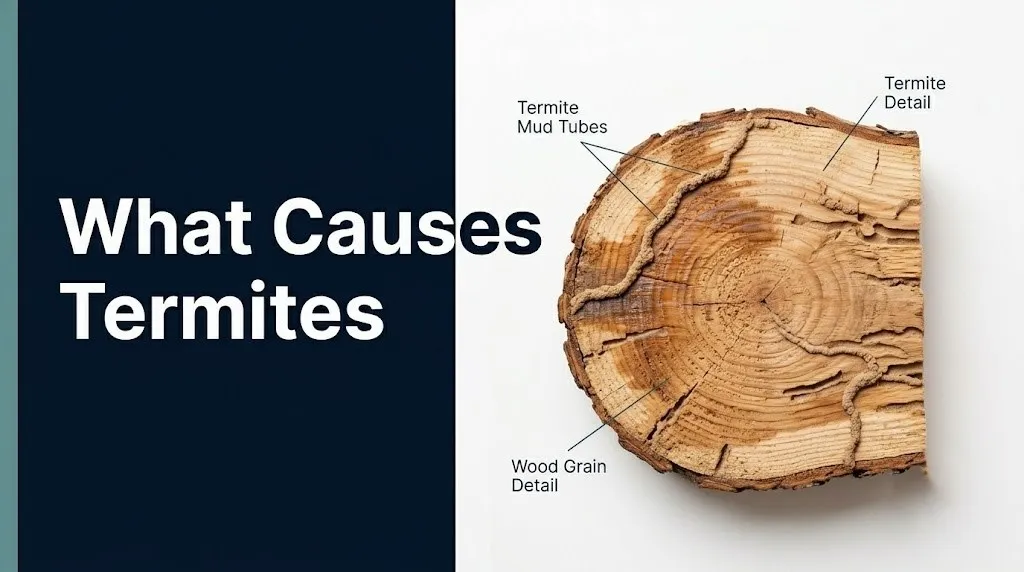
Termite mud tubes are caused by subterranean workers’ biological need to travel from their underground nest to their wood food source without exposure to open air, sunlight, or low humidity, all of which would cause fatal desiccation within minutes.
A mud tube is one of the most reliable visible signs of subterranean termite activity, and understanding how they are built explains both why they appear where they do and what they mean about the infestation’s progression.
Workers construct mud tubes from a mixture of soil particles, fecal material, and saliva-based secretions. The tube maintains an internal microclimate with relative humidity near 90 percent, even when the outside surface temperature is hot and dry. Think of a mud tube as a pressurized underground tunnel extended above ground: it allows the colony to reach food sources that would otherwise be unreachable without abandoning their moisture-dependent physiology.
Types of mud tubes by function:
| Tube Type | Description | Clinical Significance |
|---|---|---|
| Working tube | Main foraging highway from soil to wood | Active infestation; workers inside |
| Exploratory tube | Thin, branching tubes searching for new cellulose | Expanding foraging range; colony growing |
| Swarm tube | Built in late winter/spring to allow alates to exit | Colony mature; reproductive swarm imminent |
| Drop tube | Hang down from infested wood toward soil | Established feeding site above grade |
An active mud tube will contain live workers when opened. An abandoned tube is dry, crumbles easily, and contains no insects. However, the NPMA cautions that absence of activity in a tube observed on one inspection does not confirm the colony has departed. Workers can relocate tubes and re-establish them after disturbance.
Homeowners with slab-on-grade construction should inspect the interior and exterior perimeter of the foundation wall annually, looking specifically for mud tubes emerging from expansion joints, from behind electrical outlet covers on exterior walls, or from under baseboards adjacent to the foundation perimeter.
Key Takeaway: Finding a mud tube on your foundation is not a warning sign to monitor: it confirms an active or previously active subterranean termite colony is working your structure, and a licensed pest management professional needs to evaluate it the same week.
Mulch, Firewood, and Landscaping as Termite Risks
Mulch, improperly stored firewood, and moisture-retaining landscaping features cause termites by creating cellulose-rich, moisture-rich zones adjacent to your home’s foundation, which both sustain existing colony foraging networks and increase the probability of a new colony establishing nearby.
Mulch is worth addressing directly, because the relationship is slightly more nuanced than most pest company websites acknowledge. Wood mulch does not typically harbor active termite colonies. The University of Florida IFAS has published research clarifying that mulch itself is not a primary termite nesting site for subterranean species. The problem is what mulch does to the soil moisture profile directly adjacent to your foundation: it retains moisture, keeps soil temperatures elevated, and maintains the conditions that make subterranean foraging workers active and exploratory right where they meet your structure. Cellulose-heavy mulches (fresh wood chips, bark) also provide a supplementary food source that sustains foraging workers in that zone longer.
The EPA recommends maintaining a minimum 18-inch clearance of mulch-free, stone or concrete ground cover directly adjacent to the foundation perimeter. This creates a dry barrier zone that subterranean workers are reluctant to cross without constructing a visible mud tube.
Firewood is a more direct risk. Stacked firewood against the side of a house provides both food (cellulose) and shelter (protected, humid microclimate within the stack) that can support a subterranean foraging base or, in warm climates, a drywood colony. Workers that establish a foraging base in a firewood stack near the house perimeter are a short foraging extension from the structure itself.
Landscaping risk factors beyond mulch:
- Dense ground cover plants (ivy, vinca, monkey grass) planted against the foundation retain moisture and obscure mud tube inspection
- Irrigation systems that discharge near the foundation perimeter, particularly those set to water overnight
- Dead tree stumps within the drip line of the structure (stump root systems extend outward and downward, creating underground cellulose pathways directly toward the foundation)
- Wooden garden edging, raised bed walls, or landscape timbers in contact with foundation soil
Apartment residents and condominium owners should note that landscaping decisions made by building management around shared foundation perimeters directly affect their unit’s termite risk, even though they have no control over those decisions.
Climate and Geographic Termite Risk Factors
Climate causes termites by determining the ambient soil temperature and moisture conditions in which termite colonies can survive year-round, with warm, humid regions supporting the largest and most aggressive species and the highest colony density per acre of soil.
The USDA Forest Service has mapped termite hazard zones across the continental United States using a classification system from Zone 1 (very heavy termite activity, continuous risk) through Zone 4 (slight to none). Zone 1 encompasses the entire Gulf Coast from Texas to Florida, the southeastern Atlantic coast through the Carolinas, Southern California, and Hawaii. Homeowners in Zone 1 regions live with active soil termite pressure 12 months per year, because winter temperatures are never consistently cold enough to suppress colony activity.
Temperature thresholds matter biologically. Subterranean termite worker activity drops significantly when soil temperature falls below 10 degrees Celsius, and most surface foraging halts below 5 degrees Celsius. However, the colony does not die. It retreats deeper into the soil and resumes activity when temperatures rise. Homeowners in Zone 3 (the northern tier of the lower 48 states) who assume they have no termite risk are frequently incorrect: Reticulitermes flavipes has been documented as far north as Ontario, Canada, and routinely infests homes in Ohio, Indiana, Illinois, and Pennsylvania.
Geographic risk by region:
| Region | Primary Species | Seasonal Risk Pattern | Hazard Zone |
|---|---|---|---|
| Gulf Coast, Southeast, Hawaii | Coptotermes formosanus, Reticulitermes species | Year-round | Zone 1 |
| Mid-Atlantic, Southeast interior | Reticulitermes flavipes | March through November peak | Zone 2 |
| Pacific Coast (CA, OR, WA) | Reticulitermes hesperus, Zootermopsis species | March through October peak | Zone 2 to 3 |
| Great Plains, Midwest | Reticulitermes flavipes, R. tibialis | May through September peak | Zone 2 to 3 |
| Mountain West, Northern tier | Reticulitermes flavipes (localized) | June through August only | Zone 3 to 4 |
Climate change is measurably expanding termite pressure northward. Research published in Science of the Total Environment in 2021 documented that the northern range limit of multiple Reticulitermes species in the eastern United States has shifted 50 to 100 kilometers northward over the preceding 40 years, correlating with rising mean annual temperatures and fewer extreme cold events.
Termite Damage, Health Effects, and Indoor Air Quality
Termite damage causes direct structural health and safety risks through the progressive loss of load-bearing wood fiber integrity, and causes indirect health effects through airborne particulate from frass and damaged wood, along with the respiratory risks associated with moisture conditions that support termite activity.
This is the section most competitors ignore entirely. Termites are not classified as a direct human health hazard in the way that cockroaches or rodents are. They do not bite humans, transmit diseases, or contaminate food. However, the conditions they create and the treatment they require have genuine health considerations.
Structural safety is the primary physical health risk of a severe infestation. Load-bearing structural members (floor joists, rim joists, support beams, wall studs at the sill plate) that have been consumed to hollowness can fail under normal occupancy load. The National Association of Home Builders has documented cases of floor collapse in severely infested structures, though this represents advanced infestation rather than early or moderate activity.
Frass and particulate: Drywood termite frass (fecal pellets pushed from kick-out holes) accumulates in living spaces and attic areas. While not documented as a primary respiratory allergen in the peer-reviewed literature, the Centers for Disease Control and Prevention general indoor air quality guidance notes that any biological particulate accumulation in living spaces can aggravate existing respiratory conditions, including asthma and allergic rhinitis, particularly in children and older adults.
Health considerations during termite treatment:
| Treatment Type | Active Ingredient | Health Consideration | Precaution Period |
|---|---|---|---|
| Liquid soil barrier | Bifenthrin, fipronil, imidacloprid | Low mammalian toxicity at label rates; ventilate during and after application | Vacate during application; re-enter per product label (typically 4 to 6 hours) |
| Tent fumigation (drywood) | Sulfuryl fluoride | Central nervous system effects at high concentrations; no residue after aeration | Vacate 24 to 72 hours per professional guidance; certification of clearance required |
| Borate wood treatment | Disodium octaborate tetrahydrate | Low acute mammalian toxicity; eye and skin irritant | Avoid contact during application; safe after surface dries |
| Heat treatment (drywood) | No chemical | No chemical exposure risk; high structural heat may activate smoke detectors | Vacate during treatment; typically 6 to 8 hours |
Households with members who have asthma, chronic obstructive pulmonary disease, immune compromise, or are pregnant should discuss treatment timing and re-entry intervals explicitly with their licensed pest management professional and their primary care physician before whole-structure fumigation.
If pets are exposed to termiticide products during or after application, call the ASPCA Animal Poison Control Center at 888-426-4435 immediately. A consultation fee may apply.
The Mold and Termite Connection
Mold and termites share a common root cause: elevated moisture in structural wood and the surrounding environment. When termite-conducive conditions exist, the conditions for mold growth almost always exist as well, creating a concurrent health risk that extends beyond the structural damage of the infestation itself.
This connection is not incidental. Both subterranean and dampwood termite infestations are concentrated in areas of elevated wood moisture content. The Centers for Disease Control and Prevention documents that molds including Aspergillus, Penicillium, and Stachybotrys chartarum (commonly called black mold) grow on any organic material with moisture content above the fiber saturation point and a relative humidity above 60 to 70 percent in the surrounding air. These are exactly the conditions that support termite foraging and feeding.
A homeowner who discovers an active termite infestation in a crawl space or wall cavity should consider the near-certain co-occurrence of mold in the same moisture zone. The EPA recommends that any moisture investigation that reveals visible mold growth exceeding 10 square feet in area be referred to a licensed mold remediation professional rather than attempted as DIY cleaning.
The respiratory health effects of mold exposure in infested structures are distinct from the termite infestation itself:
- Allergic rhinitis symptoms (nasal congestion, postnasal drip, sneezing) from sensitization to mold spores (particularly Aspergillus and Cladosporium species)
- Asthma exacerbation in individuals with pre-existing asthma, particularly in children (the National Institutes of Health has identified indoor mold exposure as a clinically established asthma trigger in sensitized individuals)
- Hypersensitivity pneumonitis in chronically exposed individuals, a less common but more serious inflammatory lung condition caused by repeated inhalation of fungal antigens
Homeowners who identify termite activity and also notice musty odors, visible discoloration on wood or drywall surfaces, or worsening respiratory symptoms in household members should request both a pest inspection and an indoor air quality or mold assessment. A primary care physician or, for respiratory symptoms, a board-certified allergist or pulmonologist should evaluate any household member experiencing new or worsening respiratory symptoms in a structure with documented moisture or mold problems.
Key Takeaway: Finding termites in a wet crawl space or wall cavity is not just a pest problem. It is almost always a concurrent mold problem, and the respiratory health of every person in the home depends on addressing the moisture source, the mold, and the termites in that order.
When to Call a Pest Control Professional for Termites
You should call a licensed pest management professional for termites any time you observe a mud tube, a swarm of winged insects from within or immediately adjacent to your structure, frass deposits near wood surfaces, or any hollow-sounding or visibly damaged structural wood.
Home inspection and DIY assessment have a real but limited role in termite management. A homeowner can responsibly do the following without professional help: identify and correct moisture sources at the foundation perimeter, maintain the 18-inch mulch-free zone around the foundation, inspect visually for mud tubes and frass, store firewood away from the structure, and seal obvious entry points around utility penetrations. Those are prevention measures, not treatment.
Once any evidence of active infestation is present, professional evaluation is the only appropriate path. A licensed pest management professional uses diagnostic tools that are unavailable to homeowners: moisture meters (Protimeter or equivalent) to measure wood moisture content behind finished surfaces, borescopes to inspect within wall cavities, thermal imaging cameras (FLIR or equivalent) to identify thermal signatures of moisture accumulation or hollow wood voids, and acoustic emission detection in some advanced inspections.
When selecting a professional:
- Confirm the technician or company holds a current state-issued structural pest control license (required in all 50 states for commercial termite treatment)
- Request a WDO (wood-destroying organism) inspection report on the NPMA-33 form, which is the industry-standard documentation for real estate transactions and insurance purposes
- Ask specifically which termite species are present or suspected (this determines the treatment protocol and the annual monitoring approach)
- Request documentation of the termiticide product label, including active ingredient, EPA registration number, and re-entry interval
- Understand whether the company’s warranty covers retreatment and for how long, including what inspections are required to maintain the warranty
A board-certified entomologist (BCE) affiliated with the pest management company provides the highest level of species identification and treatment-protocol accuracy, particularly for mixed-species infestations or for properties in high-pressure zones with Formosan termite activity. The Entomological Society of America maintains the BCE credentialing program and a searchable directory of certified professionals.
Homeowners in Zone 1 and Zone 2 regions who have never had a professional WDO inspection should treat an annual inspection as standard property maintenance, not a response to visible infestation. The NPMA recommends annual professional inspections for all homes in active termite zones, regardless of visible infestation signs.
Frequently Asked Questions About What Causes Termites
What causes termites to suddenly appear in a house?
Termites appear to “suddenly” emerge because the visible event, most often a swarm of winged alates flying from a wall, floor, or foundation area, is the final stage of a colony that has been developing for 3 to 7 years or longer.
The swarm occurs when a mature colony produces reproductive alates and triggers them to disperse through a combination of rising temperature, increased humidity, and lengthening daylight hours, typically in spring.
Finding termite swarmers indoors means the parent colony is already established within or immediately beneath your structure and warrants same-week evaluation by a licensed pest management professional.
Does wood mulch really attract termites?
Wood mulch does not typically serve as a termite nesting site, but it significantly elevates soil moisture content and maintains warmth directly adjacent to your foundation, conditions that increase subterranean foraging worker activity in that zone.
The University of Florida IFAS research has found that the primary risk from mulch is moisture retention near the structure, not cellulose provision.
Maintaining an 18-inch mulch-free zone of gravel or exposed soil adjacent to the foundation perimeter substantially reduces this risk, per EPA landscaping guidance.
What is the number one cause of termite infestations?
The single most common cause of subterranean termite infestation, which accounts for approximately 80 percent of all U.S. termite damage according to the National Pest Management Association, is direct wood-to-soil contact at or near the foundation of the structure.
When structural wood (sill plates, deck posts, wood form boards, fence posts) touches moist soil, it eliminates the physical and moisture barrier that otherwise requires termites to build exposed mud tubes to reach the wood.
Removing all wood-to-soil contact and maintaining a dry perimeter are the most evidence-supported preventive steps a homeowner can take.
Can termites cause health problems?
Termites themselves do not bite humans, transmit diseases, or pose a direct infection risk, but the conditions they require and the damage they cause create meaningful indirect health concerns.
The moisture conditions that support subterranean and dampwood termite infestation almost always co-occur with mold growth, and the Centers for Disease Control and Prevention identifies indoor mold exposure as a clinically established trigger for allergic rhinitis, asthma exacerbation, and, in chronic exposure cases, hypersensitivity pneumonitis.
Whole-structure fumigation with sulfuryl fluoride also carries re-entry interval requirements that must be followed strictly, particularly for household members with asthma, for pregnant women, and for infants and young children.
How do termites get into a house with a concrete foundation?
Subterranean termites enter concrete-slab homes through expansion joints between the slab and the foundation wall, through gaps around plumbing and electrical penetrations in the slab, and through cracks in the concrete that develop naturally through settling and thermal cycling.
A gap of as little as 1/32 inch in an expansion joint or utility penetration is sufficient for worker termites to pass through from the moist soil below.
A liquid soil termiticide barrier applied beneath and around the slab perimeter, or an in-soil baiting system, is the standard professional treatment approach for slab-on-grade structures per EPA registered-use guidelines.
What time of year are termites most active and why?
Subterranean termites are most visibly active in spring (February through May in the southeastern United States, April through June in temperate northern states), when rising soil temperatures trigger the annual nuptial flight of alate reproductives.
Worker foraging activity continues year-round in Zone 1 regions and through most of spring, summer, and fall in Zone 2 and Zone 3 regions, only suppressing significantly when soil temperatures drop below 10 degrees Celsius.
Drywood termite swarms typically occur later in summer (July through September in California, with variation by species and latitude), and their activity is more closely tied to hot, dry conditions than to spring rainfall patterns.
Closing
What causes termites is not a mystery once you understand the biology. Cellulose, moisture, warmth, and structural access are the four conditions that turn your home into a viable termite target. Address any one of them systematically, and you meaningfully reduce your risk. Address all four, and you make your structure one of the least attractive targets in the neighborhood.
The most practical step you can take right now is a foundation perimeter inspection. Walk the exterior of your home at ground level and look for mud tubes on the foundation wall, wood in soil contact, mulch pressed against the siding, and any soft or discolored wood near grade. If you find any of those things, or if you live in a Zone 1 or Zone 2 state and have never had a professional WDO inspection, contact a state-licensed pest management professional this week.
Termite damage is not reversible once structural wood is consumed. Detection and intervention are time-sensitive. The biology is on the termites’ side if you wait.