Strangulated Hernia Symptoms: Signs and Emergency Guide 2026
Strangulated hernia symptoms include sudden severe pain at the hernia site, a lump that becomes tender, hard, and changes color from red to purple to dark, nausea and vomiting, fever, and progressive abdominal rigidity, and every one of these signs constitutes a surgical emergency that requires 911 activation or immediate emergency room evaluation without delay. A strangulated hernia is not a more uncomfortable version of a regular hernia. It is a condition in which the blood supply to trapped intestine or tissue has been cut off, and without emergency surgery, the affected bowel will die within hours.
According to the National Institute of Diabetes and Digestive and Kidney Diseases (NIDDK), hernias affect millions of Americans, with inguinal hernias alone accounting for approximately 800,000 surgical repairs annually in the United States. The World Society of Emergency Surgery (WSES) identifies strangulation as the most feared complication of hernia, carrying a mortality rate that rises sharply with each hour of delay between symptom onset and surgical intervention.
This guide explains every clinically recognized symptom of hernia strangulation with the anatomical and physiological mechanism behind each one, how strangulation differs from simple incarceration, how different hernia types produce distinct symptom patterns, which populations are at highest risk for atypical presentation, and the exact threshold at which calling 911 is the correct action. The time window here is measured in hours, not days.
Strangulated Hernia Symptoms Overview
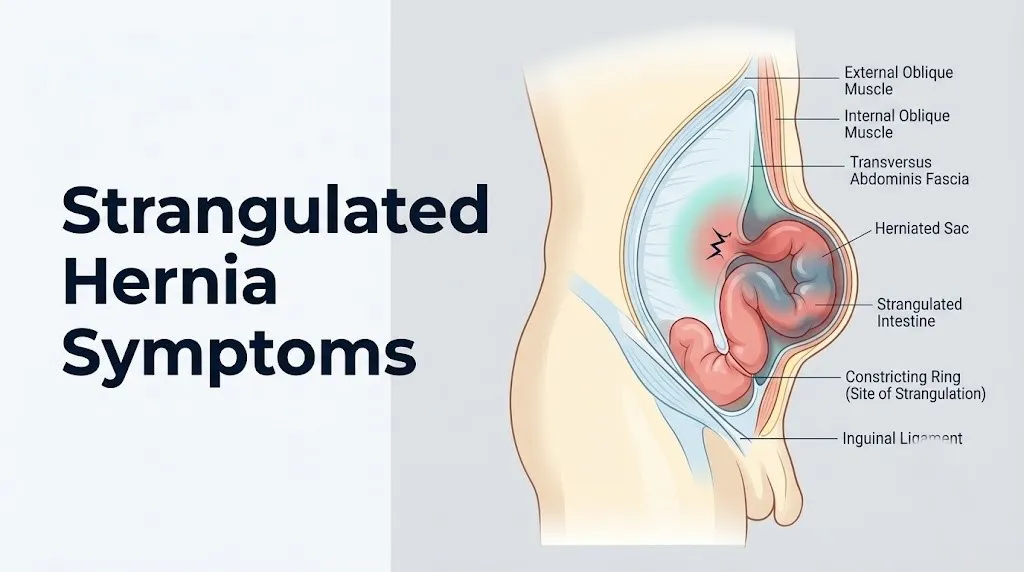
Strangulated hernia symptoms are produced when the hernial ring, the tight fascial defect through which hernia contents have passed, compresses the mesenteric vessels supplying those contents, cutting off first venous outflow and then arterial inflow to the trapped tissue.
The hernia sac is a peritoneal outpouching that contains hernia contents: most commonly a loop of small intestine (jejunum or ileum), a portion of the omentum (the fatty apron of peritoneum covering the abdominal organs), or less commonly large intestine. The hernial neck is the narrowest point of the sac, where the contents pass through the fascial defect in the abdominal wall. When the hernial ring is tight enough to compress the thin-walled mesenteric veins while initially sparing the thicker-walled mesenteric arteries, venous stasis begins. Edema accumulates. Pressure within the sac rises until arterial compression follows.
What the reader needs to understand is the sequence. Strangulation does not happen all at once. It follows a predictable progression from irreducible hernia (incarcerated) to vascular compromise (strangulated) to bowel death (necrosis and gangrene). The symptoms escalate in a defined order that corresponds to each stage of this vascular failure.
| Symptom | Physiological Stage | Urgency Level |
|---|---|---|
| Sudden severe pain at hernia site | Venous congestion and early ischemia | Emergency: go to ER immediately |
| Hernia lump becomes hard and irreducible | Incarceration with edema | Emergency: go to ER immediately |
| Lump turns red, then purple, then dark | Progressing from venous to arterial ischemia | Emergency: call 911 |
| Nausea and vomiting | Bowel obstruction activating vomiting center | Emergency: call 911 |
| Fever, rapid heart rate, sweating | Bacterial translocation and SIRS onset | Emergency: call 911 now |
| Abdominal rigidity, board-like abdomen | Peritonitis from bowel perforation | Emergency: call 911 immediately |
People taking opioid analgesics for chronic pain conditions may experience dramatically reduced pain intensity from a strangulated hernia despite progressive bowel ischemia, because opioids suppress visceral pain signaling through mu-opioid receptors in the spinal cord dorsal horn. This group must be assessed by symptom pattern, not pain intensity alone.
The Difference Between an Incarcerated and Strangulated Hernia
An incarcerated hernia is one in which the hernia contents cannot be pushed back (reduced) into the abdominal cavity, while a strangulated hernia is an incarcerated hernia in which the blood supply to the trapped contents has been compromised, producing tissue ischemia and potential necrosis.
Think of it this way: an incarcerated hernia is a package stuck in a too-tight mail slot. Uncomfortable and immovable, but the package is still intact. A strangulated hernia is that same package, but the slot has tightened enough to cut the string holding it together. Once the string is cut, the contents start to deteriorate. The transition from incarceration to strangulation is not always clinically obvious from the outside, and that is what makes the symptom picture so important.
Every strangulated hernia was incarcerated first. Not every incarcerated hernia becomes strangulated. The factors determining progression include the diameter of the hernial neck (narrow neck hernias strangulate faster than wide neck ones), the type of tissue in the sac (bowel strangulates faster than omentum), and the tightness of the fascial defect.
According to data cited by the American College of Surgeons (ACS), femoral hernias strangulate significantly more frequently per incarceration event than inguinal hernias, because the femoral canal is a rigid bony and ligamentous channel that does not expand, whereas the inguinal canal has some fascial compliance.
The clinical difference a patient can sometimes detect: an incarcerated hernia is painful and irreducible but the lump may remain skin-colored and soft. A strangulated hernia produces a lump that becomes progressively harder, more tender to the lightest touch, and begins to change color. Any transition from an uncomfortable lump to an exquisitely tender, hard, discolored lump is strangulation until proven otherwise, and it warrants the same response as any other emergency.
Strangulated Hernia Pain: What It Feels Like
Strangulated hernia pain is typically described as sudden, severe, and constant at the hernia site, qualitatively different from the aching discomfort of a reducible hernia, and it does not improve when the patient rests, changes position, or presses gently on the lump.
The pain mechanism involves two distinct physiological pathways operating simultaneously. First, visceral pain is generated by ischemic injury to the peritoneal lining of the hernia sac: the visceral peritoneum is supplied by the same autonomic afferents as the bowel it covers, and ischemia activates these nociceptors through prostaglandin E2 (produced via cyclooxygenase-2 in ischemic tissue) and substance P (released from sensitized afferent nerve endings). Visceral pain is characteristically poorly localized, deep, and crampy. Second, as ischemia progresses and the parietal peritoneum (the layer lining the abdominal wall) becomes irritated by inflammatory exudate from the ischemic sac, somatic pain is added: sharper, more precisely localized, and exquisitely worsened by movement or palpation.
The transition from predominantly visceral pain (crampy, hard to localize) to somatic pain (sharp, well-localized, worsened by touching or moving) signals that peritoneal irritation has begun. That transition is a clinical landmark indicating disease progression.
Patients who have previously had hernia pain that was dull, intermittent, and relieved by lying down should tell any clinician specifically that the character of the pain has changed, not just the intensity. A pain that was previously a 3 out of 10 ache and is now a constant 8 or 9, unrelieved by any position change, is the hallmark of ischemic progression.
People with diabetic peripheral neuropathy may experience significantly reduced pain intensity despite advanced strangulation, because autonomic and visceral afferent nerve function is impaired by long-standing hyperglycemia. Any diabetic patient with a known hernia who notices irreducibility, firmness, or color change at the hernia site should go to the emergency room immediately, regardless of pain severity.
Hernia Lump Color Change as a Strangulation Symptom
A hernia lump that changes color from its normal skin tone to red, then purple, then dark or black is one of the most specific visible signs of progressing strangulation, and the color sequence directly maps to the stage of vascular compromise in the tissue beneath the skin.
The color progression follows the vascular physiology precisely. Red or pink coloration over the hernia lump reflects venous congestion: blood is entering the hernia sac via the mesenteric artery but cannot drain through the compressed mesenteric veins, causing hyperemic engorgement of the trapped bowel. The lump is engorged with oxygenated and deoxygenated blood and appears red-pink. Purple coloration indicates deeper venous stasis with deoxygenation of pooled blood: the tissue is now a mixture of congested venous blood and early ischemic change. Dark, dusky, or black coloration represents transmural ischemia and necrosis: the tissue has lost both arterial and venous supply, and the dark color reflects gangrenous change in the bowel wall.
This color change is not always visible. In obese patients, the hernia lump may be buried in subcutaneous fat, making skin color inspection unreliable or impossible. In patients with deeply pigmented skin, the color change may be subtle or confined to the overlying skin’s local warmth and texture change rather than obvious discoloration. Clinicians in these populations must rely more heavily on palpation findings (extreme tenderness, hardness) and systemic symptoms.
Cleveland Clinic identifies color change of the hernia lump alongside increasing firmness and non-reducibility as the triad of visible external signs most reliably indicating strangulation rather than simple incarceration.
A lump that was previously soft and reducible and is now hard, tender to the lightest touch, and beginning to change color should not be manipulated, pushed, or squeezed. Manual reduction attempts on a strangulated hernia can push gangrenous bowel back into the peritoneal cavity, seeding the abdominal cavity with necrotic tissue and bacteria.
Key Takeaway: The transition from an incarcerated hernia (painful, irreducible) to a strangulated hernia (painful, irreducible, changing color, systemic illness) can occur within hours; a hernia lump that has become exquisitely tender and is beginning to turn red or purple is a 911 situation, not a wait-and-see situation.
Nausea and Vomiting in Strangulated Hernia
Nausea and vomiting in a strangulated hernia are produced by mechanical bowel obstruction activating a specific neurological pathway from the obstructed bowel to the brainstem vomiting center, and their appearance alongside hernia pain is a clear signal that the condition has moved beyond local discomfort into systemic physiological crisis.
The mechanism is anatomically precise. When the herniated bowel loop is obstructed at the hernial ring, intestinal contents cannot pass. Proximal bowel distends as peristalsis continues pushing content toward the obstruction without relief. Stretch receptors in the distended bowel wall (mechanoreceptors in the myenteric plexus and submucosal plexus of the enteric nervous system) fire afferent signals via the vagus nerve to the area postrema in the medulla oblongata, the brainstem’s chemoreceptor trigger zone that coordinates the vomiting reflex. This activation produces the nausea and projectile vomiting of bowel obstruction.
Early vomiting in bowel obstruction is bilious (containing greenish-yellow bile from the proximal small intestine). As obstruction persists and more distal bowel contents reflux upward, vomiting may become feculent: foul-smelling, brownish, and reminiscent of stool. Feculent vomiting in the setting of hernia pain is an advanced sign indicating complete, prolonged small bowel obstruction and warrants immediate 911 activation.
The American College of Surgeons (ACS) identifies vomiting alongside hernia pain and irreducibility as an indication for emergency surgical consultation without delay. The combination of these three findings, pain, irreducibility, and vomiting, constitutes a clinical picture of obstructed and potentially strangulated hernia until surgical evaluation proves otherwise.
Children with strangulated hernias may vomit before any obvious lump is apparent, particularly in girls where the inguinal canal contains the round ligament rather than obvious bowel. Vomiting in a child with groin pain and no obvious lump should prompt the same level of emergency urgency as vomiting with a visible hernia, because the hernia may be occult.
Fever and Systemic Symptoms of Strangulated Hernia
Fever in strangulated hernia is not caused directly by the mechanical compression itself but by bacterial translocation: the movement of gram-negative bacteria from the dying bowel lumen through the ischemic bowel wall into the systemic circulation, triggering a full-body inflammatory response that can progress to septic shock within hours.
The bowel wall’s integrity depends on tight junctions between intestinal epithelial cells, maintained by proteins called claudins and occludins. Under ischemia, cellular energy (ATP) required to maintain these tight junction proteins is depleted. The junctions loosen. The normally impermeable barrier between the teeming bacterial population inside the bowel lumen and the sterile peritoneal cavity and bloodstream fails. Gram-negative bacteria, primarily Escherichia coli, Klebsiella pneumoniae, and Bacteroides fragilis, cross the disrupted epithelium into the mesenteric lymphatics and the portal venous system.
Once in the systemic circulation, bacterial lipopolysaccharide (endotoxin) activates macrophages, producing a surge of tumor necrosis factor-alpha (TNF-alpha) and interleukin-6 (IL-6). These cytokines cross the blood-brain barrier and act on the anterior hypothalamus, raising the thermoregulatory set point through a prostaglandin E2-mediated mechanism, producing fever. Simultaneously, TNF-alpha and IL-6 produce vasodilation, tachycardia, and increased capillary permeability, the defining features of systemic inflammatory response syndrome (SIRS).
Fever in this context is therefore not a mild symptom requiring a thermometer check before deciding to seek care. It is evidence that bowel wall integrity has been lost, that bacteria are in the bloodstream, and that septic shock may follow within hours to days without surgical source control.
Patients taking systemic corticosteroids (prednisone, dexamethasone, methylprednisolone) may not mount a fever response at all despite bowel necrosis and bacteremia, because corticosteroids suppress the IL-6 and TNF-alpha pathways that drive fever. In these patients, tachycardia, confusion, and hypotension may be the first systemic signs of septic progression, without preceding fever.
Abdominal Rigidity and Tenderness in Strangulated Hernia
Abdominal rigidity in a strangulated hernia, the board-like hardness of the abdominal wall muscles when palpated, is the clinical sign of peritonitis: chemical and bacterial irritation of the parietal peritoneum (the inner lining of the abdominal wall) from either perforated gangrenous bowel contents or inflammatory exudate from the ischemic hernia sac.
The parietal peritoneum is supplied by somatic afferent nerves from the intercostal and lumbar spinal nerve roots, which is why peritoneal irritation produces sharply localized, exquisitely severe pain that is clearly worsened by any abdominal movement, coughing, or pressing. When palpation compresses the inflamed peritoneum and the hand is then quickly released, the sudden release of pressure causes a jolt of intense pain: this is rebound tenderness, also called Blumberg’s sign, and it is a classic clinical marker of peritoneal inflammation.
The abdominal wall muscles respond to peritoneal irritation by going into sustained reflex spasm: involuntary guarding. This is different from voluntary tensing of the abdomen when someone is anxious about being examined. Involuntary guarding persists even when the patient deliberately tries to relax the abdomen and cannot be suppressed by patient cooperation. The abdomen feels like pressing on a wooden board.
Research published in the Annals of Surgery has identified the combination of rebound tenderness and involuntary guarding alongside a painful irreducible hernia as the clinical triad most strongly predictive of bowel necrosis at the time of emergency surgery, and it is the finding that most reliably escalates a clinical presentation from “suspected strangulation” to “immediate emergency laparotomy required.”
Older adults with longstanding abdominal wall laxity may not develop the same degree of muscular rigidity as younger adults, because the muscular response to peritoneal irritation depends partly on abdominal wall muscle mass and tone. In elderly patients, peritonitis may manifest as diffuse tenderness and absence of normal bowel sounds rather than classic board-like rigidity.
Key Takeaway: Fever in strangulated hernia is caused by bacterial translocation through an ischemic bowel wall into the bloodstream, triggering SIRS via TNF-alpha and IL-6, and its appearance alongside hernia pain means bowel wall integrity has already been lost.
Strangulated Inguinal Hernia Symptoms
Strangulated inguinal hernia symptoms are centered in the groin, with pain radiating into the scrotum or labia depending on the patient’s anatomy, and the hernia lump is typically visible and palpable in the inguinal region just above the inguinal ligament.
The inguinal canal is the anatomical passage through the lower abdominal wall through which the spermatic cord (in males) or round ligament (in females) runs. Indirect inguinal hernias follow the path of the spermatic cord through the internal inguinal ring, inguinal canal, and external inguinal ring, potentially descending into the scrotum in males. Direct inguinal hernias protrude directly through a weak point in the posterior wall of the inguinal canal (Hesselbach’s triangle) without following the cord. In males, a strangulated indirect inguinal hernia typically presents as a painful, hard, non-reducible swelling in the groin that extends into the upper scrotum, with the testicle on the affected side pushed downward and the scrotal skin above the testicle tensely swollen.
A key symptom distinction: a strangulated inguinal hernia may initially be confused with testicular torsion in males, because both produce acute scrotal and groin pain. The distinguishing feature is that in testicular torsion, the testis itself is the structure that is tender and abnormally positioned (often high-riding and horizontally oriented), while in a strangulated hernia, the mass is above the testis in the inguinal region and the testis hangs normally below it.
In females, strangulated inguinal hernias are less frequent but clinically challenging because the round ligament occupies the inguinal canal and a hernia may not produce an obvious groin bulge. Female patients with inguinal hernia strangulation tend to present with groin pain and tenderness at the inguinal ring without a clearly palpable lump, which frequently leads to delayed diagnosis.
Strangulated Femoral Hernia Symptoms in Women
Strangulated femoral hernia symptoms are located in the upper medial thigh, just below the inguinal ligament, and this hernia type has a substantially higher rate of strangulation per incarceration episode than any other hernia type because of the rigid, unyielding anatomy of the femoral canal.
The femoral canal is a narrow, funnel-shaped space bounded on all sides by rigid structures: the inguinal ligament anteriorly, the pectineal ligament posteriorly, the lacunar ligament medially, and the femoral vein laterally. Unlike the inguinal canal, which has some fascial compliance, the femoral canal cannot expand at all. When hernia contents pass through the femoral ring and cannot reduce, the rigid walls of the canal exert constant circumferential compression on the mesenteric vessels from every direction simultaneously. Strangulation can occur within hours of incarceration.
Research published in the British Journal of Surgery has documented that femoral hernias account for a disproportionate share of strangulated hernia emergency operations relative to their overall prevalence, with strangulation rates at presentation significantly higher than those seen with inguinal hernias.
Women are affected by femoral hernias at substantially higher rates than men, largely because the female pelvis is wider relative to body habitus, creating a larger femoral triangle and femoral ring that is more susceptible to hernia formation, particularly after multiple pregnancies when pelvic floor tone decreases.
The symptom picture of a strangulated femoral hernia is frequently subtle and misleading:
- Pain in the groin, upper medial thigh, or hip rather than classic lower abdominal pain
- A small, firm lump below the inguinal ligament that may be mistaken for a swollen lymph node
- Nausea and vomiting from bowel obstruction that may precede dramatic local pain
- Absence of a large visible bulge, making clinical diagnosis challenging in obese patients
Any woman presenting with acute groin pain, upper thigh pain, or a small unexplained lump below the inguinal ligament alongside nausea should have a strangulated femoral hernia placed high on the differential diagnosis by the examining emergency medicine physician.
Strangulated Umbilical Hernia Symptoms
Strangulated umbilical hernia symptoms are centered at the navel, producing a painful, hard, non-reducible lump at the umbilicus that may have a skin color change in the skin directly overlying the hernia sac.
The umbilical ring is the fascial defect at the navel through which the umbilical vessels passed in fetal life. After birth, the ring closes, but it remains a potential weakness in the abdominal wall throughout life. Umbilical hernias that are large and wide-necked rarely strangulate because the wide neck allows easy reduction and does not compress mesenteric vessels. Small umbilical hernias with narrow necks are the highest-risk configuration, because the tight fascial ring provides exactly the compression mechanism that initiates venous outflow obstruction.
The hernia contents in umbilical strangulation are most commonly omentum or a segment of small intestine. Omentum strangulation produces intense local tenderness and redness at the umbilicus without the bowel obstruction symptoms (nausea, vomiting) that accompany intestinal strangulation, because omentum does not carry luminal content that can obstruct. When small bowel is the strangulated content, the full picture of obstruction, with nausea, vomiting, and progressive abdominal distension, develops alongside the local umbilical symptoms.
Mayo Clinic identifies umbilical hernias in adults as carrying a higher risk of complications than commonly appreciated, because many adults with umbilical hernias have been reassured that the hernia is “harmless” for years before a strangulation event occurs without prior warning.
Patients with liver cirrhosis and ascites (fluid accumulation in the abdomen) develop umbilical hernias at particularly high rates because of chronically elevated intra-abdominal pressure. In this population, umbilical hernias can be large and tense, and strangulation can produce rapid deterioration because the cirrhotic patient’s immune function and healing capacity are already compromised. Any strangulated umbilical hernia in a cirrhotic patient represents an extreme surgical risk and should be evaluated immediately.
Key Takeaway: Strangulated femoral hernias in women produce subtle symptoms (a small groin or thigh lump, nausea, modest local pain) that are frequently mistaken for lymph node swelling; any woman with an unexplained small firm lump below the inguinal ligament and nausea requires same-day emergency evaluation.
How Quickly Strangulation Progresses to Bowel Necrosis
Strangulation can progress from first vascular compromise to irreversible bowel necrosis in as little as 4 to 6 hours when complete arterial inflow is cut off, and this time window is the most clinically urgent fact about this condition.
The timeline depends on the type of vascular compromise. Venous-only compression (partial strangulation) allows a longer window before necrosis because some oxygenated arterial blood continues to reach the tissue, though inadequately. Full arterial and venous compromise (complete strangulation) eliminates tissue oxygenation entirely. The bowel wall’s oxygen reserve is consumed by anaerobic metabolism within minutes. Cellular necrosis begins in the mucosa (the innermost, most metabolically active layer) within 30 to 60 minutes of complete ischemia. Submucosal and muscularis layers follow. Transmural (full-thickness) necrosis, with loss of bowel wall integrity and risk of perforation, can occur within 4 to 6 hours of complete arterial compromise, based on data reviewed in the British Journal of Surgery.
Bowel necrosis is clinically silent: the patient does not feel a sudden change at the moment of necrosis. What they experience is a progression of systemic illness (rising fever, worsening nausea, increasing heart rate) as bacterial translocation escalates through the necrotic wall. By the time fever and tachycardia are fully established, the bowel is already non-viable, and the surgical window has narrowed.
A Richter hernia is a specific and dangerous variant in which only part of the bowel wall (typically the antimesenteric wall, the side opposite the mesenteric attachment) is trapped in the hernial ring. The lumen remains partially open, so bowel obstruction symptoms may be absent or minimal, but the trapped portion still undergoes strangulation and necrosis. Richter hernias can strangulate and perforate without producing the classic vomiting and obstruction symptoms that alert most patients to the emergency, making them particularly dangerous.
Elderly patients and immunosuppressed patients have further compressed effective decision-making windows because their attenuated symptom responses mean strangulation may be far advanced before the clinical picture appears urgent.
Strangulated Hernia Symptoms in Older Adults
Strangulated hernia symptoms in older adults are frequently attenuated in severity, meaning the pain, fever, and abdominal tenderness that would be dramatic in a younger patient may be subtle or misleadingly mild, producing a false sense of safety that delays emergency evaluation.
The physiological reason for attenuated pain is well-documented in gerontological research. Nociceptor density in the visceral peritoneum decreases with age. Autonomic nervous system responsiveness to visceral pain signals declines. Concurrent comorbidities including peripheral neuropathy (from diabetes, alcohol use, or vitamin B12 deficiency), baseline cognitive impairment, and polypharmacy (particularly with opioid analgesics, sedatives, or antipsychotic medications) further reduce the reliability of pain as a clinical indicator of severity in older adults.
The result is a patient population in which a strangulated hernia may present as vague malaise, decreased appetite, mild nausea, or confusion, without the striking abdominal pain and tenderness that would immediately alert a clinician to a surgical emergency in a younger patient. Older adults with known hernias who present with new-onset confusion, unexplained tachycardia, decreased appetite, or any new abdominal discomfort should have hernia strangulation considered explicitly in their clinical evaluation.
Research published in the Journal of the American College of Surgeons has consistently shown that older adults with strangulated hernias present later in the disease course, require bowel resection more frequently (because necrosis is further advanced at presentation), and have higher post-operative mortality rates than younger patients undergoing the same emergency hernia surgery.
To describe a possible strangulated hernia emergency in an older adult to emergency services:
- State that the person has a known hernia and that it has changed in the last hours.
- Describe whether the lump is harder than before, whether it has changed color, and whether the person has vomited.
- Mention any confusion or altered responsiveness that is new.
- Report heart rate if measurable: a resting heart rate above 100 beats per minute (tachycardia) alongside hernia pain is an emergency indicator.
- State current medications clearly, particularly any opioids or corticosteroids that may mask pain or fever.
Strangulated Hernia Symptoms in Children
Strangulated hernia symptoms in children center on groin pain, crying, and vomiting, and the presentation can be particularly challenging to recognize because the hernia lump may not be large or obvious, and young children cannot accurately describe their pain.
Inguinal hernias in children are almost always indirect inguinal hernias: they follow the path of the processus vaginalis, the peritoneal channel that normally obliterates after birth. When this channel remains patent, it creates a hernia sac that can enlarge over time. In male infants and toddlers, the herniated bowel may descend into the scrotum. Strangulation in this age group produces a firm, tender scrotal or groin lump, an inconsolably crying infant or toddler, and vomiting that begins within hours of strangulation onset.
In female infants and girls, the clinical picture is trickier. The inguinal canal in females contains the round ligament, not the spermatic cord, and hernias in girls frequently contain the ovary rather than bowel. An incarcerated ovary in the inguinal canal of a girl may present as a firm, smooth groin lump without vomiting (because there is no bowel obstruction), but with significant distress and tenderness. Ovarian strangulation carries its own risk: loss of the ovary’s blood supply can result in permanent ovarian damage.
According to data referenced by the American Academy of Pediatrics (AAP), inguinal hernias in premature infants and in girls under age 1 carry particularly high incarceration rates and should be evaluated for repair promptly rather than managed with a watch-and-wait approach.
A child with a known hernia who is crying inconsolably, refusing to eat, vomiting repeatedly, and has a groin or scrotal lump that cannot be gently reduced by pressing it back toward the abdomen in a relaxed child should be taken to a pediatric emergency department immediately.
Strangulated Hernia vs Appendicitis: How to Tell the Difference
A strangulated hernia and appendicitis can both present with acute abdominal pain, nausea, vomiting, and fever, but they originate from entirely different anatomical locations and require the same response: immediate emergency evaluation.
Appendicitis is inflammation and infection of the vermiform appendix, a finger-like projection from the cecum (the first segment of the large intestine) in the right lower quadrant of the abdomen. Pain typically begins as a dull, central periumbilical ache that migrates over 12 to 24 hours to the right lower quadrant, where it becomes sharp and well-localized at McBurney’s point (one-third of the distance from the right anterior superior iliac spine to the navel). A strangulated inguinal or femoral hernia produces pain originating at the groin or upper thigh rather than the periumbilical area, with a visible or palpable lump at the groin being the defining external sign.
| Feature | Strangulated Hernia | Appendicitis |
|---|---|---|
| Pain location | Groin, scrotum, upper thigh, or navel (umbilical hernia) | Central abdomen migrating to right lower quadrant |
| Visible lump | Yes (usually), at hernia site | No visible lump |
| Fever | Present in advanced strangulation | Present from early appendicitis |
| Vomiting | Present if bowel obstructed | Common in appendicitis |
| History of hernia | Usually yes | Usually no |
| Tenderness location | At hernia site and surrounding abdomen | McBurney’s point (right lower quadrant) |
| CT scan findings | Hernia sac with bowel, lack of contrast enhancement | Enlarged appendix, periappendiceal fat stranding |
The critical point is that distinguishing between the two is not the patient’s responsibility. Both conditions are abdominal emergencies. If there is any combination of acute abdominal pain, fever, nausea, and vomiting, the correct action is to go to an emergency room or call 911 for rapid deterioration, regardless of whether you can determine the specific cause.
Diabetic patients and elderly patients may present with overlapping symptoms from both conditions simultaneously, since both appendicitis and hernia incarceration can occur in the same patient, requiring CT imaging to evaluate all potential sources.
Key Takeaway: Strangulated hernia can progress from incarceration to irreversible bowel necrosis in 4 to 6 hours when arterial supply is fully cut off; older adults and immunosuppressed patients may show this progression with minimal pain, making any change in a hernia lump’s character (hardness, color, irreducibility) an emergency regardless of pain severity.
Strangulated Hernia Red Flag Symptoms
Red flag symptoms in a strangulated hernia are the specific findings that indicate bowel necrosis has begun, bacterial translocation is occurring, or septic shock is developing, and every one of them requires emergency response rather than watchful waiting or urgent care evaluation.
Red flag symptoms requiring immediate emergency action:
- Sudden dramatic worsening of hernia pain: pain that changes in character from intermittent to constant, or from manageable to severe and unrelenting, indicates ischemic progression
- A hernia lump that has become exquisitely tender: a lump that previously tolerated gentle palpation but is now painful at the lightest touch reflects periosteal and peritoneal ischemic irritation
- Color change of the hernia lump to red, purple, or dark: this visible progression maps directly to the stages of venous congestion, combined venous and arterial compromise, and transmural necrosis
- Inability to reduce (push back) a previously reducible hernia: incarceration is the first step toward strangulation; a hernia that cannot be gently returned to the abdomen with the patient supine and muscles relaxed warrants emergency evaluation
- Nausea and vomiting alongside hernia pain: bowel obstruction has developed, indicating bowel is in the hernia sac and is compromised
- Fever above 38 degrees Celsius (100.4 degrees Fahrenheit) alongside hernia pain: indicates bacterial translocation has begun through an ischemic bowel wall
- Rapid heart rate (tachycardia) above 100 beats per minute: indicates SIRS onset, even if other symptoms are mild
- Confusion or altered mental status in a known hernia patient: septic encephalopathy from bacterial translocation may present as confusion before dramatic abdominal signs
- Board-like abdominal hardness or rebound tenderness: indicates peritonitis, meaning bowel wall has perforated or inflammatory exudate is irritating the parietal peritoneum
None of these findings should be monitored at home. None of them warrant a call to a primary care office for a next-available appointment. Every one of them requires the emergency department or 911 activation.
Emergency Symptoms: When to Call 911 or Go to the ER
Certain symptoms associated with a strangulated hernia require immediate emergency evaluation. Do not wait to see if these resolve on their own.
Call 911 or go to the nearest emergency room immediately if you experience:
- A hernia lump that has become suddenly severely painful and cannot be pushed back into the abdomen: this is an incarcerated hernia and may already be progressing to strangulation
- A hernia lump that has turned red, purple, or dark in color: this color change reflects vascular compromise and potential bowel necrosis; this is a 911 emergency
- Nausea and vomiting alongside a painful hernia: bowel obstruction has developed, meaning intestine in the hernia sac is compromised
- Fever (temperature at or above 38 degrees Celsius / 100.4 degrees Fahrenheit) combined with hernia pain: bacterial translocation through an ischemic bowel wall is the mechanism; septic shock can follow within hours
- Rapid heart rate, sweating, or feeling faint alongside hernia pain: these are early signs of systemic inflammatory response syndrome progressing toward septic shock
- Confusion, disorientation, or extreme weakness in a person with a known hernia: septic encephalopathy may develop before dramatic abdominal signs in elderly or immunosuppressed patients
- A board-like, rigid abdomen or pain that dramatically worsens with the lightest touch or with coughing: peritonitis has developed, indicating bowel perforation or advanced necrosis
Do not attempt to manually push a painful, tender, or discolored hernia back into the abdomen. Reducing gangrenous bowel manually can cause bowel rupture and contaminate the abdominal cavity. Call 911 immediately if the person shows confusion, extreme weakness, rapid deterioration, or any difficulty breathing alongside hernia symptoms. For a firm, painful, irreducible hernia without systemic symptoms, go to the nearest emergency room without delay, as the window before necrosis may be only a few hours. These presentations indicate intestinal strangulation, bowel necrosis, peritonitis, or septic shock and require emergency surgical assessment, not an urgent care appointment or a call to a primary care office.
How a Strangulated Hernia Is Diagnosed and Treated
A strangulated hernia is diagnosed through a combination of clinical examination findings and imaging, with a computed tomography (CT) scan of the abdomen and pelvis with intravenous contrast representing the gold standard for confirming strangulation and assessing bowel viability.
The clinical examination by an emergency medicine physician includes: assessment of hernia location and size, determination of reducibility, assessment of lump tenderness and color, evaluation of bowel sounds (absent or high-pitched bowel sounds suggest obstruction), assessment of abdominal rigidity and rebound tenderness, vital signs measurement (fever, tachycardia, and hypotension indicating sepsis), and neurological assessment in elderly patients.
| Diagnostic Test | What It Evaluates | When It Is Ordered |
|---|---|---|
| CT abdomen and pelvis with IV contrast | Hernia contents, bowel wall enhancement (absence indicates ischemia), free air (perforation), bowel obstruction | First-line in emergency settings; most sensitive for strangulation |
| Ultrasound of hernia | Hernia contents, blood flow to hernia sac (Doppler), bowel peristalsis | Useful in children and pregnant women; less comprehensive than CT |
| Plain abdominal radiograph | Bowel obstruction pattern (air-fluid levels, dilated loops) | Rapid initial assessment; does not confirm strangulation |
| Serum lactate | Degree of bowel ischemia and anaerobic metabolism | Elevated in ischemic bowel; guides surgical urgency |
| Complete blood count (CBC) with differential | White blood cell elevation with left shift indicating infection | Systemic infection marker; normal WBC does not exclude strangulation |
Treatment of a confirmed strangulated hernia is emergency surgery. The World Society of Emergency Surgery (WSES) guidelines state that any hernia with signs of strangulation requires operation within the shortest possible time frame from diagnosis. Surgery involves reduction of the hernia contents, resection of any non-viable bowel, and repair of the hernial defect. The need for bowel resection, which significantly increases operative complexity and risk, is determined at the time of surgery by assessing bowel color, peristalsis, and arterial pulsation after the strangulating ring is released.
The treating team for a strangulated hernia includes an emergency medicine physician (initial evaluation and resuscitation), a general surgeon or acute care surgeon (emergency operative management), and potentially a critical care specialist if septic shock has developed.
Frequently Asked Questions About Strangulated Hernia Symptoms
What are the first signs of a strangulated hernia?
The first signs of a strangulated hernia are a hernia lump that suddenly becomes more painful, harder, and cannot be gently pushed back into the abdomen, combined with nausea.
These findings indicate the hernia has become incarcerated and is at risk of vascular compromise, the transition to true strangulation.
Any hernia that was previously reducible and is now tender, firm, and irreducible requires immediate emergency room evaluation, not a wait-and-see approach.
Can a hernia strangulate without causing severe pain?
A hernia can strangulate with less dramatic pain than expected in older adults with peripheral neuropathy, patients taking opioid analgesics, and patients with a Richter hernia (partial bowel wall strangulation without complete obstruction).
In these presentations, the first prominent symptoms may be nausea, vomiting, confusion, or tachycardia rather than severe pain.
Any diabetic, elderly, or opioid-using patient with a known hernia who develops nausea, vomiting, tachycardia, or any change in the hernia lump’s character should be evaluated in an emergency room immediately, regardless of pain intensity.
How do you know if a hernia is strangulated or just incarcerated?
An incarcerated hernia is painful and irreducible but the overlying skin remains normal in color and the patient does not have systemic signs such as fever, rapid heart rate, or vomiting.
A strangulated hernia adds color change of the lump (red, purple, or dark), exquisite tenderness at even the lightest touch, and systemic symptoms indicating bacterial translocation (fever, tachycardia, nausea, vomiting).
In practice, only emergency imaging with CT scan and surgical evaluation can reliably distinguish the two; any irreducible, painful hernia should be treated as potentially strangulated until proven otherwise.
How long does it take for a strangulated hernia to become dangerous?
A strangulated hernia with complete arterial inflow compromise can produce irreversible bowel necrosis in as little as 4 to 6 hours, based on clinical surgical observation data reviewed in the British Journal of Surgery.
The window is shorter when the hernial ring is very tight (femoral hernias), when the patient has pre-existing vascular disease reducing mesenteric collateral flow, or when the hernia contains large bowel (which has less metabolic reserve than the omentum).
This time constraint means a strangulated hernia is a same-hour emergency, not a same-day appointment.
What color is a strangulated hernia lump?
A strangulated hernia lump typically progresses through three color stages: red or pink (venous congestion with intact arterial flow), purple (combined venous stasis and early arterial compromise), and dark or black (transmural ischemia and bowel wall necrosis).
The color change reflects the underlying vascular physiology precisely: early red indicates hyperemic venous congestion, while dark or black indicates gangrenous change in the bowel wall.
A hernia lump that has turned purple or dark is a 911 emergency; any detectable color change away from normal skin tone warrants immediate emergency evaluation.
What should I do if I think my hernia is strangulated?
Call 911 immediately if there is any color change of the hernia lump, fever, rapid heart rate, confusion, or vomiting alongside hernia pain.
Go to the nearest emergency room without delay for a hernia that has become suddenly painful, hard, and cannot be gently reduced, even if systemic symptoms are not yet present.
Do not attempt to manually push the hernia back into the abdomen, do not eat or drink anything in case surgery is required, and tell emergency personnel the approximate time that symptoms changed so that surgical urgency can be assessed.
Closing
A strangulated hernia has a measured, predictable time window between the first symptoms and irreversible bowel death, and that window can be as short as four to six hours. Every symptom described in this guide, from the color change of the lump to the onset of fever to the development of abdominal rigidity, maps to a specific stage in that window.
If you or someone with you has a hernia that has become suddenly painful, hard, irreducible, or is beginning to change color, go to the nearest emergency room immediately. If there is fever, confusion, rapid heart rate, or vomiting alongside hernia pain, call 911 now. Do not drive yourself if systemic symptoms are present.
The anatomy is unambiguous and the physiology is precise. Knowing what each symptom means and what it signals about the timeline is what separates a person who acts in time from one who does not.