Low Coolant Symptoms: Warning Signs You Must Not Ignore
Low coolant symptoms include a rising temperature gauge, a sweet smell from the engine bay, a lit warning light on the dashboard, white exhaust smoke, and a heater that suddenly stops producing warm air. Recognizing these signs early is the difference between a straightforward coolant top-up and a complete engine replacement costing thousands of dollars.
According to the American Automobile Association (AAA), engine overheating is one of the leading causes of roadside breakdowns in the United States, and low or depleted coolant is among the most common contributing factors. The Society of Automotive Engineers (SAE) notes that a properly maintained cooling system is the single most important factor in protecting an internal combustion engine from heat-related damage under normal operating conditions.
This article covers every recognized symptom of low engine coolant, explains the mechanical reason each symptom occurs, distinguishes between minor coolant loss and catastrophic internal failure, and tells you exactly when stopping the car immediately is the only safe choice.
Low Coolant Symptoms: What Your Car Is Trying to Tell You
Low coolant symptoms are the set of warning signs a vehicle produces when the engine’s cooling circuit no longer has sufficient fluid to absorb and transfer combustion heat away from the cylinder walls, piston crowns, and cylinder head.
An internal combustion engine generates enormous heat. Sustained combustion temperatures at the cylinder wall surface routinely reach 400 to 500 degrees Fahrenheit during normal driving. Coolant running through channels cast into the engine block and cylinder head absorbs this heat continuously. When coolant volume drops, even partially, the thermal protection those channels provide degrades rapidly.
The symptoms your car produces are its version of warning signals. Some appear early when the coolant level is slightly low. Others appear only after the cooling system has already been compromised enough to begin causing internal damage. Knowing the difference, and knowing what each symptom means mechanically, determines whether you need to top off your reservoir tonight or call a tow truck right now.
The ten most frequently reported low coolant symptoms, ranked from earliest-presenting to most serious, are:
- Temperature gauge reading higher than normal
- Illuminated coolant warning light or temperature warning light
- Sweet, syrup-like smell from the engine bay
- Heater producing less warmth or no warmth at all
- White or gray exhaust smoke
- Milky or foamy appearance of engine oil
- Visible bubbles in the coolant reservoir
- Engine knocking or ticking sounds
- Reduced power and rough idle
- Steam or vapor rising from under the hood
Older vehicles (more than 10 years or 150,000 miles) may present with fewer electronic warnings because their coolant level sensors and engine control modules are less sensitive than those in newer vehicles. In those cases, the physical and sensory symptoms, the smell, the steam, the gauge reading, become the primary diagnostic signals.
What Is Engine Coolant and Why Does the Level Matter?
Engine coolant (also called antifreeze when referring to its freeze-protection function) is a fluid mixture of ethylene glycol or propylene glycol and deionized water, typically in a 50/50 ratio, that circulates through the engine’s cooling circuit to regulate operating temperature.
The cooling circuit works as a closed-loop heat exchange system. The water pump drives coolant from the lower radiator hose into the engine block’s internal channels. The coolant absorbs heat from the cylinder walls and cylinder head, then exits through the upper radiator hose into the radiator core, a tube-and-fin heat exchanger mounted at the front of the vehicle. Ambient air flowing through the radiator fins dissipates the heat. Cooled coolant then returns to the engine via the lower radiator hose, and the cycle repeats continuously.
Think of it like a refrigerant loop in an air conditioning unit: the fluid is the medium that carries heat from where it is generated to where it can be safely released. Without enough fluid in the loop, the heat transfer becomes inadequate, and temperatures climb.
The thermostat regulates coolant flow by opening and closing based on temperature, keeping the engine within its designed operating range, typically between 195 and 220 degrees Fahrenheit for most gasoline engines. The radiator pressure cap maintains the system above atmospheric pressure (typically 13 to 16 PSI), which raises the boiling point of the coolant mixture to approximately 265 to 275 degrees Fahrenheit, providing a critical buffer against boilover.
Ethylene glycol, the active compound in most coolants, also depresses the freezing point of the water mixture to approximately minus 34 degrees Fahrenheit at a standard 50/50 ratio. In winter conditions, a low coolant level may mean an insufficient concentration of glycol, leaving the cooling system vulnerable to freezing and to the physical damage that ice crystal formation causes in the radiator core and engine block.
According to SAE International technical standards, coolant should be tested annually for pH level, freeze protection concentration, and corrosion inhibitor capacity. Depleted corrosion inhibitors accelerate internal corrosion, which is a leading cause of coolant loss through pinholes in aluminum radiators and deteriorating gasket materials.
Symptoms of Low Coolant in a Car: The Full Diagnostic List
The full set of symptoms of low coolant in a car spans a range from subtle electronic alerts to visible, dangerous physical signs that require immediate action.
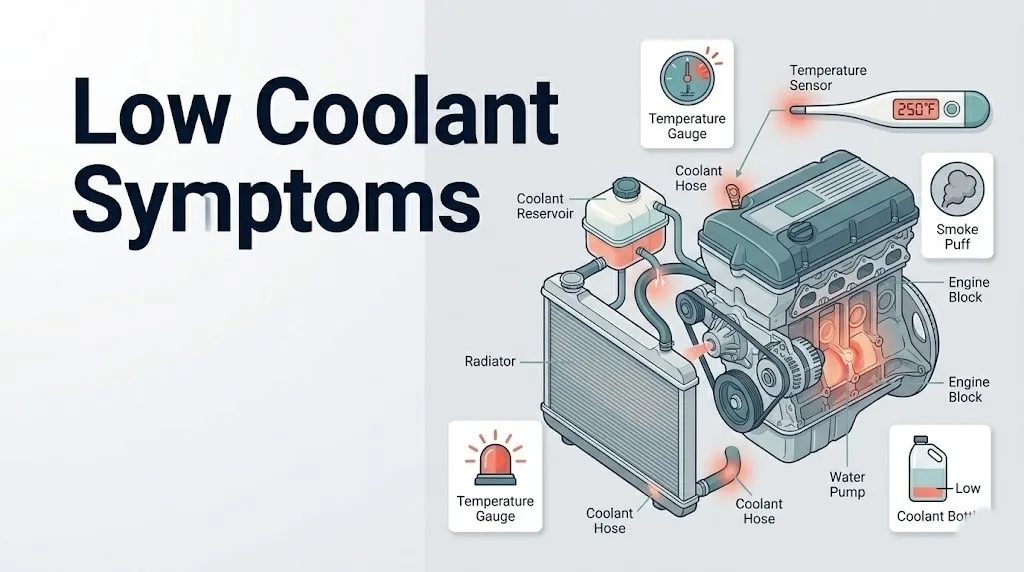
The sequence in which symptoms appear typically reflects how far the coolant level has dropped and how long the vehicle has been operating with an inadequate cooling circuit. Early symptoms present when the level is slightly below the minimum mark on the reservoir. Later symptoms indicate that the cooling system is operating critically and that engine damage may already be occurring.
| Symptom | When It Typically Appears | Severity Level | Immediate Action Required? |
|---|---|---|---|
| Coolant warning light | Early, slight deficiency | Low to moderate | Check level when engine cold; top up |
| Temperature gauge elevated | Early to moderate deficiency | Moderate | Pull over if gauge enters red zone |
| Sweet smell from engine | Early to moderate | Moderate | Inspect for visible leak; check level |
| Heater reduced warmth | Moderate deficiency | Moderate | Check level; inspect heater core hoses |
| White exhaust smoke | Moderate to severe | High | Do not continue driving; seek inspection |
| Milky/foamy oil | Severe internal loss | Critical | Stop driving; tow vehicle |
| Bubbles in reservoir | Severe, likely internal | Critical | Stop driving; tow vehicle |
| Knocking or ticking | Severe thermal stress | Critical | Stop driving immediately |
| Steam from hood | Extreme overheating | Emergency | Pull over immediately; engine off |
Vehicles with a digital driver information center (common in vehicles manufactured after 2018) may display a specific text warning such as “Coolant Level Low” before the temperature gauge rises, giving the driver more lead time than older analog-only systems do. In vehicles manufactured before 2005, the temperature gauge may be the first and only warning that appears.
Low Coolant Warning Light: What It Means and What to Do
The low coolant warning light illuminates when the coolant level sensor mounted in the coolant reservoir detects that the fluid level has dropped below the manufacturer-specified minimum threshold.
The sensor is a float-type or resistive-type device. As coolant level falls, the sensor signals the engine control module (ECM), which activates the dashboard warning. In most vehicles, this light is shaped like a thermometer submerged in wavy lines. Some vehicles use an amber light for low coolant level warnings and a red temperature warning light for active overheating. Both mean the vehicle needs attention, but they are not the same signal.
The amber low coolant warning is your early opportunity to act before any overheating begins. The correct response is:
- Pull over when it is safe to do so. Do not continue driving long distances with this light illuminated.
- Wait until the engine has been off for at least 30 minutes and the temperature gauge has returned to the cold position before opening the hood.
- Locate the coolant reservoir (a translucent plastic tank with a pressure cap, typically connected to the radiator via a hose). Check whether the fluid level is between the “MIN” and “MAX” markings on the side of the tank.
- If the level is below the “MIN” mark and the engine is completely cold, add the correct type of coolant for your vehicle (check the owner’s manual for specification) until the level reaches the “MAX” line.
- After topping up, monitor the temperature gauge on your next drive. If the warning light returns within 100 miles, the vehicle is losing coolant faster than normal wear would explain, and a qualified mechanic should inspect the cooling system promptly.
Never open the radiator cap or coolant reservoir cap when the engine is hot or warm. The pressurized system can release steam and boiling coolant at high velocity, causing severe burns. This safety rule applies equally to all drivers regardless of mechanical experience.
Drivers of older vehicles without a coolant level sensor (common in vehicles manufactured before 1995) will not receive an electronic warning. Temperature gauge monitoring becomes the only early electronic indicator available.
Engine Overheating and a Rising Temperature Gauge
Engine overheating is the most recognized of all low coolant symptoms, and it occurs when the coolant volume in the circuit is insufficient to absorb and transport combustion heat fast enough to maintain the engine’s designed operating temperature range.
At a 50/50 ethylene glycol and deionized water ratio maintained at the correct level and system pressure, the coolant mixture has a boiling point of approximately 265 to 275 degrees Fahrenheit. When coolant volume drops significantly, the water pump begins to cavitate, meaning it circulates air pockets rather than liquid. Air is a poor heat conductor. The engine temperature rises rapidly once cavitation begins.
Most gasoline engine temperature gauges enter the “normal” zone between 195 and 220 degrees Fahrenheit. The red zone or overheat zone on most gauges begins at approximately 240 to 260 degrees Fahrenheit. Sustained operation above 250 degrees Fahrenheit begins to:
- Warp aluminum cylinder heads (aluminum begins to deform at approximately 400 degrees Fahrenheit, but sustained heat stress causes micro-warping at lower sustained temperatures)
- Accelerate head gasket degradation, because the gasket material expands under heat at a different rate than the surrounding metal
- Break down engine oil viscosity, reducing its ability to protect crankshaft bearings and camshaft lobes
- Trigger pre-ignition and detonation in the combustion chamber
According to research published in the SAE International Journal of Engines, repeated thermal cycling above 240 degrees Fahrenheit measurably accelerates head gasket failure in aluminum-head engines compared with cast-iron head engines, because aluminum’s higher thermal expansion coefficient creates greater shear stress at the gasket interface.
Drivers in stop-and-go city traffic are more vulnerable to rapid overheating when coolant is low, because the vehicle’s cooling system depends on airflow through the radiator at speed. At idle, the electric radiator cooling fan must compensate entirely for the lack of ram airflow. If coolant is low and the fan is also underperforming, temperatures climb quickly.
Key Takeaway: A rising temperature gauge is your earliest mechanical warning that the cooling system is under stress. Pull over before the gauge reaches the red zone, not after.
A Sweet Smell From the Engine Bay
A sweet, syrup-like, or slightly caramel-like odor from the engine bay is the characteristic smell of ethylene glycol, the primary active ingredient in most engine coolants.
Ethylene glycol has a distinctive sweet odor that becomes noticeable when it leaks onto hot engine surfaces, such as the exhaust manifold or the turbocharger housing, and volatilizes. The volatilization temperature of ethylene glycol is well below the normal operating temperatures of these engine surfaces, so even a small drip from a cracking hose or a weeping radiator seam will produce a detectable smell within minutes of the engine reaching operating temperature.
This smell is an important diagnostic signal because it indicates that coolant is escaping from somewhere in the system, whether externally through a hose, radiator, or reservoir crack, or internally through a failing head gasket (in which case the glycol burns in the combustion chamber and exits through the exhaust, producing a sweet exhaust smell rather than a sweet underhood smell).
The location of the sweet smell helps distinguish external from internal loss:
- Sweet smell concentrated under the hood with a visible drip or puddle beneath the parked vehicle: external leak
- Sweet smell from the tailpipe exhaust, often accompanied by white or gray exhaust smoke: internal leak, consistent with head gasket failure
Ethylene glycol is acutely toxic to humans and animals. It is also attractive to animals due to its sweet taste. If you detect a coolant leak in your driveway, clean the area thoroughly before allowing pets access, and contact your veterinarian immediately if you suspect your pet has ingested coolant.
Propylene glycol-based coolants (marketed as less toxic alternatives, often found in recreational vehicle applications) produce a similar sweet smell but present a lower acute toxicity risk than ethylene glycol formulations.
Heater Not Blowing Warm Air
A cabin heater that suddenly produces cool or lukewarm air instead of warm heat is one of the less-obvious but diagnostically valuable symptoms of low coolant, occurring because the heater core depends on hot coolant flow to function.
The heater core is a small heat exchanger located inside the dashboard, connected to the engine’s cooling circuit via two heater hoses. Hot coolant from the engine flows through the heater core’s internal tubes. A blower motor forces cabin air across the fins of the heater core, warming it. That warmed air is what the driver and passengers feel as cabin heat.
When coolant level drops, the coolant that remains in the system tends to circulate preferentially through the primary cooling loop between the engine and radiator. The heater core, positioned at the end of a branch circuit within the dashboard, may receive inadequate coolant flow or may contain trapped air pockets. The result is cabin heat output that drops noticeably below what the driver normally experiences.
This symptom tends to appear at moderate levels of coolant deficiency rather than at extreme levels. Some drivers first notice it as a gradual reduction in heater performance over several days or weeks, corresponding to a slow coolant leak. Others notice it suddenly after a more rapid loss.
It is worth distinguishing this symptom from a separate mechanical failure. A faulty blend door actuator (which controls the ratio of warm to cool air in the climate control system) can also cause reduced heat output without any connection to coolant level. A failed thermostat stuck in the open position can also reduce heat output because the coolant never fully warms to operating temperature. If adding coolant to the correct level does not restore heater performance within one to two warm-up cycles, a thermostat check is warranted.
Drivers in colder climates (ambient temperatures below 20 degrees Fahrenheit) face an additional risk: a heater that stops working during winter driving is also a safety risk from reduced windshield defrost capacity, making driving in freezing conditions dangerous regardless of the mechanical cause.
White Exhaust Smoke and What It Signals
White or gray exhaust smoke that persists beyond the first 60 to 90 seconds of a cold engine start is one of the most serious low coolant symptoms, because it typically indicates that coolant is entering the combustion chamber and burning alongside the fuel-air mixture.
Under normal conditions, white vapor from a cold exhaust in cool weather is condensation, not smoke. It disappears within a minute or two as the exhaust system warms. Persistent white exhaust smoke that continues throughout the drive, that has a faintly sweet smell, or that appears in warm weather when condensation is not expected, is a different signal entirely.
The most common mechanical cause of persistent white exhaust smoke when related to coolant is a failed head gasket. The head gasket seals the junction between the cylinder head and the engine block, maintaining separate boundaries between the combustion chamber, the coolant passages, and the engine oil passages. When the head gasket fails at a coolant passage boundary, coolant under pressure (the cooling system operates at 13 to 16 PSI) migrates into the combustion chamber during the engine’s intake stroke. It burns during combustion and exits as white steam/smoke through the exhaust.
The head gasket failure does two things simultaneously: it allows coolant to escape the cooling circuit (producing low coolant level and overheating), and it contaminates the combustion cycle (producing the white exhaust smoke). This is why low coolant level and persistent white exhaust smoke appearing together is a critical diagnostic combination.
A cracked cylinder head or cracked engine block can produce identical symptoms. The distinction requires a mechanical diagnosis by an ASE-certified automotive technician using a combustion leak test kit (which detects hydrocarbons in the coolant) and a cooling system pressure test.
Do not continue driving a vehicle producing persistent white exhaust smoke. Coolant burning in the combustion chamber accelerates catalytic converter damage, and the underlying head gasket or structural failure will worsen with continued driving.
Key Takeaway: White exhaust smoke that persists past the first two minutes of driving is a signal of internal coolant loss. Stop driving and have the vehicle inspected before further damage occurs.
Milky or Foamy Engine Oil: The Internal Leak Indicator
Milky or foamy engine oil is one of the clearest physical signs that coolant has entered the engine’s lubrication circuit, and it represents a serious internal failure requiring immediate attention.
Normal engine oil is amber to dark brown in color. When coolant mixes with engine oil, the two fluids emulsify (mix into a foam-like emulsion rather than separating cleanly), producing oil that appears milky, beige, frothy, or like a chocolate milkshake consistency on the dipstick or inside the oil filler cap.
The most common pathway for coolant to enter the oil circuit is through a head gasket failure at the boundary between a coolant passage and an oil passage within the engine block or cylinder head. Less commonly, a cracked engine block or cylinder head can create the same contamination pathway. A very rare cause in high-mileage engines is a failed intake manifold gasket in engines that route coolant through the intake manifold (a design used in several V6 engine architectures from the late 1990s to mid-2000s, notably certain GM 3.1L and 3.4L engines).
Coolant in the engine oil is mechanically dangerous for reasons beyond the coolant loss itself. Ethylene glycol disrupts the oil film that protects crankshaft journal bearings and camshaft lobes. According to research in the SAE International Journal of Fuels and Lubricants, even a 1% coolant contamination of engine oil measurably reduces the load-bearing capacity of the oil film at bearing surfaces, accelerating wear. At 5% contamination, bearing damage occurs rapidly under normal driving loads.
To check for this at home without mechanical tools:
- With the engine cold and off, pull the engine oil dipstick.
- Observe the color and consistency of the oil on the dipstick. Normal oil is dark and flows cleanly off the stick. Contaminated oil appears pale, milky, or frothy.
- Remove the oil filler cap on top of the engine (the cap where you add oil). Look at the underside of the cap. A thin brown sludge or frothy tan residue on the underside of the cap is a reliable sign of coolant-oil mixing.
- If either sign is present, do not start or drive the vehicle. Tow it to a mechanic.
Older high-mileage vehicles (150,000 miles or more) are at significantly greater risk of head gasket failure because gasket materials and the sealing surfaces around them degrade with age, thermal cycling, and prior overheating events.
Bubbles in the Coolant Reservoir
Visible bubbles or foam in the coolant reservoir when the engine is running or immediately after shutdown is a specific and serious diagnostic sign that combustion gases are entering the cooling circuit.
Under normal conditions, the coolant reservoir contains fluid that may expand and contract as the engine heats and cools, but it does not bubble actively. Bubbling occurs when the pressure differential between the combustion chamber and the cooling circuit allows combustion gases (primarily a mixture of nitrogen, carbon dioxide, carbon monoxide, and unburned hydrocarbons) to push through a breach in the barrier between the two systems.
That barrier is the head gasket. A head gasket failure at the boundary between a combustion chamber and an adjacent coolant passage allows combustion gas pressure (which peaks at 400 to 600 PSI during the power stroke) to push into the cooling circuit (which operates at only 13 to 16 PSI). The pressure differential is enormous, and gases rush in with every combustion event, creating the bubbling visible in the reservoir.
This is why the combustion leak test (also called the block test or hydrocarbon sniff test) works: a chemical test strip held over the coolant reservoir opening changes color from blue to yellow when combustion hydrocarbons are present in the coolant vapor. This test is available in kit form at automotive parts stores and takes less than five minutes to perform. A positive result confirms that combustion gases are entering the cooling system.
According to ASE diagnostic guidelines, persistent bubbling in the coolant reservoir, a positive combustion leak test, and persistent white exhaust smoke together constitute a reliable diagnostic triad for head gasket failure, even before expensive disassembly. Vehicles displaying all three signs require immediate mechanical inspection and should not be driven.
Turbocharged vehicles may produce transient bubbling from air entering the cooling circuit through a leaking turbocharger coolant fitting, which is a less catastrophic but still serious failure requiring prompt repair.
Reduced Engine Performance and Knocking Noises
Low coolant that has progressed to active overheating begins to affect engine performance directly, producing symptoms that drivers may initially mistake for fuel system problems or ignition issues rather than recognizing them as heat-related.
Pre-ignition (sometimes called engine knock or pinking) is the combustion of the air-fuel mixture before the spark plug fires, triggered by excessively hot cylinder walls and combustion chamber surfaces. When coolant is low and the engine runs hotter than normal, the combustion chamber surfaces absorb heat between cycles rather than being cooled adequately. These hot surfaces ignite the incoming air-fuel mixture prematurely, creating a pressure spike that collides with the piston before it has reached the top of its stroke. The result is an audible metallic knocking or pinging sound, particularly noticeable under load (accelerating uphill or under heavy throttle).
Sustained pre-ignition damages piston crowns, piston rings, and connecting rod bearings. A 2019 analysis published in the SAE International Journal of Engines found that repeated pre-ignition events in turbocharged direct-injection gasoline engines cause piston crown cracking at a rate significantly higher than in naturally aspirated engines under the same thermal conditions.
Beyond knocking, low coolant can cause:
- Rough idle: Cylinders running hotter than normal produce inconsistent combustion timing, manifesting as a rough, uneven idle
- Reduced power output: The ECM’s knock sensor detects pre-ignition and retards ignition timing to protect the engine, which reduces power as a protective measure
- Hesitation under acceleration: Heat-related reduction in charge density (hot air is less dense than cool air) reduces the mass of air entering the cylinder, reducing combustion efficiency
- Check engine light with misfire codes (P0300 series): Severe overheating can cause misfires as combustion efficiency deteriorates
Drivers of high-performance turbocharged vehicles should note that these performance symptoms appear faster under low coolant conditions than in naturally aspirated engines, because the turbocharger adds heat to the intake charge and places additional thermal load on the engine that the cooling system must manage.
Key Takeaway: Engine knocking under load, combined with a higher-than-normal temperature gauge, means the engine is already suffering heat stress. Stop driving and do not restart until the cooling system has been inspected.
What Causes Low Coolant Level?
Low coolant level has two fundamentally different categories of cause, and understanding which category applies determines the urgency of the repair and the type of mechanic intervention required.
External coolant loss occurs when coolant escapes from the outside of the cooling circuit through a breach in a hose, the radiator, the reservoir, a gasket connecting external components, or a corroded freeze plug (also called a core plug) in the engine block. External loss is visible: coolant drips or pools beneath the parked vehicle, typically a bright green, orange, pink, or blue puddle depending on the coolant formulation. The sweet smell of ethylene glycol accompanies it.
Common external causes include:
- Deteriorated upper or lower radiator hoses (rubber degrades with age and heat cycling, typically after 60,000 to 100,000 miles or 5 to 7 years, whichever comes first)
- Pinhole leaks in the radiator core (caused by corrosion from depleted corrosion inhibitors in old coolant)
- Cracked coolant reservoir (plastic becomes brittle with age and heat exposure)
- Leaking heater core (produces a sweet smell inside the cabin, not just under the hood, and may cause foggy windshield from glycol vapor)
- Failed radiator pressure cap seal (allows coolant to escape under pressure)
- Corroded freeze plugs in the engine block (common in older engines after 15 or more years)
Internal coolant loss occurs when coolant escapes into the combustion chamber, the oil circuit, or between two internal engine passages through a breach in the head gasket, cylinder head, or engine block. Internal loss may leave no visible puddle under the vehicle, which is why some drivers are surprised when they discover a serious coolant problem. The coolant is not going onto the ground; it is going into the engine.
According to Consumer Reports vehicle reliability data, head gasket failure is among the most costly engine repairs, with repair costs ranging from $1,500 to $3,500 or more depending on engine configuration and labor market. Continued driving after symptoms of internal coolant loss appear consistently increases the scope of damage and the cost of repair.
Low Antifreeze Symptoms in Cold Weather
Low antifreeze concentration in cold weather produces a distinct set of symptoms that differ from warm-weather low coolant symptoms, because the primary threat shifts from overheating to freezing-induced mechanical damage.
At a standard 50/50 ethylene glycol-to-water ratio, most coolant formulations protect to approximately minus 34 degrees Fahrenheit. When the glycol concentration drops (either because coolant level is low and was topped up with plain water, or because the coolant has not been refreshed and the glycol has degraded), the freeze protection threshold rises toward 32 degrees Fahrenheit, the freezing point of water.
Water expands by approximately 9% when it freezes. Inside a sealed cooling system, that expansion generates enormous pressure. The weakest points in the system, typically the radiator core, rubber hoses, and the water pump housing, fail first. Radiator core tubes crack, rubber hoses split, and the water pump housing fractures, releasing coolant rapidly when the ice thaws.
Low antifreeze symptoms specific to cold weather include:
- Engine slow to warm up (thermostat opening and closing erratically due to slushy coolant mixture near the thermostat housing)
- Heater producing inadequate warmth (the slush-like partially frozen coolant does not flow efficiently through the heater core)
- Gurgling sounds from the dashboard when the heater is on (partially frozen coolant moving sluggishly through the heater core hose circuit)
- Cracking or popping sounds from the cooling system during warm-up (ice crystal formation and expansion stressing hoses and radiator components)
- Coolant leak appearing suddenly after a freezing night without any prior visible external damage (freeze-induced crack in the radiator core)
According to the AAA, vehicles in regions that experience temperatures below 20 degrees Fahrenheit should have coolant freeze protection tested annually before winter. Test strips are inexpensive and available at any automotive parts store.
Drivers in northern climates who notice any of these cold-weather symptoms should have a mechanic test the coolant concentration using a refractometer (the most accurate tool) or a float-type antifreeze tester before the first hard freeze of the season.
Turbocharged and Aluminum Engines: Elevated Risk
Turbocharged engines and vehicles with aluminum cylinder heads (which includes the majority of gasoline passenger cars manufactured after 2000) face elevated risk from low coolant conditions compared with older cast-iron engine designs, and they produce accelerated damage at lower coolant deficiency thresholds.
Aluminum has a thermal conductivity approximately four times greater than cast iron, meaning it transfers heat rapidly. This property is valuable in normal operation because it helps the engine reach operating temperature quickly. Under low coolant conditions, the same property means that heat builds up faster in an aluminum head than in a cast-iron head, and the threshold for warping or cracking is reached more quickly.
Aluminum also has a significantly higher thermal expansion coefficient than the steel head bolts and cast-iron engine block with which it is typically paired. Temperature increases cause aluminum to expand more than steel, creating shear stress at the head gasket interface with every heat cycle. When coolant is insufficient to moderate the rate of temperature change, these expansion differentials are more extreme and gasket failure occurs at lower total mileage.
Turbocharged engines add another specific risk: the turbocharger itself relies on engine coolant for cooling, both during operation and after shutdown. The turbocharger compresses intake air, generating substantial heat at the compressor and turbine housings. Coolant circulates through internal passages in the turbocharger’s center housing to cool the bearing journals. After engine shutdown, many turbocharged vehicles continue circulating coolant through the turbocharger via a small electric coolant pump for several minutes, preventing “heat soak” from cooking the bearing oil.
If coolant level is low, turbocharger bearing cooling is compromised both during and after operation. This accelerates turbocharger bearing wear and can cause coking (carbon buildup from oil decomposing under excessive heat) in the turbocharger’s oil passages.
Owners of turbocharged vehicles should treat any coolant warning earlier and more conservatively than owners of naturally aspirated vehicles, and should not restart a hot turbocharged engine and immediately shut it off again (a common mistake), as this cuts the post-shutdown coolant circulation cycle short.
How to Check Your Coolant Level Safely
Checking your coolant level is a straightforward task when the engine is cold, and it should be done only when the engine is cold, because a hot cooling system is under pressure and opening any cap can cause serious burns.
The coolant reservoir is a translucent plastic tank, usually white or light gray, located near the radiator. It has a pressure cap on top and “MIN” and “MAX” markings on its side. This is the correct place to check the level on virtually all vehicles manufactured after 1990. Most modern vehicles do not require opening the radiator cap directly to check the level.
To check your coolant level correctly:
- Park the vehicle on level ground and turn off the engine. Allow the engine to cool completely. This takes a minimum of 30 minutes after a short drive, or up to two hours after extended highway driving.
- Open the hood and locate the coolant reservoir. If you are unsure which tank it is, consult the vehicle owner’s manual; the reservoir is typically labeled with a snowflake or thermometer symbol and a warning about not opening when hot.
- Look at the side of the reservoir. Check that the coolant level sits between the MIN and MAX lines. On most vehicles, the fluid should be visible through the translucent plastic without opening the cap.
- If the level is below MIN, open the cap slowly and carefully only when the engine is completely cold. Turn the cap slowly counterclockwise; if you hear hissing or feel pressure, stop immediately and wait longer.
- Add the correct type of coolant for your vehicle. The correct type is listed on the reservoir cap, in the owner’s manual, or on the manufacturer’s coolant specification label inside the hood. Mixing incompatible coolant types (for example, adding orange OAT coolant to a system filled with green IAT coolant) causes chemical precipitation and accelerates corrosion.
- Fill to the MAX line, not above it. Overfilling causes coolant to purge through the pressure cap overflow tube, which appears as a drip and can be mistaken for a leak.
According to the AAA, the single most common coolant-related mistake drivers make is adding plain water repeatedly to a low coolant system rather than the correct coolant formulation. This dilutes both the freeze protection and the corrosion inhibitor package, accelerating internal corrosion.
Can You Drive With Low Coolant?
Whether it is safe to drive with low coolant depends entirely on how low the level is, what symptoms the vehicle is showing, and how far you need to drive.
A coolant level that is slightly below the MIN line on the reservoir, with no warning light illuminated, no elevated temperature gauge reading, and no other symptoms, presents minimal immediate risk on a short, slow-speed trip (less than 5 miles) to a location where coolant can be added or the vehicle can be inspected. This is the only scenario in which driving a vehicle with low coolant is defensible.
Any of the following conditions change that assessment entirely:
- The temperature gauge is above the midpoint or moving toward the red zone: stop driving
- The coolant warning light is illuminated: check the level before driving further
- White exhaust smoke is visible: stop driving immediately
- The engine is making knocking or ticking sounds it did not make before: stop driving
- Steam or vapor is visible from under the hood: stop the car safely, engine off, do not restart
The risk of continuing to drive with moderate to severe coolant deficiency is not gradual inconvenience; it is the risk of complete engine destruction within a short distance. A seized piston or spun crankshaft bearing caused by overheating can destroy an engine that would have cost $800 to $1,500 to repair (head gasket) in a way that instead requires a full engine replacement costing $5,000 to $12,000 or more depending on the vehicle.
Pregnant drivers, elderly drivers, and drivers with mobility limitations who are concerned about pulling over safely on a high-speed road should note that emergency hazard lights should be activated before pulling onto a shoulder, and that pulling completely off the road surface (onto a wide shoulder, into a parking lot, or onto a road exit) is always safer than stopping in an active lane.
Key Takeaway: Slightly low coolant with no other symptoms allows a brief, cautious trip to get it topped up. Any other symptom on this list means stopping the car before you reach your destination.
Emergency Signs: When to Stop Driving Immediately
Certain symptoms of low coolant require you to stop the vehicle immediately. Do not wait to see if they resolve or get better on their own.
Pull over safely, turn off the engine, and call for roadside assistance immediately if you experience any of the following:
- The temperature gauge enters the red zone or reads at or near maximum: continuing to drive risks warping or cracking the cylinder head, seizing the pistons, or destroying the head gasket within minutes
- Steam or vapor is rising from under the hood: the coolant is actively boiling and escaping the system, the engine is in critical thermal failure, and driving further will guarantee major engine damage
- A strong burning or sweet chemical smell combined with a rising temperature gauge: coolant is contacting hot exhaust or engine surfaces in significant quantity, indicating an active and serious leak
- The engine suddenly loses power dramatically and begins making loud knocking or banging sounds: these are signs of impending piston or bearing seizure from heat damage, and every second of continued driving worsens the outcome
- The oil pressure warning light illuminates alongside the temperature warning: catastrophic cooling failure is damaging the lubrication system simultaneously, and the engine is at risk of a complete mechanical failure
Do not open the hood immediately if steam is visible. Wait at least 15 minutes for the pressure to normalize before approaching the engine compartment. Do not open the radiator cap or coolant reservoir cap when the engine is hot or warm. Both actions risk severe burns from pressurized steam and boiling coolant.
Do not add cold water to a severely overheated engine. Adding cold liquid to an extremely hot engine block or cylinder head causes thermal shock, which can crack an aluminum cylinder head instantly. If you add any fluid, wait until the engine has cooled to the point where the metal surfaces are cool to the touch.
These situations represent a mechanical emergency. The correct action is to stop the vehicle safely, activate hazard lights, exit the vehicle if it is safe to do so, and call for roadside assistance. Do not drive to a mechanic. Tow the vehicle.
What Happens to an Engine When Coolant Runs Out?
Complete coolant loss, or near-complete loss, produces a rapid and catastrophic sequence of mechanical failures that typically destroys the engine permanently within a very short period of driving.
The sequence follows a predictable thermal cascade. First, the water pump begins pumping air rather than liquid. Heat absorption by the cooling circuit stops. Engine block and cylinder head temperatures climb from the normal operating range of 195 to 220 degrees Fahrenheit toward 300, 400, and beyond.
At approximately 275 to 300 degrees Fahrenheit sustained, the head gasket begins to fail at its most stressed points, typically the sealing rings around the combustion chambers. Combustion gas enters the cooling circuit, and coolant enters the combustion chamber. This mutual contamination happens rapidly.
At 300 to 400 degrees Fahrenheit sustained at the cylinder head surface, aluminum cylinder heads begin to warp. The head warps away from the engine block surface, breaking the head gasket seal completely. At this point, coolant and oil mix freely in the engine, and the lubrication film protecting crankshaft bearings collapses.
At 400 degrees Fahrenheit and above at the cylinder walls, piston rings lose their spring tension and begin to seize against the cylinder bore wall. A seized piston stops moving, which can cause the connecting rod to bend or break, or the crankshaft to spin within its bearing journals (called a spun bearing), tearing apart the bottom end of the engine.
In some cases, the engine simply locks solid and will not turn over. In severe cases, connecting rod failure can cause the rod to puncture the engine block, producing the sound mechanics call “throwing a rod,” which is usually the point of no return for the engine.
According to Consumer Reports data, complete engine failure from overheating following coolant system neglect is one of the top five most expensive vehicle repair scenarios, with replacement or remanufactured engine costs ranging from $4,000 to more than $15,000 depending on the vehicle.
An engine that has been run to complete coolant loss is, in the majority of cases, a total loss. The cost of engine replacement typically exceeds the vehicle’s market value in any vehicle more than 10 years old.
Frequently Asked Questions About Low Coolant Symptoms
What are the first signs of low coolant in a car?
The first signs of low coolant are typically an illuminated coolant or temperature warning light on the dashboard, followed by a temperature gauge reading slightly above its normal midpoint position.
A sweet, syrup-like smell from the engine bay, especially noticeable after parking, is another early sign that coolant is escaping from the system through a minor external leak.
If you notice any of these signs, check the coolant level in the reservoir when the engine is completely cold, before driving further.
Can low coolant cause a car to overheat immediately?
Low coolant does not always cause immediate overheating; the rate of temperature rise depends on how far below the minimum level the coolant has dropped and what driving conditions are present.
A slightly low level may produce no immediate overheating under highway driving conditions, where airflow through the radiator is strong, but can cause rapid overheating in stop-and-go traffic where the electric radiator fan must compensate for the absence of ram airflow.
A severely low level, or a system operating with air pockets caused by rapid coolant loss, can cause temperatures to climb dangerously within five to ten minutes of driving.
How do I know if I have an internal coolant leak?
An internal coolant leak is indicated by persistent white or gray exhaust smoke that continues beyond the first two minutes of driving, milky or foamy oil on the dipstick or under the oil filler cap, and active bubbling in the coolant reservoir when the engine is running.
These three signs together constitute the classic diagnostic triad for head gasket failure, the most common cause of internal coolant loss, and can be confirmed by an ASE-certified mechanic using a combustion leak test kit that detects hydrocarbons in the coolant vapor.
A vehicle showing any two of these three signs should not be driven; it should be towed to a mechanic for inspection.
Is it safe to add water instead of coolant in an emergency?
Adding clean water to a low coolant system is acceptable as a very short-term emergency measure to get the vehicle to a safe location, but it should be replaced with the correct coolant formulation as soon as possible.
Plain water lowers the boiling point and raises the freeze point of the coolant mixture, removing both heat and freeze protection, and it contains minerals that accelerate internal corrosion of aluminum components and the radiator core.
Never add water to a hot engine, and replace the diluted mixture with the correct coolant type at the earliest opportunity, ideally at the next service stop.
How often should engine coolant be replaced?
Most vehicle manufacturers recommend a coolant flush and replacement every 30,000 miles for older inorganic additive technology (IAT, typically green) coolants, or every 5 years/150,000 miles for newer organic acid technology (OAT) and hybrid organic acid technology (HOAT) formulations.
The owner’s manual for your specific vehicle contains the manufacturer’s exact specification; following the OEM interval rather than a generic rule is the most reliable approach because coolant chemistry varies significantly between manufacturers and engine types.
Coolant that has not been replaced at the correct interval loses its corrosion inhibitor effectiveness, accelerating internal damage to the radiator, water pump, heater core, and aluminum engine surfaces.
What does low coolant smell like?
Low coolant that is leaking from the system smells distinctly sweet, syrup-like, and slightly caramel-like, due to the ethylene glycol compound that makes up the primary active ingredient in most engine coolants.
The smell is most noticeable after the engine has warmed up and is coming from the engine bay rather than the exhaust, which indicates an external leak; a sweet smell specifically from the exhaust tailpipe, accompanied by white smoke, indicates an internal leak.
If you detect this sweet smell inside the vehicle cabin, particularly combined with a foggy windshield, a leaking heater core inside the dashboard is the likely source.
Putting It All Together
Low coolant symptoms follow a clear progression from early electronic warnings to physical signs of active cooling failure. Catching the symptom at the warning light or the elevated temperature gauge stage costs you the price of a coolant top-up and a mechanic’s inspection. Missing the white exhaust smoke, the milky oil, or the bubbling reservoir until the engine overheats completely costs you an engine.
The single most important action you can take right now is to check the coolant reservoir level when the engine is completely cold, look at the oil dipstick and oil cap for any milky discoloration, and note whether you have seen any of the symptoms described here. If the level is low and there is no visible external puddle on the ground, an internal loss is possible, and a cooling system pressure test by an ASE-certified technician is the appropriate next step.
Your engine cannot repair itself. But every one of the symptoms described here, caught early, gives a qualified mechanic the information needed to fix the problem before it becomes irreversible.