Labrum Tear Symptoms: Signs, Types and When to Act
Labrum tear symptoms include deep shoulder pain, a clicking or catching sensation during arm movement, a feeling of shoulder instability or apprehension with overhead activity, and in some cases a dead arm sensation during throwing, with the exact symptom pattern depending critically on which part of the glenoid labrum is torn. The two most important distinctions are SLAP tears, which involve the superior labrum at the biceps tendon anchor, and Bankart lesions, which involve the anteroinferior labrum and produce glenohumeral instability.
According to the American Academy of Orthopaedic Surgeons (AAOS), shoulder labral tears are among the most frequently missed diagnoses in shoulder pain evaluation, partly because the symptom pattern overlaps substantially with rotator cuff pathology, biceps tendinopathy, and acromioclavicular joint disease. Standard MRI misses up to 30 percent of labral tears; MR arthrography (MRI with intra-articular gadolinium contrast injection) is required for reliable imaging diagnosis.
This article covers every established labral tear symptom with the anatomical and neurophysiological mechanism behind each one, how SLAP tears and Bankart lesions produce different but overlapping symptom patterns, how symptoms differ by athlete type, age, and sex, what the diagnostic examination process involves, and exactly when symptoms require urgent evaluation.
Labrum Tear Symptoms: What the Clinical Evidence Shows
The established clinical symptom pattern of a shoulder labral tear includes deep aching shoulder pain, mechanical clicking or catching, apprehension or instability during specific arm positions, weakness or fatigue with overhead activity, and in throwing athletes a characteristic “dead arm” sensation during the deceleration phase of the throw.
What the top-ranking health content consistently fails to explain is that identical-appearing symptoms can arise from entirely different tear locations. The glenoid labrum is a fibrocartilaginous ring that surrounds the entire circumference of the glenoid cavity, and different zones of this ring serve different biomechanical and neurological functions. A tear at 12 o’clock (the SLAP zone) produces a completely different clinical picture from a tear at 4 o’clock (the Bankart zone), even though both produce “shoulder pain and clicking.”
The complete symptom inventory includes:
- Deep, aching shoulder pain localized to the posterior or anterior shoulder depending on tear location
- Clicking, popping, or catching sensation with arm movement
- Shoulder instability or apprehension with the arm in abduction and external rotation
- Painful arc of motion, typically between 90 and 120 degrees of shoulder elevation
- Dead arm sensation during overhead throwing (primarily SLAP tears)
- Night pain, worsening when lying on the affected shoulder
- Loss of shoulder strength, particularly with pressing and pulling movements
- Decreased range of motion, particularly internal rotation or cross-body reach
- Bicipital groove pain or pain with resisted forearm supination (when biceps anchor is involved)
Understanding which symptoms are present, which positions provoke them, and which movements relieve them gives an examining clinician the information needed to suspect a specific tear type before any imaging is ordered.
What Is a Shoulder Labral Tear
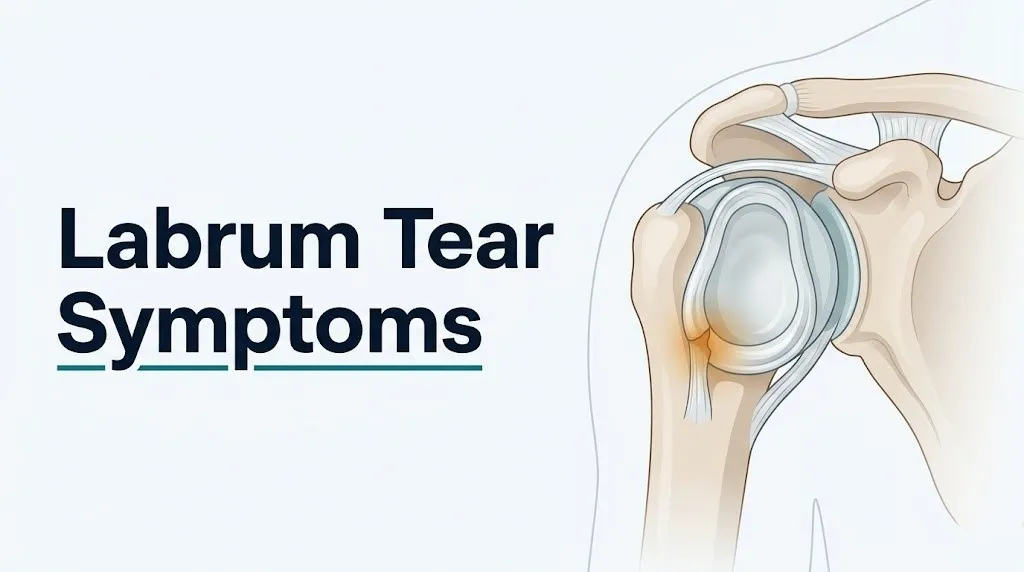
A shoulder labral tear is a disruption of the fibrocartilaginous glenoid labrum, the ring of fibrocartilage attached to the rim of the glenoid cavity of the scapula that deepens the socket of the glenohumeral joint and serves as the anchor point for the major static stabilizing ligaments of the shoulder.
The glenohumeral joint is the most mobile joint in the human body, a design that comes with a specific trade-off: the glenoid cavity is remarkably shallow, resembling a golf tee supporting a golf ball rather than a deep socket. The glenoid labrum compensates for this shallow geometry by increasing the depth of the glenoid by approximately 50 percent, converting the flat glenoid surface into a deeper cup that resists humeral head translation in all directions.
Beyond its mechanical deepening function, the labrum serves as the attachment site for the inferior glenohumeral ligament complex (IGHLC), the most important static restraint against anterior shoulder dislocation, and for the long head of the biceps tendon (LHBT), which anchors to the superior glenoid labrum (the supraglenoid tubercle) and transmits tensile load from biceps contraction directly through the superior labral tissue.
When a portion of this fibrocartilaginous ring tears, two consequences occur simultaneously. The mechanical stabilizing function of that zone is reduced, allowing greater humeral head translation. The nociceptive nerve fibers embedded in the labral tissue and adjacent joint capsule are disrupted and sensitized, generating pain signals that travel via branches of the suprascapular nerve, the axillary nerve, and the lateral pectoral nerve, depending on which quadrant of the labrum is affected.
According to the National Institute of Arthritis and Musculoskeletal and Skin Diseases (NIAMS), shoulder instability resulting from labral tears affects millions of Americans annually, with the highest incidence in active adults between 15 and 40 years old.
Shoulder Labral Tear Symptoms: The Complete List
The complete list of shoulder labral tear symptoms, in order of clinical frequency and significance, includes deep shoulder pain, mechanical clicking or catching, instability or apprehension, painful overhead motion, dead arm sensation, bicipital groove tenderness, decreased internal rotation range of motion, night pain, and progressive shoulder weakness.
The symptom experience varies substantially by which part of the labrum is affected and whether the tear is acute (from a discrete injury event) or chronic (developing gradually from repetitive stress). Understanding this variation is the most practically useful aspect of labral tear symptom recognition.
Symptom severity by tear location:
| Symptom | SLAP Tear (Superior) | Bankart Lesion (Anteroinferior) | Posterior Labral Tear |
|---|---|---|---|
| Deep aching pain | Posterior superior shoulder | Anterior shoulder | Posterior shoulder |
| Clicking/catching | With overhead reach | With abduction and ER | With forward flexion and IR |
| Instability | Subtle, with throwing | Frank, with abduction and ER | Posterior instability |
| Dead arm sign | Characteristic | Occasional | Less common |
| Painful arc | 90-120 degrees elevation | 90-120 degrees abduction and ER | Forward flexion and cross-body |
| Night pain | Yes, on affected side | Yes, on affected side | Yes, on affected side |
| Weakness | Biceps and overhead press | Pushing motions | Pulling motions |
Patients with rheumatoid arthritis or other inflammatory joint conditions may have labral symptoms that are masked by concurrent synovitis, making the mechanical features (clicking, catching, instability) less distinct and more difficult to isolate clinically.
Key Takeaway: The location of your shoulder pain and the specific arm position that provokes or relieves it provides the most reliable clue about which zone of the labrum is involved, and that information is worth documenting precisely before your physician appointment.
SLAP Tear Symptoms
SLAP tear (superior labrum anterior to posterior tear) symptoms are characterized by deep posterior shoulder pain during overhead and throwing activities, a painful arc between 90 and 120 degrees of shoulder elevation, a catching or grinding sensation within the joint during arm movement, and in throwing athletes a classic “dead arm” phenomenon during the late cocking and early deceleration phases of throwing.
The SLAP lesion involves the superior zone of the glenoid labrum, specifically the area where the long head of the biceps tendon anchors to the supraglenoid tubercle. The anatomy here is particularly vulnerable because the LHBT transmits substantial tensile force through its superior labral attachment during any activity involving elbow flexion against resistance, forearm supination, or the deceleration phase of overhead throwing. When this attachment tears, every overhead and throwing motion transmits biceps tension through a disrupted anchor, generating pain deep within the posterior shoulder.
Think of the biceps tendon anchor in the superior labrum like the root of a garden stake. When the stake is solidly planted, you can pull on it from any direction. But if the root is torn loose, pulling the stake in the direction of the tear causes the root to lever painfully against the surrounding soil. That levering sensation, reproduced with the arm in the position of maximum biceps tension, is exactly what an SLAP tear patient experiences.
The characteristic positions that provoke SLAP tear pain include:
- Reaching overhead with the palm forward (shoulder external rotation and elevation)
- Throwing or lifting with the arm elevated above shoulder height
- Performing push-ups or bench press at the deepest position of elbow flexion with the arm abducted
- Carrying a heavy bag with the elbow extended and forearm supinated
The O’Brien test (active compression test), performed by the examining clinician with the arm forward flexed to 90 degrees, horizontally adducted 15 degrees, and the forearm fully pronated versus supinated, detects SLAP tears when pain is produced in the pronated position and relieved in the supinated position. Research published in the American Journal of Sports Medicine has documented the O’Brien test’s sensitivity for SLAP tears at approximately 47 to 78 percent, making it useful but not definitive as a standalone test.
Overhead workers (electricians, painters, plumbers) who perform repetitive reaching above shoulder height are at elevated occupational risk for chronic SLAP tears from cumulative biceps anchor loading.
Bankart Lesion Symptoms
A Bankart lesion (anteroinferior glenoid labral tear) produces symptoms of anterior shoulder instability: a sense of apprehension or fear that the shoulder will dislocate when the arm is placed in abduction and external rotation, frank anterior shoulder pain in that position, and a subjective feeling that the shoulder is “slipping out” of place during reaching or throwing movements.
The Bankart lesion involves the anteroinferior labrum from approximately the 3 to 6 o’clock position on the glenoid clock face. This zone serves as the attachment site for the inferior glenohumeral ligament (IGHL), the primary static restraint against anterior humeral head translation. When a traumatic anterior shoulder dislocation (the most common mechanism) tears the labrum away from the glenoid rim in this zone, both the labral bumper and the IGHL’s glenoid attachment are compromised. The result is that the anterior “guardrail” is gone: the humeral head can now translate anteriorly under loads that a normal shoulder resists passively.
The position of maximum anterior glenohumeral instability is 90 degrees of shoulder abduction combined with maximum external rotation. This is the position of the late cocking phase in throwing, the position of reaching for an overhead cabinet from the side, and the position a clinician uses in the apprehension test: placing the arm in this position and observing whether the patient experiences apprehension (a sense that the shoulder is about to dislocate) rather than simply pain.
The relocation test follows the apprehension test. The examiner applies a posteriorly directed force to the humeral head while the arm remains in the provocative position. Reduction of the apprehension response confirms that anterior humeral head translation was responsible for the symptom, strongly supporting a Bankart lesion.
According to the Journal of Bone and Joint Surgery, first-time anterior shoulder dislocations result in a Bankart lesion in approximately 85 to 97 percent of cases in young athletic patients. Young males under 25 years old who sustain a first-time anterior dislocation have a redislocation rate approaching 80 percent without surgical stabilization, based on clinical series reviewed in the American Journal of Sports Medicine.
Labrum Tear Pain Location and Character
The pain from a labral tear is typically described as a deep, poorly localized aching within the shoulder joint itself rather than on the surface of the shoulder, because the pain signal originates from nociceptive nerve fibers within the fibrocartilaginous labral tissue and adjacent joint capsule rather than from skin or superficial muscle.
The specific location of the deep aching pain provides the most reliable anatomical clue about tear zone. This is explained by the neuroanatomy: the posterior superior labrum (SLAP zone) is innervated by branches of the suprascapular nerve, which enter the posterior joint capsule and labrum after supplying the supraspinatus and infraspinatus muscles. Activation of these nociceptive fibers produces pain in the posterior and superior shoulder region. The anteroinferior labrum (Bankart zone) receives innervation from branches of the axillary nerve and produces pain in the anterior shoulder and, in some cases, the lateral upper arm where the axillary nerve’s cutaneous branch (the superior lateral cutaneous nerve of the arm) distributes.
Pain character in labral tears is typically described as:
- Aching at rest, which worsens predictably with specific provocative movements
- Sharp and catching during the specific motion that loads the torn zone
- Electric or shooting in some cases when the torn labrum catches between the humeral head and glenoid rim during movement
- Pressure-like when lying on the affected shoulder at night, from compression of the inflamed capsulolabral complex
The pain rarely radiates below the elbow unless a concurrent cervical radiculopathy or brachial plexus irritation is present alongside the labral tear. Pain that travels clearly past the elbow or into the hand warrants cervical spine evaluation by a primary care sports medicine physician or orthopedic spine specialist alongside the shoulder assessment.
Patients taking non-steroidal anti-inflammatory drugs (NSAIDs) for concurrent conditions may partially mask the aching component of labral tear pain while the mechanical symptoms (clicking, catching, instability) remain fully present and clinically informative.
Labrum Tear Clicking, Popping, and Catching Symptoms
The clicking, popping, or catching sensation produced by a labral tear occurs when the torn, irregularly edged labral tissue or a displaced labral flap is mechanically interposed between the humeral head and the glenoid rim during joint motion, producing a palpable and audible mechanical event within the joint.
The normal glenoid labrum provides a smooth fibrocartilaginous surface around the glenoid rim. When a portion of this surface tears, the free edge of the tear can displace into the joint space during certain arm movements. As the humeral head moves across the glenoid, it contacts this displaced tissue, and the resulting catch-and-release motion is what the patient feels as clicking or catching. The sensation is typically felt deep inside the joint rather than on the surface, and it often reproduces the patient’s pain at the moment of the catch.
Not all shoulder clicking indicates a labral tear. Benign crepitus from the subacromial bursa or from the AC joint produces superficial grinding or grating sounds that are not associated with a reproducible catching sensation or pain. Labral tear clicking has three distinguishing characteristics:
- It is reproducible: the same movement produces the same click each time
- It is often associated with a sharp catch of pain at the moment of clicking
- It occurs deep within the joint, not at the shoulder surface or AC joint
A labral tear that produces a clunk (a more pronounced, lower-pitched mechanical event) during a specific provocative examination maneuver (the clunk test, performed by the examiner while manipulating the fully elevated and loaded shoulder) is a strongly positive finding for a large labral tear with significant flap displacement.
Adolescent overhead athletes are particularly likely to describe clicking as their primary presenting symptom, because their complaint of pain may be dismissed as growing pains while the mechanical clicking persists and worsens with each training session.
Key Takeaway: Clicking or catching that happens in exactly the same arm position every time, accompanied by a moment of sharp pain, is mechanically distinct from benign shoulder crepitus and warrants evaluation by a primary care sports medicine physician or board-certified orthopedic surgeon.
Labrum Tear Instability Symptoms
Labrum tear instability symptoms include a feeling that the shoulder is loose, slipping, or “about to go out,” apprehension when the arm is placed in specific positions, episodes of the arm going dead or weak during throwing or overhead activity, and in severe cases frank dislocation or subluxation of the glenohumeral joint.
The glenoid labrum’s primary contribution to shoulder stability is its role as an attachment site for the glenohumeral ligament complex and its mechanical deepening of the glenoid socket. When this tissue tears, the shoulder loses what biomechanical researchers call the “labral buttressing effect.” Think of the labrum as a rubber gasket around the rim of a jar lid. When the gasket is intact, the lid seats firmly against the jar and resists being pulled off in any direction. When the gasket is torn in one sector, the lid can be leveraged off in that direction with relatively little force.
Instability symptoms from labral tears have a specific directional pattern based on tear location. Anteroinferior tears (Bankart lesions) produce instability when the arm is abducted to 90 degrees and externally rotated, the position that maximally stresses the anterior capsulolabral complex. Posterior labral tears produce instability when the arm is forward flexed and internally rotated across the body, such as during pushing movements or a bench press with a wide grip.
One of the most clinically underrecognized instability symptoms is the dead arm sign, which occurs almost exclusively with SLAP tears and anterior instability from Bankart lesions in throwing athletes. During the late cocking phase of a throw, the combined forces of the biceps anchor tension and anterior capsular stress cause a brief neurological event in the brachial plexus (from traction or compression) that produces a transient complete loss of arm strength and sensation. The athlete describes throwing a pitch and suddenly feeling the entire arm go limp, numb, and powerless for seconds to minutes.
Young male athletes under 25 years old who experience a dead arm sign during throwing have a very high probability of a labral pathology requiring evaluation by a board-certified orthopedic sports medicine specialist, based on clinical observation documented in the American Journal of Sports Medicine.
Labrum Tear Symptoms at Night and Rest
Labral tear symptoms at night and at rest are primarily caused by the positional compression of the inflamed capsulolabral complex when lying on the affected shoulder, combined with the reduced distraction of the glenohumeral joint in the recumbent position that allows the humeral head to rest against the torn labral tissue.
The glenohumeral joint depends on maintained joint capsule tension and muscle activity to keep the humeral head centered in the glenoid. During the day and during activity, the rotator cuff muscles actively compress the humeral head into the glenoid, providing dynamic stability and preventing the humeral head from resting directly against the torn labral tissue. At night in the recumbent position, this active muscle support is absent and the joint is more relaxed. The humeral head rests passively against the glenoid and its surrounding labral tissue, and if that tissue is torn and inflamed, the sustained contact produces aching pain that worsens over the course of the night.
The specific complaint pattern of labral tear night pain is:
- Pain that begins within one to two hours of lying on the affected shoulder
- Pain that resolves when the patient rolls to the opposite side or sits up
- Morning stiffness lasting 30 to 60 minutes as the inflamed tissue settles after position change
- Night waking from pain, typically occurring in the second half of the night as the shoulder position shifts during deep sleep
Night pain from a labral tear is clinically important because it distinguishes structural joint pathology from musculotendinous pain (such as a pure muscle strain), which typically does not produce night waking from positional pain. However, subacromial impingement syndrome and rotator cuff tendinopathy also produce night pain in the same positional pattern, making this symptom alone insufficient to differentiate labral pathology from tendon pathology without clinical examination and imaging.
Patients who are pregnant may find shoulder positioning during sleep particularly challenging if they have a labral tear, as the available sleep positions are already limited by the pregnancy, and this population should be evaluated earlier rather than monitoring at home for an extended period.
Labrum Tear Symptoms vs Rotator Cuff Symptoms
Labrum tear symptoms and rotator cuff tear symptoms overlap substantially, with both producing deep shoulder aching, painful overhead motion, night pain, and shoulder weakness, but they are distinguished by the presence of instability and catching in labral tears versus an arc of weakness and a specific strength deficit in a single plane in rotator cuff tears.
The overlap is not coincidental. The rotator cuff and the glenoid labrum interact biomechanically: the rotator cuff provides dynamic compression of the humeral head into the glenoid, and the labrum provides the stable socket into which this compression is directed. When either structure fails, the glenohumeral joint destabilizes, and both produce an overlapping symptom picture.
| Feature | Labral Tear | Rotator Cuff Tear |
|---|---|---|
| Primary pain location | Deep, inside the joint | Lateral shoulder, deltoid region |
| Clicking or catching | Characteristic and reproducible | Occasionally present, not prominent |
| Instability or apprehension | Present (especially Bankart) | Absent |
| Night pain | Yes | Yes |
| Weakness pattern | Generalized or with specific positions | Specific arc (supraspinatus: 60-120 degrees) |
| Painful arc | Yes, 90-120 degrees | Yes, 60-120 degrees (supraspinatus) |
| Dead arm sign | With SLAP tears | Absent |
| Provocative test | O’Brien, apprehension test | Empty can, drop arm test |
| Imaging | MR arthrography preferred | Standard MRI |
| Age pattern | 15-40 years (traumatic); 40-60 (degenerative SLAP) | 40-70 years (degenerative), any age (traumatic) |
The most reliable differentiating feature is instability: apprehension, a sense of slipping, or a dead arm sign strongly points toward labral pathology rather than isolated rotator cuff disease. A pure supraspinatus tear produces a specific arc weakness without apprehension.
According to the National Institute of Arthritis and Musculoskeletal and Skin Diseases (NIAMS), rotator cuff tears and labral tears co-occur in a substantial proportion of patients, particularly in adults over 45 years old, which is why clinical examination and imaging should evaluate both structures simultaneously rather than assuming one diagnosis excludes the other.
Key Takeaway: Apprehension (the feeling the shoulder will dislocate) with the arm in abduction and external rotation, or a dead arm sign during throwing, strongly points toward a labral tear rather than a rotator cuff problem, but both can coexist and both require imaging to confirm.
Labral Tear Symptoms in Overhead Athletes
Overhead athletes, particularly baseball pitchers, volleyball players, swimmers, and tennis players, develop labral tear symptoms through a specific mechanism of repetitive eccentric biceps loading during the deceleration phase of throwing or striking, which gradually fatigues and ultimately tears the superior labral anchor from the supraglenoid tubercle.
During a baseball pitch, the shoulder undergoes approximately 7,000 degrees per second of internal rotation during the acceleration phase, followed by deceleration forces that generate distraction loads on the glenohumeral joint exceeding twice body weight. During this deceleration phase, the long head of the biceps fires eccentrically to decelerate elbow extension, and this eccentric load is transmitted through the biceps tendon directly to its superior labral anchor. Repeat this cycle 100 times per game, over hundreds of games across a career, and the superior labrum eventually fatigues and tears at its anchor.
The characteristic symptom cluster in overhead throwing athletes includes:
- Posterior superior shoulder pain during the late cocking and early deceleration phases of throwing
- Velocity loss: the athlete notices reduced throwing velocity before pain becomes disabling
- Loss of command: reduced throwing accuracy, often preceding pain by months
- Dead arm: transient complete arm weakness during throwing
- Morning stiffness and posterior shoulder tightness after a throwing session
- GIRD (glenohumeral internal rotation deficit): reduced internal rotation range on the throwing side compared to the non-throwing side, from posterior capsule contracture that accompanies chronic overhead loading
Swimmers who develop labral tear symptoms typically present with a different pattern: anterior shoulder pain during the pull phase of freestyle or butterfly, associated with subacromial impingement and anterior capsular stress from the repetitive wide-arc shoulder motion. The symptom provocation position in swimmers (arm in forward flexion and internal rotation) differs from the throwing athlete’s pattern (arm in abduction and external rotation).
A throwing athlete who notices unexplained velocity loss alongside posterior shoulder discomfort should be evaluated by a primary care sports medicine physician or board-certified orthopedic sports medicine specialist within 2 to 4 weeks, as delayed diagnosis allows continued labral stress with each throwing session.
Labral Tear Symptoms in Females and Older Adults
Labral tear symptoms in females follow the same anatomical and mechanical patterns as in males, but the demographic context differs: females have a higher baseline joint laxity (from estrogen’s effect on ligament collagen cross-linking), a different shoulder injury mechanism distribution (less contact sport dislocation, more hypermobile shoulder instability), and a specific risk from falls on outstretched hands causing anterior dislocation in the postmenopausal years when bone density is reduced.
Females with generalized joint hypermobility (measured by the Beighton scoring system) are more likely to develop labral tears through a different mechanism than traumatic single-event dislocation. In hypermobile shoulders, the glenohumeral joint subluxates (partially displaces) repeatedly during normal daily activities without frank dislocation. This repetitive microinstability gradually stresses and frays the anteroinferior labrum, producing symptoms of diffuse shoulder aching and a “loose” feeling rather than the acute onset pain of a traumatic Bankart lesion.
Postmenopausal women who sustain an anterior shoulder dislocation from a fall face an amplified Bankart lesion risk because their reduced bone mineral density at the glenoid rim makes the anterior glenoid more susceptible to concurrent bony Bankart lesion (an avulsion fracture of the anteroinferior glenoid rim) rather than a purely soft tissue labral tear. This bony variant has a different imaging appearance and different surgical implications.
In adults over 50, the most common “labral tear” diagnosis is actually degenerative posterior superior labral fraying, which represents age-related fibrocartilage degeneration at the posterosuperior labrum rather than an acute traumatic tear. This degenerative variant produces symptoms nearly identical to a traumatic SLAP tear, including posterior shoulder aching and painful overhead motion, but it responds very differently to treatment. A 2020 systematic review published in Arthroscopy: The Journal of Arthroscopic and Related Surgery found that isolated SLAP repair in patients over 40 years old produces inferior outcomes compared to biceps tenodesis (surgical relocation of the biceps anchor) or conservative management, partly because the underlying tissue degeneration is not addressed by simply reattaching a degenerating labrum.
How to Tell If You Have a Labral Tear
You cannot confirm whether you have a labral tear without clinical examination and imaging, but specific symptom patterns make labral pathology substantially more likely than competing diagnoses, and documenting these patterns before your appointment gives an examining physician the most diagnostically useful information available without a scan.
The symptom features that most strongly suggest a labral tear, based on clinical diagnostic accuracy research published in the American Journal of Sports Medicine, are:
- Reproducible clicking or catching with a specific arm movement that also produces pain at the moment of the catch
- Apprehension when the arm is placed in 90 degrees of abduction and external rotation (the provocative position for anterior instability)
- Dead arm sign during throwing or overhead reaching
- Deep posterior shoulder pain specifically in the late cocking phase of throwing (SLAP tear pattern)
- Pain with resisted forearm supination with the elbow at 90 degrees (Speed test positive for biceps anchor involvement)
- Pain relief with the arm in the “hand in pocket” position (shoulder internal rotation and slight abduction, which reduces biceps tendon tension on the superior labrum)
To document your symptoms accurately before a physician appointment:
- Note the exact arm position that provokes your pain: what angle is your arm at, is it reaching forward, sideways, or overhead, and is the palm facing up, down, or forward?
- Note whether clicking, catching, or instability accompanies the pain, or whether it is pain alone.
- Rate the pain on a scale of 0 to 10 at its worst, at rest, and with the specific provocative movement.
- Note whether the shoulder has ever slipped, partially dislocated, or felt like it was coming out of the socket.
- Note whether you have ever experienced a dead arm sensation during throwing or reaching.
- Note how long the symptoms have been present and whether there was a specific injury event that started them.
Bring this documented symptom log to your appointment with a primary care sports medicine physician or a board-certified orthopedic surgeon who can correlate your history with the physical examination findings.
Acute vs Chronic Labral Tear Symptoms
Acute labral tear symptoms develop suddenly after a specific identifiable event, most often a shoulder dislocation, a fall on an outstretched hand, or a sudden forceful overhead movement, and present with immediate severe pain, swelling, and loss of shoulder function. Chronic labral tear symptoms develop insidiously over weeks to months from repetitive stress, producing a more gradually progressive ache with mechanical symptoms that worsen incrementally.
Acute labral tears from traumatic dislocation present within the first 24 to 72 hours with:
- Severe acute anterior shoulder pain at the moment of injury
- Visible or palpable shoulder deformity if the humeral head has not spontaneously reduced
- Immediate loss of shoulder range of motion from pain and swelling
- Possible paresthesia (numbness or tingling) in the lateral shoulder or arm from axillary nerve stretch during dislocation
- Point tenderness over the anterior shoulder capsule
Chronic labral tears from repetitive stress (the SLAP tear pattern in overhead athletes) develop differently:
| Feature | Acute Labral Tear | Chronic Labral Tear |
|---|---|---|
| Onset | Sudden, linked to specific event | Gradual, no identifiable single event |
| Initial pain severity | Severe, immediately limiting | Mild to moderate, activity-related |
| Swelling | Present acutely | Absent or minimal |
| Mechanical symptoms | Develop after initial swelling resolves | Present from early stage |
| Instability | Immediate (Bankart) | Progressive (SLAP with instability) |
| Performance decline | Immediate | Gradual: velocity loss, accuracy decline |
| Natural history | Will not resolve without treatment in young athletes | May partially stabilize with activity modification |
The axillary nerve stretch during acute anterior dislocation is a clinically important consideration that competitors do not address. Transient paresthesia in the lateral shoulder (the “regimental badge” area supplied by the superior lateral cutaneous nerve of the arm, a branch of the axillary nerve) after a shoulder dislocation indicates stretch injury to the axillary nerve and resolves in most patients within 3 to 6 months. However, persistent numbness or weakness of the deltoid muscle after dislocation warrants neurological evaluation by an orthopedic surgeon or neurologist.
How a Labral Tear Is Diagnosed
A shoulder labral tear is diagnosed through a combination of clinical history, physical examination with named provocative tests, and imaging, with magnetic resonance arthrography (MR arthrography) using intra-articular gadolinium contrast injection as the gold-standard imaging study for labral pathology detection.
The diagnostic process from first presentation to confirmed diagnosis typically unfolds as follows:
- History taking: the physician documents onset, mechanism (traumatic vs. insidious), symptom character and location, provocative and relieving positions, instability episodes, and relevant history (prior dislocations, overhead sport participation, occupational demands).
- Physical examination: the clinician performs a systematic shoulder examination including range of motion assessment, rotator cuff strength testing, and a series of specific labral provocative tests: the O’Brien test, the apprehension and relocation tests, the Speed test, the clunk test, the posterior stress test, and the Neer and Hawkins-Kennedy tests (to screen for concurrent subacromial impingement).
- Plain radiographs (shoulder X-ray): ordered first to identify bony abnormalities, including a Hill-Sachs lesion (a compression fracture of the posterolateral humeral head from anterior dislocation), a bony Bankart lesion (avulsion of the anteroinferior glenoid rim), calcification, or arthritis that would alter management.
- Standard MRI of the shoulder: can detect moderate to large labral tears and concurrent rotator cuff pathology but misses up to 30 percent of labral tears due to the labrum’s appearance on non-contrast sequences.
- MR arthrography (direct): gadolinium contrast is injected directly into the glenohumeral joint under fluoroscopic or ultrasound guidance, followed by MRI. The contrast fluid distends the joint capsule and outlines the labrum clearly, allowing detection of even small labral tears. This is the most sensitive and specific non-invasive test for labral pathology, with sensitivity approaching 87 to 96 percent for SLAP tears in high-quality studies from the Journal of Bone and Joint Surgery.
- Diagnostic arthroscopy: in cases where clinical suspicion is high but MR arthrography is inconclusive, direct arthroscopic visualization of the labrum inside the shoulder joint provides the definitive diagnosis and allows simultaneous surgical repair if indicated.
Patients with implanted devices that are MRI-incompatible should discuss CT arthrography as an alternative with their orthopedic surgeon, as this provides comparable labral visualization to MR arthrography using CT scanning with intra-articular contrast.
Key Takeaway: Standard MRI alone misses up to 30 percent of labral tears; if your physician orders an MRI for shoulder pain with clicking and instability and it comes back normal, it is worth asking specifically whether MR arthrography with intra-articular contrast was performed rather than a standard non-contrast study.
When to See a Doctor for Labral Tear Symptoms
The appropriate urgency for seeking medical evaluation for labral tear symptoms depends on the specific presentation: acute shoulder dislocation with suspected labral injury warrants emergency evaluation immediately, new shoulder pain with instability and mechanical clicking warrants evaluation within one to two weeks, and gradually progressive shoulder aching in an overhead athlete warrants evaluation within two to four weeks.
Knowing which provider to see first matters for getting the right evaluation efficiently:
- New shoulder pain with suspected labral tear, no instability or dislocation: contact your primary care physician or primary care sports medicine physician within one to two weeks. Bring your documented symptom log. Request a shoulder X-ray if not already obtained. Ask for referral to a board-certified orthopaedic surgeon if the physical examination is positive for labral provocative tests.
- Shoulder pain with instability, apprehension, or prior dislocation history: ask your primary care physician for direct referral to a board-certified orthopaedic surgeon or orthopaedic sports medicine specialist within one week. The combination of instability and prior dislocation substantially increases the probability of a Bankart lesion requiring surgical evaluation.
- Throwing athlete with velocity loss, dead arm sign, or progressive posterior shoulder pain: evaluation by a board-certified orthopaedic sports medicine specialist experienced in overhead athletic shoulder pathology within two to four weeks. Bring video of your throwing mechanics if available.
- Progressive neurological symptoms (numbness in the arm or hand, deltoid weakness): urgent evaluation by a board-certified orthopaedic surgeon or neurologist within 2 to 3 days.
Emergency Symptoms: When to Call 911 or Go to the ER
Certain presentations associated with a labral tear and shoulder dislocation require immediate emergency evaluation. Do not wait to see if these resolve on their own.
Call 911 or go to the nearest emergency room immediately if you experience:
- Acute shoulder dislocation that has not spontaneously reduced: a visible or palpable deformity of the shoulder with severe pain and inability to move the arm, indicating the humeral head remains displaced and requires urgent closed reduction
- Acute shoulder dislocation with numbness, tingling, or loss of sensation in the arm or hand: indicates possible axillary nerve or brachial plexus injury from the dislocation that requires emergency neurovascular assessment
- Acute shoulder injury with absent radial pulse or cold, pale hand: indicates possible axillary artery injury from the dislocation, which is a vascular emergency
- Shoulder injury from high-energy trauma (motor vehicle collision, fall from height): concurrent fractures, neurovascular injury, and thoracic injury require emergency evaluation before any shoulder-specific assessment
These presentations require emergency medical assessment by an emergency medicine physician with orthopaedic surgery consultation, not an urgent care appointment or a scheduled outpatient visit.
Frequently Asked Questions About Labrum Tear Symptoms
What does a labrum tear in the shoulder feel like?
A labral tear typically feels like a deep, aching pain inside the shoulder joint, often accompanied by a clicking or catching sensation during specific arm movements, and a feeling of instability or apprehension when the arm is raised to shoulder height in certain positions.
The pain is usually described as poorly localized and coming from deep within the joint rather than at the shoulder surface, which distinguishes it from superficial muscle soreness.
The exact character and location of the pain depends on which zone of the labrum is torn: SLAP tears produce posterior superior shoulder pain, while Bankart lesions produce anterior shoulder apprehension and instability.
Can a labral tear heal on its own without surgery?
Some labral tears, particularly degenerative fraying in older adults and small partial tears without instability, can improve with conservative management including physical therapy and activity modification, based on clinical observation data reviewed in the American Journal of Sports Medicine.
Traumatic Bankart lesions in young athletes have a redislocation rate approaching 80 percent without surgical stabilization and are unlikely to achieve reliable healing without surgical repair.
A board-certified orthopaedic surgeon’s evaluation, including MR arthrography to characterize the tear type and size, is required to determine whether conservative or surgical management is appropriate for a specific tear.
What is the difference between a SLAP tear and a Bankart lesion?
A SLAP tear involves the superior glenoid labrum at the biceps tendon anchor and produces deep posterior shoulder pain during overhead and throwing activities, with the characteristic dead arm sign in throwing athletes.
A Bankart lesion involves the anteroinferior glenoid labrum (3 to 6 o’clock position) and produces anterior shoulder instability with apprehension when the arm is in abduction and external rotation, the position of maximum anterior glenohumeral stress.
Both can occur simultaneously, particularly after an anterior shoulder dislocation in a throwing athlete.
How do I know if my shoulder pain is a labral tear or a rotator cuff tear?
The most reliable distinguishing feature is instability: apprehension (the feeling the shoulder will slip out) with the arm in abduction and external rotation, or a dead arm sign during throwing, strongly points toward a labral tear rather than a rotator cuff problem.
Rotator cuff tears produce a specific strength deficit in one plane (typically difficulty raising the arm against resistance in the scapular plane) without apprehension or instability.
Both conditions can occur together, and MR arthrography is needed to evaluate both structures simultaneously and provide a definitive answer.
What movements make labral tear symptoms worse?
SLAP tears are typically provoked by overhead movements, throwing, performing a bench press at maximum elbow flexion, and carrying heavy objects with the elbow extended and forearm supinated.
Bankart lesions are provoked by placing the arm in abduction and external rotation (the throwing or reaching-overhead position), which stresses the disrupted anteroinferior capsulolabral complex.
Posterior labral tears worsen with forward flexion and cross-body movements, such as reaching across the body or performing a bench press with a close grip.
Is a shoulder labral tear considered an emergency?
A labral tear itself is not an emergency, but the event most commonly associated with creating a Bankart lesion, an acute anterior shoulder dislocation, is an orthopedic emergency requiring immediate reduction.
Go to the emergency room immediately if the shoulder has dislocated and not reduced spontaneously, or if you have numbness, tingling, or loss of pulse in the arm or hand after a shoulder injury.
Stable labral tear symptoms without dislocation warrant evaluation by a primary care physician or orthopedic surgeon within one to two weeks, not an emergency visit.
Closing
A labral tear does not produce the same symptoms in every person. The character, location, and provocation pattern of your shoulder pain tells a specific anatomical story about which part of the labrum is involved, and that story is worth understanding before you walk into your first clinical appointment.
The two most actionable things to take from this article: document the exact arm position that provokes your pain and whether it produces clicking, catching, or a feeling of instability alongside the aching. That specific pattern, brought to a primary care sports medicine physician or board-certified orthopedic surgeon, gives a skilled clinician the most diagnostically valuable information available before imaging.
If your shoulder has ever slipped, felt like it was coming out, or produced a dead arm during throwing, request an evaluation with MR arthrography rather than standard MRI. Standard MRI misses too many labral tears to be the final word on a shoulder that has demonstrable mechanical symptoms.