Clogged Fuel Filter Symptoms, Causes and Safety Guide
Clogged fuel filter symptoms include hard starting, rough idling, engine misfires, loss of acceleration power, and sudden engine stalling, all caused by restricted fuel flow preventing your engine from receiving the volume and pressure of fuel it needs to run properly. Recognizing these symptoms early can prevent both a roadside breakdown and, in serious cases, a genuine health and safety emergency.
According to the National Highway Traffic Safety Administration (NHTSA), fuel system failures contribute to thousands of vehicle fires annually in the United States. A blocked fuel filter doesn’t just hurt performance: it strains the fuel pump, stresses pressurized fuel lines, and in advanced cases creates combustion inefficiencies that generate excess carbon monoxide inside and around the vehicle.
This guide covers every known clogged fuel filter symptom in mechanical and clinical detail, explains the health and safety risks that no other resource addresses, shows you how to tell a blocked filter from a failing fuel pump, and gives you clear, specific guidance on when the situation crosses from inconvenient to genuinely dangerous.
What a Fuel Filter Does and Why It Clogs
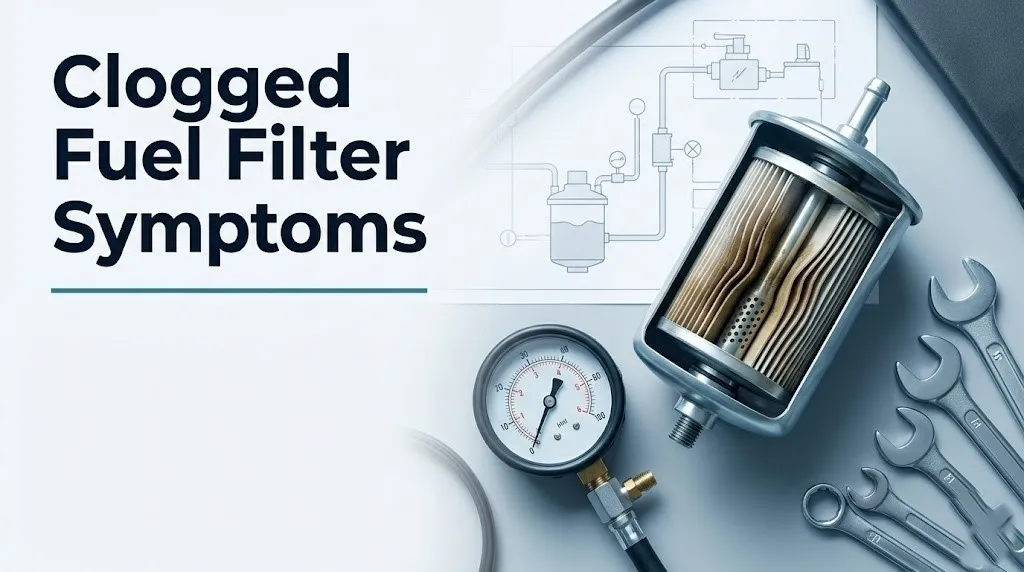
A fuel filter is a mechanical component that removes particulate contaminants from fuel before it reaches the fuel injectors and combustion chambers, protecting precision fuel system components from abrasive damage and blockage.
The filter housing contains a pleated paper or synthetic fiber filter media rated by micron size, typically between 10 and 30 microns for modern gasoline engines. Fuel passes through this media under pressure generated by the electric fuel pump, and contaminants including rust particles, sediment, tank scale, and organic debris are trapped within the media fibers.
Over time and mileage, accumulated debris reduces the open surface area of the filter media. Think of it like a kitchen strainer gradually filling with coffee grounds: water still gets through at first, but the flow rate drops with every cup. Your engine’s fuel demand, however, doesn’t drop with it.
Clogging accelerates in several specific circumstances:
- Fueling from contaminated fuel sources or tanks with significant rust or sediment
- Operating a high-mileage vehicle with an aged, deteriorating fuel tank interior
- Running fuel tanks consistently near-empty, which draws sediment from the tank bottom into the fuel pickup
- Operating in regions where ethanol-blended fuels (E10, E15, E85) absorb water and carry it through the fuel system
- Driving turbocharged or gasoline direct injection (GDI) engines that operate at significantly higher fuel demand and pressure than port-injected engines
Older vehicles with carbureted engines and inline external fuel filters are easier to inspect visually. Modern vehicles with in-tank fuel filter assemblies integrated into the fuel pump module require partial tank removal to access, which is why manufacturer maintenance schedules typically set longer replacement intervals for these designs.
Clogged Fuel Filter Symptoms Overview
The core symptoms of a clogged fuel filter follow a consistent mechanical pattern: the engine receives insufficient fuel for its operating demand, and performance degrades in proportion to how severely flow is restricted.
The following table presents the full symptom spectrum by severity:
| Symptom | Severity Level | When It Occurs | Clinical Mechanism |
|---|---|---|---|
| Hard starting (extended cranking) | Mild to Moderate | Cold starts, morning | Low fuel pressure during pump prime cycle |
| Rough idle | Mild | At rest, warm engine | Marginal fuel flow meets low idle demand barely |
| Engine misfires | Moderate | Idle and light load | Insufficient fuel causes lean misfire in one or more cylinders |
| Hesitation on acceleration | Moderate | Throttle application | Demand spike exceeds restricted supply |
| Loss of top-end power | Moderate to Severe | Highway speeds, heavy load | Filter cannot sustain high flow rates under demand |
| Engine stalling at idle | Severe | Traffic stops, idling | Pressure drops below injector opening threshold |
| Engine stalling at speed | Severe/Emergency | Highway driving | Sudden flow cessation at high throttle demand |
| Fuel odor in cabin | Severe/Emergency | Any | Line stress or connection failure from pressure surging |
| Check engine light, lean codes | Variable | Any stage | ECM detects lean air-fuel ratio from oxygen sensor feedback |
Adults with older vehicles (pre-2000, typically inline external filter designs) may notice symptoms appear more suddenly. Owners of newer vehicles with in-tank integrated filters often experience a longer, more gradual symptom progression because these filters have larger media surface area by design.
Hard Starting as a Clogged Fuel Filter Symptom
Hard starting is often the first clogged fuel filter symptom a driver notices, occurring because low fuel pressure during the engine’s pre-start prime cycle cannot build adequate rail pressure before the starter motor engages.
When you turn the ignition key to the “on” position before cranking, your electric fuel pump runs a brief priming cycle, typically one to three seconds, designed to pressurize the fuel rail to the engine control module’s target specification. For most port-injected gasoline engines, this target is 35 to 65 PSI, depending on manufacturer specification. A partially blocked filter creates enough flow restriction that rail pressure builds slowly, or fails to reach target pressure before cranking begins.
The engine then cranks longer than normal as the starter motor turns the engine while the ECM waits for adequate injector delivery pressure. What normally takes one to two seconds of cranking extends to three, five, or more seconds of labored starting. Cold mornings worsen this pattern because fuel is denser at low temperatures and flows slightly slower through restricted media.
To document this symptom accurately when speaking with a technician:
- Note the ambient temperature when the hard start occurs (cold weather is a key modifier)
- Count the seconds of cranking time before the engine catches
- Note whether the engine starts normally when fully warm (warm-start vs. cold-start distinction matters diagnostically)
- Observe whether the hard start is getting progressively worse over days or weeks
- Note whether the condition improved temporarily after a fuel fill-up (fresh fuel with less sediment briefly reduces demand on a marginal filter)
People driving turbocharged vehicles or those with gasoline direct injection (GDI) engines should recognize that their fuel systems operate at vastly higher pressures (up to 2,000 PSI at the high-pressure pump) and are considerably more sensitive to upstream fuel pressure deficits caused by a restricted pre-filter.
Rough Idle and Engine Misfires from a Clogged Fuel Filter
Rough idle and engine misfires from a clogged fuel filter occur because marginal fuel delivery at low engine speed produces an inconsistent, lean air-fuel mixture that combusts unevenly across cylinders.
At idle, a modern gasoline engine requires the least fuel of any operating condition. This is why rough idle from a clogged filter typically appears in the middle stages of blockage, after hard starting but before highway stalling. The filter is delivering some fuel, just not consistently enough for stable combustion at every injection event.
A misfire occurs when a cylinder receives insufficient fuel to ignite properly. The engine control module (ECM) monitors individual cylinder combustion events through crankshaft position sensor feedback. When it detects a cylinder failing to contribute its expected power pulse, it logs a misfire diagnostic code (P0300 for random misfire, P0301 through P0308 for specific cylinder misfires). The driver typically feels this as a vibration, shudder, or rhythmic stumble at idle.
The misfire pattern from fuel starvation differs from misfires caused by ignition problems. Fuel-starvation misfires tend to shift between cylinders (random or multiple cylinder codes) and worsen as fuel demand increases. Ignition-related misfires, by contrast, typically stay fixed on one specific cylinder regardless of load.
Quick Tip:
- A rough idle that smooths out at higher RPM often points toward fuel delivery as the root cause, not ignition
- Random misfire codes (P0300) combined with lean codes (P0171 or P0174) together strongly suggest a fuel supply problem
- Older adults with hearing difficulty may not detect the subtle vibration of early misfires and should watch for the check engine light as their primary early indicator
Key Takeaway: Hard starting, rough idle, and random misfires appearing together, especially with lean diagnostic codes, form a classic early-to-mid-stage clogged fuel filter pattern that deserves prompt inspection before the situation reaches the stalling stage.
Engine Stalling Caused by a Clogged Fuel Filter
Engine stalling from a clogged fuel filter happens when fuel flow restriction drops rail pressure below the minimum threshold required for the fuel injectors to open and deliver fuel, causing combustion to cease entirely.
This is where the situation moves from inconvenient to genuinely dangerous. Stalling at a traffic light is frustrating. Stalling at 65 mph on a freeway eliminates power steering, reduces braking assist (power brake boosters require engine vacuum), and creates a sudden obstacle in high-speed traffic. The National Highway Traffic Safety Administration (NHTSA) has documented multiple crash investigations involving vehicle stalls at highway speed as contributing factors in rear-end collisions.
The stall from a clogged filter has a characteristic pattern. It happens most often under high fuel demand conditions: merging onto a highway, accelerating up a hill, or pulling away from a stop under load. In these moments, the engine demands a sudden surge in fuel volume that the restricted filter cannot supply fast enough to maintain rail pressure above the minimum injector opening threshold.
Some drivers report a brief warning before the stall: a significant loss of power, a sensation of the engine “hitting a wall,” followed within one to three seconds by complete shutdown. This is the fuel rail depressurizing faster than the restricted filter can replenish it.
Call 911 or hazard your vehicle safely to the shoulder immediately if your engine stalls at highway speed. Do not attempt to restart and re-enter traffic until the vehicle has been inspected. An engine that stalls once under load from fuel starvation will stall again under the same conditions.
Elderly drivers and drivers with physical limitations that make emergency steering more difficult are at the greatest risk from highway stalls and should treat a single stall-at-speed event as a same-day service priority.
Poor Acceleration and Loss of Power from Fuel Filter Restriction
Poor acceleration and power loss are among the most consistently reported fuel filter clogged symptoms, occurring when increased throttle demand requires a fuel volume spike that a partially blocked filter cannot deliver at adequate pressure and flow rate.
Think of the fuel filter’s effect on acceleration the same way you’d think of trying to run a garden hose through a pinched section. At low flow, the restriction is barely noticeable. The moment you open the tap fully, the pinch becomes the limiting factor. The same principle applies to your fuel system at wide-open throttle.
Under normal conditions, a driver pressing the accelerator pedal triggers the ECM to dramatically increase injector pulse width, meaning each injector stays open longer to deliver more fuel per combustion cycle. A restricted filter cannot sustain the required volumetric flow rate, so actual fuel delivery falls short of the commanded delivery. The engine produces less power than the throttle position commands.
Drivers typically describe this as: the car feels like it’s running “out of breath,” or there’s a ceiling to how fast it accelerates no matter how hard the pedal is pressed. High-revving acceleration is worse than low-revving because fuel demand peaks at high RPM.
| Driving Condition | Fuel Demand Level | Filter Restriction Effect |
|---|---|---|
| Idle (600-900 RPM) | Very low | Marginal restriction tolerated |
| City driving (1,500-2,500 RPM) | Low to moderate | Noticeable hesitation begins |
| Highway cruise (2,000-3,000 RPM) | Moderate | Power ceiling becomes apparent |
| Merging/passing (3,500+ RPM) | High | Significant power loss, possible stall |
| Wide-open throttle (redline) | Maximum | Severe restriction, likely stall |
Drivers of turbocharged vehicles notice acceleration symptoms earlier than those with naturally aspirated engines. Turbocharged systems require higher sustained fuel pressure to support boost conditions, so a filter that would only mildly affect a naturally aspirated engine creates severe acceleration deficits under boost in a forced-induction vehicle.
Check Engine Light and Fuel System Fault Codes
The check engine light illuminates in response to clogged fuel filter symptoms when the engine control module (ECM) detects air-fuel ratio anomalies through oxygen sensor feedback and logs one or more diagnostic trouble codes (DTCs) associated with lean combustion or misfires.
A clogged fuel filter does not have its own dedicated fault code. Instead, the ECM observes the downstream consequences of fuel starvation and logs the codes that match those observations. The most common codes associated with a restricted fuel filter are:
- P0087: Fuel rail/system pressure too low (direct pressure feedback, common on GDI engines with a fuel pressure sensor in the rail)
- P0171: System too lean, bank 1 (oxygen sensor detecting excess oxygen from insufficient fuel)
- P0174: System too lean, bank 2 (same lean condition on the second cylinder bank, common on V6 and V8 engines)
- P0300 through P0308: Random or cylinder-specific misfires (consequence of the lean condition)
These codes are not specific to the fuel filter. A faulty mass airflow sensor (MAF), a vacuum leak, or a failing fuel pressure regulator can produce identical codes. The codes tell you the engine is running lean. They don’t tell you why. That’s what the fuel pressure test resolves.
According to data from OBD-II diagnostic service records compiled across multiple automotive repair networks, P0171 and P0174 together in the absence of vacuum leak evidence are among the strongest indicators of a fuel supply restriction issue, with the fuel filter being the first component to inspect before the fuel pump.
Young drivers and first-time vehicle owners should not clear a check engine light without recording or photographing the fault codes first. Cleared codes erase the freeze-frame data that shows exactly what the engine was doing when the fault occurred, which technicians use to narrow down the diagnosis.
Key Takeaway: The combination of P0087, P0171, and P0174 fault codes without a vacuum leak or MAF fault strongly points to a fuel supply restriction, and the fuel filter is the correct first diagnostic step before replacing the more expensive fuel pump.
Symptoms of Clogged Fuel Filter at Idle Versus Under Load
The symptom pattern of a clogged fuel filter shifts distinctly between idle conditions and load conditions, and understanding this difference is one of the most reliable ways to distinguish a fuel delivery problem from other causes of poor engine performance.
At idle, the engine’s fuel demand is near its minimum. A filter that is 50 to 70 percent blocked by accumulated contaminants can often still deliver enough flow to sustain idle, though it may produce a slightly rough or surging idle as pressure fluctuates. This is why many drivers with a progressively clogging filter initially notice their car runs fine sitting still but behaves strangely when they accelerate.
Under load, fuel demand increases sharply. The fuel pump must push more volume per second through the same restricted media. Fuel rail pressure drops toward and eventually below the injector minimum opening threshold. The engine stumbles, hesitates, or stalls, depending on how severe the restriction is.
This idle-to-load symptom progression follows a predictable pattern:
| Stage | At Idle | Under Light Load | Under Heavy Load |
|---|---|---|---|
| Early restriction (25-40% blocked) | Normal | Slight hesitation | Marginal power loss |
| Moderate restriction (50-65% blocked) | Slightly rough, occasional surge | Noticeable hesitation, misfires | Clear power ceiling, rough running |
| Severe restriction (70-85% blocked) | Rough idle, stalling possible | Significant power loss, misfires | Frequent stalling |
| Near-complete blockage (>85% blocked) | Stalling at idle | Cannot sustain load | Immediate stall |
Drivers of vehicles equipped with a fuel pressure regulator with a return line (older port-injection designs) may notice that the idle-to-load symptom gap is narrower. Return-line systems bleed off excess pressure at idle, meaning a filter restriction at idle doesn’t benefit from the regulator’s pressure-smoothing effect in the same way.
Progressive Versus Sudden Clogged Fuel Filter Symptoms
The timeline of symptoms of a clogged fuel filter falls into two distinct clinical patterns: a gradual progressive pattern developing over thousands of miles, and a sudden acute pattern triggered by a single contaminated fuel fill-up.
The progressive pattern is far more common. Filter media fills with accumulated debris over 15,000 to 40,000 miles (depending on fuel quality and manufacturer specifications), and symptoms emerge gradually. Hard starting appears first on cold mornings. Months later, acceleration hesitation develops. Eventually, stalling under load follows. This pattern gives the driver time to notice and respond.
The sudden acute pattern is less common but more dangerous. It occurs when a driver fills up from a contaminated fuel source (a station with a compromised underground storage tank, a pump recently agitated by a tanker delivery, or a jerry can with sediment) and receives a large dose of particulate matter that overwhelms the filter media rapidly. Symptoms in this case can progress from none to stalling within a single drive.
A 2019 technical bulletin issued by the Society of Automotive Engineers (SAE) on fuel quality and filtration noted that underground storage tank contamination events, while not frequent, have caused documented cases of rapid fuel filter blockage that left drivers stranded within hours of fueling.
Key distinguishing features:
- Progressive pattern: symptoms worsen slowly over weeks to months, correlate with mileage accumulation, improve briefly after fresh fuel fill-ups
- Acute pattern: symptoms appear suddenly within one to two fill-ups, no prior performance issues, coincide clearly with a specific fueling event
Pregnant women and elderly passengers are at elevated risk from acute sudden stalling events because emergency vehicle exit is physically more difficult, and the stress of a highway stall carries cardiovascular implications for people with pre-existing heart conditions.
Clogged Fuel Filter Versus Bad Fuel Pump Symptoms
Distinguishing clogged fuel filter symptoms from a bad fuel pump is one of the most practically important diagnostic decisions a driver faces, because the repair costs differ by a factor of three to ten and the urgency level is similar for both.
The confusion is understandable. Both conditions restrict fuel delivery to the engine. Both produce hard starting, poor acceleration, and stalling. The difference is in the failure pattern, the failure progression, and what a fuel pressure test reveals.
| Feature | Clogged Fuel Filter | Bad Fuel Pump |
|---|---|---|
| Symptom onset | Gradual over weeks to months | Can be sudden or gradual |
| Behavior improvement after filter replacement | Yes, typically complete | No improvement |
| Fuel pressure at idle | Low-normal to low | Low or fluctuating |
| Fuel pressure drop under load | Pronounced drop | Drops and may recover briefly |
| Noise from fuel tank | Normal | Whining or grinding sound from pump |
| Stalling pattern | Primarily under high demand | Can stall at idle or any load |
| Last replaced mileage | Overdue for maintenance | Within or past pump lifespan |
| Cost to repair | $20 to $150 (filter only) | $200 to $900+ (pump assembly) |
The single most reliable distinguishing test is a live fuel pressure measurement at idle and under load. A clogged filter typically shows near-normal or slightly low idle pressure with a pronounced pressure collapse under load. A failing fuel pump often shows abnormally low pressure at idle that drops further under load, and the pump may also produce an audible whining or humming noise from the fuel tank during the priming cycle.
Older adults who have driven a vehicle for many years without filter replacement are statistically more likely to be presenting with a filter issue than a pump failure, because high-quality modern fuel pump motors routinely last 100,000 to 150,000 miles when supplied with clean fuel from a maintained filter.
Key Takeaway: If a whining sound from the fuel tank area accompanies performance symptoms, the fuel pump itself is the more likely culprit; if the tank is silent and symptoms worsen only under load, start with the fuel filter.
Fuel Pressure Test and How to Diagnose a Clogged Fuel Filter
The fuel pressure test is the definitive diagnostic step for confirming a clogged fuel filter, providing an objective measurement of how well the fuel system is delivering pressurized fuel to the engine under real operating conditions.
The test uses a fuel pressure gauge connected to the fuel rail’s Schrader valve test port, a fitting identical in concept to a tire valve stem. Most technicians perform the test in three conditions: key-on/engine-off (measuring the pump prime pressure), engine idle, and under simulated load (typically by holding engine RPM at 2,500 to 3,000 RPM).
To understand what a technician is doing during this process:
- The pressure gauge is connected to the Schrader valve on the fuel rail with the engine off
- The ignition is turned to the “on” position without cranking, triggering the pump prime cycle
- Prime pressure is recorded and compared to the manufacturer’s specification (typically 45-65 PSI for port-injected engines)
- The engine is started and idle pressure is recorded
- Engine RPM is raised to 2,500-3,000 RPM and held; pressure under this increased demand is recorded
- Results below specification at any stage indicate a supply restriction, with the pattern differentiating filter from pump failure
According to the Society of Automotive Engineers (SAE), a fuel pressure drop of more than 10 PSI below specification at high RPM while idle pressure remains within range is a strong diagnostic indicator of upstream filter restriction rather than pump failure.
Home mechanics with a fuel pressure gauge kit (available for $30 to $60 at automotive parts retailers) can perform this test safely with basic mechanical knowledge. Drivers without mechanical experience should have a qualified technician perform the test to avoid accidental fuel line depressurization and fuel spray, which represents a fire and vapor inhalation risk.
Health and Safety Risks of Driving with a Clogged Fuel Filter
Driving with a severely clogged fuel filter creates health and safety risks that no automotive resource adequately explains, and these risks extend beyond the inconvenience of a breakdown to genuine threats to occupant safety.
The three primary health and safety risks are: engine stall at highway speed creating an acute crash hazard, fuel system pressure surge damage creating a fire and fuel leak risk, and combustion inefficiency creating a carbon monoxide exposure risk for occupants.
Regarding pressure surges: when a filter is severely restricted, the fuel pump continues building pressure against the blockage. In vehicles without an adequate fuel pressure regulator bypass, this can stress fuel line connections and fittings. Stressed high-pressure fuel lines, particularly in older vehicles with rubber fuel line sections that have hardened with age, can develop micro-cracks or fitting failures. Fuel escaping under pressure from a compromised line can contact hot exhaust components and ignite.
According to NHTSA vehicle fire investigation data, fuel system component failures, including filter and fuel line-related failures, contribute to a significant portion of non-crash vehicle fires in older vehicles in the United States.
Regarding combustion inefficiency: a fuel-starved engine running lean produces incomplete combustion, which increases carbon monoxide (CO) output in exhaust gases. While the exhaust system normally routes CO safely away from occupants, a vehicle with exhaust system leaks or damage, or a vehicle that stalls and the driver sits idling in a closed garage or enclosed space attempting restarts, creates a genuine CO exposure risk.
People with cardiovascular disease, anemia, chronic pulmonary disease, or pregnancy are at greater risk from any elevation in CO exposure because their oxygen-carrying capacity or oxygen demand is already altered.
Carbon Monoxide Exposure Risk from a Straining Engine
Carbon monoxide (CO) exposure risk from a straining, fuel-starved engine is a real and documentable health consequence that applies specifically to drivers sitting in poorly ventilated conditions, in enclosed spaces, or in vehicles with any exhaust system compromise.
CO is produced when combustion is incomplete. A normal, properly fueled engine produces minimal CO in its exhaust. An engine running lean from fuel starvation, particularly one that is misfiring and failing to fully combust the air-fuel mixture in each cylinder, produces elevated CO in exhaust gases. The Centers for Disease Control and Prevention (CDC) reports that CO poisoning kills approximately 420 people annually in the United States from non-fire-related CO exposure, with vehicle exhaust identified as one of the primary sources.
CO binds to hemoglobin in red blood cells with 200 to 250 times greater affinity than oxygen, forming carboxyhemoglobin (COHb). This displaces oxygen from hemoglobin, reducing oxygen delivery to the brain, heart, and muscles. The earliest symptoms of CO exposure are often mistaken for other conditions:
- Headache (most common early symptom, often attributed to stress or dehydration)
- Dizziness or lightheadedness (often attributed to fatigue)
- Nausea (often attributed to motion sickness)
- Confusion or difficulty concentrating
- Chest tightness
- Shortness of breath with exertion
The critical point: if you or any passenger develops headache, dizziness, or nausea while in a vehicle with known engine problems or suspected fuel system issues, treat this as a potential CO exposure emergency.
If you suspect carbon monoxide exposure in your vehicle: exit the vehicle immediately, move to fresh air, and call 911 or Poison Control at 1-800-222-1222. Children, pregnant women, elderly passengers, and individuals with cardiovascular or pulmonary disease reach dangerous carboxyhemoglobin (COHb) levels faster than healthy adults and should be prioritized in any evacuation.
When to Stop Driving: Fuel Filter Emergency Thresholds
Certain clogged fuel filter symptoms cross a threshold where continuing to drive the vehicle is not a mechanical inconvenience but a physical safety risk to the driver, passengers, and other road users.
Stop driving and do not restart the vehicle under the following conditions:
- Engine stalling at highway speed: Pull safely to the shoulder with hazard lights on. Do not attempt to restart and re-enter traffic. Call for roadside assistance.
- Fuel odor inside the cabin: A fuel smell in the passenger compartment indicates fuel vapors entering the vehicle, which represents both a fire risk and a toxic vapor inhalation risk. Exit the vehicle immediately. Move at least 50 feet away. Do not start the engine. Call 911.
- Headache, dizziness, or nausea in occupants coinciding with engine problems: These symptoms in vehicle occupants during a mechanical failure event warrant immediate exit to fresh air and a call to Poison Control at 1-800-222-1222 or 911.
- Visible fuel leak from under the vehicle: Any liquid dripping from the undercarriage that smells of gasoline is a fire emergency. Exit the vehicle immediately and move away from it.
- Engine stalling multiple times on a single drive: A filter that has caused two or more stalls in a single drive session is at or near complete blockage and will stall again, including at the most dangerous possible moment.
Drivers in unfamiliar areas or on highways without adequate shoulders should use navigation to locate the nearest safe pull-off location and proceed there at reduced speed using hazard lights rather than attempting to continue normal driving.
Elderly drivers, drivers of older vehicles, and drivers who have recently fueled from a non-major-brand station after a prolonged period of near-empty tank operation are in the highest-risk group for sudden complete filter blockage.
Key Takeaway: A fuel odor inside the vehicle cabin, occupant headache or dizziness during a mechanical performance failure, or a second engine stall in a single trip are the three threshold conditions that move a clogged fuel filter from a maintenance issue to a same-day safety emergency requiring immediate vehicle exit and professional evaluation.
Can a Clogged Fuel Filter Damage the Fuel Pump
A clogged fuel filter can damage and eventually destroy the electric fuel pump, because forcing the pump to work continuously against increased backpressure causes the pump motor to run hotter than its design temperature and accelerates wear on the pump’s internal components.
The electric fuel pump in most modern vehicles is a brushless or brush-type DC motor submerged in the fuel tank. Fuel flowing through the pump carries heat away from the motor windings. When a blocked filter forces the pump to strain against resistance, two things happen simultaneously: the motor draws more electrical current (generating more heat) and the reduced fuel flow through the system carries less of that heat away. The pump runs hotter. Over time, the motor windings degrade, the pump output drops, and eventually the pump fails.
This is why technicians often recommend replacing a severely blocked fuel filter before performing a fuel pressure test that will fully load the pump. A pump that has been running hot against a blocked filter for months may test borderline-normal once the filter is replaced, only to fail within months because the motor has already sustained heat damage.
According to SAE technical literature on fuel system maintenance, replacing a clogged fuel filter without addressing the pump when pump symptoms (whining noise, intermittent pressure) are present often results in repeat failure.
The cost relationship makes this important:
| Component | Typical Replacement Cost | Typical Lifespan |
|---|---|---|
| Inline fuel filter | $20 to $60 (part only) | 20,000 to 40,000 miles |
| In-tank filter (integrated with pump) | $150 to $400 (part only) | 60,000 to 100,000 miles |
| Electric fuel pump assembly | $200 to $600 (part only) | 100,000 to 150,000 miles |
| Fuel pump + filter (simultaneous replacement) | $250 to $700 (parts only) | Resets both components |
High-performance vehicle owners and owners of turbocharged vehicles should recognize that their pumps operate at higher duty cycles and are more vulnerable to heat-related damage from filter restriction than pumps in standard naturally aspirated vehicles.
Fuel Filter Replacement Intervals and When to Replace
Fuel filter replacement intervals vary significantly by vehicle make, model, engine type, and filter design, but the symptoms of a clogged fuel filter themselves remain the most reliable real-world signal that replacement cannot wait any longer regardless of schedule.
Most automotive manufacturer maintenance guides recommend replacing inline external fuel filters every 20,000 to 40,000 miles. In-tank integrated filter assemblies, which have larger filter media surface area, are typically rated to 60,000 to 100,000 miles by manufacturers. However, these intervals assume average fuel quality and normal operating conditions, an assumption that does not hold for drivers in regions with older fuel infrastructure, heavy agricultural areas with fuel contamination risks, or vehicles operated primarily on E85 ethanol blends.
The American Automobile Association (AAA) has consistently recommended following the lower end of manufacturer replacement intervals for vehicles driven in urban stop-and-go conditions, which draws more heavily on the fuel pump and filter per mile than highway driving.
Signs that replacement is overdue regardless of mileage:
- Any combination of hard starting, rough idle, misfires, and acceleration hesitation appearing together
- Fuel pressure test showing below-specification pressure at idle or a pronounced pressure drop under load
- Filter last replaced more than 40,000 miles ago on an inline design
- Vehicle operated in an area with known recent fuel contamination reports
- Any stalling event, even a single one
After replacement, most drivers notice an immediate improvement in starting ease and acceleration response within the first drive. Full performance normalization, including ECM fuel trim recalibration, typically completes within 50 to 100 miles of driving as the oxygen sensor feedback loop updates the ECM’s fuel delivery maps.
Older adults and drivers of high-mileage vehicles should treat a first-ever fuel filter replacement on a vehicle with more than 80,000 miles as a two-component service: filter plus fuel pump inspection and pressure testing at the same appointment.
Faulty Fuel Filter Symptoms in Diesel Vehicles
Faulty fuel filter symptoms in diesel vehicles follow the same fundamental pattern as gasoline engines (hard starting, power loss, stalling) but include two diesel-specific failure modes that gasoline vehicle owners never encounter: water contamination symptoms and fuel wax gelling symptoms.
Diesel fuel filters are almost always two-stage systems in modern applications. The primary filter removes large particulates. The secondary filter, called a water separator, specifically captures and holds water that has entered the fuel system. Diesel fuel absorbs water from tank condensation, poor fuel storage, and contaminated dispensing equipment. Water reaching diesel injectors causes immediate injector damage because diesel injectors use precision-machined components that depend on fuel as a lubricant and cannot tolerate the incompressibility of water.
Water separator saturation symptoms include:
- A dashboard warning light labeled “Water in Fuel” on most modern diesel vehicles
- Rough running and loss of power even with the throttle fully open
- White or gray smoke from the exhaust (water vapor in the exhaust stream)
- Sudden power loss followed by engine recovery (as water passes through in slugs)
Diesel wax gelling symptoms appear in cold climates when the paraffin wax crystals naturally present in diesel fuel begin to solidify at temperatures below the fuel’s cloud point (typically between 10°F and 32°F for standard No. 2 diesel). These crystals clog filter media rapidly, and symptoms appear as: hard starting in cold weather, severe power loss that worsens the colder the temperature gets, and in severe cases complete engine shutdown that does not clear until the fuel and filter warm up.
According to the Society of Automotive Engineers (SAE), diesel operators in climates that regularly drop below 20°F should use winter-blend diesel fuels or anti-gel additives, and should replace water separator filter assemblies at least annually or every 15,000 miles in high-condensation operating environments.
Diesel truck drivers, agricultural equipment operators, and diesel passenger vehicle owners in northern climates are the highest-risk population for both water contamination and wax gelling filter failures.
Fuel Filter Replacement Symptoms and Recovery Signs
Fuel filter replacement symptoms refer to the positive performance changes a driver experiences immediately after a new filter is installed, which serve as confirmation that the old filter was indeed the source of the performance problems.
The most immediate post-replacement change most drivers notice is starting ease. An engine that required four to six seconds of cranking before catching will often start within one to two seconds of the ignition key turning after a new filter is installed. This immediate response reflects the restored ability of the fuel pump to build rail pressure rapidly during the priming cycle.
Acceleration response improvement typically follows within the first few miles. Hesitation at low throttle clears first. Top-end power restoration at high throttle may take slightly longer as the ECM recalibrates its fuel trim values based on new oxygen sensor feedback reflecting the restored proper air-fuel ratio.
Recovery signs to confirm the diagnosis was correct:
- Starting time returns to normal within the first drive
- Acceleration hesitation clears within 10 to 20 miles
- Engine idle smooths and stabilizes within the first warm-up cycle
- Check engine light clears on its own within one to three drive cycles as lean codes stop triggering
- Fuel pressure test post-replacement shows readings within the manufacturer’s specification range
If symptoms do not improve after filter replacement, the diagnosis was either incomplete or the fuel pump has sustained damage from operating against the blocked filter. A post-replacement fuel pressure test confirms whether the pump is now delivering adequate pressure. If it isn’t, the pump requires evaluation and likely replacement.
The Centers for Disease Control and Prevention (CDC) notes that routine vehicle maintenance, including fuel system service, reduces the risk of roadside emergencies that create hazardous roadway exposure situations for drivers and pedestrians, reinforcing that filter replacement is a safety action as well as a mechanical one.
Drivers who replace the filter themselves should ensure all fuel line fittings are fully seated and leak-tested with the engine running for the first minute before driving, to confirm no connection was disturbed during the service.
Emergency Symptoms: When to Call 911 or Go to the ER
Certain symptoms associated with a clogged fuel filter and resulting fuel system failure require immediate emergency response. Do not wait to see if these resolve on their own.
Call 911 or move to safety and call for emergency assistance immediately if you experience:
- Engine stalling at highway speed with inability to safely steer to the shoulder (crash risk from loss of steering and braking assist)
- Visible fuel leak from the vehicle undercarriage combined with any ignition source nearby (fire emergency)
- Fuel odor inside the passenger cabin while driving (toxic vapor inhalation risk and fire risk; exit the vehicle, move 50+ feet away, call 911)
- Headache, dizziness, nausea, or confusion in any vehicle occupant during or shortly after a drive in a vehicle with known engine problems (potential carbon monoxide exposure; exit to fresh air immediately, call 911 or Poison Control at 1-800-222-1222)
- Vehicle fire starting in the engine compartment (exit all occupants immediately, move at least 100 feet from the vehicle, call 911; never attempt to open the hood of a burning vehicle)
If you or a passenger experiences symptoms consistent with carbon monoxide poisoning (severe headache, confusion, loss of consciousness, difficulty breathing), call 911 immediately and move every person to fresh air. Do not re-enter the vehicle until it has been assessed by emergency personnel.
These presentations can indicate active fire risk, structural fuel line failure, or acute carbon monoxide poisoning, none of which can be assessed safely from inside the vehicle or handled by a roadside self-inspection.
Frequently Asked Questions About Clogged Fuel Filter Symptoms
What are the most common symptoms of a clogged fuel filter?
The most common clogged fuel filter symptoms are hard starting, rough idle, engine misfires, hesitation during acceleration, and engine stalling under load.
These symptoms occur because restricted fuel flow reduces rail pressure below the engine’s operating specification, causing lean combustion and inconsistent injector delivery.
In advanced cases, the engine may stall completely at highway speed, which represents a crash safety emergency.
Can a clogged fuel filter cause engine stalling while driving?
Yes, a clogged fuel filter can cause engine stalling, particularly during high-demand driving conditions like highway merging, hill climbing, or hard acceleration.
The stall occurs when fuel rail pressure drops below the minimum threshold required for the fuel injectors to open and deliver fuel.
A single stalling event while driving at speed is a safety threshold that warrants same-day vehicle inspection, not continued driving.
How do I know if my fuel filter is clogged or my fuel pump is bad?
A clogged fuel filter typically produces symptoms only under heavy load, while a failing fuel pump often shows abnormally low fuel pressure even at idle.
A whining or grinding sound from the fuel tank area during the priming cycle points toward pump failure rather than filter blockage.
A live fuel pressure test measuring idle pressure and load pressure is the definitive way to differentiate the two conditions.
Is it safe to drive with a clogged fuel filter?
Driving with a mildly restricted fuel filter is generally manageable for short distances to reach a repair facility, but driving with a severely clogged filter is not safe.
A severely blocked filter can cause highway stalling, fuel system pressure surges that stress fuel lines, and increased carbon monoxide output from incomplete combustion.
Any vehicle that has stalled at speed, produces a fuel odor inside the cabin, or causes occupant symptoms like headache or dizziness should not be driven until inspected.
How often should a fuel filter be replaced?
Inline external fuel filters should generally be replaced every 20,000 to 40,000 miles, while in-tank integrated filter assemblies are typically rated to 60,000 to 100,000 miles by manufacturers.
These intervals assume average fuel quality and may need to be shortened for vehicles driven in areas with older fuel infrastructure or high contamination risk.
The appearance of any clogged fuel filter symptom, regardless of mileage, is a signal to inspect and replace the filter immediately.
Can a clogged fuel filter cause a check engine light to come on?
Yes, a clogged fuel filter can trigger the check engine light by causing the ECM to detect a lean air-fuel ratio through oxygen sensor feedback.
The most common fault codes logged are P0087 (fuel rail pressure too low), P0171 and P0174 (system lean, bank 1 and bank 2), and P0300 through P0308 (random or specific cylinder misfires).
These codes are not exclusive to a fuel filter problem, so a fuel pressure test is needed to confirm the filter as the source rather than a vacuum leak, MAF sensor fault, or fuel pressure regulator failure.
Closing
Recognizing clogged fuel filter symptoms early, specifically hard starting, rough idle, random misfires, and load-dependent power loss, gives you time to address the problem before it escalates into a roadside emergency or a safety crisis. The filter is the least expensive component in your fuel system to replace. Letting it go until it produces highway stalling or fuel system pressure damage turns a $50 maintenance item into a $600 repair.
The health and safety dimensions of a severely clogged filter deserve the same attention as the mechanical ones. Fuel odor in the cabin, occupant headache or dizziness during a drive, and engine stalling at speed are not just inconveniences. They are emergency thresholds. Treat them as such.
If your vehicle is showing two or more of the symptoms described here, schedule a fuel pressure test with a qualified technician this week. If it is showing fuel odor, occupant symptoms, or highway stalling, stop driving it today and call for assistance. Your fuel system’s job is to keep your engine running. Your job is to know when it has stopped doing that safely.