Power Steering Pump Symptoms: 17 Warning Signs (2026)
Power steering pump symptoms include whining or groaning noises when turning, a steering wheel that requires noticeably more effort to turn, visible fluid leaks under the front of the vehicle, and steering that feels inconsistent or jerky at low speeds. These signs point to a hydraulic or mechanical failure inside the pump assembly that reduces the pressure delivered to your steering gear, making the system progressively harder to control.
According to the National Highway Traffic Safety Administration (NHTSA), loss of power steering assist is a documented contributing factor in vehicle control incidents, particularly in heavier vehicles such as trucks and SUVs where unassisted steering requires substantially greater physical force than most drivers can comfortably sustain. Recognizing the early symptom pattern is the difference between a scheduled shop visit and an emergency on the highway.
This article covers all 17 warning signs of a failing power steering pump, explains the mechanical reason behind each symptom, distinguishes hydraulic pump failure from electric power steering failure, and tells you exactly when a vehicle is no longer safe to drive.
Power Steering Pump Symptoms: What Your Car Is Telling You
Power steering pump symptoms are the mechanical signals your steering system produces when the pump can no longer deliver adequate hydraulic pressure to the steering gear.
The pump is the pressure source for the entire hydraulic steering circuit. When it degrades, every component downstream, including the steering gear, the tie rods, and the driver’s feedback through the wheel, is affected. Symptoms appear in a predictable order because hydraulic pressure loss follows a progressive failure curve, not a sudden cliff.
The most common early signs are auditory: a whining, moaning, or squealing noise that changes pitch with steering input. As failure progresses, the symptoms shift from sound-based to feel-based: increasing steering effort, inconsistent feedback, and eventually near-total loss of assist.
Key symptoms at a glance:
- Whining or groaning noise when turning the wheel
- Steering wheel noticeably harder to turn, especially at low speeds or when parking
- Visible reddish, amber, or brown fluid under the front of the vehicle
- Steering that feels jerky or jumpy rather than smooth and linear
- Steering effort that varies unpredictably, sometimes easy, sometimes stiff, in the same driving session
- Burning fluid smell from under the hood
- Squealing noise when the engine first starts in cold weather
- Power steering warning light on the instrument cluster (EPAS vehicles)
Older drivers, individuals with reduced grip strength, or those recovering from hand or arm injuries will notice the increased steering effort sooner than younger, physically stronger drivers. The symptom is the same; the point at which it becomes functionally limiting is different.
Bad Power Steering Pump Symptoms: The Full Clinical Picture
Bad power steering pump symptoms span a spectrum from mild intermittent noise to complete loss of steering assist, and understanding where a vehicle sits on that spectrum determines how urgently it needs professional attention.
A failing pump does not fail all at once. Think of it like a water pump with a worn impeller: it still moves fluid, but with progressively less pressure and volume. Early on, the symptoms appear only under peak demand, meaning at full steering lock, during cold starts, or when the fluid level is slightly low. As internal components wear further, the symptoms become present under normal driving conditions.
The distinction between early and advanced failure matters practically because an early-stage failing pump may still be driveable under specific conditions, while a late-stage failing pump can produce sudden and complete loss of assist without warning.
| Failure Stage | Primary Symptom | Driving Risk Level |
|---|---|---|
| Early (minor internal wear) | Intermittent whining at full lock | Low; schedule shop visit within 2 weeks |
| Moderate (pressure reduction) | Consistent steering stiffness at low speed | Moderate; schedule within days, avoid heavy traffic |
| Advanced (seal failure or bearing damage) | Jerky or unpredictable steering effort | High; limit driving, arrange inspection same day |
| Severe (pump seizure or fluid loss) | Near-total loss of steering assist | Critical; do not drive; arrange towing |
Drivers of front-wheel drive vehicles with heavy engines experience bad power steering pump symptoms more acutely than drivers of rear-wheel drive vehicles with balanced weight distribution, because the steering load on the front axle is greater in FWD configurations.
What Is a Power Steering Pump and How Does It Work?
A power steering pump is a hydraulic pressure-generating device, typically a vane-type pump, driven by the engine through a serpentine belt and pulley assembly, that pressurizes power steering fluid and delivers it to the steering gear to reduce the physical effort required to turn the vehicle’s front wheels.
Inside a vane-type pump, a slotted rotor spins inside an oval-shaped cam ring. As the rotor turns, vane blades extend outward from the slots under centrifugal force and spring pressure, pressing against the cam ring wall. This creates sealed chambers between vanes that grow in volume on one side (drawing in fluid from the reservoir) and shrink on the other side (forcing fluid out at high pressure). A pressure relief valve limits maximum system pressure, typically between 1,000 and 1,500 PSI in passenger vehicles, to prevent damage to the steering gear seals.
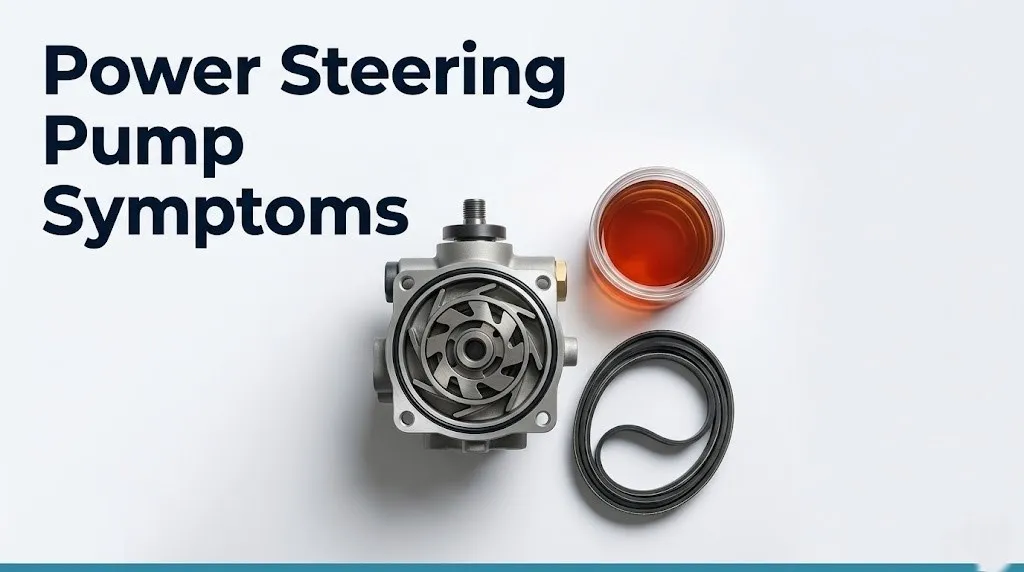
The pump is not intelligent: it generates pressure continuously whenever the engine runs. Pressure delivery to the steering gear is modulated by a flow control valve and, in variable-assist systems, by an electronic solenoid that reduces assist at highway speeds for better road feel.
Understanding this mechanism is why the symptom list makes mechanical sense. A worn vane blade reduces the seal between chambers, dropping output pressure and making the wheel harder to turn. A degraded pump shaft seal allows fluid to escape, dropping reservoir level and introducing air into the circuit (causing whining and foamy fluid). A failing pressure relief valve stuck in the open position sends fluid back to the reservoir rather than to the steering gear, producing the same stiffness symptom but from an entirely different internal failure.
Key Takeaway: Power steering pump failure is a progressive mechanical process driven by vane wear, seal degradation, and fluid breakdown, not a sudden event, and recognizing where on that progression curve your vehicle sits determines whether you schedule a shop visit or arrange a tow.
Symptoms of a Failing Power Steering Pump (Early to Late Stage)
Symptoms of a failing power steering pump follow a recognizable progression that begins with sound changes and ends with steering control compromise if left unaddressed.
Early-stage symptoms (weeks to months before complete failure):
- A soft whining or moaning sound that appears only when the steering wheel is turned to or near full lock, then disappears when the wheel is centered
- Slightly increased steering effort when parking or maneuvering at very low speeds, not noticeable at highway speeds
- Faint burning or sweet smell when the hood is opened after driving, indicating early fluid overheating
Mid-stage symptoms (days to weeks before significant control loss):
- Consistent whining present throughout steering input, not just at full lock
- Steering stiffness that appears at normal parking lot speeds, not just at full lock
- Steering effort that varies noticeably between engine cold and engine warm, because degraded fluid loses viscosity inconsistently with temperature
- Visible fluid on the ground under the engine bay after the vehicle has been parked overnight
Late-stage symptoms (immediate attention required):
- Jerky or lurching steering response where the wheel alternately catches and releases
- Steering that requires two-handed muscular effort even at low speeds
- Complete loss of assist on one side of the steering sweep but not the other, indicating a failing flow control valve or severe rotor vane damage on one pressure chamber
- Grinding, metal-on-metal sound from the pump location (front of engine, belt-driven side), indicating bearing failure
Older vehicles with over 100,000 miles are significantly more likely to display mid-to-late stage symptom patterns because pump wear is cumulative over the component’s service life. According to Consumer Reports vehicle reliability data, power steering system problems are among the most frequently reported issues in vehicles with 80,000 to 150,000 miles across multiple manufacturer brands.
Power Steering Pump Whining Noise: What It Means
A power steering pump whining noise is produced by cavitation inside the pump, the rapid formation and collapse of vapor bubbles within the hydraulic fluid as the pump attempts to draw more fluid than is available or when air is introduced into the fluid circuit.
Cavitation sounds like a high-pitched whine or moan that rises in pitch as steering effort increases. It is the hydraulic equivalent of a drain pipe gurgling when water flow is restricted. The sound is loudest at or near full steering lock because that is when the steering gear demands maximum fluid flow and the pump is working hardest.
There are two distinct sources of whining noise, and telling them apart matters for diagnosis:
Fluid-level cavitation: The reservoir is low, so the pump inlet is pulling air along with fluid on each rotation cycle. The whining appears gradually and worsens as fluid level drops further. Topping off the fluid to the correct level between the MIN and MAX marks on the reservoir often temporarily resolves this specific noise pattern within minutes of restarting the engine.
Internal pump cavitation from worn vanes: Even with adequate fluid, worn vane blades no longer seal tightly against the cam ring, creating micro-gaps that allow fluid to slip backward between chambers. The pump generates turbulence and vapor formation from this internal leakage. Topping off fluid does not resolve this type of whining because the cause is mechanical wear, not insufficient fluid supply.
According to SAE International technical literature on hydraulic system acoustics, cavitation-induced noise in vane-type pumps produces a distinctive broadband frequency signature peaking between 500 Hz and 2,000 Hz, which is why it is perceived as a whine rather than a rattle or knock.
Drivers with hearing impairment may not detect whining noise until it has progressed to a groaning or moaning that is felt through the steering column as vibration rather than purely heard.
Hard to Turn Steering Wheel Symptoms
A hard-to-turn steering wheel caused by a failing power steering pump occurs because the pump can no longer deliver sufficient hydraulic pressure to overcome the mechanical resistance of the front wheels, the steering gear, and the vehicle’s own weight distribution against the front axle.
The specific feel of pump-related steering stiffness has identifiable characteristics that distinguish it from other causes of heavy steering:
Characteristics of pump-related steering stiffness:
- Worst at very low speeds or when the vehicle is stationary (parking lot maneuvering)
- Improves noticeably at highway speeds because at speed, the vehicle’s own momentum reduces the effective load on the steering gear
- Present in both directions of steering input (left and right), typically with similar effort required in each direction
- Accompanied by whining noise at the same time the stiffness is felt
- Worsens when the engine is cold because power steering fluid is more viscous at low temperatures and a worn pump has even more difficulty maintaining pressure in the thicker fluid
The effort required to steer without power assist in a modern full-size truck or large SUV can exceed 25 to 40 pounds of sustained rotational force at the steering wheel rim. For drivers with arthritis in the wrists or hands, rotator cuff injuries, or reduced grip strength, this level of effort can produce acute hand and wrist strain within minutes and constitutes a physical as well as a vehicle safety concern.
One-directional stiffness, meaning the wheel is significantly harder to turn in one direction than the other, typically points to a problem in the rack-and-pinion steering gear or a tie rod rather than the pump itself, because the pump delivers pressure equally to both sides of the steering gear valve spool.
Power Steering Fluid Leak Symptoms
Power steering fluid leak symptoms include a reddish, amber, or light brown puddle or stain on the pavement under the front of the vehicle, a reservoir level that drops consistently between check intervals, and a burning or sweet smell from the engine bay during or after driving.
Power steering fluid is typically red or amber when fresh and darkens to brown or black as it oxidizes with heat and contamination. Identifying the color and location of the fluid helps pinpoint the source:
| Fluid Color | Leak Location | Most Likely Source |
|---|---|---|
| Bright red, oily | Front center to front left | High-pressure hose or pump outlet fitting |
| Amber to light brown | Under engine near belt | Pump shaft seal or reservoir cap seal |
| Dark brown, burnt smell | Any location | Severely oxidized fluid; chronic leak or overdue fluid service |
| Thin, watery, pinkish | Front of vehicle | Coolant mixed with power steering fluid (rare; indicates cracked gear housing) |
The pump itself leaks at two primary points: the pump shaft seal, which surrounds the spinning input shaft where the belt pulley attaches, and the pressure port O-rings, which seal the high-pressure hose fitting at the pump body. Both types of leaks are progressive: a small seep becomes a drip becomes an active flow as seal material continues to degrade.
Driving with active power steering fluid loss accelerates internal pump damage significantly. When the reservoir runs low enough to expose the pump inlet to air, the aeration cycle begins: air mixes into the fluid, compresses differently than liquid, and causes the vane chambers to collapse violently (cavitation), scoring the cam ring and rotor surfaces that would otherwise be protected by the fluid’s lubricating film.
Vehicles in hot climates (consistent ambient temperatures above 95°F, or 35°C) experience accelerated seal degradation because heat increases the rate of elastomer hardening in the O-ring and shaft seal materials, according to vehicle manufacturer technical service bulletins from Ford and General Motors addressing power steering fluid service intervals in high-temperature operating regions.
Key Takeaway: Power steering fluid leaks are not a “top it off and ignore it” problem because active fluid loss leads directly to cavitation damage inside the pump, turning a seal replacement into a full pump replacement if ignored.
Power Steering Pump Noise When Turning
Power steering pump noise specifically during turning is distinct from constant pump noise and carries precise diagnostic meaning because it occurs only when the steering gear demands maximum or near-maximum fluid flow.
When the steering wheel is turned, the rotary valve spool in the rack-and-pinion gear opens, directing high-pressure fluid to the appropriate side of the steering piston. This creates a sudden demand spike for pressurized fluid from the pump. If the pump cannot meet that demand because of internal wear, low fluid, or a faulty flow control valve, several noises result:
Whining or moaning during turning: Cavitation in response to the demand spike, as described above. Most common noise type associated with pump failure.
Groaning or creaking during turning: Associated with pump bearing wear. The bearing that supports the rotor shaft experiences peak radial load when the pump is under peak demand (during turning). Groaning that occurs specifically during a turn and stops when the wheel is released from full lock points to bearing degradation rather than cavitation.
Clunking during turning at low speeds: This sound rarely originates from the pump itself. A clunk during turning more commonly indicates a worn CV joint (constant velocity joint) in a front-wheel drive vehicle, a loose tie rod end, or a worn strut bearing plate. Misattributing this to the power steering pump is a common diagnostic error.
The noise pattern in relation to steering input is one of the most useful diagnostic tools available before any mechanical inspection:
- Note whether the noise occurs only during turning or also when driving straight.
- Note whether it changes with steering speed (faster turns, louder noise) or only with steering angle (noise only at full lock).
- Note whether revving the engine without moving the steering wheel changes the noise (a belt or pulley issue would change with engine RPM; a pump issue typically does not change significantly at neutral steering).
Elderly drivers may describe pump whining as a new “road noise” rather than a steering-specific noise, because the pitch is similar to tire drone. This misperception leads to diagnostic delays.
Power Steering Pump Going Out Signs You Shouldn’t Ignore
Power steering pump going out signs are the intermediate warning signals that appear between the earliest subtle symptoms and complete pump failure.
Think of the progression like a dimmer switch, not a light switch. The pump does not go from fully functional to completely failed in a single moment (except in cases of catastrophic belt failure or bearing seizure). The “going out” phase is the window where intervention is both possible and cost-effective.
Signs the pump is actively failing, not just worn:
- Steering effort that is noticeably inconsistent within a single drive. Easy at one turn, heavy at the next, without any identifiable change in driving condition. This inconsistency reflects intermittent pressure relief valve malfunction or partial fluid bypass through a degraded internal seal.
- Fluid that is foamy or milky when inspected at the reservoir dipstick or by opening the reservoir cap. Foamy fluid means air is being circulated through the pump, either from a low fluid level, a suction side hose crack, or internal cavitation damage that has altered the pump’s fluid dynamics.
- A growling or rumbling noise from the pump location that is present even when the steering wheel is centered and the vehicle is traveling straight. This indicates bearing degradation inside the pump, which is a mechanical failure distinct from hydraulic pressure loss.
- The steering wheel momentarily “snaps” back to center faster than expected after a turn, because the flow control valve is malfunctioning and releasing pressure asymmetrically.
According to Automotive Service Excellence (ASE) diagnostic training materials, a power steering pump that has entered bearing failure territory should be considered at risk for seizure, which can cause the serpentine belt to lock up, simultaneously disabling the alternator and water pump.
This is not a hypothetical worst-case scenario. Belt lockup from a seized accessory drive pulley is a documented cause of sudden engine overheat and loss of electrical power while driving.
Symptoms of Bad Power Steering Pump vs. Rack and Pinion Failure
Distinguishing symptoms of a bad power steering pump from rack and pinion failure is one of the most practically important diagnostic steps because both conditions produce steering stiffness and noise, but require completely different repairs at very different cost levels.
The rack-and-pinion is the steering gear itself, the component that converts rotary steering wheel input into the lateral movement of the tie rods that actually turn the front wheels. When the rack fails internally, it does so through seal leakage (at the end seals of the rack housing), internal gear wear (which produces grinding), or failure of the rotary valve spool that controls hydraulic flow direction.
| Symptom | More Likely: Pump Failure | More Likely: Rack and Pinion Failure |
|---|---|---|
| Whining noise when turning | Yes, strongly | Rarely |
| Fluid leak location | Near pump/belt area or high-pressure hose | Under the car, toward the center or either end of the rack housing |
| Steering stiffness: both directions equally | Common with pump failure | Less common; rack failure often produces directional stiffness |
| Clunking or knocking during turns | Unlikely; suggests other components | Possible, from worn rack teeth or end seals |
| Steering wanders at highway speed | Not typical for pump failure | Yes, common with rack wear (excess play in gear mesh) |
| Vibration felt through the steering wheel | Unlikely with pump failure alone | Common with worn rack-and-pinion gear teeth |
| Fluid on pavement directly under car center | Less common from pump | Common from end seal leakage on rack |
An ASE-certified technician performs a power steering pressure test using a hydraulic gauge installed in the high-pressure line to differentiate the two. If system pressure falls below manufacturer specification with the steering wheel centered, the pump is the primary suspect. If pressure is adequate at the pump outlet but drops significantly at the steering gear inlet, the gear itself is the problem.
Key Takeaway: The single most reliable field distinction between pump failure and rack failure is where the fluid leak appears: pump leaks show up near the engine belt area, while rack leaks pool directly under the center or ends of the steering gear housing beneath the vehicle.
Electric Power Steering Failure Symptoms
Electric power steering (EPAS) failure symptoms are fundamentally different from hydraulic pump symptoms because there is no fluid circuit, no pulley, no belt, and no cavitation involved. EPAS systems use a brushless DC electric motor mounted on the steering column, rack, or pinion to provide assist based on real-time inputs from a torque sensor and steering angle sensor, processed by an EPS control module.
Understanding this distinction is critical for 2026 readers: the majority of vehicles manufactured after 2014 use EPAS rather than hydraulic systems. If your vehicle is a 2015 model year or newer in most brands, you almost certainly have EPAS, and the hydraulic pump symptom checklist does not apply to your vehicle.
EPAS failure symptoms:
- A power steering warning light (often labeled “EPS,” “EPAS,” or “PS” with an exclamation mark) illuminates on the instrument cluster. This is often the first and most reliable sign of EPAS system fault.
- Steering assist cuts out intermittently. The wheel goes from normal effort to full-unassisted weight without warning, then returns to normal. This reflects EPS control module communication errors or thermal overload protection engaging.
- A distinct buzzing or humming sensation through the steering column (not a noise from the engine bay), produced by the electric motor running under increased load or with damaged windings.
- Steering that feels “off center” or produces unexpected self-correction, caused by steering angle sensor drift or miscalibration.
- Assist that varies with vehicle speed in an unusual or unexpected way, more assist at highway speeds rather than less, caused by a faulty vehicle speed input signal to the EPS module.
When EPAS fault is suspected, an OBD-II scan tool retrieves diagnostic trouble codes (DTCs) from the EPS control module. Common codes include C0450 (steering angle sensor circuit), C1900 (EPS motor circuit), and manufacturer-specific codes related to torque sensor calibration.
Power Steering Pump Cavitation and Low Fluid Symptoms
Power steering pump cavitation occurs when the pump’s vane chambers cannot fill completely with fluid on the inlet stroke, drawing a mixture of fluid and air vapor instead. The vapor bubbles formed during low-pressure intake collapse violently as they enter the high-pressure discharge side of the pump, producing the whining noise and simultaneously eroding the cam ring and rotor vane surfaces.
Low fluid is the most common trigger for cavitation in an otherwise healthy pump. The symptoms of low-fluid cavitation have a specific character:
Low fluid cavitation symptom pattern:
- Whining noise that appears gradually and worsens over days or weeks as fluid level drops
- Noise that is loudest immediately after a cold start, when fluid is thickest and the pump must work hardest to circulate it
- Noise that temporarily worsens after quick full-lock maneuvers (like a three-point turn), because those maneuvers consume the most fluid from the reservoir in the shortest time
- Foamy or aerated fluid visible at the reservoir, which appears lighter in color or has a frothy texture
The difference between cavitation from low fluid and cavitation from internal pump wear is diagnosable by simply adding the correct type of fluid to the reservoir to the MAX mark and allowing the engine to idle for 60 seconds while slowly sweeping the steering wheel lock to lock three times to purge air. If the whining significantly reduces, low fluid was the primary cause. If it persists unchanged, internal pump wear is the more likely explanation.
The correct fluid type matters critically. Using automatic transmission fluid (ATF) when the vehicle specifies dedicated power steering fluid, or vice versa, causes premature seal hardening and micro-cracking in the internal seals according to vehicle manufacturer technical service bulletins. The reservoir cap or the vehicle owner’s manual specifies the correct fluid type: never assume.
Vehicles driven primarily in stop-and-go urban traffic experience higher cavitation rates than highway-driven vehicles, because low-speed maneuvering creates more frequent peak-demand fluid draw cycles per mile driven.
Causes of Power Steering Pump Failure
The causes of power steering pump failure fall into four categories: mechanical wear, fluid-related degradation, external component failure, and manufacturer defects. Understanding which cause applies to a given vehicle determines the appropriate repair strategy.
Mechanical wear (most common, accounts for the majority of pump failures in vehicles over 80,000 miles):
The vane blades, cam ring surface, and rotor bearings wear gradually over the pump’s service life. This is normal mechanical degradation accelerated by infrequent fluid service, high steering load use (heavy vehicles, frequent full-lock maneuvers, off-road use), and operating in temperature extremes.
Fluid-related degradation (most preventable cause):
Power steering fluid oxidizes with heat exposure, darkening and thickening over time. Oxidized fluid loses its lubricity rating, meaning it no longer protects internal metal surfaces from metal-on-metal contact during high-load steering events. Contaminated fluid (mixed types, water intrusion, or particles from worn seals) accelerates internal abrasion. The Society of Automotive Engineers (SAE) fluid standard SAE J1529 specifies performance requirements for hydraulic steering fluids; fluids that do not meet this standard are not adequate substitutes regardless of marketing claims.
External component failure:
A loose or slipping serpentine belt allows the pump pulley to slip under peak load, delivering inconsistent rotational input to the pump shaft. A failed belt tensioner produces the same problem. Either condition causes intermittent assist loss that mimics internal pump failure but resolves completely when the belt system is serviced.
Causes summary:
| Cause | Mechanism | Most Affected Vehicles |
|---|---|---|
| Vane blade and cam ring wear | Reduced pressure output from widening vane-to-ring gap | High mileage, any vehicle |
| Oxidized or contaminated fluid | Loss of lubricity, increased metal-on-metal abrasion | Vehicles with no fluid service history |
| Shaft seal failure | Fluid loss, air ingestion, cavitation | Hot climate vehicles, high-mileage |
| Loose serpentine belt | Intermittent pump shaft speed reduction | Older vehicles with worn tensioners |
| Manufacturer defect (TSB-documented) | Component quality variation at production | Specific make/model/year combinations |
Key Takeaway: Most power steering pump failures in vehicles over 80,000 miles are the result of long-term fluid neglect rather than inevitable mechanical wear, which means regular fluid service (every 50,000 to 75,000 miles, per most manufacturer guidelines) is the single most effective prevention strategy.
How to Tell If Your Power Steering Pump Is Bad
Telling whether your power steering pump is bad involves a structured self-assessment that any driver can perform before a shop visit, combined with a formal pressure test that only a technician can perform.
Step-by-step field assessment:
- Check the fluid level and condition first. With the engine cold, locate the power steering reservoir (typically a small translucent plastic reservoir near the engine belt, labeled with a steering wheel icon). The fluid should be between MIN and MAX. Note the color: clean fluid is red or amber. Dark brown or black fluid is oxidized and overdue for service. Milky or foamy fluid indicates air contamination or water intrusion.
- Start the engine and turn the steering wheel slowly from lock to lock (left full stop to right full stop) two times while parked on level ground. Listen for whining or moaning during this sweep. Note whether the sound changes with steering direction or appears only at full lock versus throughout the sweep.
- Rev the engine gently to 2,000 RPM while holding the steering wheel centered. A whining noise that increases with engine RPM but does not change with steering input points more toward a belt, tensioner, or pulley issue than the pump itself. A whining that is tied to steering input regardless of RPM is more consistent with a pump fault.
- Drive at low speed in a parking lot and perform slow full-lock turns in both directions. Notice whether steering effort is equal in both directions. One-directional heaviness suggests a rack or tie rod issue rather than the pump. Equal stiffness in both directions during slow maneuvers is more consistent with inadequate pump pressure output.
- Inspect under the vehicle and under the hood for fluid stains or active dripping. Photograph any fluid and note its color and location relative to the engine, steering column, and rack housing.
- Have an ASE-certified technician perform a power steering pressure test. This test installs a calibrated hydraulic gauge and shutoff valve between the pump outlet and the high-pressure hose. With the valve open, the technician checks free-flow pressure. With the valve closed briefly (maximum 5 seconds to prevent pump damage), they check maximum pump pressure. Values below manufacturer specification confirm pump fault.
Can You Drive with a Bad Power Steering Pump?
Whether you can drive with a bad power steering pump depends entirely on which symptom stage the pump has reached, your vehicle type, and the road conditions you would be driving in.
When continued driving is low to moderate risk (with caution and urgency):
- Intermittent whining only at full lock, fluid level is normal, no leaks visible, and steering effort is only slightly increased: driving to an ASE-certified shop for evaluation within two to three days is generally reasonable, avoiding highway speeds where possible and minimizing full-lock maneuvers.
When continued driving is high risk and should be avoided:
- Active fluid leak: continuing to drive risks total fluid loss, which leads to rapid bearing failure and pump seizure within miles, not days.
- Steering effort is significantly increased in both directions, making low-speed maneuvering difficult: this level of impairment reduces vehicle control, particularly in emergency evasive maneuvers, crosswind correction, and highway lane changes.
- Steering effort is inconsistent or unpredictable: a wheel that alternates between easy and heavy without warning is unsafe because it disrupts the driver’s feedback loop and makes precise steering inputs unreliable.
When driving is not safe and the vehicle should be towed:
- Near-total or complete loss of steering assist in a vehicle over 3,500 pounds curb weight
- Bearing grinding noise from the pump, indicating imminent seizure risk that could lock the serpentine belt
- Active large-volume fluid leak (fluid dripping rather than staining)
Drivers who are elderly, have reduced hand strength, or drive heavy trucks or large SUVs reach the “unsafe to drive” threshold at an earlier symptom stage than younger, physically stronger drivers of lighter vehicles, because the unassisted steering effort in a heavy vehicle is proportionally greater.
Emergency Symptoms: When to Pull Over and Stop Driving Immediately
Certain symptoms associated with power steering pump failure represent an active vehicle safety emergency. Do not attempt to complete a trip or “make it to the shop” if any of the following occur while driving.
Pull over safely and stop driving immediately if you experience:
- Sudden complete loss of steering assist while moving, particularly at speeds above 30 mph, because the force required to steer a heavy vehicle without any assist may exceed what many drivers can physically apply quickly enough to avoid an obstacle or lane departure
- Loud grinding, screeching, or metallic noise from the engine belt area, which indicates the pump bearing may be seizing and could lock the serpentine belt, disabling the alternator and water pump simultaneously while the engine is running
- Smoke or burning smell from the engine bay combined with steering stiffness, indicating severe fluid overheating or active fluid contacting hot exhaust components
- Power steering fluid visible spraying or dripping rapidly rather than seeping, indicating a high-pressure hose has failed and fluid loss is occurring at a rate that can empty the reservoir within minutes of driving
If steering assist fails completely while driving at speed: do not panic. Grip the wheel firmly with both hands, reduce speed by releasing the accelerator (avoid hard braking if possible at high speed), steer smoothly and with deliberate effort toward the shoulder or a safe stopping point, activate hazard lights, and call roadside assistance. Do not attempt to restart the vehicle and continue driving.
These situations require a tow to an ASE-certified repair facility, not a slow drive to the nearest shop.
Power Steering Pump Replacement: When Is It Necessary?
Power steering pump replacement is necessary when pressure testing confirms output below manufacturer specification, when bearing damage is confirmed by noise and vibration analysis, when the pump shaft seal has failed and cannot be isolated from pump replacement in a cost-effective repair, or when internal components are scored to the point that rebuild is not economically viable.
Not every power steering pump symptom requires full pump replacement. The appropriate repair depends on the specific failure mode confirmed by diagnosis:
| Confirmed Failure Mode | Appropriate Repair | Estimated Scope |
|---|---|---|
| Low fluid from reservoir or hose leak only | Hose replacement or seal replacement, fluid refill | Minor repair |
| Shaft seal leakage, pump otherwise functional | Shaft seal replacement (if pump is serviceable) or pump replacement | Moderate |
| Vane/bearing wear confirmed by pressure test | Pump replacement (rebuilt or new) | Major repair |
| Belt or tensioner causing intermittent assist | Belt/tensioner replacement only | Minor repair |
| Rack-and-pinion failure (misdiagnosed as pump) | Rack replacement, not pump | Major repair; different component |
The average cost for power steering pump replacement in 2026 varies by vehicle type: approximately $200 to $450 for the part itself (rebuilt unit) for most passenger sedans, and $400 to $900 for full-size trucks and European import vehicles that use more complex pump assemblies with integrated reservoirs or solenoid-controlled variable assist. Labor adds $100 to $250 at most independent shops, depending on belt removal requirements and pump accessibility.
Rebuilt pumps carry a manufacturer’s warranty that typically ranges from 12 months to a lifetime depending on the supplier. An ASE-certified technician should always flush the entire power steering circuit (reservoir, hoses, and rack gear) with fresh fluid when replacing the pump, because debris and contaminated fluid from the failed pump will circulate into the new unit and accelerate its failure within months if the circuit is not cleaned.
Key Takeaway: Replacing only the pump without flushing the entire hydraulic circuit is one of the most common and costly mistakes in power steering service because contaminated fluid from the failed pump will damage the new unit within months.
Power Steering Pump Failure Symptoms by Vehicle Type and Climate
Power steering pump failure symptoms do not present identically across all vehicles and operating environments. The same underlying pump wear produces different symptom severity and urgency depending on vehicle weight, drivetrain configuration, and the climate in which the vehicle is operated.
By vehicle type:
Full-size trucks and large SUVs (e.g., Ford F-150, Chevrolet Silverado, Toyota 4Runner): These vehicles generate significantly higher hydraulic demand than passenger sedans because of greater front axle weight and larger turning radius. A pump that still produces adequate pressure for a light sedan may be completely inadequate for a 5,500-pound truck. Symptoms of stiffness appear earlier in the failure progression in heavy vehicles, and the safety risk of assist loss is proportionally greater because unassisted steering effort can reach 40 to 60 pounds of rotational force at the wheel rim.
Front-wheel drive passenger sedans: The front axle carries both the engine weight and the drive half-shafts, producing a higher steering load per steering event than rear-wheel drive sedans of the same curb weight. FWD vehicles experience pump pressure demand more frequently during urban driving because of the constant low-speed maneuvering load.
2015-and-newer vehicles with EPAS: No hydraulic pump symptoms apply. Steering assist issues present through the EPS warning light, intermittent assist cutout, and DTCs retrievable via OBD-II scan.
By climate:
Cold climates (sustained temperatures below 20°F / -7°C): Cold significantly increases power steering fluid viscosity. A pump with moderate internal wear that functions adequately in warm weather may show pronounced stiffness and whining immediately after cold starts in winter because the thicker cold fluid requires higher pump output pressure to circulate. Symptoms typically improve after 5 to 10 minutes of engine warm-up as fluid reaches operating temperature. Per SAE International fluid performance standards, power steering fluids must maintain adequate flow characteristics at temperatures as low as -40°F for vehicles specified for cold-climate operation.
Hot climates (sustained ambient temperatures above 95°F / 35°C): Heat accelerates elastomer seal degradation. Vehicles in hot climates experience pump shaft seal and O-ring failure earlier in their service life than identical vehicles in temperate climates. Hot climate power steering fluid also oxidizes faster, reaching the point of inadequate lubricity sooner, which makes adherence to fluid service intervals (typically every 50,000 to 75,000 miles) particularly important in desert and subtropical operating regions.
Frequently Asked Questions About Power Steering Pump Symptoms
What does a bad power steering pump sound like?
A bad power steering pump most commonly produces a whining or moaning sound that changes in pitch or intensity when the steering wheel is turned.
The noise is caused by cavitation inside the pump: the rapid formation and collapse of vapor bubbles when the pump cannot fill its vane chambers completely with fluid.
A bearing that has also degraded adds a lower-frequency groaning or growling that may be present even when the steering wheel is centered and the vehicle is driving straight.
Can a bad power steering pump damage other parts?
Yes, a failing power steering pump can damage the rack-and-pinion steering gear, the high-pressure hose, and the serpentine belt if the pump seizes.
Contaminated fluid from an internally degrading pump circulates through the entire steering circuit, scoring the valve spool and seals inside the rack, which can turn a pump replacement into a full steering system rebuild.
A seized pump pulley can also lock the serpentine belt, immediately disabling the alternator and water pump while the engine is running.
How long can you drive with a bad power steering pump?
There is no single safe answer because it depends on the specific failure stage, your vehicle’s weight, and the driving conditions involved.
A pump with early-stage cavitation from low fluid may be driveable for days with added fluid and a scheduled shop appointment, while a pump with active fluid leaks, bearing grinding, or significant assist loss should not be driven at all.
The responsible answer is: if your steering effort has increased noticeably or you hear consistent whining, arrange evaluation within 48 hours; if assist has partially or fully failed, do not drive the vehicle.
What color is power steering fluid when it leaks?
Fresh power steering fluid is typically red or amber in color, similar in appearance to automatic transmission fluid, and has a slightly sweet or oily smell.
As it oxidizes with heat and age, it darkens to light brown, then dark brown or black, and may smell burnt.
A milky or foamy appearance in the reservoir indicates air or water contamination, not a color change from oxidation, and warrants immediate inspection by an ASE-certified technician.
Is a hard-to-turn steering wheel always a power steering pump problem?
No. A hard-to-turn steering wheel can also be caused by a failing rack-and-pinion gear, a worn tie rod end, a low tire (particularly the front tires), a misaligned front end, a slipping serpentine belt, or in EPAS vehicles, an EPS motor or control module fault.
The pump is the most common cause of bilateral steering stiffness (equal difficulty in both directions) accompanied by whining noise, but one-directional stiffness, grinding during turns, or stiffness without any noise points toward other components.
A pressure test and physical inspection by an ASE-certified technician is the only reliable way to isolate the cause.
How much does it cost to replace a power steering pump in 2026?
The total cost to replace a power steering pump in 2026 typically ranges from $300 to $800 for most passenger vehicles, including parts and labor at an independent shop.
Rebuilt pump units for common passenger sedans cost $150 to $350, while heavy trucks, European imports, and vehicles with variable-assist solenoid-equipped pumps can bring the parts cost alone to $400 to $900.
The complete cost also depends on whether the high-pressure hose, return hose, or fluid flush is included in the service, all of which are recommended when the pump is replaced.
Closing
Power steering pump symptoms follow a predictable mechanical sequence, from the early whining noise of cavitation to the late-stage steering stiffness of pressure loss, and that sequence gives you a practical window to act before the problem becomes a safety event on the road. The key is not to dismiss the early sounds as minor irritations, because a pump that whines quietly today can fail to a point of dangerous assist loss within weeks if the underlying cause (low fluid, seal degradation, or bearing wear) is not addressed.
Check your fluid level this week if you have heard anything unusual from your steering system. If the fluid is low, correct it with the type specified on the reservoir cap, not a generic substitute, and monitor closely for recurrence. If the whining continues after correcting the fluid level, or if you have noticed any steering stiffness, fluid on the pavement, or inconsistent steering effort, schedule an appointment with an ASE-certified technician within 48 hours for a power steering pressure test.
You now have the mechanical context to describe your symptoms accurately, ask the right diagnostic questions, and recognize when a whining noise has crossed into a vehicle safety concern. That specific knowledge is what gets you an accurate diagnosis rather than an unnecessary replacement.