Engine Misfire Causes: 16 Reasons Your Car Misfires (2026)
Engine misfire causes include worn spark plugs, failed ignition coils, clogged fuel injectors, vacuum leaks, low cylinder compression, and sensor failures, and identifying the specific cause requires understanding which stage of the combustion cycle has broken down. Each cause produces a distinct symptom pattern, a specific OBD-II code signature, and a different level of urgency for repair.
The Environmental Protection Agency (EPA) established OBD-II misfire detection standards requiring every vehicle sold in the United States since 1996 to monitor combustion events in real time using the crankshaft position sensor, counting misfire events per 1,000 crankshaft revolutions. When misfire rates exceed the catalyst damage threshold defined in EPA OBD-II regulations, your check engine light does not just illuminate. It flashes, which is the system’s signal that your catalytic converter is actively being destroyed.
This article covers all 16 engine misfire causes with the mechanical explanation behind each one, how the OBD-II system classifies them, which causes are minor and fixable with routine maintenance, and exactly when a misfire means you need to pull over rather than drive to the shop.
Engine Misfire Causes: What Is Actually Happening Inside Your Engine
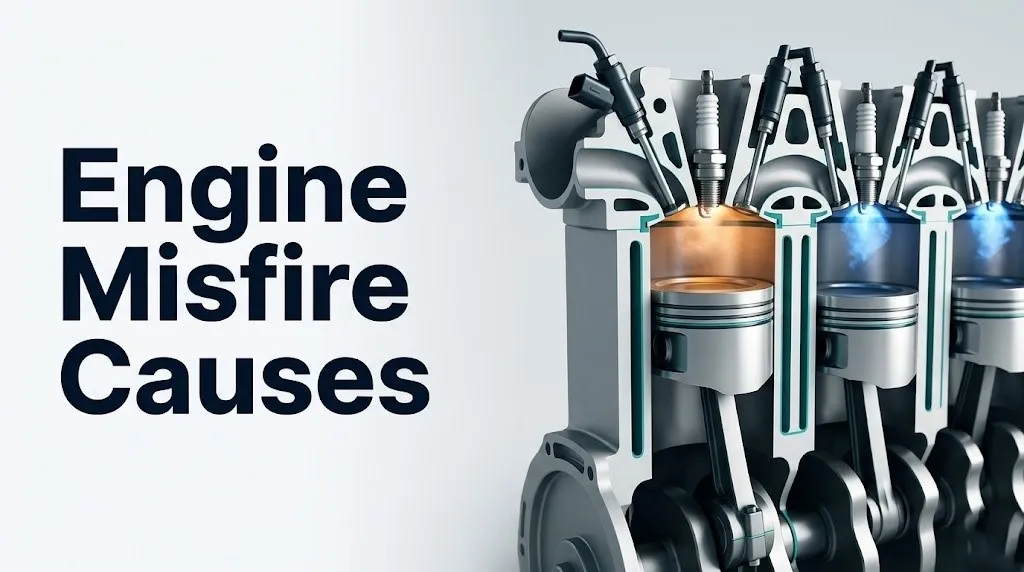
Engine misfire causes all share one common outcome: a cylinder fails to complete a proper combustion event during its power stroke, delivering no usable mechanical force to the crankshaft for that firing cycle.
The combustion process inside each cylinder depends on three simultaneous conditions being met: the right quantity of air and fuel mixed at approximately the correct ratio (14.7 parts air to 1 part fuel by mass in a gasoline engine), a spark of sufficient energy arriving at precisely the right moment, and adequate compression pressure to enable ignition and efficient combustion. If any one of these three conditions fails in a given cylinder during a given cycle, that cycle produces no power output. The crankshaft loses the expected acceleration impulse, and the engine vibrates or stumbles.
What makes diagnosing engine misfire causes genuinely complex is that the same observable symptom (rough idle, vibration, power loss) can be produced by failures in any of three entirely separate mechanical systems. A rough idle from a worn spark plug and a rough idle from a vacuum leak look identical to the driver but require completely different diagnostic approaches and repairs.
| Cause Category | System Involved | Typical OBD-II Code Pattern | Diagnostic Priority |
|---|---|---|---|
| Worn spark plug | Ignition | P0301-P0308 (cylinder-specific) | High frequency, first to check |
| Failed ignition coil | Ignition | P0301-P0308 + coil circuit code | Common, often paired with plug |
| Clogged fuel injector | Fuel delivery | P0301-P0308, may show lean trim | Moderate frequency |
| Vacuum leak | Air induction | P0300 or lean multiple cylinders | Common in higher mileage |
| Compression loss | Mechanical | P0300 or cylinder-specific, low compression confirmed | Less common, most serious |
| Sensor failure | Electronics | P0300, may have associated sensor code | Variable frequency |
| Carbon buildup (GDI) | Air induction/mechanical | P0300 or cylinder-specific, GDI-specific | Increasing with GDI prevalence |
Vehicles manufactured before 1996 lack OBD-II monitoring, so misfire diagnosis on older cars relies entirely on mechanical testing without code guidance. This makes engine misfire causes on pre-OBD-II vehicles more time-consuming to isolate.
What Is an Engine Misfire and How Does It Happen
An engine misfire is a failure of normal combustion in one or more cylinders during a specific firing event in the four-stroke combustion cycle, detected by the powertrain control module (PCM) through a measured deceleration of the crankshaft at the position corresponding to that cylinder’s power stroke.
Think of the four-stroke cycle like a precisely timed pump with four distinct movements. The first stroke pulls the air-fuel mixture into the cylinder (intake). The second stroke compresses it (compression). The third stroke ignites it and receives the power impulse (power). The fourth stroke expels the exhaust gases (exhaust). Every single cylinder repeats this sequence thousands of times per minute, and a misfire is a failure of step three: the cylinder goes through the motions but produces no power output.
The PCM detects this failure via the crankshaft’s reluctor wheel and the crankshaft position sensor (CKP sensor). At each successful power stroke, combustion gas expanding against the piston crown momentarily accelerates the crankshaft. A cylinder that misfires skips that acceleration. The PCM measures the time between each tooth of the reluctor wheel passing the CKP sensor: if one interval is longer than expected (indicating deceleration rather than acceleration), it records a misfire event for the cylinder whose power stroke corresponds to that crankshaft position.
Per SAE J1979 (the standard governing OBD-II diagnostic test modes), misfire event counting runs continuously during vehicle operation. Two separate thresholds exist: one at which stored codes and an illuminated MIL (malfunction indicator lamp, commonly called the check engine light) are set, and a higher rate threshold at which the MIL flashes continuously to indicate active catalytic converter damage.
High-performance vehicles, those with variable cylinder deactivation systems, and those with asymmetric firing orders require modified misfire detection algorithms because the expected crankshaft velocity profile differs from a conventional sequentially fired engine. Drivers of vehicles with cylinder deactivation technology (such as Honda’s Variable Cylinder Management or GM’s Active Fuel Management) should be aware that misfire codes can occasionally be generated by the deactivation system itself if solenoids or lifters in the deactivation mechanism malfunction.
Spark Plugs as a Cause of Engine Misfires
Worn or fouled spark plugs are the most frequently identified cause of engine misfires in gasoline-powered vehicles, producing ignition failure when the electrode gap widens beyond the ignition coil’s output voltage capacity or when electrode contamination creates an alternative low-resistance path that diverts the spark before it crosses the gap.
The spark plug works by concentrating the high-voltage secondary output of the ignition coil (typically 20,000 to 40,000 volts) across the air gap between the center electrode and the ground electrode. The voltage required to fire across this gap is directly proportional to gap width and combustion chamber pressure at the moment of ignition. A new spark plug in a gasoline engine typically has a gap of 0.028 to 0.060 inches depending on OEM specification. As the electrodes erode from the heat and electrical discharge of millions of firing events, the gap widens. A wider gap demands higher voltage from the coil to jump. Eventually the gap exceeds what the coil can reliably supply, and misfires begin, typically initially under load (when cylinder pressure is highest and gap-firing voltage demand is greatest) before progressing to misfire at idle as gap erosion continues.
Spark plug fouling produces a different failure mechanism. Oil contamination of the plug from worn valve stem seals or piston rings deposits conductive carbon on the insulator nose, creating a shunt path for the coil’s energy. The spark travels through the carbon deposit to ground rather than crossing the electrode gap. The cylinder sees no ignition event. This pattern is common in high-mileage engines with oil consumption and in engines that have been sitting for extended periods.
According to ASE technical training curriculum, spark plug-related misfires are the first component to evaluate in any misfire diagnosis on a gasoline engine with more than 60,000 miles, because plug service intervals are 30,000 miles for copper plugs and 60,000 to 100,000 miles for platinum or iridium tip plugs under most OEM specifications. Vehicles in which the driver has deferred spark plug replacement beyond 20 to 30 percent of the OEM service interval face a disproportionately higher misfire risk. Older vehicles using distributor-based ignition systems face a compounded failure mode: a worn distributor cap or rotor adds resistance to the secondary circuit, raising the effective voltage demand even before considering plug gap.
- Electrode gap wider than OEM specification by 0.020 inches or more: high misfire risk under load
- Plug tip showing black sooty deposits: indicates rich-running or oil fouling
- Plug tip showing white or gray chalky deposits: indicates overheating or lean-running condition
- Plug tip showing oily black deposits: indicates oil entry into combustion chamber via rings or valve seals
Ignition Coil Failure and Engine Misfires
A failed ignition coil causes an engine misfire by being unable to generate sufficient secondary voltage to fire the spark plug in its assigned cylinder, either from insulation breakdown within the coil’s secondary winding, from primary winding resistance drift outside specification, or from heat-induced coil-pack cracking that allows the high-voltage secondary circuit to arc to ground before reaching the plug.
The ignition coil is a step-up transformer. Primary current (typically 5 to 8 amperes at 12 volts) passes through the primary winding (usually 0.5 to 2 ohms resistance) and is interrupted by the PCM’s ignition driver circuit at the precise moment of spark timing. The rapid magnetic field collapse induces a high-voltage pulse in the secondary winding (usually 6,000 to 15,000 ohms resistance). This secondary voltage, ranging from 20,000 to 40,000 volts, travels to the spark plug and jumps the electrode gap. Coil failure occurs when winding insulation breaks down: the secondary voltage leaks through the compromised insulation to the coil body (and from there to engine ground) rather than reaching the plug. The plug sees no voltage. No combustion follows.
Coil-on-plug (COP) systems, now standard on most modern vehicles, mount one ignition coil directly on top of each spark plug. While this arrangement improves ignition energy delivery efficiency, it means each coil is exposed to engine bay heat cycles and vibration continuously. COP coil failures are characteristically single-cylinder events, making them relatively straightforward to isolate: a P0301 code (cylinder 1 misfire) combined with a coil driver circuit code pointing to cylinder 1 almost always indicates a COP coil failure on that cylinder.
A technician can swap a suspected coil with an identical one from an adjacent cylinder. If the misfire code follows the swapped coil to the new cylinder, the coil is confirmed as the fault. If the code stays in the original cylinder position, the coil is not the primary fault. This swap test is standard ASE diagnostic procedure and requires no specialized equipment beyond a basic OBD-II scanner.
High-ambient-temperature environments (vehicles operated in extreme heat climates, or vehicles with clogged engine bay heat shields) accelerate COP coil insulation degradation. Vehicles with turbocharged engines that place coils in high-heat proximity to the turbocharger housing face shortened coil service life compared to naturally aspirated counterparts.
Fuel Injector Problems Causing Engine Misfires
A clogged or failed fuel injector causes an engine misfire by delivering insufficient fuel to the combustion chamber during the intake stroke, creating a lean air-fuel mixture that either fails to ignite reliably or burns so incompletely that the power stroke generates inadequate cylinder pressure.
Each fuel injector is a precision solenoid valve that opens for a specific pulse width (measured in milliseconds) commanded by the PCM, spraying a calibrated quantity of fuel in a designed spray pattern into the intake port or directly into the combustion chamber. In a gasoline port injection system, partial clogging of the injector pintle or spray tip reduces fuel mass flow below the commanded quantity, leaning the mixture in that cylinder. The PCM detects the lean condition via the upstream oxygen sensor and attempts to compensate by widening injector pulse width globally (reflected in positive short-term fuel trim values). But global fuel trim correction cannot compensate for a single injector’s deficit in isolation, so the affected cylinder continues to run lean and misfire.
According to ASE fuel system diagnostic training, injector-related misfires in port fuel injection systems are distinguishable from ignition misfires by their fuel trim fingerprint: a fuel injector fault typically shows a positive short-term fuel trim (STFT) trending above plus 10 percent combined with a cylinder-specific misfire code, while an ignition system fault typically shows normal fuel trim with a cylinder-specific code.
Direct injection fuel injectors (GDI injectors) operate at much higher fuel pressures (1,500 to 3,500 psi) than port injectors (40 to 65 psi). GDI injector clogging produces a similar lean misfire pattern, but at those higher pressures, GDI injector cleaning procedures differ from port injection cleaning methods. Vehicles with GDI systems require periodic professional injector service (typically ultrasonic cleaning off-vehicle or fuel system induction service) at intervals often not specified in the owner’s manual but recommended by ASE technical guidance based on accumulated GDI-specific diagnostic experience.
Older vehicles with high mileage, particularly those operated on lower-quality fuels or those that have sat unused for extended periods, face elevated risk of injector pintle varnish deposits from fuel oxidation. Women and men who drive infrequently or who regularly fill with the minimum octane rating in an engine requiring premium grade face accelerated injector deposit formation.
Key Takeaway: Spark plug failure, ignition coil failure, and fuel injector problems account for the large majority of single-cylinder misfire codes in gasoline engines over 60,000 miles, and a fuel trim reading above plus 10 percent alongside a cylinder-specific code points toward the fuel system rather than the ignition system.
Vacuum Leaks and Intake Air System Misfire Causes
A vacuum leak causes engine misfires by allowing unmetered air to enter the intake manifold downstream of the mass airflow (MAF) sensor, creating an unmeasured lean condition that the PCM cannot accurately compensate for because the MAF sensor has no data on the additional air the engine is actually receiving.
Think of the intake system like a precisely measured recipe. The MAF sensor measures the air mass entering the engine so the PCM can calculate exactly how much fuel the injectors must deliver to achieve stoichiometry. A crack in an intake hose, a failed intake manifold gasket, a deteriorated vacuum hose to a brake booster or sensor port, or a stuck-open PCV (positive crankcase ventilation) valve admits additional air that the MAF sensor never counted. The PCM calculates fuel delivery based on the measured air (which is now less than the actual air in the cylinder), delivers inadequate fuel, and the cylinder runs lean. Lean mixtures have a higher ignition voltage demand and a narrower flammability range, making them more prone to misfire than stoichiometric mixtures.
Large vacuum leaks tend to produce P0300 random multi-cylinder misfires because the unmetered air distributes across all cylinders (particularly at idle, where manifold vacuum is highest). Small vacuum leaks may produce intermittent lean misfires that worsen at idle (high vacuum, maximum lean effect) and partially improve at higher speeds (lower manifold vacuum reduces the proportional effect of the leak).
The long-term fuel trim (LTFT) data stream is the most valuable diagnostic indicator for vacuum leaks: LTFT values persistently above plus 10 to plus 15 percent indicate the PCM is adding fuel to compensate for a lean condition that has been present long enough to shift the learned base fuel map. This pattern, combined with a P0300 code and no ignition system faults, directs the diagnostic toward the air induction system.
Drivers of high-mileage vehicles (typically above 100,000 miles) face elevated vacuum leak risk because rubber vacuum hoses, intake boot clamps, and manifold gasket materials all degrade with thermal cycling over time. Vehicles stored in extreme cold climates where rubber components contract and crack seasonally are at disproportionately higher risk.
Low Cylinder Compression Causing Misfires
Low cylinder compression causes engine misfires by failing to adequately compress the air-fuel mixture during the compression stroke, preventing the mixture from reaching the temperature and density conditions needed for reliable ignition and complete combustion.
Compression is the mechanical prerequisite for combustion. In a gasoline engine, compressing the air-fuel mixture (typically to a ratio of 8:1 to 12:1) raises both its temperature and its molecular density. This creates the conditions under which the spark can reliably ignite the mixture across the entire combustion chamber volume. When compression pressure drops below approximately 100 psi (with most OEM specifications calling for 140 to 180 psi at cranking speed), ignition becomes unreliable and complete combustion of the compressed charge becomes impossible. The result is a mechanical misfire that no spark plug replacement or ignition upgrade will fix.
The causes of low cylinder compression each produce a characteristic pattern in a cylinder leakdown test: air introduced into the cylinder at TDC (top dead center) escapes through the specific failed seal. Air escaping from the dipstick tube or PCV hose indicates piston ring or cylinder wall wear. Air escaping from the adjacent cylinder’s spark plug port indicates a head gasket failure between those cylinders. Air escaping from the throttle body or carburetor indicates a leaking intake valve. Air escaping from the exhaust pipe indicates a leaking exhaust valve. Each pathway implicates a different internal component.
Compression loss misfires are distinguished from ignition and fuel misfires by two features. First, they do not respond to spark plug or coil replacement. Second, they typically produce a cylinder-specific misfire code in a cylinder that shows measurably lower compression than adjacent cylinders when tested. A compression test comparison across all cylinders is the most straightforward screen: more than 15 to 20 percent variation between the highest and lowest cylinder readings is the threshold ASE training identifies as indicative of a mechanical sealing problem.
High-mileage engines (typically above 150,000 miles in vehicles without documented regular oil change intervals) and any engine that has previously overheated face the highest risk of compression-related misfires. Overheating can warp cylinder head sealing surfaces, accelerate valve seat recession, and permanently damage piston ring lands.
Timing Chain and Camshaft Timing Misfire Causes
A stretched timing chain or failed variable valve timing (VVT) system causes engine misfires by advancing or retarding camshaft timing relative to crankshaft position, disrupting the precise valve opening and closing sequence that determines when the combustion chamber receives its air-fuel charge and when it expels exhaust.
The timing chain synchronizes the crankshaft and camshaft rotation at a fixed ratio (2:1 in a four-stroke engine: the crankshaft completes two full rotations for every one camshaft rotation). This synchronization controls when the intake valves open to admit the air-fuel mixture and when the exhaust valves open to expel combustion products. The precision required is extraordinary: valve timing is typically controlled to within one to two crankshaft degrees in OEM specification. A stretched timing chain advances the camshaft relative to the crankshaft, retarding valve events relative to piston position. The intake valve opens late, the cylinder fills incompletely, and the combustion event produces reduced pressure on the piston. At sufficient chain stretch, this produces a measurable misfire.
VVT solenoid failures cause a related but distinct misfire pattern. VVT systems use oil pressure, directed by an electrically operated solenoid valve commanded by the PCM, to advance or retard camshaft position dynamically across the operating range. A stuck-closed VVT solenoid locks the camshaft in a fixed position (typically full retard), reducing low-speed torque and causing misfire-like stumbling at idle and low speeds. A stuck-open solenoid holds the camshaft in maximum advance, which improves low-speed filling but destabilizes combustion at higher speeds. Both patterns trigger camshaft position correlation codes (typically P0341, P0346, P0366, or P0391 depending on the affected camshaft) alongside the misfire code.
Timing chain stretch is a function of engine oil change interval adherence. Oil that has been used well beyond its drain interval loses its viscosity index and anti-wear additive package, failing to adequately lubricate the timing chain tensioner and chain links. Vehicles whose owners have consistently deferred oil changes beyond 20 to 30 percent of the OEM-specified interval face substantially accelerated timing chain wear. High-performance engines, turbocharged engines, and engines using a dry-sump oiling system where oil circulation rates are higher face different timing chain wear characteristics than standard naturally aspirated engines.
Key Takeaway: Timing chain and VVT misfire causes are the most frequently misdiagnosed misfire sources because they produce codes that initially look like sensor faults; the diagnostic tell is a camshaft position correlation code appearing alongside the misfire code rather than an ignition or fuel system code.
Sensors and Electronics Causing Engine Misfires
Failed or out-of-specification sensors cause engine misfires by providing the PCM with incorrect data that causes it to command the wrong fuel quantity, wrong ignition timing, or wrong valve timing for actual operating conditions, producing misfires through erroneous fuel delivery and timing rather than mechanical component failure.
The mass airflow (MAF) sensor measures air mass entering the engine using a heated platinum wire element. As air passes the wire, it cools it; the control circuit increases current to maintain constant wire temperature, and that current draw is the signal the PCM uses to calculate air mass. Contamination of the MAF wire (from oil mist from an overfilled or missing air filter, or from excessive PCV oil vapors) reduces the sensor’s accuracy. A contaminated MAF sensor under-reports actual air mass, causing the PCM to under-deliver fuel, creating a lean condition that produces misfire across all cylinders at specific speed and load points.
The crankshaft position sensor (CKP) and camshaft position sensor (CMP) are directly involved in ignition timing control. A failing CKP sensor that intermittently loses its signal causes the PCM to lose cylinder position tracking. Without confirmed cylinder position data, the PCM cannot calculate accurate ignition timing or fuel injection timing. The engine stumbles or stalls intermittently, and the PCM logs a P0300 random misfire code alongside a CKP sensor fault code (typically P0336 or P0339). This pattern distinguishes a sensor-caused misfire from a mechanical or ignition system misfire.
The EGR (exhaust gas recirculation) valve can cause misfires when it sticks open under conditions where it should be closed, typically at idle and cold start. An open EGR valve at idle introduces exhaust gas into the intake manifold, diluting the fresh air-fuel charge with inert combustion products that neither burn nor support combustion. The result is an unstable idle and intermittent misfire, typically with a P0400 or P0401 EGR flow code alongside a P0300 multi-cylinder misfire.
Drivers of vehicles with more than 100,000 miles who have never had MAF sensor service (many sensors can be cleaned with dedicated MAF cleaner) or who have operated the engine with an air filter in degraded condition face an elevated risk of contamination-related sensor misfires. Vehicles in geographic areas with high dust or pollen levels face accelerated air filter clogging and increased MAF contamination risk.
Carbon Buildup in Direct Injection Engines Causing Misfires
Carbon buildup on intake valves in gasoline direct injection (GDI) engines causes misfires by restricting airflow into the cylinder during the intake stroke and disrupting the air-fuel mixture preparation process, producing a partially starved combustion event that the spark cannot reliably ignite.
This misfire cause requires specific explanation because it affects only GDI engines, not port-injected engines, and the reason is entirely architectural. In a port fuel injection (PFI) system, fuel is sprayed onto the back of the closed intake valve. This continuous fuel washing keeps the intake valve clean by dissolving and carrying away the oily deposits that naturally accumulate from crankcase blow-by vapors entering the intake via the PCV system. GDI systems spray fuel directly into the combustion chamber at high pressure, bypassing the intake valve entirely. The intake valve receives only air and PCV blow-by vapors. With no fuel wash, deposits accumulate on the back of the intake valve over time.
According to technical papers published by SAE International, GDI intake valve carbon deposits become measurably restrictive to airflow at accumulations that typically develop between 50,000 and 100,000 miles in vehicles without periodic induction system maintenance. The deposits reduce effective valve curtain area during the intake stroke, partially restricting the air-fuel charge entering the cylinder. On cold starts, when fuel atomization is poorest and deposit adhesion to valves is highest, these restrictions contribute directly to misfire.
A cylinder-specific P0301 through P0308 code on a GDI vehicle that has had recent spark plug and coil service but continues to misfire is a strong indicator of intake valve carbon deposits as the contributing cause. Walnut shell blasting of the intake ports (a service performed with the intake manifold removed, using specialized blasting equipment) is the only fully effective cleaning method for severe GDI valve deposits. Mild early-stage deposits in some vehicles can be partially treated with intake induction cleaning services using chemical agents introduced through a vacuum port.
Drivers of GDI-equipped vehicles should be aware that most owner’s manuals do not specify GDI intake valve cleaning as a scheduled maintenance item, despite the SAE-documented accumulation pattern. This omission means the service is frequently deferred until a misfire develops.
Engine Misfire Causes in Turbo and Diesel Engines
Turbocharged gasoline engines and diesel engines both produce distinct engine misfire symptom patterns because elevated cylinder pressures (from turbocharger boost in gasoline engines and from diesel’s 16:1 to 23:1 compression ratios) change the ignition voltage demand, fuel delivery requirements, and sensor calibration thresholds relative to naturally aspirated gasoline engines.
In a turbocharged gasoline engine, the compressed intake charge entering the cylinder is already at higher pressure and density than in a naturally aspirated engine. The spark plug must fire across the electrode gap against a higher cylinder pressure at the moment of ignition, which increases the voltage demand on the ignition coil. A spark plug that would perform adequately in a naturally aspirated engine at a given electrode gap may consistently misfire in a turbocharged application at the same gap because the coil’s output is insufficient to overcome the higher gap-firing voltage requirement. Turbocharged engines therefore have tighter OEM spark plug replacement intervals and more specific heat range requirements than their naturally aspirated equivalents. Using a spark plug with an incorrect heat range in a turbocharged engine is a recognized cause of persistent misfires that does not respond to plug replacement if the replacement is also the wrong heat range.
Diesel engines do not use spark plugs. Combustion is achieved by compression ignition: the air is compressed at ratios of 16:1 to 23:1, raising its temperature above the fuel’s auto-ignition point (approximately 250 degrees Celsius for diesel fuel). Diesel “misfire” is technically a combustion irregularity caused by failed glow plugs (on cold starts), clogged fuel injectors, low injector rail pressure from a failed high-pressure fuel pump, or injection timing errors from a failed injection control pressure sensor. Diesel misfires produce a characteristic rough clattering at idle that worsens in cold weather and typically produce specific diesel-related fault codes rather than the standard P0300-series misfire codes used for gasoline engines.
Owners of turbocharged direct injection engines (a combination now found in a majority of new passenger vehicles sold in the United States) face the compounded risk of both turbo-related ignition voltage demands and GDI carbon deposit accumulation, making these engines the highest-maintenance misfire risk category of any current gasoline engine configuration.
Key Takeaway: Turbocharged engines have higher spark plug voltage demands than naturally aspirated engines, meaning a plug that fails to misfire in one engine may misfire in a boosted one at the same electrode gap, which is why turbo-specific spark plug heat range and gap specifications must be followed exactly per OEM documentation.
OBD-II Misfire Codes: P0300 Versus P0301 Through P0312
The OBD-II misfire code system uses two distinct code categories that carry different diagnostic implications: P0300 indicates random or multiple cylinder misfires (no single cylinder is dominant), while P0301 through P0312 indicate cylinder-specific misfires (the number following P030 identifies the specific cylinder firing in the misfire pattern).
The number structure in cylinder-specific codes is straightforward: P0301 means cylinder 1 is the primary misfiring cylinder, P0302 means cylinder 2, and so on through P0312 for a twelve-cylinder engine. The cylinder numbering convention varies by manufacturer and engine configuration, so a P0301 does not always correspond to the front-left cylinder; the OEM service documentation for the specific vehicle must be consulted to identify which physical cylinder corresponds to which number.
A single-cylinder code (P0302, for example) with no other supporting codes directs diagnosis to the specific cylinder’s ignition components (coil, plug), then the fuel injector, then compression testing of that cylinder. A P0300 random misfire code directs diagnosis to causes affecting all cylinders equally: vacuum leaks, MAF sensor contamination, fuel system pressure issues, timing chain problems, or EGR valve faults.
| Code | Meaning | Primary Suspects | Diagnostic First Step |
|---|---|---|---|
| P0300 | Random/multiple cylinder misfire | Vacuum leak, MAF sensor, fuel pressure, timing, EGR | Fuel trim data, smoke test |
| P0301 | Cylinder 1 misfire | Spark plug, coil, injector (cylinder 1) | Swap coil with adjacent cylinder |
| P0302 | Cylinder 2 misfire | Spark plug, coil, injector (cylinder 2) | Swap coil with adjacent cylinder |
| P0300 + P0301 + P0302 | Multiple cylinder (adjacent) | Head gasket between cylinders 1 and 2, coil pack | Compression test cylinders 1 and 2 |
| P0300 + lean fuel trim | Random misfire with lean indication | Vacuum leak, low fuel pressure, MAF | Long-term fuel trim data, smoke test |
Vehicles with Mode 6 data accessible via an enhanced OBD-II scanner provide misfire event counters per cylinder per 1,000 crankshaft revolutions, allowing a technician to see which cylinder has accumulated the most misfire events even before a code has set, enabling earlier intervention before catalyst damage thresholds are reached.
What a Flashing Check Engine Light Means During a Misfire
A flashing check engine light (malfunction indicator lamp, or MIL) during an active engine misfire is the OBD-II system’s indication that the misfire rate has exceeded the EPA-defined catalyst damage threshold: more than 200 misfire events per 1,000 crankshaft revolutions in the affected cylinder or cylinders.
This threshold is not arbitrary. It was established by the EPA in its OBD-II regulations based on engineering testing of catalytic converter substrate temperatures during misfire events. When a cylinder misfires, the unburned air-fuel charge (containing unburned hydrocarbons) passes through the open exhaust valve and enters the exhaust system. These unburned hydrocarbons reach the three-way catalytic converter and undergo exothermic oxidation on the catalyst substrate (a washcoat of platinum, palladium, and rhodium on a cordierite ceramic monolith). This oxidation reaction releases heat directly into the substrate. At misfire rates below the EPA threshold, catalyst substrate temperature rise is manageable within the material’s thermal tolerance. At rates above the threshold, substrate temperatures can exceed 1,000 to 1,200 degrees Celsius, at which the cordierite substrate begins to melt and fuse, permanently destroying the catalyst’s internal structure and flow capacity.
The flashing MIL is therefore a real-time emergency signal, not a routine maintenance reminder. A steadily illuminated check engine light means a fault has been detected that may not be immediately damaging; a flashing light means damage is actively occurring.
Drivers of all vehicle types should treat a flashing check engine light during engine operation as a stop-driving signal. Vehicles under manufacturer warranty: a flashing MIL event that results in catalytic converter destruction while the driver continued operating the vehicle despite the warning may affect warranty coverage of the subsequent converter replacement. Vehicles outside warranty: catalytic converter replacement costs range from $800 to $3,500 or more depending on the vehicle, making the decision to continue driving through a flashing MIL an economically consequential one in addition to a mechanical one.
Catalytic Converter Damage From Engine Misfires
Catalytic converter damage from engine misfires occurs through a specific thermal destruction mechanism: unburned hydrocarbons from the misfiring cylinder undergo exothermic oxidation on the converter’s platinum, palladium, and rhodium catalyst washcoat, raising internal substrate temperatures above the cordierite ceramic monolith’s structural tolerance.
The three-way catalytic converter is designed to operate at internal temperatures between approximately 400 and 800 degrees Celsius during normal vehicle operation. At these temperatures, the catalyst efficiently oxidizes carbon monoxide (CO) to carbon dioxide (CO2), oxidizes unburned hydrocarbons (HC) to water and CO2, and reduces nitrogen oxides (NOx) to nitrogen and oxygen. The catalyst substrate, made from cordierite ceramic, maintains its internal honeycomb channel geometry at these temperatures reliably through hundreds of thousands of heat cycles.
Severe misfire events deliver large quantities of unburned fuel directly to the catalyst. The oxidation of this excess fuel is exothermic: heat release is proportional to the quantity of unburned hydrocarbons oxidized. Internal catalyst temperatures during severe misfire events can briefly reach 1,200 degrees Celsius or above. At these temperatures, the cordierite substrate partially melts, fusing adjacent honeycomb channels and dramatically reducing the internal surface area available for catalytic reactions. The external appearance of the converter may remain unchanged while the internal structure is completely destroyed.
A converter damaged by misfire produces several recognizable symptoms after the misfire is repaired: a rattling sound from the converter body (from fragments of the fractured ceramic substrate), a sulfurous smell from the exhaust (from incomplete HC conversion on the damaged substrate), elevated exhaust backpressure (from partially blocked channels), and persistent downstream oxygen sensor codes indicating poor catalyst efficiency.
Per EPA OBD-II regulations, a vehicle with a failed catalytic converter will fail federal emissions testing and, in states with mandatory emissions inspection programs, will not pass inspection until the converter is replaced. Because catalytic converters contain precious metals (platinum, palladium, rhodium), their replacement cost is substantially higher than most other emission control components.
Is It Safe to Drive With an Engine Misfire
Driving with an active engine misfire is not safe beyond the minimum distance required to reach a qualified repair facility, because the specific risk level depends on the severity and type of misfire: a mild intermittent single-cylinder misfire with no flashing light may allow cautious short-distance driving, while a severe multi-cylinder misfire with a flashing check engine light requires immediate vehicle shutdown.
The safety assessment depends on four observable factors:
| Factor | Low Risk | High Risk | Stop Immediately |
|---|---|---|---|
| Check engine light status | Steady, no flash | Flashing intermittently | Flashing continuously |
| Engine behavior | Slight intermittent roughness | Consistent rough idle, power loss | Severe shaking, stalling |
| Speed/load pattern | Misfire only at specific RPM | Misfire at all RPMs | Misfire worsening rapidly |
| Associated symptoms | None | Slight power reduction | Strong smell, smoke, stalling |
A mild single-cylinder misfire on a multi-cylinder engine with a steady (not flashing) check engine light and no significant power loss represents a manageable situation for a short drive (less than 5 miles) to a repair facility, provided the driver monitors the light and pulls over immediately if it begins flashing.
A severe misfire, particularly one involving multiple cylinders, produces real-time traffic safety risks beyond mechanical damage. A vehicle misfiring severely enough to cause engine stumbling or stalling at highway speeds creates a hazardous situation for the driver and other road users. Loss of power during a freeway merge or engine stall at an intersection are outcomes with serious safety consequences independent of the mechanical repair question.
Vehicles with a catalytic converter already damaged by a previous misfire event may face an additional hazard: a severely damaged converter with fragmented internal substrate can partially block exhaust flow, increasing backpressure, reducing engine power further, and in rare cases creating an exhaust system fire risk from heat accumulation behind a blocked converter.
How to Diagnose Engine Misfire Causes
Diagnosing engine misfire causes follows a structured sequence that begins with OBD-II code retrieval, uses live data streams to narrow the cause category, and progresses through component-specific tests to confirm the fault before any parts are replaced.
To diagnose an engine misfire systematically:
- Retrieve all stored and pending OBD-II codes using a scan tool. Record every code present, not just the misfire code. Associated codes (MAF sensor, EGR, camshaft position correlation, coil driver circuit) give immediate directional information about which system is involved.
- Identify the code pattern: a cylinder-specific code (P0301-P0312) with no associated system codes directs you to that cylinder’s ignition components first. A P0300 with lean fuel trim (STFT and LTFT positive) directs to air induction or fuel system. A P0300 with camshaft correlation codes directs to VVT or timing chain.
- Record live data parameters with the engine running: short-term fuel trim, long-term fuel trim, MAF sensor grams per second at idle (typically 2 to 7 g/s at idle for a 2-liter engine in good condition), intake air temperature, coolant temperature, and individual cylinder misfire counters if Mode 6 data is available.
- Perform the coil swap test for cylinder-specific ignition misfires: move the suspected cylinder’s coil to an adjacent cylinder and re-read codes. Code migration confirms coil fault.
- Perform a compression test on any cylinder showing a persistent misfire after ignition component verification. Below 100 psi, or more than 15 to 20 percent variation between cylinders, indicates mechanical failure.
- Perform a cylinder leakdown test if compression is low to identify the specific seal failure: rings, intake valve, exhaust valve, or head gasket.
- Present all findings to an ASE Master Technician along with the vehicle’s full maintenance history, oil change records, and any prior repair invoices. This context allows the technician to prioritize between competing possible causes and avoid unnecessary parts replacement.
Owners of vehicles still under manufacturer powertrain warranty should have misfire diagnosis performed at an authorized dealership, as improper diagnosis or parts replacement outside the dealer network can complicate warranty claim processing.
Emergency Situations: When to Stop Driving Immediately
Certain engine misfire presentations require an immediate vehicle stop. Do not attempt to drive to a shop, a parking lot, or any destination.
Pull over safely and turn off the engine immediately if you observe any of the following:
- Check engine light flashing continuously: active catalyst damage is occurring in real time. Every additional mile driven at this point risks destroying the catalytic converter entirely and may create an exhaust system fire hazard from unburned fuel accumulation.
- Engine shaking severely or stalling at highway speed: a misfire severe enough to cause engine stall at speed is a direct traffic safety emergency. Signal, move to the shoulder, and stop safely.
- Strong smell of fuel or burning from the engine bay or exhaust while misfiring: unburned fuel accumulating in the exhaust system or catalytic converter presents a fire risk. Do not continue driving.
- Smoke from the engine bay or exhaust while misfiring: visible smoke during an active misfire may indicate fuel igniting on hot exhaust components. Exit the vehicle safely and move away from the vehicle.
- Sudden severe power loss combined with loud engine knocking: this combination may indicate a mechanical failure beyond misfire (such as piston damage or connecting rod failure) that has been precipitated or worsened by the misfire event. Continuing to drive risks complete engine seizure.
After stopping safely, turn on your hazard lights and call for a tow truck. Do not attempt to restart the engine to “get to the shop.” If a misfire has been severe enough to trigger any of the above symptoms, restarting the engine continues whatever mechanical damage was occurring.
These presentations require diagnosis by an ASE-certified mechanic with OBD-II diagnostic equipment, not a roadside assessment or a phone consultation.
Frequently Asked Questions About Engine Misfire Causes
What is the most common cause of an engine misfire?
Worn or fouled spark plugs are the most frequently identified cause of engine misfires in gasoline-powered vehicles with more than 60,000 miles, according to ASE technical training curriculum.
Electrode gap erosion beyond OEM specification raises the voltage required to fire the plug above what the ignition coil can reliably supply, causing the cylinder to skip combustion events.
On vehicles with deferred spark plug maintenance past the OEM service interval, plug replacement is the appropriate first diagnostic and repair step before any other components are tested.
Can a bad spark plug cause a misfire in one cylinder?
A bad spark plug causes a misfire in one specific cylinder because each plug serves only its assigned cylinder in a coil-on-plug ignition system.
The OBD-II system identifies the affected cylinder and sets a specific code (P0301 for cylinder 1, P0302 for cylinder 2, and so on), which directs diagnosis directly to that cylinder’s ignition components.
Swapping the suspected plug with one from a verified healthy cylinder and monitoring whether the misfire code follows the plug to the new cylinder confirms the plug as the fault.
What does an engine misfire feel like when driving?
An engine misfire typically feels like a rhythmic stumbling, hesitation, or shuddering sensation from the engine, often most pronounced at idle or during light acceleration.
In a four-cylinder engine, a single-cylinder misfire removes 25 percent of the available power strokes, creating a noticeable vibration; in a six-cylinder engine, the same failure removes roughly 17 percent, producing a somewhat subtler feel.
Under hard acceleration or at highway load, misfires often intensify because higher cylinder pressure increases the voltage demand on any already-compromised ignition component.
Can low oil cause an engine to misfire?
Low engine oil does not directly cause an ignition or combustion misfire, but it can cause a misfire indirectly through two mechanisms.
First, low oil pressure reduces the hydraulic force available to the variable valve timing (VVT) solenoids, causing camshaft timing errors that disrupt valve event synchronization and produce combustion irregularities detected as misfires.
Second, severe low oil level causes accelerated ring and valve seal wear, eventually producing compression loss that presents as a mechanical misfire on affected cylinders.
How do I know if my engine misfire is serious?
An engine misfire is serious if the check engine light is flashing continuously, if the engine is shaking severely, if there is power loss significant enough to affect driving ability, or if there is a fuel or burning smell accompanying the misfire.
A flashing check engine light specifically indicates the misfire rate has exceeded the EPA catalyst damage threshold of 200 misfire events per 1,000 crankshaft revolutions, meaning the catalytic converter is actively being damaged.
Any misfire accompanied by a flashing light, severe stalling, or unusual smells warrants stopping the vehicle immediately rather than continuing to a shop.
Can I drive my car with a misfire to the shop?
A mild intermittent misfire with a steady (not flashing) check engine light and no significant power loss may allow a short drive of less than 5 miles to a shop, with the driver monitoring the check engine light continuously.
If the light begins flashing at any point during that drive, pull over immediately, because active catalyst damage has begun.
A severe misfire with a flashing light, stalling, severe shaking, smoke, or fuel smell requires a tow rather than driving: the mechanical risk and traffic safety risk of continuing to operate the vehicle outweigh the inconvenience of waiting for roadside assistance.
Closing
The most actionable piece of information from all of this is the check engine light distinction. A steady light means document the code, schedule a repair. A flashing light means stop the vehicle as soon as it is safe to do so and call for a tow. That single distinction separates a $300 repair from a $2,500 catalytic converter replacement.
If you have already retrieved a code, use the code pattern to narrow your system: a cylinder-specific P030X code with normal fuel trim points to ignition first. A P0300 with lean fuel trim points to air induction or fuel pressure. Either way, bring the printed code, any live data screenshots, and your vehicle’s maintenance history to an ASE-certified technician before authorizing any parts replacement.
Your engine’s misfire detection system is working exactly as the EPA designed it to. When the light flashes, it is telling you something specific and urgent. You now have the mechanical understanding to act on that signal correctly.