Bad Torque Converter Symptoms and Warning Signs 2026
Bad torque converter symptoms range from a persistent shudder between 40 and 50 mph to complete gear slippage, and recognizing them early is the difference between a manageable repair and a destroyed transmission. Most drivers experience at least two or three of these symptoms together before realizing the source is the torque converter rather than the transmission itself.
The torque converter is one of the most thermally and mechanically stressed components in an automatic transmission vehicle. According to the Automatic Transmission Service Group (ATSG), torque converter internal failures account for a measurable proportion of automatic transmission removal and replacement jobs, with lockup clutch friction disc failure representing the single most common internal failure mode in high-mileage converters. Left unaddressed, converter failure consistently accelerates wear throughout the rest of the transmission.
This article covers every major warning sign of torque converter failure in specific mechanical detail, explains what is actually breaking inside the unit when each symptom appears, identifies which symptoms are early warnings versus signs of imminent total failure, and tells you exactly what to tell a mechanic and when to stop driving.
Bad Torque Converter Symptoms
Bad torque converter symptoms include shuddering at highway speeds, slipping between gears, whining or grinding noises, delayed acceleration, dirty or burnt-smelling transmission fluid, overheating, and in severe cases, complete failure of power delivery to the drivetrain.
These symptoms do not all appear at once. Early-stage torque converter failure typically produces one or two intermittent signs, often only under specific conditions such as sustained highway driving or towing a load. As internal damage progresses, symptoms become constant and compound on each other.
The most important thing to understand is that a torque converter is a sealed hydraulic device. You cannot open it, inspect it visually from outside the vehicle, or repair individual components without removing the entire transmission. Every symptom it produces is a signal from inside a sealed system. The only way to confirm failure is through specific diagnostic procedures performed by an ASE-certified transmission specialist.
Key symptoms to watch for immediately:
- Shuddering or vibration between 40 and 55 mph, especially when the transmission attempts to lock up the converter clutch
- Slipping sensation where the engine revs rise but vehicle speed does not follow
- Whining, grinding, or rattling noises that change with vehicle speed rather than engine speed
- Sluggish acceleration from a stop, with the engine feeling disconnected from the drivetrain
- Transmission fluid that appears dark brown or black, smells burnt, or contains metallic flakes
- Illuminated check engine light with stored OBD-II codes P0740, P0741, or P0742
What Is a Torque Converter and How Does It Work
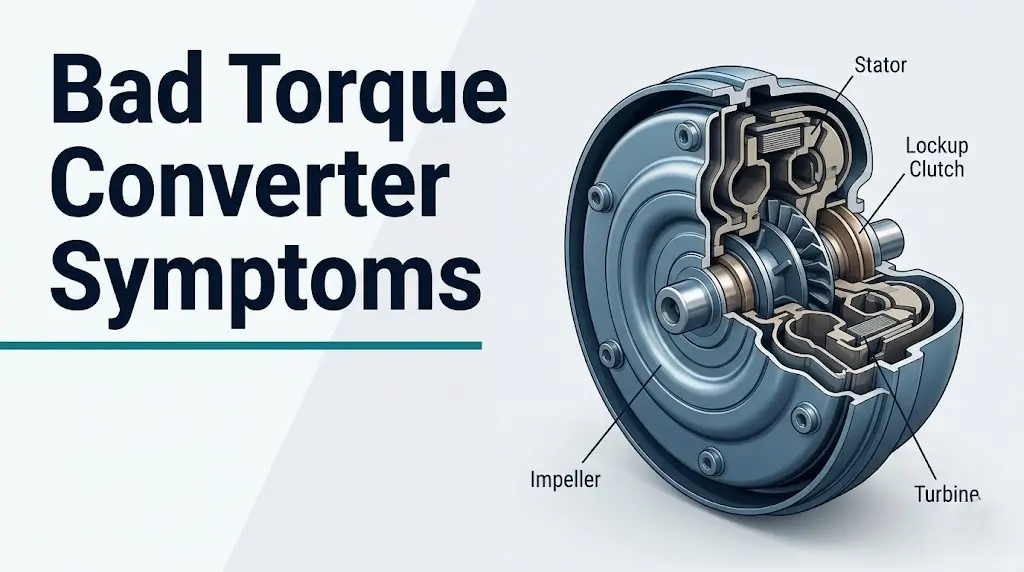
A torque converter is a sealed, fluid-filled coupling device mounted between the engine and the automatic transmission that transfers engine power to the transmission hydraulically and multiplies torque at low speeds to produce smooth acceleration.
Think of it like a sophisticated water wheel inside a sealed drum. The engine spins one half of the drum, which throws fluid outward onto a second wheel. That fluid force rotates the second wheel and transmits power to the transmission without any mechanical contact at low speeds. This is how your car can sit still at a stoplight with the engine running and the transmission in gear without stalling.
Inside every torque converter are four primary components:
| Component | Function | How It Fails |
|---|---|---|
| Impeller (pump wheel) | Rotates with the engine, accelerates ATF outward | Blade erosion from cavitation; damage from debris in fluid |
| Turbine wheel | Receives fluid force, drives transmission input shaft | Bearing failure; blade deformation from overheating |
| Stator with one-way clutch | Redirects fluid to multiply torque at low speeds | Clutch seizure or freewheeling, eliminating torque multiplication |
| Lockup clutch (TCC) | Mechanically locks turbine to housing at highway speed | Friction disc glazing, cracking, or material disintegration |
The lockup clutch, also called the torque converter clutch (TCC), is the most failure-prone component in high-mileage converters. It engages at highway speeds to eliminate hydraulic slip and improve fuel economy. When its friction disc material wears, glazes from heat, or breaks apart, the most recognizable symptom of torque converter failure appears: the shudder.
Vehicles with higher towing demands place the greatest thermal stress on the lockup clutch, accelerating wear significantly faster than light-duty driving patterns.
Symptoms of a Bad Torque Converter: The Core Warning Signs
The core warning signs of a bad torque converter are shuddering between 40 and 55 mph, slipping gears, unusual transmission noises, sluggish acceleration, overheating, contaminated transmission fluid, and reduced fuel efficiency.
These signs share a common origin: the hydraulic coupling efficiency inside the converter has been compromised, meaning the converter is either transferring too much heat into the fluid, failing to multiply torque correctly, or engaging and disengaging its lockup clutch inconsistently.
Here are the core warning signs ranked by how frequently they appear in early-stage converter failure, based on ATRA technical bulletins and common diagnostic patterns reported by transmission specialists:
- Torque converter shudder at a specific speed range (most common early sign)
- Gear slippage where engine RPM climbs without corresponding vehicle acceleration
- Whining or grinding noise from the transmission area
- Delayed or sluggish launch from a stopped position
- Rough or erratic shifting between gears, particularly third to fourth or fourth to fifth
- Dirty or burnt transmission fluid with visible metallic particles
- Check engine light with TCC-related diagnostic codes
- Transmission overheating indicated by a warning light or gauge
Older vehicles manufactured before 1995 do not have OBD-II systems capable of generating TCC-specific codes, so drivers of those vehicles must rely entirely on symptom recognition and mechanical testing. For 1996 and newer vehicles, an OBD-II scan tool costing under $30 at most auto parts stores can reveal TCC diagnostic codes before symptoms become severe.
Key Takeaway: The shudder between 40 and 55 mph is the single earliest and most recognizable sign of lockup clutch friction disc degradation. Do not dismiss it as road vibration.
Torque Converter Shudder Symptoms
Torque converter shudder is a rapid, rhythmic vibration felt through the floorboard, seat, and steering wheel that occurs at a specific speed range, typically 40 to 55 mph, and disappears when the vehicle either accelerates past that speed or decelerates below it.
This is the symptom most vehicle owners describe as “feeling like driving over rumble strips” or “like the car is shaking over washboard road.” The sensation is so consistent that experienced transmission technicians can often identify a torque converter shudder diagnosis from that description alone before any diagnostic test is run.
The mechanical cause is precisely defined. When the lockup clutch friction disc wears, glazes from heat exposure, or loses its friction material, the clutch cannot apply and release cleanly. Instead, it chatters: gripping, slipping, gripping, slipping many times per second. Each grip-and-slip cycle produces one vibration pulse. At 40 to 55 mph, the TCC is attempting to engage at exactly the speed range that produces the most noticeable symptom frequency.
Above 55 mph, the lockup clutch is fully engaged. The shudder stops because the friction disc has locked completely. Below 40 mph, the clutch is fully disengaged. The shudder stops because the disc is not in contact. The shudder lives only in the engagement transition zone.
Several overlapping conditions can produce a similar shudder sensation, including engine misfire, faulty spark plugs, worn motor mounts, or driveshaft imbalance. A transmission specialist can isolate the source by inducing the shudder in a controlled setting and observing whether it correlates with TCC engagement commands from the Transmission Control Module (TCM).
According to ATSG technical guidance, using a transmission fluid conditioner or a manufacturer-approved friction modifier additive can temporarily reduce lockup clutch shudder in early-stage friction disc wear. This is not a repair. It is a temporary reduction in symptom severity that delays, but does not prevent, the need for torque converter replacement.
Drivers of vehicles used for towing, rideshare driving, or sustained high-speed highway driving will experience lockup clutch shudder progression faster than drivers with light urban driving patterns, due to higher cumulative TCC engagement cycles and thermal load.
Torque Converter Slipping Symptoms
Torque converter slipping produces a sensation where the engine revs increase normally but the vehicle does not accelerate at the expected rate, creating a disconnected feeling between throttle input and vehicle response.
This is mechanically distinct from shudder. Slipping occurs when the hydraulic coupling between the impeller and turbine has lost efficiency, meaning fluid is not transferring rotational force effectively from the engine side to the transmission input shaft side. The result feels like pressing the gas pedal and having the engine respond while the car hesitates.
The most common internal cause of torque converter slipping is stator one-way clutch failure. The stator sits between the impeller and turbine and redirects fluid to produce torque multiplication at low speeds. Its one-way clutch should allow the stator to freewheel at high speeds and lock during torque multiplication. When the one-way clutch fails in the freewheeling direction at all speeds, the stator can no longer redirect fluid correctly. Torque multiplication disappears. The converter behaves like a simple fluid coupling with no multiplication effect, and the vehicle feels sluggish and underpowered, especially under load.
In severe cases, a failing torque converter will slip so significantly that the engine RPM will climb to 3,000 RPM or higher while the vehicle barely moves, particularly from a dead stop on an incline.
| Symptom Scenario | Engine RPM | Vehicle Response | Likely Cause |
|---|---|---|---|
| Light throttle from stop | 1,200-1,500 RPM normal | Hesitation then normal acceleration | Early TCC wear |
| Full throttle from stop | Climbs to 2,500+ RPM | Sluggish launch, delayed acceleration | Stator clutch wear or TCC slip |
| Highway cruise RPM spike | Sudden RPM increase without speed change | Speed drops, RPM rises | TCC disengaging unexpectedly |
| Incline driving | Excessive RPM, poor torque | Vehicle struggles to climb grade | Severe fluid coupling efficiency loss |
For drivers with OBD-II-compatible vehicles, slipping combined with a P0741 code (TCC circuit stuck off) confirms the TCM is detecting incorrect TCC slip RPM relative to commanded engagement. This is a specific, actionable diagnostic data point to give any transmission specialist at the start of a diagnostic appointment.
Torque Converter Noise Symptoms
A failing torque converter produces three distinct noise types: whining, grinding, and rattling, each originating from a different failing internal component.
Whining noise from the torque converter area is produced by cavitation inside the converter. Cavitation occurs when automatic transmission fluid is aerated, degraded, or insufficient, causing the impeller blades to generate vapor bubbles as they accelerate fluid. These bubbles collapse and produce a high-pitched whine that increases with engine RPM. A whining tone that disappears when the vehicle is placed in park or neutral, then returns when placed in drive, strongly suggests internal converter fluid dynamics problems rather than an engine accessory issue.
Grinding noises indicate needle thrust bearing failure inside the converter. The torque converter contains multiple thrust bearings that maintain precise spacing between the impeller, stator, and turbine as they rotate at different speeds. When these bearings fail, metal-to-metal contact begins. The resulting grinding sound typically correlates with vehicle speed rather than engine RPM because bearing rotation speed is tied to output shaft rotation, not engine rotation alone.
Rattling noises, particularly at idle or low speed, often originate from the flexplate, the thin metal disc that bolts the torque converter to the engine crankshaft. Cracks in the flexplate or loose flexplate-to-converter bolts produce a rattling sound that varies with engine idle speed. While flexplate damage is distinct from internal converter failure, the two often occur together in high-mileage vehicles because converter imbalance from internal component failure can place stress on flexplate mounting points.
Quick Tip:
- Whining that changes with engine RPM (in park or neutral): more likely a front pump or fluid issue than a converter
- Whining or grinding that changes with vehicle speed (disappears in neutral at the same engine RPM): more consistent with internal converter bearing failure
- Rattling at idle that stops when the transmission shifts into second gear: flexplate cracking is the priority diagnostic suspect
Key Takeaway: Grinding noise from the torque converter area means metal-to-metal contact inside a sealed unit. Metallic debris is circulating through your transmission fluid. Stop driving and schedule immediate evaluation.
Dirty Transmission Fluid as a Symptom of Torque Converter Failure
Dark, burnt-smelling transmission fluid with visible metallic particles is one of the clearest physical indicators of internal torque converter damage, because the converter shares its fluid supply with the entire transmission.
Healthy automatic transmission fluid is translucent red or pink, has no strong odor, and contains no visible particulate matter. When torque converter internal components begin to fail, the evidence ends up in the fluid. Friction disc material from the lockup clutch disintegrates and circulates as fine black particles. Needle bearing failure generates metallic flakes. Overheated fluid oxidizes, turning dark brown or black and developing a sharp burnt smell.
To assess your transmission fluid condition:
- Park the vehicle on a level surface with the engine warmed up and running.
- Locate the transmission dipstick (present on most rear-wheel-drive and some front-wheel-drive vehicles; many newer vehicles do not have a dipstick and require shop inspection).
- Remove the dipstick, wipe it clean with a white cloth or paper towel, reinsert fully, then remove again.
- Observe the color: healthy fluid is translucent red or light pink. Orange or light brown indicates oxidation. Dark brown or black indicates severe degradation.
- Smell the fluid: a sharp, acrid, or burnt odor indicates overheating damage.
- Look for particulate matter on the cloth: black specks indicate friction material debris; metallic glitter indicates bearing or hard-part failure.
If metallic flakes are visible in the fluid, internal hard-part failure has already occurred. Continuing to drive circulates these particles through transmission passages, accelerating damage to solenoids, valve body bores, and clutch packs throughout the entire transmission.
According to the Automatic Transmission Rebuilders Association (ATRA), contaminated transmission fluid resulting from internal torque converter failure is one of the leading causes of secondary transmission damage that converts what would have been a converter-only replacement job into a full transmission rebuild.
Vehicles that have gone beyond the manufacturer-recommended transmission fluid service interval (typically 30,000 to 60,000 miles depending on the manufacturer and driving conditions) are at elevated risk, because degraded, oxidized fluid accelerates friction disc wear inside the converter.
Torque Converter Overheating Symptoms
A failing torque converter causes transmission overheating because internal slippage between the impeller and turbine converts mechanical energy into heat rather than motion, raising automatic transmission fluid temperature beyond safe operating limits.
Normal transmission fluid operating temperature ranges from approximately 175°F to 200°F (79°C to 93°C). When the torque converter is slipping internally, either through lockup clutch disengagement or stator clutch failure, mechanical energy that should drive the vehicle is instead converted entirely to heat inside the converter. Fluid temperatures can spike to 250°F, 300°F, or beyond. At temperatures above 240°F (116°C), automatic transmission fluid begins to oxidize rapidly, losing its lubricating properties and viscosity index.
Symptoms of transmission overheating related to torque converter failure include:
- Transmission temperature warning light illuminating on the dashboard (present on many vehicles manufactured after 2010)
- A burning smell from beneath the vehicle during or after driving
- Transmission shifting erratically or refusing to engage higher gears as a self-protection response from the TCM
- Delayed or absent engagement when shifting from park to drive after the vehicle has been driven for 20 or more minutes
- Visible fluid leakage from transmission cooler lines, which can rupture under sustained high-pressure overheating conditions
Vehicles used for towing face the highest overheating risk from torque converter failure. A vehicle with a partially failing torque converter towing a load at highway speed may overheat the transmission within 20 to 30 minutes. The Society of Automotive Engineers has documented in multiple technical papers that towing applications produce fluid temperature spikes of 50°F to 100°F above light-duty driving baselines under equivalent ambient conditions.
If the transmission temperature warning light activates while driving, pull off the road safely, shift to park, and allow the vehicle to idle for 10 to 15 minutes before proceeding. Do not continue driving under load if the light returns. Schedule a diagnostic appointment before the next driving session.
Key Takeaway: A transmission overheating warning during normal driving without towing is a red flag for internal torque converter slippage. Do not continue driving to your destination. Stop and allow cooling before proceeding.
Poor Fuel Economy From a Failing Torque Converter
A failing torque converter reduces fuel economy because the lockup clutch, when it fails to engage properly at highway speeds, forces the engine to overcome continuous hydraulic fluid slippage rather than delivering power through a mechanically locked drivetrain connection.
Under normal operation, the TCC engages at approximately 40 to 55 mph (depending on vehicle calibration) and creates a direct mechanical link between engine and transmission. In lockup mode, the torque converter operates at nearly 100% efficiency with minimal energy loss. When the TCC fails to engage or engages inconsistently, the engine must continuously drive the impeller against fluid resistance to maintain vehicle speed. This resistance represents wasted fuel energy, producing a measurable decrease in miles per gallon, particularly on highway driving where the TCC is designed to operate continuously.
Drivers typically notice a gradual fuel economy decline of 2 to 4 miles per gallon at highway speeds as the torque converter TCC begins to fail. This decline is more pronounced on long highway drives than on city driving, because the TCC is designed to engage and remain engaged during sustained highway cruising.
A stored P0741 code (TCC circuit stuck off) specifically indicates the TCM has commanded TCC engagement but the system is not detecting the expected reduction in converter slip RPM. In plain terms: the TCM is telling the lockup clutch to engage, but it is not engaging. Every mile of highway driving in this condition is consuming more fuel than normal.
Many drivers attribute gradual fuel economy loss to aging spark plugs, a dirty air filter, or fuel system issues before the torque converter is investigated. If fuel economy testing at constant highway speed produces consistently lower readings than the vehicle’s EPA rating, and spark plugs, air filter, and tire pressure are confirmed correct, the torque converter TCC should be evaluated by an ASE-certified technician using a scan tool capable of monitoring TCC slip RPM in real time.
Symptoms of a Torque Converter Going Bad in Stages
Torque converter failure typically progresses through three identifiable stages, from intermittent minor symptoms to constant severe dysfunction, with each stage representing increasing internal mechanical damage.
Stage 1: Early Failure (Intermittent Symptoms)
At this stage, the lockup clutch friction disc is beginning to glaze or show early wear. Symptoms appear only under specific conditions: the shudder occurs only in the 40 to 55 mph range, clears when you accelerate above or decelerate below that range, and may not appear at all on cooler days when the fluid is thicker and provides more friction. Fuel economy is slightly reduced. There are no other noticeable symptoms. The vehicle may continue to function this way for months with no codes stored if the condition is borderline.
Stage 2: Progressive Failure (Consistent Symptoms)
Friction disc wear has progressed significantly, and the stator one-way clutch may be showing early failure. The shudder now occurs on every drive in the relevant speed range. Gear slippage begins, particularly under load. Transmission fluid starts to show discoloration. A TCC diagnostic code may be stored. Fuel economy has dropped noticeably. Acceleration from a stop feels sluggish.
Stage 3: Severe or Terminal Failure
Internal components have failed completely or partially. Hard-part damage (bearing failure, impeller blade damage) may have occurred. Transmission fluid is dark, burnt, and may contain metallic debris. The vehicle may barely move from a stop, or the transmission may refuse to engage certain gears. Overheating is occurring on most drives. Multiple OBD-II codes may be stored.
| Stage | Symptoms Present | Urgency Level | Action Required |
|---|---|---|---|
| Stage 1 | Occasional shudder at specific speed | Schedule within 2-4 weeks | Fluid check + shop evaluation |
| Stage 2 | Consistent shudder, slipping, fluid change, minor codes | Schedule within 1 week | Transmission specialist evaluation |
| Stage 3 | Constant symptoms, overheating, codes, fluid damage | Stop driving | Tow to transmission shop immediately |
Detecting failure at Stage 1 or early Stage 2 typically makes the repair a torque converter replacement only. Reaching Stage 3 often means rebuilding or replacing the entire transmission due to debris contamination.
Failing Torque Converter Symptoms at Highway Speed
Failing torque converter symptoms at highway speed are distinct from city driving symptoms because the lockup clutch is designed to remain continuously engaged during sustained highway cruising, making its failure most apparent during exactly that driving mode.
At highway speeds, the TCM commands the TCC to lock fully and remain locked. A failing lockup clutch will either refuse to engage (producing a sudden RPM spike with no speed change), engage inconsistently (producing the rhythmic shudder), or disengage unexpectedly under load (producing a brief surge in engine RPM followed by a jerk as it re-engages).
Highway-specific symptoms to monitor:
- A sudden RPM increase of 300 to 500 RPM at constant speed without any change in throttle position, indicating an unexpected TCC disengagement
- A rhythmic shudder that begins within 2 to 5 minutes of reaching highway speed and persists until you slow down, indicating the TCC is engaging but not holding cleanly
- Engine RPM that feels “loose” at cruising speed, fluctuating slightly around the cruise control set point without clear cause
- A brief jolt or bump felt through the drivetrain at regular intervals during steady-state highway driving, indicating the TCC is cycling on and off rather than staying locked
These symptoms are especially relevant on vehicles equipped with overdrive gear, where the TCC lockup is most critical for fuel economy and transmission temperature management. Disabling overdrive (via the O/D OFF button present on many vehicles) will often make highway driving feel more normal because it prevents the TCC from attempting to engage in its problematic range. This is a temporary workaround, not a solution. It increases fuel consumption and transmission temperatures.
According to ATSG technical service information, highway-speed TCC cycling on and off generates significantly more heat than either continuous lockup or continuous unlocked operation, because the repeated friction disc engagement and disengagement events each produce a heat spike. This cycling pattern accelerates friction material breakdown faster than any other failure mode.
Key Takeaway: If disabling overdrive makes your vehicle’s highway driving feel smoother and more stable, this is strong evidence the torque converter lockup clutch is the source of the problem. Describe this finding specifically to the mechanic.
Seized Torque Converter Symptoms
A seized torque converter is a condition where the internal components of the converter lock together mechanically, preventing normal relative rotation between the impeller and turbine, and in extreme cases, between the converter and the transmission input shaft.
This is the most severe form of torque converter failure, and it produces symptoms that are immediately obvious and dangerous. When a torque converter seizes internally, several failure patterns are possible:
If the stator one-way clutch seizes in the locked position (the more common seizure pattern), the stator locks rotationally and the converter loses its ability to allow the turbine to freewheel relative to the impeller. The vehicle will feel like it is dragging, with significantly reduced top speed and extremely poor fuel economy, because the engine must overcome the locked stator resistance continuously.
If the lockup clutch seizes in the engaged position, the mechanical connection between the engine and transmission becomes permanent, eliminating any hydraulic slip at any speed. The vehicle will stall when coming to a stop, because the transmission is still connected to the engine as if it were a manual clutch vehicle with no slip allowance at low speed.
Seized torque converter symptoms include:
- Vehicle stalls when decelerating to a stop, even with the brakes applied lightly
- Engine RPM does not drop to normal idle when the transmission is in drive at a stop
- Extremely strong vibration at idle with the transmission in gear that stops when shifted to neutral or park
- Vehicle will not move at all from a stop if the seizure is complete
- Immediate transmission overheating within minutes of initial driving
A seized converter requires immediate cessation of driving. Continuing to operate a vehicle with a seized torque converter risks damaging the flexplate, transmission front pump, and input shaft bearing, turning a converter replacement into a complete transmission overhaul.
Can a Bad Torque Converter Damage the Transmission
Yes, a bad torque converter can and regularly does cause damage to the entire automatic transmission if the failure is allowed to progress without repair.
The torque converter and the automatic transmission share the same hydraulic fluid circuit. Every drop of automatic transmission fluid that circulates through the converter also circulates through the transmission’s valve body, hydraulic passages, solenoids, clutch packs, and bands. When internal converter components fail and release debris into the fluid, that debris travels directly into the transmission.
According to ATRA technical resources, metallic debris from failed torque converter bearings is one of the most destructive contaminants that can enter an automatic transmission. Bearing metal particles score valve body bores, clog solenoid screens, and embed in clutch friction material throughout the transmission. What begins as a torque converter replacement job becomes a transmission rebuild once contamination has progressed through the unit.
The specific damage pathways from converter failure to transmission damage are:
- Friction disc material from a failing lockup clutch disintegrates into fine black particles. These particles clog the transmission filter rapidly, reducing hydraulic pressure throughout the unit and causing clutch pack slippage in gears unrelated to the converter.
- Needle thrust bearing failure generates metallic flakes. These score transmission valve body aluminum bores and seize solenoid valves, causing erratic shifting and transmission control failure independent of the original converter problem.
- Overheating from converter slippage raises fluid temperature throughout the entire transmission. Sustained temperatures above 250°F (121°C) degrade clutch pack friction material, transmission seals, and solenoid coil insulation simultaneously.
- A stalled or seized converter places extreme mechanical stress on the transmission front pump, which drives internal lubrication and hydraulic pressure. Front pump failure is often the secondary casualty of a seized converter.
Catching torque converter failure at Stage 1 or early Stage 2 (as defined in the staging section above) and replacing the converter before fluid contamination occurs typically results in a converter-only repair. Waiting until Stage 3 almost always means a partial or full transmission rebuild.
Is It Safe to Drive With Bad Torque Converter Symptoms
Driving with bad torque converter symptoms carries real risk of sudden transmission failure, complete loss of power delivery in traffic, and secondary damage that transforms a moderately priced repair into a much larger one.
The answer depends entirely on which symptoms are present and at what stage of failure they appear.
When limited driving may be tolerable (Stage 1 only):
A vehicle with only occasional shudder at a specific speed, no codes stored, normal fluid condition, and no slipping or noise may be driven carefully to a mechanic within a few days. Avoid highway driving, towing, and sustained high-load operation. Do not delay scheduling an evaluation.
When driving should be stopped immediately:
- Transmission fluid shows metallic particulate or smells burnt
- The transmission overheating warning light has activated
- Gear slippage is occurring (engine revs without vehicle acceleration)
- The vehicle stalls when decelerating to a stop
- Grinding or bearing noise is audible from the transmission area
- Multiple OBD-II codes are stored alongside physical symptoms
Any of these conditions indicate that continued driving is causing active, progressive damage to the transmission. The cost of towing the vehicle to a repair shop is small relative to the cost difference between a torque converter replacement and a full transmission rebuild.
A note for specific vehicle types: Vehicles with continuously variable transmissions (CVTs) and dual-clutch transmissions (DCTs) do not use a traditional hydraulic torque converter and will not present the same symptom patterns. CVT belt and pulley failure and DCT clutch pack failure produce different symptoms discussed in vehicle-specific resources.
Key Takeaway: If your transmission fluid contains visible metallic particles or the overheating light has activated, stop driving immediately. Every mile adds progressive contamination damage that increases the total repair cost.
How to Diagnose a Bad Torque Converter
Proper torque converter diagnosis requires a combination of a detailed symptom history, an OBD-II scan for stored codes, a transmission fluid condition assessment, a road test with live data monitoring, and in some cases, a stall speed test performed by an experienced transmission specialist.
No single test confirms torque converter failure alone. The diagnosis is made by combining multiple data sources.
To prepare for a diagnostic appointment effectively:
- Write down exactly when each symptom appears: the specific speed range, the temperature of the engine (cold or warmed up), whether it happens on city roads or highway, and whether it occurs under light throttle or heavy acceleration.
- Note any OBD-II codes stored in the system. An OBD-II scanner from any auto parts store can retrieve codes before your appointment. Codes P0740, P0741, and P0742 are the most directly relevant TCC codes.
- Check and document your transmission fluid condition before going to the shop: color, smell, and presence of particulate matter.
- Note your vehicle’s mileage and when the last transmission fluid service was performed, including what fluid specification was used.
- Ask the mechanic specifically to perform a live data road test using a professional scan tool that monitors TCC slip RPM, transmission fluid temperature, TCC command status, and transmission line pressure simultaneously. This is the gold standard for confirming lockup clutch behavior.
- Ask whether a transmission fluid analysis or a visual inspection of the transmission pan for debris accumulation will be performed. Both provide direct evidence of internal converter damage.
The stall speed test (performed by placing the vehicle in drive, holding the brake firmly, and briefly applying full throttle while observing maximum RPM before the torque converter stalls) can indicate stator one-way clutch failure, but this test carries risk of overheating if held too long. It should only be performed by an experienced technician following manufacturer-specified procedures.
ASE-certified transmission specialists and shops that are members of the Automatic Transmission Rebuilders Association (ATRA) have the scan tools, training, and test procedures to differentiate between a converter-only failure and a transmission valve body or clutch pack problem that produces overlapping symptoms.
Torque Converter Failure Symptoms vs Transmission Failure Symptoms
Torque converter failure symptoms and broader automatic transmission failure symptoms overlap significantly, but several specific symptom patterns, driving conditions, and diagnostic codes help distinguish the two sources.
Both conditions can produce gear slippage, rough shifting, noise, poor fuel economy, and overheating. The key differentiating factors are the specific speed and condition under which symptoms appear, the specific OBD-II codes stored, and the results of live data monitoring during a road test.
| Feature | Torque Converter Failure | Transmission Failure |
|---|---|---|
| Shudder at 40-55 mph | Very common; signature symptom | Less common; more likely a driveshaft or mount issue |
| Slipping under light load | Occurs, tied to TCC engagement | Occurs across multiple gears and loads |
| Slipping only under heavy load | Suggests converter fluid coupling loss | Also suggests clutch pack wear |
| Specific OBD-II codes | P0740, P0741, P0742 (TCC codes) | P0700, gear ratio codes, solenoid codes |
| Noise correlation | Changes with vehicle speed, not engine RPM alone | May correlate with specific gear engagement |
| Fluid condition | Black debris from friction material | Metal shavings, possible clutch friction material |
| Symptom onset speed | Highway speed specific for shudder; low speed for stall | Any speed for clutch pack failure |
| Symptom in park/neutral | Flexplate rattle only; drivetrain disconnected | Symptoms usually stop; some pump noises persist |
| Response to O/D disable | Shudder and slipping often improve significantly | Transmission slipping continues in lower gears |
A critical practical rule: if disabling overdrive eliminates or significantly reduces the shudder and slipping at highway speed, the problem is almost certainly in the torque converter’s lockup clutch rather than in the transmission’s internal clutch packs or valve body. This one diagnostic observation can save significant diagnostic time at the shop.
Transmission valve body failures and solenoid failures can produce codes that overlap with TCC codes. A professional scan tool with live data capability is the only reliable way to confirm whether the TCC is being commanded by the TCM and whether the transmission is responding as commanded.
Emergency Warning Signs: When to Stop Driving Immediately
Certain bad torque converter symptoms indicate active mechanical failure that makes continued driving genuinely dangerous and will cause rapid escalation of repair cost and severity.
Stop driving and have the vehicle towed to a transmission specialist if you experience any of the following:
- The transmission overheating warning light activates during normal driving without towing or extreme conditions
- The vehicle stalls when coming to a stop and requires shifting to neutral to prevent engine stall at traffic lights
- Gear slippage is severe: engine RPM climbs to 3,000 or above from a stop while the vehicle barely moves
- Grinding noise is audible from the transmission area during any driving condition, indicating active metal-to-metal contact inside the converter or transmission
- Transmission fluid on the ground beneath the vehicle, particularly if the fluid smells burnt
- The vehicle refuses to move from a stopped position in drive or reverse
- A sudden loss of throttle response occurs while driving at speed, where pressing the accelerator produces engine RPM increase but no vehicle acceleration
- The check engine light activates alongside any physical driving symptom described in this article
These symptoms can indicate complete torque converter seizure, transmission front pump failure, or total hydraulic pressure loss. Each of these conditions can cause the vehicle to become undrivable suddenly and without further warning.
Do not drive to the nearest shop. Call a tow service. Driving a vehicle with severe torque converter failure risks stalling in traffic, inability to accelerate from intersections, and complete drivetrain failure while moving. Have the vehicle towed to an ATRA-member transmission shop or a dealership transmission service department for evaluation.
Frequently Asked Questions About Bad Torque Converter Symptoms
What does a bad torque converter feel like when driving?
A bad torque converter typically feels like rhythmic shuddering between 40 and 55 mph, a disconnected sensation where the engine revs but the car does not accelerate proportionally, or sluggish launch from a stopped position.
In early stages, the shudder may be the only symptom and it disappears when you speed up or slow down past the engagement speed range.
As failure progresses, you may also feel rough or erratic gear shifts, a burning smell from the transmission, and general loss of driving smoothness.
Can a bad torque converter cause a car not to move?
Yes, a severely failed or seized torque converter can prevent a vehicle from moving at all from a stopped position.
This occurs when internal converter damage has progressed to the point where the hydraulic coupling between the impeller and turbine has effectively failed, leaving the engine unable to transfer rotational force to the transmission input shaft.
If your vehicle will not move from a stop with the engine running and the transmission in drive or reverse, stop driving immediately and have the vehicle towed to a transmission specialist.
What does torque converter shudder feel like?
Torque converter shudder feels like driving over a continuous strip of rumble strips or washboard road, with rapid vibration felt through the floor, seat, and steering wheel at a specific speed, typically 40 to 55 mph.
The shudder starts and stops abruptly as you pass through the lockup clutch engagement speed range, and it disappears at higher or lower speeds because the lockup clutch is either fully locked or fully disengaged outside that range.
This pattern, a vibration that exists only within a narrow speed window, is the most consistent and recognizable signature of lockup clutch friction disc wear.
How do I know if it’s my torque converter or my transmission?
The clearest distinguishing factor is whether disabling overdrive makes highway driving feel more normal: if it does, the torque converter lockup clutch is the most likely source.
Torque converter failure produces shudder specifically in the 40 to 55 mph lockup clutch engagement zone, while broader transmission failure typically produces slippage across multiple gears and speed ranges.
An ASE-certified transmission specialist using a professional scan tool with live data monitoring, checking TCC command status against actual slip RPM, can confirm the source definitively and give you the most accurate repair estimate.
How long can you drive with a bad torque converter?
There is no safe general answer, because the appropriate action depends entirely on which symptoms are present and how severe they are.
A vehicle with only mild, intermittent shudder at a specific speed and clean transmission fluid may be driven carefully for a short time while scheduling a repair appointment, but towing, highway driving, and heavy acceleration should be avoided entirely.
If any of the emergency symptoms described in this article are present, including overheating warning lights, metallic debris in fluid, severe slipping, or stalling at stops, the vehicle should be towed immediately rather than driven.
What are the first signs of a torque converter going bad?
The first signs of a torque converter going bad are almost always the characteristic shudder between 40 and 55 mph and a subtle reduction in fuel economy on highway driving.
These early symptoms reflect the beginning of lockup clutch friction disc wear, where the clutch is still engaging but doing so inconsistently rather than cleanly and completely.
Catching the problem at this stage, before transmission fluid contamination occurs, typically allows a torque converter replacement alone rather than a more expensive transmission rebuild.
Closing
Recognizing bad torque converter symptoms at the earliest stage, particularly the specific shudder between 40 and 55 mph and the gradual highway fuel economy decline, is the most effective way to prevent a moderately priced repair from becoming a full transmission rebuild. The torque converter does not fail all at once. It gives you clear, recognizable warning signals before it does.
Check your transmission fluid condition, note any OBD-II codes your vehicle has stored, and bring a written symptom log to your diagnostic appointment. Tell the mechanic exactly when, where, and under what conditions the symptoms occur. Ask them to perform a live data road test with a professional scan tool.
The difference between a $400 to $800 torque converter replacement and a $2,500 to $4,000 transmission rebuild often comes down to how early the problem was caught and whether the vehicle was driven until fluid contamination spread. Act on the symptoms. Your transmission does not give second warnings.