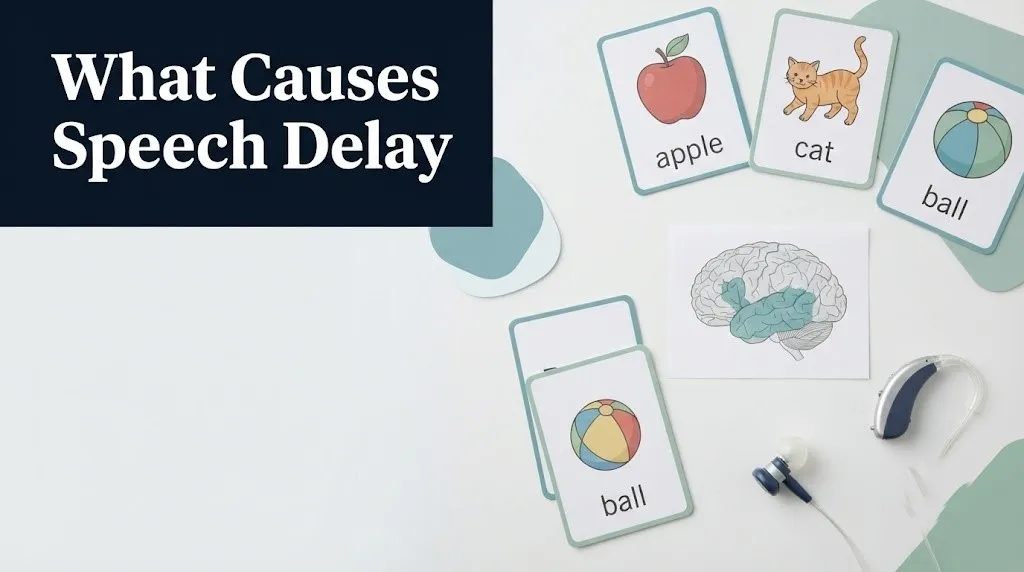
What Causes Speech Delay in Children: 2026 Guide
Speech delay is caused by a range of factors including hearing impairment, neurological differences, oral-motor structural problems, genetic conditions, and environmental influences, each of which disrupts the developing language circuit through a distinct physiological mechanism. Identifying the specific cause matters because it determines which type of specialist evaluation is needed and how early targeted intervention can begin.
According to the National Institute on Deafness and Other Communication Disorders (NIDCD), approximately 1 in 12 children aged 3 to 17 years in the United States has had a disorder related to voice, speech, language, or swallowing. Speech delay is among the most common developmental concerns parents raise with pediatricians, yet the causes vary enormously from simple conductive hearing loss in one ear to complex genetic syndromes affecting the architecture of the brain’s language network.
This article covers each major cause of speech delay with the specific neurological, anatomical, or physiological reason it disrupts language development. It addresses how causes differ across age groups, how to tell an expressive delay from a receptive one, which causes resolve without treatment, and exactly when professional evaluation is needed rather than watchful waiting.
What Causes Speech Delay
Speech delay is caused when any part of the brain-ear-mouth circuit responsible for language acquisition is disrupted, whether by peripheral hearing loss, cortical processing differences, motor pathway dysfunction, structural oral-motor problems, genetic factors, or environmental deprivation.
Language development is not a single process. It requires a child to hear speech sounds clearly, process those sounds through the auditory cortex in the temporal lobe, build phonological memory templates in Wernicke’s area (the left superior temporal gyrus, Brodmann area 22), connect those templates to word meaning, and then generate the motor speech program in Broca’s area (the left inferior frontal gyrus, Brodmann areas 44 and 45). The arcuate fasciculus, a white matter tract running beneath the cortex, physically connects Wernicke’s and Broca’s areas. Any breakdown along this circuit, at any link in the chain, produces speech delay.
Think of this circuit like a relay race. If the first runner (the ear) drops the baton, the second runner (the auditory cortex) never gets going. If the third runner (Broca’s area) is injured, the baton may reach her but she cannot pass it to the final leg (the oral-motor muscles). The race stalls at whichever point the disruption occurs, and that stalling point tells clinicians a great deal about what type of intervention is most likely to help.
The American Academy of Pediatrics (AAP) classifies speech delay as either primary (no identifiable underlying condition) or secondary (resulting from a named cause such as hearing impairment, autism spectrum disorder, or intellectual disability). Most cases that reach clinical attention involve a specific identifiable cause, which is why evaluation is more informative than watchful waiting beyond the established milestone thresholds.
Key causes include:
- Hearing impairment (conductive or sensorineural)
- Neurological differences (autism spectrum disorder, childhood apraxia of speech, cerebral palsy, Landau-Kleffner syndrome)
- Oral-motor structural problems (ankyloglossia, cleft palate, velopharyngeal insufficiency)
- Genetic syndromes (fragile X syndrome, Down syndrome, FOXP2 mutations)
- Environmental factors (low verbal interaction, socioeconomic deprivation, excessive passive screen time)
- Prematurity and perinatal complications
Individual variation note: Boys are three to four times more likely than girls to have speech delay, according to research published in the Journal of Child Psychology and Psychiatry. The biological basis involves slower maturation of the left hemisphere’s language networks in males, partly influenced by higher prenatal testosterone exposure, which temporarily reduces synaptic density in frontal language areas.
Speech Delay Causes: The Full Clinical Picture
Speech delay causes fall into two broad categories: those that disrupt the input side of language (hearing what others say) and those that disrupt the output side (producing language). Understanding which side is affected first determines the diagnostic pathway.
Input-side disruption usually involves the auditory system. The cochlea in the inner ear contains approximately 16,000 hair cells that transduce sound wave vibrations into electrochemical signals. These signals travel along the cochlear nerve (cranial nerve VIII) to the cochlear nuclei in the brainstem, then relay upward through the inferior colliculus and medial geniculate nucleus of the thalamus to arrive at the primary auditory cortex (Heschl’s gyrus) in the temporal lobe. When any part of this pathway is compromised, a child receives degraded or absent auditory input. Without consistent, clear auditory input, the brain cannot build the phonological templates that word production requires.
Output-side disruption involves the motor speech planning network. Broca’s area generates the motor speech program, which then travels down the corticobulbar tract to brainstem motor nuclei. Cranial nerve VII (facial) controls lip movement, cranial nerve X (vagal) manages the velum and pharynx, and cranial nerve XII (hypoglossal) drives tongue movement. A problem anywhere in this motor pathway, from cortical planning through nerve conduction to muscle execution, produces delayed or impaired speech output despite normal language comprehension.
| Cause Category | Side Affected | Primary Mechanism | Diagnostic First Step |
|---|---|---|---|
| Hearing impairment | Input | Degraded auditory signal to cortex | Audiological evaluation (OAE, ABR) |
| Autism spectrum disorder | Both | Atypical social-communicative neural processing | M-CHAT-R screening, developmental evaluation |
| Childhood apraxia of speech | Output | Disrupted motor speech program in Broca’s area | SLP evaluation, dynamic motor assessment |
| Oral-motor structural problem | Output | Mechanical restriction of articulation | Clinical oral-motor examination |
| Intellectual disability | Both | Global cortical processing differences | Developmental neuropsychological evaluation |
| Environmental deprivation | Input/Integration | Insufficient linguistic input for template building | Developmental history, parent interview |
Individual variation note: Children with Down syndrome (trisomy 21) show both input and output disruption. They have a higher prevalence of conductive hearing loss due to narrow Eustachian tubes, and they also have reduced oral-motor muscle tone (hypotonia) affecting articulation. This combination means a hearing evaluation alone is insufficient; oral-motor assessment must accompany it.
What Is Considered a Speech Delay
A speech delay is present when a child is not meeting the language production milestones established by the American Academy of Pediatrics and American Speech-Language-Hearing Association (ASHA) for their chronological age.
The established milestone thresholds that define clinical concern are specific:
| Age | Expected Milestone | Concern Threshold |
|---|---|---|
| 12 months | First words, babbling with consonants | No babbling with consonants, no gestures |
| 15 months | 3 to 5 words with meaning | Fewer than 3 meaningful words |
| 18 months | 10 or more words | Fewer than 10 words |
| 24 months | 50+ words, two-word phrases | Fewer than 50 words or no phrases |
| 36 months | Sentences of 3 to 4 words, 75% intelligible to strangers | Single words only, strangers cannot understand |
| 48 months | 4 to 5 word sentences, 90% intelligible | Persistent difficulty being understood by familiar adults |
One distinction matters enormously here. “Speech delay” strictly refers to delayed production of speech sounds and words. “Language delay” refers to delayed development of the underlying system of meaning, grammar, and communication, which includes both understanding and expression. Clinicians often use the terms together, but they do not always co-occur. A child can have delayed speech production with normal language comprehension, or can have both delayed production and delayed comprehension, and these two profiles point toward different underlying causes.
According to ASHA clinical practice guidelines, any child who has not yet babbled by 9 months, has not produced a first word by 16 months, or has not produced two-word combinations by 24 months should receive a formal speech-language evaluation rather than a “wait and see” recommendation.
Individual variation note: For children in bilingual households, milestones should be assessed across both languages combined, not in each language separately. A bilingual child may appear delayed in each language individually but meet total vocabulary milestones when both languages are counted. This is a normal feature of bilingual language acquisition and not itself a sign of pathology, according to ASHA guidance.
Causes of Speech Delay in Toddlers
The causes of speech delay in toddlers cluster into five main groups: sensory (primarily hearing), neurological, structural oral-motor, genetic, and environmental. Each operates through a different physiological mechanism and each requires a different clinical approach.
Among toddlers specifically, hearing impairment is the most important cause to rule out first, because it is both common and highly treatable when identified early. A 2016 study published in Pediatrics found that children with unidentified mild to moderate hearing loss show language scores 1.5 standard deviations below the mean by age 3. Identifying and correcting the hearing impairment before age 3 substantially changes that trajectory because of the concept of the critical period: the developing auditory cortex undergoes rapid synaptic pruning between birth and age 3, and the patterns of connection it establishes during this window strongly influence later language ability.
After hearing is cleared, the next most common cause evaluated in toddlers is neurodevelopmental difference, particularly autism spectrum disorder. The CDC’s Autism and Developmental Disabilities Monitoring (ADDM) Network reports that as of 2023, approximately 1 in 36 children in the United States is identified with autism spectrum disorder. Communication differences, including delayed or absent speech, are among the most common presenting concerns that lead to an ASD evaluation.
Common causes of speech delay in toddlers in approximate order of prevalence:
- Hearing impairment (conductive or sensorineural), estimated to affect 2 to 3 per 1,000 newborns with moderate to profound loss
- Autism spectrum disorder, present in approximately 1 in 36 children (CDC ADDM Network, 2023)
- Developmental language disorder (no identifiable structural or neurological cause), estimated at 7 to 8% of kindergarten children by ASHA
- Intellectual disability, present in approximately 1 to 3% of the population
- Childhood apraxia of speech, present in 1 to 2 per 1,000 children by ASHA estimates
- Structural oral-motor problems (ankyloglossia, cleft palate), variable prevalence by specific condition
Individual variation note: Toddlers with chronic otitis media with effusion (fluid behind the eardrum) often have fluctuating mild to moderate conductive hearing loss that parents do not notice because the child can still hear loud sounds. This intermittent degradation of auditory input during the critical period of language acquisition is enough to delay phonological template development. A pediatrician examining the eardrums at a well-child visit may miss this unless pneumatic otoscopy or tympanometry is performed.
Key Takeaway: Hearing impairment is the single most important cause of speech delay to rule out first in any toddler, because unidentified hearing loss during the first three years actively shapes the language network in ways that become progressively harder to reverse.
What Causes Speech Delay in Toddlers: The Neurological Explanation
The neurological explanation for speech delay in toddlers centers on two processes: the maturation of white matter tracts connecting language areas, and the synaptic pruning that refines language circuits during the first three years of life.
White matter myelination in the language network is not complete at birth. The arcuate fasciculus, which links Wernicke’s and Broca’s areas, undergoes active myelination throughout the first three to four years of life. Myelination is the process by which glial cells wrap the axon of a neuron in a fatty sheath, dramatically increasing conduction speed. In children with language delays, neuroimaging research published in the Journal of Speech, Language, and Hearing Research has consistently found reduced fractional anisotropy (a measure of white matter tract integrity) in the arcuate fasciculus compared with typically developing peers. This means the neural signal connecting comprehension to production is literally slower and less reliable.
Synaptic pruning is the complementary process. During the first three years, the brain eliminates synaptic connections that are not being used and strengthens the ones that are. Language input, specifically the quantity and quality of speech directed at the child, drives which connections survive. Without sufficient verbal input, the synapses supporting phonological memory and grammar do not receive enough activation to survive pruning. This is the neurological mechanism behind environment-related speech delay, not simply a social or cultural observation.
Specific neurological conditions that disrupt these processes include:
- Childhood apraxia of speech (CAS): A motor speech planning disorder where Broca’s area generates inconsistent or erroneous motor programs for the same word across repetitions, not explained by muscle weakness
- Cerebral palsy: Perinatal brain injury affecting the corticobulbar tract, reducing the motor signal that reaches the cranial nerve nuclei controlling articulation
- Landau-Kleffner syndrome: A rare acquired epileptic aphasia where seizure activity progressively destroys Wernicke’s area, causing loss of previously acquired language skills
- Intellectual disability: Reduced overall cortical processing capacity affecting the integration and storage of phonological and grammatical information
Individual variation note: In children with a history of neonatal seizures or neonatal hypoxic-ischemic encephalopathy, speech delay may be the first clinically apparent sign of cortical injury. These children warrant evaluation by a board-certified pediatric neurologist in addition to speech-language pathology assessment.
Hearing Loss and Speech Delay
Hearing loss is the most common medical cause of speech delay, and it works through a direct physiological mechanism: without adequate auditory input reaching the auditory cortex, the brain cannot build the phonological memory templates that word learning and production depend on.
Sound enters the outer ear canal, causes vibration of the tympanic membrane, and is amplified through the ossicles (malleus, incus, stapes) of the middle ear before arriving at the cochlea in the inner ear. The cochlea’s approximately 16,000 hair cells convert these mechanical vibrations into electrochemical signals. Those signals travel via the cochlear nerve (CN VIII) to the cochlear nuclei in the brainstem, then relay upward to the auditory cortex. In conductive hearing loss, the mechanical transmission through the middle ear is disrupted, typically by fluid (otitis media with effusion), structural malformation, or ossicular damage. In sensorineural hearing loss, the hair cells themselves or the cochlear nerve are damaged, usually permanently.
The NIDCD reports that approximately 2 to 3 infants per 1,000 births in the United States are born with detectable hearing loss in one or both ears. Crucially, even a mild hearing loss of 25 to 40 decibels, which is the range produced by fluid behind the eardrum, is sufficient to muffle the high-frequency consonant sounds (s, f, th, sh) that are essential for building phonological distinctions between words.
According to research published in Pediatrics, children whose hearing loss is identified and treated before 6 months of age demonstrate significantly better language outcomes at age 5 compared with children whose loss was identified after 6 months, even when the degree of hearing loss is comparable. This is the clearest evidence that early identification, not simply identification at any point, is the relevant variable.
Diagnostic approaches for hearing as a cause of speech delay:
- Otoacoustic emissions (OAE) test: Measures the response of cochlear hair cells to sound. Fast, non-invasive, performed even in sleeping newborns. Does not assess the neural pathway beyond the cochlea.
- Auditory brainstem response (ABR) test: Measures the electrical response of the auditory nerve and brainstem to sound clicks. Assesses the full peripheral auditory pathway. The gold standard for infants under 6 months.
- Pure-tone audiometry: A behavioral test used in children old enough to respond to tones (typically 3 years and older). Provides a precise audiogram of hearing thresholds across frequencies.
- Tympanometry: Measures eardrum compliance and middle ear pressure. Identifies fluid or structural problems in the middle ear.
Individual variation note: Children with a history of recurrent otitis media (middle ear infections) require tympanometry at each well-child visit during the toddler years, not just a visual otoscope check. The presence of fluid behind an intact tympanic membrane is frequently missed without this test.
Neurological Causes of Speech Delay
Neurological causes of speech delay involve direct dysfunction of the brain structures and pathways that plan, process, and produce language, regardless of whether the ears and oral-motor structures are anatomically intact.
Autism spectrum disorder (ASD) is the most clinically prominent neurological cause because it affects not only the language network but the social-communication motivation system. Research published in JAMA Pediatrics has shown that children with ASD demonstrate atypical connectivity between the default mode network (involved in social cognition) and the language network, meaning that the social reinforcement loop that typically drives language acquisition is disrupted. A neurotypical infant learns words partly because social interaction is inherently rewarding and language use is the tool for more of it. In ASD, this reward loop is attenuated, reducing the drive for communicative language production even when the structural language network is functional.
Childhood apraxia of speech (CAS) involves a different mechanism entirely. The language comprehension system works normally; the child understands words and sentences. But Broca’s area and the supplementary motor area fail to generate consistent, accurate motor programs for speech production. The hallmark clinical feature is inconsistency: the same word produced differently on different attempts, with groping mouth movements as the child searches for the right motor sequence. CAS is estimated to affect between 1 and 2 per 1,000 children by ASHA estimates and requires intensive, specialized speech-motor therapy rather than standard language stimulation.
Neurological conditions causing speech delay:
- Autism spectrum disorder (atypical social-communicative neural connectivity)
- Childhood apraxia of speech (motor speech planning dysfunction in Broca’s area and supplementary motor area)
- Intellectual disability (global cortical processing reduction affecting language integration)
- Cerebral palsy (corticobulbar tract damage reducing motor output to oral-motor cranial nerve nuclei)
- Landau-Kleffner syndrome (acquired epileptic aphasia destroying Wernicke’s area)
- Traumatic brain injury affecting language cortices
- Periventricular leukomalacia in preterm infants (white matter damage to language tracts)
Individual variation note: In girls, autism spectrum disorder is frequently underdiagnosed at preschool age because girls with ASD more often demonstrate social masking behaviors, compensating for communication difficulties through observation and mimicry. A girl presenting with speech delay and strong social mimicry skills may have her ASD missed until school age. Clinicians and parents should not interpret apparent social engagement as ruling out ASD in girls with speech concerns.
Key Takeaway: Childhood apraxia of speech and autism spectrum disorder both cause speech delay through entirely different neurological mechanisms, and they require different treatment approaches, making accurate differential diagnosis by a speech-language pathologist essential before starting any therapy.
Oral-Motor Causes of Speech Delay
Oral-motor causes of speech delay involve structural or functional problems with the physical structures used to articulate speech sounds: the lips, tongue, velum (soft palate), and pharynx.
Ankyloglossia, commonly called tongue-tie, is a condition where the lingual frenulum (the band of tissue connecting the underside of the tongue to the floor of the mouth) is shorter, thicker, or less elastic than normal. This restricts the tongue’s range of motion, particularly elevation toward the palate and lateral movement. Clear production of the speech sounds l, t, d, n, r, th, and s requires precise tongue tip elevation and placement against the alveolar ridge (the bony ridge just behind the upper front teeth). When the frenulum mechanically prevents this, articulation errors result. The prevalence of ankyloglossia is estimated at 4 to 11% of newborns, according to a 2012 review published in Pediatrics, though not all cases produce speech problems.
Cleft palate, with or without cleft lip, disrupts the structural integrity of the velum (soft palate) and the velopharyngeal mechanism. During speech, the velum elevates and presses against the posterior pharyngeal wall to close off the nasal cavity, directing airflow through the mouth for oral speech sounds. When this mechanism is structurally incomplete due to cleft palate, air escapes through the nose during oral consonant production. This produces hypernasality and makes pressure consonants (p, b, t, d, k, g, s, z) particularly difficult to produce with adequate intraoral pressure. Cleft palate occurs in approximately 1 in 1,500 to 2,000 births, according to the CDC.
Velopharyngeal insufficiency (VPI) can also occur without a cleft, in children with submucous cleft palate (a structural deficiency concealed beneath intact mucosa) or after adenoid removal. VPI produces the same hypernasality and pressure consonant errors as overt cleft palate.
| Oral-Motor Condition | Structure Affected | Speech Impact | Treatment |
|---|---|---|---|
| Ankyloglossia | Lingual frenulum | Reduced tongue elevation; errors on l, t, d, n, r | Frenotomy (if clinically indicated); SLP therapy |
| Cleft palate | Velum, velopharyngeal mechanism | Hypernasality; errors on oral pressure consonants | Surgical repair; SLP therapy post-repair |
| Velopharyngeal insufficiency | Velum-pharyngeal closure | Hypernasality; nasal air emission | Surgical or prosthetic management; SLP |
| Low oral-motor tone | Lip, tongue, cheek muscles | Imprecise articulation; slurred speech sounds | SLP oral-motor therapy |
Individual variation note: Children with Down syndrome frequently present with low oral-motor tone (hypotonia) affecting the tongue and lip muscles, which compounds any hearing-related difficulties. Both the structural and muscular components require separate, concurrent evaluation rather than a sequential approach.
Causes of Speech Delay in 2-Year-Olds
At age 2, the expected language milestone is a vocabulary of at least 50 words and the ability to combine two words into simple phrases (for example, “more milk” or “mama go”). A 2-year-old who is not meeting this benchmark warrants prompt evaluation, not continued watchful waiting.
The most common causes of speech delay specifically in 2-year-olds, based on the clinical pattern of who presents to speech-language pathologists and developmental pediatricians at this age, are:
- Hearing impairment that was missed or incompletely treated in the first year
- Autism spectrum disorder, with 2 years being a common age for initial recognition of developmental differences
- “Late talker” profile (expressive language delay with intact comprehension, normal non-verbal skills, no concerning behavioral features), which resolves spontaneously in approximately 50% of cases by age 3 according to a longitudinal study in the Journal of Child Psychology and Psychiatry
- Developmental language disorder, where language processing is affected beyond what a simple “late talker” profile predicts
- Psychosocial or environmental delay from insufficient verbal stimulation
The “late talker” label deserves precision. A late talker at age 2 is a child who has fewer than 50 words but demonstrates normal understanding of spoken language, normal non-verbal cognitive skills, normal social development, and normal hearing. These children may simply be on the slower end of the normal distribution of language maturation. But approximately 25 to 50% of late talkers do not catch up without intervention, which is why the AAP’s Bright Futures developmental surveillance guidelines recommend that all children who do not meet the 24-month language milestone receive a formal language evaluation even if they appear otherwise healthy.
To determine what is causing a 2-year-old’s speech delay:
- Request a pediatric audiology evaluation (pure-tone audiometry or ABR if the child cannot cooperate with behavioral testing) to assess hearing bilaterally.
- Ask your pediatrician to administer the M-CHAT-R (Modified Checklist for Autism in Toddlers, Revised) at the 18 and 24-month well-child visits, as this is an AAP-recommended screening tool.
- Request a referral to a speech-language pathologist for a formal standardized language evaluation.
- Track whether your child uses pointing to show you things (proto-declarative pointing), a gesture that typically appears by 12 months and is markedly reduced or absent in ASD.
- Note whether comprehension appears normal: does your child follow simple two-step directions without gestural cues?
Individual variation note: Boys at age 2 outnumber girls in referrals for speech delay by approximately 3 to 1. This sex ratio does not mean parents should wait longer with boys before seeking evaluation. The same developmental thresholds apply regardless of sex.
Key Takeaway: A 2-year-old who is not combining words and does not demonstrate normal comprehension of simple directions warrants an audiology evaluation and speech-language pathology assessment the same month the concern is identified, not at the next annual well-child visit.
Environmental Causes of Speech Delay
Environmental causes of speech delay work through the same underlying mechanism as neurological ones: they reduce the quality or quantity of language input available to drive synaptic strengthening in the developing language network.
The brain’s language circuits require activation to develop properly. A useful analogy: the language network is like a muscle that strengthens with use and atrophies with disuse, except the critical period window means the atrophy risk is not evenly distributed across a lifetime. The period between birth and age 3 is when language circuits are most plastic and most dependent on input-driven synaptic selection. Research published in Science by Hart and Risley found that by age 3, children in low-income households had heard approximately 30 million fewer words than children in professional households, a gap associated with measurable differences in vocabulary size and language processing speed. Though the “30 million word gap” has been refined by subsequent research, the core finding, that the quantity and quality of child-directed speech during the first three years predicts language outcomes, is supported by multiple independent studies.
Specific environmental factors associated with speech delay:
- Low parental verbal interaction: Reduced quantity of child-directed speech, including narrating activities, reading aloud, and responsive conversation
- Socioeconomic stressors: Poverty, caregiver mental health challenges, household instability, and chronic stress reduce the cognitive bandwidth available for interactive language engagement
- Excessive passive screen time: Content that plays at the child without requiring or rewarding verbal response does not provide the contingent, responsive interaction that language development requires (addressed separately below)
- Emotional neglect or adverse childhood experiences (ACEs): Severe environmental neglect is a well-established cause of language delay through both reduced input and stress-related disruption of prefrontal cortical development
The American Academy of Pediatrics recommends zero screen time for children under 18 months (except video chatting with family), and no more than one hour per day of high-quality, co-viewed programming for children 2 to 5, specifically because passive screen exposure does not generate the responsive, contingent interaction that builds language.
Individual variation note: Children in households experiencing significant socioeconomic stress may present with environmental speech delay that improves substantially with targeted language-enrichment programs. However, clinicians note that environmental delay should not be assumed without first ruling out hearing impairment and neurodevelopmental conditions. Environmental factors and medical causes frequently co-occur.
Is Speech Delay Genetic
Speech delay has a genetic component, and research has identified several specific genes and chromosomal patterns associated with language development disruption.
The most studied single-gene contributor to speech and language development is FOXP2, a transcription factor gene on chromosome 7. Mutations in FOXP2 disrupt the normal development of neural circuits involved in speech-motor sequencing and language learning. A seminal study published in Nature in 2001 identified a FOXP2 mutation in a three-generation family where affected members showed severe speech and language difficulties, establishing for the first time that a specific gene variant could produce a heritable language disorder. FOXP2 is not the only relevant gene, but it remains the most clearly characterized.
Beyond single-gene effects, chromosomal conditions with well-established language delay profiles include:
- Fragile X syndrome (FMR1 gene mutation): The most common inherited cause of intellectual disability and a frequent cause of speech delay. Boys are more severely affected than girls due to X-linked inheritance patterns. Speech in fragile X often has a distinctive rapid, cluttered quality.
- Down syndrome (trisomy 21): Associated with both expressive and receptive language delay, compounded by high rates of conductive hearing loss.
- 22q11.2 deletion syndrome (DiGeorge syndrome): Associated with velopharyngeal insufficiency, learning difficulties, and language delay.
- Williams syndrome: Characterized by a distinctive language profile with relatively spared expressive vocabulary but impaired syntax and pragmatic language.
Family history matters. According to a 2019 review in the Journal of Child Psychology and Psychiatry, children with a first-degree relative (parent or sibling) with a history of speech or language difficulty have approximately twice the risk of developing speech delay themselves, pointing to a polygenic inherited component beyond named syndromes.
Individual variation note: Genetic causes of speech delay are more likely to be identified when the delay is accompanied by other developmental concerns (intellectual disability, motor delay, distinctive facial features, cardiac or structural anomalies). An isolated speech delay with no other developmental concerns less often has a diagnosable single-gene cause, but the polygenic familial risk remains.
Speech Delay and Autism
Autism spectrum disorder is one of the most common identified causes of speech delay in toddlers, but it is not the most common, and speech delay itself is not a diagnostic criterion for autism. Understanding this distinction prevents both overinterpretation and underrecognition.
Autism spectrum disorder (ASD) is defined by the DSM-5 as a neurodevelopmental condition characterized by persistent deficits in social communication and social interaction, and restricted, repetitive patterns of behavior. Language delay occurs frequently in ASD because the social-communicative motivation system is atypically organized: the neural reward circuits that make verbal interaction inherently reinforcing are less strongly activated in many children with ASD, which reduces the drive to acquire and use communicative language.
Specific speech and language patterns in ASD differ from other causes of delay:
- Children with ASD may have spoken words and then lose them (language regression), typically between 15 and 24 months
- Functional communicative language (using words to request, comment, or engage) is often more impaired than rote or scripted language (repeating phrases from videos or books, called echolalia)
- Joint attention (following another person’s gaze, pointing to share interest rather than to request) is usually reduced or absent
- Prosody (the melody and rhythm of speech) may be atypical even when words are present
According to the CDC’s ADDM Network, approximately 1 in 36 children in the United States has ASD as of the most recent surveillance data (2023). Not all children with ASD have speech delay, and not all children with speech delay have ASD. The M-CHAT-R is a validated 20-item parent-report screening tool recommended by the AAP at 18 and 24-month visits to identify children who warrant further evaluation for ASD.
The critical point: a child with speech delay whose delay might be related to ASD needs evaluation by a developmental pediatrician or board-certified child psychiatrist with expertise in ASD, not just a speech-language pathologist alone. The SLP treats the communication profile; the developmental evaluation determines the underlying diagnosis and broader support plan.
Individual variation note: Girls with ASD show speech and language profiles that more closely resemble those of neurotypical girls than boys with ASD resemble neurotypical boys. Girls may have less obvious repetitive behaviors and stronger social mimicry, making ASD-related speech delay harder to identify and leading to delayed diagnosis on average of one to two years compared with boys, according to research published in the Journal of Autism and Developmental Disorders.
Key Takeaway: Speech delay is a common presenting feature of autism spectrum disorder but is caused by atypical social-communicative neural organization rather than a structural language network problem, and this means ASD-related delay requires a different therapeutic approach than hearing-related or structural delay.
Risk Factors for Speech Delay
Risk factors for speech delay are the biological, developmental, and environmental conditions that increase the probability that a child will not meet language milestones, independent of whether a specific named cause has been identified.
| Risk Factor | Mechanism of Increased Risk | Approximate Magnitude of Risk |
|---|---|---|
| Male sex | Slower left-hemisphere language network maturation; hormonal effects on synaptic density | 3 to 4x higher prevalence than females |
| Prematurity (under 37 weeks) | White matter injury, immature auditory cortex, NICU environment reducing early language input | 2 to 4x higher risk, proportional to prematurity degree |
| Family history of speech or language delay | Polygenic inherited language processing vulnerability | Approximately 2x higher risk |
| Recurrent otitis media with effusion | Fluctuating conductive hearing loss during critical period | Significant but variable; depends on severity and duration |
| Low socioeconomic status | Reduced quantity and quality of child-directed speech | Associated with 6 to 12 month language gaps at school entry |
| Autism spectrum disorder (family history) | Elevated ASD risk increases co-occurring language delay risk | Elevated if sibling with ASD |
| Perinatal complications (hypoxia, trauma) | Cortical or white matter injury affecting language areas | Variable based on severity and location of injury |
| Bilingual household | Temporary reduced exposure to each individual language | Not a pathological risk; delay in one language may be normal |
The NIH’s National Institute of Child Health and Human Development (NICHD) notes that risk factors are not causes, and that many children with multiple risk factors develop normal language while some with no identified risk factors experience delay. Risk factor identification is most useful for guiding surveillance intensity and lowering the threshold for formal evaluation, not for predicting individual outcomes.
Individual variation note: Children with congenital hypothyroidism (underactive thyroid present at birth) are at elevated risk of speech and language delay even when treated, because thyroid hormone is required for normal cortical myelination and neuronal migration during fetal brain development. Newborn thyroid screening catches most cases, but children with confirmed hypothyroidism should have language development closely monitored even after thyroid levels are normalized.
Speech Delay in Premature Babies
Speech delay in premature babies (born before 37 weeks gestation) results from a constellation of overlapping biological vulnerabilities that affect the developing language network at multiple levels simultaneously.
The brain undergoes its most intensive period of language-network construction between approximately 24 and 40 weeks of gestation. The arcuate fasciculus and other white matter tracts connecting language areas are actively myelinating during this period. A premature birth interrupts this in utero developmental environment and introduces the premature infant to a NICU environment characterized by noise, medical procedures, and reduced exposure to the contingent, responsive parent-child vocal interaction that normally drives early auditory cortex organization.
Periventricular leukomalacia (PVL), a form of white matter injury particularly common in very preterm infants (born before 32 weeks), affects the regions of white matter adjacent to the lateral ventricles. These regions carry the descending corticobulbar tracts (motor speech pathways) and connecting language association tracts. Even mild PVL that does not produce obvious cerebral palsy can produce subtle language processing difficulties and speech delays that become apparent at 18 to 36 months corrected age.
Key points about speech delay in preterm infants:
- Language milestones in preterm infants should be assessed using corrected age (chronological age minus weeks of prematurity) for at least the first two years
- Hearing loss is more common in preterm infants due to cochlear immaturity, ototoxic medications (gentamicin, furosemide) used during NICU care, and noise exposure
- The risk of speech and language delay is inversely proportional to gestational age at birth: the more preterm, the greater the risk
- According to a systematic review published in the Archives of Disease in Childhood, preterm infants born before 32 weeks have a 40 to 60% rate of some form of language difficulty at school age compared with 7 to 8% in term-born children
Individual variation note: Very low birth weight (VLBW) infants, those born under 1,500 grams, have particularly high rates of language delay even in the absence of obvious brain injury on imaging. The mechanism involves microstructural white matter differences detectable on diffusion tensor imaging that standard MRI may not show, underscoring the value of language-specific follow-up programs for VLBW infants through school age.
Expressive vs. Receptive Language Delay Causes
The distinction between expressive language delay and receptive language delay is one of the most clinically significant differentiations in speech delay evaluation because the two profiles have different probable causes, different levels of urgency, and different treatment implications.
Expressive language delay means the child understands more than they can produce. They follow directions, respond appropriately to questions with gestures or non-verbal communication, and demonstrate comprehension, but their spoken vocabulary and sentence production lag behind age expectations. The most common causes of pure expressive delay are:
- Late talker profile (maturational variation with intact underlying language system)
- Childhood apraxia of speech (motor speech planning disrupts output despite intact comprehension)
- Hearing loss in the frequency ranges most critical for consonant perception (high-frequency sensorineural loss may impair production more than comprehension initially)
- Selective mutism (a specific anxiety-related condition where a child who speaks normally in some environments produces no speech in others, particularly school settings)
Receptive-expressive language delay means both comprehension and production are affected. This is the more concerning profile because it suggests that the underlying language system itself, not just the output mechanism, is disrupted. The most common causes of combined receptive-expressive delay are:
- Moderate to severe hearing loss (insufficient auditory input reaching the auditory cortex for comprehension or production)
- Autism spectrum disorder (disrupted social-communicative language processing at the network level)
- Intellectual disability (global cortical processing capacity affecting language integration)
- Developmental language disorder (a primary language processing disorder without a specific identifiable cause)
- Landau-Kleffner syndrome (acquired epileptic aphasia destroying language comprehension cortex)
According to ASHA clinical practice guidelines, any child with combined receptive-expressive delay at 24 months should receive a comprehensive evaluation including audiology, speech-language pathology, and developmental pediatrics rather than sequential evaluation starting with only one specialty.
Individual variation note: Selective mutism, a cause of apparent expressive-only delay, is more common in girls than boys, tends to present more prominently upon school entry, and is frequently misidentified as shyness or introversion rather than recognized as an anxiety-based communication disorder. A child who speaks fluently at home but produces no speech at daycare or preschool should be evaluated by a psychologist or psychiatrist with experience in pediatric anxiety disorders, not just an SLP.
Key Takeaway: A child who does not understand simple spoken directions without gestural cues has a combined receptive-expressive delay rather than a simple late-talker profile, and this distinction warrants a more comprehensive evaluation including audiology and developmental pediatrics within the same month.
When to See a Speech-Language Pathologist for Speech Delay
A speech-language pathologist (SLP) should be the first specialist seen for any child who is not meeting language milestones, because the SLP performs the standardized assessments that identify the profile of delay and guide all subsequent referrals.
The specific clinical thresholds that indicate an SLP evaluation should be requested immediately rather than at a future well-child visit:
- No babbling with varied consonants by 9 months
- No first words by 16 months
- Fewer than 10 words at 18 months
- No two-word combinations by 24 months
- Loss of previously acquired language skills at any age (language regression)
- Difficulty being understood by familiar adults at 36 months
- Difficulty being understood by unfamiliar adults at 48 months
- Stuttering or disfluency that persists beyond 6 months or causes visible physical struggle
The SLP evaluation includes standardized language tests (such as the Preschool Language Scale (PLS-5) or MacArthur-Bates Communicative Development Inventories), informal observation of communication, and parent report measures. The evaluation distinguishes expressive from receptive delays, identifies the specific sound errors or language pattern deficits, and determines whether the profile points toward a primary language disorder, a motor speech disorder, or a secondary language delay from another cause.
After the SLP evaluation:
- If hearing has not been cleared: request a pediatric audiological evaluation immediately.
- If the SLP identifies features consistent with ASD: request a referral to a developmental pediatrician or board-certified child psychiatrist for a comprehensive ASD evaluation.
- If motor speech features suggest childhood apraxia of speech: ensure the SLP has specific training in dynamic motor assessment and CAS-specific therapy protocols.
- If intellectual disability or neurological cause is suspected: request a referral to a board-certified pediatric neurologist.
- If the delay appears to be purely environmental and language comprehension is normal: early intervention services through the Individuals with Disabilities Education Act (IDEA) Part C can provide SLP services at no cost to families of children under age 3.
Individual variation note: In the United States, children under age 3 with suspected developmental delays are legally entitled to a free evaluation through their state’s Early Intervention Program under IDEA Part C. Parents do not need a physician referral to self-refer their child to Early Intervention. This is a right guaranteed by federal law, and families should not wait for a pediatrician to initiate the process if they have concerns.
Emergency Symptoms: When to Call 911 or Go to the ER
Certain presentations associated with changes in a child’s speech and language require urgent or emergency medical evaluation. Speech delay itself is not a medical emergency, but specific patterns of language loss or acute neurological changes are.
Call 911 or go to the nearest emergency room immediately if your child experiences:
- Sudden loss of previously acquired speech or language skills over hours to days, which can indicate Landau-Kleffner syndrome (acquired epileptic aphasia), viral encephalitis, stroke, or a space-occupying lesion
- Seizure activity accompanied by language regression, particularly if seizures occur during sleep
- Sudden inability to swallow, drool excessively, or make any vocal sounds after previously being able to do so, which can indicate a brainstem event or severe airway issue
- Any new neurological symptom alongside speech loss: facial asymmetry, limb weakness, altered consciousness, severe headache, or fever with neck stiffness
If your child loses words they previously used, regardless of whether any other neurological sign is present, this is not a “wait and see” situation. Language regression is always a red flag. Evaluation by a pediatric emergency medicine physician or urgent same-day evaluation by a board-certified pediatric neurologist is warranted immediately.
Frequently Asked Questions About Speech Delay
What is the most common cause of speech delay in toddlers?
Hearing impairment is the most common medical cause of speech delay in toddlers and should be the first cause ruled out with a formal audiological evaluation.
Conductive hearing loss from chronic otitis media with effusion is particularly common and may not be noticed by parents because the child can still respond to loud sounds.
After hearing is cleared, the next most common causes evaluated in toddlers are autism spectrum disorder, developmental language disorder, and the late-talker profile.
Can speech delay be caused by hearing loss?
Yes, hearing loss is a direct and well-established cause of speech delay through a specific physiological mechanism: without adequate auditory input, the brain cannot build the phonological memory templates required for word learning and production.
Even mild conductive hearing loss of 25 to 40 decibels, the level produced by fluid behind the eardrum, can significantly muffle the high-frequency consonant sounds essential for distinguishing words.
According to the NIDCD, children whose hearing loss is identified and treated before 6 months of age show substantially better language outcomes at age 5 than those identified later.
Does screen time cause speech delay in children?
Passive screen time does not provide the contingent, responsive interaction that the developing language network requires to build phonological templates, and excessive passive screen exposure is associated with reduced language development in observational studies.
The American Academy of Pediatrics recommends zero screen time for children under 18 months (except video chatting) and no more than one hour daily of high-quality co-viewed programming for children 2 to 5.
Screen time has not been proven to cause speech delay in the way hearing loss or neurological conditions do, but the displacement of interactive parent-child verbal engagement is the proposed mechanism for the association.
Is speech delay always a sign of autism?
Speech delay is not always a sign of autism, and autism spectrum disorder is not the most common cause of speech delay.
Hearing impairment, the late-talker developmental profile, developmental language disorder, and oral-motor structural problems are all more frequently identified causes than ASD in children presenting with speech delay.
However, when speech delay is accompanied by reduced joint attention, lack of pointing to share interest, social withdrawal, or language regression, ASD evaluation should be requested from a developmental pediatrician or board-certified child psychiatrist.
What causes speech delay in a 2-year-old specifically?
A 2-year-old not combining two words warrants evaluation for hearing impairment, autism spectrum disorder, developmental language disorder, or the late-talker profile, with hearing cleared first.
The late-talker profile (expressive delay with intact comprehension, normal non-verbal skills, and normal social development) resolves spontaneously in approximately 50% of cases, but the remaining 50% benefit from early SLP intervention.
The AAP recommends a formal language evaluation for any 2-year-old who does not meet the 24-month milestone of 50 words and two-word combinations, regardless of how otherwise healthy and engaged the child appears.
When should I be worried about my child’s speech delay?
Concern is warranted immediately if a child has lost language skills they previously had at any age, produces fewer than 10 words at 18 months, or produces no two-word combinations by 24 months.
Additional red flags include difficulty following simple two-step directions without gestural cues, no response to their name by 12 months, and reduced or absent pointing to share interest by 14 months.
Request a pediatric audiological evaluation and an SLP evaluation in the same month these thresholds are identified; do not wait for the next scheduled well-child visit.
Closing
Speech delay is not a single problem with a single solution. It is a clinical signal that something in the brain-ear-mouth language circuit is not developing on the expected timeline, and the specific point of disruption determines everything: the most likely cause, the most appropriate evaluation, and the most effective intervention.
The clearest action step is this: if your child is not meeting language milestones at any age checkpoint, request a pediatric hearing evaluation and a referral to a speech-language pathologist in the same month. Do not wait for a reassuring “let’s check again in six months.” The language network’s critical period does not pause for administrative scheduling.
The parents and caregivers who get the best outcomes for their children are the ones who trust their concern and act on it early. Early identification is not overreaction. It is, by every measure in the clinical research, the variable that matters most.