Sway Bar Link Symptoms: All Key Signs Explained 2026
Sway bar link symptoms range from a rhythmic clunking over bumps to alarming body roll in corners, and recognizing them early can prevent a minor repair from becoming a serious driving safety issue. A failing sway bar link, also called a stabilizer link or end link, disrupts the suspension’s anti-roll geometry and produces a recognizable cluster of noise, handling, and tire wear problems that worsen progressively as the component degrades.
According to the National Highway Traffic Safety Administration (NHTSA), suspension component failures are among the most frequently cited causes of vehicle handling complaints in passenger vehicles, with stabilizer and sway bar system problems appearing in thousands of annual Technical Service Bulletins across major vehicle manufacturers. A worn link is rarely an emergency on the first day of failure, but a fully separated link on a high-center-of-gravity vehicle at highway speed is a genuine vehicle control risk.
This article covers every major sway bar link symptom in detail, explains the specific mechanical reason each symptom occurs, distinguishes front from rear axle failure patterns, and gives you a clear, honest answer about when it’s safe to keep driving and when it isn’t.
Sway Bar Link Symptoms: What Your Vehicle Is Actually Telling You
Sway bar link symptoms are your vehicle’s mechanical way of signaling that the connection between the anti-roll bar and the suspension control arm or strut is no longer functioning correctly. The symptoms occur because the link is the critical transfer point for torsional anti-roll force during cornering.
When a link is worn, cracked, loose, or separated, the anti-roll bar loses its ability to transfer load between the left and right suspension corners. The result is that the vehicle body moves more freely during cornering, braking, and rough road inputs, and you feel that freedom as noise, lean, and instability.
The specific symptoms depend on how far along the degradation is. A link with worn rubber bushings produces different symptoms than a link with a worn ball stud, and both produce different symptoms than a fully separated link.
| Failure Stage | Primary Symptom | Secondary Symptom |
|---|---|---|
| Early (bushing wear) | Faint clunking on rough roads | Slight increase in body roll |
| Moderate (ball stud wear) | Louder, rhythmic clunking | Noticeable cornering lean |
| Advanced (link loose or cracking) | Constant clunking, squeaking | Poor steering precision |
| Severe (separated link) | Loud bang, then silence | Dramatic body roll, unstable handling |
Older vehicles, particularly those in high-salt winter road regions, tend to progress through these stages faster because road salt accelerates corrosion at the ball stud socket and the link’s attachment threads.
What Does a Sway Bar Link Do?
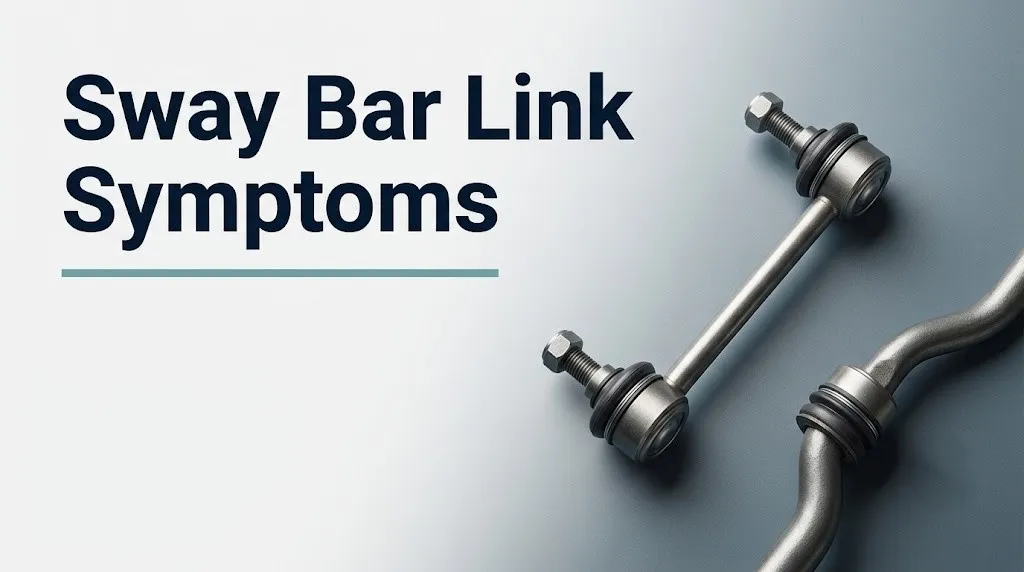
The sway bar link is a short, rigid or semi-rigid rod that connects the outer end of the sway bar (anti-roll bar) to the lower control arm or strut body on each side of the vehicle. Its job is to transmit torsional resistance from one side of the vehicle to the other during lateral weight transfers.
Think of it this way: when you turn right, your vehicle’s center of gravity tries to shift left, compressing the left suspension and lifting the right. The sway bar, mounted to the subframe at its center, resists this differential compression. The links are the mechanical connectors that make that resistance possible. Without functioning links, the bar essentially floats free at its ends and cannot transmit force to the suspension corners that need it.
Each link typically contains two ball stud joints (one at each end) and a link shaft between them. The ball studs allow angular movement as the suspension travels through its range, while the shaft transmits the longitudinal and torsional loads. The ball stud joints are encased in rubber boots and packed with grease.
According to the Society of Automotive Engineers (SAE), the design loads through a sway bar end link during aggressive cornering on an average passenger sedan are measured in hundreds of pounds of force, concentrated through a joint that is roughly the size of a thumb. That load concentration, combined with constant suspension cycling, is why these joints wear over time.
- Links on performance vehicles or vehicles with larger anti-roll bars carry higher loads and may wear faster.
- Vehicles with independent rear suspension have sway bar links on both front and rear axles.
- Vehicles with a solid rear axle (many trucks, older SUVs) have a front sway bar link only; rear body roll on these vehicles is controlled by the axle geometry itself.
Bad Sway Bar Link Symptoms: The Full Clinical Picture
Bad sway bar link symptoms present as a combination of audible noise, handling changes, and, in later stages, visible wear or tire wear patterns. The full symptom picture includes noise over bumps, excessive cornering lean, vague or wandering steering, squeaking sounds in temperature extremes, and uneven tire wear on the axle with the failed link.
No single symptom is exclusive to a bad sway bar link. Clunking can come from worn ball joints, strut mount bearings, control arm bushings, or tie rod ends. The pattern of multiple symptoms occurring together, particularly noise combined with a handling change, is what points the diagnosis toward the link rather than another suspension component.
Key symptoms of a bad sway bar link, in order of typical appearance as wear progresses:
- Rhythmic clunking or knocking noise on rough roads or during slow-speed turns
- Faint squeaking or creaking when the vehicle rocks over a dip or speed bump
- Increased body lean during cornering, more noticeable than before
- Vague or imprecise steering feel, especially at highway speed lane changes
- Shimmy or vibration through the steering wheel during cornering
- Uneven tire wear on the tires at the affected axle
- A loud metallic bang followed by dramatic handling change if the link separates completely
For drivers of pickup trucks or body-on-frame SUVs, the handling consequence of a bad link is often more pronounced than in a sedan because these vehicles already have a higher center of gravity and rely more heavily on the anti-roll bar to control body motion.
Key Takeaway: A bad sway bar link almost always produces a clunking noise before it produces a handling change. If you hear new clunking and then notice your car leaning more in corners, the link is the primary suspect.
Clunking Noise Sway Bar Link: What Causes That Sound?
A clunking noise from a bad sway bar link is caused by the worn ball stud joint losing its preloaded fit within the socket, allowing the joint to rattle or knock against its housing as the suspension moves through compression and rebound cycles. This clunk is the most commonly reported and most diagnostically reliable early symptom of link wear.
The ball stud is a spherical metal ball pressed into a housing with a polymer or rubber bearing surface. When the bearing surface wears down or the grease inside the joint dries out, the ball develops play, meaning it can move slightly within the socket. Every time the suspension compresses over a bump, the joint moves, hits the limit of its play, and produces an audible knock.
The sound has a distinctive character that helps separate it from other suspension noises. It is typically a single, sharp knock rather than a prolonged grinding, and it tends to occur at the same point in the wheel’s travel, giving it a rhythmic, predictable pattern on rough roads.
To help narrow down the noise:
- Drive slowly over a known speed bump or rough patch and listen for the clunk’s timing relative to the bump impact.
- Have a passenger listen from outside the vehicle as you rock it by pushing down firmly on one corner at a time.
- Note whether the clunk changes when the steering wheel is turned fully to one side, which loads the link differently.
- Listen for whether the noise comes from the front, rear, or one specific corner.
- Ask your mechanic to perform a pry bar test on the link joints to check for play while the vehicle is on a lift.
Drivers of high-mileage vehicles over 80,000 miles should note that ball stud wear clunking from a sway bar link is difficult to distinguish from ball joint or tie rod clunking without a hands-on inspection. Both can produce similar acoustic signatures. A mechanic’s lift inspection is the reliable differentiator.
Squeaking and Rattling Sway Bar Link Sounds
A squeaking sound from a sway bar link is caused by degraded or dry rubber bushings at the link’s attachment points rubbing against the metal contact surfaces during suspension movement. This sound is distinct from the clunk of ball stud wear and often appears earlier in the wear cycle or as a separate, concurrent complaint.
Rubber bushings separate the link’s metal hardware from the metal of the sway bar or control arm, providing both cushioning and NVH isolation. When the rubber dries, cracks, or deforms under fatigue loading, the surfaces begin to make contact with insufficient lubrication, producing a creaking or squeaking that is typically worse in cold weather. Cold temperatures cause rubber to stiffen and lose its compliance, reducing the thin lubrication film that normally prevents metal-to-rubber squeak.
Rattling, as distinct from clunking, often indicates a loose fastener rather than worn joints or bushings. The mounting nut at the top or bottom of the link, if under-torqued or corroded loose, allows the entire link assembly to rattle within its attachment points during road vibration. This rattle tends to be more constant and less distinctly rhythmic than a ball stud knock.
| Sound Type | Likely Source | Typical Triggering Condition |
|---|---|---|
| Sharp knock | Worn ball stud joint | Bumps, rough roads, slow turns |
| Creak or squeak | Degraded rubber bushing | Cold start, slow rock, parking lot turns |
| Rattle | Loose mounting fastener | Constant on rough roads, vibration |
| Metallic scrape | Cracked or bent link shaft | Any road surface, continuous |
Drivers in cold climates often report that link squeaking is worse in winter mornings and improves as the vehicle warms up. This temperature-dependent pattern is a useful diagnostic clue: it points toward bushing degradation rather than ball stud failure, and it means the noise often appears before serious handling degradation has occurred.
Excessive Body Roll: Bad Sway Bar Link’s Clearest Warning
Excessive body roll caused by a bad sway bar link is the most direct expression of what the link is failing to do: transmit anti-roll torsional force between the left and right suspension corners. When the link is worn or separated, the sway bar can no longer transfer the suspension compression load from the cornering side to the opposing side, and the vehicle tilts more than it should through turns.
The physics are straightforward. During a right-hand turn, the vehicle’s center of gravity shifts leftward, compressing the left suspension. A functional sway bar link transmits that compression force through the bar to the right side, resisting the differential travel and keeping the body flatter. A failed link breaks that transmission pathway, and the left suspension compresses freely without the bar’s resistance. The result is a vehicle that leans noticeably more than it did before the link failed.
This symptom is most noticeable in steady-state cornering at moderate speeds, such as highway on-ramp curves or sweeping freeway bends. It is less noticeable in sharp, low-speed turns in parking lots.
According to SAE International suspension engineering standards, the anti-roll bar and its end links can contribute between 30% and 60% of a vehicle’s total roll stiffness depending on the suspension design. Losing that contribution at one link point meaningfully increases the body roll angle a driver experiences during cornering.
- Drivers of tall SUVs, crossovers, and pickup trucks will notice excessive roll more than sedan drivers because their vehicles have a higher center of gravity and typically a larger, more active sway bar.
- A vehicle that was previously comfortable on highway curves and now feels noticeably floaty or tippy should be inspected promptly, not monitored for weeks.
Key Takeaway: Excessive body roll after a clunking noise appeared is the strongest combined signal that your sway bar link has moved beyond early wear into functional failure. Book a mechanical inspection the same week.
Loose Steering and Poor Handling: Bad Sway Bar Link Effects
Loose steering and vague handling caused by a bad sway bar link are secondary symptoms produced by the geometry changes that occur when lateral load transfer is no longer properly controlled. The sway bar link’s failure does not directly touch the steering components, but it changes how the tires contact the road during directional changes, and those contact patch changes feed imprecise information back through the steering system.
When the anti-roll bar cannot control body roll effectively, the suspension geometry at the cornering wheels changes dynamically. Camber angle, the vertical tilt of the tire relative to the road, shifts toward negative during excessive roll, reducing the tire’s effective contact patch. A reduced contact patch means less lateral grip, which the driver experiences as understeer (the front pushing wide) or a general sense of the car not going where the steering input says it should.
At highway speeds during lane changes, this imprecision is most noticeable. The vehicle may feel as though it needs a moment to respond to steering inputs, or it may feel as though it floats slightly before settling onto the new lane’s path. This is not a steering rack problem or a power steering failure. It is the tire losing predictable grip because the link-compromised suspension geometry is allowing too much camber change under load.
The American Automobile Association (AAA) notes in its vehicle maintenance guidance that steering feedback changes accompanying unusual noises are among the clearest indicators that a suspension inspection is warranted, as multiple components can be involved and isolated noise testing is not sufficient.
- Drivers who regularly tow trailers or carry heavy cargo should know that loaded conditions increase the lateral forces through the sway bar system and amplify the handling degradation caused by a worn link.
- Elderly drivers or those with delayed reaction time should treat any new handling imprecision as a prompt inspection, not a watchful-wait situation, because their ability to compensate for unexpected handling changes is reduced.
Uneven Tire Wear and the Sway Bar Link Connection
Uneven tire wear from a bad sway bar link develops over weeks to months of driving with compromised anti-roll geometry and is most visible as accelerated wear on the inner or outer shoulder of the tires on the axle with the failed link. The mechanism is camber-driven: excessive body roll changes the dynamic camber angle of the cornering tires, causing them to load one edge of the tread more than the other through repeated cornering cycles.
During normal driving on an average road network, a vehicle changes direction hundreds of times per hour. Each direction change involves a camber load shift at the tires. With a functional sway bar link controlling body roll, the camber excursions stay within the range the tire was designed to tolerate. With a failed link allowing excessive roll, the camber excursions become larger, and the inner or outer shoulder bears disproportionate load through every turn.
This wear pattern does not appear overnight. It requires sustained driving with the failed link over a period that, depending on driving habits and mileage, could range from a few weeks to several months. By the time the tire wear is visible to the naked eye, the link has usually been failing for some time.
According to Consumer Reports automotive data, uneven tire wear caused by suspension geometry problems is one of the costliest secondary effects of deferred suspension maintenance, as prematurely worn tires represent an expense that dwarfs the cost of the link replacement that would have prevented it.
- Drivers who primarily drive in a straight line (long highway commutes with minimal cornering) may not develop this wear pattern as rapidly as drivers with urban or winding-road driving patterns.
- All-wheel-drive vehicle owners should be particularly attentive: uneven tire wear on AWD systems can trigger traction-control and AWD system errors because the diameter difference between worn and unworn tires creates rotational speed mismatches that the AWD system detects as wheel slip.
Key Takeaway: Uneven tire wear is a late symptom of sway bar link failure. If your tires are wearing unevenly alongside clunking and body roll, the link has been compromised for a while and immediate inspection is overdue.
Bad Front Sway Bar Symptoms: What the Front Axle Tells You
Bad front sway bar symptoms are typically more immediately noticeable to the driver than rear failures because the front axle is the primary steering and braking input point. Front sway bar link failure produces clunking that is felt through the floorboard and steering column, increased body roll that the driver perceives at the front of the vehicle, and a loss of cornering precision that affects the vehicle’s response to steering inputs directly.
The front sway bar on most passenger vehicles is larger in diameter and carries more anti-roll load than the rear bar, because the front axle bears the primary braking load and a higher share of cornering force. When the front link fails, the front axle loses the ability to resist differential compression between the left and right front corners, and the driver feels the nose of the vehicle dive and lean more aggressively in turns.
Front link noise typically originates from directly under the driver or passenger footwell area and can travel up through the A-pillar or firewall, sometimes sounding as though it is inside the cabin. This acoustic pathway causes some drivers to misattribute the noise to door hinges, dashboard rattles, or seat mounts.
| Front Link Failure Symptom | Why It Occurs | Severity |
|---|---|---|
| Clunking felt in footwell | Ball stud play transmits through strut to cabin | Moderate |
| Nose dive in corners | Front anti-roll bar loses torsional transfer | Moderate to severe |
| Steering wheel shimmy | Camber shift changes front tire contact patch | Moderate |
| Loose lane-change feel | Front lateral grip reduced by geometry change | Moderate to severe |
- Front-wheel-drive vehicles tend to notice front sway bar link failure more acutely in acceleration out of corners, because the driven wheels are also the primary cornering wheels. Reduced front lateral geometry control during power-on cornering feels like torque steer or front-end push.
- Sports and performance vehicles with active anti-roll bar systems may trigger a dashboard warning light when a front link fails, because the electronic suspension module detects abnormal bar position.
Rear Sway Bar Link Symptoms: The Rear Axle Failure Pattern
Rear sway bar link symptoms produce a distinct handling character from front failures: the rear of the vehicle feels loose, squirrely, or prone to stepping out during lane changes, rather than the nose-diving and understeer pattern of front link failure. This is because the rear sway bar controls lateral load transfer at the rear axle, which determines whether the rear wheels maintain traction symmetrically during cornering.
When the rear link fails, the rear axle becomes laterally softer, meaning the body can roll freely at the rear during cornering without the bar’s resistance. The result is a vehicle whose rear end rotates more than the driver expects during quick lane changes or sudden swerves. This oversteer tendency is more unsettling than the understeer produced by front link failure, and it is particularly pronounced on vehicles with an aggressive rear weight distribution (mid-engine or rear-engine layouts, rear-loaded trucks).
Rear link noise is often reported as coming from the trunk area, behind the rear seat, or from the rear suspension corners. Drivers sometimes confuse it with spare tire rattle, cargo compartment items, or rear shock absorber noise.
According to the Insurance Institute for Highway Safety (IIHS), rear suspension instability under emergency maneuver conditions is a documented contributor to lane departure and oversteer-initiated incidents, particularly in pickup trucks and SUVs.
- Vehicles with independent rear suspension (most modern sedans, crossovers, and performance vehicles) have a dedicated rear sway bar and rear links that are distinct from the front system. Failure of either front or rear links produces an independent and identifiable symptom set.
- Drivers of solid rear axle vehicles, including many older body-on-frame trucks, typically have only front sway bar links. Rear end instability in these vehicles is more likely attributable to worn rear leaf spring bushings, shackles, or rear shock absorbers than to a sway bar link.
Key Takeaway: Rear sway bar link failure feels like a loose or squirrely rear end during quick direction changes. Front sway bar link failure feels like too much nose dive and front lean in steady corners. The difference in handling character points to which axle to inspect.
Loose Sway Bar Link Symptoms vs. Tight But Worn
Loose sway bar link symptoms occur when the mounting fasteners at the top or bottom of the link have lost their torque, allowing the entire link to move beyond its designed range of motion. This is a different failure mode from a link whose joints are internally worn but still tightly assembled.
A loose link produces a more irregular, less rhythmic noise than a worn ball stud. Because the link can move at its attachment point rather than only within its joint travel, the noise may occur on smooth roads as well as rough ones, and it may change character when the steering wheel is held at different angles. A loose link can also produce a perceptible clunk under hard braking, when the longitudinal weight shift loads the link differently than cornering does.
A tight but internally worn link, by contrast, produces its clunk almost exclusively during vertical suspension travel (bumps and dips). The noise is rhythmic and predictable. The fasteners are secure, but the ball stud inside the joint has worn its bearing surface and developed play.
To distinguish between the two without a lift:
- Park the vehicle and set the parking brake.
- Have an assistant push firmly down on the fender above the suspected corner and watch the sway bar end and link for visible movement.
- Observe whether the movement at the link attachment point is large and translational (loose fastener) or small and rotational only within the joint itself (worn ball stud).
- Check whether the link body is straight and undamaged visually.
- Check the lock nut at each end of the link for signs of corrosion-induced loosening or thread stripping.
- High-mileage vehicles in salt-exposed regions frequently develop loose sway bar link fasteners because road salt corrodes the fastener threads, reducing clamping force below the OEM torque specification. Re-torquing to specification sometimes resolves rattling without requiring full link replacement.
- Vehicles that have had recent front-end collision repairs should have their sway bar link torque values verified, as the components may have been reinstalled without final torque confirmation.
Separated Sway Bar Link Symptoms: The Serious End of the Spectrum
Separated sway bar link symptoms occur when the link has broken or pulled apart entirely, severing the mechanical connection between the sway bar and the suspension. This is the most severe stage of link failure and, particularly on high-center-of-gravity vehicles, represents a genuine driving safety concern.
The initial symptom of a separated link is often a loud metallic bang or clang, followed by an abrupt change in the vehicle’s handling character. The clunking noise that preceded the separation typically disappears, replaced by a new, different sound profile or silence in that corner, because the loose component is no longer cycling rhythmically through a worn joint. Instead, it may be dragging, scraping, or simply hanging free.
After separation, the affected axle has zero anti-roll resistance from the sway bar on that side. On a sedan or low-profile vehicle, this is noticeable but not typically dangerous at ordinary road speeds. On a tall SUV, pickup truck, crossover, or van, the loss of front or rear anti-roll stiffness at one link point can produce dramatic body roll during lane changes and cornering, significantly increasing the risk of rollovers in emergency swerve situations.
The NHTSA rollover resistance rating for high-center-of-gravity vehicles is based on suspension components functioning within their design parameters. A separated sway bar link moves the vehicle outside those parameters.
- If you hear a loud bang from a suspension corner followed by noticeably worse handling, do not continue driving at highway speeds. Reduce speed, avoid sudden lane changes, and proceed to the nearest repair facility.
- A separated link can also contact moving suspension components, brake lines, or the tire sidewall if it falls into a position the designers did not account for. This secondary contact is unpredictable and can cause brake system or tire failure.
Bad Stabilizer Link Symptoms: Understanding the Naming Confusion
Bad stabilizer link symptoms are identical to bad sway bar link symptoms because these are two names for the same component. The sway bar is also called the stabilizer bar, and the sway bar link is also called the stabilizer link or end link. The terms are used interchangeably across vehicle manufacturers, repair shops, and parts suppliers, and the symptom pattern does not change based on the name used.
The naming variation exists because different automotive manufacturers used different terminology in their service documentation when the component was standardized in the mid-20th century. European manufacturers, particularly German brands, commonly use “stabilizer link” or “anti-roll bar link” in their service materials. American manufacturers historically used “sway bar” and “sway bar link” in their documentation. Both terms appear in OEM service manuals, aftermarket parts catalogs, and ASE technician training materials.
When describing symptoms to a mechanic, either term is correct and will be understood. For parts ordering, either terminology will return the correct component when combined with the vehicle’s make, model, year, and axle location.
The practical implication: if you search for your symptoms and find references to both “stabilizer link” and “sway bar link,” recognize that every symptom described under either name applies to the same part on your vehicle.
- Import vehicle owners (Volkswagen, BMW, Toyota, Honda, Hyundai, and others) will more commonly see “stabilizer link” or “anti-roll bar link” in their OEM service documentation.
- Domestic vehicle owners (Ford, GM, Chrysler) will typically see “sway bar link” in their OEM service documentation.
- Aftermarket parts suppliers including MOOG, Mevotech, and Dorman use both terms interchangeably in their catalog listings.
Key Takeaway: Stabilizer link, sway bar link, and end link all refer to the same part. Every symptom described in this article applies equally regardless of which term appears in your vehicle’s service record.
How to Inspect a Sway Bar Link at Home
Inspecting a sway bar link at home is practical for identifying obvious wear, damage, or looseness, though a definitive assessment of joint play requires a vehicle lift and hands-on manipulation that a driveway inspection cannot fully replicate. A home inspection can tell you whether further immediate concern is warranted.
To inspect the sway bar link from your driveway:
- Park the vehicle on a flat, level surface and engage the parking brake firmly.
- Allow the vehicle to cool if recently driven, then crouch or lie beside the front wheel and look rearward toward the strut lower mount. The sway bar link is the short, vertical rod connecting the bar’s outer end to the strut or control arm.
- Look for visible cracking or splitting of the rubber boots covering the ball stud joints. Torn or missing boots mean the joint has lost its grease protection and water and debris have entered.
- Look for any visible bending, corrosion, or fracture of the link shaft itself. A link that is visibly bent has been overloaded and should be replaced regardless of joint feel.
- Grasp the link body and attempt to move it laterally. Any appreciable lateral movement not associated with the sway bar itself pivoting (which requires more force) indicates joint play.
- Check the fastener ends for corrosion-induced loosening: if the nut spins without resistance against a visibly corroded bolt, the thread engagement is compromised.
- Repeat for the rear sway bar links if the vehicle has independent rear suspension. Rear links are typically shorter and located between the sway bar and the rear control arm or trailing arm.
- Drivers without mechanical experience should treat this inspection as a preliminary assessment only. A professional on-lift inspection, where the mechanic can apply measured force to each joint and observe movement directly, is the standard for confirming a worn ball stud within the link.
- Vehicles with plastic or composite link components (found on some European and Asian import models) require visual inspection for cracking along the composite body, not just at the rubber boots.
Is It Safe to Drive With a Bad Sway Bar Link?
Whether it is safe to drive with a bad sway bar link depends entirely on the stage of failure, the vehicle type, and the driving conditions involved. Early-stage wear (clunking noise, minimal handling change) is generally tolerable for short-distance, low-speed driving while awaiting a repair appointment. A fully separated link on a tall vehicle at highway speed is a different situation entirely.
The honest, staged assessment:
| Failure Stage | Safe for Local Driving? | Safe for Highway Driving? | Action Required |
|---|---|---|---|
| Early (bushing noise, minor clunk) | Yes, with caution | Yes, with reduced speed | Schedule repair within 2 weeks |
| Moderate (consistent clunking, modest body roll) | Yes, limited distance | Use caution, avoid aggressive lanes | Repair within 1 week |
| Advanced (loud clunking, noticeable lean) | Short trips only | Not recommended | Repair within days |
| Separated (bang followed by dramatic lean) | No | Absolutely not | Repair before next drive |
The vehicle type matters enormously. The Insurance Institute for Highway Safety (IIHS) notes that SUVs and pickup trucks have rollover risks that are meaningfully higher than sedans under emergency maneuver conditions even with fully functional suspension systems. A bad or separated sway bar link on these vehicle types narrows the already-reduced margin for error during emergency swerves or evasive maneuvers.
- Drivers in regions with winter road conditions (ice, snow) face a compounded risk with a bad sway bar link, because the reduced lateral grip of winter surfaces combined with compromised anti-roll geometry reduces the vehicle’s ability to execute emergency lane changes safely.
- If your vehicle also has worn shock absorbers alongside a failing sway bar link, the combination is more serious than either component alone. Both systems contribute to cornering stability, and their failures are additive.
When to Replace a Sway Bar Link
The right time to replace a sway bar link is as soon as a clear symptom, confirmed by inspection, indicates the link is no longer functioning within its design parameters. Waiting for complete failure is not a rational maintenance strategy for a component that directly affects vehicle handling.
The ASE (Automotive Service Excellence) technician training curriculum identifies sway bar links as a component with no serviceable repair: once the ball stud joint develops play or the bushing material degrades beyond specification, replacement of the entire link assembly is the appropriate remedy. There is no approved method for re-greasing or adjusting a worn ball stud in a sway bar link to restore it to specification.
Replacement is typically straightforward and fast for an experienced technician: most passenger vehicle link replacements require 30 to 60 minutes per axle. Most manufacturers recommend replacing links in pairs (both left and right on the same axle) when one has failed, because if one link has reached end-of-life, the other on the same axle is typically at a similar wear stage given identical operating conditions.
What to tell your mechanic at the appointment:
- When the noise started and what driving conditions trigger it most reliably
- Whether you have noticed any handling changes alongside the noise (body roll, vague steering, rear end looseness)
- Whether the noise is front-only, rear-only, or from a specific corner
- Your current mileage and the vehicle’s maintenance history if you have it
- Any prior suspension repairs, particularly if alignment or strut work was performed recently
- Aftermarket link quality varies substantially. OEM-specification links from established brands (MOOG, Mevotech, Meyle, Lemfoerder for European vehicles) are preferable to the cheapest available option on high-mileage vehicles, because the load cycles through this joint are substantial.
- Following replacement, a four-wheel alignment check is advisable if handling imprecision was part of the symptom set, as the geometry changes during the period of link failure may have altered the vehicle’s alignment settings from factory specification.
Emergency Guidance: When to Stop Driving and Get Help Now
Certain sway bar link failure presentations require you to stop driving immediately rather than scheduling a future appointment. Do not continue at highway speed or in demanding traffic conditions if any of the following apply.
Pull over safely and arrange transportation or towing if you experience:
- A loud metallic bang or clang from a suspension corner followed by immediately worse handling in any direction
- Dramatic body lean in a corner that was not present the day before, particularly in a tall SUV, truck, or crossover
- The vehicle pulling strongly to one side without steering input, appearing suddenly, alongside suspension noise
- A scraping or dragging sound from a suspension corner that was not present before
- Any loss of steering precision severe enough that the vehicle does not go where the wheel points during normal driving
A completely separated sway bar link at highway speed, particularly on a vehicle with a high center of gravity, reduces the vehicle’s rollover resistance during emergency maneuvers. This is not a noise inconvenience. It is a structural failure of a handling safety component.
If you are unable to safely drive the vehicle to a repair facility, contact a towing service. Do not attempt highway driving with a confirmed separated link on any tall vehicle. For immediate safety concerns related to vehicle control loss, pull to a safe location and call for roadside assistance.
Frequently Asked Questions About Sway Bar Link Symptoms
What does a bad sway bar link sound like?
A bad sway bar link most commonly sounds like a rhythmic clunking or knocking noise that occurs when driving over bumps, rough roads, or during slow-speed turns.
The sound originates from a worn ball stud joint that has developed play within its socket, allowing the joint to knock against its housing as the suspension compresses and rebounds.
A degraded rubber bushing on the same link may produce a creaking or squeaking sound that is often worse in cold temperatures.
Can a bad sway bar link cause vibration?
A bad sway bar link can contribute to steering wheel shimmy or vibration, particularly during cornering, because the compromised anti-roll geometry allows camber changes at the front tires that reduce the contact patch uniformity.
The vibration produced by a bad sway bar link is typically felt most during direction changes rather than in a straight line, which helps distinguish it from tire imbalance or wheel bearing vibration.
Straight-line vibration at specific speeds is more likely caused by tire imbalance or driveshaft issues than by sway bar link failure.
How long can you drive with a bad sway bar link?
A vehicle with early-stage sway bar link wear (clunking noise but no significant handling change) can typically be driven for short local trips while awaiting repair, but highway driving should be limited and aggressive cornering avoided.
A completely separated sway bar link should not be driven at highway speeds, particularly on SUVs, trucks, and crossovers with a higher center of gravity.
The safest guidance is to have any confirmed sway bar link failure assessed by an ASE-certified mechanic within one week of symptom appearance.
Does a bad sway bar link affect alignment?
A bad sway bar link does not directly change the static alignment settings of the vehicle, but it allows greater dynamic camber changes during cornering that produce uneven tire loading and accelerated shoulder wear.
After link replacement, a four-wheel alignment check is advisable if the vehicle has been driven with the failed link for an extended period, because handling imprecision during that time may indicate geometry changes worth verifying.
True static alignment errors require a separate alignment correction and are not corrected by link replacement alone.
What happens if a sway bar link breaks while driving?
If a sway bar link breaks completely while driving, the first noticeable effect is typically a loud bang or metallic clang from the affected corner, followed by a sudden increase in body roll during the next turn or lane change.
The vehicle becomes harder to control at speed because the anti-roll bar can no longer transfer torsional force on the side where the link separated.
On tall vehicles like SUVs and trucks, a separated link significantly reduces the rollover safety margin during emergency maneuvers, and driving should be limited to a slow, direct route to a repair facility.
How much does sway bar link replacement cost?
Sway bar link replacement typically costs between $80 and $250 per axle including parts and labor at an independent repair shop, based on vehicle type and link design.
Luxury vehicles, European imports, and vehicles with active suspension systems may have higher parts costs, with some link assemblies priced above $150 per side for OEM-quality components.
Labor time is generally 30 to 60 minutes per axle for most passenger vehicles, and most repair shops recommend replacing both links on the same axle simultaneously because they wear at similar rates.
Closing
Sway bar link symptoms follow a predictable progression: noise comes first, handling changes follow, and tire wear appears last. That sequence is actually useful, because it means you have a window between the first clunk and a serious handling problem to address the issue before the repair context gets more expensive or the driving situation gets more unsafe.
The practical takeaway is this: if your vehicle is producing a rhythmic clunk over bumps and you have noticed the car leaning more in corners than it used to, have an ASE-certified mechanic inspect the sway bar links at the next available appointment, not the next available convenient opportunity. If the clunk has been joined by a separation event (a loud bang, a sudden dramatic handling change), stop highway driving immediately and arrange for a tow or a very slow, direct local trip to a repair shop.
You now have a specific, mechanically grounded understanding of what a sway bar link does, what every stage of its failure feels and sounds like, how front and rear failure differ, and exactly when the risk level moves from manageable to unacceptable. That understanding is the difference between an informed repair decision and a preventable roadside emergency.