Bad Spark Plug Symptoms: Complete 2026 Diagnosis Guide
Bad spark plug symptoms include engine misfires, rough idle, hard starting, sudden drops in fuel economy, and sluggish acceleration, and recognizing them early is the difference between a simple plug replacement and a damaged catalytic converter or engine. These symptoms follow specific failure mechanisms inside the combustion chamber, and understanding which mechanism is active tells you exactly how urgent your situation is.
According to the Society of Automotive Engineers (SAE International), spark plug ignition performance degrades gradually through electrode wear and gap widening, but it can also fail suddenly through contamination events like oil intrusion or severe carbon fouling. The U.S. Environmental Protection Agency mandates that all vehicles built after 1996 monitor ignition misfire events continuously through the OBD-II diagnostic system, which means your car is already tracking these symptoms internally, often before you consciously notice them.
This guide covers every major symptom with the specific mechanical reason it occurs, explains how the type of failure (wear, fouling, or damage) changes the symptom pattern, and gives you a clear framework for deciding whether you can drive to a shop or need to stop now.
Bad Spark Plug Symptoms: What Your Engine Is Telling You
Bad spark plug symptoms are your engine’s way of signaling that the ignition system can no longer reliably ignite the compressed air-fuel mixture at the moment the engine control unit commands it to fire.
The spark plug is a deceptively simple component. Its job is to generate a precisely timed electrical arc across a narrow air gap inside each cylinder, triggering controlled combustion that drives the piston downward. When the plug cannot do that reliably, every downstream system in the engine is affected. Fuel burns incompletely. Power output drops per cylinder. The emissions control system receives partially burned exhaust gases it cannot process efficiently.
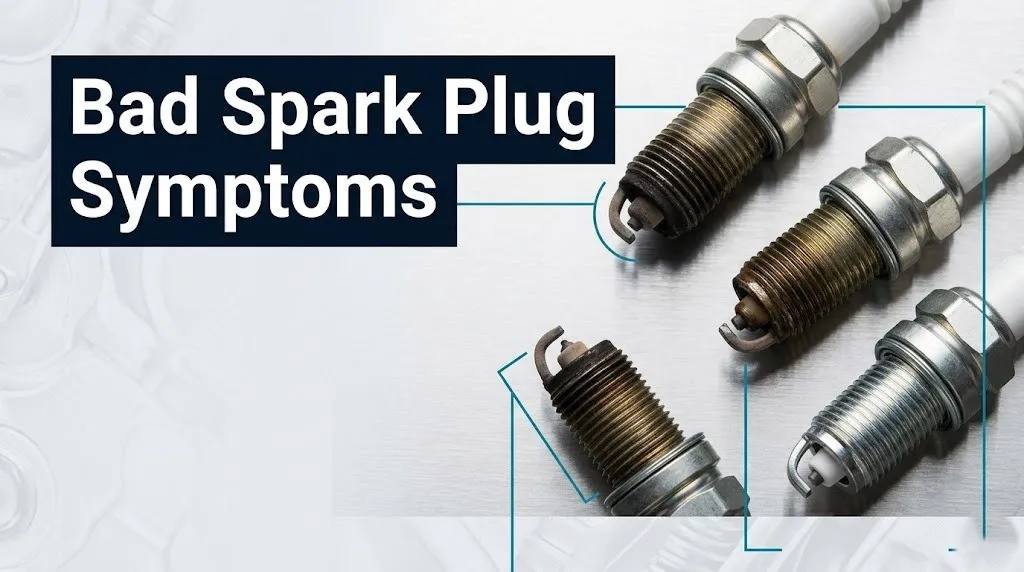
Think of a spark plug like a precision striker in a gas stove igniter. When the igniter is clean and properly gapped, it produces a crisp, immediate spark every time. When it wears down or gets coated with grease, the arc becomes unreliable. The burner hesitates, catches unevenly, or fails to light at all. Your engine cylinders respond identically.
What makes automotive spark plug diagnosis useful is that different symptom patterns point to different failure types. A rough idle that is worse when cold but smooths at operating temperature suggests a different problem than a misfire that occurs under hard acceleration. Knowing which symptom is present, and when it occurs during the drive cycle, gives you and your technician a starting point before any wrench is picked up.
Key symptoms to watch for:
- Engine hesitation or stumbling during acceleration
- Rough or uneven idle that you feel through the steering wheel or seat
- Difficulty starting, especially in cold weather
- A noticeable drop in fuel economy over recent weeks
- Reduced power when climbing hills or merging onto highways
- A sulfur or rotten-egg smell from the exhaust (indicating catalytic converter stress)
- A visible “Check Engine” light on the instrument cluster
Older drivers on vehicles with more than 100,000 miles and no spark plug service record face the highest probability that these symptoms trace directly to plug degradation. However, younger vehicles running a rich air-fuel mixture due to a separate sensor fault can foul plugs at well under 30,000 miles.
What Are the Symptoms of Bad Spark Plugs? The Full List
The symptoms of bad spark plugs cover every major aspect of engine performance: starting, idling, acceleration, fuel consumption, emissions, and engine smoothness.
No single symptom is pathognomonic of spark plug failure alone. Rough idle, for example, can also be produced by a vacuum leak, a dirty fuel injector, or a failing mass airflow sensor. But spark plug failure is unique in that it typically produces a cluster of symptoms simultaneously, because every cylinder that is misfiring contributes to a cascade of problems across the engine and emissions systems.
| Symptom | Severity | When It Occurs | Urgency |
|---|---|---|---|
| Engine misfire (rough running) | Moderate to severe | Idle, acceleration, or both | High if persistent |
| Rough idle | Mild to moderate | At stop, in park or neutral | Moderate |
| Hard starting or no start | Moderate to severe | Cold mornings or hot restarts | High |
| Poor fuel economy | Mild | Gradual onset over weeks | Low to moderate |
| Sluggish acceleration | Mild to moderate | Under load, highway merging | Moderate |
| Check engine light illuminated | Varies | Any time misfire is detected | High if flashing |
| Strong smell of unburned gasoline | Moderate | At idle or after cold start | High |
| Engine knocking or pinging | Moderate to severe | Under acceleration | High |
| Rough sound at high RPM | Mild to moderate | Highway speeds | Moderate |
| Excessive exhaust emissions | Moderate | Continuous | Moderate to high (emissions test failure) |
Two populations notice these symptoms differently. Drivers of older vehicles with carbureted engines (pre-1990s) experience hard starting and rough idle as the dominant early symptoms. Drivers of modern direct-injection (GDI) engines often notice a hesitation during cold starts first, because GDI engines cannot perform port wash (the process of fuel spray cleaning intake valves) and build carbon deposits faster, which amplifies the effect of marginal spark plug performance.
How Spark Plugs Fail: The Mechanisms Behind Every Symptom
Spark plugs fail through four distinct mechanical pathways, and each pathway produces a recognizable symptom pattern that makes diagnosis more precise.
Pathway 1: Electrode erosion. This is normal wear. The center electrode tip (made of nickel alloy in standard copper plugs, or iridium or platinum in premium plugs) is gradually eroded by the repeated high-voltage electrical arc. Over thousands of ignition cycles, the electrode tip recedes. The gap between the center electrode and the ground electrode widens beyond the factory specification. The ignition coil must produce increasingly higher voltage to arc across the larger gap. Eventually it cannot produce enough voltage. The spark fails. The cylinder misfires.
Pathway 2: Carbon fouling. Rich air-fuel mixtures (too much fuel relative to air), short-trip driving that does not allow the engine to reach full operating temperature, or a faulty oxygen sensor that tells the ECU to over-enrich the mixture all cause unburned carbon to coat the ceramic insulator surrounding the center electrode. That carbon coating creates a short-circuit path. Instead of the electrical energy building up to arc across the gap, it bleeds away through the carbon coating before it can fire.
Pathway 3: Oil fouling. Worn valve stem seals or piston rings allow engine oil to enter the combustion chamber. Oil coats the plug tip, creating a thick deposit that prevents reliable arc formation. Oil fouling produces a wet, dark brown or black greasy coating on the plug tip. This symptom is significant because it indicates an engine wear problem, not just plug wear.
Pathway 4: Pre-ignition or overheating damage. An incorrectly specified plug (wrong heat range), sustained detonation (knock from low-octane fuel or advanced ignition timing), or a cooling system fault can cause the plug to operate above its rated tip temperature. The ceramic insulator may crack. The electrode tip may blister or melt. Pre-ignition damage produces severe symptoms: engine knock, power loss, and potential piston damage if driving continues.
The practical implication: symptoms that appeared gradually over 10,000 to 20,000 miles likely reflect electrode erosion or mild carbon fouling. Symptoms that appeared suddenly after an oil change or unusual driving event may indicate oil fouling or pre-ignition damage, both of which require more than plug replacement to fix.
Symptoms of a Misfiring Spark Plug
A misfiring spark plug produces a distinctly felt hesitation or jolt in the engine’s power delivery, most noticeable as a rhythmic stumble at idle or a sharp loss of thrust during acceleration.
When a single cylinder fails to fire, the engine loses the power contribution from that cylinder for that combustion cycle. On a 4-cylinder engine, losing one cylinder means losing 25% of power per cycle. On a V8, one misfiring cylinder costs 12.5% per cycle. The engine control unit detects this through the crankshaft position sensor, which measures rotational speed variations. When one cylinder fails to add its power pulse, the crankshaft slows very slightly at that point in its rotation. The ECU registers this as a misfire event.
The OBD-II system counts misfire events per 200 and per 1,000 crankshaft revolutions. If misfire frequency crosses a threshold set by the EPA, the malfunction indicator lamp (MIL) illuminates. If the misfire rate is high enough to damage the catalytic converter, the MIL flashes rather than staying steady. A flashing check engine light during a misfire is a specific warning that unburned fuel is entering and potentially destroying the catalytic converter.
What a misfire feels like in different driving conditions:
| Driving Condition | Misfire Sensation |
|---|---|
| Idling in park or neutral | Rhythmic vibration through seat and steering wheel |
| Light acceleration from a stop | Brief hesitation or stumble in the first 1,000 RPM range |
| Hard acceleration at highway speed | Sudden flat spot in power delivery, engine surging |
| Cruising at steady highway speed | Intermittent roughness, subtle power fluctuation |
| Cold start (first 60 seconds) | Rough running that smooths once engine reaches operating temperature |
Drivers with turbocharged engines experience misfire symptoms more dramatically because turbo boost amplifies any combustion irregularity. A misfire under boost on a turbocharged vehicle produces a noticeably sharper stumble than the same plug condition in a naturally aspirated engine.
Key Takeaway: A flashing check engine light during an engine misfire means unburned fuel is actively damaging your catalytic converter. Stop driving as soon as it is safe to do so and have the vehicle towed or driven minimally to a repair facility.
Rough Idle and Bad Spark Plugs: What Is Actually Happening
Rough idle from bad spark plugs is the engine equivalent of a perfectly choreographed rhythm section losing one drummer: the beat becomes uneven, and every other component in the ensemble compensates awkwardly.
At idle, your engine runs at the lowest RPM it can sustain without stalling, typically between 600 and 900 RPM depending on engine design and temperature. At these low speeds, the engine has the least rotational momentum to smooth over individual cylinder misfires. Every missed combustion event is felt as a vibration pulse transmitted through the engine mounts, through the chassis, and into the seat and steering wheel.
A rough idle specifically caused by spark plug wear or fouling tends to have a consistent rhythm because the failing plug is in a fixed cylinder that fires at predictable intervals. This differentiates it from vacuum leaks, which produce a more irregular or hissing idle, or from injector problems, which can produce a slightly different vibration character.
According to NGK Spark Plugs technical documentation, a plug operating with a gap 50% wider than factory specification requires approximately 30% more voltage to fire reliably. At idle, when manifold vacuum is high and the air-fuel mixture is slightly leaner than at full load, this marginal electrical condition is most likely to result in a complete misfire event rather than a partial or delayed ignition.
Rough idle tends to be more pronounced in cold weather because cold air is denser, cold fuel atomizes less completely, and the engine runs a richer mixture during warm-up. All three factors challenge a marginal plug’s ability to fire reliably. A rough idle that improves significantly once the engine reaches normal operating temperature (approximately 195-220°F coolant temperature) is a classic early-stage symptom of spark plug degradation rather than a more serious mechanical failure.
People driving automatic-transmission vehicles may notice that rough idle causes the transmission to feel sluggish or to engage roughly at low speeds, because the irregular power pulses from the engine affect the torque converter’s ability to provide smooth power transfer.
Hard Starting: A Key Bad Spark Plug Symptom
Hard starting is one of the most recognizable bad spark plug symptoms, particularly on cold mornings when the engine needs the most reliable ignition spark to fire a cold, partially atomized air-fuel mixture.
Starting an engine from cold requires the ignition system to fire a mixture that has not yet reached optimal vaporization temperature. Fuel droplets in a cold combustion chamber are larger and less atomized than at operating temperature. The spark plug must generate enough energy to ignite this imperfect mixture reliably. A plug with a widened gap, a contaminated insulator, or a damaged electrode simply may not have the electrical reliability to fire under these demanding conditions.
The hard-start symptom specifically caused by spark plugs typically manifests as an engine that cranks normally (the starter motor spins freely and at normal speed) but takes multiple crank cycles to fire, or fires and then immediately stalls. This distinguishes it from a weak battery (which produces slow cranking) or a fuel delivery problem (which may produce an engine that cranks but does not fire at all).
To describe a hard-start symptom accurately to a mechanic:
- Note whether the problem occurs on the first cold start of the day, on hot restarts after a short trip, or both
- Count how many seconds the engine cranks before it fires (less than 2 seconds is normal, 3 to 5 seconds suggests ignition or fuel delivery compromise, over 5 seconds indicates a more serious issue)
- Note whether the engine fires and immediately stalls or fires and runs roughly before smoothing out
- Record whether the problem is worse in temperatures below 40°F
- Note whether the problem improved after the engine fully warmed up on a previous start
Hard starting that is exclusive to cold mornings and improves completely at operating temperature strongly suggests spark plug or ignition coil degradation. Hard starting that occurs on hot restarts (the “heat soak” phenomenon) more often indicates fuel delivery issues, though badly worn plugs can contribute.
Vehicles with higher compression ratios (performance engines, some diesel-adjacent gasoline designs) are more sensitive to plug condition during cold starts because they require a wider spark gap specification, and even minor electrode erosion pushes that gap toward unreliability.
Poor Fuel Economy as a Bad Spark Plug Symptom
Poor fuel economy caused by bad spark plugs is a slow, gradual signal that incomplete combustion is wasting fuel that should be converting to power and instead passing unburned into the exhaust system.
When a spark plug fails to ignite the air-fuel mixture reliably, the unburned fuel exits the cylinder without contributing to engine output. The engine control unit detects the resulting drop in performance through multiple sensors and attempts to compensate by adjusting fuel trim (adding slightly more fuel to maintain target power output and idle stability). This compensation maintains drivability but worsens fuel economy further.
According to the U.S. Department of Energy, properly maintained ignition systems, including timely spark plug replacement, can improve fuel economy by up to 4% compared to engines with worn ignition components. For a vehicle averaging 25 miles per gallon on 15,000 annual miles, that represents roughly 24 gallons of fuel per year, approximately $85 to $120 depending on local fuel prices.
The fuel economy decline from spark plug degradation is typically gradual rather than sudden. Most drivers notice it only when they consciously track fuel fill-ups over several months. A useful self-monitoring approach is to calculate miles per gallon at every third fill-up by dividing miles driven since the last fill by gallons added. A consistent downward trend over 6 to 10 fill-ups, in the absence of changes in driving habits or route, points to an underlying mechanical inefficiency. Spark plugs are a high-probability cause in vehicles over 60,000 miles without a recorded plug service.
Drivers of flex-fuel vehicles using E85 (85% ethanol fuel blend) may notice a more pronounced fuel economy impact from degraded plugs because ethanol requires more precise ignition timing and spark energy to combust efficiently than conventional gasoline.
Key Takeaway: A gradual fuel economy decline of more than 10% over several months in a vehicle with over 60,000 miles and no spark plug service history is a reliable early indicator of spark plug wear, even before other drivability symptoms appear.
Dirty Spark Plug Symptoms You Can See and Feel
Dirty spark plug symptoms are the clearest evidence that something beyond normal wear is occurring inside the combustion chamber, because the deposits on the plug tip tell a specific story about what is happening upstream.
A properly functioning spark plug should have a light tan or gray color on the ceramic insulator tip and a clean, slightly worn but intact electrode. Any significant deposit, discoloration, or physical damage tells an experienced technician something specific about combustion conditions. NGK Spark Plugs publishes a widely used spark plug condition reference chart that categorizes plug appearance by likely cause. Understanding these visual indicators helps diagnose whether plug replacement alone will fix the problem or whether an underlying engine condition also needs addressing.
Dirty plug appearance and what it indicates:
| Visual Appearance | Likely Cause | Engine Condition Indicated |
|---|---|---|
| Dry, matte black carbon deposits on insulator | Rich air-fuel mixture, short-trip driving, weak ignition | Fuel system or driving pattern issue |
| Wet, oily dark deposits on tip | Oil entering combustion chamber | Worn valve stem seals or piston rings |
| White or chalky coating on insulator | Very lean mixture or cooling system coolant leak | Serious engine issue, possible head gasket |
| Blistered or melted electrode tip | Pre-ignition, detonation, or wrong heat range plug | Engine knock or incorrect plug specification |
| Heavy gray or tan deposits on ground electrode | Normal wear (electrode erosion pattern) | Normal end-of-life wear |
| Glazed or shiny deposits on insulator | Intermittent rich operation at high temperature | Fuel mapping or temperature cycling issue |
Wet, oily deposits are a specific red flag. They indicate oil is entering the combustion chamber, which is an engine mechanical problem. Replacing the spark plugs without addressing the source of oil intrusion will result in immediate re-fouling of the new plugs. Drivers of high-mileage vehicles (over 150,000 miles) with oil fouled plugs need a compression test or cylinder leak-down test to determine whether valve seals or piston rings are worn before committing to any repair.
Fouled Plug Symptoms: Carbon, Oil, and Lead Fouling Explained
Fouled plug symptoms differ based on the specific type of fouling present, and identifying which type is causing the problem determines whether the fix is a simple plug swap or a more involved engine repair.
Carbon fouling produces symptoms that are worse during cold starts and at idle, because these are the conditions under which the air-fuel mixture is richest and plug tip temperatures are lowest. Carbon-fouled plugs often cause a rough idle that clears at higher RPM, because increased combustion temperature burns away some of the carbon deposit temporarily. This “self-clearing” at higher engine speeds is a useful diagnostic clue that distinguishes carbon fouling from electrode erosion, which does not improve at higher RPM.
Oil fouling causes consistent misfires regardless of RPM because the wet oil coating on the plug tip prevents arc formation under all operating conditions. A vehicle with oil-fouled plugs will often have blue smoke from the exhaust at startup, indicating oil burning in the combustion chamber. The smell of burning oil from the exhaust is a distinct companion symptom that separates oil fouling from purely electrical ignition problems.
Lead fouling is rare in modern vehicles since leaded gasoline was phased out in the United States in 1996, but it can still occur in vehicles used with aviation fuel, certain race fuels, or fuel contaminated during illegal blending. Lead fouling produces a yellowish-green glassy deposit on the insulator and consistent misfires across multiple cylinders.
According to Denso Corporation ignition technical documentation, oil-fouled plugs should be replaced and inspected after no more than 1,000 miles with the new plugs to confirm that re-fouling is not occurring. If the replacement plugs show oil contamination within 1,000 miles, the underlying cause (valve seals, piston rings, or positive crankcase ventilation system malfunction) must be diagnosed before further plug replacement is warranted.
Older adults driving high-mileage vehicles often attribute oil consumption and blue exhaust smoke to “the car just getting old” and delay diagnosis. This pattern allows oil fouling to cause increasingly severe misfires and, over time, catalytic converter damage from unburned fuel and oil aerosol.
Worn Spark Plugs Symptoms Over Time
Worn spark plugs symptoms develop gradually over tens of thousands of miles, which is why they are so easy to miss until the performance loss becomes undeniable.
The center electrode of a standard copper spark plug erodes at a rate of approximately 0.001 inches per 10,000 miles under normal operating conditions, according to SAE International technical documentation on spark plug electrode wear. Factory spark plug gap specifications typically range from 0.028 to 0.060 inches depending on engine design. A plug that starts at 0.035 inches and grows to 0.055 inches over 80,000 miles is operating at a gap 57% wider than its design center. The ignition coil must work harder to bridge that gap. The spark energy per firing decreases. Combustion efficiency falls.
The symptom pattern of gradual electrode wear is insidious because the driver adapts to the slowly worsening performance. The car “just doesn’t feel like it used to.” Fuel economy that was once 32 MPG on the highway is now 28 MPG. The engine takes a fraction of a second longer to respond when you press the accelerator. These are real symptoms, but they develop slowly enough that many drivers only notice them in retrospect, after getting a tune-up and feeling how different the car performs with fresh plugs.
Symptom timeline for worn spark plugs (standard copper plugs, normal driving conditions):
| Mileage Range | Likely Symptom Stage | Observable Changes |
|---|---|---|
| 0 to 30,000 miles | No symptoms | Normal performance |
| 30,000 to 60,000 miles | Subtle degradation | Very slight fuel economy drop, not yet noticeable |
| 60,000 to 80,000 miles | Mild symptoms | Reduced throttle response, fuel economy down 2 to 4% |
| 80,000 to 100,000 miles | Moderate symptoms | Noticeable rough idle, check engine light possible, fuel economy down 5 to 8% |
| Over 100,000 miles | Severe symptoms | Engine misfires, hard starting, strong smell of unburned fuel |
Premium iridium and double-platinum spark plugs have significantly longer service intervals, often 100,000 to 120,000 miles, before they reach the same gap widening threshold. However, they are still subject to fouling from oil intrusion, carbon deposits, or overheating damage regardless of their longevity rating.
Old Spark Plug Symptoms at High Mileage
Old spark plug symptoms at high mileage overlap with worn plug symptoms but include additional failure patterns that appear specifically when plugs have been in service for extreme periods, particularly when they seize in the cylinder head.
Beyond 100,000 miles on copper plugs or beyond 120,000 miles on iridium plugs, the physical integrity of the plug itself becomes a concern separate from ignition performance. The steel plug shell can corrode and bond to the aluminum cylinder head threads over years of thermal cycling. A plug that has seized in the head may snap during removal, leaving the threaded portion in the head, which is a serious and expensive repair. This is why high-mileage plug replacement is not just about ignition performance but about the plug remaining removable.
According to technical service bulletins from multiple manufacturers, certain aluminum cylinder heads (particularly in Ford 5.4-liter Triton engines and some Toyota aluminum heads) are specifically known to have spark plug removal complications at high mileage. Owners of these vehicles should have plug removal performed by an experienced technician with proper extraction tools.
Symptoms specific to very high mileage plugs include:
- Misfires that do not respond to replacement of ignition coils (because the plug, not the coil, is the actual failure point)
- Cold start behavior that worsens disproportionately to the ambient temperature drop
- An engine that stumbles during the first minute of operation but runs smoothly once warmed, a pattern driven by the combination of wide electrode gaps and cold dense air
- Check engine light codes that return within 500 miles after coil replacement (because the plug was the actual fault, not the coil)
Drivers who have purchased used high-mileage vehicles with unknown service history should have spark plugs inspected and potentially replaced as one of the first maintenance steps, regardless of whether symptoms are currently present.
Key Takeaway: If a vehicle over 80,000 miles has never had spark plugs replaced and shows even mild drivability symptoms, plug replacement is the highest-value diagnostic and maintenance step before pursuing more expensive ignition system diagnosis.
Can Bad Spark Plugs Cause a Check Engine Light?
Yes. Bad spark plugs are one of the most common causes of a check engine light because the OBD-II system monitors misfire events in real time and illuminates the malfunction indicator lamp when misfire frequency crosses a federally defined threshold.
The OBD-II system, mandated by the EPA under the Clean Air Act Amendments of 1990 for all passenger vehicles sold in the United States from the 1996 model year forward, continuously monitors crankshaft rotational velocity for variations caused by cylinder misfire events. It counts these misfire events per 200 and per 1,000 crankshaft revolutions. If the misfire rate exceeds a threshold calculated to indicate a potential emissions increase of 1.5 times the federal test standard, the malfunction indicator lamp (MIL) illuminates as a steady light.
A steady check engine light during a misfire is a prompt to have the vehicle inspected. A flashing check engine light is a different signal entirely. A flashing MIL indicates that misfire events are occurring at a rate high enough that unburned fuel is entering the catalytic converter, where it can ignite and damage the converter’s internal ceramic substrate. Catalytic converter replacement costs between $800 and $2,500 for most passenger vehicles as of 2026 depending on vehicle type and converter location. Continuing to drive a vehicle with a flashing check engine light during a misfire can convert a $150 to $400 spark plug service into a $1,500 to $3,000 repair.
It is important to note that a check engine light has many potential causes beyond spark plugs. A loose gas cap (evaporative emission system code), a failing oxygen sensor, a faulty mass airflow sensor, or a failing catalytic converter itself can all illuminate the MIL without any spark plug involvement. Reading the specific OBD-II diagnostic trouble code stored in the ECU is the necessary first step before attributing the light to any specific cause.
OBD-II Codes for Bad Spark Plugs: What the Numbers Mean
OBD-II codes for bad spark plugs are a specific subset of misfire diagnostic trouble codes (DTCs) that tell you exactly which cylinder is misfiring and how severely, giving you a practical diagnostic head start before any disassembly occurs.
An OBD-II scanner (available at auto parts stores for $25 to $150, or free as a loan tool at many retailers) reads diagnostic trouble codes stored in the engine control unit’s memory. The codes relevant to spark plug failure are:
| OBD-II Code | Meaning | Likely Spark Plug Cause |
|---|---|---|
| P0300 | Random or multiple cylinder misfire detected | Multiple plugs degraded, or ignition system fault |
| P0301 | Cylinder 1 misfire detected | Cylinder 1 plug worn, fouled, or ignition coil failure |
| P0302 | Cylinder 2 misfire detected | Cylinder 2 plug issue (confirm by swapping plug to another cylinder) |
| P0303 | Cylinder 3 misfire detected | Cylinder 3 plug issue |
| P0304 | Cylinder 4 misfire detected | Cylinder 4 plug issue |
| P0305 | Cylinder 5 misfire detected | Cylinder 5 plug issue |
| P0306 | Cylinder 6 misfire detected | Cylinder 6 plug issue |
| P0307 | Cylinder 7 misfire detected | Cylinder 7 plug issue |
| P0308 | Cylinder 8 misfire detected | Cylinder 8 plug issue |
| P0420 | Catalyst system efficiency below threshold (Bank 1) | Downstream consequence of prolonged misfire, catalytic converter damage |
A P0301 through P0308 code pinpoints a specific cylinder. To distinguish between a failed spark plug and a failed ignition coil in that cylinder, a skilled approach is to swap the suspect plug (or coil, on coil-on-plug systems) to a known-good cylinder. If the misfire code follows the component to its new cylinder, the component is faulty. If the misfire code stays in the original cylinder, the cylinder itself (compression, injector, or valvetrain) is the issue.
A P0420 code appearing after a period of misfire events should be treated seriously. It means the catalytic converter has likely already sustained damage from unburned fuel combustion inside the converter body.
Spark Plug Symptoms by Engine Type and Plug Material
Spark plug symptoms vary meaningfully based on whether the engine uses port fuel injection or gasoline direct injection, whether it is turbocharged, and what plug material (copper, platinum, or iridium) was installed from the factory.
Gasoline direct injection (GDI) engines inject fuel directly into the combustion chamber rather than into the intake port. Because fuel never washes over the intake valves, these engines accumulate carbon deposits on intake valves and combustion chamber surfaces faster than port-injected engines. This carbon buildup amplifies the symptoms of marginal spark plug condition. A GDI engine with mildly worn plugs may exhibit noticeably worse cold-start hesitation and rough idle than a comparable port-injected engine with the same plug gap widening, because the combustion environment is already compromised by carbon deposits.
Turbocharged engines operate at higher combustion pressures and temperatures than naturally aspirated engines. Higher cylinder pressure requires more spark energy to arc across the same gap distance. This means a turbocharged engine is less tolerant of electrode gap widening and reaches misfire symptoms sooner per unit of electrode erosion than a naturally aspirated equivalent. Turbocharged vehicles often require iridium or platinum plugs from the factory specifically because these materials maintain a finer, more stable electrode tip geometry at elevated temperatures.
Plug material and expected service intervals:
| Plug Material | Electrode Tip | Typical Service Interval | Gap Stability |
|---|---|---|---|
| Standard copper (nickel alloy tip) | 2.5mm diameter | 30,000 to 45,000 miles | Lowest, widest gap growth rate |
| Single-platinum | 0.8mm platinum disc | 60,000 to 75,000 miles | Moderate |
| Double-platinum | Platinum on center and ground electrode | 75,000 to 100,000 miles | Good |
| Iridium tip (single) | 0.4mm iridium tip | 80,000 to 100,000 miles | Excellent |
| Double iridium | Iridium on both electrodes | 100,000 to 120,000 miles | Best available |
Installing a standard copper plug in an engine specifying iridium plugs will accelerate symptom onset significantly, because copper plugs cannot maintain the fine electrode geometry required for the tighter combustion parameters of high-performance or turbocharged engines.
Can You Drive with Bad Spark Plugs? When to Stop Immediately
Whether you can drive with bad spark plugs depends entirely on the severity of the symptoms, the specific failure mode, and whether the malfunction indicator lamp is steady or flashing.
Mild spark plug degradation, a slight roughness at idle, a small fuel economy drop, and occasional brief hesitation during cold starts, is technically drivable for a short period. “Short period” means days to weeks, not months. The deterioration is progressive. What is drivable today becomes a misfire severe enough to damage the catalytic converter within weeks of continued delay.
Certain symptom presentations mean you should not continue driving:
Stop driving and have the vehicle inspected or towed if you experience:
- A flashing check engine light during operation (active catalytic converter damage is occurring)
- A misfire severe enough to make the vehicle shake or vibrate continuously while driving
- A strong smell of unburned gasoline from the exhaust at operating temperature
- Engine knocking or pinging sounds under acceleration (possible pre-ignition damage)
- A sudden and severe loss of power that makes the vehicle unsafe at highway speeds
- Smoke from the exhaust, particularly blue smoke (oil burning) or black smoke (severe rich misfire) that did not exist previously
- Any loss of control or unpredictable power delivery that affects road safety
Continuing to drive with a severe misfire does not just risk the spark plug or the catalytic converter. Unburned fuel dilutes the engine oil over time as it passes the piston rings, reducing oil viscosity and lubrication effectiveness. This mechanism, called fuel dilution, can accelerate bearing wear and camshaft lobe wear in vehicles driven extensively with persistent misfires. A condition that begins as a $200 plug replacement can evolve into engine damage requiring thousands of dollars in repair if ignored.
If a vehicle with a severe misfire or flashing check engine light leaves you stranded in an unsafe location, call for roadside assistance immediately. If the vehicle is on fire or in a dangerous position on a highway, call 911 immediately.
Key Takeaway: A flashing check engine light is not a warning to schedule service next week. It is a signal to stop driving as soon as it is safely possible and arrange for the vehicle to be evaluated immediately.
How to Inspect and Replace Spark Plugs
Inspecting spark plugs is something most car owners with basic mechanical ability can do safely with the right tools, and the visual condition of the removed plugs provides immediate diagnostic information that no dashboard warning light can match.
Before inspecting plugs, allow the engine to cool completely. A hot engine means hot components and hot exhaust gases. Working on a cool engine also prevents thread damage from thermal expansion.
To inspect spark plugs:
- Gather tools: a spark plug socket (5/8 inch or 13/16 inch depending on plug size), a torque wrench, a 6-inch extension, a ratchet, a plug gap gauge (feeler gauge), and the vehicle’s factory spark plug specification (found in the owner’s manual or on the emissions label under the hood)
- Remove the ignition coil or spark plug wire from the first plug (label which coil or wire goes to which cylinder before removal)
- Clean the area around the plug hole with compressed air or a brush before removing the plug, to prevent debris from falling into the cylinder
- Remove the plug by turning counterclockwise, and place it on a clean surface with a note of which cylinder it came from
- Examine the plug tip against the condition reference chart: color, deposits, electrode shape, and gap width all provide diagnostic information
- Measure the electrode gap with a feeler gauge and compare to the factory specification; a gap more than 0.010 inches over the specification indicates replacement is warranted regardless of visual appearance
- Repeat for all cylinders, and compare the plugs to each other: a single fouled plug in an otherwise uniform set points to a cylinder-specific problem
When reinstalling plugs, use the factory torque specification (typically 10 to 25 foot-pounds depending on plug size and cylinder head material). Over-tightening strips threads in aluminum heads. Under-tightening allows the plug to back out under combustion pressure. Anti-seize compound on aluminum heads can be beneficial if the plug will be removed again for inspection, but it alters torque readings, so adjust torque by approximately 20% downward if anti-seize is used.
Drivers with no mechanical experience, turbocharged engines, or engines with difficult plug access (coil-on-plug systems buried under intake manifolds) should have inspection and replacement performed by a licensed automotive technician with specific experience on their vehicle type.
When to Pull Over: Driving Safety and Severe Spark Plug Failure
Certain severe spark plug failure presentations create immediate road safety risks that require stopping the vehicle as soon as safely possible.
A severe misfire that causes the engine to shake or vibrate violently can distract the driver, interfere with steering feel, and, in extreme cases, cause engine mount failure over time. An engine that stumbles unpredictably under acceleration on a highway entry ramp represents a real collision risk. Loss of power during highway merging, where maintaining adequate speed is a safety necessity, is a specific situation where spark plug failure becomes a road hazard rather than just a mechanical inconvenience.
If a vehicle with a severe misfire and a flashing check engine light develops visible smoke from under the hood, pull over immediately on the nearest safe shoulder. Heat from unburned fuel igniting in the catalytic converter can, in rare extreme cases, generate enough heat to create a fire risk in the undercarriage. Smoke from under the hood or from under the vehicle is not normal and warrants an immediate, safe stop.
If your vehicle stalls on a highway or freeway:
- Signal and steer to the right shoulder as far from traffic as possible
- Turn on hazard lights immediately
- Remain in the vehicle with the seatbelt fastened if you cannot safely exit away from traffic
- Call 911 if you are in a dangerous position in traffic or if you feel you are in immediate danger
For roadside assistance that does not involve immediate danger, contact your roadside assistance provider (AAA, dealer roadside, or insurance-provided service). Do not attempt to restart a vehicle repeatedly if it has stalled from a severe misfire, as this pumps additional unburned fuel into the exhaust system.
Frequently Asked Questions About Bad Spark Plug Symptoms
How do I know if my spark plugs are bad?
The most reliable indicators of bad spark plugs are a combination of engine misfire (felt as a rhythmic hesitation or stumble), rough idle, hard cold starts, and a noticeable decline in fuel economy over recent months.
A check engine light with stored OBD-II codes P0300 through P0308 confirms misfire events and points directly to the ignition system.
Physical inspection of the removed plugs, comparing electrode gap to factory specification and examining the tip for deposits or erosion, provides the most definitive pre-replacement confirmation.
Can bad spark plugs cause a car not to start?
Yes. Severely degraded or heavily fouled spark plugs can prevent the engine from starting by failing to generate a reliable arc in any cylinder or in enough cylinders to sustain initial combustion.
A car that cranks normally (starter motor spins at normal speed) but does not fire, particularly in cold weather, is a pattern consistent with severe spark plug failure, though fuel delivery and battery issues must also be ruled out.
An OBD-II scan immediately after a failed start attempt often stores a relevant misfire or communication code that helps a technician narrow down the cause.
How long do spark plugs last before they go bad?
Standard copper spark plugs typically last 30,000 to 45,000 miles under normal driving conditions before electrode erosion begins producing noticeable symptoms.
Premium iridium and double-platinum plugs are engineered for service intervals of 80,000 to 120,000 miles, though they remain susceptible to fouling from oil intrusion, carbon deposits, or incorrect heat range specification regardless of their rated longevity.
Short-trip city driving, rich fuel mixtures from a faulty oxygen sensor, or turbocharged operation shortens these intervals significantly.
What does a misfiring spark plug feel like while driving?
A misfiring spark plug typically feels like a brief, rhythmic stumble or hesitation in the engine’s power delivery, most noticeable at idle as a vibration through the seat and steering wheel, or during light acceleration from a stop as a momentary flat spot in throttle response.
At highway speeds, a single-cylinder misfire can feel like a subtle surge or roughness in the power delivery rather than a sharp jolt.
The sensation tends to be rhythmic because the misfiring cylinder fires at predictable intervals relative to engine RPM, which distinguishes it from the more random feel of a fuel delivery problem or vacuum leak.
Can driving with bad spark plugs damage my engine?
Yes. Continued driving with severely misfiring spark plugs can damage the catalytic converter (from unburned fuel combustion inside the converter), dilute the engine oil with unburned fuel passing the piston rings, and in cases of pre-ignition-related plug failure, cause piston or cylinder head damage.
A flashing check engine light is the OBD-II system’s specific signal that catalytic converter damage is actively occurring and that further driving will likely result in converter replacement at a cost of $800 to $2,500 or more.
Mild spark plug wear without active misfire codes carries lower immediate risk but should be addressed within 30 days to prevent progressive deterioration.
What is the first symptom of bad spark plugs most drivers notice?
The first symptom most drivers notice is a rough or uneven idle felt as a subtle vibration through the seat or steering wheel at a stop, because idle is the condition under which a marginal spark plug’s inability to fire reliably is most exposed.
A small but consistent fuel economy decline is often the first measurable change, though it is so gradual that many drivers only recognize it in retrospect after spark plug replacement restores normal efficiency.
Cold-morning hard starting is frequently the trigger that brings drivers to investigate, because cold, dense air and imperfectly atomized cold fuel demand peak ignition system performance at the moment when degraded plugs are most likely to fail.
What to Do When Your Engine Tells You Something Is Wrong
The symptoms described throughout this guide follow real mechanical logic. A rough idle traces to a specific cylinder not contributing its combustion event. A fuel economy drop traces to incomplete combustion sending unburned fuel through the exhaust. A hard cold start traces to a plug that cannot reliably arc across a widened gap in cold, dense air. Understanding the mechanism behind each symptom lets you assess severity accurately instead of guessing.
If your vehicle has over 60,000 miles, has not had documented spark plug service, and is showing two or more of the symptoms covered here, get the plugs inspected first. Use a $30 OBD-II reader to check for stored misfire codes before spending money on more expensive ignition components. If the code returns after plug replacement, the investigation moves to the ignition coil, the injector, or the cylinder itself.
A flashing check engine light during a misfire means stop driving now, not next week. Every other symptom in this guide gives you a window of days to weeks to address the problem. A flashing MIL closes that window. Act on it today.