Bad Drive Shaft Symptoms: What Your Car Is Telling You
Bad drive shaft symptoms include persistent vibration under the vehicle, clunking noises during acceleration or braking, clicking sounds when turning, and shuddering that begins as soon as the car moves. These are not minor annoyances. They are mechanical signals that a core drivetrain component is wearing out, and some of them indicate a failure mode that can leave your vehicle undriveable within days or miles.
According to the National Highway Traffic Safety Administration (NHTSA) Vehicle Safety Complaints database, driveshaft and universal joint failures are among the most frequently reported powertrain complaints across light trucks, SUVs, and rear-wheel drive passenger cars. Driveshaft component failures have been documented as contributing factors in sudden loss of vehicle control at highway speed, making early recognition of symptoms a genuine safety priority rather than a maintenance inconvenience.
This article covers every recognized symptom of a failing driveshaft, the mechanical reason each symptom occurs, how symptoms differ based on whether your vehicle is rear-wheel drive, front-wheel drive, all-wheel drive, or four-wheel drive, and a clear framework for deciding whether your vehicle needs a same-week appointment, a same-day inspection, or an immediate tow.
What Are Bad Drive Shaft Symptoms?
Bad drive shaft symptoms are the sensory signals a driver experiences when one or more driveshaft components, including universal joints, constant velocity joints, the center support bearing, or the slip yoke, begin to wear, crack, or lose structural integrity.
These symptoms are transmitted to the driver through the floor, the seat, the steering wheel, and the cabin’s acoustics. They are not random. Each symptom type maps to a specific mechanical failure mode, which is why recognizing the pattern matters as much as noticing the symptom itself.
The most widely reported bad drive shaft symptoms, based on NHTSA complaint data and ASE-certified repair industry documentation, fall into five categories:
- Vibration felt in the floor, seat, or steering column
- Clunking, banging, or thudding during acceleration, deceleration, or gear changes
- Clicking or popping when turning at low speeds
- Shuddering during initial acceleration from a stop
- Squeaking or grinding noises at consistent speed or during specific driving conditions
A single symptom can indicate early-stage wear. Multiple simultaneous symptoms typically indicate intermediate to advanced failure where continued driving risks secondary damage to the differential, transmission output shaft, or wheel bearing assembly.
Older vehicles (10 years or more) and high-mileage vehicles (above 100,000 miles) show disproportionately higher rates of driveshaft component wear in the NHTSA complaint database, particularly for U-joint and center bearing failures. Vehicles used regularly for towing, off-road driving, or aggressive high-load acceleration experience accelerated wear on all driveshaft components.
What Is a Driveshaft and How Does It Work?
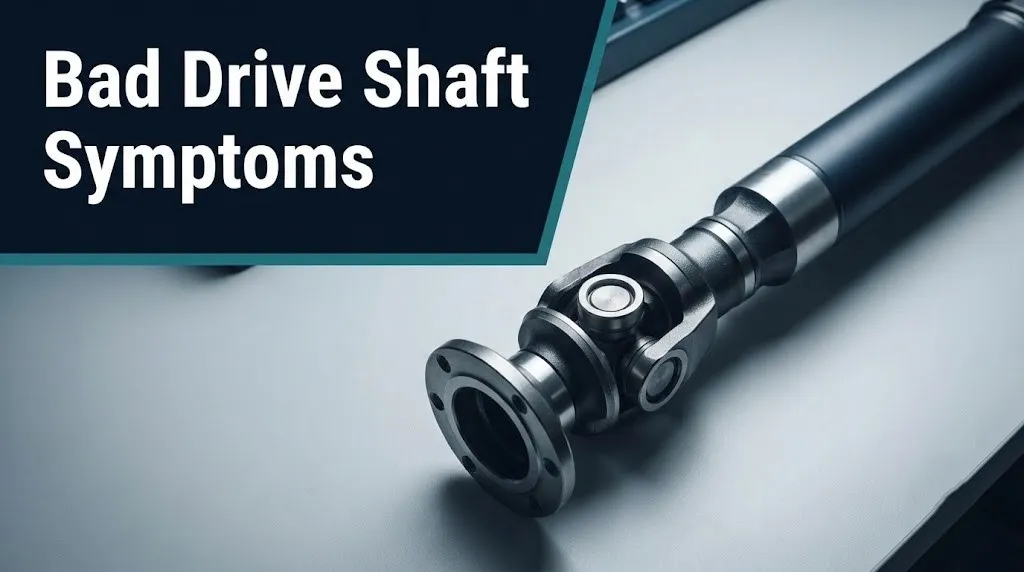
A driveshaft (also called a propeller shaft or prop shaft) is a rotating steel or aluminum tube that transfers engine torque from the transmission to the differential, which then distributes power to the drive wheels.
Think of it like the rotating shaft in a mechanical clock. The transmission is the mainspring, the differential is the gear mechanism turning the hands, and the driveshaft is the shaft connecting them. When that shaft wobbles, binds, or breaks, the entire power delivery system fails regardless of how well the rest of the mechanism works.
The driveshaft does not run in a perfectly straight line. Vehicle suspension movement, manufacturing tolerances, and chassis geometry mean the driveshaft operates at a slight angle, called the working angle or driveline angle. The universal joint (U-joint), a cross-shaped coupling with four needle-bearing-loaded trunnion caps, accommodates this angle while transmitting rotation. The slip yoke allows the shaft to change length as suspension compresses and extends. On longer driveshafts in trucks and larger vehicles, a center support bearing (carrier bearing) mounted to the chassis supports the shaft at its midpoint, preventing resonant wobble.
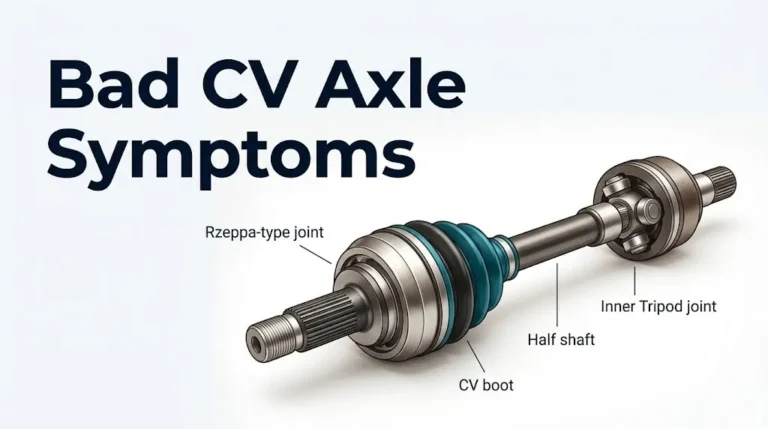
In front-wheel drive vehicles, the driveshaft function is split between two CV axle half-shafts, each connecting the transmission (transaxle) to a front wheel. These use constant velocity (CV) joints rather than U-joints because CV joints maintain perfectly smooth rotation through larger articulation angles, which front wheels require during steering.
| Component | Function | Failure Consequence |
|---|---|---|
| U-joint (Cardan joint) | Accommodates driveline angle change | Vibration, clunking, separation |
| CV joint (Rzeppa or tripod) | Smooth torque delivery at large angles | Clicking, shuddering, loss of drive |
| Center support bearing | Mid-shaft support on two-piece driveshafts | Resonant vibration at specific speeds |
| Slip yoke | Allows shaft length change with suspension travel | Clunking, binding, vibration |
| CV boot | Retains CV joint grease, excludes contamination | Rapid CV joint wear when torn |
The Full Symptom Picture: Every Sign of a Failing Driveshaft
The complete set of symptoms of a bad drive shaft spans vibration, noise, handling changes, and in advanced cases, visible physical changes observable during a vehicle inspection.
Here is the full inventory, organized by symptom category:
Vibration symptoms:
- Rhythmic floor vibration that increases with vehicle speed
- Seat or steering wheel vibration that disappears or changes character above certain speeds
- Vibration specifically during acceleration that lessens or disappears at steady cruise speed
- Rumbling felt underfoot that resembles an unbalanced tire but does not resolve after tire rotation
Noise symptoms:
- Clunking or banging when the transmission engages drive from park or neutral
- Thudding during acceleration or when lifting off the throttle (on-throttle/off-throttle transitions)
- Clicking or popping sound on every wheel revolution when turning
- Squeaking at low speed on smooth surfaces, particularly before the drivetrain warms up
- Grinding or metallic scraping during specific driving maneuvers
Handling and control symptoms:
- Vehicle shudder during initial acceleration from a stop, often more pronounced when the powertrain is cold
- Difficulty or resistance during turning in front-wheel drive vehicles
- Apparent looseness or delayed response when changing from acceleration to engine braking
- Wobble felt at the steering wheel during highway driving that does not respond to wheel balancing
Observable physical symptoms (visible under the vehicle):
- Torn or cracked CV boot with grease thrown outward, often visible as a dark grease spray on the wheel well or inner fender
- Rust or corrosion on U-joint trunnion caps
- Visible wobble of the driveshaft when the vehicle is on a lift with the engine running (requires professional inspection)
- Missing balance weights on the driveshaft tube
Key Takeaway: A torn CV boot is one of the first physically observable bad drive shaft symptoms, and fixing it early (before the joint itself fails) costs a fraction of a full CV joint or axle shaft replacement.
Driveshaft Vibration Symptoms: Why Your Car Shakes
Driveshaft vibration is the most common and often earliest symptom of a failing driveshaft, and it originates from a specific mechanical phenomenon called cyclic force variation.
Here is the physics: a U-joint operating at a working angle does not transmit rotation at a perfectly constant velocity. Instead, it produces a twice-per-revolution speed variation in the driven shaft. This is mathematically predictable and intentionally cancelled out in a properly designed driveshaft by phasing two U-joints 180 degrees apart. When a U-joint wears, the needle bearings in its trunnion caps develop play (excessive clearance). That play converts the normal twice-per-revolution speed variation into a physical oscillating force. That force travels through the driveshaft, through the transmission mount and differential mount, and into the vehicle floor as a rhythmic vibration.
The frequency of the vibration increases directly with vehicle speed. At 35 mph, you might feel a subtle buzz. At 55 mph, it may become a pronounced shake. At 70 mph, it can be severe enough to affect steering precision.
Worn or missing balance weights produce a different vibration pattern: rotational imbalance. This feels similar to an out-of-balance tire, peaks at a specific speed, and may diminish above that speed as the driveshaft passes through its resonance band. The key distinguishing feature is that tire balancing does not resolve it.
Center support bearing deterioration produces a third vibration pattern: a resonant buzz at a specific, narrow speed range (often between 45 and 65 mph) that disappears above and below that range. The deteriorated rubber isolator within the bearing bracket allows the shaft to vibrate at its natural resonance frequency when vehicle speed excites that frequency.
Drivers who experience towing, payload-loaded driving, or frequent highway driving should be aware that driveshaft vibration in these conditions can worsen dramatically faster than under normal driving, because higher torque loads accelerate needle bearing wear.
Bad Driveshaft Noise: What Each Sound Means
Every distinct bad driveshaft noise type corresponds to a specific mechanical failure mode. Identifying the sound character, when it occurs, and under what driving conditions it appears narrows the diagnosis considerably before a vehicle even reaches a lift.
Clunking or banging: This is the sound of mechanical slop, meaning excessive clearance in a joint. When you shift into drive from park, or accelerate hard after coasting, the driveshaft momentarily takes up slack in the worn joint before it can transmit torque smoothly. The audible result is a single bang or thud on engagement. Worn U-joint trunnion caps and corroded slip yokes both produce this pattern. The clunk occurs specifically at the transition between engine braking and acceleration (or vice versa) because that transition reverses the direction of torque loading through the slack.
Squeaking: A squeaking driveshaft noise, particularly at low speed and often more pronounced when the drivetrain is cold, indicates a U-joint that has lost lubrication. On sealed-for-life U-joints (common in passenger cars), this means the grease within the trunnion caps has dried out or been contaminated. On greaseable U-joints (common in trucks), it means the zerk fitting has not been serviced at the manufacturer-specified interval.
Grinding or scraping: This sound indicates metal-to-metal contact within a joint that has progressed past the lubrication-loss stage into bearing surface destruction. This is an advanced failure symptom. Continued driving at this stage causes rapid joint disintegration.
According to SAE International technical literature on driveline noise, vibration, and harshness (NVH), the acoustic character of driveshaft component noise is highly speed-dependent and load-dependent, which is why the same failing U-joint may be inaudible at 30 mph but produce a pronounced clunk at highway speed during a quick throttle lift-off.
| Noise Type | When It Occurs | Most Likely Cause |
|---|---|---|
| Single clunk on engagement | Shifting into Drive or Reverse | Worn U-joint or slip yoke play |
| Rhythmic clunk at speed | Under load at highway speed | Worn U-joint needle bearings |
| Squeaking at low speed | Cold start, low speed | Dry U-joint, lost lubrication |
| Clicking on turns | Cornering at low speed | Worn outer CV joint |
| Grinding continuously | Any driving condition | Advanced bearing destruction |
| Rumbling at specific speed | 45 to 65 mph, narrows then disappears | Center support bearing failure |
Clicking Noise When Turning: CV Joint Failure Explained
A clicking or popping noise that occurs specifically when turning, most audible at low speeds and most pronounced during tight turns under acceleration, is the hallmark symptom of a worn outer CV joint on a front-wheel drive or all-wheel drive vehicle.
Here is the mechanical reason it happens. The outer CV joint (typically a Rzeppa-type ball-and-socket joint) must accommodate the large articulation angles produced when the front wheel steers. At full lock, the joint operates at an angle of 40 to 50 degrees. Within the joint, six steel balls ride in precision-ground grooves in the inner and outer races, held in position by a cage. This geometry maintains constant velocity through any articulation angle, as long as the ball-to-groove contact surfaces are properly lubricated and free of contamination.
When the rubber CV boot cracks, tears, or loses a clamp, grease escapes outward (you’ll often see it sprayed inside the wheel well as a dark, thick ring). Road grit, water, and dirt then enter the joint. This contamination acts as a lapping compound against the polished ball and groove surfaces. Wear accelerates rapidly. Within weeks to months, the ball-to-groove clearance increases beyond tolerance, and the balls slip and re-engage their grooves with each revolution under the combined lateral and driving forces of a turn. Each slip-and-catch event produces one click.
The clicking pattern has a specific diagnostic signature. It occurs at low speed under engine load during a turn, typically below 15 mph. It increases in frequency with vehicle speed. It is typically absent at highway speeds or during straight-line driving because the joint angle is near zero during straight travel, and the balls do not load laterally against the groove edges.
Repairing a torn CV boot before the joint fails costs between $150 and $350 at most shops according to RepairPal industry data. Waiting until the joint itself fails brings the cost to $350 to $800 per axle for a complete CV axle replacement. Early intervention here has a direct financial consequence beyond the safety concern.
Shuddering During Acceleration: What It Really Means
Driveshaft shuddering during acceleration, particularly during initial throttle application from a stop or at low speeds, is distinct from the high-speed vibration produced by worn U-joints or imbalance. It has its own specific mechanical sources.
The most common cause is a worn or binding slip yoke. The slip yoke is a splined coupling that slides along the transmission output shaft, allowing the driveshaft to change length as the rear axle moves through suspension travel. When road salt, lack of lubrication, or corrosion causes the slip yoke to bind in the output shaft, it cannot slide freely during suspension movement. Under acceleration, when axle torque causes the rear suspension to load and the slip yoke should move freely, it instead sticks and then releases suddenly. Each stick-and-release event produces a shudder.
A second cause is a worn or deteriorated CV joint on a front-wheel drive axle that has progressed to the point where the joint cannot maintain smooth rotation under the combined torque and angle load of initial acceleration. This produces a low-speed shudder specifically felt in the front of the vehicle, most pronounced when the steering is slightly turned during a turn from a stop.
A third cause specific to all-wheel drive vehicles is a shudder related to the center viscous coupling or front differential engagement. This is not a driveshaft failure per se, but it presents identically to a driveshaft shudder and requires professional differentiation.
Drivers with low-clearance vehicles or vehicles that have been lowered (suspension modification) experience more frequent slip yoke binding because changes in suspension geometry steepen the driveline working angle beyond the U-joint’s optimal operating range, accelerating every wear mode simultaneously.
Key Takeaway: Shuddering specifically during initial acceleration from a stop most often points to a binding slip yoke or a severely worn CV joint, both of which worsen quickly under the repeated torque loading of city driving.
Bad U-Joint Symptoms: The Most Common Failure Point
Bad U-joint symptoms represent the most frequently encountered driveshaft failure pattern in rear-wheel drive trucks, SUVs, and body-on-frame vehicles, and they follow a predictable progression.
A U-joint consists of a cross-shaped steel spider (the trunnion) with four bearing caps, each containing a tight stack of needle roller bearings. These caps press into the yoke ears of the driveshaft and the differential or transmission yoke. Each bearing cap is preloaded to eliminate play. When the needle bearings lose lubrication through seal failure, or when the bearing races develop pitting from metal fatigue, the precise preload is lost and play develops in the joint.
Early-stage U-joint wear symptoms:
- A faint, rhythmic vibration at highway speed, often described as a light buzz through the floor
- A subtle single clunk when shifting from Drive to Reverse or Reverse to Drive
- Occasional squeaking from beneath the vehicle at low speed during cold starts
Intermediate-stage symptoms:
- Pronounced clunking on every throttle engagement and release transition
- Vibration noticeable to passengers in the rear seat, not just the driver
- Squeaking audible with the windows open at neighborhood driving speeds
Advanced-stage symptoms:
- Loud banging during acceleration
- Visible driveshaft wobble on a lift
- Rusted or seized U-joint cap discovered during inspection (cap does not rotate; races have spalled)
According to SAE International engineering data on U-joint service life, properly lubricated U-joints on light trucks should last between 80,000 and 150,000 miles under normal operating conditions. Towing, off-road use, and neglected grease service intervals reduce this range by 30 to 50 percent. Sealed-for-life U-joints common in passenger cars typically reach end-of-life between 100,000 and 150,000 miles, with earlier failure in high-corrosion environments where road salt compromises the bearing cap seals.
Trucks used for towing at or near their rated tow capacity experience the most severe U-joint wear because the elevated driveline angle under tongue weight combined with maximum torque loading places the needle bearings at the edges of their load capacity with every tow trip.
Bad Center Support Bearing Symptoms
The center support bearing (also called the carrier bearing) is found on two-piece driveshafts in full-size trucks, rear-wheel drive sedans with long wheelbases, and many SUVs. It is a conventional ball bearing enclosed in a rubber isolator, bolted to a chassis crossmember. Its job is to support the midpoint of the two-piece shaft and prevent the resonant whipping motion a long, unsupported rotating tube would otherwise develop.
The rubber isolator is the component most likely to fail first. Over years of heat cycling, oil contamination, and ozone exposure, the rubber cracks, hardens, and separates from the bearing housing. When this happens, the center bearing can move freely within its mounting bracket instead of being held rigidly. The symptom is a distinctive resonant vibration that appears at a specific, narrow vehicle speed range and disappears above and below it.
This speed-specific character is the diagnostic key. Worn U-joint vibration increases continuously with speed. Center support bearing vibration peaks at a narrow speed band, often between 50 and 65 mph, and diminishes noticeably if you accelerate through it. It resembles driving over a long rumble strip. Some drivers describe it as feeling as if the rear of the vehicle is oscillating side to side rather than simply shaking vertically.
The bearing itself can also fail, producing a growling or rumbling sound similar to a worn wheel bearing, but localized to the center underside of the vehicle rather than a specific wheel corner. A simple diagnostic: with the vehicle on a lift, an ASE-certified technician can rotate the driveshaft by hand and feel for rough bearing rotation or hear the growl produced by damaged bearing races.
Replacement of the center support bearing, including the rubber isolator assembly, ranges from $250 to $500 in parts and labor at most shops, according to Mitchell 1 industry repair data. Neglecting a failed center bearing allows the bearing races to overheat from friction, which can cause the bearing to seize and the driveshaft to vibrate severely enough to fracture its mounting hardware.
Symptoms at Low Speed vs. High Speed: Why the Difference Matters
Whether driveshaft symptoms appear at low speed, high speed, or across the entire speed range tells a trained technician which component is most likely failing, because each component has a characteristic frequency-response signature.
This is similar to how a doctor reads an EKG. The pattern of the signal, not just its presence, carries the diagnostic information.
Low-speed symptoms (under 25 mph):
These typically indicate CV joint failure, slip yoke binding, or advanced U-joint play where the clunk on engagement is the dominant symptom. At low speed, the driveshaft rotates slowly enough that the frequency of any cyclic force variation is below the threshold needed to excite chassis resonance. What you feel at low speed is mechanical slop or joint roughness transmitted directly, not amplified by resonance.
Mid-speed symptoms (25 to 55 mph):
This range is where center support bearing resonance typically peaks, and where early to intermediate U-joint wear begins to produce perceptible vibration. The driveshaft rotational speed at these vehicle speeds falls within the resonant frequency range of the center bearing isolator and the chassis mounting points.
High-speed symptoms (above 55 mph):
Imbalance and severe U-joint wear dominate in this range. The centrifugal force acting on an imbalanced driveshaft increases with the square of rotational speed, which is why a mild imbalance that is unnoticeable at 40 mph can produce a severe shake at 70 mph.
| Speed Range | Dominant Symptom | Most Likely Component |
|---|---|---|
| Under 25 mph | Clicking on turns, clunk on engagement | CV joint, slip yoke |
| 25 to 55 mph | Speed-specific resonant vibration | Center support bearing |
| 55 to 75 mph | Progressive vibration increasing with speed | U-joint wear, imbalance |
| Any speed, under load | Shudder during acceleration | Slip yoke binding, CV joint |
| Any speed, throttle transitions | Clunk/bang when accelerating or lifting off | U-joint play, slip yoke play |
Key Takeaway: Symptoms that appear only at a specific narrow speed range and disappear above it almost always point to center support bearing failure, not U-joint wear, which requires different repair approach and parts.
Rear-Wheel Drive Driveshaft Symptoms
In rear-wheel drive (RWD) vehicles, the driveshaft is a single tube (or two-piece shaft on longer vehicles) running longitudinally from the transmission tail housing to the rear differential pinion flange. All torque for vehicle propulsion passes through this one shaft.
RWD driveshaft symptoms are felt throughout the vehicle because the single shaft spans nearly the full vehicle length. Vibration originating from a worn U-joint transmits forward through the transmission mount into the floorpan and rearward through the differential mount into the rear seat and trunk floor. Drivers in the front seat and rear passengers often both notice the vibration simultaneously in more advanced failure cases.
The defining characteristic of RWD driveshaft symptoms is their relationship to throttle loading. A clunk specifically heard and felt when you go from engine braking to acceleration (lifting off then pressing the throttle again) is the single most reliable diagnostic indicator of worn U-joints on a RWD vehicle. The clunk occurs because the worn joint has developed rotational play, and that play takes up abruptly when torque direction reverses.
Pickup trucks and body-on-frame SUVs in this category often have serviceable (greaseable) U-joints with zerk fittings. The Society of Automotive Engineers recommends lubrication of greaseable U-joints every 5,000 miles or at every oil change interval on vehicles used for towing or off-road driving. Neglecting this interval is the single most preventable cause of premature U-joint failure in this vehicle category.
RWD vehicles used in high-corrosion environments (northern US states with heavy road salt use from October through April) show dramatically higher rates of U-joint failure from external corrosion of the bearing cap seals, even on properly lubricated joints. The seal lip deteriorates in salt brine exposure, allowing moisture to enter the bearing caps and displace the grease.
Front-Wheel Drive CV Axle Symptoms
In front-wheel drive (FWD) vehicles, there is no conventional propeller shaft. Instead, two CV axle half-shafts transmit torque from the transaxle to each front wheel. Each axle has an inboard CV joint (typically a tripod-type plunge joint) and an outboard CV joint (typically a Rzeppa-type fixed joint). Both joints are enclosed in rubber boots sealed with clamps.
Front-wheel drive CV axle symptoms differ from RWD driveshaft symptoms in several important ways:
- The clicking sound on turns is the most specific FWD symptom and rarely occurs with RWD driveshaft problems
- Symptoms are localized to one side of the vehicle because each halfshaft is independent
- Shuddering during acceleration, when it occurs, is felt in the front of the car and may be accompanied by torque steer (the steering pulling to one side under hard acceleration)
- In advanced outer CV joint failure, the click may progress to a grinding sound and eventually a complete inability to turn under load
The inboard tripod joint rarely fails before the outer Rzeppa joint because the outer joint operates at much larger articulation angles during steering. However, when the inboard joint fails (often from a torn inboard boot allowing contamination), the symptom is a vibration during acceleration and shuddering on uneven surfaces, rather than clicking on turns.
Diagnosing the failed side in a FWD vehicle: listen for the click to intensify when turning in one direction versus the other. If clicking is louder when turning left, the right (passenger side) outer CV joint is typically the source, because turning left loads the right joint at its maximum angle. The reverse applies for right turns.
Compact and subcompact FWD vehicles under 150,000 miles rarely require full CV axle replacement if boot tears are caught early. Replacing the boot kit and repacking the joint with the correct CV grease specification (matching OEM grade) extends joint life by an additional 60,000 to 100,000 miles in most cases, according to RepairPal industry data.
AWD and 4WD Driveshaft Symptoms
All-wheel drive (AWD) and four-wheel drive (4WD) vehicles have multiple driveshafts, typically including a rear propshaft from the transfer case to the rear differential, a front propshaft from the transfer case to the front differential, and two or four CV halfshafts at the wheels. This complexity means driveshaft symptoms can originate from more locations, and isolating the specific source requires more systematic diagnosis.
AWD vehicles add a center differential or viscous coupling unit that automatically distributes torque between front and rear axles. A shudder during tight, low-speed turns (such as in a parking lot) in an AWD vehicle sometimes indicates center differential or coupling wear rather than driveshaft joint failure. This is called AWD system shudder or drivetrain binding and is specific to AWD systems with limited slip or torque-sensing center units. Differentiating this from a CV joint click or a rear propshaft clunk requires professional diagnosis.
4WD vehicles with a two-speed transfer case and manually selectable 4WD typically develop front propshaft symptoms most noticeably when 4WD is engaged. A vibration that appears only in 4WD High or 4WD Low and disappears in two-wheel drive almost always originates from the front propshaft U-joints or the front differential input yoke.
Symptoms specific to AWD and 4WD drivetrain failures:
- Shudder during slow tight turns (AWD center coupling)
- Vibration only in 4WD engagement (front propshaft U-joint)
- Clicking from front wheels during low-speed cornering (front CV halfshaft)
- Clunk on 4WD engagement or disengagement (transfer case yoke or output shaft U-joint)
Luxury AWD vehicles (German and Japanese manufacturers particularly) sometimes use a Cardan-type center propshaft with a rubber flex disc (guibo coupling) rather than a traditional U-joint at the transmission end. When the rubber guibo cracks or tears, the symptom is a clunk during gear changes or throttle transitions, identical to a worn U-joint. Guibo replacement is frequently overlooked because the component is less well-known than U-joints, but failure to replace a cracked guibo leads to driveshaft yoke damage that requires more extensive repair.
Key Takeaway: In AWD and 4WD vehicles, a vibration or shudder that only appears when 4WD is engaged almost always originates from the front propshaft or transfer case output U-joint, not from the rear driveshaft or wheel-end components.
What Causes a Driveshaft to Fail?
A driveshaft fails for predictable mechanical reasons. None of them are random. Each failure mode has a specific pathway from normal operation to complete breakdown.
1. Lubrication failure (most common cause of U-joint failure):
Sealed U-joints lose their factory grease through seal deterioration over time and mileage. Greaseable U-joints lose lubrication when the service interval is neglected or when the zerk fitting becomes plugged. Without a full grease film separating the needle bearings from the trunnion surface, metal-to-metal contact begins. The bearing surfaces pit, the needle bearings flatten and fragment, and joint play develops within thousands of miles.
2. CV boot failure (most common cause of CV joint failure):
Rubber CV boots deteriorate from heat cycling, ozone exposure, road debris impact, and age. A crack or tear in the boot allows grease to escape and contamination to enter. Once road grit enters the joint, wear is rapid and irreversible without replacement.
3. Overloading and high working angles:
Operating a vehicle beyond its rated towing capacity, or modifying suspension geometry without adjusting the driveline angle, places U-joints and CV joints outside their designed operating range. The Society of Automotive Engineers’ technical standards for U-joint operating angles specify that continuous operation beyond 3 to 5 degrees of working angle significantly reduces bearing fatigue life.
4. Impact damage:
Off-road driving, severe pothole impact, or collision damage can bend the driveshaft tube, fracture a CV boot, or fracture a U-joint cap. A bent driveshaft tube creates rotational imbalance that presents identically to U-joint wear vibration but does not resolve with U-joint replacement.
5. Corrosion:
Road salt exposure corrodes the exterior of U-joint bearing caps, slip yoke splines, and center bearing brackets. The NHTSA Vehicle Safety Complaints database shows a statistically higher rate of driveshaft-related complaints from vehicles registered in northern US states with aggressive winter road treatment programs.
6. Age and material fatigue:
Steel driveshaft components accumulate fatigue cycles with every vehicle mile. At high mileage, even properly maintained driveshafts approach the end of their designed fatigue life. Aluminum driveshafts (increasingly common in performance and fuel economy applications) are lighter but can be more susceptible to fatigue cracking from impact damage.
Can You Drive With a Bad Driveshaft?
Whether you can drive with a bad driveshaft depends entirely on which component is failing and how far the failure has progressed. This is not a situation where the answer is a uniform yes or no.
Early-stage symptoms: drive with caution, schedule soon.
A vehicle showing only a faint vibration at highway speed or a very mild clunk on engagement that has been stable and unchanged for less than two weeks can typically be driven short distances to a repair shop. The risk of complete failure within a short timeframe is low, but the window for low-cost repair is closing.
Intermediate-stage symptoms: drive minimally, schedule within days.
Pronounced clunking on every gear change, moderate vibration at highway speed, or confirmed clicking on turns (indicating CV joint wear without grease contamination visible at the boot) means the component is past early wear and approaching accelerated deterioration. Driving the vehicle daily in this state risks sudden failure.
Advanced-stage symptoms: do not drive. Arrange a tow.
Loud banging during acceleration, severe shuddering at any speed, visible grease spray inside the wheel well (indicating a ruptured CV boot with contaminated joint), or any grinding noise from the drivetrain indicates imminent component failure. Driving in this state risks:
- Complete driveshaft separation, where the shaft drops to the road surface and can pole-vault the vehicle or cause immediate loss of control
- Differential or transmission damage from a failed joint that fractures inside the yoke
- Loss of steering in FWD vehicles if a CV halfshaft fractures
The NHTSA has investigated multiple incidents involving driveshaft separation on light trucks and SUVs at highway speeds, with outcomes including loss of directional control and vehicle rollover. The agency’s safety standards for driveshaft retention are designed to reduce the catastrophic consequence of this specific failure mode, but they do not eliminate the risk of sudden control loss when a shaft fails at speed.
Stop driving the vehicle immediately and arrange a tow if you experience any of the following:
- A sudden, severe vibration that was not present before
- A loud bang followed by loss of drive to the wheels
- Grinding that appeared suddenly rather than progressively
- Any symptom that has changed rapidly over the course of hours or a single drive
Bad Driveshaft vs. Bad Transmission Symptoms
Distinguishing bad driveshaft symptoms from bad transmission symptoms is a critical step because the two conditions share several surface-level sensory presentations but require completely different diagnoses and repairs. Misidentifying one for the other results in unnecessary and expensive repair, or worse, leaving the actual problem unaddressed.
The key differentiating factors:
Vibration that changes with engine RPM (not vehicle speed) = transmission or torque converter problem.
If the vibration frequency tracks with engine RPM rather than vehicle speed (it changes when you put the transmission in neutral and rev the engine while stationary), the source is upstream of the driveshaft: the engine, torque converter, or transmission itself.
Vibration that changes only with vehicle speed = driveshaft or wheel-end problem.
A driveshaft rotates at a speed proportional to vehicle speed, not engine RPM. Vibration that appears at 55 mph in any gear, including when coasting in neutral, is almost certainly from a rotating component: the driveshaft, wheel bearing, or out-of-balance tire.
Clunk specific to gear shift between Drive and Reverse = more likely driveshaft (worn U-joint or slip yoke) than transmission.
A worn U-joint’s play is taken up abruptly when torque direction reverses. Transmissions do not typically produce a single sharp clunk at gear changes; they produce slipping (hesitation), shuddering during engagement, or grinding (in manual transmissions).
Slipping, delayed engagement, shuddering at a specific RPM, or harsh gear changes without noise = transmission.
These symptoms do not occur with driveshaft failure. A failed driveshaft does not cause delayed engagement or gear slippage.
| Symptom | Driveshaft | Transmission |
|---|---|---|
| Vibration at specific vehicle speed | Yes | Rarely |
| Vibration at specific engine RPM in neutral | No | Yes |
| Single clunk Drive to Reverse | Yes (U-joint) | Rarely |
| Delayed gear engagement | No | Yes |
| Slipping between gears | No | Yes |
| Clicking when turning | Yes (CV joint) | No |
| Shuddering during acceleration from stop | Yes (slip yoke, CV) | Possible (TCC lockup) |
A torque converter clutch (TCC) shudder in an automatic transmission produces a low-frequency shudder during light throttle at cruising speed (55 to 70 mph) that can be confused with driveshaft vibration. The distinguishing test: the shudder disappears when you apply slightly more throttle to exit the TCC engagement zone. Driveshaft vibration does not respond to minor throttle changes in this way.
When to See a Mechanic About Driveshaft Symptoms
The timing of professional evaluation for driveshaft symptoms maps directly to the severity of what you’re experiencing, and the consequences of waiting are not symmetric: early repair costs a fraction of what deferred repair costs, and a failed driveshaft at highway speed is a vehicle safety emergency.
Here is the specific framework for when to act:
Schedule a routine inspection within two weeks:
- Faint vibration at highway speed that has been present and stable
- Very mild, infrequent clunk on gear change that began recently
- A tear in the CV boot discovered during a routine oil change with no joint noise yet present
Schedule a priority inspection within 48 to 72 hours:
- Vibration that has worsened over the last few drives
- Clicking on turns that is present on most low-speed cornering events
- Clunking on every throttle engagement or release
- Squeaking from beneath the vehicle at most low-speed driving situations
Go to a shop today or arrange a tow:
- Severe vibration that appeared suddenly
- Loud banging during acceleration
- Grinding noise from the drivetrain
- Visible grease spray in the wheel well indicating a ruptured CV boot
- Any shuddering so severe that it affects steering precision
When you visit an ASE-certified mechanic, bring the following information to your appointment:
- Describe exactly when the symptom occurs: starting from a stop, at highway speed, during turns, when shifting gears, or continuously.
- State whether the symptom is getting worse, staying the same, or appearing intermittently.
- Note whether the symptom is felt, heard, or both, and where in the vehicle it is most noticeable: floor, seat, steering wheel, or specific location under the vehicle.
- Report your vehicle’s mileage, towing history, and whether the suspension has been modified.
- Ask the mechanic specifically to check U-joints for play and corrosion, inspect CV boots for tears, check the center support bearing, and measure driveshaft runout with a dial indicator.
Driveshaft inspection on a two-post lift by an ASE-certified technician typically takes 20 to 40 minutes and costs nothing if you are already paying for another service. A driveshaft runout measurement (checking for a bent tube) requires a dial indicator and takes an additional 15 minutes.
Emergency Symptoms: When to Stop Driving Immediately
Certain symptoms associated with a failing driveshaft require you to stop driving immediately. Do not wait to see if these resolve on their own.
Pull over safely and arrange a tow if you experience any of the following:
- A sudden, severe vibration that was not present at the start of your trip and is rapidly worsening
- A loud bang from beneath the vehicle followed by a loss of power to the drive wheels
- Grinding or metallic scraping that appeared suddenly rather than developing gradually
- Complete loss of vehicle propulsion despite the engine running
- Any symptom so severe that the steering wheel is difficult to hold steady or the vehicle is pulling sharply to one side
Do not continue driving under any of these conditions. A driveshaft that separates completely can drop to the road surface and pole-vault the vehicle forward, become lodged against the pavement and cause immediate rollover, or strike vehicles behind you. The NHTSA has documented fatal and injury crashes attributable to driveshaft separation at highway speed. These presentations indicate a component at or past its mechanical failure point. A tow is the only safe option.
If you are on a highway and cannot safely pull off immediately, reduce your speed gradually, turn on your hazard lights, and move to the rightmost lane before stopping.
Frequently Asked Questions About Bad Drive Shaft Symptoms
What does a bad drive shaft feel like when driving?
A bad drive shaft typically feels like a rhythmic vibration through the floor, seat, or steering wheel that increases with vehicle speed.
In more advanced failure, you may feel a shudder during acceleration from a stop, or a jolt or clunk every time you shift between acceleration and engine braking.
Some drivers describe an advanced failing driveshaft as feeling like driving with a severely unbalanced tire, except the vibration does not improve after tire service.
What noise does a bad driveshaft make?
A bad driveshaft most commonly produces a clunking or banging noise during throttle engagement, a clicking sound when turning at low speed, or a squeaking sound at low speeds before the drivetrain warms up.
The clunking indicates worn U-joint or slip yoke play taking up abruptly under load reversal; the clicking specifically indicates a worn outer CV joint operating at a large cornering angle.
A grinding or metallic scraping sound indicates advanced bearing destruction and requires stopping the vehicle and arranging a tow rather than continuing to drive.
Can a bad driveshaft damage my transmission or differential?
Yes, a severely worn driveshaft can damage both the transmission output shaft yoke and the differential input pinion flange through impact loading from excessive joint play.
A U-joint that fractures inside the yoke can score or crack the yoke ears, requiring replacement of the yoke or, in severe cases, the entire transmission tail housing.
Catching driveshaft symptoms early prevents this secondary damage cascade, which can increase total repair cost by $500 to $2,000 or more depending on the affected component.
How long can you drive with a bad driveshaft before it fails completely?
There is no reliable mileage answer because the timeline depends entirely on the degree of wear, the driving conditions, and the specific component that is failing.
A mildly worn U-joint discovered at 500 miles might last another 5,000 miles under gentle driving; the same joint under towing loads might fail within 200 miles.
Any symptom beyond mild intermittent vibration warrants scheduling professional inspection within days, not weeks.
What is the difference between bad U-joint symptoms and bad CV joint symptoms?
Bad U-joint symptoms are most noticeable as a clunk during drive-to-reverse or acceleration-to-engine-braking transitions, and as a vibration that increases continuously with vehicle speed.
Bad CV joint symptoms are most specific as a rhythmic clicking sound that occurs during low-speed cornering and is absent during straight-line driving at any speed.
U-joint problems are most common in rear-wheel drive and four-wheel drive vehicles; CV joint problems are the primary driveshaft failure mode in front-wheel drive and all-wheel drive vehicles.
How much does it cost to fix a bad driveshaft?
The cost depends on which component has failed: a single U-joint replacement typically ranges from $150 to $350 in parts and labor according to RepairPal industry data.
A complete CV axle replacement on a front-wheel drive vehicle typically costs $350 to $800 per side, while a full rear driveshaft replacement on a truck or SUV ranges from $400 to $1,200 depending on vehicle and shop.
Center support bearing replacement typically falls between $250 and $500 in parts and labor.
What You Know Now and What to Do Next
A failing driveshaft does not fail quietly or without warning. The symptoms are real, they are mechanically specific, and they follow a predictable progression from early vibration or clicking through intermediate clunking to advanced shuddering and eventual component separation. Recognizing the pattern early is the difference between a $200 boot replacement and a $1,000 axle replacement, or between a scheduled shop appointment and a roadside emergency.
The single most actionable step: if you are hearing a click when you turn, check for a grease spray pattern inside the wheel well. A torn CV boot with grease thrown outward confirms the diagnosis and gives you a short but real window to repair it before the joint itself fails.
Take your vehicle to an ASE-certified mechanic, describe the specific conditions under which the symptom occurs (speed, turning, throttle engagement, or gear changes), and ask directly for a driveshaft and halfshaft inspection including U-joint play check, CV boot integrity check, center bearing rubber condition, and driveshaft runout measurement. That specific request takes the guesswork out of the diagnostic process and gets you an accurate answer the same day.