Symptoms of a Bad Crankshaft Position Sensor: Full Guide
The symptoms of a bad crankshaft position sensor include engine misfires, a check engine light, hard starting or complete no-start, stalling while driving, rough idle, reduced engine power, and poor fuel economy. When this sensor fails, the engine control module loses the data it needs to time ignition and fuel delivery correctly, and every aspect of engine performance that depends on that timing breaks down.
The crankshaft position sensor is one of the most critical inputs to the engine management system in any modern vehicle. Without an accurate signal from this sensor, the engine control module cannot determine which cylinder is approaching its firing point, which means it cannot fire the ignition coil at the right moment or open the fuel injectors at the correct time. The result is a cascade of drivability problems that can range from minor to completely disabling.
This guide covers every symptom in mechanistic detail, explains what is happening inside the engine management system when the sensor fails, provides the specific OBD-II fault codes to look for, shows how to distinguish CKP sensor failure from other common causes of the same symptoms, explains what causes these sensors to fail, and gives you a clear framework for deciding whether your vehicle is safe to drive.
Symptoms of a Bad Crankshaft Position Sensor: Overview
A bad crankshaft position sensor (CKP sensor) produces symptoms that affect engine starting, running, and power delivery, because this sensor provides the engine control module with the positional and speed data it needs for every combustion event in real time.
The severity of symptoms ranges from subtle and intermittent in early failure stages to complete no-start in total failure. What makes CKP sensor diagnosis challenging is that its symptoms overlap significantly with failures of other engine management components. A misfire, for example, can be caused by a bad CKP sensor, a failing ignition coil, worn spark plugs, low fuel pressure, or a bad camshaft position sensor. The CKP sensor’s symptoms alone do not confirm the diagnosis; diagnostic testing is required.
| Symptom | Severity Level | Drive Risk |
|---|---|---|
| Check engine light only | Mild | Low, monitor immediately |
| Rough idle, minor misfires | Moderate | Low to moderate, diagnose soon |
| Intermittent stalling at idle | Moderate | Moderate, avoid highway use |
| Hard starting, extended cranking | Moderate to severe | Do not leave yourself stranded |
| Stalling at speed while driving | Severe | Pull over immediately, do not drive |
| Complete no-start | Severe | Vehicle inoperable, requires repair |
High-mileage vehicles (over 100,000 miles) are disproportionately represented in CKP sensor failure cases, because the sensor has been exposed to years of heat cycling, vibration, and potential oil contamination from engine seals that degrade with age. Turbocharged engine vehicles also fail CKP sensors at higher rates, as turbocharger heat output elevates underhood temperatures beyond what naturally aspirated engines produce.
How the Crankshaft Position Sensor Works and Why It Fails
The crankshaft position sensor monitors the rotation of the reluctor wheel (also called the tone ring or trigger wheel), a toothed metal ring mounted on the crankshaft, by detecting each tooth as it passes the sensor tip and converting that detection into an electrical signal the engine control module uses for ignition and fuel timing.
Two sensor types are used across modern vehicles. Variable reluctance (VR) sensors, also called magnetic inductive sensors, contain a permanent magnet wrapped in a coil of wire. As each tooth of the reluctor wheel passes the sensor tip, the changing magnetic field induces an alternating current (AC) voltage in the coil. The amplitude of this signal increases with crankshaft speed and the frequency increases proportionally with RPM. The ECM reads both the amplitude and frequency to determine crankshaft position and speed simultaneously.
Hall effect sensors operate differently. They are powered by a reference voltage (typically 5V or 12V from the ECM) and produce a digital square wave signal that switches between low voltage (0V) and reference voltage with each tooth passage. Hall effect sensors provide a consistent signal amplitude regardless of crankshaft speed, making them more reliable at low RPM during cranking and at very high RPM.
Think of the reluctor wheel and CKP sensor like a bicycle wheel and a speedometer pickup. The spokes passing the magnet generate a pulse with each pass. The frequency of pulses tells the speedometer (the ECM) exactly how fast the wheel is spinning. If a tooth on the reluctor wheel breaks off, or if the sensor develops a fault, the pulse pattern has a gap. The ECM sees a gap in crankshaft rotation data and cannot maintain accurate ignition timing through that gap.
The reluctor wheel typically has a specific tooth count with one or more missing teeth at a defined position. These missing teeth create a reference point that tells the ECM exactly where the crankshaft is in its rotation cycle, identifying which cylinder is approaching TDC on its compression stroke.
Vehicles with higher engine displacement or higher compression ratios may experience more pronounced symptoms from CKP sensor failure because the engine management system relies more heavily on precise timing accuracy at these performance levels.
Check Engine Light as a Crankshaft Position Sensor Symptom
A check engine light caused by a bad crankshaft position sensor appears when the engine control module (ECM) detects that the CKP sensor signal is absent, erratic, out of range, or inconsistent with expected crankshaft behavior, triggering the storage of a diagnostic trouble code in the ECM’s memory.
The check engine light is frequently the first and sometimes only symptom in early-stage CKP sensor degradation. The sensor may be producing an intermittently weak or noisy signal that the ECM detects as out-of-specification without the signal being absent entirely. During this phase, the driver may notice no other drivability problem at all, or only minor symptoms that are easy to overlook.
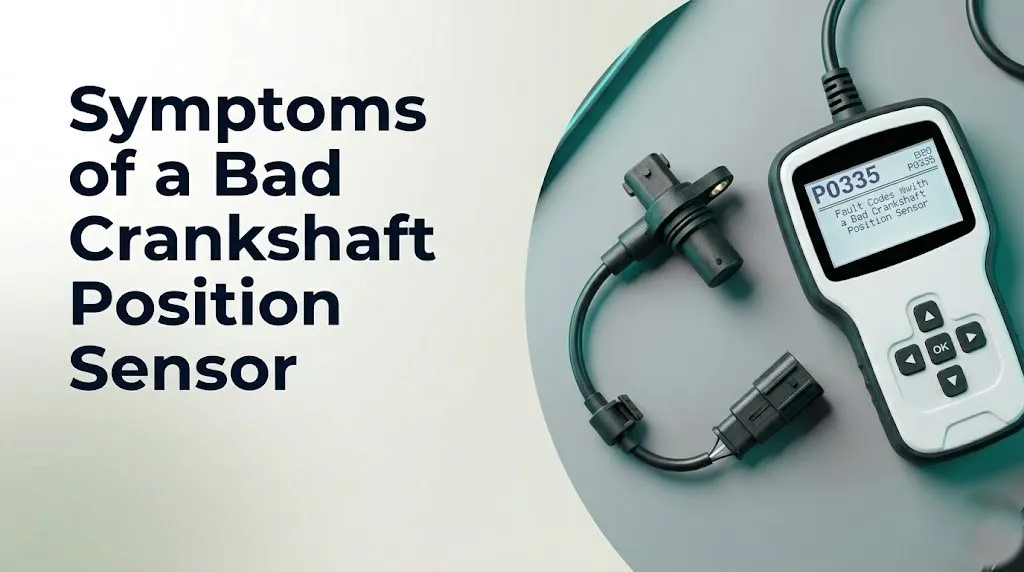
The check engine light alone does not confirm which component has failed. The same light activates for hundreds of different fault conditions. The critical next step is reading the stored diagnostic trouble codes with an OBD-II scan tool to identify whether the codes stored are in the P0335 through P0339 range, which are the codes specific to crankshaft position sensor circuit faults.
Quick Tip:
- Most major auto parts chains (AutoZone, O’Reilly, NAPA) offer free OBD-II code reading with a scan tool. This is always the right first step when the check engine light appears.
- A check engine light combined with any other drivability symptom (misfiring, rough idle, stalling) is more urgent than a check engine light alone.
- Vehicles manufactured before 1996 do not have standardized OBD-II systems and require different diagnostic tools. If your vehicle is pre-1996, code reading must be performed by an ASE-certified mechanic with the appropriate proprietary diagnostic tool.
Diesel vehicles may present check engine light patterns differently from gasoline vehicles with CKP sensor issues, because diesel engine management systems use the crankshaft position signal for fuel injection timing control rather than ignition timing. The ECM response to signal loss may be more aggressive in diesel systems, including forcing the engine into a reduced-power protective mode.
Engine Misfires from a Bad Crankshaft Position Sensor
Engine misfires from a bad crankshaft position sensor occur when the ECM receives an incomplete, delayed, or absent crankshaft position signal and cannot determine the precise moment to fire the ignition coil or open the fuel injector for each cylinder.
The four-stroke combustion cycle requires that ignition occur at a very precise point relative to the piston’s position approaching top dead center (TDC) on the compression stroke. In modern engines, this ignition advance angle is typically between 10 and 35 degrees before TDC depending on engine load and RPM, and it is adjusted continuously by the ECM based on CKP sensor data. When the CKP signal is missing or erratic for even one engine cycle, the ECM either fires the coil at the wrong time or does not fire it at all, producing a misfire.
A misfire manifests as a momentary hesitation or stumble felt through the drivetrain, often accompanied by a brief loss of smoothness in engine vibration. At idle, misfires can be felt as a rhythmic lurch or shake. Under load at higher RPM, misfires may feel like brief stutters or jerks during acceleration. Severe misfires can produce a noticeable reduction in engine power.
The ECM tracks misfire events per cylinder per 200-revolution window. If misfires exceed a threshold that could damage the catalytic converter, the check engine light will flash rather than illuminate steadily. A flashing check engine light during acceleration indicates catalytic converter-damaging misfire and warrants pulling over and stopping the vehicle to prevent secondary damage.
Older vehicles with distributor-based ignition systems (pre-1990s) are less likely to show isolated misfires from CKP sensor issues, because the distributor mechanically distributes ignition rather than relying on ECM timing control based on sensor input. This distinction is relevant if you are diagnosing an older vehicle.
Key Takeaway: A flashing check engine light during driving indicates active, severe misfires that can destroy the catalytic converter. Pull over and stop driving if the check engine light is flashing, regardless of whether you suspect the CKP sensor or another cause.
Hard Start or No-Start from a Bad Crankshaft Position Sensor
A bad crankshaft position sensor causes hard starting or a complete no-start condition when the ECM receives no usable signal during engine cranking, leaving it unable to determine crankshaft position and therefore unable to initiate the ignition and fuel injection sequence required to start the engine.
During the starting process, the starter motor rotates the crankshaft. The ECM monitors the CKP sensor signal from the first rotation to identify the reference position (the missing tooth or teeth on the reluctor wheel that mark a specific crankshaft angle). Once it identifies that reference point, it activates the appropriate injector and fires the corresponding ignition coil to initiate combustion. If the CKP signal is absent or too weak to interpret during cranking, the ECM never initiates the fuel-and-fire sequence, and the engine cranks indefinitely without starting.
Hard starting, where the engine requires extended cranking before eventually catching, often indicates a CKP sensor that is degrading but not yet completely failed. The sensor may produce enough signal after several revolutions for the ECM to establish position reference, resulting in a delayed start. As the sensor degrades further, start attempts take progressively longer until the engine eventually fails to start at all.
A complete no-start from CKP sensor failure is sometimes misdiagnosed as a fuel system failure because the symptoms overlap. Both conditions result in an engine that cranks but does not fire. The distinction is made through diagnostic testing: if the CKP sensor has failed completely, a connected scan tool will show no RPM signal during cranking, confirming the sensor as the source.
Vehicles with push-button start systems and proximity key fobs may show an additional symptom: the keyless entry system may register the key fob but the engine fails to start, which the driver may misinterpret as a key fob battery issue before the actual sensor cause is identified.
Stalling and Sudden Engine Shutdown from a Bad CKP Sensor
Stalling caused by a bad crankshaft position sensor occurs when the sensor signal drops out intermittently while the engine is running, causing the ECM to lose its timing reference and immediately cut ignition and fuel delivery, shutting the engine down without warning.
This is the most dangerous symptom of CKP sensor failure from a road safety perspective. A sensor that produces an intermittent signal may allow the engine to run normally under some conditions but drop the signal during others, particularly under heat, vibration, or electrical load changes. When the signal drops mid-operation, the ECM has no choice but to immediately suspend combustion because it cannot safely fire ignition or inject fuel without knowing crankshaft position. The result is an instantaneous engine shutdown.
At idle in a parking lot, an unexpected stall is an inconvenience. At highway speed, a sudden engine shutdown creates an immediate hazard. Power steering assist is lost. Power brake vacuum assist begins to deplete. The driver must manage a coasting vehicle while activating hazard lights and steering to the shoulder, all simultaneously.
If your engine stalls unexpectedly while driving at speed, activate your hazard lights immediately, coast to the shoulder, and call for roadside assistance. Do not attempt to restart and re-enter moving traffic until the cause has been diagnosed.
The stalling pattern from CKP sensor failure often has a characteristic that helps differentiate it from fuel system stalling. CKP sensor stalls tend to be instantaneous with no preceding stumble, because the signal drops completely and the ECM responds immediately. Fuel system stalls from a failing fuel pump often involve a preceding stuttering or loss of power before the engine dies. This distinction is useful for communicating the symptom pattern to a mechanic.
Vehicles with manual transmissions have the additional road safety consideration that a sudden stall at speed removes engine braking, which can surprise drivers accustomed to using it for speed management.
Rough Idle from a Bad Crankshaft Position Sensor
A bad crankshaft position sensor produces rough idle when the signal is intermittently weak or noisy at low RPM, causing the ECM to make imprecise timing corrections that result in uneven combustion between cylinders and the irregular vibration characteristic of an unsteady idle.
At idle, the engine is operating at its lowest RPM, typically between 600 and 900 RPM depending on engine temperature, electrical load, and vehicle type. Variable reluctance CKP sensors produce a lower voltage signal at low RPM because signal amplitude in these sensors is proportional to crankshaft speed. A sensor that is beginning to degrade may produce a signal that is above the ECM’s minimum detection threshold at highway RPM but drops to or below that threshold at idle, causing timing inaccuracies specifically at low engine speed.
Hall effect sensors, by contrast, produce a consistent signal amplitude regardless of RPM, meaning they are less likely to produce idle-specific rough running unless the failure is more complete. The type of idle roughness produced by a degrading Hall effect CKP sensor tends to be less RPM-dependent and may present equally at idle and at higher speeds.
Rough idle from a bad CKP sensor may be more noticeable in cold weather, because cold oil is thicker and cranks the engine more slowly during warm-up, placing the CKP signal in the low-amplitude range for a longer period before the engine reaches normal operating temperature.
Vehicles with variable valve timing (VVT) systems have additional complexity here. The ECM uses both CKP and CMP sensor data to manage cam phaser positions. A degraded CKP signal may cause the VVT system to make incorrect cam phaser adjustments at idle, amplifying the rough idle symptom beyond what the ignition timing error alone would produce.
Key Takeaway: Rough idle from a bad CKP sensor is often worse at cold start and improves as engine temperature rises, while rough idle from a misfire-causing ignition coil failure tends to be consistent regardless of engine temperature. This pattern difference is worth noting when describing your symptoms to a mechanic.
Poor Fuel Economy and Reduced Engine Power from a Bad CKP Sensor
A deteriorating crankshaft position sensor reduces fuel economy and engine power by forcing the ECM into a conservative timing strategy when the signal quality drops below the threshold needed for precise closed-loop timing control, trading performance for safety.
The ECM continuously optimizes ignition timing for maximum combustion efficiency within the engine’s knock safety limits. This optimization requires a clean, consistent CKP signal at every engine cycle. When the signal is present but noisy or slightly erratic, the ECM may not detect a hard fault severe enough to trigger a check engine light, but it does detect enough signal variability to reduce its timing advance and operate with a more conservative, less efficient ignition strategy.
Running retarded ignition timing reduces the energy extracted from each combustion event. Less energy means less torque, which translates to reduced power and, because the engine must work harder to produce the same output, lower fuel efficiency. The driver may notice that the vehicle feels sluggish or less responsive than normal, particularly during acceleration from a stop or when merging at highway speeds.
The National Highway Traffic Safety Administration notes that undiagnosed engine management faults contribute to increased emissions in addition to reduced fuel efficiency, as incomplete combustion from timing errors increases hydrocarbon and carbon monoxide output in exhaust gases.
Vehicles in regions with annual emissions inspections (smog tests) may fail inspection due to increased emissions from a degraded CKP sensor even if the check engine light has not activated, because some early-stage timing degradation produces emissions above legal limits without generating a stored fault code at a level that triggers the malfunction indicator lamp.
Intermittent Symptoms and Heat Soak from a Bad Crankshaft Sensor
Intermittent crankshaft position sensor symptoms that appear and disappear without an obvious pattern are often caused by heat soak, a condition in which the sensor’s internal electronics or its surrounding wiring connections fail when hot and recover when cool, producing symptoms that disappear after the vehicle sits and cools down.
The CKP sensor sits in close proximity to the engine block, often near areas where engine oil temperature and coolant heat radiate intensively. Over time, the heat cycling that the sensor experiences with each drive-cool cycle degrades the sensor’s internal components: the permanent magnet in a VR sensor can lose flux density with repeated high-temperature exposure, and the Hall effect chip in a Hall effect sensor can develop intermittent internal failures that manifest only when hot.
The heat soak pattern is diagnostically distinctive. The vehicle runs normally when started cold. Symptoms begin appearing after 10 to 20 minutes of driving when the engine reaches full operating temperature. If the driver pulls over, turns the engine off, and waits 30 minutes for the engine to cool, the vehicle starts and runs normally again for a short period. This cycle of symptoms appearing when hot and resolving when cool is a strong clinical indicator of heat soak in the CKP sensor or its immediate wiring.
The challenge of heat soak-related CKP sensor failure is that the check engine light may not activate during the cool phase when the mechanic first reads codes. The fault is stored in the ECM during the hot phase, but if the scan tool is connected after the vehicle has cooled and the sensor has recovered, the code may appear as a stored historical fault rather than a current active fault.
Quick Tip:
- If your vehicle consistently shows symptoms only when fully warmed up, tell your mechanic specifically: “It runs fine when cold but shows [symptom] after 15 to 20 minutes of driving.”
- Ask the mechanic to perform a hot diagnosis by reading codes and testing the sensor while the engine is at full operating temperature rather than after a cold start.
- Vehicles from manufacturers with documented CKP sensor heat soak issues for specific model years should have the relevant technical service bulletins checked before diagnosis begins.
Bad Crankshaft Position Sensor vs Bad Camshaft Position Sensor Symptoms
A bad crankshaft position sensor and a bad camshaft position sensor (CMP sensor) produce overlapping symptoms including check engine light, misfires, rough idle, and hard starts, but they can be distinguished by their specific fault codes, the conditions under which symptoms worsen, and their distinct roles in the engine management system.
The CKP sensor monitors crankshaft position and speed, providing the primary timing reference for every combustion event. The CMP sensor monitors camshaft position and is used primarily for cylinder identification (which cylinder is on its compression stroke) and, in engines with variable valve timing, for cam phaser position feedback. Both sensors work together; the ECM cross-references their signals to confirm timing accuracy.
| Feature | Bad CKP Sensor | Bad CMP Sensor |
|---|---|---|
| Primary fault codes | P0335, P0336, P0337, P0338, P0339 | P0340, P0341, P0342, P0343, P0344 |
| Effect on starting | Severe: can cause complete no-start | Moderate: usually harder start, rarely no-start |
| Effect on idle | Present, often pronounced | Present but usually milder |
| Effect on VVT/cam phasing | Indirect | Direct: cam phaser malfunctions |
| Stalling while driving | Yes, can occur suddenly | Less frequent than CKP failure |
| Symptom pattern | Often more severe overall | Often milder, more specifically related to cam timing |
In practice, both sensors failing simultaneously occurs in older high-mileage vehicles where wiring harness degradation affects multiple sensor circuits. When both codes are present, diagnosis should begin by confirming wiring harness integrity before replacing either sensor.
Engines with variable valve timing systems that rely heavily on CMP sensor data for cam phaser control may show additional symptoms from CMP sensor failure: specific knocking sounds at low RPM from incorrect cam phaser positioning, reduced low-end torque, and specific VVT-related fault codes alongside the CMP circuit codes.
OBD-II Fault Codes for a Bad Crankshaft Position Sensor
The specific OBD-II diagnostic trouble codes stored when a crankshaft position sensor fails are in the P0335 through P0339 range, each indicating a distinct type of circuit or signal fault in the CKP sensor system as defined by the SAE J1979 diagnostic standard.
Understanding which specific code is stored is more useful than simply knowing “a CKP sensor code is present,” because different codes point to different failure modes and different diagnostic next steps.
| Fault Code | Definition | Most Likely Cause |
|---|---|---|
| P0335 | CKP Sensor A Circuit Malfunction | Complete signal loss; sensor failure or open circuit in wiring |
| P0336 | CKP Sensor A Circuit Range/Performance | Signal present but outside expected range; worn reluctor wheel or intermittent sensor |
| P0337 | CKP Sensor A Circuit Low Input | Signal voltage consistently too low; sensor failure, damaged wiring, or poor ground |
| P0338 | CKP Sensor A Circuit High Input | Signal voltage consistently too high; short circuit in wiring or ECM issue |
| P0339 | CKP Sensor A Circuit Intermittent | Signal drops out intermittently; heat soak, loose connector, or harness damage |
The suffix “A” in these codes refers to the primary CKP sensor circuit. Some vehicles with two CKP sensors (found on some V6 and V8 engines) may also generate “B” circuit codes (P0385 through P0389) for the secondary sensor.
A P0339 code (intermittent) combined with heat soak symptoms is one of the most common CKP sensor failure presentations in aging vehicles and should prompt both sensor replacement and wiring harness inspection before clearing the code and road testing.
Vehicles manufactured before 1996 use OBD-I diagnostic systems with manufacturer-specific codes and retrieval methods. The P03xx code family applies only to OBD-II equipped vehicles (1996 and newer in the United States).
Key Takeaway: The specific code stored (P0335 vs. P0336 vs. P0339) tells you whether the sensor has failed completely, is producing a weak signal, or is failing intermittently. Each code points to a different diagnostic path and should not be treated as identical.
What Causes a Crankshaft Position Sensor to Fail
A crankshaft position sensor fails through four primary mechanisms: heat damage to internal electronics, physical damage to the sensor body or reluctor wheel, wiring harness and connector failure, and normal wear-related degradation in high-mileage engines.
The most frequent cause of CKP sensor failure is heat damage. The sensor is mounted in close proximity to the engine block, often on the engine timing cover, transmission bell housing, or engine block itself, depending on the vehicle. It operates in an environment that cycles between ambient temperature at cold start and temperatures exceeding 300 degrees Fahrenheit at full operating temperature with the engine running. Over years of these thermal cycles, the sensor’s internal components degrade, particularly in variable reluctance sensors where the magnet loses strength over time.
Common causes of CKP sensor failure in order of frequency:
- Heat damage: Internal component degradation from repeated thermal cycling over high mileage
- Wiring harness damage: Chafing, cracking, or rodent damage to the sensor wiring, particularly near routing points where the harness contacts the engine block or frame
- Connector corrosion or looseness: Moisture ingress into the sensor connector causes oxidation of the electrical contacts, increasing circuit resistance and degrading signal quality
- Oil contamination: Leaking engine oil seals near the sensor mounting location allow oil to contact the sensor, degrading the sensor body and potentially causing electrical shorts
- Reluctor wheel damage: Physical damage to the teeth of the reluctor ring from road debris, improper engine service, or bearing failure can produce CKP sensor symptoms without the sensor itself having failed
- High vibration exposure: Engines with worn motor mounts transmit excessive vibration to the sensor mounting point, accelerating mechanical fatigue of the sensor body and wiring connections
Diesel engines and turbocharged engines expose the CKP sensor to higher sustained operating temperatures than naturally aspirated gasoline engines, shortening the expected sensor service life in these applications.
How to Test a Crankshaft Position Sensor
Testing a crankshaft position sensor involves three sequential steps: reading stored OBD-II fault codes with a scan tool, performing a visual inspection of the sensor and its wiring, and conducting electrical testing with either a multimeter or oscilloscope to verify the sensor’s signal output.
To diagnose a crankshaft position sensor systematically:
- Read fault codes with an OBD-II scan tool. Connect the scan tool to the OBD-II port under the dashboard, read all stored and pending codes, and note whether any P0335 through P0339 codes are present. Note whether the codes are current (active) or historical (stored but not currently active). Historical codes with no current activity suggest intermittent failure.
- Inspect the sensor and wiring visually. Locate the CKP sensor using the vehicle’s service manual or a reliable parts reference for the specific make and model. Inspect the sensor body for physical damage, oil contamination, or cracks. Trace the wiring harness back from the sensor connector and look for chafing, melted insulation, cuts, or connector corrosion. A corroded or loose connector is often repairable without sensor replacement.
- Test sensor resistance with a multimeter (variable reluctance sensors only). Disconnect the sensor connector. Set a multimeter to resistance (ohms). Measure across the two signal terminals of a VR sensor. Compare the reading to the manufacturer specification, typically between 200 and 1500 ohms depending on the application. An open circuit (infinite resistance) or a short to ground confirms sensor failure. Hall effect sensors cannot be tested meaningfully with a multimeter resistance test because they require power to operate.
- Perform a live signal test with the engine cranking or running. For VR sensors, set a multimeter to AC voltage and probe the signal circuit while cranking. A functioning VR sensor produces an AC voltage signal that increases with engine speed. For Hall effect sensors, use a multimeter on DC voltage to observe the reference voltage (5V or 12V) with the key on but engine off, then observe signal switching during cranking.
- Use an oscilloscope for definitive diagnosis. An oscilloscope displays the complete waveform pattern of the CKP signal, allowing identification of missing teeth signals, signal noise, low amplitude, and intermittent dropouts that a multimeter’s single-value display cannot reveal.
Technicians using basic consumer-grade code readers rather than professional scan tools should be aware that consumer readers may not display pending codes (codes that have tripped but not yet met the threshold for check engine light activation), which may cause early-stage sensor degradation to be missed.
Is It Safe to Drive with a Bad Crankshaft Position Sensor
Driving with a bad crankshaft position sensor ranges from a low immediate risk to a serious road safety hazard depending on which specific symptoms are present, and the decision to continue driving should be based on the severity and stability of those symptoms rather than on a blanket answer.
Driving is reasonable for a short period if the only symptom is a stored check engine light with a P03xx code and no drivability symptoms at all. In this situation, the sensor may be degrading but not yet producing dangerous signal dropout. Driving to a shop for diagnosis within a day or two is reasonable.
Driving requires caution when symptoms include rough idle, minor misfires at idle, or slightly extended cranking before starting. These symptoms indicate the sensor is failing but still producing enough signal for normal operation most of the time. Avoid highway driving until the diagnosis is confirmed. Do not leave yourself in a situation where a no-start strands you.
Do not drive when symptoms include:
- Stalling or sudden engine shutdown while moving, even if the vehicle restarts normally afterward
- Stalling at highway speed on any occasion
- Extended no-start conditions that resolve only after waiting
- A flashing check engine light during operation
If the engine stalls while you are driving at highway speed, do not attempt to steer around other vehicles to restart immediately. Activate hazard lights, allow the vehicle to coast to the shoulder using remaining steering and brake assist, and call for roadside assistance.
Continued driving with known stalling symptoms creates a road safety risk not only for the driver but for other road users who may be behind or alongside the vehicle when the engine shuts down unexpectedly. A mechanic’s diagnosis should be obtained before the vehicle returns to highway use.
Older drivers over 70 who may have slower reaction times should particularly avoid driving any vehicle with intermittent stalling symptoms, as the vehicle control demands of a sudden highway stall require rapid, coordinated response.
Frequently Asked Questions About Bad Crankshaft Position Sensor Symptoms
What are the most common symptoms of a bad crankshaft position sensor?
The most common symptoms of a bad crankshaft position sensor are a check engine light with P0335-P0339 fault codes, engine misfires, rough idle, hard starting or no-start, and stalling while driving.
These symptoms occur because the engine control module cannot determine crankshaft position without a reliable CKP sensor signal, and without that data, it cannot correctly time ignition or fuel injection for each cylinder.
Symptoms range from mild (check engine light only) to severe (complete no-start or highway stalling), and the severity generally worsens as the sensor degrades further.
Can a bad crankshaft position sensor cause a car not to start?
Yes, a bad crankshaft position sensor can cause a complete no-start condition when the sensor fails to produce any usable signal during engine cranking.
Without a CKP signal, the ECM cannot determine which cylinder is approaching TDC on its compression stroke and therefore cannot initiate the ignition and fuel injection sequence required to start the engine.
A no-start from CKP sensor failure is confirmed by connecting a scan tool during cranking and observing zero RPM signal, which distinguishes it from fuel system no-start conditions where the RPM signal is present.
What code does a bad crankshaft position sensor throw?
A bad crankshaft position sensor typically stores fault codes in the P0335 through P0339 range as defined by the SAE J1979 OBD-II diagnostic standard.
P0335 indicates a circuit malfunction (complete signal loss), P0336 indicates a range or performance issue (weak or erratic signal), P0337 and P0338 indicate circuit low or high input, and P0339 indicates an intermittent signal loss.
Reading the specific code is more useful than knowing a CKP code is present because different codes point to different failure modes and diagnostic next steps.
How do I know if my crankshaft sensor is bad or if it’s something else?
The most reliable way to differentiate a bad CKP sensor from other causes of the same symptoms is to read OBD-II fault codes with a scan tool and look specifically for P0335 through P0339 codes rather than P0300 (random misfire), P0340 (camshaft sensor), or ignition coil codes.
A professional electrical test of the CKP sensor circuit using a multimeter or oscilloscope, combined with a live RPM signal check during cranking, confirms or rules out the sensor as the source.
Multiple codes present simultaneously (CKP codes plus ignition codes, for example) warrant a thorough wiring harness inspection before replacing any individual component.
How much does a crankshaft position sensor replacement cost?
The crankshaft position sensor replacement cost typically ranges from approximately $150 to $400 at an independent shop, including parts and labor, though costs vary by vehicle make, model, sensor accessibility, and geographic labor rates.
The sensor itself typically costs between $20 and $100 for the part, with OEM sensors generally more expensive than aftermarket alternatives; labor ranges from 30 minutes to 2 hours depending on how accessible the sensor is on that specific engine.
Luxury and European vehicles may have significantly higher costs due to higher OEM part pricing and greater labor time requirements.
Can I drive my car with a bad crankshaft position sensor?
Driving with a bad crankshaft position sensor is safe only if the sole symptom is a stored check engine light with no drivability symptoms, and only for a short period before getting the vehicle diagnosed.
Any symptom of stalling while driving, sudden engine shutdown, or multiple misfires makes continued driving unsafe, particularly at highway speed where a sudden stall creates an immediate road safety hazard.
Vehicles displaying intermittent stalling should not be driven on highways or in heavy traffic until the CKP sensor has been tested and replaced if confirmed faulty.
The most practically useful action from everything in this guide is this: if your vehicle is showing symptoms beyond a check engine light alone, get the OBD-II codes read at an auto parts store today. That takes five minutes and costs nothing. The specific code stored (P0335 vs. P0336 vs. P0339) tells you and your mechanic whether the sensor has failed completely, is producing a degraded signal, or is failing intermittently, and that information changes the diagnostic path significantly.
If you have stalled while driving at any speed, do not drive the vehicle on a highway again until the CKP sensor has been diagnosed and replaced if confirmed faulty. The repair is straightforward and the part is inexpensive. The risk of ignoring intermittent highway stalling is not.
You now have the specific technical information to have an accurate conversation with any mechanic about what your vehicle is doing and what needs to be tested.