Bad Water Pump Symptoms: Every Warning Sign Explained
Bad water pump symptoms include coolant leaks near the front of the engine, whining or grinding noises from the pump bearing, engine overheating, steam from under the hood, and a cabin heater that suddenly stops producing warm air. Recognizing these signs early and acting quickly can prevent a failing pump from escalating into a destroyed engine.
A water pump failure is not just an inconvenience. According to SAE International cooling system engineering standards, sustained engine operation above the normal coolant temperature threshold accelerates the degradation of aluminum cylinder head gaskets, can warp cylinder heads, and in severe cases causes complete engine seizure. The repair cost difference between a replaced water pump and a rebuilt engine can exceed $8,000.
This article covers every water pump failure symptom in mechanical detail, explains the engineering mechanism behind each, distinguishes early-stage from late-stage warning signs, differentiates water pump failure from thermostat failure, addresses the growing category of electric water pump failure (which presents very differently), and tells you exactly when pulling over and calling for help is the right call.
Bad Water Pump Symptoms: What They Are and Why They Matter
Bad water pump symptoms are the observable mechanical and performance changes that result when the pump’s ability to circulate coolant through the engine is compromised by seal failure, bearing wear, impeller damage, or corrosion.
The water pump is the heart of your engine’s cooling system. When it works properly, you never think about it. When it begins to fail, your engine’s entire thermal regulation system is affected simultaneously. That is why the symptoms span multiple vehicle systems: the temperature gauge, the cabin heater, the engine bay, and the driveway under your car.
Some symptoms appear gradually over weeks or months as the pump deteriorates slowly. Others appear suddenly if a bearing seizes or a seal ruptures acutely. The distinction between gradual and sudden onset matters for how urgently you need to act.
Key bad water pump symptoms, from earliest to most severe:
- Coolant seeping from the weep hole below the pump pulley (earliest mechanical sign)
- Coolant puddle under the front-center of the vehicle after parking
- Whining, grinding, or squealing noise from the front of the engine
- Engine temperature gauge reading higher than the normal midpoint
- Cabin heater producing lukewarm or cold air with no other HVAC fault
- Temperature gauge fluctuating erratically rather than holding steady
- Steam or white vapor rising from under the hood
- Temperature gauge in the red zone or at maximum (acute emergency)
Drivers who commute long distances daily and drivers of high-mileage vehicles over 80,000 miles face the highest exposure to water pump failure, because pump bearing life and seal integrity both degrade with cumulative operating hours and thermal cycling.
What Does a Car Water Pump Do
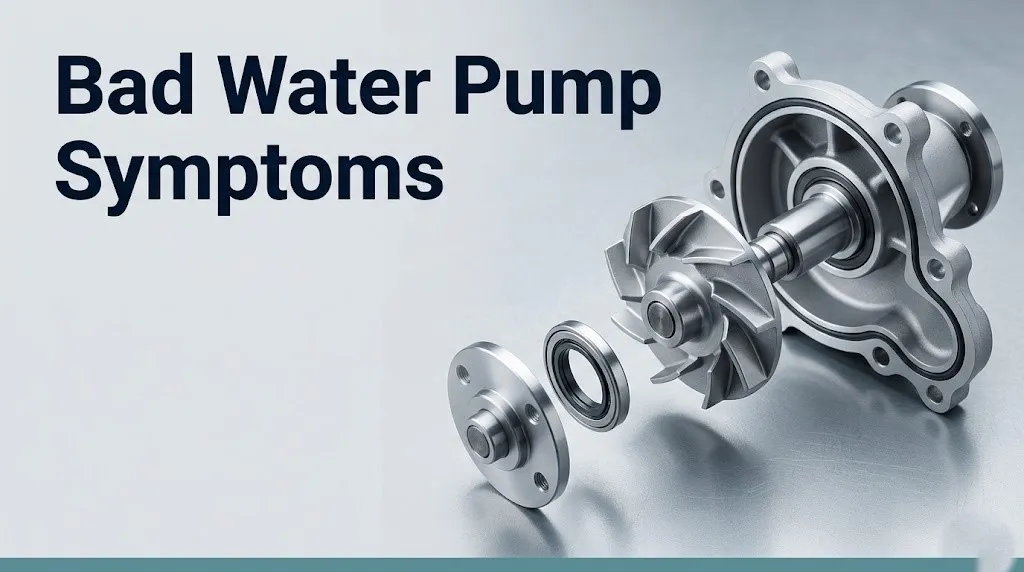
A car water pump is a centrifugal hydraulic pump that circulates coolant continuously through the engine block, cylinder head, radiator, heater core, and back to the pump inlet, maintaining the engine at its designed operating temperature.
Think of the water pump as the heart of the cooling system, and the coolant as the blood. The pump doesn’t create temperature: it moves the fluid that carries heat away from the engine’s hottest areas (the combustion chambers and cylinder walls) to the radiator, where airflow removes that heat before the cooled fluid returns to repeat the cycle.
The pump’s central component is the impeller, a disc fitted with curved vanes that rotates inside the pump housing. As the impeller spins, driven either by the serpentine belt, timing belt, or an electric motor, the vane geometry accelerates coolant outward by centrifugal force. This creates a low-pressure zone at the pump’s center (inlet) and higher pressure at the outlet, driving coolant through the entire cooling circuit.
A typical engine coolant flow rate ranges from 10 to 40 gallons per minute depending on engine size and RPM, according to SAE International cooling system engineering references. That flow rate is what keeps aluminum cylinder heads from overheating and failing under the intense thermal load of combustion.
Older vehicles and most current trucks and performance cars use belt-driven mechanical pumps, while many vehicles produced after 2010, particularly European models and hybrids, use electrically driven pumps. The failure modes and symptom profiles of these two designs differ in ways that most online guides ignore entirely.
How a Failing Water Pump Damages Your Engine
A failing water pump damages your engine by reducing or stopping coolant flow, allowing combustion heat to build in the engine block and cylinder head beyond the thermal tolerance of aluminum components, gaskets, and seals.
The damage sequence follows a predictable thermal escalation. When coolant flow drops below the threshold needed to maintain normal operating temperature (typically 195 to 220 degrees Fahrenheit for most engines), the engine begins operating in the overheating range. Aluminum cylinder heads, which expand at roughly twice the rate of cast iron engine blocks per degree of temperature rise, begin to distort relative to the block surface.
That distortion is what destroys head gaskets. The gasket is compressed between two metal surfaces that are now moving at different rates under thermal stress. Once the gasket fails, combustion gases enter the cooling system, coolant enters the combustion chamber, and the engine requires a head gasket replacement costing $1,500 to $3,000 in most cases, according to automotive repair cost data from RepairPal’s national cost database.
Extended overheating beyond the head gasket failure stage can cause cylinder head warping (requiring machining or replacement at $500 to $1,500 additional) and, in the most severe cases, piston seizure from inadequate lubrication when coolant contaminates the oil. These are not theoretical risks. They are documented failure consequences of driving a vehicle with a confirmed failing water pump past its warning signs.
Turbocharged engines face an accelerated damage timeline. Turbochargers operate at exhaust temperatures exceeding 1,600 degrees Fahrenheit and rely on coolant circulation (and oil flow) to cool the turbo bearing housing after engine shutdown. A failing pump that allows coolant flow to stop completely risks oil coking in the turbo bearing housing, destroying the turbocharger as a secondary failure.
Key Takeaway: A failing water pump is not a “fix it next month” problem. The damage progression from early pump failure to blown head gasket to warped cylinder head follows a predictable sequence that can be prevented if the warning signs are addressed when they first appear.
Coolant Leak From a Water Pump
A coolant leak from a water pump appears as a wet or crusty residue near the front-center of the engine, often below the pump pulley, and it is produced by failure of the pump’s shaft seal, gasket, or O-ring sealing the pump to the engine block.
Coolant leaks are identifiable by the fluid’s characteristic color (typically bright green, orange, pink, or blue depending on the coolant type used), its slightly sweet smell, and its slippery feel between the fingers. A fresh leak may appear as a wet stain. An older, slower leak often shows as a dried, crystallized white, green, or orange residue caked around the pump housing or on the engine block below the pump.
The sealing surfaces on a water pump are the shaft seal (which prevents coolant from traveling along the rotating shaft to the bearing), the gasket between the pump housing and the engine block, and in some designs, an O-ring or press-fit seal at the pump outlet port. Each of these can fail independently, and each produces a slightly different leak location.
ASTM International coolant specification standards, including ASTM D3306 for conventional ethylene glycol coolant, specify corrosion inhibitor packages designed to protect metal sealing surfaces. When coolant is not changed on the manufacturer’s recommended interval (typically every 2 to 5 years depending on coolant type), the corrosion inhibitor depletes, and the acidic or alkaline coolant chemistry begins attacking the pump housing gasket surface and shaft seal elastomer, accelerating leak development.
Drivers in regions with hard water should note that tap water used to top off the cooling system introduces minerals that deposit on internal pump surfaces and accelerate corrosion of the pump housing and sealing surfaces faster than soft water or distilled water additions.
To locate a water pump coolant leak accurately:
- Allow the engine to cool completely before inspecting (at least 2 hours after last operation).
- Open the hood and look for wet staining or dried crystalline residue directly behind the water pump pulley and on the engine block face where the pump bolts on.
- Run a clean white cloth or paper towel along the lower edge of the pump housing to collect any seeping coolant for color and smell identification.
- Check the coolant reservoir level. A gradually dropping level with no visible external puddle suggests a slow internal or pressurized leak that appears only when the system is at operating temperature.
- Have an ASE-certified mechanic perform a cooling system pressure test using a hand-pump pressure tester to confirm the leak source before committing to pump replacement.
Water Pump Noise Symptoms
Water pump noise symptoms include a whining, grinding, squealing, or rumbling sound that originates from the front of the engine at the pump location, increases with engine RPM on belt-driven pumps, and indicates bearing wear or impeller contact with the pump housing.
The water pump’s bearing assembly, typically a sealed radial ball bearing, supports the rotating shaft and impeller against the forces applied by belt tension (on mechanical pumps) and coolant pressure. As the bearing wears, its internal clearances increase. The shaft develops radial runout, a slight wobble with each rotation, and the bearing race begins producing an audible grinding or rumbling sound as degraded steel balls ride on worn races.
Think of a worn pump bearing like a shopping cart wheel with a failing ball bearing. At slow speeds, the wobble is barely noticeable. At higher speeds, the vibration becomes pronounced, and the noise increases proportionally. On a belt-driven water pump, that correlation with engine RPM is a diagnostic clue: if the noise increases as you rev the engine, it originates from a rotating component driven at engine speed.
The most reliable way to isolate water pump bearing noise from other accessory noise sources:
- With the engine running at idle (do not reach into a running engine; listen from a safe distance), note whether the noise is continuous or intermittent.
- Using an automotive stethoscope (a mechanic’s tool that touches specific components safely with the engine running), have an ASE-certified technician probe the pump body directly to confirm the noise is loudest at the pump housing.
- Do not attempt to test shaft wobble with the engine running. With the engine off and cold, grasp the pump pulley and attempt to rock it side to side. More than 1 to 2 millimeters of play indicates bearing wear.
- Note whether the noise is accompanied by visible pulley wobble during engine operation, which confirms bearing degradation severe enough to cause impeller misalignment.
Drivers of diesel pickup trucks should note that diesel water pump bearings are subject to higher sustained thermal and belt tension loads than gasoline equivalents, and bearing noise in diesel applications may appear earlier in mileage terms than the 60,000 to 100,000 mile typical failure range for gasoline engines.
Engine Overheating as a Water Pump Symptom
Engine overheating caused by a bad water pump occurs when insufficient coolant flow allows combustion heat to accumulate in the engine block and cylinder head faster than it can be dissipated, causing the coolant temperature to exceed the normal operating range of 195 to 220 degrees Fahrenheit.
The temperature gauge on your dashboard is connected to a coolant temperature sensor (CTS) threaded into the engine block or cylinder head coolant jacket. When the sensor reads above the normal midpoint of the gauge’s range, or when the warning light activates, the engine is operating outside its designed thermal envelope.
A water pump’s contribution to overheating is most apparent at highway speeds, when the engine generates maximum heat under sustained load, and the pump must deliver maximum coolant flow to keep pace. A pump with a worn impeller (reduced efficiency) or partial bearing seizure may maintain adequate coolant flow at low RPM and idle but fail to keep up at higher RPM, producing a pattern of normal temperatures in stop-and-go traffic and overheating at highway speed.
Quick Tip:
- If your temperature gauge climbs above the midpoint on the highway but drops back to normal in city traffic, a partially failing water pump with reduced high-RPM flow capacity is one of the most likely explanations.
- Turn on the cabin heater to full heat and maximum fan when overheating begins. This diverts heat through the heater core (a second heat exchanger), reducing the thermal load on the main radiator circuit and buying time to reach a safe stopping point.
- Drivers of older vehicles with original equipment water pumps past 100,000 miles should have the cooling system pressure-tested and the pump inspected before summer driving seasons, when ambient temperatures reduce the temperature differential available for radiator heat rejection.
Key Takeaway: A water pump that causes overheating at highway speed but not at idle is showing classic partial impeller or bearing failure. That pattern is mechanically specific and tells a competent mechanic exactly where to look before any component is removed.
Water Pump Weep Hole Leak
The water pump weep hole is a small intentional aperture drilled into the pump housing between the shaft seal and the bearing assembly, and seepage from this hole is the earliest mechanical sign of shaft seal degradation in a belt-driven water pump.
Most vehicle owners and many non-specialist mechanics misidentify weep hole seepage as a gasket leak or dismiss it as condensation. It is neither. The weep hole has a specific engineering purpose: it vents coolant that has bypassed the shaft seal before that coolant can reach the bearing assembly. Once coolant reaches the bearing, it strips the lubricating grease from the ball races, accelerating bearing failure dramatically.
A minor, intermittent weep with no coolant puddle under the vehicle may be acceptable as defined by some OEM technical service manuals (typically described as a slight discoloration or film without active dripping). Active dripping from the weep hole, a coolant stain extending beyond the immediate pump area, or any weep hole discharge accompanied by bearing noise indicates that the shaft seal has degraded beyond its service tolerance and pump replacement is warranted.
The weep hole is located on the underside of the pump housing, approximately aligned with the pulley face. To locate it:
- Park on a clean, dry surface and let the engine cool completely.
- Use a flashlight to inspect the underside of the pump housing, just inboard of the pulley mounting flange.
- Look for a small hole, approximately 2 to 4 millimeters in diameter, often surrounded by a dried mineral or coolant residue ring.
- A Q-tip or white cloth can be pressed gently against the weep hole area to collect any active seepage for color confirmation.
Drivers of vehicles with interference engines, where the water pump is driven by the timing belt and must be replaced at the timing belt service interval regardless of condition, should discuss weep hole inspection with an ASE-certified technician at every timing belt service. Timing belt-driven pumps that fail between service intervals can cause timing belt derailment and catastrophic engine valve damage in interference engine designs.
White Smoke and Steam From a Bad Water Pump
White smoke or steam rising from under the hood of a vehicle with a bad water pump indicates that coolant has escaped the cooling system and is contacting the hot engine block, exhaust manifold, or other high-temperature surfaces where it immediately vaporizes.
Steam is distinct from smoke in appearance and smell. Steam from coolant is white, dissipates relatively quickly in open air, and carries a slightly sweet or chemical odor from the ethylene glycol content of the coolant. Engine oil smoke is typically blue-grey, thicker, and smells burnt rather than sweet. Distinguishing these by smell and appearance helps identify the source before the hood is opened.
When a water pump seal or gasket fails acutely under operating pressure, coolant can escape rapidly onto the exhaust manifold or any other surface operating above coolant’s vaporization point. The result is immediate steam production visible from outside the vehicle. This represents a late-stage or acute failure event, not an early warning sign.
Do not open the radiator cap or coolant reservoir cap on an engine producing steam. The cooling system operates under pressure (typically 13 to 16 PSI above atmospheric pressure in most passenger vehicles). At operating temperature, coolant inside the system reaches temperatures exceeding 250 degrees Fahrenheit. Opening the cap releases that pressure instantly. The resulting steam and superheated coolant can cause severe burns to hands, arms, and face.
If steam appears from under the hood while driving:
- Signal, check mirrors, and pull over safely to the right shoulder or a parking area. Do not continue driving.
- Turn the engine off. Do not leave it idling: idle-speed coolant flow in a pump that is actively failing or a system that has lost coolant is insufficient to prevent thermal damage.
- Wait a minimum of 30 minutes before opening the hood. Wait at least 60 minutes before touching any cooling system component.
- Call roadside assistance (AAA or your vehicle’s roadside service) rather than attempting to add coolant and continue driving.
Heater Not Working as a Water Pump Symptom
A cabin heater that stops producing warm air, or produces noticeably cooler air than normal, can indicate water pump failure because the heater core depends on hot coolant circulated by the water pump to transfer heat into the cabin air stream.
The heater core is a small radiator-like heat exchanger mounted inside the dashboard. Hot coolant from the engine flows through the heater core’s internal passages, and the blower fan pushes cabin air across its fins, picking up heat and delivering it to the passenger compartment. If coolant flow through the heater core drops because the water pump is circulating inadequately, the heater output drops proportionally.
This symptom is often misattributed to low coolant level, a stuck thermostat, or a failed heater core itself. The differentiating clue is correlation with other water pump symptoms: if the heater output has dropped alongside a rising temperature gauge, grinding noise from the front of the engine, or a coolant leak, the water pump is the most likely common cause.
In vehicles with electronically controlled variable-flow water pumps (common on BMW, Mercedes-Benz, and Volkswagen Group vehicles since approximately 2010), the heater output may drop intermittently or only at certain engine speeds, because the pump’s flow rate is modulated electronically rather than tied directly to belt-driven engine RPM. These symptoms are harder to correlate and may trigger no OBD-II fault code until the pump fails completely.
Drivers in cold-weather regions who notice reduced heater output in January or February while also noticing their engine temperature running slightly above normal should bring both symptoms to an ASE-certified technician simultaneously. Presenting both symptoms together gives the technician the diagnostic context to distinguish a water pump issue from a heater control valve, blend door, or thermostat problem efficiently.
Key Takeaway: A heater that suddenly loses output alongside any other cooling system symptom (rising temperature gauge, noise, coolant loss) is a cluster presentation that points specifically toward water pump failure rather than an isolated HVAC fault.
Temperature Gauge Fluctuating Water Pump
A temperature gauge that fluctuates erratically, swinging between normal and above-normal without a clear pattern, can indicate a water pump with intermittent coolant flow caused by a damaged or partially separated impeller, air pockets in the cooling system from a slow leak, or early thermostat interaction with reduced pump output.
The dashboard temperature gauge reflects the reading from the coolant temperature sensor, which measures coolant temperature at a fixed point in the engine block or cylinder head coolant passage. When coolant flow is steady and the pump is functioning correctly, the gauge stabilizes at the normal midpoint within a few minutes of warm-up and holds there consistently. Fluctuating readings mean the sensor is experiencing varying coolant temperatures at that fixed point, which indicates either irregular flow, air pockets displacing coolant at the sensor, or intermittent thermostat function.
A specific failure mode relevant to temperature fluctuation is impeller slip or detachment. In some water pumps, particularly those with plastic impellers (common in cost-reduced OEM designs from the early 2000s), the impeller can slip on the shaft or partially detach from the hub. When this happens, the impeller spins at a reduced rate relative to the shaft, reducing coolant flow unpredictably. The temperature gauge fluctuates because flow is inconsistent rather than zero.
According to documented Technical Service Bulletins (TSBs) from OEM manufacturers, plastic impeller degradation has been a noted failure pattern in several specific engine families, including the Chrysler 2.7L V6 (multiple model years) and certain Chevy Ecotec 2.2L applications. Owners of vehicles in these platforms who observe temperature gauge fluctuation alongside other cooling symptoms should specifically mention impeller integrity to their servicing technician.
Water Pump Bearing and Seal Failure Symptoms
Water pump bearing and seal failure produce distinct but often co-occurring symptoms: bearing wear produces audible noise, visible shaft wobble, and eventual impeller misalignment, while seal failure produces coolant leakage at the weep hole or pump face before bearing contamination occurs.
These two failure modes are mechanically connected. The shaft seal separates the coolant-wetted impeller compartment from the bearing assembly compartment. When the seal degrades, coolant seeps into the bearing cavity. Bearing grease, which lubricates the ball races against the radial loads imposed by belt tension and coolant pressure, is water-soluble and washes out rapidly once coolant infiltrates the bearing housing. The bearing then runs with inadequate lubrication, generating heat, accelerating wear, and producing the grinding or rumbling noise drivers hear from the front of the engine.
| Failure Mode | Primary Symptom | Secondary Symptom | Timeline to Replacement |
|---|---|---|---|
| Shaft seal degradation | Weep hole seepage, coolant residue | Dropping coolant level | Replace at first active dripping |
| Gasket or O-ring failure | External coolant leak at pump face | Coolant smell, puddle under vehicle | Replace immediately |
| Bearing wear (no seal breach) | Whining or grinding noise at engine RPM | Shaft wobble detectable by pulley rock test | Replace before noise becomes severe |
| Bearing failure with coolant contamination | Grinding noise plus weep hole seepage | Rapid bearing deterioration | Replace immediately |
| Impeller slip or detachment | Temperature fluctuation, reduced heat output | Overheating at high RPM | Replace immediately |
High-performance and turbocharged vehicle owners face accelerated bearing failure risk because their engines operate at sustained higher coolant temperatures and higher coolant pressures, both of which increase the thermal and mechanical load on the pump’s bearing assembly beyond the conditions it experiences in a standard naturally aspirated passenger car application.
Water Pump Cavitation and Impeller Erosion
Water pump cavitation is a hydrodynamic phenomenon where localized low-pressure zones on the impeller vane surfaces allow coolant to briefly vaporize, forming small vapor bubbles that collapse violently against the impeller metal, progressively eroding the vane surfaces.
Cavitation sounds complicated, but its physical analogy is straightforward. Think of repeatedly snapping a wet towel against a metal surface. Each individual snap is small, but thousands of snaps per second over months of engine operation eventually pit and groove the metal. That is what vapor bubble collapse does to an impeller’s vane surfaces: each bubble implosion creates a microscopic shockwave that chips away at the aluminum or cast iron of the vane.
The conditions that promote cavitation in a car water pump include: coolant that has degraded below its recommended concentration (diluted below the 50/50 coolant-to-water ratio, which raises the coolant’s vapor pressure), entrained air in the cooling system from a slow leak or recent coolant top-off, and pump operating speeds beyond the impeller’s designed efficiency range (which can occur in modified or high-revving engines).
ASTM International coolant specification D3306 and D6210 specify the ethylene glycol concentration ranges (typically 40 to 60 percent by volume) at which coolant’s vapor pressure, corrosion inhibitor performance, and freezing protection are within design parameters. Coolant diluted below 40 percent glycol concentration not only loses freeze protection but also increases the vapor pressure of the fluid, lowering the cavitation threshold of the pump.
Observable symptoms of impeller erosion from cavitation are indirect: the pump becomes progressively less efficient as vane surfaces are damaged, producing reduced coolant flow, rising operating temperatures, and reduced heater output without any external leak or audible bearing noise. This makes cavitation damage one of the harder failure modes to identify without pump disassembly or professional diagnosis.
Key Takeaway: Cavitation damage is a silent killer of water pumps: it produces no leak, no audible noise, and no dramatic symptom until the impeller is so degraded that coolant flow drops enough to cause overheating. Maintaining correct coolant concentration prevents it.
Electric Water Pump Failure Symptoms
Electric water pump failure symptoms differ from mechanical pump failure symptoms because electric pumps do not produce the characteristic belt-driven noise or weep hole leak that alerts drivers to a mechanical pump problem, making electric pump failure harder to detect before overheating occurs.
Many vehicles produced after 2010, including most BMW models using the N52, N54, and N55 engine families, Volkswagen and Audi vehicles with the EA888 engine series, Toyota hybrid models (Prius, Camry Hybrid), and various Mercedes-Benz platforms, use electrically driven coolant pumps in place of or in addition to belt-driven mechanical pumps. The electric pump is controlled by the engine control module (ECM) and can vary its flow rate independently of engine RPM.
When an electric water pump fails, it typically does so through motor winding failure, impeller jam, or electronic control failure rather than bearing wear or seal degradation. The result is often a complete and sudden loss of coolant circulation rather than the gradual degradation typical of mechanical pump failure.
Symptoms specific to electric water pump failure:
- No audible warning noise: electric motors fail silently in most cases.
- No weep hole: electric pumps typically do not have a mechanical shaft seal weep hole.
- Sudden overheating with no prior temperature gauge warning in some failure modes (motor seizes without warning).
- An OBD-II fault code stored in the ECM: electric pump failures frequently trigger codes such as P0128 (coolant temperature below thermostat regulating temperature, indicating insufficient flow), or manufacturer-specific fault codes for pump circuit malfunction.
- In BMW applications specifically, the iDrive or instrument cluster may display a cooling system warning message before temperature gauge changes.
Any vehicle owner with a post-2010 European or hybrid vehicle who experiences sudden overheating with no prior symptoms, no coolant leak, and no audible noise should have an ASE-certified technician scan the vehicle for ECM fault codes as the first diagnostic step, rather than assuming a mechanical pump failure presentation.
Bad Water Pump vs Bad Thermostat Symptoms
A bad water pump and a bad thermostat both cause engine overheating, but they produce different symptom patterns that a driver can use to identify which component is more likely responsible.
The thermostat is a thermostatic valve in the cooling circuit that stays closed when the engine is cold, directing coolant through a bypass loop (not through the radiator) to allow faster warm-up. Once coolant reaches the thermostat’s rated opening temperature (typically 185 to 205 degrees Fahrenheit), it opens fully, directing flow through the radiator for cooling. A thermostat that fails in the closed position blocks coolant from reaching the radiator, causing rapid overheating. A thermostat that fails in the open position allows coolant to circulate through the radiator constantly, causing the engine to run below normal operating temperature.
| Symptom | Bad Water Pump | Bad Thermostat (stuck closed) | Bad Thermostat (stuck open) |
|---|---|---|---|
| Overheating | Yes, typically gradual or at high RPM | Yes, rapid from cold start | No |
| Runs too cold | No | No | Yes |
| Coolant leak | Yes (seal or gasket) | No | No |
| Audible noise | Often (bearing) | No | No |
| Weep hole seepage | Yes (seal failure) | No | No |
| Heater output reduced | Yes | Yes (if stuck closed, no hot coolant) | No |
| Temperature fluctuation | Yes (impeller issue) | Typically rapid rise then stabilizes high | Slow to warm, runs below normal |
| OBD-II fault codes | Rare (mechanical) | P0128, P0125 common | P0128 most common |
The most reliable differentiating sign is the presence of a coolant leak, audible bearing noise, or weep hole seepage. These are specific to water pump failure and do not occur in thermostat failure. Conversely, an engine that runs consistently below the normal temperature midpoint (gauge in the lower half of the range) points exclusively toward a thermostat stuck open, not a water pump issue.
Older vehicles with original-equipment thermostats past 100,000 miles or 10 years of service should have the thermostat inspected alongside the water pump, because both components share similar service life expectancy and it is standard practice to replace the thermostat when replacing the water pump to avoid a second labor charge for the same job.
How Long Can You Drive With a Bad Water Pump
How long you can drive with a bad water pump depends entirely on which component of the pump has failed and how severely, with the practical answer ranging from no further driving at all (acute overheating) to a short monitored drive to a repair facility (slow leak with normal temperature gauge).
This is not a decision to be made casually. The variables that determine safe continued driving distance are:
- Current engine temperature gauge reading: If the gauge is above the normal midpoint, do not drive. If it remains at the normal midpoint, short-distance driving with monitoring may be acceptable.
- Active coolant loss rate: A pump losing coolant rapidly (visible dripping at idle) can empty the cooling system within miles. A slow seep may allow limited driving.
- Bearing condition: A pump with a grinding or squealing bearing is approaching mechanical seizure. If the pump shaft seizes while driving, it can shred or lock the serpentine belt, potentially disabling power steering and the alternator simultaneously.
- Distance to a repair facility: Driving two miles to a shop on a known slow leak with a normal temperature gauge is categorically different from driving 40 miles on a highway with a temperature gauge at the high end of the normal range.
- Vehicle make, model, and engine interference design: Vehicles with timing belt-driven water pumps face an additional risk. If the pump locks up, it can break or jump the timing belt, causing catastrophic engine valve damage in interference engine designs.
If the temperature gauge enters the red zone or reaches maximum at any point, pull over safely and immediately. Turn the engine off. Do not continue driving. Call roadside assistance. The cost of a tow is a fraction of the cost of a rebuilt engine.
Drivers who choose to drive a known-bad water pump to a shop should check the coolant level before starting, drive the minimum distance possible, monitor the temperature gauge continuously, and be prepared to pull over and stop if the gauge rises above the normal range at any point.
Key Takeaway: There is no universal safe driving distance for a bad water pump. The only safe answer is: address it as soon as possible, do not drive if the temperature gauge is elevated, and call for a tow if the gauge enters the red zone at any point.
How to Diagnose and Test a Bad Water Pump
Diagnosing a bad water pump accurately requires a structured inspection sequence that rules out other cooling system components before concluding the pump is the cause of observed symptoms.
Many cooling system problems, including thermostat failure, radiator blockage, cooling fan failure, and head gasket breach, produce symptoms that overlap with water pump failure. Replacing the pump without confirming it as the fault source wastes money and may leave the actual problem unresolved.
Diagnostic sequence for a suspected bad water pump:
- Check the coolant level in the reservoir and at the radiator cap (engine cold only). Low coolant points to a leak source that needs location before diagnosis is complete.
- Perform a cooling system pressure test. An ASE-certified technician uses a hand-pump pressure tester attached to the cooling system filler neck. The system is pressurized to its rated cap pressure (usually 13 to 16 PSI). If pressure drops, a leak exists. The technician traces the leak source to the pump, hose, radiator, or head gasket.
- Inspect the weep hole. With the engine cold, locate the weep hole on the pump housing underside. Active dripping or heavy crystalline buildup confirms shaft seal failure.
- Test the pump pulley for bearing play. Engine off and cold: grasp the pump pulley and rock it perpendicular to the shaft. More than 1 to 2 millimeters of movement indicates bearing wear. Note any roughness when rotating the pulley by hand.
- Scan for OBD-II fault codes. Particularly relevant for electric water pump applications. Codes P0116, P0117, P0118, P0119, and P0128 all relate to coolant temperature circuit faults that may indicate pump flow issues.
- Request a flow and function test if impeller slip is suspected. Some technicians use an infrared thermometer to measure temperature differential between the pump inlet and outlet at operating temperature, confirming whether adequate coolant is actually moving through the circuit.
- Inspect belt tension and condition on belt-driven pumps. A worn or loose serpentine belt can cause the pump to slip and underperform without the pump itself being faulty. Belt condition rules out a false positive diagnosis.
An ASE-certified mechanic at a reputable independent shop or dealership service center is the appropriate professional to perform this diagnostic sequence, interpret the results, and confirm whether pump replacement is warranted.
When to Stop Driving: Safety Guidance for Water Pump Failure
Certain water pump failure presentations require stopping the vehicle immediately, not driving cautiously to a shop, because continued operation will cause engine damage within minutes.
Pull over safely and turn off the engine immediately if you observe any of the following:
- Temperature gauge in the red zone or at the maximum position on the gauge face
- Steam or white vapor rising from under the hood while driving
- A sudden loss of power steering or alternator function (indicating serpentine belt failure from a seized pump pulley)
- A loud grinding, clunking, or squealing noise from the engine that appeared suddenly and is getting worse
- A coolant warning light illuminated on the dashboard alongside a rising temperature gauge
- Any combination of temperature gauge above normal AND coolant smell inside the cabin (indicating coolant is burning off inside the engine or heater core)
Do not open the radiator cap or coolant reservoir cap when the engine is hot or has been running. The system is pressurized. Superheated coolant at temperatures exceeding 250 degrees Fahrenheit will spray from the opening and cause severe burns to hands, arms, and face.
After pulling over and shutting off the engine, wait a minimum of 30 to 60 minutes before opening the hood or touching any cooling system component. Call roadside assistance through your vehicle’s service plan, AAA, or your insurance provider’s roadside assistance program. Inform them that the vehicle has overheated and you suspect a cooling system failure.
Do not add cold water to a hot engine. Pouring cold water into a superheated engine block can cause thermal shock, cracking the cylinder block or head in some engine materials.
Frequently Asked Questions About Bad Water Pump Symptoms
What are the first signs of a bad water pump?
The earliest signs of a bad water pump are coolant seepage from the weep hole below the pump pulley, a new whining or grinding noise from the front of the engine, and a very gradual upward trend in the engine temperature gauge.
These early signs typically appear before any active coolant leak, engine overheating, or steam, which is why inspecting the weep hole and listening for bearing noise during routine oil change visits can catch pump failure before it escalates.
An ASE-certified technician performing a cooling system inspection can confirm early-stage pump degradation through a pressure test and physical shaft wobble assessment before symptoms become severe.
Can I drive my car with a bad water pump?
Driving with a bad water pump is only appropriate for the shortest possible distance to a repair facility, and only if the temperature gauge remains at the normal midpoint during the drive.
If the temperature gauge rises above the normal range at any point during driving, pull over immediately and turn the engine off, as continued operation risks head gasket failure, cylinder head warping, or engine seizure.
A vehicle that has already overheated should not be driven again until an ASE-certified mechanic has inspected the cooling system and confirmed the cause and extent of any damage.
What does a bad water pump sound like?
A bad water pump typically produces a whining, grinding, or rumbling sound from the front of the engine that increases in intensity and pitch as engine RPM increases on belt-driven pumps.
This sound is produced by worn ball bearing races inside the pump bearing assembly as the bearing runs with reduced lubrication or increased internal clearance from wear.
A squealing sound that changes with belt tension (rather than engine RPM) may indicate a slipping serpentine belt rather than the pump bearing itself, and an ASE-certified technician can distinguish between these sources using an automotive stethoscope.
How do I know if my water pump or thermostat is bad?
A bad water pump typically shows a coolant leak, audible bearing noise, or weep hole seepage alongside overheating, while a bad thermostat causes overheating or chronic under-temperature without any leak or mechanical noise.
A thermostat stuck in the closed position causes rapid overheating from a cold start; a water pump failure usually causes temperature to rise gradually or specifically at highway speeds.
An ASE-certified technician can confirm which component is responsible through a cooling system pressure test, shaft wobble assessment, and OBD-II fault code scan, usually within one diagnostic appointment.
How much does it cost to replace a water pump?
Water pump replacement typically costs between $300 and $750 for most passenger vehicles including parts and labor, but timing belt-driven water pumps that require timing belt removal can cost $600 to $1,200 or more because of the additional labor involved.
Electric water pumps on European vehicles, particularly BMW models, can cost $400 to $900 for the part alone, with total repair bills ranging from $700 to $1,500 at a dealership service center.
Requesting quotes from at least two ASE-certified repair shops before authorizing the repair provides cost comparison and confirms the diagnosis through independent assessment.
How long does a car water pump last?
Most mechanical water pumps are designed to last between 60,000 and 100,000 miles or approximately 5 to 10 years of normal driving, according to typical OEM service interval guidance and automotive engineering practice.
Timing belt-driven water pumps are typically replaced at the timing belt replacement interval (usually 60,000 to 90,000 miles depending on the manufacturer) regardless of condition, because the labor cost of returning to replace a failed pump after a fresh timing belt is prohibitive.
Coolant maintenance has a direct effect on pump longevity: neglecting coolant flush intervals allows corrosion inhibitor depletion, which accelerates corrosion of the pump housing, gaskets, and impeller, shortening pump life below the expected mileage range.
What This Means for Your Vehicle Right Now
Bad water pump symptoms follow a clear mechanical progression from early warning signs (weep hole seepage, bearing noise) through mid-stage alerts (temperature gauge creeping up, reduced heater output) to acute emergency presentation (steam from the hood, temperature gauge in the red). The earlier you act on the first category of signs, the lower the repair cost and the lower the risk of secondary engine damage.
If your vehicle is showing any combination of the symptoms described here, the next step is a cooling system inspection by an ASE-certified mechanic. Ask specifically for a pressure test of the cooling system, a visual weep hole inspection, and a bearing play assessment on the pump pulley. These three checks take less than 30 minutes and give a competent technician enough information to confirm or rule out water pump failure accurately.
Your engine temperature gauge is the most reliable real-time signal you have. Keep your eyes on it. Any sustained reading above the normal midpoint is your signal to stop driving and get the vehicle inspected before you turn a $500 repair into a $5,000 one.