What Causes a Tire Blowout: Full Safety Guide 2026
The most common causes of a tire blowout are underinflation, extreme heat, tire age-related rubber degradation, overloading beyond the tire’s rated capacity, and impact damage from road hazards. Each of these causes attacks a specific structural component of the tire, producing the catastrophic rapid air loss that makes a blowout so dangerous at highway speeds.
The National Highway Traffic Safety Administration (NHTSA) reports that tire-related crashes cause approximately 11,000 accidents and result in hundreds of fatalities in the United States each year. Blowouts are a leading category within those crashes, and the injuries they produce, including traumatic brain injury (TBI), spinal cord injury, and thoracic trauma, are among the most severe caused by any roadway mechanical failure.
This guide covers every major structural cause of tire blowouts with engineering-level mechanism explanations, the warning signs you can detect before a blowout happens, the specific injuries a blowout crash produces, what to do in the moment a blowout occurs, and the concrete prevention steps that most effectively reduce your risk.
What Causes a Tire Blowout
A tire blowout is caused by structural failure of one or more tire components, resulting in the sudden and complete loss of air pressure from a pressurized tire while the vehicle is in motion.
Unlike a slow leak, which loses pressure gradually over hours or days, a blowout releases air in a fraction of a second. The sound is typically a loud bang or pop, followed immediately by a sharp pull of the vehicle toward the side where the failure occurred. That pull happens because the deflated tire produces dramatically more rolling resistance than the intact tires, creating an asymmetric braking force that the driver must actively counter.
The tire is not a single material. It is an engineered composite structure with distinct components, each serving a specific load-bearing or sealing function. A blowout occurs when one of those components fails catastrophically. Understanding which component fails in each cause type is what separates a mechanistic understanding of blowouts from a simple cause list.
Key tire structural components that can fail:
- Carcass plies: layers of fabric cord (polyester, nylon, or aramid) that form the skeleton of the tire and bear the vehicle’s weight
- Steel belt package: two or more layers of steel cord woven at opposing angles beneath the tread, providing dimensional stability under load and speed
- Bead wire ring: a bundle of high-tensile steel wires that anchor the tire’s edges to the wheel rim, maintaining the airtight seal
- Inner liner: a thin, specialized rubber layer inside the tire that replaces the inner tube and maintains air pressure
- Sidewall rubber compound: the flexible outer wall connecting the bead to the tread, designed to flex repeatedly with each rotation
- Tread compound: the outer rubber surface that contacts the road
Failure of any of these components through the mechanisms described in the following sections produces a blowout.
How Does a Tire Blowout Happen
A tire blowout happens when internal air pressure drops below the threshold needed to support the vehicle’s weight, or when a structural component fails suddenly from impact, fatigue, or material degradation, releasing air pressure too rapidly for vehicle control to be maintained.
Think of a healthy tire as a pressurized structural arch. The air inside isn’t just filling space. It’s actively holding the tire’s shape against the weight of the vehicle bearing down on it, the centrifugal forces of rotation, and the lateral forces of cornering. The moment that internal pressure drops enough, or the arch itself fractures, the system fails instantly.
The physics of a blowout operate faster than a driver’s neuromuscular response time. Research published in the Journal of Safety Research indicates that the average driver reaction time in an unexpected emergency is approximately 1.5 seconds. A blowout-induced loss of directional control begins within the first 0.2 to 0.3 seconds of the failure event. That gap between when the tire fails and when the driver can react is the primary reason high-speed blowouts are so frequently fatal.
At the structural level, the failure sequence typically follows this pattern in a fatigue-based blowout:
- Repeated mechanical stress (from underinflation, overloading, or age-related stiffness) accumulates in the carcass plies or the rubber-to-steel-cord adhesive bond
- Heat generated by hysteresis (energy conversion to heat during cyclic rubber deformation) accelerates adhesive bond degradation
- Delamination begins between the steel belt and the overlying rubber compound
- The delaminated section of tread and belt separates from the tire body during rotation
- The sudden structural breach causes instantaneous pressure loss through the inner liner
Elderly drivers aged 70 and older face a compounded risk at this moment. Age-related decline in vestibular system function and proprioceptive feedback reduces the speed and precision of corrective steering inputs, making the loss-of-control phase of a blowout significantly more likely to result in a crash.
What Causes Tire Blowouts: The Primary Causes Overview
The primary causes of tire blowouts fall into six categories: underinflation, heat-accelerated rubber degradation, tire age and material brittleness, overloading beyond load rating, road hazard impact damage, and manufacturing defects.
These causes are not equally common or equally preventable. Underinflation accounts for the largest proportion of tire blowouts. NHTSA estimates that roughly 75% of tire-related road failures involve some degree of underinflation contributing to the failure, either as the primary cause or as a contributing factor that accelerated a different failure mode.
| Cause | Primary Structural Component Attacked | Frequency | Preventability |
|---|---|---|---|
| Underinflation | Sidewall carcass plies, rubber-to-steel-cord bond | Most common | High (TPMS monitoring, regular pressure checks) |
| Heat and high temperature | Rubber compound adhesive bonds, inner liner | Very common (summer peak) | Moderate (pressure management, speed reduction) |
| Tire age and deterioration | All rubber compounds, inner liner integrity | Common in vehicles over 6 years | High (proactive replacement) |
| Overloading | Carcass plies, bead wire ring | Moderately common | High (load compliance) |
| Road hazard impact | Sidewall, inner liner, carcass plies | Moderately common | Low (road conditions variable) |
| Manufacturing defects | Variable by defect type | Uncommon but serious | Low (recall awareness) |
Commercial truck drivers face a disproportionate risk from the overloading category. A single overloaded axle on a commercial vehicle exceeds the load rating of each tire on that axle simultaneously, and the consequences of a commercial truck tire blowout at highway speed extend to all nearby passenger vehicle occupants.
Key Takeaway: Underinflation is the single leading contributor to tire blowouts, involved in roughly 75% of tire-related road failures according to NHTSA, and it is almost entirely preventable with monthly tire pressure checks.
Underinflation: The Leading Cause of Tire Blowouts
Underinflation causes tire blowouts by forcing the sidewall carcass plies to flex excessively with every rotation, generating heat through a process called hysteresis that progressively destroys the adhesive bond between the rubber compound and the steel cord reinforcement.
Here’s the engineering reality: a properly inflated tire holds its shape because the internal air pressure creates a rigid structural form. The sidewall flexes slightly with each rotation, but the geometry stays controlled. When pressure drops, even by 20% below the recommended cold inflation pressure, the sidewall begins to buckle inward with each rotation rather than flex gently. That buckling motion is orders of magnitude more mechanically stressful than normal flexion.
The heat generated by this repeated excessive flexion is not trivial. Tire engineers quantify hysteresis losses in terms of temperature rise within the tire structure. A tire running at 20 PSI below its recommended pressure on a summer highway can reach internal temperatures that degrade the natural rubber adhesive compounds used to bond the rubber matrix to the steel cord reinforcement. Once that bond weakens, the steel belt package separates from the overlying rubber, and tread separation follows.
NHTSA reports that a tire that is 25% underinflated is three times more likely to be involved in a crash than a properly inflated tire. The risk escalates exponentially, not linearly, as pressure drops further.
Quick Tip:
- Check tire pressure monthly and before any highway trip longer than two hours, using a calibrated digital gauge, not the gas station stick gauge
- Always check cold inflation pressure (before the vehicle has been driven more than one mile), because heat from driving raises pressure and gives a falsely reassuring reading
- Drivers with a tire pressure monitoring system (TPMS) warning light should note that TPMS alerts activate only when pressure has already dropped 25% below recommended levels, meaning a tire can be meaningfully underinflated without triggering any warning
Pregnant drivers face a specific additional risk. A blowout-induced crash at any speed can cause abdominal trauma from steering wheel contact, increasing the risk of placental abruption. A pregnant driver involved in any crash event, including one caused by a blowout, should be evaluated by an obstetrician-gynecologist the same day, regardless of whether they feel pain.
Heat and Temperature: How Summer Roads Cause Blowouts
High ambient temperatures and hot road surfaces accelerate the chemical degradation of tire rubber compounds, increasing blowout risk during summer months and in high-heat climates.
Tire rubber is a vulcanized polymer network. At elevated temperatures, the sulfur cross-links within that network begin to degrade through a process called reversion, softening the compound and reducing its elastic recovery after deformation. Simultaneously, high temperatures accelerate oxidative degradation of the rubber matrix, reducing its tensile strength. Both processes weaken the tire’s structural integrity before any visible change appears on the outer surface.
Road surface temperatures in summer can exceed ambient air temperature by 40 to 60 degrees Fahrenheit. On a 95-degree Fahrenheit day, the asphalt surface a tire is rolling on may be 130 to 155 degrees Fahrenheit. That radiant heat transfers directly into the tire’s contact patch, adding to the heat already being generated internally by hysteresis during normal operation.
The combination of pre-existing underinflation with summer heat is particularly dangerous. Each factor independently raises internal tire temperature. Together, they can push the rubber-to-steel-cord adhesive bond past its thermal tolerance in a matter of minutes at highway speed.
According to the American Automobile Association (AAA), tire blowout incidents increase noticeably during the summer months, with July and August representing the peak period for tire failure-related roadside emergencies across the United States.
Drivers in Arizona, Nevada, Texas, and Florida face a year-round elevated blowout risk compared to drivers in northern states, because road surface temperatures in these states exceed the national average for a larger portion of the calendar year. Adjusting tire pressure by approximately 1 PSI for every 10-degree Fahrenheit increase in ambient temperature is a standard tire industry guideline for managing heat-related pressure fluctuations.
Tire Age and Deterioration: When Old Tires Become Dangerous
Tire age causes blowouts even when tires appear visually intact, because rubber compound degradation from oxygen exposure, ozone, and ultraviolet light occurs throughout the entire tire structure, not just on the visible surface.
This is the most counterintuitive blowout cause for most drivers. A tire with 4,000 miles on it that is seven years old can be more dangerous than a tire with 40,000 miles that is three years old. Tread depth tells you nothing about the internal structural integrity of aged rubber.
The chemical process is called oxidative aging at the polymer network level. Atmospheric oxygen and ozone attack the carbon-carbon and carbon-hydrogen bonds in the rubber polymer chains. As those bonds break and reform in a degraded configuration, the rubber loses its elasticity and becomes progressively more brittle. Brittle rubber cracks under the repeated cyclic stress of rotation, and internal cracks propagate through the carcass plies in ways that are invisible from the outside until sudden failure.
Consumer Reports and multiple tire manufacturers, including Michelin and Bridgestone, recommend replacing any tire that is six years or older regardless of tread depth or apparent condition. Most manufacturers set a maximum service life of ten years from the date of manufacture, with six years as the recommended inspection threshold.
Every tire carries a DOT code on its sidewall. The last four digits of the DOT code indicate the week and year of manufacture. A tire reading “3519” was manufactured in the 35th week of 2019. Any tire manufactured before 2020 should be evaluated by a tire professional in 2026 regardless of tread depth.
Vehicles stored for long periods, including RVs, trailers, classic cars, and spare tires, are especially vulnerable to age-related tire failure. The spare tire in a vehicle trunk is often ignored during routine maintenance and can be older than the vehicle owner realizes.
Key Takeaway: A tire that is six or more years old is a blowout risk even with full tread depth. Check the four-digit DOT week-and-year code on each tire’s sidewall, and replace any tire manufactured in 2019 or earlier in 2026.
Overloading: How Exceeding Tire Load Ratings Causes Blowouts
Exceeding a tire’s load rating causes blowouts by placing mechanical stress on the carcass plies and bead wire ring beyond their engineered design limits, producing rapid material fatigue and structural failure.
Every tire carries a load index number as part of its specification. A load index of 95, for example, corresponds to a maximum load capacity of 1,521 pounds per tire. Exceed that weight and the carcass plies experience tensile stress beyond their design envelope. The bead wire ring, which holds the tire against the wheel rim and maintains the airtight seal, experiences separation forces beyond what it was engineered to resist.
The failure does not always happen immediately. Overloading tends to accumulate damage over multiple trips, weakening the carcass progressively until a final trigger, often heat or a road impact, causes sudden failure. This is why a vehicle may be overloaded repeatedly without immediate consequence and then experience a blowout seemingly without obvious cause.
Drivers moving heavy loads, including furniture, construction materials, landscaping supplies, or towing trailers near or at maximum capacity, are in the highest-risk category for overloading-related blowouts.
To assess your vehicle’s load limit:
- Locate the tire and loading information placard inside the driver’s door jamb
- Note the maximum vehicle load listed on the placard in pounds
- Add the weight of all passengers, cargo, and any trailer tongue weight
- Compare the total to the maximum load listed; if the total exceeds the listed limit, reduce load before driving
- Check the tire load index number on the tire sidewall and confirm it matches or exceeds the vehicle manufacturer’s requirement
Pickup truck drivers frequently overestimate safe payload by loading the truck bed without accounting for the weight of passengers in the cabin. A full-size pickup with four adult passengers and a loaded bed can easily approach or exceed the vehicle’s Gross Vehicle Weight Rating (GVWR), placing each rear tire near or above its individual load limit.
Road Hazards and Sidewall Damage Causing Blowouts
Road hazards cause tire blowouts by delivering sudden high-energy impacts to the sidewall or tread, puncturing the inner liner, fracturing the carcass plies, or causing an immediate bead unseating that releases air pressure instantly.
Potholes are the most common road hazard cause of blowouts in the United States. When a tire rolls over a pothole edge at speed, the sidewall is pinched sharply between the wheel rim and the pothole edge. This pinch impact can sever multiple carcass ply cords simultaneously, creating an internal structural failure that may produce a blowout immediately or may create a weakened zone that fails days later under normal driving stress.
Debris impact works differently. A nail or screw typically punctures the tread and produces a slow leak rather than a blowout, because the object often remains in place and partially seals the hole. A sharp metal fragment or large piece of debris striking the sidewall at highway speed can penetrate the inner liner directly and produce rapid air loss.
Curb strikes at an angle are a frequently overlooked cause of sidewall damage that precedes blowouts. Parallel parking errors that bring the tire into contact with the curb at 10 to 15 mph can create internal carcass ply damage that is completely invisible from the outside but catastrophically weakens the sidewall’s resistance to the cyclic stress of highway driving.
The Insurance Institute for Highway Safety (IIHS) notes that road surface condition is a contributing factor in a substantial proportion of single-vehicle crashes, many of which are initiated by tire failures caused by road hazard impacts.
Drivers of low-profile tires (with a sidewall aspect ratio of 45 or lower) face a higher risk of pothole-induced structural damage because the thin sidewall has less material to absorb impact energy before the pinch force reaches the carcass plies. Performance sports car drivers and drivers who have installed aftermarket low-profile tires on standard vehicles should be aware of this specific vulnerability.
Key Takeaway: A pothole impact or curb strike hard enough to make a noticeable impact sound warrants a sidewall inspection by a tire professional within 24 hours, even if no immediate pressure loss occurs, because internal carcass ply damage can produce a delayed blowout miles or days later.
Tire Manufacturing Defects and Blowouts
Tire manufacturing defects cause blowouts by introducing structural weaknesses during the production process that are invisible during normal inspection but produce failure under normal operating stress.
Manufacturing defects are uncommon but have been responsible for major recalls involving millions of tires. The most well-known example is the Firestone ATX and Wilderness AT tire recall in 2000, which followed investigations linking tread separation defects to over 270 deaths and hundreds of serious injuries. The defect involved improper adhesion of the steel belt package to the overlying rubber during the tire curing (vulcanization) process, producing tread separation under highway conditions.
Categories of manufacturing defects that cause blowouts include:
- Adhesion failures: inadequate bond between rubber compound and steel cord during vulcanization, causing premature belt or tread separation
- Air pocket inclusions: trapped air voids within the rubber matrix that create localized structural weakness in the carcass or sidewall
- Bead wire defects: improperly formed or under-strength bead wire that allows bead unseating under load or pressure
- Inner liner thickness variation: inconsistent inner liner thickness that creates zones of inadequate air retention
- Cord count errors: missing or misaligned carcass ply cords that reduce the structural strength of specific tire sections
NHTSA maintains an active tire recall database. Drivers can check whether their tire is subject to a safety recall by entering the tire brand, model, and size on the NHTSA website, or by entering their Vehicle Identification Number (VIN) to identify any open safety recalls affecting their specific vehicle.
Drivers of older vehicles who purchased tires second-hand or received a vehicle with tires of unknown provenance should ask a tire professional to check the tire DOT code and run it against current recall databases. Used tire sales sometimes involve tires under open recalls that the buyer has no way of knowing about without checking.
Warning Signs Before a Tire Blows Out
A tire blowout is preceded by detectable warning signs in the majority of cases, and recognizing these signs before catastrophic failure occurs is what separates a timely tire change from a high-speed crash.
The clearest warning signs a tire is approaching failure:
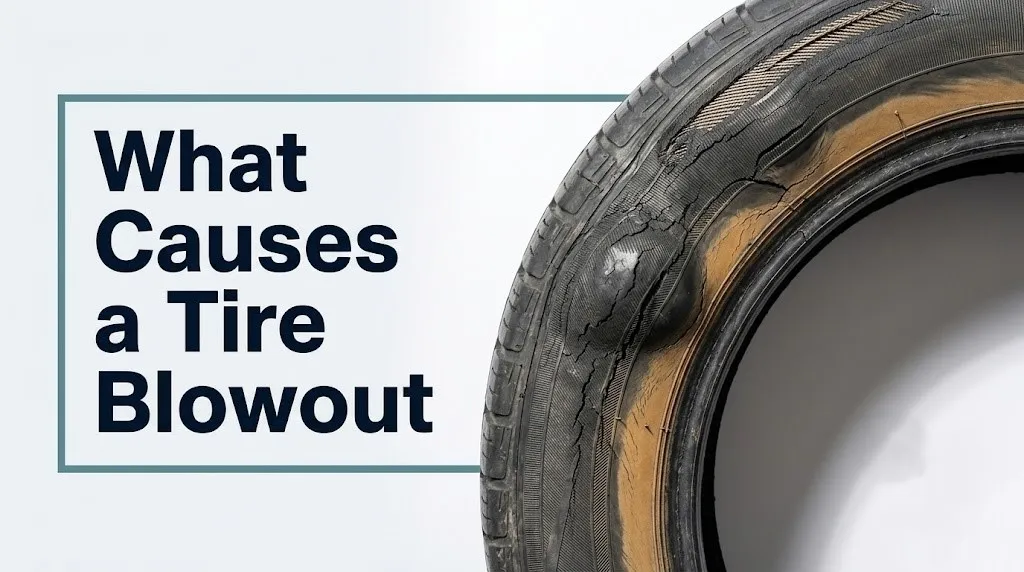
- Visible sidewall bulges or bubbles: a bulge in the sidewall indicates that the inner carcass plies have already partially separated, leaving only the outer rubber containing the air pressure. This is a failure-in-progress, not a warning to watch.
- Tread wear indicator bars visible: when tread depth reaches 2/32 of an inch, the molded wear indicator bars become flush with the tread surface. Tires at or below this depth have dramatically reduced resistance to road hazard puncture and are at elevated blowout risk.
- Vibration felt through the steering wheel or seat: unusual vibration, particularly vibration that increases at higher speeds, can indicate internal belt separation beginning before outward signs appear.
- Vehicle pulling consistently to one side: a tire losing pressure slowly from an undetected puncture will produce a consistent pull toward the deflating side.
- TPMS warning light: even though TPMS activates only when pressure has already dropped 25% below recommended, the warning light represents a meaningful failure already in progress. Stop and check pressure immediately, do not continue driving while assuming the sensor is faulty.
- Visually obvious tread cracking or sidewall cracking: surface cracks in the tread or sidewall (ozone cracking, dry rot) indicate advanced rubber oxidation and an urgent need for tire replacement.
Drivers who have difficulty bending down to inspect tire sidewalls, including elderly drivers and those with mobility limitations, can ask a tire professional at any quick-service oil change or tire shop to perform a visual inspection at any routine service visit.
What Happens to a Vehicle During a Tire Blowout
During a tire blowout, the vehicle experiences an immediate asymmetric braking force and directional pull toward the failed tire, combined with a destabilizing reduction in the structural support of that corner of the vehicle.
The physics unfold in a specific sequence. At the moment of blowout, the deflated tire’s rolling resistance increases sharply compared to the three intact tires. That asymmetric resistance acts like a braking force applied to only one corner of the vehicle. The vehicle yaws (rotates around its vertical axis) toward the side of the failure.
At low speeds, this yaw is manageable. At highway speeds above 65 mph, the same yaw moment produces a vehicle rotation rate that can quickly exceed the recovery capability of electronic stability control (ESC) systems. NHTSA began requiring electronic stability control (ESC) on all new passenger vehicles beginning with the 2012 model year. ESC systems can detect and partially compensate for blowout-induced yaw, but they cannot fully counteract the sudden directional forces of a high-speed blowout on all vehicles in all circumstances.
The failed tire also loses its ability to support the vehicle’s corner weight. The wheel drops toward the road surface. On some vehicles, particularly older models without adequate wheel arch clearance, the dropped wheel can contact the wheel arch, causing additional loss of control or debris impacts.
In a rear tire blowout, the loss of rear-end stability is more difficult to correct than a front tire blowout. Front tire blowouts produce a strong, detectable steering wheel pull that most drivers can respond to. Rear blowouts may not produce an immediately obvious steering-wheel signal, meaning the driver may not recognize the failure as quickly, and the rear of the vehicle may begin to swing before any corrective input is applied.
Tire Blowout Injuries and Health Consequences
Tire blowout-related crashes produce a specific pattern of serious injuries that includes traumatic brain injury, spinal cord injury, thoracic cage trauma, and blunt abdominal injury, with injury severity determined primarily by vehicle speed at the time of the blowout and whether a rollover occurs.
NHTSA data indicates that rollover crashes, which are a frequent consequence of high-speed blowouts, have a fatality rate approximately three times higher than non-rollover crashes of comparable speeds. The rollover mechanism produces head and neck injuries as occupants contact the vehicle’s interior roof and pillars during rotation.
Specific injury patterns from blowout-related crashes:
- Traumatic brain injury (TBI): from head contact with steering wheel, side window, door pillar, or road surface in ejection events
- Cervical spinal cord injury: from violent lateral and rotational loading of the cervical spine during rapid direction change or rollover
- Thoracic aortic injury: from high-energy deceleration loading of the chest, a frequently fatal injury in high-speed crashes
- Rib fractures and pneumothorax: from steering wheel or seatbelt loading of the thoracic cage during sudden deceleration
- Extremity fractures: from vehicle intrusion or bracing impact as occupants react to the sudden loss of control
- Placental abruption in pregnant occupants: from abdominal impact against the steering wheel or seatbelt loading
Any person who was in a vehicle during a blowout-caused crash, regardless of whether the crash appeared minor, should be evaluated in an emergency department by an emergency medicine physician if they experience any head pain, neck pain, back pain, chest pain, abdominal pain, numbness, visual changes, or confusion after the event. Spinal injury symptoms can be delayed hours after the initial trauma.
A pregnant woman involved in any crash event caused by a tire blowout should be evaluated by an obstetrician-gynecologist or maternal-fetal medicine specialist the same day, even without symptoms. Placental abruption can occur without immediate pain or visible bleeding.
Key Takeaway: A blowout crash at highway speed has a fatality rate approximately three times higher than a non-rollover crash at similar speeds, according to NHTSA data. Any occupant with post-crash head, neck, back, or chest symptoms needs emergency department evaluation, not urgent care or a wait-and-see approach.
Tire Blowout at Highway Speeds: Why Speed Multiplies Risk
A tire blowout at highway speeds above 65 mph is dramatically more dangerous than the same failure at urban speeds, because the kinetic energy available for injury-producing crash forces increases with the square of velocity.
The physics are straightforward. Kinetic energy equals one-half the vehicle mass multiplied by the square of velocity. A vehicle traveling at 70 mph carries approximately twice the kinetic energy of the same vehicle at 50 mph. That doubling of kinetic energy means a crash resulting from a 70-mph blowout must dissipate twice the energy through vehicle deformation, occupant restraint systems, and ultimately through the occupants’ own bodies.
At highway speeds, the yaw rate produced by a blowout-induced asymmetric braking force can exceed the physical recovery limits of the vehicle before the driver has time to react. The average driver recognition-and-reaction sequence (perceive the pull, recognize it as a blowout, decide to apply counter-steering, physically execute the steering input) takes approximately 1.5 to 2 seconds at best. At 75 mph, the vehicle travels 165 to 220 feet during that 1.5-to-2-second window. The lane width of a standard U.S. highway is 12 feet.
Highway speed blowouts at night carry additional risk. Reduced visibility limits the driver’s ability to identify the post-blowout vehicle path and available recovery space. Drivers who are fatigued, a condition that extends reaction time and reduces steering precision, face a compounded hazard.
According to Consumer Reports, tire blowout risk at highway speeds is substantially elevated for vehicles towing trailers because the trailer’s inertia amplifies the yaw moment produced by the blowout. A vehicle towing a loaded trailer that experiences a rear tire blowout at highway speed can experience rapid trailer swing that overcomes the vehicle’s ability to maintain directional control, even with skilled driver response.
Young drivers aged 16 to 24, while having faster reaction times than elderly drivers, have less vehicle control experience to draw on in a sudden blowout event. Inexperience with handling vehicle instability, and a higher rate of inappropriate responses (such as slamming the brakes immediately), makes this group vulnerable in a different way than elderly drivers.
How to Respond When a Tire Blows Out
The correct response to a tire blowout is counterintuitive: do not brake, do not lift your foot from the accelerator immediately, and do not steer sharply away from the direction of pull.
The instinctive driver response to a sudden loss of control is to press the brake pedal. In a blowout, that response actively worsens the situation. Braking on a deflated tire locks the vehicle into the direction the pull is taking it and removes the forward momentum that keeps the vehicle’s physics manageable. Here is what to do instead:
- Grip the steering wheel firmly with both hands at the moment you sense the blowout; the vehicle will pull suddenly and you need to counter it without overcorrecting
- Maintain your current speed momentarily: do not accelerate, but do not lift your foot abruptly. The continued forward power keeps the vehicle stable long enough for you to take control.
- Apply steady, firm counter-steering: steer gently but positively in the direction opposite to the pull to keep the vehicle in your lane
- Gradually reduce throttle and allow the vehicle to decelerate naturally over three to five seconds rather than applying brakes immediately
- Apply gentle brake pressure only after the vehicle has slowed substantially, below 40 mph, and you have stabilized the vehicle’s direction
- Signal and steer toward the road shoulder safely and progressively: do not cut across lanes; aim for the nearest point of the shoulder ahead of you
- Come to a complete stop well off the travel lanes: engage hazard lights immediately upon stopping
- Call 911 if you or any occupant has been injured, if the vehicle is in a dangerous position, or if you cannot safely change the tire off the roadway
Do not attempt to change a tire on the travel lanes or the left shoulder of a highway. The National Safety Council (NSC) reports that secondary crashes involving stopped vehicles on highway shoulders are a significant source of roadway fatalities. Move the vehicle to the farthest point of the right shoulder, away from traffic, before exiting the vehicle.
How to Prevent a Tire Blowout
Preventing a tire blowout requires consistent attention to four variables: tire pressure, tire age, vehicle loading, and tire condition, each of which addresses one of the primary failure mechanisms described in this guide.
The AAA recommends that drivers perform the following monthly tire maintenance regardless of whether a TPMS warning light is present:
Prevention steps by priority:
- Monthly cold pressure check: use a digital gauge on cold tires (driven less than one mile) and inflate to the PSI listed on the door jamb placard, not the maximum PSI listed on the tire sidewall
- DOT age check annually: look at the four-digit DOT code on each tire. Replace any tire aged six years or older, and do not allow any tire to exceed ten years of service regardless of tread depth
- Visual inspection at every fill-up: look for sidewall bulges, surface cracking, foreign objects embedded in the tread, and uneven tread wear patterns that indicate alignment or suspension problems
- Load compliance before any heavy cargo trip: check the door jamb placard for maximum vehicle load capacity and ensure cargo weight plus passenger weight does not exceed it
- Post-impact inspection within 24 hours of any significant pothole or curb strike: have a tire professional examine any tire that experienced a hard impact for internal carcass damage
- Recall status check annually: enter your VIN at the NHTSA vehicle recall database to identify any open tire or vehicle safety recalls applicable to your specific vehicle
Drivers of vehicles older than ten years should note that tire inspection services at many dealerships and tire retailers are available at no charge. Scheduling one of these inspections as part of an annual vehicle maintenance visit provides an expert second check on tire condition that a visual inspection by the driver alone cannot replicate.
Emergency Safety: When to Call 911 After a Tire Blowout
Certain situations following a tire blowout require immediate emergency response. Do not attempt to manage these situations without calling for help.
Call 911 immediately if any of the following occur:
- The vehicle has crashed, rolled, or left the roadway following a blowout
- Any occupant of the vehicle has lost consciousness, even briefly
- Any occupant complains of head pain, neck pain, back pain, chest pain, or difficulty breathing after a crash
- A pregnant occupant was in the vehicle during any crash event, regardless of perceived severity
- The vehicle is stopped in a position that puts it in the path of oncoming traffic
- Any occupant has been ejected from the vehicle
- You smell fuel, see smoke, or see flames after a crash stop
- You or another occupant cannot move a limb, has numbness or tingling, or has visual disturbance after the event
Do not move a crash victim who has neck or back pain unless the vehicle is on fire or there is an immediate life-threatening hazard requiring movement. Moving a person with a potential cervical spine injury without stabilization can convert an incomplete spinal cord injury into a complete and permanent one.
These situations represent potential traumatic brain injury, spinal cord injury, thoracic trauma, or hemorrhage, all of which require emergency medical assessment by emergency medicine physicians and trauma surgeons, not an urgent care visit or a drive to a primary care office the next day.
Frequently Asked Questions About Tire Blowout Causes
What is the most common cause of a tire blowout?
Underinflation is the most common cause of tire blowouts, contributing to approximately 75% of tire-related road failures according to the National Highway Traffic Safety Administration.
Low air pressure forces the sidewall carcass plies to flex excessively with each rotation, generating heat through hysteresis that degrades the rubber-to-steel-cord adhesive bond until belt or tread separation occurs.
Checking tire pressure monthly with a calibrated digital gauge and inflating to the door jamb placard specification is the most effective single preventive action a driver can take.
Can a tire blow out without any warning?
A tire can blow out without obvious external warning signs, particularly when the failure is driven by internal rubber compound degradation, manufacturing defects, or sudden road hazard impact damage.
Many blowouts are preceded by detectable signs including sidewall bulges, vibration through the steering wheel, vehicle pulling to one side, and surface cracking in the sidewall or tread, all of which a driver or tire professional can identify before catastrophic failure.
Regular monthly pressure checks and visual inspections at every fuel stop allow drivers to catch the majority of pre-blowout warning signs before the failure becomes uncontrolled.
How dangerous is a tire blowout at highway speed?
A tire blowout at highway speeds above 65 mph is among the most dangerous mechanical vehicle failures a driver can experience, because the kinetic energy available for crash impact increases with the square of velocity.
NHTSA data indicates that rollover crashes, which frequently result from high-speed blowouts, have a fatality rate approximately three times higher than non-rollover crashes at similar speeds.
The gap between blowout occurrence and the driver’s ability to respond is approximately 1.5 seconds, during which the vehicle at 75 mph travels over 160 feet.
What should you do immediately when a tire blows out?
The correct immediate response to a tire blowout is to grip the steering wheel firmly, maintain your current speed momentarily without lifting the throttle abruptly, and apply steady counter-steering to resist the directional pull.
Pressing the brake immediately is the wrong response; it locks the vehicle into the direction of the pull and removes the forward momentum that keeps vehicle physics manageable.
After stabilizing the vehicle and decelerating naturally to below 40 mph, apply gentle brakes, signal toward the right shoulder, and bring the vehicle to a complete stop well off the travel lanes before calling 911 if any injuries occurred.
How do I know if my tires are at risk of blowing out?
Tires are at elevated blowout risk if they show visible sidewall bulges, surface cracking (ozone cracking or dry rot), tread wear bars flush with the tread surface, are six or more years old by DOT code, or have recently experienced a hard pothole or curb impact.
A tire pressure monitoring system warning light indicates pressure has already dropped 25% below recommended levels, which is a meaningful underinflation already capable of accelerating sidewall fatigue damage.
Any tire showing a sidewall bulge should be considered a failure in progress and replaced immediately; driving on a bulging tire is not a matter of risk reduction but of timing before an inevitable blowout.
Can old tires cause a blowout even if they look fine?
Old tires can cause a blowout even with full tread depth and no visible external damage, because rubber compound oxidative aging occurs throughout the entire tire structure, including the inner liner and carcass, without producing surface-visible changes until the degradation is already severe.
Consumer Reports and major tire manufacturers recommend replacing tires at six years from the manufacture date regardless of remaining tread depth, because internal brittleness and adhesive bond degradation make older tires structurally unreliable under normal operating stress.
The manufacture date is encoded in the last four digits of the DOT code on the tire sidewall: a tire reading “2519” was made in the 25th week of 2019, making it seven years old in 2026 and past its recommended replacement threshold.
The single most actionable fact from this entire guide is also the most consistently ignored one: most tire blowouts are preventable. Underinflation, age-related deterioration, and overloading together account for the overwhelming majority of blowouts, and every one of these causes is detectable and correctable before catastrophic failure occurs.
Check your tire pressure with a digital gauge this week, not the TPMS light on your dashboard. Read the four-digit DOT code on each tire and calculate how old they are. Look at the door jamb placard before your next cargo-heavy trip.
If you or anyone in your vehicle experiences a blowout-related crash and has any pain in the head, neck, back, or chest afterward, go to an emergency department, not an urgent care clinic. A blowout crash is a trauma event, and trauma injuries do not always announce themselves immediately.