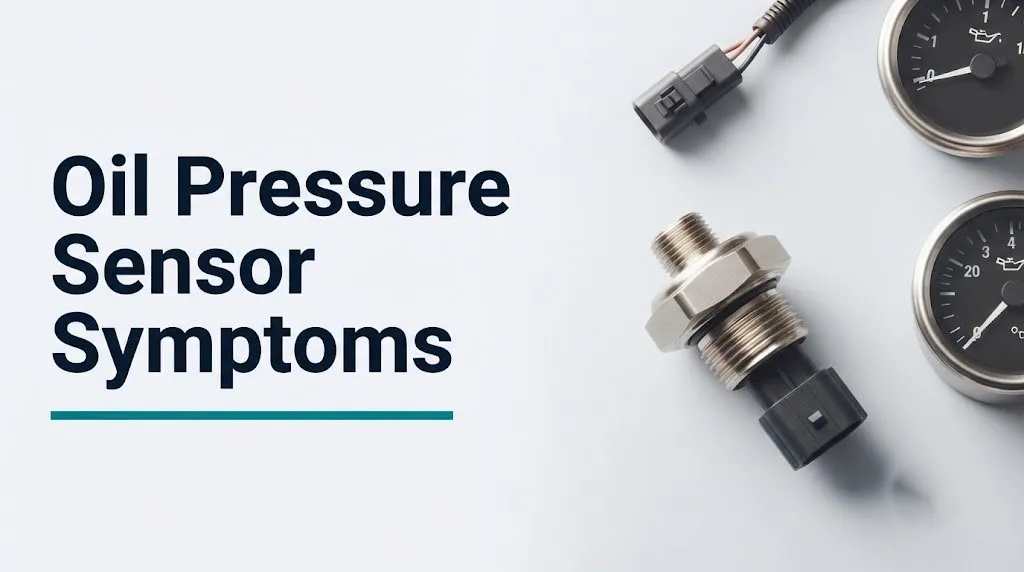
Oil Pressure Sensor Symptoms: What Your Car Tells You
Oil pressure sensor symptoms range from a warning light that flickers at idle to a gauge that reads zero at highway speed, and the difference between those two presentations determines whether you have a $25 fix or a catastrophic engine on the way. Knowing which symptoms point to a failed sensor versus genuine oil pressure loss is the single most important diagnostic question your dashboard is asking you.
The oil pressure sensor (also called the oil pressure sending unit) is one of the most safety-critical monitoring components in your engine. According to SAE International, adequate oil pressure is the mechanical foundation of hydrodynamic lubrication, the thin film of pressurized oil that prevents direct metal-to-metal contact between rotating bearing surfaces and their journals. When that film fails, bearing damage begins within seconds.
This article covers every major symptom pattern associated with a faulty oil pressure sensor, explains the electrical and mechanical mechanisms behind each one, and gives you a clear severity framework for deciding what to do right now. It also covers the symptoms of genuine low oil pressure, which look similar on the dashboard but are mechanically unrelated and far more dangerous.
Oil Pressure Sensor Symptoms: The Full Picture
The most common oil pressure sensor symptoms include an illuminated oil pressure warning light, an abnormally fluctuating or pegged pressure gauge, intermittent warning lights at idle, oil leaking from the sensor body, and the engine throwing OBD-II diagnostic trouble codes related to oil pressure circuit performance.
These symptoms can appear individually or in combination. A single flickering warning light with normal oil level and no engine noise almost always points to sensor or wiring failure. A warning light accompanied by a low gauge reading, engine knocking, or metallic noise shifts the picture entirely toward real oil pressure loss, which is a mechanical emergency.
The distinction matters because the correct response is opposite in each case. A confirmed faulty sensor with normal actual pressure means you can drive cautiously to a shop while monitoring for changes. Confirmed or suspected genuine low pressure means you stop the engine immediately, regardless of where you are.
Here is a severity overview of oil pressure sensor symptoms:
| Symptom | Likely Cause | Severity Level | Action Required |
|---|---|---|---|
| Warning light on, oil level correct, no noise | Faulty sensor or wiring | Low-Moderate | Schedule diagnostic promptly |
| Gauge fluctuates at idle, normal at speed | Sensor or loose wiring | Low-Moderate | Check oil level, schedule diagnostic |
| Light on at idle only, off at speed | Worn engine or sensor | Moderate | Professional diagnostic same week |
| Light flashing at highway speed | Sensor or genuine pressure loss | High | Pull over safely, check oil level |
| Gauge reads zero at operating speed | Genuine pressure loss possible | Emergency | Stop engine. Do not drive. |
| Knocking + warning light + low gauge | Genuine low pressure with damage | Emergency | Stop engine. Call for tow. |
| Oil leaking from sensor housing | Failed sensor seal | Low-Moderate | Do not delay repair; monitor oil level daily |
Individual variation note: Older vehicles (over 150,000 miles) with worn main bearing clearances show pressure drop symptoms that can mimic sensor failure, especially at idle. In these vehicles, a reading that looks like a marginal sensor fault may actually reflect early bearing wear. The age and mileage of the engine changes the diagnostic probability significantly.
What Is an Oil Pressure Sensor and How Does It Work
An oil pressure sensor is an electromechanical transducer that converts physical oil gallery pressure into an electrical signal readable by the instrument cluster or engine control unit (ECU).
Inside the sensor body, oil from the engine gallery contacts a flexible diaphragm (in most modern sensors) or a Bourdon tube (in some older designs). As oil pressure rises, it deflects the diaphragm. That deflection mechanically moves the wiper of a variable resistor (a rheostat or potentiometer track). The position of the wiper on the resistance track determines the electrical resistance of the sensor circuit.
Think of it like a dimmer switch connected to a pressure gauge. Higher oil pressure moves the wiper further along the track, lowering resistance, which allows more current flow and produces a higher voltage reading at the instrument cluster. The cluster translates that voltage into the needle position you see on the gauge. When the sensor’s internal resistor track corrodes, cracks, or shorts out, it sends a wrong voltage signal regardless of actual oil pressure.
The ECU in modern vehicles also monitors the sensor signal against expected values for current engine speed and temperature. When the signal falls outside expected parameters, the ECU stores an OBD-II diagnostic trouble code and may illuminate the oil pressure warning light independently of the gauge reading.
Quick Tip:
- The oil pressure sensor is not the same as the oil level sensor. The pressure sensor measures force-per-unit-area (PSI) in the lubrication circuit. The level sensor measures how much oil is in the pan.
- Most gasoline engines have oil pressure specifications between 25 and 65 PSI at normal operating temperature and moderate RPM. Specifications vary by manufacturer and engine design.
- Older vehicles built before 1996 may use a simpler oil pressure switch rather than a variable-resistance sensor, which reports only “pressure present” or “pressure absent” rather than a continuous reading.
Oil Pressure Sensor vs. Oil Pressure Switch
An oil pressure switch is a simpler, binary device that completes or breaks an electrical circuit at a single calibrated pressure threshold, typically between 4 and 8 PSI, while an oil pressure sensor provides a continuous variable reading across the full pressure range.
The switch works like a doorbell button connected to your warning light. Below the threshold pressure, the switch contacts close (or open, depending on whether the switch is normally-open or normally-closed design), completing the warning light circuit. Above the threshold, the switch breaks the circuit and the light goes out. That’s all it does. It tells you “pressure is either present or not” with no intermediate information.
The sensor, by contrast, reports a proportional voltage signal across the full range of operating pressures. This allows the instrument cluster to display an actual pressure reading (either via analog needle or digital readout) and allows the ECU to monitor pressure trends over time, not just a binary threshold.
| Feature | Oil Pressure Switch | Oil Pressure Sensor |
|---|---|---|
| Output type | Binary (on/off) | Continuous variable voltage |
| Information provided | Pressure present / absent | Actual pressure value |
| Gauge compatibility | Warning light only | Full analog or digital gauge |
| ECU integration | Limited | Full OBD-II integration |
| Common failure mode | Contacts corrode, light stays on | Resistor track fails, false reading |
| Typical cost | $10 to $25 | $20 to $60 |
| Typical vehicles | Pre-1996, basic models | 1996-present, most makes/models |
Bad oil pressure switch symptoms are almost identical to bad oil pressure sensor symptoms in practical terms: the warning light illuminates regardless of actual pressure. The distinction matters for diagnosis and replacement because the parts are different, the testing methods differ, and many vehicles use both a switch and a sensor simultaneously (one to trigger the warning light, one to feed the gauge).
Individual variation note: Some European vehicles (certain BMW, Mercedes-Benz, and Audi platforms) use oil pressure sensors integrated into a multi-function sensor cluster that also monitors oil temperature and oil quality. Failure of the combined unit can produce multiple simultaneous warning indicators that appear unrelated, which complicates diagnosis if a technician is not familiar with the platform.
Oil Pressure Warning Light On But Oil Is Full
When the oil pressure warning light illuminates and the dipstick confirms the oil level is correct and the oil appears clean, the most probable cause is a failed oil pressure sensor, a damaged wiring harness, or a poor ground connection in the sensor circuit, not genuine low oil pressure.
The warning light circuit in most vehicles is designed to illuminate when the oil pressure sensor signal falls below a calibrated voltage threshold. A sensor with a corroded resistor track, a damaged internal diaphragm, or a broken wiring connection can drop the signal voltage below that threshold without any change in actual oil gallery pressure. The engine is producing normal oil pressure. The sensor is just not reporting it correctly.
However, confirming that oil level is correct is only one step in ruling out genuine pressure problems. Oil level and oil pressure are related but not identical. An engine can have adequate oil volume but still have low pressure if the oil pump is worn, the oil pressure relief valve is stuck open, the oil is heavily diluted with fuel or coolant, or internal bearing clearances have widened from wear.
The right next step is to check not just oil level but also oil condition (color, consistency, whether it smells like fuel or coolant), and to listen for any metallic ticking, knocking, or rattling from the engine at idle or under load.
Key red flags that shift this from “probably the sensor” to “needs immediate evaluation”:
- Oil is correct on dipstick but appears milky white or caramel-colored (indicates coolant contamination)
- Oil smells strongly of gasoline (indicates fuel dilution, which thins the oil and reduces pressure)
- Warning light came on suddenly rather than intermittently
- Warning light is accompanied by any unusual engine noise
- Engine temperature is rising simultaneously
Individual variation note: In vehicles equipped with active fuel management (AFM) or cylinder deactivation systems (common in certain General Motors V8 engines), the oil pressure circuit actively controls deactivation solenoids. A false low-pressure reading from a failed sensor can trigger diagnostic codes that appear to involve the AFM system rather than the sensor itself, leading to misdiagnosis if only symptom codes rather than circuit codes are addressed.
Oil Pressure Gauge Fluctuating: What It Means
A fluctuating oil pressure gauge is one of the clearest signs of a faulty oil pressure sensor because a healthy, mechanically sound oil pressure system produces relatively stable readings that change predictably with RPM, not randomly.
In a properly functioning engine, oil pressure rises with engine speed and falls at idle. These changes are gradual and proportional. An analog gauge should show a steady reading in the normal operating range (typically between 25 and 65 PSI depending on the engine, RPM, and temperature) with smooth, predictable drops during deceleration or idle. Erratic needle swings, rapid oscillation, or readings that jump between high and low without corresponding RPM changes are characteristic of a failing sensor with an intermittent internal resistor connection.
Picture the sensor’s variable resistor like a volume knob with a worn spot on the control track. Most of the time it turns smoothly, but when the wiper hits the worn section, the reading jumps unpredictably. That’s exactly what produces the erratic gauge behavior you’re seeing.
That said, fluctuating gauge readings are not exclusively a sensor symptom. According to Mitchell1 professional repair data, a fluctuating oil pressure reading can also indicate:
- A worn oil pressure relief valve that cannot hold consistent pressure
- An oil pump with worn gears producing pulsating rather than steady flow
- An air entrainment in the oil system from a low oil level causing the pickup tube to suck air intermittently
- An internal leak in the oil gallery circuit at a gasket or plug
| Gauge Behavior | Most Likely Cause | Action |
|---|---|---|
| Oscillates rapidly at all RPM | Faulty sensor / loose wiring | Diagnostic scan; check wiring harness |
| Drops at idle, recovers at speed | Low oil level or worn bearings | Check dipstick immediately |
| Pegged high, never moves | Sensor open circuit (wiper disconnected) | Replace sensor |
| Normal at cold, drops when hot | Oil too thin, viscosity mismatch, worn bearings | Check viscosity grade, professional evaluation |
| Gradually drops over weeks | Progressive bearing wear or pump wear | Prompt professional evaluation |
Individual variation note: Vehicles equipped with variable displacement oil pumps (found on many modern turbocharged four-cylinder and V6 engines) actively modulate oil pressure electronically. On these platforms, pressure readings that appear “too low” for the RPM may be intentional ECU behavior during warm-up or low-load operation, not a sensor fault. Diagnosis without a scan tool that reads manufacturer-specific live data is unreliable on these engines.
Oil Pressure Light Comes On at Idle
The oil pressure light coming on specifically at idle while going out at higher RPM is one of the most frequently misinterpreted oil pressure sensor symptoms, and it is also one of the most diagnostically important.
At idle, the oil pump is turning slowly, producing lower oil pressure than at operating speed. This is normal. Most gasoline engines maintain approximately 7 to 15 PSI at hot idle, which is well above the typical warning light threshold of 4 to 7 PSI. If the warning light illuminates at idle but turns off as RPM rises, the actual pressure at idle may be borderline or the sensor may be triggering at a threshold that correctly reflects marginal pressure.
A faulty sensor that is slightly hypersensitive (triggering at 10 PSI rather than its calibrated 4 to 7 PSI) will illuminate the light at idle even when actual pressure is adequate. Genuine marginal idle pressure from worn main bearings will do exactly the same thing. Telling them apart requires either a professional oil pressure test with a mechanical gauge installed at the sensor port, or an oil pressure sensor replacement followed by rechecking.
The clinical equivalent here is like a smoke alarm with a dying battery: it beeps at low points (idle, where the signal is weakest) but seems fine the rest of the time. The alarm might be oversensitive, or there might actually be a small amount of smoke. You need to investigate rather than ignore it.
Key considerations for idle-only oil pressure light:
- High-mileage engines (over 150,000 miles) with worn main bearing clearances genuinely produce lower idle oil pressure and commonly trigger this pattern
- Engines running a viscosity grade thinner than specified (e.g., 0W-20 in an engine specifying 5W-30) may produce lower-than-expected idle pressure when the oil is fully at operating temperature
- Switching to a slightly higher viscosity oil (within manufacturer specification range) can confirm whether idle pressure was marginal; if the light stops, the bearing clearances may be the underlying issue
Individual variation note: The General Motors Gen IV V8 engine (LS series, 4.8L, 5.3L, 6.0L, 6.2L) has a well-documented pattern of AFM lifter failure that can cause intermittent low oil pressure at idle due to collapsed lifters diverting oil flow. In these engines, an idle oil pressure light may not be a sensor problem at all but a sign of lifter failure requiring inspection by an ASE-certified technician familiar with AFM system diagnostics.
Key Takeaway: An oil pressure warning light on with correct oil level almost always points to a faulty sensor or wiring fault, but confirming this requires checking oil condition, listening for engine noise, and testing actual pressure with a mechanical gauge before assuming the sensor is at fault.
Oil Pressure Light Flashing While Driving
An oil pressure light that flashes while driving at speed is a qualitatively different symptom from one that simply illuminates at idle, and it warrants a more immediate response.
At operating speed, the oil pump is turning fast enough to generate significantly more pressure than at idle. A warning light that comes on while driving at normal road speed (typically above 1,500 RPM) suggests either the sensor is producing severely intermittent signals, the wiring harness is loose or chafed against an exhaust component, or the engine is generating genuinely inadequate pressure even at elevated RPM, which narrows the possible causes to oil pump failure, significant oil loss, or severe bearing clearance increase from wear damage.
According to ASE diagnostic standards, a flashing or intermittent oil pressure warning light during vehicle operation (rather than at idle) should always trigger a roadside check of oil level before continuing to drive. If the oil level is correct and no engine noise is audible, cautious driving to a shop is generally appropriate. If the light stays on continuously at speed, the engine is noisy, or the oil level is low, the engine should be shut off and the vehicle towed.
Steps to take when the oil pressure light flashes while driving:
- Reduce speed gradually and pull to a safe location off the roadway.
- Turn off the engine and wait 2 minutes for oil to drain back to the pan.
- Check oil level on the dipstick. Note the color and smell of the oil.
- If oil level is correct, oil appears normal, and no engine noise was audible, restart and listen carefully for any knocking, ticking, or rattling at idle.
- If all observations are normal, drive slowly and directly to a mechanic or shop while monitoring the light.
- If oil is low, top up with the correct viscosity grade and recheck within the next 20 minutes of driving.
- If oil level is correct but engine noise is present, stop the engine. Do not restart. Arrange a tow.
Individual variation note: In convertibles and vehicles driven regularly at high lateral-G angles (spirited cornering, track driving), oil pickup tube starvation under sustained high-G cornering can produce a real, transient oil pressure drop that illuminates the warning light. This is not a sensor fault. It is a known limitation of sump-based wet-sump lubrication systems under dynamic load conditions.
Oil Pressure Reading Zero: How Serious Is This
An oil pressure gauge reading of zero at normal operating engine speed is one of the highest-priority warning signals a vehicle can display, and distinguishing between a failed sensor producing a false zero and genuine zero oil pressure is a matter of engine survival.
A gauge reading of zero can occur because the sensor’s internal wiper has completely lost contact with the resistor track (open circuit), sending maximum resistance and minimum voltage to the cluster, which the gauge interprets as zero pressure. This is a pure sensor failure with no actual pressure emergency. The gauge reads zero, but the engine is producing normal pressure and is in no danger.
Alternatively, zero gauge reading can reflect actual zero oil pressure in the gallery because the oil pump has failed, the pickup tube is clogged, the oil level is so low the pump is sucking air, or a severe internal oil gallery leak has occurred. In this case, the gauge is accurate. The engine bearings are being destroyed at the rate of a few seconds per PSI of missing lubrication film.
The only reliable field differentiation between these two scenarios is engine sound. A sensor failure producing a false zero will be accompanied by a completely normal-sounding, smooth-running engine. Genuine oil starvation is almost always accompanied within seconds to minutes by a characteristic metallic rod knock: a deep, rhythmic, repetitive knocking sound that worsens with RPM and is loudest from the lower engine block.
If your gauge reads zero and your engine sounds abnormal in any way, stop the engine immediately. Do not move the vehicle under its own power. Arrange a tow.
Individual variation note: Some instrument clusters in older vehicles (pre-2005) are prone to gauge sender ground failure, where the instrument cluster ground connection corrodes and causes all gauges to read low or zero simultaneously. If your oil pressure gauge, fuel gauge, and temperature gauge all appear abnormal at the same time, a cluster ground fault is a more likely explanation than simultaneous failure of multiple sensors.
Faulty Oil Pressure Sensor Symptoms vs. Actual Low Oil Pressure
Distinguishing faulty oil pressure sensor symptoms from the symptoms of actual low oil pressure is the most important diagnostic differentiation in this entire topic because the correct response to each is opposite.
A faulty sensor produces false electrical signals. The engine is physically fine. Actual low oil pressure means the engine is being damaged in real time and may seize if driving continues. The symptoms overlap almost completely on the dashboard. The key differentiation points are found by listening to the engine, checking oil condition, and observing whether symptoms appeared suddenly or gradually.
| Diagnostic Factor | Faulty Sensor | Actual Low Oil Pressure |
|---|---|---|
| Oil level on dipstick | Normal | Low or normal (can be low internally) |
| Oil appearance | Normal color and consistency | May be milky, gritty, or thin |
| Engine sound | Completely normal | Knocking, ticking, rattling |
| Symptom onset | Often gradual or intermittent | Often sudden or worsening rapidly |
| RPM relationship | Light may only occur at idle | Light persists or worsens at speed |
| OBD-II codes | P0520, P0521, P0522, P0523 | May trigger multiple codes or none |
| Mechanical gauge test | Confirms normal actual pressure | Confirms genuine low pressure |
| Symptom behavior after oil top-up | No change (sensor still reports false) | May improve if low oil was the cause |
| Engine temperature | Normal | May begin rising if oil film fails |
The single most reliable field confirmation that the sensor is at fault (and not actual pressure) is installing a mechanical oil pressure test gauge directly into the sensor port. A mechanical gauge cannot produce a false reading because it has no electronics. It simply reads physical pressure via a Bourdon tube. If the mechanical gauge reads normal pressure while the dashboard shows zero or a warning light, the sensor is definitively at fault.
Individual variation note: Vehicles with oil life monitoring systems (common in Honda, GM, and Chrysler products) may not illuminate a separate low oil level warning alongside the oil pressure light. Owners of these vehicles sometimes assume a pressure warning means a sensor issue because they assume the system would tell them separately if oil were low. Oil life monitoring tracks oil degradation by algorithm, not physical oil level. The two warnings are independent. Always check the dipstick manually when any oil pressure symptom appears.
Key Takeaway: The single most reliable field test to separate a faulty sensor from genuine low oil pressure is engine sound at idle. A completely silent, smooth-running engine with a warning light almost always means sensor or wiring fault. Any engine noise accompanying the warning light should be treated as a genuine pressure emergency until proven otherwise.
Bad Oil Pressure Sensor Symptoms and Engine Knocking
Engine knocking accompanying oil pressure warning symptoms is the clearest sign that what you are dealing with is not a faulty sensor but a genuine lubrication failure, and it requires immediate engine shutdown.
The knocking sound that accompanies true oil pressure loss is specifically bearing knock (also called rod knock or main bearing knock). It is produced when the hydrodynamic oil film between the crankshaft journal and the connecting rod bearing (or main bearing) collapses. Without that film, the bearing surface contacts the journal metal directly. The rhythmic impact of the rotating crank hitting the bearing with each revolution produces the characteristic repetitive knock.
This is categorically different from the light, rapid ticking that sometimes accompanies a cold start and resolves within 30 seconds (which is caused by hydraulic valve lifters that haven’t yet filled with oil). Rod knock is deeper, lower in pitch, and persists or worsens as the engine warms up and oil viscosity thins further.
According to SAE International lubrication engineering standards, the hydrodynamic oil film separating a crankshaft journal from its bearing surface is typically between 1 and 5 micrometers thick at normal operating pressure. When oil pressure drops below the minimum required to maintain this film (which varies by engine but is typically between 7 and 10 PSI at idle for most gasoline engines), that film collapses in seconds. Damage begins immediately.
Critical distinction:
- Valve train tick (light, rapid, top-engine): Often resolves at warm-up; associated with hydraulic lifter fill time; may indicate low oil level but is not immediately catastrophic
- Rod knock (deep, rhythmic, lower engine): Does not resolve; worsens with RPM and heat; indicates active bearing damage; requires immediate engine shutdown
- Piston slap (hollow, moderate knock): Worse on cold start, fades when warm; associated with worn cylinder walls rather than oil pressure directly
Individual variation note: In engines running active fuel management (GM’s AFM/DOD system on 5.3L and 6.2L V8 engines), collapsed lifters can produce a knocking or tapping sound that is sometimes mistaken for rod knock. These engines have a documented pattern of AFM lifter failure that produces noise even with normal oil pressure. However, the distinction matters: AFM lifter noise does not require immediate engine shutdown in the same way rod knock does. If uncertain, err on the side of stopping and having the engine professionally evaluated.
OBD-II Codes for Oil Pressure Sensor Failure
When a vehicle’s OBD-II (On-Board Diagnostics, second generation) system detects an abnormal signal from the oil pressure sensor circuit, it stores a diagnostic trouble code (DTC) in the ECU’s memory and may illuminate the check engine light or the dedicated oil pressure warning light.
The four primary OBD-II codes associated with oil pressure sensor circuit problems are:
| OBD-II Code | Definition | What It Means Practically |
|---|---|---|
| P0520 | Oil pressure sensor circuit malfunction | General circuit fault; sensor, wiring, or ECU communication issue |
| P0521 | Oil pressure sensor range/performance | Signal outside expected parameters for current engine operating conditions |
| P0522 | Oil pressure sensor circuit low voltage input | Signal too low; open circuit, short to ground, or failed sensor sending low voltage |
| P0523 | Oil pressure sensor circuit high voltage input | Signal too high; wiring short, failed sensor sending high voltage |
These codes are defined under SAE J1979, the standard that governs OBD-II diagnostic coverage across all manufacturers selling vehicles in the United States. Every OBD-II compliant vehicle (1996 and later) is required to monitor the oil pressure sensor circuit and store these codes when a fault is detected.
A P0520 code alone does not tell you whether the sensor has failed, the wiring has been damaged, the connector has corroded, or the ECU’s internal reference voltage has drifted. Professional diagnosis involves reading live data from the scan tool to compare the sensor’s reported voltage against expected values, testing the sensor’s resistance with a multimeter, and inspecting the wiring harness for chafe, corrosion, or open circuits.
Individual variation note: Some manufacturer-specific enhanced diagnostic platforms (BMW ISTA, GM MDI, FCA wiTECH) use proprietary oil pressure codes beyond the standard SAE J1979 codes listed above. A generic code reader may not retrieve these. European-brand vehicles and some newer domestic platforms require manufacturer-specific scan tools or capable aftermarket equivalents (Autel, Launch) to access all oil pressure-related fault codes.
Key Takeaway: OBD-II codes P0520 through P0523 confirm a sensor circuit fault but do not confirm actual oil pressure is normal. A mechanical pressure gauge test is still needed to rule out genuine low pressure before treating a code as purely a sensor replacement job.
How to Test an Oil Pressure Sensor
Testing an oil pressure sensor involves two parallel procedures: testing the sensor’s electrical resistance and voltage output to identify electrical failure, and performing a mechanical pressure test to confirm whether the engine is actually producing normal oil pressure.
Testing the electrical function of the sensor with a digital multimeter (volt-ohm meter):
- With the engine cold and off, locate the oil pressure sensor (typically on the engine block, oil filter housing, or cylinder head, depending on the make and model).
- Disconnect the electrical connector from the sensor.
- Set the multimeter to resistance (ohms) mode.
- Place the multimeter probes on the sensor’s signal terminal and its body (ground). A typical failed sensor will show infinite resistance (open circuit) or zero resistance (short circuit) rather than the expected value (which varies by manufacturer but is commonly between 10 and 180 ohms across the operating range).
- Reconnect the sensor connector and set the multimeter to DC voltage mode.
- With the engine running at idle, backprobe the signal wire at the connector and compare the voltage reading to the manufacturer’s specified voltage range for idle pressure (consult the service manual or ALLDATA/Mitchell1 data for the specific vehicle).
- Rev the engine to approximately 2,000 RPM and observe whether the voltage signal changes proportionally. A failed resistor track will show no change or erratic jumping.
- Inspect the wiring harness from the sensor to the ECU for visible chafing, burn marks, corrosion, or loose connections.
Testing actual oil pressure with a mechanical gauge:
- Warm the engine to operating temperature, then shut it off.
- Remove the oil pressure sensor from its threaded port.
- Thread a calibrated mechanical oil pressure test gauge (available at most auto parts stores for rental) into the same port.
- Start the engine and read the mechanical gauge at idle and at 2,000 RPM.
- Compare readings to manufacturer specifications (a common benchmark is 10 PSI per 1,000 RPM for many gasoline engines, but always verify against the specific engine’s service data).
Individual variation note: On engines where the oil pressure sensor port is located in a difficult-to-access area (certain transversely mounted four-cylinder engines, some V6 configurations), professional testing with a remote gauge adapter is more practical than DIY testing. Attempting to access a sensor on a hot exhaust-adjacent location carries a burn risk that makes professional service advisable.
Oil Pressure Sensor Leaking Oil
An oil pressure sensor that is leaking oil from its base or body is a distinct failure mode from an electrical malfunction, but it is equally important to address and can directly cause or worsen a genuine low oil pressure situation.
The oil pressure sensor threads directly into a pressurized port in the engine block, oil filter housing, or cylinder head. Engine oil at full operating pressure (25 to 65 PSI in most gasoline engines) continuously contacts the sensor’s diaphragm from inside. The only barrier between pressurized oil and the outside of the engine is the sensor’s threaded seal (usually a tapered thread that seats against the port without a separate gasket) and the sensor’s internal diaphragm.
When the sensor body cracks from heat cycling, when the threaded connection strips or loosens from vibration, or when the internal diaphragm ruptures, oil escapes at the sensor location. The leak may be a seeping residue visible as oil staining around the sensor base, or a dripping external leak at higher engine pressures and temperatures.
An oil sensor leak does two things simultaneously: it produces oil loss (which can cause genuine low oil pressure if allowed to progress), and it may allow air ingestion into the sensor port (which affects sensor readings). The two problems compound each other.
Signs of an oil pressure sensor leak:
- Fresh oil staining or oil wetness directly at the sensor body or its base thread
- Oil smell from the engine bay with no other obvious leak source
- Slow but consistent oil consumption between oil changes without visible external drips elsewhere
- Oil dripping from the underside of the engine near the sensor location after driving
Individual variation note: In turbocharged engines, the oil pressure sensor is sometimes located close to the turbocharger oil feed line or turbocharger heat shield. Oil leaks in this area are particularly dangerous because oil contacting the turbocharger turbine housing (which operates at temperatures exceeding 900 degrees Celsius in some applications) can ignite. Any oil leak near turbocharger components should be treated with immediate repair urgency.
Can You Drive With a Bad Oil Pressure Sensor
Whether you can drive with a bad oil pressure sensor depends entirely on one factor: whether you have confirmed through an engine noise check, oil level verification, and ideally a mechanical gauge test that the actual oil pressure in the engine is normal.
If the oil pressure sensor has been confirmed faulty (either by mechanical gauge test showing normal actual pressure or by professional diagnosis confirming a circuit fault), and the engine is producing normal pressure, driving to a shop for repair is generally safe as long as you drive short distances, monitor the engine for any new noises, check oil level before each drive, and get the repair completed within a few days rather than weeks.
The problem with driving on a suspected faulty sensor without confirmation is that you have eliminated your warning system. The sensor is the only warning mechanism you have for detecting genuine oil pressure loss while driving. An engine that loses oil pressure at highway speed due to a sudden pump failure or blown oil seal will have no working warning system if the sensor has already been dismissed as broken. Damage from oil starvation at highway speed can occur within 30 to 60 seconds of pressure loss.
According to ASE diagnostic standards, a confirmed undiagnosed oil pressure warning should not be driven on for more than the distance necessary to reach a repair facility. Driving extended distances on an active oil pressure warning of unknown cause is categorically unsafe.
What to do:
- Confirmed faulty sensor with confirmed normal actual pressure: Drive short distance to repair shop. Monitor closely.
- Unconfirmed warning light with unknown actual pressure: Do not drive extended distances. Get a mechanical gauge test the same day.
- Warning light with any engine noise: Stop immediately. Do not drive. Arrange a tow.
- Warning light with low oil level: Top up, recheck, and get professional evaluation the same day.
Individual variation note: Vehicles with oil pressure-dependent systems (VVT actuators, AFM solenoids, hydraulic cam phasers) can sustain damage to these secondary systems from intermittent pressure issues even when main bearing damage has not yet begun. Driving extended distances on a known pressure issue in engines using oil pressure as an active control medium (most modern VVT-equipped engines, which is essentially all engines built after 2005) risks secondary system damage beyond bearing wear.
Emergency Symptoms: When to Pull Over and Stop the Engine
Certain combinations of oil pressure sensor symptoms indicate a genuine mechanical emergency requiring immediate engine shutdown. Do not wait to see if these resolve.
Stop the engine immediately and do not restart it if you experience:
- Oil pressure gauge reading at or near zero while driving at normal road speed, combined with any unusual engine sound
- A deep, rhythmic knocking or banging sound from the lower engine that persists or worsens with RPM (rod knock or main bearing knock)
- Oil pressure warning light that stays on continuously at highway speed (above 2,000 RPM) with confirmed correct oil level
- Any simultaneous oil pressure warning and rising engine temperature gauge
- A sudden strong smell of burning oil from the engine bay while driving
- Oil pressure warning light combined with sudden loss of engine power or rough running
- Visible oil spray or heavy oil mist from under the hood
Call for a tow rather than restarting the engine if any of the above conditions applied when you stopped. These presentations can indicate main bearing failure, oil pump failure, catastrophic internal oil leak, or engine seizure in progress, and restarting the engine after any of these events can complete the destruction of an engine that might otherwise be repairable.
Oil Pressure Sensor Symptoms in Diesel and Turbocharged Engines
Oil pressure sensor symptoms in diesel and turbocharged engines follow the same fundamental pattern as in naturally aspirated gasoline engines, but the pressure specifications, failure consequences, and diagnostic thresholds are meaningfully different in ways that change the urgency of the clinical picture.
Diesel engines operate at significantly higher baseline oil pressure than comparable gasoline engines. Many diesel engines (particularly commercial and light-truck diesel applications like the Ford Power Stroke, General Motors Duramax, and Ram Cummins) maintain operating oil pressure between 40 and 80 PSI at idle and up to 100+ PSI at operating speed. An oil pressure warning light threshold that would be appropriate for a gasoline engine may trigger at a point that still represents adequate diesel oil pressure, making the calibration of the warning system more critical to understand for these platforms.
Turbocharged engines of any fuel type have an additional oil pressure dependency that naturally aspirated engines do not: the turbocharger center bearing is a high-speed floating bearing (rotating at 100,000 to 200,000 RPM in some applications) that is lubricated entirely by engine oil pressure. The oil feed line to the turbocharger is typically a pressurized line drawing from the main gallery. If oil pressure drops, the first component to suffer irreversible damage is often not the crankshaft bearing but the turbocharger center bearing, which can seize within seconds of oil starvation.
Key differences for turbocharged and diesel engines:
| Factor | Gasoline Naturally Aspirated | Turbocharged | Diesel |
|---|---|---|---|
| Typical operating pressure | 25 to 65 PSI | 30 to 70 PSI (higher demand) | 40 to 100 PSI |
| Additional critical component | Main bearings | Turbocharger center bearing | Main and cam bearings at high load |
| Warning light threshold | 4 to 7 PSI typically | Often higher (7 to 10 PSI) | Varies widely; consult service data |
| Consequence of ignoring warning | Bearing damage within minutes | Bearing damage + turbo seizure | Bearing damage at high rate |
| Cold start pressure | Higher than operating temp | Higher than operating temp; turbo not fully pressurized for first 30 seconds | Significantly higher cold start |
Individual variation note: Turbocharged engines should always be idled down for 30 to 60 seconds before shutdown after hard driving, particularly at high speed or high load. Immediate shutdown cuts oil pressure to the turbocharger while the turbine is still spinning at very high speed. A faulty oil pressure sensor that was dismissed as non-urgent is especially dangerous in this context because the driver has no warning system for an oil pressure drop during the post-drive idle period.
Key Takeaway: In turbocharged engines, a dismissed oil pressure warning carries the additional risk of turbocharger bearing failure (a $1,000 to $3,000+ repair on its own) on top of engine bearing risk, making early professional diagnosis more financially and mechanically important than in naturally aspirated engines.
Oil Pressure Sensor Replacement Cost and When to Replace
Oil pressure sensor replacement costs range from approximately $20 to $80 for the sensor part alone, with professional labor adding $50 to $150 in most cases, making this one of the more economical repairs associated with a warning light if the sensor is genuinely at fault.
The sensor itself is typically a threaded component that can be removed with an oil pressure sensor socket (a special deep-well socket with a slot for the wiring harness) and replaced in under 30 minutes on most vehicles with accessible sensor locations. Some vehicles with sensors located behind the intake manifold, inside a valley cover, or adjacent to tight exhaust components require significantly more labor.
OEM (original equipment manufacturer) sensors are generally preferred for diagnostic accuracy because they are calibrated to the specific vehicle’s instrument cluster and ECU. Aftermarket sensors from reputable brands (Standard Motor Products, Dorman, ACDelco, Bosch) are acceptable alternatives and are typically 30 to 50 percent less expensive than dealer-sourced OEM parts.
Timing replacement:
- Replace immediately: Any sensor confirmed faulty by mechanical gauge test or multimeter diagnosis, any sensor with an active oil leak, any sensor throwing confirmed circuit codes (P0520-P0523) with normal actual pressure confirmed
- Replace promptly (within one week): Intermittent warning light with confirmed normal actual pressure and no engine noise
- Do not replace the sensor until actual pressure is confirmed: Replacing a sensor without confirming actual oil pressure is normal risks masking a genuine pressure problem behind a new sensor warning you have just declared unreliable
What you get for the money:
| Scenario | Sensor Cost | Labor (Estimate) | Total Estimate |
|---|---|---|---|
| Accessible sensor location, standard engine | $20 to $60 | $50 to $100 | $70 to $160 |
| Difficult location (behind intake, etc.) | $20 to $60 | $100 to $200 | $120 to $260 |
| Dealer OEM part, dealer labor | $60 to $120 | $100 to $250 | $160 to $370 |
| DIY replacement (accessible location) | $20 to $60 | $0 | $20 to $60 |
Individual variation note: On high-mileage vehicles (over 150,000 miles) where the oil pressure sensor port may have corroded threads, forcing the old sensor out of the port during replacement carries a risk of stripping or damaging the threaded port in the engine block. In engines with brittle or heat-damaged thread material around the sensor port, professional removal with penetrating oil pre-treatment and appropriate torque tools is strongly advisable over DIY extraction.
Frequently Asked Questions About Oil Pressure Sensor Symptoms
What are the first signs of a bad oil pressure sensor?
The first signs of a bad oil pressure sensor are typically an illuminated oil pressure warning light with a correct oil level on the dipstick and a completely normal-sounding engine.
An erratic or fluctuating pressure gauge reading that does not correspond to changes in engine RPM is also an early indicator of sensor resistor track failure.
These early symptoms are often intermittent, appearing and disappearing before becoming persistent.
How do I know if my oil pressure sensor is bad or if I actually have low oil pressure?
The most reliable field differentiation is engine sound: a faulty sensor will be accompanied by a completely normal, smooth-sounding engine, while genuine low oil pressure almost always produces metallic knocking, ticking, or rattling within minutes.
A mechanical oil pressure gauge installed directly into the sensor port will confirm actual engine pressure independent of the electrical sensor.
Any engine noise accompanying an oil pressure warning should be treated as genuine low pressure until a mechanical gauge confirms otherwise.
Can a bad oil pressure sensor cause engine damage?
A faulty oil pressure sensor itself cannot cause engine damage because it is a monitoring device, not a mechanical component of the lubrication system.
The danger is indirect: a false sensor reading can mask genuine low oil pressure, causing a driver to continue operating an engine that is actually oil-starved and sustaining bearing damage.
For this reason, every oil pressure warning should be investigated rather than dismissed as “probably just the sensor” without confirmation.
What does a flickering oil pressure light mean while driving?
A flickering oil pressure light while driving at speed indicates either an intermittent electrical fault in the sensor circuit (loose connector, chafed wire, failing sensor resistor track) or intermittent genuine oil pressure fluctuation.
According to ASE diagnostic standards, a light that flickers specifically at highway speed rather than only at idle is higher priority than idle-only illumination because oil pressure at speed should be well above any warning threshold.
Pull over, check oil level, listen for engine noise, and arrange professional diagnosis the same day.
What OBD-II code does a bad oil pressure sensor throw?
The primary OBD-II codes associated with oil pressure sensor failure are P0520 (circuit malfunction), P0521 (range/performance fault), P0522 (low voltage input), and P0523 (high voltage input), all defined under SAE J1979.
P0522 is the most common code produced by a sensor with a failed resistor track sending a low or absent voltage signal.
Retrieving and interpreting these codes requires an OBD-II scan tool; a code reader that only retrieves emissions codes may miss oil pressure circuit codes on some platforms.
How long can you drive with a bad oil pressure sensor?
With a confirmed faulty sensor and confirmed normal actual oil pressure, driving short distances to a repair facility is generally safe.
The practical limit is determined by how quickly you can get the repair done, not by a mileage or time threshold, because the primary risk is driving without a functional warning system if actual pressure drops for another reason.
Any oil pressure warning of unconfirmed cause should not be driven on for more than the distance necessary to reach diagnostic testing, per ASE diagnostic guidance.
Closing
The gap between a faulty oil pressure sensor and genuine oil pressure loss is measured not in dashboard lights but in engine sounds and actual pressure readings. A warning light with a silent, smooth-running engine and a correct oil level is almost always an electrical problem. A warning light with any knocking or ticking from the engine block is a mechanical emergency. The physical test that separates these two scenarios takes a professional mechanic about 15 minutes with a mechanical gauge.
Get that test done before replacing parts or, worse, before deciding the light is not worth worrying about. An oil pressure sensor replacement costs roughly $70 to $160. An engine rebuild from oil starvation costs $3,000 to $8,000 or more. The decision to investigate rather than ignore is the only diagnostic choice that protects both the engine and your wallet.
When your oil pressure light comes on, check the oil level immediately, listen to the engine carefully at idle, and get a mechanical pressure test within 24 to 48 hours if the light persists with no apparent cause. That sequence is specific, actionable, and the single most protective thing you can do for an engine that is trying to tell you something important.