Bad Timing Chain Symptoms and All Warning Signs 2026
Bad timing chain symptoms include a metallic rattling noise at engine startup, random misfires across multiple cylinders, rough or hunting idle, and a check engine light displaying cam-to-crank correlation fault codes. These symptoms appear because the timing chain links your engine’s crankshaft and camshaft rotation, and any deviation in that synchronized relationship disrupts every stage of the combustion cycle.
According to the Society of Automotive Engineers (SAE), timing chain wear is one of the leading causes of catastrophic engine failure in high-mileage vehicles, particularly those operated with extended oil change intervals or incorrect oil viscosity grades. A failed timing chain on an interference-design engine can destroy pistons, valves, and cylinder heads in the same mechanical event.
This article covers every documented symptom of a failing timing chain, organized by the specific mechanical failure mode producing each symptom. You’ll learn which symptoms mean you can schedule a shop visit this week, which mean you should stop driving today, and exactly what an ASE-certified technician will do to confirm the diagnosis.
Bad Timing Chain Symptoms: What Your Engine Is Telling You
Bad timing chain symptoms fall into three distinct categories depending on which component is failing: the chain itself, the hydraulic tensioner, or the guide rails.
Most people notice symptoms in a predictable order. Rattling at cold start is typically the first audible sign. Rough idle, misfires, and a check engine light follow as the mechanical deviation worsens. Late-stage symptoms include sudden violent shaking, stalling, and in the worst cases, an engine that turns over but refuses to start because the valves and pistons are no longer operating in phase.
Understanding which symptom you are experiencing, and in which sequence, tells you not just that something is wrong but which specific component is failing and how much time you have before the repair becomes a rebuild.
| Symptom | Likely Failure Mode | Urgency Level |
|---|---|---|
| Cold-start rattle, clears in 30 seconds | Early tensioner wear | Monitor; schedule inspection |
| Persistent rattle at all temperatures | Advanced tensioner or guide wear | Inspect within days |
| Random misfires + check engine light | Chain stretch, cam timing retard | Schedule shop visit this week |
| Rough idle, poor acceleration | Chain stretch or VVT actuator disruption | Schedule shop visit this week |
| Violent shake, stall, won’t restart | Chain jump or catastrophic guide failure | Stop driving immediately |
| Engine turns over but won’t fire | Chain jumped off sprocket | Do not drive; tow only |
Older vehicles with over 150,000 miles on the original timing chain, and any vehicle that has regularly gone beyond the OEM-recommended oil change interval, face disproportionately higher risk across all three failure modes.
Key Takeaway: Timing chain symptoms appear in a predictable order from early rattle to late-stage catastrophic jump, and identifying which stage you are at determines whether you have days or seconds to act.
What Is a Timing Chain and How Does It Work
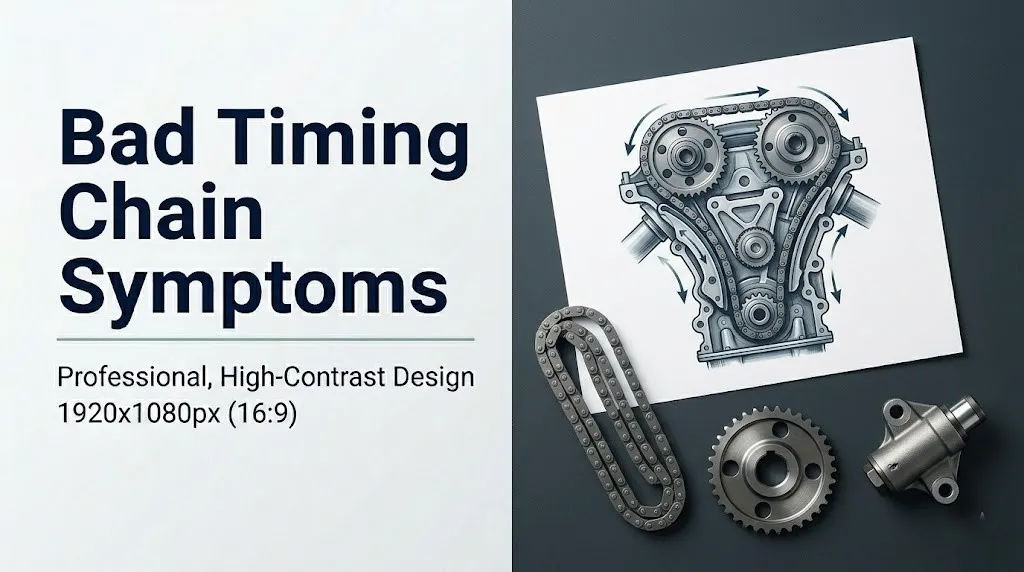
A timing chain is a precision roller or silent chain that mechanically links the crankshaft sprocket (driven by piston movement) to one or more camshaft sprockets (which open and close intake and exhaust valves), maintaining an exact rotational relationship that the engine’s combustion cycle depends on absolutely.
Think of it like the chain on a bicycle, except instead of moving you forward, it keeps two shafts spinning in exact mathematical synchrony thousands of times per minute. If that chain stretches, skips a tooth, or snaps, the relationship between piston position and valve position breaks down instantly.
Unlike a timing belt, which is made of rubber-reinforced polymer and requires scheduled replacement every 60,000 to 105,000 miles depending on the manufacturer, a timing chain is made of hardened steel and is designed to last the life of the engine. The critical caveat is that “life of the engine” assumes the lubrication system functions correctly at all times.
The timing chain operates inside the engine, bathed continuously in pressurized motor oil. That oil serves two functions: it lubricates the chain’s roller links and sprocket teeth to prevent metal-to-metal wear, and it pressurizes the hydraulic chain tensioner that keeps the chain taut against the guide rails. Any interruption to that oil supply accelerates wear on every component in the timing chain system simultaneously.
Turbocharged engines, which generate significantly higher oil temperatures and place greater thermal demand on the lubrication system, experience timing chain wear at lower mileage than naturally aspirated engines of equivalent displacement. Owners of turbocharged vehicles should note this specifically.
Timing Chain Rattle Noise Symptoms
A timing chain rattle is the most well-recognized early symptom of timing chain system failure, and it is almost always produced by a loss of hydraulic pressure in the chain tensioner rather than by the chain itself degrading.
Here is what produces that specific sound mechanically. At engine startup, oil pressure builds from zero as the oil pump begins circulating motor oil. For the first five to fifteen seconds of operation, the hydraulic tensioner piston does not yet have enough oil pressure behind it to push firmly against the chain. The chain hangs with slight slack, slapping against the guide rails or the timing cover. That metal-to-metal contact produces the distinctive rattling sound.
In a healthy engine with a well-functioning tensioner, this startup rattle lasts no more than two to three seconds before oil pressure builds and the tensioner extends, eliminating slack. A rattle that persists beyond fifteen to twenty seconds at startup is the first reliable sign that the tensioner is worn, the oil supply passages to the tensioner are partially blocked by sludge, or the tensioner’s internal check valve is no longer holding pressure between shutdown and the next startup.
A 2022 analysis of OBD-II fault patterns from fleet vehicles compiled by RepairPal found that timing chain-related complaints in the NHTSA database overwhelmingly described cold-start rattle as the first symptom reported, typically appearing 12,000 to 30,000 miles before any fault code was stored.
- Rattle lasts 2 to 3 seconds at startup: normal tensioner behavior
- Rattle lasts 15 to 30 seconds at startup: tensioner wear or oil passage restriction
- Rattle present at all temperatures and speeds: advanced tensioner failure or guide rail contact
- Rattling with a metallic “slapping” quality rather than a tinny rattle: possible guide rail fracture beginning
Diesel engine owners, particularly those operating BMW N47 or N57 engines, should note that timing chain rattle in these engine families can appear at under 80,000 miles due to an OEM design where the chain drive is located at the rear of the engine, making oil delivery to the tensioner particularly sensitive to cold-start oil pressure.
Timing Chain Stretch Symptoms
Timing chain stretch is not literal elongation of steel links but rather cumulative wear at each individual roller pin and bushing contact point across hundreds of chain links, producing an effective increase in total chain length that the tensioner eventually cannot compensate for.
A new timing chain runs at a specified pitch, meaning the distance between each roller link is precisely controlled to mesh perfectly with the sprocket tooth geometry. As those contact points wear, each link effectively becomes fractionally longer. Across a chain of 100 or more links, those fractions add up to measurable total stretch, typically expressed in millimeters. Once chain stretch exceeds the tensioner’s maximum compensation range, the chain runs with permanent slack and cam timing begins to deviate from the crank.
The powertrain control module (PCM) receives position data from both the crankshaft position sensor (CKP) and the camshaft position sensor (CMP). When chain stretch causes the cam to rotate even a few degrees behind its expected position relative to the crank, the PCM detects this as a cam-crank correlation error. The engine does not receive correctly timed valve events, combustion efficiency drops, and the driver notices the effects as reduced power, worsened fuel economy, and inconsistent throttle response.
| Chain Stretch Stage | Cam Timing Deviation | Driver-Noticeable Effect |
|---|---|---|
| Mild (0.5% pitch increase) | 2 to 4 degrees retard | Slight fuel economy drop, marginal |
| Moderate (1.0% pitch increase) | 5 to 8 degrees retard | Rough idle, misfires at load |
| Severe (1.5%+ pitch increase) | 9+ degrees retard | Hard start, persistent misfire, fault codes |
| Critical (approaching skip) | Variable / sudden | Violent shake, stall, potential catastrophic |
Vehicles operated in extreme cold climates experience accelerated chain stretch because repeated cold-start cycles with marginally thin oil (due to viscosity breakdown or incorrect grade) create periods of inadequate lubrication at the roller-to-pin interface, increasing wear rate per engine hour.
Key Takeaway: Timing chain stretch produces a gradual, progressive worsening of engine performance that is easy to miss in isolation but follows a predictable sequence from subtle fuel economy loss to active misfires and fault codes.
Engine Misfire From a Failing Timing Chain
A timing chain-related engine misfire occurs because cam timing retard from chain stretch or a jumped chain disrupts the precise coordination between valve opening events and piston position in the combustion cycle.
For combustion to occur efficiently, the intake valve must open as the piston descends to draw in the air-fuel mixture, close before the piston rises to compress that mixture, and the spark must fire at precisely the right moment before top dead center. When the cam is retarded by several degrees due to chain stretch, the intake valve opens and closes late, the mixture is not fully compressed when the spark fires, and the combustion event is incomplete. The cylinder fails to contribute its expected power pulse, producing what the engine management system classifies as a misfire event.
Unlike a misfire from a failed ignition coil or a fouled spark plug, which typically affects a single cylinder consistently, a timing chain misfire often affects multiple cylinders simultaneously and may be random rather than predictable. This is a key differentiator when discussing symptoms with a technician.
The National Highway Traffic Safety Administration (NHTSA) complaints database documents thousands of consumer reports describing random multi-cylinder misfires, specifically in GM 3.6L LFX and LLT V6 engines, that were ultimately traced to timing chain stretch producing cam timing retard across both banks of the engine.
- Single-cylinder misfire, consistent: likely ignition coil, plug, or injector issue
- Multi-cylinder misfire, random: timing chain or tensioner more likely
- Misfire worse at high RPM or high load: chain slack increases under load; more consistent with chain issue
- Misfire with cam-crank correlation OBD-II code: confirms timing chain system as the source
Older adults or individuals unfamiliar with engine behavior may first notice this symptom as unexplained hesitation during highway merging or a sensation that the car briefly “loses its footing” under acceleration, rather than recognizing it as a classical misfire.
Rough Idle and Poor Performance From Timing Chain Wear
Rough idle from timing chain wear occurs because combustion instability caused by retarded cam timing creates uneven power contributions across engine cylinders, producing the characteristic hunting or shaking idle that drivers often describe as the engine “running on bad gas.”
At idle, the engine operates at its lowest RPM and relies on precise valve timing events to maintain consistent, smooth combustion across all cylinders. Any deviation in the cam-to-crank relationship reduces combustion completeness in one or more cylinders. The engine management system attempts to compensate by adjusting fuel trims, ignition advance, and idle speed, but once chain stretch exceeds a few degrees, these corrections are insufficient to restore smooth idle quality.
Think of it like a symphony orchestra where the percussion section starts playing one beat behind everyone else. The conductor (the PCM) can adjust the tempo slightly, but if the percussion is far enough off, the performance falls apart regardless of correction attempts.
Poor acceleration performance accompanies rough idle in moderate-to-severe timing chain wear cases. The driver notices that the engine lacks its previous responsiveness below 2,500 RPM, that there is a flat spot or hesitation when transitioning from light throttle to moderate throttle, and that the vehicle feels generally sluggish compared to its normal behavior. This is consistent with 5 to 10 degrees of cam timing retard, which reduces volumetric efficiency and peak cylinder pressure during the power stroke.
According to Consumer Reports automotive reliability data, vehicles with documented timing chain complaints consistently report “engine runs rough” and “loss of power” as the two most common driver-reported symptoms in the 12 to 24 months preceding confirmed timing chain replacement.
Quick Tip:
- Note whether the rough idle is present when the engine is cold, warm, or both; timing chain-related rough idle typically worsens when warm because chain slack increases slightly as metal expands with heat
- Check whether the tachometer needle fluctuates between 550 and 750 RPM at idle rather than holding steady; this is characteristic of multi-cylinder incomplete combustion
- For newer vehicles with cylinder deactivation (Active Fuel Management or similar systems), disable the cylinder deactivation mode temporarily and see whether idle quality improves; if it does, the base cause may be VVT-related rather than pure chain stretch
Key Takeaway: Rough idle and poor acceleration from timing chain wear reflect the PCM’s failed attempt to compensate for cam timing retard that has exceeded the software’s correction range.
Check Engine Light and Timing Chain Problems
A check engine light related to a failing timing chain almost always stores one or more OBD-II cam-crank correlation fault codes, which the powertrain control module (PCM) generates when camshaft position data from the camshaft position sensor (CMP) consistently deviates from the expected angular relationship to the crankshaft position sensor (CKP).
The specific fault codes associated with timing chain problems are among the most diagnostically informative codes the OBD-II system generates, because they pinpoint not just a performance problem but a specific mechanical deviation in degrees of cam rotation.
| OBD-II Fault Code | Description | Most Likely Cause |
|---|---|---|
| P0008 | Engine Position System Performance, Bank 1 | Chain stretch or VVT actuator lag, Bank 1 |
| P0009 | Engine Position System Performance, Bank 2 | Chain stretch or VVT actuator lag, Bank 2 |
| P0016 | Crankshaft/Camshaft Timing Misalignment, Bank 1 Intake | Cam retard from chain stretch, Bank 1 |
| P0017 | Crankshaft/Camshaft Timing Misalignment, Bank 1 Exhaust | Exhaust cam retard, Bank 1 |
| P0340 | Camshaft Position Sensor Circuit Malfunction, Bank 1 | CMP sensor failure or severe cam timing deviation |
| P0341 | Camshaft Position Sensor Range/Performance, Bank 1 | CMP signal inconsistency; possible chain skip |
A stored P0016 or P0017 without any associated oil control valve or cam phaser code is a strong indication that the timing chain itself is the source of the cam timing deviation rather than the VVT system. However, these codes require a licensed technician with a professional scan tool capable of live data graphing to differentiate chain stretch from VVT actuator lag, because the OBD-II code alone does not confirm which component is at fault without further testing.
Clearing the codes without addressing the underlying mechanical cause will result in their return, typically within one to three drive cycles.
Young drivers and first-time vehicle owners should be aware that a check engine light alone, without any audible symptom or performance change, can be the sole early indicator of beginning timing chain deviation. The engine’s adaptive systems may be masking the performance impact while the fault code accurately documents the problem.
Timing Chain Tensioner Failure Symptoms
The hydraulic chain tensioner is the single most failure-prone component in the timing chain system, and its failure produces the most immediately audible symptom of any timing chain problem.
The tensioner works like a hydraulic cylinder, with pressurized motor oil behind a spring-loaded piston pushing outward against a pivoting tensioner arm, which presses against the chain’s slack side. The piston incorporates a one-way check valve that traps oil in the tensioner body between engine shutdowns, maintaining pre-load on the chain at the next cold start. When this check valve wears or its seating surface deteriorates, the trapped oil bleeds back into the sump during shutdown, and the tensioner piston retracts fully. The chain goes slack. Cold-start rattle is the result.
Advanced tensioner failure progresses beyond intermittent cold-start rattle. Once the tensioner piston can no longer maintain adequate chain pre-load at operating temperature, the chain develops permanent dynamic slack. Under load, particularly during rapid throttle application or engine deceleration, the chain whips against the guide rails. The driver may notice a sudden sharp metallic knock under hard acceleration, different in character from the softer cold-start rattle.
According to published OEM Technical Service Bulletins (TSBs), General Motors issued multiple TSBs for the 2.4L Ecotec and 3.6L LFX engines specifically addressing tensioner check valve failure as a primary cause of cold-start timing chain rattle, recommending replacement of the complete tensioner assembly rather than individual seals.
- Cold-start rattle lasting more than 15 seconds: tensioner check valve degraded
- Rattle that returns after recent oil change: tensioner not priming despite fresh oil; worn check valve
- Metallic knock under hard acceleration: tensioner piston bottomed out; chain whipping against guide
- Rattle accompanied by oil pressure warning light: oil supply problem to tensioner; critical urgency
Vehicles that sit unused for extended periods (several weeks or months) will often experience tensioner rattle at restart regardless of tensioner condition, because even a healthy check valve allows some oil bleed-down over extended static periods. A single cold-start rattle after long storage is less diagnostically meaningful than rattle that occurs every morning after overnight parking.
Timing Chain Guide Rail Failure Signs
Timing chain guide rails are the fixed and pivoting plastic or composite channels that keep the timing chain aligned along its intended path between sprockets, preventing lateral whip and reducing the amplitude of chain vibration at high RPM. Their failure produces one of the most dangerous timing chain system conditions, because a fractured guide rail can send debris into the oil sump, into the chain path, or into the VVT actuator passages.
Most guide rails in modern engines are molded from high-temperature nylon or a glass-reinforced composite. These materials resist heat and oil degradation under normal conditions but become brittle over time with thermal cycling. Engines that have experienced oil starvation events, even briefly, accelerate this brittleness significantly. The guide rail does not fail all at once; it develops microcracks that propagate gradually until a segment fractures.
The symptom profile of guide rail failure is distinct from tensioner failure in one key way. Tensioner failure produces a rattle that tracks consistently with engine RPM. Guide rail failure, particularly after a piece has fractured, produces an irregular, intermittent metallic ticking or slapping noise that varies with engine load in ways that don’t follow a simple RPM pattern, because the loose fragment is being struck by the chain irregularly.
A 2021 technical review published in the SAE International Journal of Engines documented that guide rail fragmentation in high-mileage engines frequently deposits debris fragments in the oil sump, where they circulate through the oil pump and can lodge in oil passages serving the VVT actuators, compounding the failure with a secondary VVT malfunction.
Signs specific to guide rail failure:
- Irregular, arrhythmic metallic ticking at idle that changes unpredictably with load
- Sudden onset of timing-related fault codes with no prior progressive symptom history
- Oil contamination with small plastic or nylon fragments visible on the magnetic drain plug
- VVT system fault codes appearing simultaneously with timing chain codes, without any prior oil change or service event
Key Takeaway: Guide rail failure is the most unpredictable timing chain system failure mode because it can produce sudden symptom onset with no prior warning, and it sends debris into the lubrication system that causes secondary damage beyond the chain itself.
Timing Chain Jumped Symptoms
When a timing chain jumps, the chain has physically skipped one or more teeth on a camshaft or crankshaft sprocket, producing an immediate and severe disruption in the cam-to-crank relationship that manifests as sudden, dramatic symptoms unlike the gradual progression of chain stretch or tensioner wear.
The mechanical sequence is straightforward. Under high chain slack (from tensioner failure, guide rail fracture, or severe chain stretch), the chain can lose contact with one or more sprocket teeth during a load transient such as throttle application, deceleration compression braking, or engine startup. The chain re-engages one or more teeth ahead of or behind its correct position. The camshaft is now permanently displaced from its correct relationship to the crankshaft until the engine is stopped and the chain is re-indexed mechanically.
The driver experiences this as a sudden, violent change in engine behavior. The engine may shake severely and immediately. Power drops abruptly. If the chain jumps far enough in an interference engine (where pistons and valves occupy overlapping space in the cylinder at different points in the cycle), pistons may contact open valves, bending or breaking them instantaneously.
Vehicles with interference engine designs include most modern four-cylinder and V6 engines from Honda, Toyota, Volkswagen, Audi, BMW, and many General Motors platforms. A timing chain jump on these engines is not a “limp home” situation.
If your engine suddenly shakes violently, loses power severely, produces a loud bang or series of metallic impacts, and then stalls or refuses to restart, stop the vehicle safely and immediately and do not attempt to restart the engine. Turn the ignition off. Call for a tow truck. Restarting a jumped-chain engine on an interference platform risks complete engine destruction, including bent valves, damaged pistons, and cracked cylinder head casting.
Symptoms immediately before and during a chain jump:
- Brief but violent engine shake lasting a fraction of a second before full stall
- Sudden stall with no prior warning at highway speed
- Violent metallic banging sound from the engine area
- Immediate illumination of multiple warning lights simultaneously
- Engine turns over normally when restart is attempted but will not fire (cam no longer in phase with crank)
Can You Drive With a Bad Timing Chain
Whether you can continue driving with a bad timing chain depends entirely on which component is failing and how advanced the failure is.
A mild cold-start rattle that clears within 15 seconds and is accompanied by no fault codes and no performance symptoms represents early tensioner wear. In this condition, you can drive the vehicle to a scheduled shop appointment within the next few days, provided you check the oil level daily and do not allow the oil to fall below the minimum mark. Reduced oil level dramatically accelerates the tensioner degradation progression.
A persistent rattle at all temperatures, rough idle, or any stored cam-crank correlation fault code (P0016, P0017, P0008, P0009) represents moderate timing chain system failure. You should not plan road trips, highway driving at sustained high speeds, or any situation where engine failure at speed would create a safety hazard. Schedule a shop appointment within two to three days.
Any symptom consistent with guide rail failure, advanced tensioner bottoming, or a chain approaching skip territory means the vehicle should not be driven at all until inspected by an ASE-certified engine technician. The difference between “one more drive to the shop” and catastrophic engine failure in these cases can be a single hard acceleration event.
| Symptom Severity | Driving Status | Recommended Action |
|---|---|---|
| Cold-start rattle, clears in 10 seconds, no codes | Can drive; monitor daily | Schedule inspection within 1 week |
| Persistent rattle + check engine light | Limited driving only | Shop appointment within 2 to 3 days |
| Rough idle + misfires + cam-crank codes | Minimize driving | Shop appointment today or tomorrow |
| Violent knock + power loss | Do not drive | Stop; call tow truck |
| Engine stalled, won’t restart | Do not attempt restart | Tow only; possible interference engine damage |
The risk calculus changes significantly for interference engine vehicles. On a non-interference engine, a chain jump produces a no-start condition that is repairable without internal engine damage. On an interference engine, a chain jump can be an engine-ending event. Know whether your vehicle’s engine is an interference design by consulting the OEM owner’s manual or asking a technician.
Timing Chain Failure and Oil Pressure Connection
Timing chain health is directly dependent on engine oil pressure, and the relationship is bidirectional: inadequate oil pressure accelerates timing chain wear, while advanced timing chain failure can itself cause oil pressure instability by disturbing the timing chain cover and associated oil passages.
The hydraulic chain tensioner requires a continuous supply of pressurized motor oil to maintain its pre-load on the chain. That oil supply comes through dedicated passages drilled into the engine block and cylinder head, controlled in VVT-equipped engines by oil control valves (OCVs) that also regulate cam phaser position. If oil pressure drops below the threshold required to keep the tensioner piston extended, the tensioner collapses, chain slack develops, and rattle begins immediately.
Oil pressure inadequacy can stem from several sources: low oil level from underfilling or consumption, oil of incorrect viscosity for the ambient temperature (a 10W-30 oil in a sub-zero climate will be significantly thicker and slower to reach operating pressure than the OEM-specified 0W-20), or a worn oil pump that delivers reduced volume at low RPM. Engine sludge that partially occludes the oil feed passage to the tensioner is particularly insidious because it is invisible from outside the engine and often produces no oil pressure warning light.
According to data published by the National Highway Traffic Safety Administration (NHTSA) from consumer complaint files, a disproportionate share of timing chain failure complaints in high-mileage vehicles involve owners who described infrequent oil changes or oil consumption they had not addressed between changes.
Checking oil health in the context of timing chain symptoms:
- Pull the dipstick and observe oil level. It should be at or near the full mark.
- Wipe the dipstick on a white cloth or paper. Fresh oil is amber or tan. Degraded oil is dark brown to black.
- Rub a drop of oil between your index finger and thumb. Gritty texture indicates metal particle contamination.
- Smell the oil. A burnt or acrid odor suggests thermal degradation from overheating.
- If oil is black and gritty, do not perform only an oil change. Request an oil system flush evaluation from an ASE-certified technician before the next start.
Key Takeaway: Engine oil condition and change interval history are the single most predictive factors in timing chain lifespan; neglected oil maintenance does not just accelerate chain wear, it guarantees it.
Variable Valve Timing Problems From Timing Chain Wear
Variable valve timing (VVT) problems appear as a specific subset of timing chain failure symptoms in modern engines equipped with cam phaser systems, because the cam phaser, the chain, and the oil control valve all operate as an integrated timing control system where failure in any one component disrupts the others.
A cam phaser (also called a VVT actuator) is a hydraulically controlled helical gear unit mounted on the camshaft sprocket. It uses engine oil pressure, regulated by the oil control valve (OCV), to rotate the camshaft up to 40 to 60 degrees relative to the sprocket position, advancing or retarding cam timing dynamically based on engine speed, load, and temperature. This allows the engine to optimize valve timing across its entire operating range rather than using a single fixed compromise.
When timing chain stretch causes the cam to run retarded of its commanded position, the VVT system attempts to compensate by advancing the cam phaser to bring the camshaft back toward target timing. This means the VVT actuator operates at or near its maximum advance position continuously, rather than using that range dynamically. The result is that the VVT system’s ability to provide further advance for performance optimization is fully consumed by compensating for chain wear. Fuel economy worsens. Peak power availability narrows.
As chain stretch worsens, the PCM eventually detects that the cam position cannot be achieved even at full VVT advance command. This registers as a cam-crank performance code rather than a cam phaser position code, which is how a skilled technician can differentiate chain stretch from OCV or cam phaser failure using live scan data.
Symptoms specific to VVT disruption from timing chain wear:
- Engine idle rough specifically after the VVT system activates (typically above 1,200 RPM on acceleration)
- Fuel economy decline noted on the vehicle’s trip computer, not dramatic but consistent (2 to 4 MPG reduction over several months)
- Slight surge or hesitation at light throttle as the VVT system struggles to hit commanded cam position
- Cam phaser fault codes appearing alongside cam-crank correlation codes
VVT-equipped engines with timing chain wear should not be diagnosed by OCV replacement alone. Replacing an OCV on an engine with underlying chain stretch will temporarily improve some symptoms but will not correct the fundamental mechanical deviation, and the fault codes will return.
Metal Shavings in Oil as a Timing Chain Warning
Metal shavings in the engine oil are one of the most serious and least ambiguous indicators of advanced timing chain system deterioration, representing physical wear metal generated by metal-to-metal contact between the chain and sprocket teeth under conditions of inadequate lubrication or excessive slack.
In a healthy, properly lubricated timing chain system, an oil film of 0.001 to 0.003 inches separates moving metal surfaces at all times. No metal-to-metal contact occurs. No wear metal enters the oil. The oil drained at a change will contain microscopic wear particles that are expected and normal, visible only with laboratory analysis and well below thresholds of concern.
When the oil film breaks down, whether from oil starvation, incorrect viscosity, or thermal degradation, chain roller pins contact bushing surfaces directly. The resulting abrasive metal removal generates particles visible to the naked eye. These appear as a metallic sheen or visible glittering particles in the drained oil, or as metallic debris on a magnetic drain plug or in an oil filter cut-open during inspection.
Magnetic drain plugs, which are standard equipment on some performance and diesel vehicles and available as aftermarket upgrades for most others, are the most cost-effective early warning system for timing chain metal contamination.
A 2023 review article in Lubrication Science examining wear debris analysis in high-mileage engines found that iron particle concentration in engine oil increases exponentially in the 20,000-mile period preceding confirmed timing chain failure, with magnetic plug debris visible to the naked eye appearing approximately 8,000 to 12,000 miles before catastrophic failure events in unmonitored engines.
What metal shavings in oil tell you about timing chain status:
- Shiny metallic sheen in drained oil without visible particles: early wear, begin monitoring
- Fine metallic glitter visible in drained oil: moderate wear, inspection warranted now
- Visible particles on magnetic drain plug (1 to 3 mm): advanced wear, consider oil analysis before next start
- Large fragments (greater than 3 mm) on magnetic plug: critical; possible guide rail fracture; do not drive
Owners of high-mileage vehicles (over 120,000 miles) who have not previously used a magnetic drain plug are encouraged to install one at the next oil change and inspect it at every subsequent interval.
Key Takeaway: Visible metal debris on a magnetic drain plug is a concrete, unambiguous signal of active timing chain system wear that is detectable months before catastrophic failure, making it one of the highest-value preventive monitoring tools available.
How to Diagnose a Bad Timing Chain
Diagnosing a bad timing chain requires a combination of structured physical inspection, OBD-II scan tool data analysis, and in some cases, direct timing chain inspection through the timing cover or via borescope, because no single test alone confirms chain condition with certainty.
The diagnostic process a qualified technician follows is systematic. Each step either confirms or rules out specific failure modes.
Diagnosis steps in order:
- Connect a professional-grade scan tool and retrieve all stored and pending OBD-II fault codes. Note any cam-crank correlation codes (P0008, P0009, P0016, P0017), cam phaser performance codes, or CMP sensor codes.
- Review live data with the engine running: observe actual camshaft position values versus commanded position values. A deviation greater than 5 degrees at idle or light throttle indicates either chain stretch or VVT system failure.
- Perform a relative compression test or a cylinder contribution test to identify whether specific cylinders are under-contributing, which correlates with cam timing retard on those cylinders.
- Inspect engine oil for color, consistency, and metal contamination. Cut the oil filter open and inspect the filter media for metal particles.
- Listen to the timing chain with a mechanic’s stethoscope or electronic chassis ears, placing the probe at the timing cover location, at idle and at 2,000 RPM. Rattle amplitude that increases with RPM rather than decreasing suggests chain whip rather than tensioner pre-load loss.
- If the above steps support timing chain diagnosis, inspect the timing cover for oil leakage, which can indicate timing cover gasket damage from chain contact with the cover due to excessive slack.
- On engines where access permits, perform a direct borescope inspection through a port into the timing chain area to observe chain slack and guide rail condition visually.
- Compare the actual cam timing deviation in degrees to the OEM specification tolerance, typically plus or minus 2 to 3 degrees. Deviation beyond this range with an otherwise healthy VVT system confirms chain-as-primary-cause.
The complete diagnosis typically takes one to two hours of technician time. Requesting that the shop document live scan data values in writing is appropriate and gives you a baseline for comparison if the repair is deferred.
When to Replace a Timing Chain
Timing chain replacement is warranted when diagnostic findings confirm cam timing deviation beyond OEM tolerance, when tensioner or guide rail failure is confirmed, or when any symptom of chain system distress appears in a high-mileage vehicle with a documented history of extended oil change intervals.
Unlike a timing belt, which has a published replacement interval in the OEM service manual (typically 60,000 to 105,000 miles), a timing chain does not have a universal replacement interval. Replacement is condition-based rather than mileage-based, which is why symptom recognition and diagnostic confirmation are the primary decision triggers.
A complete timing chain replacement includes not just the chain itself but the full system: the tensioner assembly, all guide rails, the camshaft and crankshaft sprockets (if worn), and any OCV filters that may be partially blocked. Replacing the chain alone while leaving a worn tensioner or cracked guide rail guarantees a repeat failure within 30,000 to 50,000 miles.
According to RepairPal industry cost data, timing chain replacement on a typical four-cylinder or V6 engine ranges from $800 to $1,800 in total repair cost including parts and labor, depending on engine accessibility and whether the timing cover or oil pan must be removed for access. Some rear-chain-drive engines (certain BMWs, some Audis) involve removing significant additional components, pushing costs to $2,500 or more.
Situations that make timing chain replacement clearly the right decision:
- Confirmed cam timing deviation greater than 5 degrees with no VVT system fault independent of chain condition
- Visible metal debris in oil attributable to chain system wear
- Tensioner failure with guide rail damage on a vehicle otherwise in good mechanical condition
- Any symptom of timing chain skip on an interference engine regardless of other vehicle condition
- Vehicle value significantly exceeds the repair cost and the engine has no other major mechanical issues
For vehicles whose market value is substantially lower than the repair estimate, and where the timing chain failure is severe enough to suggest the engine is beyond economical repair, discussing engine replacement versus vehicle replacement with an ASE-certified technician is the appropriate next step.
Emergency Symptoms: When to Stop Driving Immediately
Certain bad timing chain symptoms require stopping the vehicle immediately rather than driving to a shop.
Stop the vehicle safely, turn off the engine, and call for a tow if you experience any of the following:
- A sudden violent engine shake accompanied by immediate severe power loss, especially at highway speed
- A loud metallic bang or series of banging impacts from the engine compartment followed by stalling
- The engine stalls unexpectedly and cannot be restarted, turning over without firing
- Multiple warning lights illuminate simultaneously, including the check engine light and oil pressure warning light, during normal driving
- A sudden grinding or catastrophic metallic noise from the engine area that does not resolve when the throttle is released
Do not attempt to restart the engine after any of these events. On interference engine designs, which include most modern Honda, Toyota, BMW, Audi, Volkswagen, and General Motors four-cylinder and V6 platforms, a jumped or broken timing chain that contacts pistons will bend or break valves in one or more cylinders. Each restart attempt after this occurs worsens the damage and converts a timing chain replacement into a full engine rebuild or replacement.
Call a tow truck and transport the vehicle to an ASE-certified engine repair facility for diagnosis before any restart.
Frequently Asked Questions About Bad Timing Chain Symptoms
What does a bad timing chain sound like?
A bad timing chain most commonly produces a metallic rattling noise at engine startup, generated by chain slack slapping against the timing chain guide rails when oil pressure has not yet built up in the hydraulic tensioner.
As failure progresses, the sound may become a persistent rattle at all engine speeds, a sharp metallic knock under hard acceleration, or an arrhythmic metallic ticking that varies with engine load rather than following RPM consistently.
A timing chain jump produces a sudden loud bang or series of metallic impacts followed immediately by severe engine shake and stalling, a distinctly different and more violent sound from progressive wear rattle.
Can a bad timing chain cause a car not to start?
Yes, a bad timing chain can cause a no-start condition if the chain has jumped enough teeth on the sprocket to move the camshaft out of phase with the crankshaft, preventing the combustion cycle from completing.
In this condition, the engine cranks normally because the starter motor is still engaging, but the cylinders cannot fire because valve timing no longer corresponds to piston position.
This is one of the most dangerous scenarios on an interference engine, because each attempt to start the engine risks piston-to-valve contact damage; tow the vehicle rather than attempting repeated starts.
How long can you drive with a bad timing chain?
The safe driving window with a bad timing chain depends entirely on which component is failing and how advanced the failure is.
Early tensioner rattle with no fault codes may allow several days of limited driving to reach a shop, provided oil level is maintained and hard acceleration is avoided; advanced failure with cam-crank fault codes, rough idle, or misfires should not be driven more than is necessary to reach a repair facility safely.
Any symptom consistent with guide rail failure, chain skip, or violent engine shake means the vehicle should not be driven under any circumstances and requires towing.
What OBD-II codes are associated with a bad timing chain?
The primary OBD-II fault codes associated with bad timing chain symptoms are P0016 (cam-crank timing misalignment, Bank 1 intake cam), P0017 (cam-crank misalignment, Bank 1 exhaust cam), P0008, and P0009 (engine position system performance, Banks 1 and 2).
These codes indicate that the powertrain control module has detected a deviation between actual camshaft position and expected crankshaft-relative position, which is the direct electronic signature of timing chain stretch or a jumped chain.
Secondary codes such as P0340 or P0341 (camshaft position sensor circuit malfunction) may also appear when cam timing deviation is severe enough to produce irregular or missing camshaft position sensor signals.
What causes a timing chain to go bad?
Timing chains fail primarily from insufficient lubrication caused by extended oil change intervals, incorrect oil viscosity for the engine’s OEM specification, low oil level from consumption, or oil starvation from a worn or failing oil pump.
Turbocharged engines are at higher risk because their higher operating oil temperatures accelerate viscosity breakdown and oxidation between changes, reducing the oil film thickness at timing chain contact surfaces.
Some engine families also have documented design factors that accelerate timing chain wear, including rear-of-engine chain placement (certain BMW diesel engines), inadequate original tensioner check valve design (certain GM Ecotec and LFX engines), and VVT actuators that place higher cyclical load on the chain than non-VVT designs.
Is timing chain replacement worth it, or should I replace the engine?
Timing chain replacement is generally the right choice when the engine is otherwise sound, the vehicle’s other mechanical systems are in acceptable condition, and the repair cost is less than 50 to 70 percent of the vehicle’s current market value.
When the timing chain failure has progressed to the point of interference engine contact damage (bent valves, damaged pistons, cracked cylinder head), the repair cost often approaches or exceeds engine replacement cost, at which point comparing timing chain repair cost, engine replacement cost, and vehicle replacement cost with the guidance of an ASE-certified technician is the appropriate framework.
A used engine from a low-mileage donor vehicle with a documented service history, professionally installed with a new timing chain kit, is often the most cost-effective solution when the original engine has sustained interference damage.
Closing
Bad timing chain symptoms follow a predictable mechanical progression, from a subtle cold-start rattle that lasts a few seconds too long, to rough idle and misfires with stored OBD-II codes, to the sudden violent shake of a jumped chain. The difference between a $1,200 timing chain replacement and a $6,000 engine rebuild is often a matter of weeks, and sometimes a single drive.
The practical action from this information is straightforward. If you hear a cold-start rattle that lasts more than ten to fifteen seconds, check your oil level and condition today, connect a basic OBD-II reader or visit an auto parts store for a free code scan, and schedule an inspection with an ASE-certified technician within the week. Do not wait for the misfire or the check engine light to confirm what the rattle is already telling you.
Your engine’s timing chain is one of the few components where catching the warning at stage one versus stage three changes the repair from “significant but manageable” to “potentially engine-ending.” You now know what each stage sounds and feels like.