Water in Gas Tank Symptoms: Full Diagnostic Guide 2026
Water in gas tank symptoms include rough idling, engine misfires, sputtering, hesitation under acceleration, and sudden stalling, all produced by water disrupting the combustion process when it enters the fuel stream from the bottom of the tank. Identifying these symptoms early is the difference between a straightforward fuel system drain and a costly repair bill involving damaged injectors, a failed fuel pump, or a ruined catalytic converter.
Water contamination of a vehicle fuel system is more common than most drivers realize. The U.S. Department of Energy’s Alternative Fuels Data Center documents that ethanol-blended fuels (E10 and E15, the standard gasoline sold at most U.S. pumps) are particularly vulnerable to water contamination through a process called phase separation, in which absorbed water causes ethanol to separate from gasoline and drop as a dense layer to the tank bottom, directly in the path of the fuel pickup tube.
This guide covers every major symptom of water in a gas tank in mechanical detail, explains the specific fuel system and combustion chemistry behind each symptom, distinguishes mild from severe contamination, and tells you exactly when driving any further puts you or your engine at serious risk.
Water in Gas Tank Symptoms
Water in gas tank symptoms occur because water, being denser than gasoline and incapable of vaporizing and combusting under normal engine operating conditions, disrupts every stage of fuel delivery and combustion when it enters the fuel stream.
Think of a gasoline engine as a precision-timed system that depends on fuel vaporizing at exactly the right moment in the intake stroke and igniting cleanly at the top of the compression stroke. Water does not vaporize at engine operating temperatures below the boiling threshold inside the cylinder. Instead it absorbs combustion energy, cools the combustion event, and prevents complete fuel burn. The result is a cascade of observable symptoms from the moment the engine begins drawing water-contaminated fuel.
The symptom pattern follows a predictable sequence tied to the concentration of water reaching the fuel injectors at any given moment. Small amounts produce subtle performance changes. Larger amounts cause misfires, stalling, and refusal to restart.
Key symptoms of water in a gas tank, ordered by typical sequence of appearance:
- Rough or erratic idle that appears shortly after starting, particularly from a cold start
- Engine sputtering and stumbling under moderate acceleration
- Hesitation when pressing the throttle, as if the engine briefly loses power before recovering
- Misfires in one or more cylinders, sometimes felt as a sudden jerk or shudder
- Intermittent stalling at idle or low speed, often when the tank is near empty
- Hard starting or extended cranking time required before the engine fires
- Loss of power under full throttle or during highway merging
- Illumination of the check engine light, typically with misfire-related diagnostic trouble codes
Older vehicles with carbureted engines tend to show rough idle and stalling more immediately, since water directly floods the carburetor float bowl. Modern direct-injection engines may show initially subtler symptoms because their higher fuel rail pressures partially compensate before misfire detection occurs.
What Happens When Water Gets in Your Gas Tank
When water gets in a gas tank, it sinks to the bottom of the fuel tank because water has a density of approximately 1.0 g/cm³ compared to gasoline’s density of approximately 0.71 to 0.77 g/cm³, and then accumulates directly at the fuel pickup tube inlet where it is drawn into the fuel system first.
Water that enters the combustion chamber does not combust. It absorbs energy from the combustion event, dramatically lowers the localized temperature inside the cylinder, and prevents the complete oxidation of the air-fuel mixture. The result is a lean misfire in affected cylinders: the ECU detects the oxygen sensor voltage deviation from the stoichiometric reference point and logs a diagnostic fault.
At low water concentrations, the effects are intermittent and may resolve temporarily as the fuel pump draws from cleaner gasoline layers above the water. At higher concentrations, symptoms become continuous. In extreme cases where large volumes of water enter the tank (flood damage, fuel station pump contamination), enough water can enter the cylinders to cause hydrolock: the pistons compress toward a water slug rather than vaporized air-fuel mixture, and since water is incompressible, the mechanical force required to complete the compression stroke can bend a connecting rod or fracture a piston, causing catastrophic internal engine damage.
| Water Concentration Level | What Happens in the Fuel System | Symptom Severity |
|---|---|---|
| Trace (less than 0.1% by volume) | Partially absorbed by ethanol in E10/E15; minimal effect | None or very subtle rough idle |
| Mild (0.1% to 0.5% by volume) | Water slugs reach injectors intermittently | Rough idle, occasional sputter, intermittent misfire |
| Moderate (0.5% to 2% by volume) | Consistent water ingestion by fuel pump; sustained misfires | Persistent rough idle, stalling, check engine light |
| Severe (greater than 2% by volume) | Continuous water delivery to combustion chamber | Engine will not sustain idle, stalling, possible no-start |
| Extreme (flood or major intrusion) | Water fills fuel lines and enters cylinders | Risk of hydrolock, engine will not crank normally |
Turbocharged engines face additional risk. Water entering a turbocharged combustion chamber can cause a sudden temperature drop that produces thermal shock in the turbocharger’s intercooler and intake tract components.
How Does Water Get in a Gas Tank
Water gets into a gas tank through four primary pathways: condensation from temperature cycling inside a partially filled tank, a damaged or improperly sealed fuel filler cap, contaminated fuel from a filling station, and direct water entry from flood exposure or pressure washing near the filler neck.
Condensation is the most common and least obvious source. When an air space exists above the fuel level in a partially filled tank, the humid air inside cycles through temperature changes with the environment. Overnight temperature drops cause water vapor in that air space to condense on the inner tank walls and drip down into the fuel. Over months, this accumulates to a functionally meaningful volume. The American Automobile Association (AAA) has documented that vehicles driven infrequently with consistently low fuel levels in high-humidity environments are particularly susceptible to this progressive condensation pathway.
Fuel filler cap seal failure is the second most common source. The rubber gasket inside the fuel cap deteriorates with age, heat cycling, and UV exposure. A cracked or missing seal allows rainwater to drip down the filler neck and into the tank, particularly during heavy rain or car washing. This pathway can introduce water quickly and in measurable volumes within a single rain event.
Common pathways for water entering a gas tank:
- Condensation inside a partially filled tank from daily temperature cycling in humid climates
- Damaged, loose, or missing fuel filler cap rubber seal
- Contaminated fuel from a filling station with compromised underground storage tanks
- Flood water entering the tank through the filler neck during deep water driving
- Pressure washing directed at the filler cap area, forcing water past the cap seal
- Long-term vehicle storage without a full tank (reduces condensation air space is debated; keeping a full tank minimizes the vapor space available for condensation)
Vehicles stored outdoors in coastal humid climates or in areas with frequent temperature swings between day and night are at the highest cumulative risk from condensation-based water accumulation.
Key Takeaway: Water gets into a fuel tank most often through condensation in a partially filled tank or a deteriorated fuel cap seal, and the symptoms it causes are directly determined by how much water reaches the fuel pickup tube and in what concentration.
Water in Gas Tank Rough Idle
A rough idle caused by water in the gas tank occurs when water-contaminated fuel reaching the fuel injectors produces incomplete combustion in one or more cylinders, creating an uneven power output across the engine’s firing sequence that the driver feels as a vibrating, shuddering, or stumbling idle.
A healthy engine idles by firing each cylinder in a precise sequence, with each cylinder contributing a nearly equal power pulse to the crankshaft. When water enters even one cylinder’s combustion event, that cylinder either misfires completely or produces a significantly reduced power pulse. The crankshaft experiences a gap in the expected torque pattern, and the engine vibrates noticeably at idle speed where these irregularities are felt most distinctly.
Cold starts typically reveal water contamination first. During cold start conditions, the fuel system draws from the tank sump where water has settled, and the engine has not yet warmed its combustion chamber surfaces sufficiently to assist in vaporizing trace moisture. The rough idle often improves as the engine warms because the combustion chamber temperatures rise, partially assisting in vaporizing tiny water droplets before they quench the combustion event. This temporary improvement-after-warm-up pattern is a useful diagnostic clue that separates water contamination from other causes of persistent rough idle.
Quick Tip:
- A rough idle that is worst at cold start and improves after 5 to 10 minutes of running is consistent with mild water contamination in the lower fuel tank layers
- A rough idle that worsens progressively as you drive down through the tank level suggests increasing water concentration at the pickup tube as fuel level drops
- Older vehicles with port fuel injection may show rougher idle than direct-injection engines at equivalent water concentrations, because direct injection’s higher fuel rail pressure (200 to 300 bar vs. 3 to 5 bar in port injection) partially atomizes the water more finely before combustion
Drivers of vehicles with cylinder deactivation technology (common in some V6 and V8 engines from manufacturers including General Motors, Honda, and Fiat Chrysler) may find rough idle from water contamination feels more pronounced, since the deactivation system interprets the contamination-related cylinder inconsistency as a signal to alter its deactivation pattern.
Water in Gas Tank Engine Misfires
Engine misfires from water in a gas tank occur when water reaching the combustion chamber prevents the spark plug from igniting the air-fuel mixture completely, either by quenching the flame front, absorbing too much ignition energy, or creating a combustion event too lean to propagate across the cylinder.
A misfire is technically defined as a combustion failure in a specific cylinder during a specific engine cycle. The SAE J1979 OBD-II standard requires all vehicles manufactured after 1996 to monitor crankshaft rotational velocity for the deceleration signature that occurs when a cylinder misfires. When the ECU detects that a cylinder contributed less torque than expected, it logs a misfire event and increments a counter for that cylinder.
Water misfires tend to follow a random or rotating pattern across cylinders rather than being locked to a single cylinder, because water enters the fuel rail as slugs that move through different injectors depending on injector timing and fuel rail pressure pulses. This random pattern typically triggers a P0300 (random multiple cylinder misfire detected) fault code rather than a cylinder-specific P0301-P0308 code, which is a useful diagnostic differentiation from a failing ignition coil (which usually produces a consistent single-cylinder misfire code).
| Misfire Code | Meaning | Water Contamination Likelihood |
|---|---|---|
| P0300 | Random misfire detected across multiple cylinders | High; consistent with water slug contamination |
| P0301-P0308 | Misfire in specific cylinder (1 through 8) | Lower; more likely a coil, plug, or injector issue in that cylinder alone |
| P0300 + P030X | Random misfire with concurrent cylinder-specific codes | Moderate; may indicate water contamination plus a pre-existing ignition weakness |
Repeated misfires from water contamination cause unburned gasoline to pass through to the exhaust system. In the exhaust, that unburned fuel contacts the hot catalytic converter substrate and can ignite within the converter, producing temperatures that exceed the converter’s design limits. This is how sustained water-induced misfires lead to catalytic converter damage.
Water in Gas Tank Car Sputtering and Hesitation
Sputtering and hesitation from water in a gas tank are felt as a brief but unmistakable loss of power and stumbling during acceleration, caused by water slugs interrupting the continuous fuel delivery that a modern engine requires to maintain smooth throttle response.
Think of the engine’s throttle response as a chain of precisely timed dominos. Press the throttle, the throttle body opens, the MAF sensor signals the ECU, and the ECU commands increased fuel injection volume to maintain the stoichiometric ratio. If a water slug reaches an injector at the moment of increased fuel demand, the cylinder receives less energy per unit volume than the ECU expected, and the engine stumbles before the ECU can compensate. The driver feels this as a stutter or a momentary sensation of the car “catching” before power resumes.
Hesitation under full throttle acceleration is particularly noticeable because the fuel demand is at its highest point. Partial throttle at light loads may show minimal sputtering because the fuel-to-water ratio reaching the injectors is less concentrated. Full throttle pulls maximum fuel draw from the pickup tube, which dramatically increases water ingestion if water is present at the sump.
The U.S. Department of Energy notes that hesitation during acceleration is one of the earlier observable symptoms of fuel quality issues including water contamination, and that this symptom often precedes confirmed misfire detection by the OBD-II system because the ECU misfire counter requires a minimum number of misfire events per 1,000 engine cycles before logging a fault code.
Drivers of turbocharged vehicles should be especially attentive to hesitation symptoms. Turbocharger boost pressure amplifies airflow into the combustion chamber, and if the fuel supply is simultaneously disrupted by water, the resulting lean condition during a turbocharged pull can be more mechanically stressful than in a naturally aspirated engine.
Key Takeaway: Sputtering and hesitation under acceleration are often the first noticeable driving symptoms of water contamination, appearing before the check engine light illuminates because the OBD-II misfire counter requires repeated events before logging a fault.
Water in Gas Tank Stalling
Stalling caused by water in a gas tank occurs when the concentration of water reaching the combustion chambers is high enough to prevent the engine from sustaining the minimum combustion energy needed to maintain idle speed or low-speed operation, effectively shutting the engine down.
An engine stalls when torque output drops below the threshold needed to overcome internal friction and maintain the flywheel’s rotational momentum. Water in sufficient concentration does this by delivering enough incompressible, non-combusting fluid to the cylinders to reduce net torque output below idle sustainability. The ECU detects the drop in crankshaft speed, attempts to compensate by increasing fuel injection, but if the fuel being delivered is itself primarily water at that moment, compensation fails and the engine stops.
Stalling from water contamination tends to happen first at idle or very low speed, because at higher rpm the engine has greater rotational momentum and the individual combustion events matter less to overall speed sustainability. At idle, every cylinder misfire reduces rpm significantly, and a sufficient number of simultaneous misfires drops rpm below the idle threshold.
A pattern of stalling that occurs specifically when the fuel tank is low (below one-quarter tank) is a strong clinical indicator of water contamination. As the fuel level drops, the fuel pickup tube draws from a smaller total pool of fuel, and if water has settled to the tank sump, the ratio of water to gasoline at the pickup increases with lower fuel level.
- Stalling at cold start that improves once the engine warms: consistent with mild-to-moderate water contamination
- Stalling specifically when fuel tank is near empty: strong indicator of water settled at tank sump
- Stalling that makes the vehicle impossible to restart without an extended wait: suggests a significant water slug is blocking the fuel line and must dissipate before fuel flow normalizes
- Stalling while driving at highway speed: indicates severe contamination and represents a traffic safety emergency requiring immediate hazard light activation and safe pullover
Drivers of vehicles with start-stop technology (automatic engine shut-off at traffic lights) may experience this technology failing to restart the engine cleanly when water contamination is present, which can make diagnosis harder because drivers initially attribute it to a start-stop system malfunction.
Water in Gas Tank Check Engine Light
A check engine light caused by water in the gas tank illuminates when the ECU’s OBD-II monitoring system detects enough combustion events falling outside the normal parameters to log a diagnostic trouble code, most often a misfire-related or oxygen sensor lean-condition code.
The OBD-II system, standardized under SAE J1979 and required on all U.S. vehicles since 1996, monitors crankshaft rotational deceleration to detect misfires at a resolution of one misfire per 200 engine cycles. When misfire events exceed a threshold (typically 1 to 2% of firing events within a monitoring window), the system logs a P0300 or cylinder-specific P0301-P0308 code and illuminates the malfunction indicator lamp (MIL), which most drivers know as the check engine light.
Water contamination that produces misfires intermittently, rather than continuously, may cause the check engine light to flash rather than remain steady. A flashing check engine light specifically indicates that active misfires are occurring at a rate high enough to damage the catalytic converter. This is the OBD-II system’s way of signaling that the condition requires immediate attention, not a scheduled appointment.
Quick Tip:
- A steady (non-flashing) check engine light with a P0300 code and a recent history of rough idle or sputtering warrants fuel system inspection for water contamination
- A flashing check engine light means active misfires are occurring right now; reduce speed, avoid full throttle, and arrange mechanical evaluation the same day
- An OBD-II scanner (available at auto parts stores for loan or purchase) can read the specific DTC codes and help a technician differentiate water contamination misfires from ignition system failures
Vehicles that recently filled up from an unfamiliar station, particularly in areas with known flooding or during post-storm periods, should have water contamination considered as a primary differential for a new check engine light with P0300 codes.
Key Takeaway: A flashing check engine light with rough idle or misfires in a vehicle that recently filled up during or after a heavy rain event is a pattern that warrants immediate mechanical evaluation, not delayed scheduling, because catalytic converter damage accumulates with every continued misfire cycle.
Water in Fuel Injectors Symptoms
Water in fuel injectors produces symptoms including a metallic knocking sound during injection events, extended fuel injector spray duration without proportional power output, and in direct-injection engines, a higher rate of injector tip carbon fouling than expected for the vehicle’s mileage.
Fuel injectors are precision solenoid-actuated valves that spray atomized fuel into either the intake port (port fuel injection) or directly into the combustion chamber (gasoline direct injection, GDI). They are designed to handle gasoline, which is compressible and slightly lubricating at the tip orifice. Water is incompressible and provides no lubrication to the injector tip orifice or needle valve seat.
When water passes through an injector, two distinct problems occur. First, the hydraulic incompressibility of water creates a pressure spike at the injector tip orifice during the rapid valve-closing event that can physically stress the injector’s needle valve seat and tip geometry over repeated events. Second, because water does not atomize as finely as gasoline under the same injection pressure, water droplets enter the combustion chamber at larger particle sizes, producing uneven combustion distribution and increasing the likelihood of localized lean zones that misfires originate from.
According to automotive engineering data published in SAE International technical papers on fuel injector failure modes, sustained exposure to water-contaminated fuel reduces injector spray pattern symmetry over time and can accelerate tip erosion in both port and direct-injection injectors. GDI injectors, which operate at much higher fuel rail pressures (150 to 350 bar versus 3 to 5 bar in port injection), are more susceptible to hydraulic stress from water slugs due to the amplified pressure differential at the tip.
Symptoms that may specifically indicate injector-level water damage versus simple upstream contamination:
- Rough idle that persists after the fuel tank has been drained and refilled with clean fuel
- Fuel trim data showing individual cylinder fuel trim corrections that do not normalize after tank refill
- Injector flow rate testing (performed by a technician) showing reduced or uneven spray volume across the injector set
Can Water in Gas Tank Damage the Fuel Pump
Yes, water in a gas tank can damage the electric fuel pump by depriving its internal bushings, bearings, and motor armature of the lubrication and cooling that gasoline normally provides, accelerating wear on the pump’s moving components and potentially causing premature pump failure.
The electric fuel pump assembly sits inside the fuel tank and is submerged in gasoline during normal operation. Gasoline’s low viscosity (approximately 0.4 to 0.8 cSt depending on blend and temperature) provides meaningful lubrication to the fuel pump’s impeller, motor shaft bushings, and commutator brushes. It also carries heat away from the motor windings during operation. Water has essentially no lubrication value for these components and significantly higher thermal conductivity, which means it pulls heat away from the motor differently than gasoline and leaves the sliding contact surfaces without protective film.
When the fuel pump runs through a water-contaminated tank layer, the pump’s bushing surfaces experience metal-to-metal contact that would not occur during normal gasoline operation. Over repeated exposure, this wear pattern produces a whining or buzzing sound from the fuel pump (audible from inside the vehicle as a high-pitched noise from the rear of the cabin where the tank sits) and eventually reduces pump flow capacity and fuel pressure output.
Vehicles with a history of consistently low fuel levels are at amplified risk from this mechanism. Running a tank repeatedly to near-empty means the pump is more likely to ingest whatever has settled at the tank sump (including water), and it runs hotter because there is less cool gasoline surrounding the pump to absorb heat.
| Fuel Pump Damage Stage | Observable Symptom | Diagnostic Finding |
|---|---|---|
| Early wear from water exposure | Whining or buzzing from rear of vehicle | Fuel pressure slightly below spec on fuel pressure test |
| Moderate wear | Rough idle worsening under high fuel demand (hot weather, full throttle) | Fuel pressure drops under load; normal at idle |
| Advanced wear | Engine stalls under acceleration; hard to restart when hot | Fuel pressure severely below spec; pump amperage elevated |
| Pump failure | No start; engine cranks but will not fire | No fuel pressure; no audible pump prime on key-on |
Water in Gas Tank Catalytic Converter Damage
Water in a gas tank damages the catalytic converter indirectly, by causing repeated engine misfires that send large quantities of unburned gasoline into the exhaust stream, where that fuel ignites inside the catalytic converter’s substrate and produces temperatures far exceeding the converter’s operational design limits.
A three-way catalytic converter operates between approximately 400°C and 800°C (750°F to 1470°F) during normal emission control function. The ceramic substrate (or metallic substrate in some designs) coated with platinum, palladium, and rhodium is designed to sustain these temperatures over the vehicle’s service life. When unburned gasoline reaches the converter and ignites within it, internal temperatures can spike above 1,000°C to 1,200°C (1,830°F to 2,190°F), which is sufficient to melt or fracture the ceramic substrate, destroy the precious metal catalyst coating, and in extreme cases cause the substrate to partially melt and block exhaust flow.
A blocked catalytic converter creates severe exhaust backpressure that restricts the engine’s ability to expel combustion gases, which causes a distinct symptom separate from the original water contamination signs: the vehicle may accelerate acceptably at low speed but feel as though it hits an invisible wall at higher rpm, because exhaust backpressure prevents the engine from breathing at the flow rates required for higher power output.
The OBD-II system monitors catalytic converter efficiency through the comparison of upstream and downstream oxygen sensor voltage patterns. When the substrate is damaged, the downstream oxygen sensor begins mimicking the upstream sensor’s voltage oscillation rather than showing the steady mid-range voltage of a functioning converter, triggering a P0420 or P0430 catalyst efficiency code.
Catalytic converter damage from water-induced misfires is a secondary injury that compounds the original contamination problem. A vehicle whose tank is drained and refilled but whose converter is already damaged will still show poor performance and a check engine light until the converter is replaced. This is why addressing water contamination early, before sustained misfiring, is mechanically far less expensive.
Key Takeaway: A flashing check engine light from water-induced misfires is not just an emissions warning: it is a real-time signal that unburned fuel is entering and potentially destroying the catalytic converter with every engine cycle that continues.
Phase Separation and Ethanol Fuel Water Contamination
Phase separation in ethanol-blended gasoline is a specific chemical process in which water absorbed by the ethanol fraction of E10 or E15 fuel causes the ethanol to separate from the gasoline fraction and drop to the bottom of the tank as a dense ethanol-water mixture, dramatically concentrating the contamination at the fuel pickup tube.
Ethanol is hygroscopic: it absorbs water vapor from the air and from condensation on tank walls. In an E10 fuel blend (10% ethanol by volume), the ethanol component can absorb a limited amount of water before saturation. The U.S. Department of Energy’s Alternative Fuels Data Center documents that in typical E10 fuel stored at moderate temperatures, phase separation can be triggered by water concentrations as low as 0.3% to 0.5% by volume of the total fuel. Once the threshold is crossed, the ethanol separates from the gasoline instantly and completely rather than gradually.
The separated ethanol-water layer at the tank bottom is denser than gasoline (ethanol density is approximately 0.789 g/cm³ mixed with water, versus gasoline at 0.71 to 0.77 g/cm³) and settles immediately to the sump where the fuel pickup tube sits. A vehicle drawing fuel from this layer is effectively running on a mixture of ethanol and water rather than gasoline, which produces extremely poor combustion, severe misfires, and rapid stalling because the ECU’s fuel calibration is optimized for gasoline with 10% ethanol, not concentrated ethanol-water.
Non-ethanol gasoline (available at some marinas, airports, and specialty retailers) does not undergo phase separation in the same way because there is no hygroscopic ethanol component to absorb water and concentrate it. However, water still settles to the tank bottom by density in non-ethanol fuel; it simply does not involve the phase separation amplification mechanism.
Vehicles with older rubber fuel system components (hoses, seals, diaphragms) manufactured before ethanol-blended fuel was standard may experience accelerated seal degradation from the concentrated ethanol-water mixture that results from phase separation, adding a secondary leak and contamination risk to the primary fuel quality problem.
Water in Diesel Fuel Symptoms
Water in diesel fuel produces symptoms including black smoke from the exhaust, hard starting in cold weather, loss of power under load, a rough clatter from the injection system, and in severe cases, white or grey steam-like exhaust that is distinct from the black smoke of rich combustion.
Diesel engines are fundamentally different from gasoline engines in their fuel ignition mechanism. Rather than spark ignition, diesel uses compression ignition: fuel is injected into air compressed to such a high ratio (typically 14:1 to 25:1) that the heat of compression alone ignites the fuel. Water in the diesel combustion chamber does not ignite and simultaneously cools the compressed air charge, lowering its temperature below the auto-ignition threshold and preventing reliable compression ignition. This produces incomplete combustion, hard starting, rough running, and visible exhaust smoke.
Diesel fuel systems are particularly sensitive to water contamination because common rail diesel injection systems operate at extremely high fuel rail pressures: typically 1,000 to 2,500 bar in modern direct-injection diesel engines. Water is incompressible at these pressures, and water slugs moving through a common rail injector can physically damage the injector’s needle seat, cause micro-pitting on precision ground surfaces within the injection pump, and corrode the internal components of the high-pressure fuel pump.
Most diesel-powered vehicles and equipment are fitted with a fuel water separator as a primary protection component in the fuel delivery system. This filter housing allows water to settle and be drained periodically. A water-in-fuel warning light on the dashboard of a diesel vehicle specifically indicates that the water separator’s internal float sensor has detected a water accumulation requiring drainage. Ignoring this warning and continuing to drive routes water past the separator and into the high-pressure injection system, where damage accelerates rapidly.
Diesel fuel stored in tanks is also susceptible to microbial growth (commonly called “diesel bug”): bacteria and fungi that thrive at the diesel-water interface, producing a dark sludge that can clog fuel filters and fuel lines as a separate consequence of the initial water contamination.
How Do You Know If You Have Water in Your Gas Tank
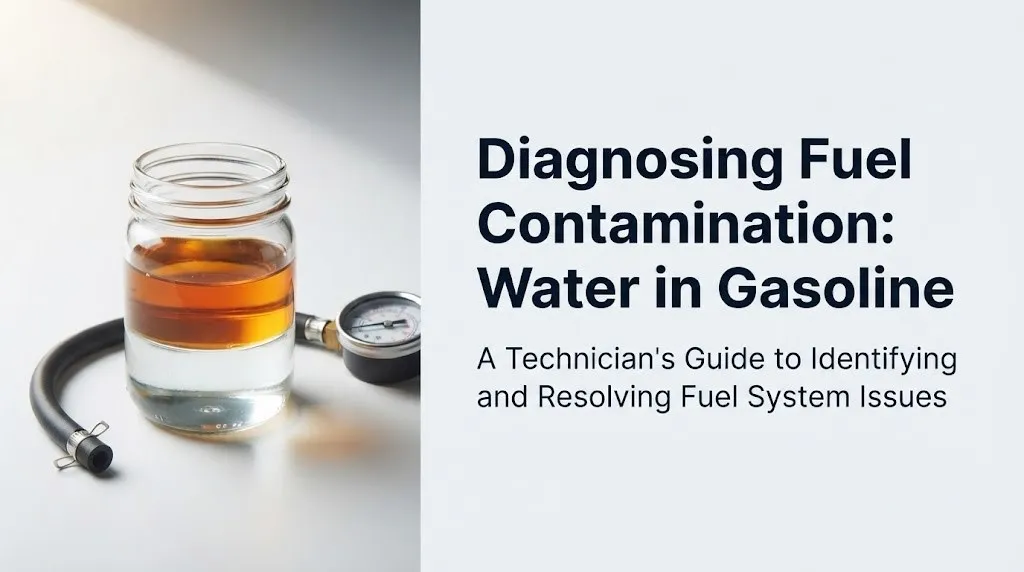
You can identify water in your gas tank by recognizing the combination of performance symptoms (rough idle, misfires, sputtering, stalling), correlating them with a triggering event (recent rain, filling up during a storm, long vehicle storage, flood exposure), and confirming with a simple visual fuel sample test or a fuel pressure diagnostic by a technician.
The visual fuel sample test is the most accessible confirmation method for any vehicle owner. To perform it:
- Obtain a clean, clear glass container.
- Drain a small fuel sample directly from the fuel filter or fuel line into the glass (disconnect the line with the ignition off and the fuel system depressurized; a mechanic can do this safely if you are not confident working with fuel lines).
- Let the sample sit undisturbed for 5 minutes.
- Observe the sample: pure gasoline is uniform amber or yellow with no layering. Water-contaminated fuel shows a visible lower layer that is clearer than gasoline, or the gasoline layer appears cloudy or milky if water is dispersed in small droplets throughout the fuel.
- Note the volume of separation: even a 1/8-inch water layer at the bottom of a 4-ounce sample represents a meaningful contamination level.
An alternative confirmation method is connecting an OBD-II diagnostic scanner and reading live fuel trim data. Water-contaminated fuel causing lean misfires will typically show long-term and short-term fuel trims greater than +10% to +15% as the ECU adds fuel to compensate for the combustion disruption, a pattern that differs from other common causes of lean trim such as a vacuum leak or failing MAF sensor.
Drivers who filled up at a station immediately before symptoms appeared should report the specific station and pump number to the station operator and to their state weights and measures authority, since fuel contamination from a service station’s storage tanks is regulated and reportable.
Key Takeaway: The visual fuel sample test, which takes under 10 minutes and requires only a clean glass jar, is the fastest way a non-mechanic can confirm whether water is present in the fuel before investing in a shop diagnostic.
How to Remove Water from Gas Tank
Water can be removed from a gas tank through three methods depending on the severity of contamination: using a fuel system isopropyl alcohol additive for trace contamination, professional fuel tank draining and refilling for moderate contamination, or complete fuel system flush including tank removal for severe contamination.
Isopropyl alcohol additives, sold under product names including dry gas, work by bonding with water molecules in the fuel tank and allowing the water-alcohol mixture to pass through the fuel system and combust with less disruption than pure water slugs. The U.S. DOE notes that isopropyl alcohol (not methanol, which is corrosive to fuel system seals) is the appropriate additive for water removal in small concentrations in both ethanol-blended and non-ethanol gasoline. This approach is appropriate only for mild trace contamination where symptoms are minimal.
For moderate to severe contamination, the correct procedure requires professional intervention:
- Confirm contamination severity with a fuel sample test or shop diagnostic.
- Depressurize the fuel system fully before any tank access (fuel is under pressure in all modern vehicles with electric fuel pumps; this step requires a trained technician).
- Connect a fuel evacuation pump to the fuel tank drain plug or fuel filler neck using an appropriate hose diameter.
- Evacuate all contaminated fuel into an approved disposal container; this fuel cannot be returned to the vehicle or poured down a drain.
- Inspect and replace the fuel filter, which will have accumulated any particulate from the contaminated fuel.
- Inspect the fuel pickup tube strainer inside the tank for debris or corrosion.
- Refill with fresh, known-quality fuel and run a brief post-fill performance check to confirm symptom resolution.
- If symptoms persist after confirmed tank drain and refill, schedule fuel injector flow testing and fuel pump pressure testing with an ASE-certified technician to assess component-level damage from the contamination event.
For flood-damaged vehicles where water entered the tank in large volumes, the fuel tank may require removal for internal inspection and cleaning due to silt, rust, or biological contamination that a simple drain cannot address.
How Long Can You Drive with Water in Gas Tank
You should not drive with confirmed water in your gas tank beyond what is necessary to safely reach a service facility, because continued operation accelerates damage to the fuel pump, fuel injectors, and catalytic converter, and in severe contamination cases creates an active traffic safety risk from sudden engine stall.
The honest answer is that the safe driving duration is zero once water contamination is confirmed or strongly suspected. This is not a monitor-and-see situation. Every mile driven with a water-contaminated fuel system cycles more water through the fuel pump (degrading its lubrication), through the injectors (hydraulically stressing the tip components), and into the combustion chambers (causing misfires that send unburned fuel to the catalytic converter).
Mild contamination with trace water in an E10 vehicle may resolve partially on its own as the fuel is consumed and the tank refilled, since the fresh ethanol absorbs small remaining water volumes below the phase separation threshold. This does not apply to severe or obvious contamination where symptoms are active and persistent.
| Symptom Severity | Recommended Action | Maximum Safe Driving |
|---|---|---|
| Trace (no symptoms, found on routine check) | Add isopropyl fuel additive; fill tank; recheck at next fill | Continue driving; monitor for symptoms |
| Mild (intermittent rough idle, clears when warm) | Schedule mechanical evaluation within 48 hours | Drive cautiously; avoid highway and full-throttle |
| Moderate (consistent misfires, check engine light, sputtering) | Stop driving; arrange tow or mechanic visit same day | Do not continue beyond necessary minimum |
| Severe (stalling, will not restart, flashing check engine) | Stop vehicle safely; call for tow | Do not drive; vehicle is not roadworthy |
| Extreme (suspected hydrolock; engine will not crank) | Do not attempt to restart; call for tow immediately | Zero; attempting to start risks catastrophic engine damage |
Drivers who experience sudden stalling from suspected water contamination while on a highway or in active traffic should: activate hazard lights immediately, use vehicle momentum to coast to the shoulder or a safe stopping area, avoid attempting multiple restarts if the engine fails to fire within 2 to 3 cranking attempts, and call for roadside assistance.
Emergency Guidance: When to Stop Driving and Call for Help
Certain presentations of water in a gas tank require immediate action and cannot be managed by continuing to drive or waiting to schedule a mechanic appointment. Do not ignore these warning signs.
Stop driving and call for roadside assistance or a tow immediately if:
- The engine stalls suddenly while driving at highway speed and cannot be restarted: this is a traffic safety emergency. Activate hazard lights immediately, coast to the shoulder, and call 911 if you are unable to safely exit the roadway.
- The check engine light is flashing (not steady): this specific OBD-II signal means active misfires are occurring that are damaging the catalytic converter with every engine cycle that continues.
- The engine cranks normally but will not fire after multiple attempts: this may indicate a significant water slug in the fuel lines; repeated cranking attempts with water in the cylinders risk hydrolock and catastrophic connecting rod or piston damage.
- You notice the engine producing a loud metallic knock or sudden loss of all power during driving: these signs can indicate hydrolock is occurring or has occurred; stop cranking the engine immediately and call for a tow.
- The vehicle recently experienced flood exposure with water reaching the rocker panel level or higher: water almost certainly entered the fuel system; do not attempt to start the vehicle. Have it towed to a facility for fuel system, electrical system, and engine assessment before any restart attempt.
These situations represent mechanical emergencies and traffic safety risks. They require a licensed ASE-certified automotive technician’s assessment, not a roadside self-repair attempt with fuel additives.
Frequently Asked Questions About Water in Gas Tank Symptoms
What are the first signs of water in your gas tank?
The first signs of water in a gas tank are typically a rough or stumbling idle at cold start and a brief hesitation or sputter when accelerating from a stop.
These early symptoms appear because water settles to the tank sump and is ingested first by the fuel pickup tube during the initial fuel draw after a cold start.
If these symptoms improve after the engine warms and worsen again the next cold start, water contamination is a primary differential to investigate.
Can water in a gas tank fix itself?
Water in a gas tank does not fully resolve on its own in most cases, though trace amounts of water in E10 ethanol-blended fuel may be partially absorbed by the ethanol fraction if the water volume is below the phase separation threshold.
Once symptoms are present, the contamination level is almost always beyond what the ethanol can absorb, and continued driving accelerates damage to the fuel pump and injectors.
The correct response to symptomatic water contamination is a professional fuel system evaluation, not waiting for the problem to clear.
How much water in a gas tank will cause problems?
As little as 0.1% to 0.5% water by volume of total fuel can produce intermittent misfires and rough idle in most modern vehicles, according to automotive fuel system engineering data.
In a typical 15-gallon fuel tank, that represents approximately 0.6 to 3.2 ounces of water mixed into the fuel supply, an amount that is invisible to the eye when the tank cap is opened but mechanically significant at the fuel pickup tube.
Phase separation in ethanol-blended fuel can be triggered by water concentrations as low as 0.3% of total fuel volume, concentrating that water at the tank sump and amplifying its effect on the fuel pump and injectors.
Will water in gas tank cause a check engine light?
Yes, water in a gas tank will cause a check engine light to illuminate when the OBD-II system detects enough misfires to exceed the malfunction threshold and logs a diagnostic trouble code.
The most common code associated with water-induced misfires is P0300 (random multiple cylinder misfire detected), though cylinder-specific P0301 through P0308 codes may appear if one cylinder consistently receives a higher proportion of water.
A flashing rather than steady check engine light specifically indicates that the misfire rate is high enough to damage the catalytic converter and requires same-day mechanical attention.
Can you damage your engine by driving with water in the gas tank?
Yes, driving with water in the gas tank can cause irreversible engine damage in several ways: premature fuel pump failure from loss of lubrication, injector tip damage from hydraulic stress, catalytic converter destruction from unburned fuel ignition within the substrate, and in extreme cases, hydrolock causing bent connecting rods or cracked pistons.
The severity of damage depends on the volume of water, the duration of driving, and the engine type, with high-pressure direct-injection engines facing higher injector damage risk than port-injection engines at equivalent water concentrations.
An ASE-certified automotive technician should evaluate any vehicle that has shown persistent misfires or stalling from water contamination, even after the fuel system is drained, to check fuel pump pressure and injector spray patterns.
How do you get water out of a gas tank without draining it?
For trace water contamination with no active symptoms, isopropyl alcohol fuel additives (sold as dry gas) can be added to the fuel tank to chemically bond with water molecules and allow the water-alcohol mixture to pass through the system with reduced combustion disruption.
This approach works only when water concentration is minimal (less than 0.1% by volume) and no symptoms of misfires or stalling are present; symptomatic water contamination requires professional fuel system draining.
Do not use methanol-based additives in vehicles with rubber fuel system components or ethanol-blended fuel, as methanol accelerates seal degradation and is incompatible with some fuel system materials.
The pattern of symptoms that water in a gas tank produces follows a logical mechanical sequence: rough idle appears first, then sputtering under acceleration, then misfires, then stalling, and finally potential no-start. Each step represents a higher concentration of water reaching the fuel injectors and combustion chambers. The earlier you identify the pattern, the less expensive the repair.
If your vehicle is showing active misfires (felt as jerks or shudders), a flashing check engine light, or stalling, arrange mechanical evaluation the same day rather than continuing to drive. Ask an ASE-certified automotive technician to perform a fuel sample test, fuel pressure test, and OBD-II code pull as the starting point for diagnosis.
A vehicle that stalls unexpectedly in traffic due to fuel system failure is a safety hazard to you and to other drivers. That reality is the practical reason this problem deserves prompt, specific attention rather than a wait-and-see approach.