Blend Door Actuator Symptoms: Signs Your HVAC Is Failing
Blend door actuator symptoms range from annoying clicking sounds behind your dashboard to complete loss of temperature control, and recognizing them early is the difference between a straightforward repair and a full HVAC diagnosis nightmare. When the actuator fails, your car’s heating and air conditioning system cannot deliver the right air temperature or direct airflow to the right vents, regardless of what you set on the climate control panel.
According to the National Institute for Automotive Service Excellence (ASE), HVAC system complaints rank among the top ten most common vehicle repair categories across all vehicle ages and makes. A failing blend door actuator accounts for a substantial share of those complaints, particularly in vehicles with more than 80,000 miles where the actuator’s internal polymer gear train begins to show wear.
This guide covers every symptom pattern associated with blend door actuator failure, explains exactly what is happening inside the actuator housing when each symptom appears, walks through how to self-diagnose before a shop visit, and gives you the information you need to have an informed conversation with an ASE-certified technician.
Blend Door Actuator Symptoms: What Your Car Is Telling You
Blend door actuator symptoms are your car’s HVAC system signaling that the small electric motor controlling your cabin air temperature or airflow direction has partially or completely failed.
The symptoms are not random. Each one corresponds to a specific mechanical or electrical failure inside the actuator assembly or the communication chain between the actuator and the HVAC control module. Understanding the symptom pattern tells you not just that the actuator is bad, but often which actuator and which failure mode is involved.
Most drivers notice the problem gradually. A faint clicking sound appears first, usually when the climate control system initializes or when you change the temperature setting. Over weeks or months, that clicking becomes more persistent, then temperature control becomes unreliable, then eventually the system locks into one position and stays there.
The severity of the functional impact depends entirely on which actuator fails. A failed blend (temperature) door actuator leaves you with no temperature control. A failed mode door actuator locks your airflow to one vent position. A failed recirculation door actuator prevents fresh-air or recirculation switching.
Key symptoms at a glance:
| Symptom | Likely Failed Component | Severity |
|---|---|---|
| Clicking or knocking behind dashboard | Actuator gear train (stripped gear) | Moderate |
| Temperature stuck at full hot or full cold | Blend door actuator (motor or gear failure) | High |
| Airflow stuck on defrost or floor only | Mode door actuator failure | Moderate to High |
| One side hot, other side cold (dual-zone) | Single-side actuator failure | Moderate |
| No response to temperature knob changes | Position sensor or motor winding failure | High |
| Intermittent temperature swings | Potentiometer wear or wiring fault | Moderate |
What Is a Blend Door Actuator and How Does It Work
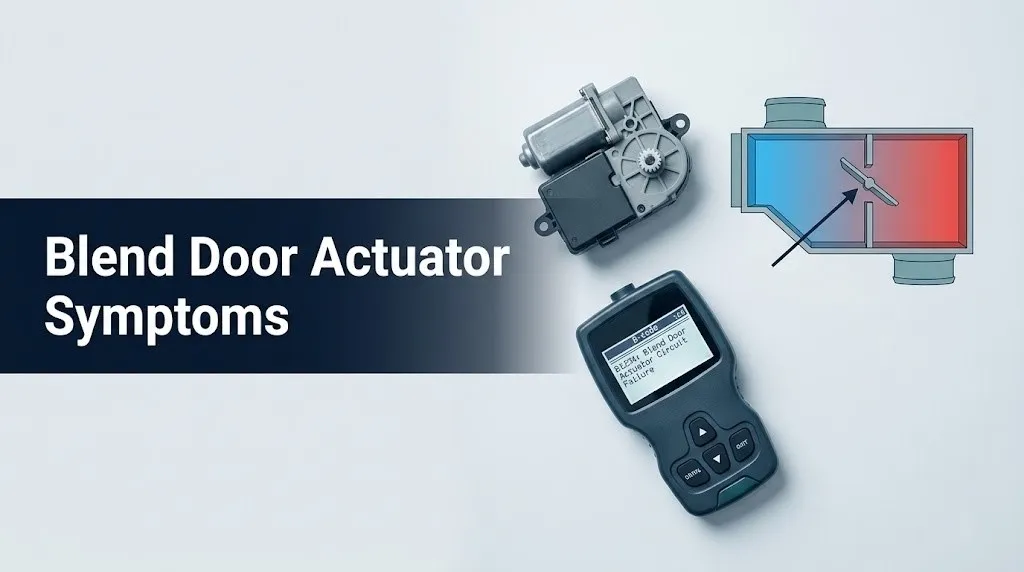
A blend door actuator is a small electric motor assembly mounted inside the HVAC plenum box that physically rotates the blend door (also called the temperature door) to control how much heated or cooled air enters the cabin.
Think of the HVAC plenum as a mixing box. Hot air from the heater core and cold air from the evaporator core both flow into this box simultaneously. The blend door is a flap that pivots inside the box. When it swings fully toward the heater core side, all air passes through it and exits as hot air. When it swings fully away, all air bypasses the heater core and exits as cold air. Every temperature setting between maximum heat and maximum cool represents a specific angle of that door.
The actuator makes that rotation happen. Inside a modern actuator, you’ll find a small stepper motor or DC motor, a polymer gear train (typically four to six nylon gears that reduce motor speed and amplify torque), and a position feedback potentiometer (a variable resistor that reports the door’s exact angle back to the HVAC control module). The control module sends a position command; the motor turns; the gear train rotates the door; the potentiometer confirms the door reached the correct angle.
Most vehicles built after 2000 use electronic actuators communicating over the vehicle’s CAN bus network. Older vehicles may use cable-actuated blend doors where a Bowden cable physically connects the temperature lever to the door. Cable systems fail differently and produce different symptoms; the actuator discussion here applies specifically to electronically controlled systems.
Quick Tip:
- Actuators in most vehicles are not repairable as a unit; when the internal gear strips, the entire actuator is replaced
- Most actuators are vehicle-specific and not universally interchangeable, even within the same brand
- Older cable-actuated systems that develop temperature control problems are often misdiagnosed as actuator failures when the cable has simply frayed or snapped
Bad Blend Door Actuator Symptoms: The Complete List
The bad blend door actuator symptoms that most drivers encounter fall into six distinct categories, each traceable to a specific failure mechanism inside the actuator or its control circuit.
Complete symptom inventory:
- Persistent clicking, ticking, or knocking from inside the dashboard, particularly when the climate control system powers on or when you adjust the temperature. This is the most recognizable and most commonly reported symptom.
- Temperature stuck at maximum heat or maximum cold regardless of the dial or button setting. The door has reached one extreme and the actuator cannot drive it back.
- Temperature that is unpredictable or inconsistent, swinging between warm and cold without a change in the control setting. This suggests intermittent failure of the position feedback potentiometer.
- Airflow locked onto a single vent setting, such as defrost only, floor only, or dash vents only, that cannot be changed with the mode selector. This indicates a mode door actuator failure rather than a blend door actuator failure, but the symptom pattern is similar.
- One side of the cabin significantly warmer or colder than the other in vehicles with dual-zone climate control. Each zone has its own actuator; one can fail while the other continues working normally.
- No airflow change when switching between recirculated and fresh air. This points to a failed recirculation door actuator.
According to Consumer Reports vehicle reliability survey data, HVAC temperature control failures and climate-related electronic faults are among the most frequently self-reported owner issues across domestic and import vehicles in the 5-to-10-year age range.
In older drivers or individuals with circulatory conditions or temperature regulation disorders, a failed heating system in winter creates a genuine safety concern, not just a comfort issue. A technician evaluation should not wait in those cases.
Key Takeaway: A clicking sound from behind the dashboard when you adjust the temperature is the earliest and most reliable warning that a blend door actuator’s internal gear train is beginning to fail, often weeks or months before temperature control is completely lost.
Blend Door Actuator Clicking Noise: What It Means
A blend door actuator clicking noise is produced when the plastic teeth on one or more gears inside the actuator’s gear train have partially stripped, causing the gear to skip over its engagement point with each rotation.
This is the mechanical equivalent of a bicycle chain jumping a sprocket. The motor continues turning, the gear engages most of its teeth normally, then the stripped section reaches the mating gear and the tooth engagement fails, producing a distinct click or tick. When the damage is limited to one or two teeth, the clicking occurs intermittently, typically once per rotation cycle. As more teeth strip, the clicking becomes continuous.
The clicking almost always correlates with HVAC activity. You’ll hear it when you first start the car and the system initializes and sweeps each actuator to confirm position. You’ll hear it when you change the temperature setting and the actuator drives the door to a new angle. You’ll hear it during a defrost cycle if a mode door actuator is involved.
What the timing of the clicking tells you:
| Clicking Pattern | Likely Cause | Clinical Priority |
|---|---|---|
| Only at startup, stops quickly | Actuator calibration sweep across stripped section | Early stage, monitor |
| When adjusting temperature, then stops | Gear skip at one specific door angle | Moderate, repair within weeks |
| Continuous whenever HVAC is on | Multiple teeth stripped, gear nearly non-functional | High, repair soon |
| Loud thumping sound, not clicking | Door hitting a physical stop due to missed position | High, door or actuator damage |
| No sound but no temperature control | Motor winding failure or potentiometer dead | High, silent failure mode |
The polymer gears inside most OEM actuators are designed to be intentionally weak, a deliberate engineering choice to protect the blend door itself from damage. If the actuator binding force becomes too high (due to a warped door, a foreign object in the plenum, or thermal expansion in extreme cold), the gear strips before the door or the HVAC housing cracks. This is why actuator gear failure is so common and door damage is comparatively rare.
Temperature Control Not Working: The Blend Door Connection
When your car’s temperature control stops responding, the blend door actuator is the first component to evaluate, because it is the only component whose sole function is to physically position the temperature door.
The failure chain here is straightforward. The HVAC control module receives your temperature input, calculates the required door angle, sends a position command to the actuator, and waits for confirmation from the potentiometer that the door has reached that angle. If the actuator motor has failed, the door does not move. If the gear train is completely stripped, the motor runs but the door does not move. If the potentiometer has failed, the control module receives no position confirmation and may command the actuator repeatedly, causing the clicking, or may enter a fault state and lock the door in its last known position.
A stuck-at-maximum-heat failure is one of the most disruptive presentations. In summer months, this becomes a genuine safety concern, particularly for children, elderly passengers, or pets in the vehicle. Cabin temperature in a vehicle with full heat output and no air conditioning can climb rapidly in warm weather.
According to the National Highway Traffic Safety Administration (NHTSA), extreme cabin temperatures pose documented injury risk for vulnerable occupants. While a failed actuator is not the most common cause of overheating events, a vehicle stuck at maximum heat output in warm weather should be treated as a priority repair, not a scheduled convenience fix.
Signs temperature control failure is blend-door-related rather than another cause:
- Temperature cannot be changed by any setting adjustment
- Blower motor still works normally at all speeds
- AC compressor engages (you can hear the clutch click) but no cold air reaches the cabin
- OBD-II scan shows an HVAC position fault code (B-code series)
- Symptoms resolve temporarily after a battery disconnect and HVAC system reset
Air Stuck on One Setting: What This Symptom Means
When airflow locks onto a single vent position and will not respond to the mode selector, the mode door actuator has failed, not the blend door actuator (which controls temperature, not airflow direction).
This distinction matters because the fix is different and the actuator location is often different. Most vehicles have at least two actuators: one blend door actuator for temperature control and one or more mode door actuators for airflow direction control. Some vehicles have three or four actuators total when you include separate floor/panel/defrost mode doors and a recirculation door.
The most problematic “stuck mode” failure is when airflow locks onto the defrost position and cannot be moved to dash vents or floor. From a road safety standpoint, being locked into defrost is actually the least dangerous stuck position because it maintains windshield visibility. Being locked off defrost and unable to clear a fogged or iced windshield is a safety hazard.
Common “stuck mode” patterns and their causes:
- Air stuck on defrost only: Mode door actuator failure with door resting at defrost position
- Air stuck on floor only: Mode door cam or actuator stripped at floor detent
- Air stuck on dash vents: Mode door actuator failed at dash-vent position
- No air from any vent: Blower motor failure (not an actuator problem)
- Air from wrong vent for the selected setting: Mode door actuator partially stripped, skipping positions
Drivers in climates with freezing temperatures should treat a failed defrost position change as a time-sensitive repair. If the mode door locks you out of defrost when you need it, windshield visibility becomes compromised within minutes on a cold morning.
Symptoms of a Bad Blend Door Actuator on One Side Only
When only one side of the cabin has temperature control problems while the other side works normally, the issue is almost always a single failed actuator in a dual-zone climate control system.
This is one of the most diagnostically useful symptom patterns because it immediately narrows the cause to a hardware failure rather than a software, refrigerant, or heater core problem. If the entire system lost heating or cooling, the heater core, evaporator, or refrigerant would be the first suspects. When temperature failure is isolated to one zone, the physical actuator for that zone is the clear primary suspect.
In a dual-zone automatic temperature control (ATC) system, the driver and front passenger each have an independent temperature sensor, independent set-point control, and an independent blend door actuator. Some vehicles extend this to a third zone for rear passengers. Each zone’s actuator can fail independently.
One-sided symptom patterns:
| Symptom | Zone Affected | Most Likely Cause |
|---|---|---|
| Driver side always hot, passenger normal | Driver-side blend door actuator | Actuator motor or gear failure |
| Passenger side cold regardless of setting | Passenger-side blend door actuator | Actuator or position sensor failure |
| Right rear always warm (3-zone vehicle) | Rear zone actuator | Actuator gear stripped |
| Driver side temp fluctuates randomly | Driver-side position potentiometer | Potentiometer wear |
Smaller drivers or children who frequently occupy the affected seat tend to notice one-sided failures more acutely, particularly in hot weather when the passenger side consistently delivers heat. If the affected occupant is elderly, has cardiovascular disease, or has autonomic temperature regulation difficulty, a one-sided heating failure in summer deserves prompt attention.
Key Takeaway: When only one side of a dual-zone HVAC system loses temperature control while the other works normally, the failed component is almost certainly a single blend door actuator, which makes diagnosis and repair more straightforward than a system-wide failure.
Mode Door Actuator Symptoms: Not Just Temperature Problems
Mode door actuator symptoms are distinct from blend door actuator symptoms because they affect airflow direction rather than temperature, though the two are often confused because the physical components look nearly identical.
The mode door actuator controls which set of vents receives airflow: dash vents, floor vents, defrost vents, or a combination. It does this by rotating a mode door (also called an air distribution door) inside the HVAC plenum, which opens and closes pathways to each duct set. The actuator uses the same stepper motor and gear train design as the blend door actuator, so its failure modes are identical. The symptom pattern, however, is different because the functional consequence of the failed component is different.
Mode door actuator failure symptoms:
- Airflow cannot be switched from one mode to another using the mode selector button or dial
- One specific vent mode always activates regardless of the selected setting
- A clicking or grinding sound occurs when the mode selector is changed but airflow does not shift
- The HVAC system responds to temperature adjustments normally but vent selection has no effect
- An OBD-II scan reveals a B-code fault specifically referencing the mode door actuator circuit
The mode door actuator is sometimes called the air distribution actuator in OEM service documentation, which can cause confusion when searching for replacement parts.
According to General Motors Technical Service Bulletin documentation for multiple platform years, mode door actuator failures are among the top five most frequently replaced HVAC components in high-mileage GM vehicles, particularly the GMT900 truck platform (Silverado, Sierra, Tahoe, Suburban, Yukon).
For drivers who primarily use the defrost setting in winter, a mode door actuator failure that prevents switching to defrost creates an immediate visibility safety concern. This type of failure should be evaluated by an ASE-certified technician before the next anticipated freezing-weather driving event.
Blend Door Actuator Failure Modes and Internal Mechanisms
The four distinct failure modes of a blend door actuator each produce a recognizable and differentiated symptom pattern, which is why understanding the internal mechanism gives you a meaningful diagnostic advantage.
Failure Mode 1: Stripped Polymer Gear (Most Common)
The gear train inside the actuator uses nylon or similar polymer gears deliberately designed to be the weakest link in the mechanical chain. Over time, repeated stress cycling, thermal expansion, and occasional actuator stall events wear down the gear teeth. When enough teeth strip, the gear skips under load, producing the clicking sound. The motor continues to run; the door either moves incompletely or does not move at all.
Failure Mode 2: Motor Winding Failure (Silent Failure)
When the stepper motor’s internal windings fail, the actuator produces no clicking sound because the motor is not attempting to turn. The symptom is temperature or airflow that is completely unresponsive to control inputs, with no audible noise from the actuator location. This silent failure is often initially misdiagnosed as a control module or wiring problem.
Failure Mode 3: Position Potentiometer Failure (Intermittent/Erratic)
The position feedback potentiometer wears along its resistive track over time. As the track develops dead spots or open circuits, the signal sent back to the HVAC control module becomes inconsistent. The module receives incorrect position information and either commands the actuator to keep adjusting (causing hunting behavior and intermittent temperature swings) or enters a fault state and freezes the door.
Failure Mode 4: Wiring Harness or Connector Fault (Intermittent)
The actuator receives both power and signal through a multi-pin connector. Corrosion, vibration-induced wire fatigue, or physical connector damage can produce symptoms that mimic internal actuator failure. This failure mode is particularly common in high-moisture environments, in vehicles where the dashboard has been removed for other repairs and connectors were not fully reseated, and in older vehicles with original wiring.
| Failure Mode | Primary Symptom | Sound | Diagnostic Clue |
|---|---|---|---|
| Stripped gear | Partial or no door movement | Clicking, ticking | Motor runs, no door response |
| Motor winding failure | No door movement | Silent | No response, no fault code initially |
| Potentiometer failure | Erratic temperature | Possible hunting noise | Inconsistent live data |
| Wiring/connector fault | Intermittent of any type | Variable | Fault code clears after disconnect |
How to Test a Blend Door Actuator Before Seeing a Mechanic
Testing a blend door actuator before a shop visit can save you the diagnostic labor charge and give you specific information to share with a technician, making the repair faster and more accurate.
Step-by-step self-diagnostic sequence:
- Start the vehicle and set the climate control to maximum heat. Listen carefully to the area behind the center console or lower dashboard where the actuator is located. Note whether you hear clicking, grinding, or thumping sounds.
- Slowly move the temperature setting from maximum heat to maximum cold. Observe whether cabin air temperature actually changes. A five-minute wait at each extreme allows time to confirm whether the temperature shifts or remains fixed.
- Switch through all mode settings (dash vents, floor, defrost, bi-level) one at a time. Confirm whether airflow actually shifts between vent locations or remains fixed.
- Toggle the recirculation button and listen for any clicking or movement sound from the left side of the HVAC housing, where the recirculation door actuator is typically located.
- Disconnect the vehicle’s battery for 10 minutes, then reconnect. This resets the HVAC control module and forces all actuators to perform a calibration sweep on the next startup. If clicking or erratic behavior disappears after a reset, the issue may be a calibration error rather than a failed actuator. If symptoms return, the actuator has a hardware fault.
- Use an OBD-II scan tool with live data capability to check for active B-code fault codes and to view actuator position data in real time. This step is the most diagnostically definitive short of removing the actuator physically.
Quick Tip:
- A basic OBD-II reader that shows only P-codes (powertrain) will miss HVAC B-codes. You need a scanner that reads body codes (B-codes) to access HVAC fault data.
- Phone-connected OBD-II Bluetooth adapters paired with apps like Torque Pro or Car Scanner ELM can read B-codes on many vehicles for under $30.
Key Takeaway: Performing a battery disconnect HVAC reset before replacing an actuator is worth doing in every case because roughly 15 to 20 percent of apparent actuator failures are actually calibration errors that resolve completely with a system reset, according to field observations documented in ASE training materials.
Blend Door Actuator OBD2 Codes and Diagnostic Tools
Blend door actuator OBD2 codes appear in the B-code (body fault) range rather than the P-code (powertrain) range, which is why a basic code reader often shows “no faults” even when the actuator is clearly malfunctioning.
The most common HVAC-related B-codes associated with blend door actuator failure include:
- B0260 to B0265: Air temperature door control circuit faults (circuit open, short to ground, short to voltage, position performance)
- B1318: Battery voltage low (relevant if actuator resets are being triggered by electrical system voltage drops)
- B2284, B2285: Mode door actuator circuit faults on specific GM platforms
- Manufacturer-specific HVAC codes that vary by OEM, particularly on Ford, Chrysler/Stellantis, Toyota, and BMW platforms
The specific code number varies by manufacturer and even by vehicle generation within the same brand. OEM service documentation is the only authoritative reference for interpreting a specific code on a specific vehicle.
Diagnostic tool capability levels:
| Tool Type | B-Code Access | Live Data | Bi-Directional Control | Cost Range |
|---|---|---|---|---|
| Basic OBD-II reader (P-codes only) | No | No | No | $15 to $40 |
| Enhanced OBD-II reader with body codes | Yes | Limited | No | $50 to $150 |
| Professional scan tool (Snap-on, Autel, Launch) | Yes | Full | Yes | $300 to $3,000+ |
| OEM factory scan tool (dealer-level) | Yes | Full | Full calibration | Dealer only |
Bi-directional control capability is the most useful feature for blend door actuator diagnosis. A scan tool with bi-directional control can command the actuator to sweep to specific positions while you observe the response, confirming whether the actuator moves, partially moves, or does not respond at all. This turns a 45-minute diagnostic process into a 5-minute definitive test.
Drivers who regularly buy and sell used vehicles would benefit from owning an enhanced scan tool with B-code access, as HVAC actuator faults are among the most commonly concealed pre-sale issues in the used vehicle market.
Blend Door Actuator vs. Heater Core Symptoms: Key Differences
Blend door actuator failure and heater core failure are two of the most frequently confused HVAC diagnoses, but they produce distinctly different symptom profiles that can be separated with a few targeted observations.
The heater core is a small radiator-like heat exchanger mounted inside the HVAC plenum. Hot engine coolant flows through it, and air passes over the fins to pick up heat. When the heater core fails (typically by developing a coolant leak or becoming clogged), heat output drops or disappears. The failure is in the heat source itself, not in the mechanism controlling how much air flows over it.
The blend door actuator controls the door that determines how much air reaches the heater core. When the actuator fails, the heat source (heater core) is typically still functioning normally; the problem is that the air cannot be properly directed over it.
Differentiating symptoms:
| Symptom | Blend Door Actuator | Heater Core |
|---|---|---|
| No heat output | Yes (door stuck at cold position) | Yes (core clogged or leaking) |
| Foggy windshield with sweet smell | No | Yes (coolant evaporating inside cabin) |
| Coolant loss without visible leak | No | Yes (leak into plenum or cabin) |
| Wet carpet under dashboard | No | Yes (severe coolant leak) |
| Clicking noise from dashboard | Yes (gear failure) | No |
| Engine overheats | No | Sometimes (if core bypass is closed) |
| Heat works normally when engine is cold | Sometimes | Rarely |
| Temperature inconsistency (swings) | Yes | Rarely |
The coolant smell and wet carpet symptoms are the most reliable indicators of a heater core problem and are never produced by a blend door actuator failure. A sweet or slightly chemical smell inside the cabin with no external leak is a heater core symptom until proven otherwise, and it warrants evaluation promptly because coolant vapor inside the passenger cabin can cause eye and respiratory irritation.
Dual Zone HVAC Blend Door Actuator Symptoms
Dual-zone HVAC blend door actuator symptoms are more complex than single-zone failures because two independent actuators, two independent temperature sensors, and two independent control circuits are operating simultaneously.
In a dual-zone ATC system, the HVAC control module runs two separate temperature loops. The driver’s side loop monitors the driver-side in-car temperature sensor, compares it to the driver’s set point, calculates a required blend door angle for the driver-side actuator, and sends position commands accordingly. The passenger-side loop does the same independently. This means each side can fail without affecting the other.
The most common dual-zone failure presentation is the asymmetric symptom: one side maintains perfect temperature control while the other is stuck at full heat or full cold. Because the working side appears normal, drivers sometimes initially suspect the malfunctioning occupant is operating their controls incorrectly, delaying the correct diagnosis.
Some dual-zone vehicles also have separate mode door actuators for each zone, separate recirculation door actuators, and in SUVs and minivans, one or more additional actuators for the rear zone. Each of these represents an independent potential failure point.
Dual-zone actuator failure by vehicle segment:
According to Technical Service Bulletin data archived through the NHTSA database, dual-zone HVAC actuator failures are reported at elevated rates in several specific vehicle platforms:
- General Motors full-size trucks and SUVs (GMT800 and GMT900 platforms)
- Ford Explorer and F-Series with dual-zone HVAC
- Chrysler Grand Cherokee and Ram trucks with ATC
- Toyota Highlander and Sienna with rear-zone HVAC
Vehicles with three or four climate zones (rear HVAC systems in larger SUVs and minivans) have proportionally more actuators and therefore statistically more opportunities for actuator failure as mileage accumulates.
Key Takeaway: In a dual-zone vehicle, an asymmetric temperature problem where one side is stuck and the other works perfectly is almost always a single failed actuator on the affected side, not a refrigerant, heater core, or control module problem.
Can You Drive with a Bad Blend Door Actuator
You can drive with a bad blend door actuator in most situations, but the decision depends entirely on which actuator has failed and what the current operating conditions are.
A failed blend door actuator does not affect engine performance, transmission function, braking, or steering. The drivetrain and safety systems operate completely independently of the HVAC actuator. From a mechanical standpoint, driving with a failed actuator causes no additional damage to the engine or drivetrain.
The safety concern is not mechanical; it is environmental. A vehicle stuck at maximum heat output in summer poses a genuine heat-related risk for occupants, particularly children, elderly passengers, and pets. A vehicle that cannot activate the defrost mode in freezing temperatures creates a visibility hazard because the windshield cannot be cleared of ice or condensation.
Decision guide by failure type:
| Failure Type | Safe to Drive? | Time Sensitivity |
|---|---|---|
| Stuck at full heat, summer conditions | Caution, limit use | High, repair within days |
| Stuck at full cold, winter conditions | Caution for vulnerable occupants | Moderate to high |
| Mode door stuck, defrost unavailable, freezing weather | Do not drive in freezing rain or frost | Repair before next cold weather event |
| Clicking noise only, temperature still adjusts | Yes | Repair within 4 to 6 weeks |
| One zone failed in dual-zone, other zone works | Yes, with comfort limitations | Moderate, repair within a few weeks |
| Recirculation door only, no other symptoms | Yes | Low, repair at next scheduled service |
Never leave a child, elderly person, or pet in a vehicle stuck at maximum heat output, even briefly. Cabin temperatures in such vehicles can reach dangerous levels within 10 minutes in warm ambient conditions.
When to Replace a Blend Door Actuator
The timing of blend door actuator replacement depends on the severity of the current symptoms, the safety implications of continued failure, and whether the failure is progressive or has stabilized.
A clicking-only actuator that still moves the door to the correct position is in early-stage failure. The clicking indicates stripped gear teeth that are occasionally skipping, but the door is still reaching its commanded angle. This stage can persist for weeks to months before complete failure occurs. Replacement is appropriate to plan within the near term, but it is not an emergency.
A stuck-temperature actuator that has completely lost the ability to move the door has entered complete failure. Replacement should not be deferred because the HVAC control module may continue sending position commands to the stalled actuator indefinitely, potentially stressing the motor windings and in rare cases causing localized heat buildup within the actuator housing.
Replacement decision criteria:
- Clicking noise present but temperature control still functional: Replace within 4 to 8 weeks
- Temperature stuck at one extreme: Replace as soon as possible, within days
- Mode door stuck, defrost unavailable, winter weather expected: Replace before next cold weather event
- Fault code confirmed by OBD-II scan: Replacement is indicated; code will not clear with a reset if the hardware has failed
- Symptoms resolved after battery reset and no return within 2 weeks: Monitor; may be a calibration event, not hardware failure
The ASE recommends that when any HVAC actuator is replaced, all actuators in the same system be inspected for wear, because actuators installed at the same time by the OEM tend to accumulate mileage simultaneously and often fail within similar timeframes.
Blend Door Actuator Replacement Cost and Repair Options
Blend door actuator replacement cost varies significantly based on the vehicle, the actuator’s location within the HVAC system, and whether multiple actuators are being replaced in one service visit.
The part itself is relatively inexpensive. OEM actuators typically range from $40 to $150 depending on the vehicle and the specific actuator. Aftermarket actuators from reputable manufacturers such as Dorman Products or ACDelco range from $20 to $80 and are functionally equivalent in most applications.
The labor cost is where significant variation occurs. Some actuators are accessible through a small access panel beneath the glovebox or under the dashboard with minimal disassembly. Others require partial or complete dashboard removal, a process that can take 4 to 8 hours of shop time at $100 to $150 per hour in most U.S. markets.
Cost overview by vehicle and access difficulty:
| Actuator Location | Labor Difficulty | Total Typical Cost (Part + Labor) |
|---|---|---|
| Easy access (below glovebox, no dash removal) | 1 to 2 hours | $120 to $350 |
| Moderate access (partial dash removal required) | 2 to 4 hours | $300 to $650 |
| Difficult access (full dash removal required) | 4 to 8 hours | $600 to $1,400+ |
| Dealer-specific calibration required after replacement | Add 30 to 60 min | Add $75 to $150 |
Some vehicles, particularly certain GM full-size trucks, have become well-documented for difficult actuator access. The HVAC actuator on some GMT900 trucks requires removing significant dashboard structure, making what seems like a simple part replacement a substantial labor investment.
An ASE-certified technician with access to the factory service manual for your specific vehicle is the appropriate professional for this repair. Provide the technician with any OBD-II fault codes you have already retrieved, the specific symptom pattern (clicking vs. stuck temperature vs. stuck mode), and which side of the vehicle is affected in a dual-zone system. This information reduces diagnostic time and gets the repair done correctly in fewer shop hours.
Frequently Asked Questions About Blend Door Actuator Symptoms
What are the most common symptoms of a bad blend door actuator?
The most common symptoms of a bad blend door actuator are a repetitive clicking or ticking noise from inside the dashboard and a loss of temperature control in which the HVAC system delivers air at only one temperature regardless of the dial setting.
Other frequent symptoms include airflow locked onto one vent position, one side of the cabin significantly warmer or colder than the other in dual-zone vehicles, and HVAC behavior that is intermittent or erratic without any control input changes.
These symptoms often start mildly and worsen over weeks to months as the actuator’s internal gear train or motor continues to degrade.
Why is my car clicking when I change the temperature?
Clicking when you change the temperature setting almost always indicates that the blend door actuator’s internal polymer gear train has developed stripped teeth that skip under load as the motor tries to rotate the door to the new position.
The actuator motor is still receiving commands and attempting to function, but the damaged gear cannot transfer that motion smoothly to the blend door.
This symptom typically appears months before complete temperature control loss, making it the most useful early warning sign of impending actuator failure.
How do I know if I have a bad blend door actuator or a bad heater core?
A bad blend door actuator produces clicking sounds, unresponsive temperature control, and erratic temperature behavior, but never produces a sweet or chemical smell inside the cabin, wet carpet under the dashboard, or coolant loss from the cooling system.
A failing heater core is identified by the presence of a sweet antifreeze smell inside the cabin, fogging on the inside of the windshield that is not cleared by the defroster, and in severe cases, wet or damp carpet on the passenger-side footwell.
If you detect a coolant smell or visible moisture inside the cabin, have a licensed automotive technician evaluate the heater core before the next drive.
Can a bad blend door actuator cause my AC to stop working?
A blend door actuator stuck in the full-heat position can make the cabin feel as if the AC has stopped working, even when the air conditioning compressor is functioning normally and producing cold air at the evaporator.
The actuator failure blocks cold air from reaching the cabin by keeping the blend door rotated toward maximum heat, so cool air from the evaporator is never delivered to the vents.
Confirming whether the AC compressor clutch engages (you’ll hear a click from the engine bay when AC is activated) helps distinguish an actuator position problem from a true refrigerant or compressor failure.
How do I reset a blend door actuator?
Resetting a blend door actuator is done by disconnecting the vehicle’s negative battery terminal for 10 minutes, then reconnecting it, which forces the HVAC control module to clear its stored actuator position memory and perform a fresh calibration sweep on the next startup.
Some vehicles, particularly those with automatic temperature control (ATC) systems, require a specific button-press sequence on the HVAC control panel to initiate a recalibration; this sequence is vehicle-specific and is documented in the owner’s manual or OEM service documentation.
If symptoms return within days of a successful reset, the actuator has a hardware fault and requires physical replacement, not another reset.
How long does a blend door actuator last?
Most blend door actuators are designed to last the service life of the vehicle, but in practice the polymer gear train begins to show wear between 80,000 and 150,000 miles in most vehicles, according to field data reported in ASE service training materials and consistent with Dorman Products’ aftermarket replacement demand data.
Vehicles operated in extreme cold or extreme heat environments experience faster actuator wear because thermal cycling stresses the polymer gears more aggressively than in moderate climates.
An actuator that is clicking but still functional may continue operating for weeks to several months before complete failure, but replacement before complete failure is always preferable because it allows the work to be scheduled at a convenient time rather than as an emergency repair.
Closing
The most practical takeaway from everything covered here is straightforward: the clicking sound is your earliest and most actionable warning. Most blend door actuator failures announce themselves weeks or months before temperature control is completely lost. That window is your opportunity to schedule a repair at your convenience rather than deal with a car locked at maximum heat in August or maximum cold in January.
If you have identified your symptoms in this guide, retrieve any OBD-II B-codes your vehicle has stored and note the specific symptom pattern before contacting a repair facility. Knowing whether you have a clicking-only actuator, a stuck-temperature actuator, a mode door problem, or a one-sided dual-zone failure will save diagnostic time and help you evaluate whether a quoted repair cost is accurate.
Take your documentation to an ASE-certified technician and ask specifically whether your vehicle requires a calibration procedure after actuator replacement. Some platforms do, and skipping that step produces continued HVAC error codes and premature actuator wear on the new part.