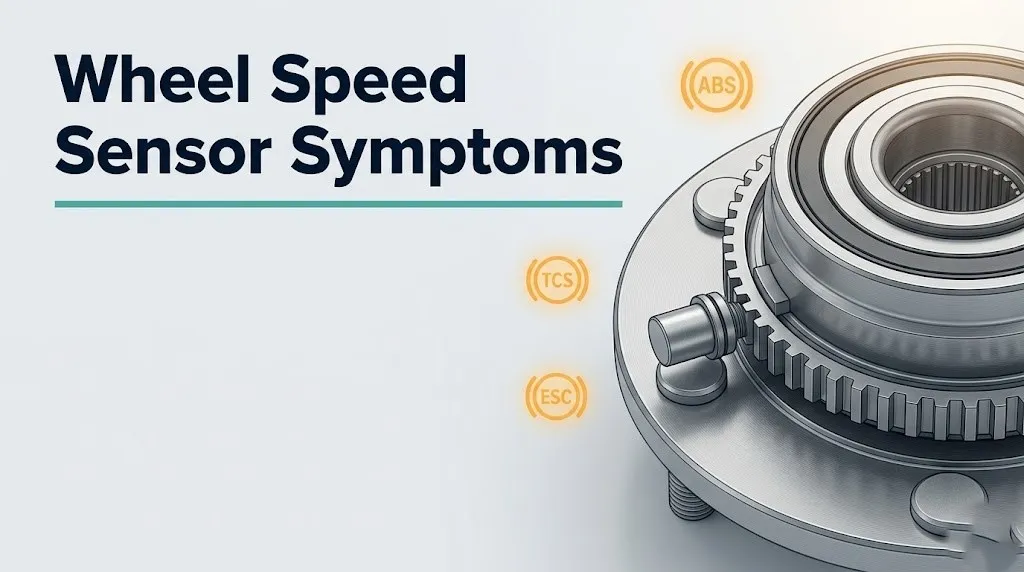
Wheel Speed Sensor Symptoms: Signs of Failure 2026
Wheel speed sensor symptoms range from a lit ABS warning light to erratic speedometer readings, transmission shifting problems, and measurably longer stopping distances. Every one of these symptoms points to the same core problem: the ABS control module is receiving corrupted, intermittent, or absent speed data from one or more wheels.
According to the National Highway Traffic Safety Administration (NHTSA), electronic stability control systems, which depend entirely on accurate wheel speed data, prevent approximately 56% of fatal rollover crashes when functioning correctly. When a faulty sensor takes these systems offline, the safety margin built into your vehicle disappears without any obvious change in how the car feels at normal speeds on dry roads.
This article covers every symptom a failed or failing wheel speed sensor produces, explains exactly why each symptom occurs at the system level, identifies which symptoms indicate immediate safety risk, and tells you precisely what an ASE-certified technician will do to confirm the diagnosis.
Wheel Speed Sensor Symptoms: The Full Picture
Wheel speed sensor symptoms collectively signal that one or more of your vehicle’s active safety systems has lost the data it needs to function. The ABS warning light is the most recognized symptom, but it’s only one of at least six distinct symptoms a failing sensor can produce.
The full list of symptoms includes:
- ABS warning light illumination (most frequent first symptom)
- Traction control system (TCS) warning light or automatic disabling
- Electronic stability control (ESC) warning light or automatic disabling
- Speedometer reading errors or erratic needle behavior
- Transmission shifting problems, including hard shifts or delayed gear changes
- Brake pedal pulsation during normal (non-ABS) braking
- Longer stopping distances on wet or slippery surfaces
- Adaptive cruise control or collision mitigation system disabling
Not every failed sensor produces all of these symptoms at once. The pattern depends on which wheel’s sensor has failed, whether the failure is complete or intermittent, and what systems your specific vehicle uses that share wheel speed data.
Older vehicles from the 1990s and early 2000s with basic passive inductive ABS sensors typically show only the ABS light. Modern vehicles with fully integrated driver-assistance systems may show four or five warning indicators simultaneously from a single sensor failure.
| Symptom | Systems Affected | Safety Risk Level |
|---|---|---|
| ABS warning light | ABS only | Moderate: ABS disabled |
| Traction control light | TCS and ABS | Moderate-High: loss of traction management |
| ESC warning light | ESC, TCS, ABS | High: loss of stability management |
| Speedometer error | Instrument cluster, PCM | Low-Moderate: navigation and speed limit concern |
| Transmission hard shift | TCM signal loss | Low-Moderate: drivability issue |
| Brake pedal pulsation | ABS hydraulic circuit | Moderate: confirms active sensor interference |
| Longer stopping distance | ABS fully disabled | High on wet or slippery surfaces |
What a Wheel Speed Sensor Does and How It Fails
A wheel speed sensor generates an electrical signal proportional to the rotational speed of its wheel, feeding that data continuously to the ABS control module so the module can compare all four wheels in real time.
There are two fundamentally different sensor types in modern vehicles. The older design, the passive inductive sensor (also called a variable reluctance sensor), contains a permanent magnet wrapped in a coil of wire. As the teeth of the reluctor ring (a toothed metal ring pressed onto the axle shaft or wheel hub) pass close to the sensor tip, they alternately increase and decrease the magnetic field through the coil. This change in flux induces an alternating current voltage signal. The frequency of that AC signal tells the ABS module how fast the wheel is spinning.
The newer design, the active Hall-effect sensor, works differently. It detects the polarity switching of a magnetic field as reluctor ring teeth pass, generating a clean digital square-wave output. Because it produces a signal even at near-zero wheel speed, it gives the ABS module data at walking-pace speeds that the older passive sensor cannot reliably deliver.
Think of the passive sensor as a microphone that only hears sound above a certain volume. Below about 3 to 5 mph, it essentially goes silent. The Hall-effect sensor is more like a digital switch: it sends a clear on-off signal regardless of how slowly the wheel turns.
Sensors fail through five primary mechanisms:
- Corrosion at the sensor body, wiring connector, or mounting bracket (most common in high-salt road environments)
- Physical damage to the sensor tip from road debris, brake dust, or metallic particles contaminating the air gap between sensor and reluctor ring
- Wiring harness damage from chafing against suspension components through normal suspension travel cycles
- Bearing failure in wheel hub units where the reluctor ring is pressed into or integrated with the bearing outer race
- Reluctor ring damage: cracked, corroded, or missing teeth produce irregular signal dropouts
Bad Wheel Speed Sensor Symptoms: ABS Warning Light
The ABS warning light illuminating on the instrument panel is the most consistent and earliest symptom of a bad wheel speed sensor. It appears because the ABS control module continuously monitors incoming sensor signals and trips a fault code when any signal deviates from expected parameters.
The module does not wait for a prolonged failure. A signal that drops out for even a fraction of a second during wheel rotation may be sufficient to trigger the fault, depending on the module’s sensitivity threshold as programmed by the manufacturer. When the fault is detected, the module disables the entire ABS circuit for that wheel and stores a diagnostic trouble code.
What many drivers misunderstand is that the ABS light coming on does not mean the brakes have stopped working. Your standard hydraulic braking system remains fully functional. What you’ve lost is the modulation function: the ability of the system to rapidly cycle brake pressure at that wheel to prevent lock-up during a panic stop.
Drivers with manual transmission vehicles or those who learned to drive before ABS was standard may feel they can compensate by threshold braking. This is possible with skill and practice on dry pavement. On wet or icy surfaces, the safety gap between a functioning ABS system and no ABS widens dramatically.
Quick Tip:
- An ABS light that comes on briefly then turns off may indicate an intermittent sensor signal dropout rather than a complete sensor death. It still warrants diagnostic scanning.
- On most vehicles, a simultaneous ABS light and red brake warning light suggests a more serious hydraulic brake system issue, not just a sensor fault.
- Older drivers or those with longer reaction times face greater risk when ABS is disabled, since they are less likely to apply threshold braking technique consistently during emergency stops.
Bad ABS Sensor Symptoms: Traction Control System Failure
Bad ABS sensor symptoms almost always include traction control system (TCS) warning light illumination or automatic TCS disabling, because the TCS uses the same wheel speed sensor data as the ABS module to do its job.
The traction control system prevents wheel spin during acceleration by comparing the rotational speed of driven wheels to non-driven wheels. If a driven wheel begins to spin faster than the others, the system interprets this as wheel slip and responds by reducing engine torque or applying selective braking to the spinning wheel. Both responses require accurate, real-time wheel speed data from all four sensors.
When a sensor fails, the TCS cannot reliably distinguish between actual wheel spin and a data artifact from a malfunctioning sensor. The system’s response is conservative and correct from a safety standpoint: it disables itself to avoid falsely applying braking to a wheel that is not actually slipping. This is why the traction control light often illuminates at the same moment as the ABS light.
According to SAE International, wheel speed sensors in modern vehicles serve as the primary input for up to seven distinct vehicle control functions, with TCS being the most frequently affected after ABS itself when a single sensor fails.
Drivers notice the practical effect most during acceleration on low-traction surfaces. On a snowy or wet road, a vehicle with a failed wheel speed sensor and disabled TCS may spin a drive wheel freely during acceleration where it previously would have managed grip automatically. The vehicle does not behave dangerously at normal speeds on dry pavement, but the safety buffer designed for adverse conditions is gone.
All-wheel-drive vehicles are particularly sensitive to this failure pattern. AWD systems that use wheel speed differential data to manage torque split between front and rear axles may behave erratically or shift abnormal amounts of torque to one axle when sensor data is unreliable.
Key Takeaway: A single bad wheel speed sensor typically disables both ABS and the traction control system simultaneously, because both systems share the same sensor data input at the ABS control module.
ABS Wheel Speed Sensor Symptoms: Electronic Stability Control
ABS wheel speed sensor symptoms extend beyond ABS and TCS to include the electronic stability control (ESC) system, which depends on wheel speed data as one of three primary inputs to function.
ESC uses wheel speed sensor data together with a yaw rate sensor (which measures the vehicle’s rotation around its vertical axis) and a lateral acceleration sensor (which measures sideways g-force). When the module detects a difference between where the driver is steering and where the vehicle is actually going, it applies selective braking to individual wheels to correct the vehicle’s path. This intervention is what prevents oversteer spins and understeer plowing during emergency maneuvers.
Remove accurate wheel speed data from one sensor, and the ESC module can no longer perform this three-way comparison reliably. Like TCS, it defaults to disabling itself.
The NHTSA mandated ESC on all new passenger vehicles and light trucks under Federal Motor Vehicle Safety Standard 126, effective September 2011. Research cited in the NHTSA rulemaking found that ESC reduced single-vehicle crash risk by approximately 34% for passenger cars and by approximately 59% for SUVs. A failed wheel speed sensor that takes ESC offline eliminates this protection entirely.
On modern vehicles, this often triggers a separate ESC warning light, sometimes labeled “StabiliTrak” (General Motors), “VSC” (Toyota), “DSC” (Mazda and BMW), “ESP” (Volkswagen and Mercedes-Benz), or “VDC” (Nissan and Subaru). Multiple warning lights appearing together for what is actually a single sensor failure surprises many drivers who assume each light indicates a separate problem.
Older adults, new drivers, and drivers of higher-center-of-gravity vehicles like SUVs and pickup trucks face the greatest marginal risk when ESC is disabled, as these groups and vehicle types benefit most from ESC intervention in emergency maneuvers.
Symptoms of a Bad Wheel Speed Sensor: Speedometer Errors
Symptoms of a bad wheel speed sensor include speedometer reading errors because, in many vehicles, the instrument cluster receives vehicle speed data from the same wheel speed sensors used by the ABS module.
In older vehicles, a dedicated vehicle speed sensor (VSS) mounted on the transmission output shaft provided speedometer data separately from the ABS sensors. Most modern vehicles have eliminated the dedicated VSS. The ABS module now processes wheel speed data and broadcasts vehicle speed information to the instrument cluster, navigation system, and any speed-dependent feature through the vehicle’s CAN bus (controller area network), the internal communication network that connects all electronic modules.
When a wheel speed sensor fails and produces corrupted data, the calculated vehicle speed becomes unreliable. The speedometer needle may fluctuate erratically, may read consistently lower or higher than actual speed, or may drop to zero momentarily before recovering. On vehicles where the ABS module defaults to disabling the affected channel entirely, the speedometer may simply freeze at its last accurate reading before the fault was detected.
This matters beyond the obvious navigation concern. Speed-dependent features like variable-ratio power steering, automatic headlight aiming, and speed-sensitive automatic door locking all use vehicle speed data. A corrupted signal can cause these systems to behave erratically in ways that initially seem unrelated to a wheel sensor problem.
Quick Tip:
- A speedometer that only malfunctions at specific speeds (particularly below 5 mph) often points to a passive inductive sensor losing signal at low wheel rotation frequency, which is a characteristic failure mode of the older variable reluctance design.
- Drivers who receive automated speeding alerts or rely on vehicle speed for adaptive cruise control will notice the cascading effect of this symptom beyond the instrument panel.
- In vehicles with integrated navigation or telematics, a persistent speed signal error may also trigger erroneous data logs or affect insurance telematics programs tied to the vehicle.
Faulty Wheel Speed Sensor Symptoms: Transmission Hard Shifting
Faulty wheel speed sensor symptoms include hard, erratic, or delayed automatic transmission shifts because the transmission control module (TCM) uses vehicle speed as a primary input for determining when to upshift, downshift, and when to engage torque converter lockup.
The TCM’s shift maps are programmed with specific speed thresholds: shift from second to third at approximately this speed under this throttle load, lock the torque converter at this cruising speed, downshift when speed drops below this threshold. All of these decisions require accurate real-time vehicle speed data.
When the ABS module broadcasts a corrupted or absent speed signal across the CAN bus, the TCM receives faulty input. The result varies by vehicle. Some transmissions shift at the wrong speed, producing a jolt or hard engagement that feels like a mechanical transmission problem. Others shift excessively early or late. Some modern transmissions default to a “limp-home mode” that limits available gears as a protective response to corrupted speed data.
Think of the CAN bus as the vehicle’s internal nervous system, carrying sensor data between modules. A bad wheel speed sensor is like a nerve sending scrambled signals: every module downstream that relies on that signal begins making decisions based on bad information.
According to SAE International technical literature, vehicle speed sensor data inaccuracy is among the top five causes of unexplained automatic transmission shift quality complaints that initially appear to be internal transmission mechanical failures. This is why an ASE-certified technician will scan all modules for fault codes before beginning any transmission-related repair.
Drivers who notice harsh shifting alongside an ABS or traction control warning light should not assume the transmission itself has failed. The symptoms may share a single root cause: one malfunctioning wheel speed sensor.
Key Takeaway: Hard or erratic automatic transmission shifting that appears alongside ABS or traction control warning lights very often traces to a single failed wheel speed sensor sending corrupted speed data to the transmission control module through the CAN bus.
Brake Pedal Pulsation and Wheel Speed Sensor Failure
Brake pedal pulsation is one of the more physically noticeable symptoms of a wheel speed sensor problem, and it occurs through a specific mechanism that distinguishes it from the pulsation caused by warped brake rotors.
Sensor-related pedal pulsation happens when the ABS module misinterprets noise or dropout in a sensor’s signal as evidence of wheel lock-up. The module responds the way it is designed to: it activates the ABS function, rapidly cycling the hydraulic solenoid valve for that wheel open and closed to modulate brake pressure. This cycling is what creates the rapid pulsation felt through the brake pedal during an actual ABS event.
When this activation happens during normal braking on a dry surface at non-emergency speeds, it means the module is responding to false data. The result is unexpected pedal pulsation under moderate braking, occasionally accompanied by the grinding or buzzing sound characteristic of ABS hydraulic cycling. Some drivers describe this as the “ABS activating on dry pavement,” which is accurate: the hardware is functioning exactly as designed, but triggering in response to a false signal.
The practical distinction between sensor-induced pulsation and rotor warp is timing. Rotor-related pulsation occurs at a specific frequency tied to wheel rotation speed and feels like a rhythmic beat that worsens at higher speeds. Sensor-induced pulsation often occurs suddenly, may not correlate with a consistent rhythm, and is more likely to trigger simultaneously with a warning light.
Older vehicles are more prone to false ABS activation from passive inductive sensor noise because the older sensor design is more susceptible to signal interference from debris contamination or slight air gap variations caused by worn wheel bearings.
| Pulsation Type | Onset Pattern | Associated Warning Light | Rotor Inspection Likely Normal? |
|---|---|---|---|
| Sensor-induced (false ABS activation) | Sudden, unpredictable | Yes, ABS or TCS | Yes |
| Warped rotor | Rhythmic, speed-dependent | No | No (rotor lateral runout present) |
| Worn brake pads | Progressive, consistent | Possibly pad-wear indicator | Pads below minimum thickness |
| ABS hydraulic unit fault | Random or persistent | Yes, ABS and possibly brake | Variable |
Front Wheel Speed Sensor Symptoms vs. Rear Sensor Symptoms
Front wheel speed sensor symptoms and rear wheel speed sensor symptoms are not identical in their practical effects, because the front and rear wheels have different roles in braking, steering, and stability control.
Front wheel speed sensors on front-wheel-drive or all-wheel-drive vehicles monitor the driven wheels. These sensors are subjected to greater mechanical stress because front wheels simultaneously steer, drive, and brake. The constant angular change through suspension travel during steering puts more flex cycles on the sensor wiring harness than rear-mounted sensors experience. Front sensor failure tends to affect speedometer accuracy more severely on vehicles where the ABS module derives vehicle speed primarily from the front wheel average.
Rear wheel speed sensors on rear-wheel-drive vehicles monitor the driven rear wheels, where traction management matters most during acceleration. On all-wheel-drive vehicles, the rear sensors contribute significantly to torque-split management between axles. A failed rear sensor may produce subtler initial symptoms than a front sensor failure: the ABS and TCS lights still illuminate, but the speedometer may remain accurate because the module can average the front sensor data.
In terms of safety consequence, a failed front sensor on a front-wheel-drive vehicle often produces more noticeable handling changes because the TCS, ESC, and speedometer all depend heavily on front wheel data. A failed rear sensor on a rear-wheel-drive vehicle matters more during acceleration on slippery surfaces, where TCS is most needed.
According to OEM technical service bulletins from several major manufacturers (including Ford, Toyota, and General Motors), front wheel speed sensor failures occur at a higher rate than rear sensor failures, attributed to greater wiring harness fatigue from steering articulation and higher front brake heat cycling causing connector seal degradation.
Vehicles in northern states with heavy road salt exposure show a different pattern: rear sensor failures are proportionally more common because rear sensors are positioned lower to the road, directly in the path of salt-laden spray thrown by front tires.
Key Takeaway: Front wheel speed sensor failure tends to affect speedometer accuracy and active safety systems more immediately; rear sensor failure creates greater risk during acceleration on slippery surfaces in rear-wheel-drive and all-wheel-drive vehicles.
Intermittent Wheel Speed Sensor Symptoms
Intermittent wheel speed sensor symptoms are the most diagnostically challenging presentation of this failure, because the warning lights may appear and disappear unpredictably with no apparent pattern.
An intermittent sensor failure typically means the sensor is still generating a signal, but that signal is becoming corrupted under specific conditions. The three most common triggers of intermittent failure are temperature, vibration, and moisture.
Temperature-triggered intermittent failure occurs when a sensor’s internal components or its wiring connector expand or contract with heat cycling from the brakes, causing a borderline connection to open and close. The ABS light may appear during a long drive after brakes have heated, then disappear after the vehicle sits overnight and components return to ambient temperature.
Vibration-triggered intermittent failure typically traces to a partially chafed wiring harness that makes contact at rest but loses connection under road vibration. The warning light may appear on rough roads and disappear on smooth ones.
Moisture intrusion into a corroded connector causes intermittent symptoms correlated with weather: the fault appears on wet or humid days when water enters the connector, and clears on dry days after the moisture evaporates.
Diagnosing intermittent failures requires more than reading stored fault codes. An ASE-certified technician typically needs to observe live sensor data through an oscilloscope or advanced scan tool while the vehicle is in motion or while conditions are manipulated (heating, vibrating, or spraying the harness with water) to reproduce the fault in real time.
Intermittent symptoms are important not to ignore or dismiss because the failure mode is likely progressive. A sensor showing occasional dropouts today is on a failure trajectory that leads to a complete, permanent signal loss. That complete failure is safer to address in a shop than to encounter during emergency braking on a highway.
ABS Speed Sensor Symptoms and OBD-II Diagnostic Codes
ABS speed sensor symptoms generate specific diagnostic trouble codes (DTCs) stored in the ABS control module that an OBD-II scanner can retrieve, providing the most direct path to confirming which sensor has failed.
Most consumer-grade OBD-II scanners read only powertrain codes (P-series codes) from the engine control module. Wheel speed sensor faults stored in the ABS module are typically C-series chassis codes, which require either a professional-grade scan tool or an enhanced consumer scanner that explicitly covers ABS and chassis systems.
The most common codes associated with wheel speed sensor failure:
- C0031, C0034, C0037, C0040: Left front, right front, left rear, and right rear wheel speed sensor circuit faults (General Motors format; equivalent codes exist for Ford, Toyota, Honda, and others with manufacturer-specific prefixes)
- P0500: Vehicle speed sensor malfunction (appears when speed data to the powertrain control module is lost or corrupted, often secondary to ABS module fault)
- P0501: Vehicle speed sensor range/performance (signal present but outside expected parameters)
- P0502: Vehicle speed sensor low input (signal below minimum expected level)
The ABS module stores not just the fault code but often the freeze frame data: the speed, temperature, and conditions present when the fault first occurred. A skilled technician reads this data to understand whether the fault is thermal, vibration-related, or constant.
According to ASE diagnostic training standards, confirming a wheel speed sensor fault requires more than reading a stored code. The code points to the circuit; the actual failed component may be the sensor itself, the reluctor ring, the wiring harness, or the module connector. Live data testing confirms which specific component in the circuit has failed before any parts are replaced.
Drivers who purchase a consumer OBD-II scanner specifically to read their ABS codes should look for tools that explicitly list ABS and chassis (C-code) support in their specifications, not just standard OBD-II powertrain coverage.
Symptoms of Bad ABS Sensor: Reluctor Ring and Wiring Damage
Symptoms of bad ABS sensor performance that persist after a sensor has been replaced often trace to damaged components in the sensor circuit rather than the sensor itself: specifically, a damaged reluctor ring or a compromised wiring harness.
The reluctor ring (tone ring) is the toothed metal ring that the sensor reads. On older vehicles, it is a separate steel ring pressed onto the axle shaft or wheel hub. On newer vehicles, it is typically machined into or pressed onto the inner bearing race of the wheel hub bearing assembly, making it part of the bearing unit itself. Corrosion, physical impact from road debris, or bearing failure can crack, pit, or knock individual teeth off the reluctor ring. Missing or damaged teeth produce signal dropouts that the ABS module interprets identically to a failed sensor.
Replacing the sensor in this situation does not resolve the fault. The technician will find the same fault code returning after the new sensor is installed. Confirming reluctor ring damage requires visual inspection, which often means removing the brake caliper and rotor to access the inner bearing area, or using a borescope camera through the caliper mounting area.
Wiring harness damage is equally common and equally overlooked. The wheel speed sensor harness routes from the sensor at the wheel hub, through a bracket on the suspension control arm or strut, and then to the chassis wiring. Every time the suspension compresses and rebounds, that harness moves. Over tens of thousands of suspension cycles, the insulation chafes against the bracket. Eventually, the conductor inside breaks.
Key points for identifying wiring vs. sensor failure:
- Resistance testing with a multimeter between the sensor connector pins: an open circuit (infinite resistance where continuity is expected) points to wiring, not sensor
- Signal testing with an oscilloscope while flexing the harness by hand: a signal that drops out when the harness is moved confirms a chafed wire
- Visual inspection of the harness routing at known chafe points: where the harness contacts any metal bracket or suspension component
Key Takeaway: Persistent ABS fault codes after a wheel speed sensor replacement most often indicate a damaged reluctor ring or chafed wiring harness rather than a second faulty sensor.
Can You Drive with a Bad Wheel Speed Sensor?
You can physically drive with a bad wheel speed sensor, but the answer to whether you should drive depends entirely on which systems have been disabled and what road conditions you are likely to encounter.
On dry pavement at legal speeds with full attention on the road, a vehicle with a single failed wheel speed sensor and disabled ABS remains controllable. Your base hydraulic braking system is still functional. If your vehicle maintains normal brake pedal feel and no red brake system warning light is illuminated, you can apply the brakes and stop the vehicle. What you cannot do is rely on the ABS, TCS, or ESC to assist you if the situation demands it.
The risk calculation changes substantially under these conditions:
- Wet, icy, or snow-covered roads: The stopping distance advantage of ABS over locked wheels is greatest on low-traction surfaces. The Insurance Institute for Highway Safety (IIHS) has documented that ABS reduces stopping distances on wet pavement and dramatically reduces the risk of loss-of-directional-control during emergency braking on slippery surfaces.
- High-speed highway driving: Emergency braking situations at highway speed are exactly the conditions where ABS provides the most critical advantage.
- Night driving or low-visibility conditions: Reaction times are reduced; ABS and ESC provide the margin of error that compensates for delayed response.
- Inexperienced drivers: Novice drivers are less likely to apply consistent threshold braking pressure and gain the most from ABS assistance.
The practical recommendation is clear: short, low-speed trips on dry roads to reach a repair facility are acceptable. Highway driving, driving in adverse weather, or using the vehicle as normal transportation while waiting for an eventually convenient appointment is not a responsible choice with a known ABS system fault.
How to Test a Wheel Speed Sensor
Testing a wheel speed sensor properly requires identifying which of several possible failure points in the circuit is responsible for the fault.
An ASE-certified technician follows this diagnostic sequence:
- Retrieve all stored fault codes from both the ABS module and the powertrain control module using a professional scan tool capable of reading C-series chassis codes. Note which wheel channel is flagged and whether the freeze frame data shows a thermal, low-speed, or constant failure pattern.
- Perform a visual inspection of the sensor body at the wheel hub, checking for physical damage to the sensor tip, contamination with metal debris or brake dust, and any evidence of oil or coolant leakage that could compromise the sensor. Inspect the wiring harness along its full routing from the wheel hub to the first chassis clip point, looking for chafed insulation, pinched sections, or broken wires.
- Check the sensor air gap where applicable. Passive inductive sensors require a specific air gap between the sensor tip and the reluctor ring teeth. A gap outside specification (typically 0.3 to 1.5 mm depending on the manufacturer) produces a weak or absent signal. Active Hall-effect sensors are less sensitive to air gap variation but still require correct positioning.
- Resistance test with a multimeter. For passive inductive sensors, measured resistance across the two sensor terminals should fall within the manufacturer’s specified range (typically 900 to 2,000 ohms, though this varies significantly by application). Open circuit (no continuity) confirms a broken sensor or harness. A short to ground requires harness inspection.
- Live data testing with an oscilloscope or scan tool. Observe the sensor signal waveform while a second person rotates the wheel slowly by hand (vehicle safely on a lift) or while driving at low speed. A clean alternating sine wave (passive) or square wave (Hall-effect) that tracks wheel rotation confirms sensor health. Dropout, noise, or flat signal confirms failure.
- Inspect the reluctor ring after removing the brake rotor if initial tests suggest ring damage: missing, damaged, or corroded teeth require hub bearing replacement on integrated units.
When to Get a Faulty Wheel Speed Sensor Replaced
A faulty wheel speed sensor should be replaced promptly, not deferred indefinitely. Waiting has both safety and mechanical consequences.
From a safety standpoint, the window between first symptom and significant risk depends on driving environment. The first day of driving with an ABS warning light on a dry suburban road carries very different risk than week three of commuting on wet highways with disabled ESC.
From a mechanical standpoint, deferred sensor replacement often leads to higher repair costs. A sensor beginning to fail due to bearing degradation in an integrated hub unit will continue degrading. By the time the sensor is completely dead, the wheel bearing may also require replacement, turning a sensor-only repair into a hub bearing assembly replacement at significantly higher cost.
Replacement intervals for wheel speed sensors are not published as a scheduled maintenance item the way brake pads or tires are. Sensors are replaced on condition, not mileage. However, OEM technical service bulletins from major manufacturers document that vehicles operating in high-salt environments (northern US states, coastal areas) typically see first wheel speed sensor failures between 80,000 and 120,000 miles. Vehicles in low-corrosion environments often reach 150,000 miles or more without sensor failure.
The appropriate action for each symptom severity level:
- ABS light only, all other systems normal, dry road conditions: Schedule repair within one week. Limit highway driving.
- ABS plus TCS or ESC lights, normal road conditions: Schedule repair within 48 to 72 hours. Avoid highway driving and any driving in wet or icy conditions.
- Multiple warning lights plus speedometer errors or transmission symptoms: Do not drive the vehicle beyond what is necessary to reach a repair facility. Have the vehicle towed if weather or road conditions are adverse.
- ABS light plus red brake system warning light: Do not drive the vehicle. A red brake light alongside an ABS light suggests a possible hydraulic brake system issue beyond a sensor fault alone.
Emergency Braking Risk from a Failed ABS Sensor
A failed ABS sensor creates the most serious safety risk specifically when emergency braking is required. This is the scenario where the absence of ABS intervention has measurable, documented consequences.
Without ABS, a driver who applies maximum brake pressure during a panic stop will lock one or more wheels. A locked wheel skids instead of rolling, and a skidding tire produces less friction force than a rolling tire at the slip threshold. This is the fundamental physics that ABS exploits: by keeping the tire rolling at its maximum grip point rather than allowing it to lock and skid, ABS consistently generates more stopping force.
The Insurance Institute for Highway Safety reports that ABS reduces stopping distances on wet pavement by up to 25% compared to a vehicle without functioning ABS under emergency braking. On loose surfaces, the advantage shifts: ABS may actually increase stopping distance slightly on gravel or loose sand, where a locked wheel digs in and creates a wedge effect. However, ABS still prevents loss of steering control even on these surfaces, which matters more in most real-world emergencies.
The second critical risk from ABS loss is directional control. A driver who locks all four wheels during a panic stop can no longer steer. The vehicle travels in whatever direction momentum carries it, regardless of how the steering wheel is turned. ABS maintains the ability to steer while braking, which is why it is often more important for crash avoidance than for raw stopping distance reduction.
According to the NHTSA, ABS combined with ESC reduces the risk of fatal single-vehicle crashes far beyond what either system achieves alone, because most fatal loss-of-control events involve both a braking demand and a directional correction demand occurring simultaneously.
Emergency Situations: When to Stop Driving Immediately and Seek Repair
Certain sensor failure symptom combinations require treating the vehicle as unsafe for regular use. Do not wait for a convenient appointment time in these situations.
Stop driving and arrange immediate repair or towing if you observe:
- The red brake system warning light illuminated at the same time as the ABS warning light (this combination may indicate low brake fluid, a hydraulic leak, or a brake system fault beyond the sensor)
- Brake pedal that feels soft, spongy, or travels further toward the floor than normal (this indicates a hydraulic brake system problem, not a sensor issue alone)
- Any sensation that braking force is unequal between wheels during normal stops, pulling the vehicle strongly to one side
- Complete loss of speedometer function combined with transmission going into limp-home mode (limited gear availability)
- ABS activating on dry, clean pavement during moderate braking with no road hazard present (confirms the sensor is sending false lock-up signals to the module, which can interfere with normal braking)
For these presentations: do not drive the vehicle on highways or in adverse weather conditions. Drive only to the nearest qualified repair facility or arrange a tow. These symptom combinations suggest the fault has progressed beyond a single sensor issue and requires immediate professional evaluation by an ASE-certified technician or dealership service department.
Frequently Asked Questions About Wheel Speed Sensor Symptoms
What are the most common symptoms of a bad wheel speed sensor?
The most common symptoms of a bad wheel speed sensor are the ABS warning light illuminating, followed by the traction control system light or electronic stability control light appearing.
Other frequent symptoms include speedometer errors, automatic transmission hard shifting, and brake pedal pulsation during normal stops.
In vehicles with advanced driver assistance features, adaptive cruise control and collision mitigation braking may also disable automatically when sensor data becomes unreliable.
Can a bad wheel speed sensor cause the check engine light to come on?
A bad wheel speed sensor can trigger the check engine light if the vehicle speed signal sent to the powertrain control module becomes corrupted or absent, generating a P0500, P0501, or P0502 diagnostic code.
This happens most often in modern vehicles where the ABS module broadcasts vehicle speed data across the CAN bus to the engine control system rather than using a separate dedicated vehicle speed sensor.
The check engine light from a wheel speed sensor issue typically appears alongside the ABS or traction control warning lights, not as an isolated symptom.
Will a bad wheel speed sensor affect how my car shifts gears?
A bad wheel speed sensor can cause hard, delayed, or erratic automatic transmission shifts because the transmission control module uses vehicle speed as a primary input for its shift programming.
When the ABS module broadcasts corrupted speed data across the CAN bus, the TCM receives faulty input and may upshift or downshift at the wrong speed or default to a limited gear limp-home mode.
An ASE-certified technician will scan all modules for related fault codes before pursuing any internal transmission diagnosis when shifting problems appear alongside ABS or traction control warning lights.
Can I drive with a bad ABS sensor?
You can drive short distances on dry roads at low speed with a bad ABS sensor, because the standard hydraulic braking system remains fully functional regardless of sensor failure.
The risk rises substantially on wet, icy, or snow-covered roads, at highway speeds, and in emergency braking situations, where the absence of ABS can increase stopping distance on wet pavement by up to 25% according to the Insurance Institute for Highway Safety.
The safest course is to limit driving to what is necessary to reach a repair facility and avoid highways or adverse weather conditions until the sensor has been replaced.
How do I know if it’s the wheel speed sensor or the ABS module that’s bad?
Distinguishing a failed wheel speed sensor from a failed ABS module requires reading the specific fault code stored in the ABS module: a code pointing to one specific wheel channel (such as left front sensor circuit) typically indicates a sensor or wiring fault, while a code pointing to the module’s internal functions or multiple simultaneous channel faults suggests module failure.
Live data testing with a scan tool or oscilloscope while the vehicle is moving confirms whether the sensor is generating a signal, if the sensor is producing a clean signal but the module is not responding correctly, the module itself is the more likely faulty component.
This distinction requires a professional-grade diagnostic tool capable of reading ABS module live data, not a basic consumer OBD-II scanner limited to powertrain codes.
How long do wheel speed sensors last before failing?
Wheel speed sensors do not have a fixed replacement interval but typically last between 80,000 and 150,000 miles depending on operating environment.
Vehicles driven in high-road-salt environments (northern US states, coastal regions) tend to experience first sensor failures at the lower end of this range due to corrosion of the sensor body, connector, and reluctor ring, while vehicles in dry climates often reach the higher end without sensor failure.
Integrated wheel hub bearing units that incorporate the reluctor ring into the bearing assembly may require replacement of the entire hub unit when the sensor fails, particularly if bearing wear has accelerated sensor degradation.
Closing
Wheel speed sensor symptoms range from subtle to unmistakable. Whether it’s an ABS warning light you have been ignoring for three weeks or a brake pedal that suddenly started pulsating on dry pavement, these symptoms share one thing: they are telling you that a safety system specifically designed to keep you in control during emergency braking has gone offline.
The next step is straightforward. Find a repair shop with an ASE-certified technician who has professional-grade diagnostic equipment capable of reading ABS module fault codes and live sensor data. Tell them exactly which warning lights appeared, when they appeared, whether the behavior is constant or intermittent, and what weather or road conditions were present when you first noticed it.
Don’t wait for a convenient time on a dry day when you can briefly justify the risk. Emergencies don’t schedule themselves around deferred maintenance.