What Causes Coolant to Leak: 2026 Causes and Warning Signs
Coolant leaks when a seal, gasket, hose, or metal component in the engine’s pressurized cooling circuit fails, allowing ethylene glycol-based coolant to escape from the closed loop that keeps engine temperatures within operating range. The most common causes include a cracked or corroded radiator, degraded radiator hoses, a failing water pump seal, a blown head gasket, or a leaking thermostat housing, heater core, or freeze plug.
A leaking cooling system is not just an inconvenience. The American Automobile Association (AAA) consistently lists overheating as one of the most common causes of roadside breakdowns in the United States, and overheating is almost always driven by insufficient coolant in the system. Beyond the engine damage risk, coolant contains ethylene glycol, which is acutely toxic to humans and lethally toxic to cats and dogs even in small quantities.
This article explains the specific material and chemical reason each cooling system component fails, how to distinguish a slow seep from a dangerous sudden loss, and exactly when continuing to drive becomes an engine-destroying or life-threatening decision.
What Causes Coolant to Leak: The Short Answer
Coolant leaks when pressure inside the cooling system forces fluid through a failed seal, cracked component, corroded metal surface, or deteriorated hose, in an engine circuit that operates at 13 to 18 psi above atmospheric pressure during normal running temperatures.
The pressurized nature of the system is worth understanding immediately. At operating temperature, most passenger vehicle cooling systems maintain an internal pressure of 13 to 18 psi, controlled by the spring-loaded radiator pressure cap. This pressure raises the boiling point of the coolant mixture above 250 degrees Fahrenheit, preventing boiling even when the engine is working hard in hot weather. Any failure in the circuit, no matter how small, is magnified by that pressure.
A small pinhole in a radiator core tube that would barely drip at atmospheric pressure becomes a steady weep at 15 psi. A slightly loosened hose clamp that seals perfectly when cold becomes a seeping joint when the system pressurizes at operating temperature. This is why coolant leaks are sometimes only visible after the engine warms up, and sometimes disappear when the engine cools and pressure drops.
| Cause of Coolant Leak | Frequency Ranking | Location | Acute or Chronic Onset |
|---|---|---|---|
| Degraded radiator hose | Most common | Engine bay hose connections | Usually chronic/gradual |
| Radiator corrosion or damage | Very common | Front of engine bay | Chronic or acute (impact) |
| Water pump seal failure | Common | Driver or passenger side of block | Chronic/gradual |
| Head gasket failure | Common in older/overheated vehicles | Internal to engine | Gradual to sudden |
| Thermostat housing or O-ring | Common | Upper engine area | Usually sudden |
| Heater core | Less common | Passenger cabin/firewall | Gradual |
| Freeze plug corrosion | Less common | Engine block sides and rear | Gradual |
| Coolant reservoir or cap | Common | Overflow tank | Variable |
| Intake manifold gasket | Engine-specific | Upper engine | Variable |
Owners of high-mileage vehicles (those with more than 100,000 miles on the odometer) experience coolant leaks more frequently because every sealing component has been subjected to more thermal cycles and more hours of pressure exposure. Drivers of vehicles that have ever overheated should treat any new coolant leak with particular urgency, because overheating is itself a direct cause of head gasket and hose failure.
How the Engine Cooling System Works
The engine cooling system is a pressurized closed loop designed to extract combustion heat from the engine block and cylinder head and dissipate it through the radiator, maintaining the engine within a narrow operating temperature range of approximately 195 to 220 degrees Fahrenheit.
Think of the cooling system like a house’s forced-air heating system, but in reverse. Instead of circulating hot air from a furnace through ducts to warm the house, the car’s cooling system circulates hot fluid from the engine through a heat exchanger (the radiator) to shed heat into the outside air. The pump that drives the circuit never stops as long as the engine runs, and the fluid it moves carries away the equivalent of roughly 30% of the total heat energy produced by combustion.
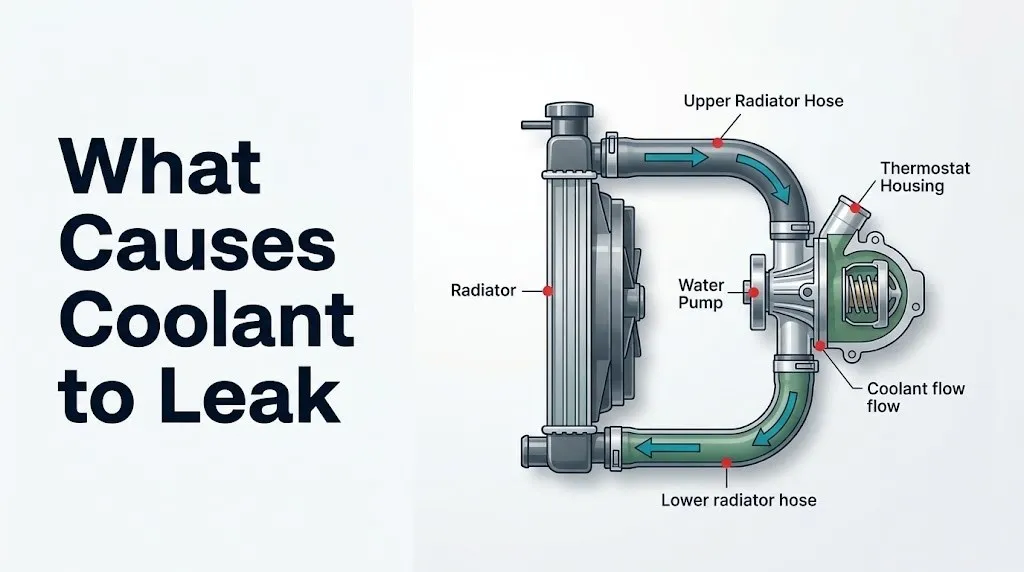
The circuit begins at the water pump, mounted directly to the engine block and driven by the serpentine belt or timing belt. The pump’s centrifugal impeller draws cooled coolant from the lower radiator hose and forces it under pressure into the engine block’s water jackets, the network of cast passages surrounding the cylinder bores and valve seats. Coolant circulates through the engine block and then up through the cylinder head, where combustion chamber temperatures are highest.
From the cylinder head, hot coolant exits through the upper radiator hose and enters the radiator at the top. As the coolant travels through the radiator’s narrow internal core tubes, airflow through the external fins (driven by vehicle forward motion or the electric radiator fan) carries heat away by forced convection. Cooled coolant exits the radiator bottom through the lower radiator hose and returns to the water pump inlet.
The thermostat is positioned between the cylinder head outlet and the upper radiator hose. When the engine is cold, the thermostat stays closed, routing coolant through a bypass circuit to allow rapid warm-up. Once coolant reaches operating temperature (typically 195 degrees Fahrenheit), the thermostat opens and allows full flow through the radiator.
The heater core is a small secondary heat exchanger located inside the HVAC box in the passenger cabin. It receives hot coolant through a separate hose circuit from the engine and uses that heat to warm cabin air. Older drivers who notice the cabin heat failing during a coolant leak have lost enough coolant that the heater core inlet tube is no longer fully submerged in circulating fluid.
Radiator Coolant Leak Causes
Radiator coolant leaks occur primarily through electrochemical corrosion of the radiator’s internal core tubes, seam failures between the core and end tanks, physical damage to the core fins, or crack propagation in plastic end tanks from thermal cycling stress.
The modern automotive radiator uses an aluminum core (rows of flat tubes and folded aluminum fins) bonded to plastic end tanks made of glass-filled nylon. That aluminum-to-plastic bond is sealed with a rubber gasket compressed by rolled crimps in the aluminum header. This is the most common leak point in a modern radiator, and it fails through a combination of rubber gasket compression set (the gradual permanent deformation of compressed rubber under load) and thermal expansion cycling that works the gasket back and forth thousands of times per year.
The other primary failure mechanism is electrochemical corrosion of the aluminum core tubes themselves. When coolant pH drops below 7.0, the acidic coolant becomes corrosive to aluminum. According to SAE International coolant degradation research, ethylene glycol oxidizes over time to produce glycolic acid and glyoxylic acid, both of which lower coolant pH from the ideal range of 7.5 to 9.0. At pH levels below 7.0, aluminum surfaces develop pitting corrosion. Small pits deepen into pinhole perforations that produce a steady external weep under system pressure.
Quick Tip:
- Radiator coolant leaks from corrosion are most common in vehicles that have never had a coolant flush, particularly those with original factory fill coolant that has been in service more than 5 years or 100,000 miles.
- A radiator that has been struck by road debris (rocks, metal fragments) can develop immediate acute leaks from fin or tube perforation, producing sudden large coolant loss rather than a slow weep.
- Owners of aluminum-block engines (the majority of vehicles manufactured after 2000) are at higher risk of radiator corrosion than owners of older cast-iron-block vehicles because aluminum’s electrochemical activity is higher than cast iron in low-pH coolant.
Radiator Hose Failure and Coolant Leaks
Radiator hose coolant leaks occur through three mechanisms: visible external cracking from heat and ozone exposure, clamp loosening from vibration and thermal cycling, and a hidden internal failure process called electrochemical degradation (ECD) that destroys the hose from the inside while the exterior still looks normal.
ECD is the most clinically important and least understood hose failure mechanism. The coolant in the cooling system has low but measurable electrical conductivity because it contains dissolved minerals, corrosion inhibitor salts, and glycol oxidation byproducts. The vehicle’s electrical system establishes ground potential through the engine block. When grounding circuits are imperfect, small stray electrical currents travel through the coolant as an alternative ground path. Where this current enters or exits the hose (at the clamp contact points), electrochemical reactions attack the inner EPDM rubber liner.
The inner liner softens to a gel-like consistency, then begins to shed. Shed material can contaminate the coolant circuit, potentially clogging the small passages of the heater core or thermostat housing. Eventually the degraded inner liner collapses under system pressure, or a pinhole perforation develops at the point of maximum electrical attack. The exterior of the hose, however, may look and feel completely normal right up to the point of failure. External squeezing (the traditional mechanic’s hose check) does not detect ECD.
According to the American Automobile Association (AAA), hose failures are a leading cause of non-accident roadside breakdowns in vehicles with more than 75,000 miles, and ECD is the primary failure mode in many of those cases. Hoses on vehicles with imperfect electrical grounding (which includes many older vehicles with corroded battery terminals or chassis ground straps) are at particularly elevated risk.
Hose clamp failure is a separate and simpler mechanism. Worm-drive clamps can loosen from vibration over time, and spring-clamp designs (used on many OEM applications) can lose clamping force from thermal cycling. The result is a leak at the hose-to-fitting interface rather than through the hose body itself.
Key Takeaway: Radiator hose failure from electrochemical degradation destroys the hose inner liner while the outside looks fine, which means squeezing a hose to check it tells you almost nothing about its true condition after 75,000 miles.
Water Pump Coolant Leak Causes
Water pump coolant leaks occur when the mechanical seal between the rotating pump shaft and the stationary pump housing deteriorates, allowing coolant under system pressure to escape through a dedicated weep hole in the pump housing.
The water pump is a centrifugal device. Its impeller, a finned rotating disc, spins at engine speed inside a sealed housing and generates the pressure differential that drives coolant flow through the system. The impeller is mounted on a shaft supported by a bearing assembly. Between the rotating shaft and the stationary housing sits the mechanical seal, a precision component that maintains a fluid-tight interface while accommodating the rotational motion.
The mechanical seal degrades through two mechanisms. First, thermal cycling causes the elastomeric seal elements to harden and lose conformability over time. Second, if the coolant pH has dropped significantly (from inhibitor depletion), the acidic coolant attacks the metal components of the seal face. When the seal fails, coolant escapes the pump cavity and exits through the weep hole, a small intentional opening in the pump housing positioned below the shaft. The weep hole’s purpose is to route escaping coolant visibly to the outside rather than allowing it to contaminate the shaft bearing and accelerate bearing failure.
A drip from the weep hole therefore indicates a failing mechanical seal. The weep hole location is specific: in most engines, it is on the lower front face of the water pump, and you’ll see coolant drips or dried residue directly below it when the pump seal is failing.
According to Consumer Reports reliability data, water pump failures are among the most commonly reported cooling system repairs in vehicles between 80,000 and 130,000 miles. Vehicles with timing belt-driven water pumps (common in many European and Japanese engines) typically have the water pump replaced as a matter of standard practice during timing belt service at 60,000 to 105,000 mile intervals, which significantly reduces the rate of water pump leak-related failures in those vehicles compared to serpentine belt-driven designs that are only replaced reactively.
Owners of vehicles with timing chain-driven water pumps mounted internally should note that internal water pump failure can leak directly into the engine oil circuit rather than to the exterior, which is a significantly more serious failure mode.
Head Gasket Coolant Leak Causes
Head gasket coolant leaks occur when the fire ring component of the head gasket, the metal sealing ring surrounding each cylinder bore, develops a breach from thermal cycling-induced micro-crack propagation, allowing combustion pressure and gases to enter the coolant circuit or allowing coolant to enter the combustion chamber.
The head gasket is a multi-layer steel (MLS) or composite gasket sandwiched between the cylinder head and the engine block. Its job is to simultaneously seal three separate fluids and pressures at the same joint: combustion gases at up to 2,000 psi during the power stroke, engine oil at 40 to 80 psi, and coolant at 13 to 18 psi. The fire ring is the innermost sealing element, a raised metal bead that deforms slightly under cylinder head bolt clamping force to create a gas-tight seal around each combustion chamber.
Each time the engine runs, the metal surfaces surrounding the fire ring expand from combustion heat. Each time the engine cools, they contract. This thermal cycling exerts cyclic stress on the fire ring. In a normally operating engine with proper coolant temperature control, this stress remains within the fatigue tolerance of the metal over the vehicle’s design life. But when the engine overheats, even once, metal temperatures exceed design limits. Aluminum cylinder heads expand more than steel head bolts or the iron block during an overheating event. This differential expansion creates shear stress at the head gasket sealing surfaces that can permanently exceed the fire ring’s clamping preload and initiate micro-cracks.
When the fire ring breaches, two patterns result. External breach: combustion gases escape laterally into the adjacent coolant passage. Combustion gases pressurize the coolant circuit, often causing the radiator overflow tank to bubble, and coolant eventually exits through the path of least resistance (often the overflow tube). Internal breach: coolant enters the combustion chamber, where it is vaporized to steam and exits through the exhaust, producing the characteristic white exhaust smoke associated with head gasket failure.
Vehicles that have ever been driven while the temperature gauge was in the red zone are at significantly elevated head gasket failure risk. Owners of vehicles with aluminum cylinder heads paired with cast-iron blocks (a common combination in older vehicles) are at higher risk than owners of all-aluminum engine assemblies, because the differential thermal expansion between aluminum and iron is greater than between two aluminum components.
Key Takeaway: A head gasket leak is the one coolant leak that does not always produce a visible external puddle. White exhaust smoke, a bubbling overflow tank, or milky oil are the signs, not a wet driveway.
Thermostat Housing and Coolant Reservoir Leaks
Thermostat housing coolant leaks occur when the O-ring or gasket sealing the thermostat within its housing fails from age-related hardening, and coolant reservoir leaks occur when the polypropylene reservoir tank cracks from thermal stress or the pressure cap fails to hold system pressure.
The thermostat housing is a cast aluminum or plastic component bolted to the engine, typically at the outlet of the cylinder head where the upper radiator hose connects. In most modern engines, the thermostat is retained by the housing cover and sealed by a rubber O-ring. That O-ring is subjected to the same coolant temperature, pH, and pressure cycling as every other seal in the system. Over time, the O-ring hardens, loses cross-sectional area, and fails to maintain the interference fit that creates the seal.
Thermostat housing leaks are typically visible as a seep or drip at the base of the upper radiator hose connection point. They are one of the simpler and less expensive cooling system repairs because the housing is accessible and the O-ring or gasket replacement is straightforward for an ASE-certified mechanic.
The coolant reservoir, also called the overflow tank, is the translucent plastic tank connected by a small hose to the radiator pressure cap. As the system heats and cools through each drive cycle, coolant expands into the reservoir and contracts back. This repeated thermal stress cycling causes plastic micro-cracking in the reservoir tank over time, particularly at stress concentration points near the hose fitting boss. A cracked reservoir leaks as a slow seep that is easily overlooked.
The radiator pressure cap deserves specific attention. The cap’s spring-loaded valve maintains system pressure at its rated psi by holding the valve closed until pressure exceeds the rating, at which point it opens and routes excess coolant to the reservoir. When the cap’s spring weakens from age, it opens at a lower pressure than designed. A low-pressure system boils at a lower temperature, causing coolant loss through the overflow tube without any crack or seal failure elsewhere in the system. Pressure cap failure is one of the most overlooked causes of gradual coolant loss.
Older vehicles and those in climates with extreme temperature swings, the American Southwest desert summers or Upper Midwest winters, experience accelerated reservoir cracking and cap spring fatigue compared to vehicles in temperate climates.
Heater Core and Freeze Plug Coolant Leaks
Heater core coolant leaks occur when the aluminum or copper matrix of the heater core corrodes or develops pinhole perforations, and freeze plug coolant leaks occur when the pressed-metal core plugs in the engine block corrode through from inside the block due to acidic coolant contact.
The heater core is positioned inside the HVAC box behind the dashboard, where cabin air passes over it to extract heat for interior warming. Because it is made of thin-walled aluminum or copper tubes with densely packed fins, the heater core is the most vulnerable component in the cooling circuit to pitting corrosion from depleted, acidic coolant. Heater core leaks have a distinctive presentation: coolant appears on the passenger-side floor mat, the windshield fogs persistently from the inside even with defrost running, and a sweet antifreeze odor becomes noticeable inside the cabin. The fogging occurs because coolant vapor from the leaking heater core enters the airstream passing through the HVAC box.
Heater core replacement is among the most labor-intensive cooling system repairs because the entire dashboard must be partially or fully removed to access the HVAC box. Repair costs range from $800 to over $2,000 at independent repair shops depending on vehicle make and model, per automotive industry labor rate data.
Freeze plugs (also called core plugs or Welch plugs) are pressed-steel or brass discs seated in the circular holes left in the engine block and cylinder head after the sand cores used during casting are removed. They are designed to be removable service access points. They are not, despite common belief, designed to pop out when coolant freezes. Their failure mode is corrosion: acidic coolant gradually etches through the thin steel or brass material from inside. When a freeze plug corrodes through, coolant escapes at the sides of the engine block, often running down the block and appearing as a puddle below the engine that mimics an oil leak in color and location.
Vehicles maintained with depleted, un-serviced coolant for extended periods are disproportionately represented in freeze plug failure cases. This is particularly common in fleet vehicles where coolant service intervals are not consistently tracked.
Key Takeaway: A sweet smell inside the car cabin combined with foggy windows points to heater core failure, and replacing it typically requires full dashboard removal, which is one of the most expensive cooling system repairs a shop can perform.
Coolant Chemistry and Depleted Coolant Causing Leaks
Depleted coolant is itself a direct cause of coolant leaks because the corrosion inhibitor packages in antifreeze have a finite service life, and once depleted, the remaining ethylene glycol-water mixture actively corrodes aluminum, steel, and copper cooling system components.
Three primary coolant chemistry types are used in modern vehicles, and each has different inhibitor chemistry, a different depletion timeline, and a different pattern of component failure when depleted:
| Coolant Type | Inhibitor Chemistry | Service Life | What Fails When Depleted |
|---|---|---|---|
| IAT (Inorganic Additive Technology) | Silicates, phosphates, nitrites | 2 years or 30,000 miles | Aluminum surfaces pit rapidly; silicate depletes quickly, leaving no aluminum protection |
| OAT (Organic Acid Technology) | Carboxylates (no silicates) | 5 years or 150,000 miles | Provides no immediate silicate buffer; aluminum still protected but longer term; color: orange/pink/red |
| HOAT (Hybrid OAT) | Silicates plus carboxylates | 5 years or 150,000 miles | Balanced protection; most OEM specifications for European and Asian vehicles; color: yellow/gold/blue |
IAT coolant (traditional green) was standard for decades but has a short inhibitor life of only 2 years or 30,000 miles. Many older vehicles still on the road were filled with IAT coolant that has long since passed its service interval. Once the silicate inhibitors in IAT coolant are consumed, the pH drops rapidly and aluminum corrosion begins aggressively. This is the primary reason that vehicles from the 1990s and early 2000s that have never been properly coolant-flushed often have severe radiator and heater core corrosion.
Mixing incompatible coolant types accelerates inhibitor depletion and can produce precipitates (solid particles) in the coolant circuit. Mixing OAT coolant with IAT coolant, for example, causes the silicate and carboxylate inhibitors to partially neutralize each other, effectively shortening the service life of both. These precipitates can clog the small passages of the heater core or thermostat bypass circuit.
According to SAE International cooling system standards, all coolant should be tested annually with a coolant hydrometer or test strips for freeze point protection and pH. A pH reading below 7.0 in any coolant type indicates immediate need for a flush and replacement, regardless of age or mileage.
Owners who purchase used vehicles should treat the coolant as unknown and have it tested immediately by an ASE-certified mechanic, regardless of color or appearance, because coolant can have correct color and still be chemically depleted.
Internal vs. External Coolant Leak
The distinction between an internal and external coolant leak determines how visible the leak is, how urgently it must be addressed, and whether the engine is at immediate risk of catastrophic damage.
An external coolant leak escapes the cooling circuit through a failed external seal, cracked component, or deteriorated hose and appears visibly outside the engine, either as a puddle on the ground, a wet stain on the engine exterior, or coolant residue on cooling system components. All the external-source leaks described in previous sections (radiator, hoses, water pump weep hole, thermostat housing, reservoir, freeze plugs) are external leaks. They are diagnosable by visual inspection or pressure testing and produce a measurable coolant level drop that the driver notices as a low coolant warning.
An internal coolant leak escapes the cooling circuit into another fluid circuit within the engine, most commonly the combustion chamber or the engine oil circuit, without producing a visible external puddle. The head gasket is the primary source of internal leaks. When the head gasket fire ring fails between a coolant passage and a combustion chamber, coolant enters the cylinder during the intake stroke and is burned or vaporized during combustion, producing white exhaust steam. When the head gasket fails between a coolant passage and an oil passage, coolant mixes with engine oil, producing the characteristic milky, chocolate-milkshake-colored oil visible on the dipstick.
Internal leaks are more dangerous than equivalently-sized external leaks for two reasons. First, coolant loss can be rapid but entirely invisible from outside the vehicle, giving no warning until the temperature gauge rises. Second, coolant in the oil circuit destroys the oil’s lubricating properties, leading to accelerated bearing wear and potential engine seizure within a short driving distance.
To check for an internal coolant leak without a shop test:
- Check the engine oil dipstick after the vehicle has been parked overnight.
- Look for a milky, creamy, or frothy appearance on the dipstick or under the oil cap, which indicates coolant contamination.
- Start the engine cold and observe exhaust for the first 3 to 5 minutes. Persistent white smoke after the initial warm-up period (some white steam at cold start is normal condensation) suggests coolant combustion.
- Check the coolant overflow reservoir for air bubbles or a frothy appearance while the engine idles, which indicates combustion gas entry into the coolant circuit.
- If any of these signs are present, do not drive the vehicle and contact an ASE-certified mechanic for a combustion leak test (block test) using a chemical indicator that detects combustion gases in coolant.
Slow Coolant Leak vs. Sudden Coolant Loss
The rate of coolant loss is the single most important factor in determining how urgently a coolant leak must be addressed, and distinguishing a slow seep from a rapid loss requires specific observation rather than a guess.
A slow coolant leak produces a gradual drop in the coolant reservoir level over days to weeks. The driver notices the low coolant warning light activating occasionally, or sees a small stain on the driveway that accumulates slowly. The engine temperature remains normal because the coolant level, while dropping, stays above the threshold needed for adequate heat exchange. Slow leaks are almost always external and typically originate from a seeping hose clamp, a weeping thermostat housing O-ring, a hairline reservoir crack, or a small radiator seam drip.
A sudden coolant loss produces rapid coolant drop within a single drive cycle. This is the scenario that precedes an overheating event. A hose that ruptures completely, a radiator that develops a large split, or a coolant reservoir that cracks and drains can lose the entire coolant volume in minutes. The temperature gauge will rise sharply. The low coolant light and high temperature warning will activate in rapid succession.
| Leak Rate | Temperature Gauge Behavior | Safe to Drive? | Urgency |
|---|---|---|---|
| Slow seep (stain on ground, stable coolant level) | Normal | Yes, for short distances; schedule inspection this week | Book mechanic appointment within 3 to 5 days |
| Moderate loss (coolant light on during drive) | Normal to slightly elevated | Low-speed local driving only | Same-day mechanic evaluation |
| Rapid loss (steam from hood, coolant puddle forming) | Rising toward red | No | Pull over, engine off; tow to mechanic |
| Complete sudden loss (hose rupture, large spill) | Already in red or rising fast | No | Pull over immediately, engine off, call for tow |
Driving with a rapid coolant loss is not merely a repair inconvenience. Aluminum cylinder heads begin to warp at sustained temperatures above 240 to 250 degrees Fahrenheit. Head warping destroys the precision machined sealing surface that the head gasket seats against, making head gasket replacement alone insufficient. A warped head may require machining (surfacing) or replacement, turning what would have been a $1,200 head gasket repair into a $3,000 to $5,000 engine rebuild.
Can You Drive With a Coolant Leak
Whether you can drive with a coolant leak depends entirely on the rate of loss and the current behavior of the temperature gauge, with no universal permissive answer that applies to all leak presentations.
The framework is straightforward:
- A slow seep with a stable temperature gauge and a coolant level above the minimum line: Low-speed, short-distance driving to a repair facility is generally considered acceptable. Top off the coolant reservoir to the maximum line before driving. Monitor the temperature gauge continuously. Do not take the vehicle on highways or extended drives.
- Any coolant loss combined with a temperature gauge above normal: Do not drive. The engine is already running hotter than designed. Continued driving accelerates the overheating curve exponentially as remaining coolant volume decreases.
- Coolant warning light on with a rising temperature gauge: Pull over safely. Turn the engine off. Wait 30 minutes for partial cooling. Do not open the radiator cap on a hot system. Call for a tow.
- Temperature gauge in the red zone: Pull over immediately and turn the engine off. This is a do-not-drive threshold. Engine damage begins within minutes at temperatures above the red zone threshold.
One common and dangerous mistake is adding water alone to a depleted system as a short-term fix and then continuing to drive extended distances. Plain water lowers the coolant mixture’s boiling point and reduces corrosion protection. It also dilutes the remaining inhibitor package. Using deionized or distilled water (not tap water, which adds mineral deposits) as a temporary top-off for a short drive to a mechanic is acceptable. Driving normally on a water-topped system is not.
Older drivers who may have reduced thermal sensitivity or who drive with air conditioning set very cold may not notice early cabin heat reduction (a sign of low coolant level) as a warning signal. For this group, consistent attention to the temperature gauge, not subjective driving feel, is the most reliable early indicator of coolant loss.
Key Takeaway: The temperature gauge is your most reliable real-time indicator of whether a coolant leak has crossed from “schedule a repair” to “pull over now.” Never drive past the normal range, regardless of how minor the visible leak appears.
Antifreeze Toxicity to Humans and Pets
Antifreeze (ethylene glycol) is acutely toxic to humans, cats, and dogs through a specific metabolic pathway that converts the relatively low-toxicity parent compound into highly toxic acid metabolites that destroy kidney tissue.
When swallowed, ethylene glycol is absorbed rapidly from the gastrointestinal tract and reaches the liver. The liver enzyme alcohol dehydrogenase metabolizes ethylene glycol through a series of steps: first to glycolaldehyde, then to glycolic acid, then to glyoxylic acid, and finally to oxalic acid. Oxalic acid combines with circulating calcium ions to form calcium oxalate monohydrate crystals. These needle-shaped crystals deposit in the renal tubules of the kidney, causing mechanical tubular obstruction and direct cellular toxicity, producing acute kidney failure within 24 to 72 hours of ingestion.
According to the U.S. National Library of Medicine (NLM), the estimated minimum lethal dose of ethylene glycol in humans is approximately 1.4 mL per kilogram of body weight. For an adult of average weight, this represents approximately 100 mL, or less than half a cup. The initial symptoms (drunken behavior, nausea, confusion) occur within 30 minutes to 12 hours and may resolve temporarily while the toxic metabolites continue to accumulate.
The toxicity profile in animals is more acute. For cats, the minimum lethal dose is as low as 1.5 mL per kilogram of body weight, meaning a cat that laps up a small puddle of coolant from a garage floor can receive a lethal dose. For dogs, the minimum lethal dose is approximately 4.4 mL per kilogram. The sweet taste of ethylene glycol makes it attractive to animals, increasing the risk of voluntary ingestion.
If any person has swallowed or may have swallowed antifreeze, call Poison Control at 1-800-222-1222 immediately. Do not wait for symptoms to develop. Early treatment with ethanol or fomepizole (a specific alcohol dehydrogenase inhibitor) blocks the conversion of ethylene glycol to its toxic metabolites before kidney damage occurs.
If a pet has consumed any amount of coolant or antifreeze, call the ASPCA Animal Poison Control Center at 888-426-4435 immediately. Time from ingestion to effective treatment is critical, particularly in cats, where the therapeutic window before irreversible kidney damage begins is as short as 3 hours.
Propylene glycol-based antifreeze (sold as “pet-safe” antifreeze) has lower toxicity than ethylene glycol but is not completely nontoxic, particularly to cats, and should not be considered fully safe around animals.
How to Find a Coolant Leak
Finding the source of a coolant leak requires a systematic inspection approach because coolant, being a low-viscosity pressurized fluid, travels along engine surfaces before dripping, making the drip point frequently far from the actual leak source.
To locate a coolant leak systematically:
- Allow the engine to cool completely for at least 2 hours before beginning. Opening a pressurized, hot cooling system causes scalding steam release.
- Check the coolant reservoir level against the MIN and MAX markings. A level below MIN confirms coolant loss has occurred.
- With the engine cold, start the vehicle and bring it to operating temperature. Observe the engine bay from a safe distance for steam, drips, or wet spots forming on hose connections, the radiator front face, the water pump area, and around the thermostat housing.
- Turn the engine off and allow 15 minutes of cooling. Using a flashlight, inspect all visible hose-to-fitting connections for wet coolant residue or white mineral deposits (dried coolant residue appears as white or yellow crystalline staining).
- Inspect the front face of the radiator for bent fins with wet spots, the end tank seams for dried coolant crust, and the petcock drain (if present) for seepage.
- Check directly below the water pump for drips or dried residue from the weep hole.
- Check the oil dipstick for milky or frothy oil, which indicates an internal head gasket leak rather than an external source.
- If no external source is found, request a cooling system pressure test from an ASE-certified mechanic.
A cooling system pressure test uses a hand pump tool attached to the radiator fill neck to pressurize the cold system to its rated cap pressure (usually 13 to 18 psi) without the engine running. Leaks that only occur under pressure but not at atmospheric pressure (including internal leaks that allow coolant to escape into the combustion chamber) become detectable under this test. A UV fluorescent dye test involves adding a small amount of UV-reactive dye to the coolant, running the vehicle, and then using a UV light to trace the dye to its leak exit point, which is particularly useful for finding small, intermittent leaks not visible by pressure testing alone.
Symptoms of a Coolant Leak in Your Car
The symptoms of a coolant leak in your car are a sweet antifreeze odor from the engine bay or cabin interior, a puddle of bright green, orange, pink, or blue-green fluid under the parked vehicle, a low coolant warning light on the dashboard, a rising engine temperature gauge, white steam from under the hood, or white exhaust smoke that persists beyond the initial cold-start period.
Each symptom points to a different aspect of the leak:
- Sweet smell outside the vehicle, near the engine bay: External leak from any component. Ethylene glycol has a characteristically sweet, slightly chemical odor. This smell is often the first sign of a hose seep or radiator drip.
- Sweet smell inside the passenger cabin: Heater core leak. Coolant vapor from the heater core enters the HVAC airstream before the cabin blower delivers it to the interior.
- Colored puddle under the parked vehicle: External leak. The color indicates coolant type: bright green (IAT), orange or pink (OAT, Dex-Cool), yellow or gold (HOAT). Note that coolant puddles are typically thin and watery in consistency, distinguishing them from thicker oil puddles.
- Low coolant warning light: Coolant reservoir level has dropped below the sensor threshold. This can accompany any leak type, internal or external.
- Rising engine temperature gauge: Coolant volume has dropped enough that heat transfer efficiency is reduced. This is past the early warning stage.
- White steam from under the hood: Coolant is contacting hot engine or exhaust surfaces and vaporizing. This indicates active, significant leakage.
- White exhaust smoke persisting after warm-up: Internal head gasket leak. Coolant entering the combustion chamber is being burned and exits as white steam through the exhaust. This is distinct from the normal white condensation exhaust visible on cold mornings, which clears within 1 to 2 minutes of warm-up.
- Milky oil on the dipstick: Coolant has entered the oil circuit through a failed head gasket or, rarely, a cracked engine block or cylinder head. This requires immediate engine shutdown.
Drivers of electric vehicles (EVs) and plug-in hybrids should note that their cooling systems often include separate coolant circuits for the battery thermal management system in addition to the traditional engine cooling circuit. Coolant leaks in an EV’s battery cooling circuit present with the same external symptoms (sweet smell, puddle, low coolant light) but carry an additional risk: coolant contact with high-voltage battery components. Any suspected coolant leak in an EV should be assessed by a technician certified in high-voltage vehicle systems, not a standard ASE mechanic unfamiliar with EV architecture.
When a Coolant Leak Becomes a Driving Emergency
Certain coolant leak presentations require immediate action and represent genuine driving emergencies rather than schedule-a-repair situations. Do not continue driving if you observe any of the following.
Pull over immediately and turn off the engine if you observe:
- The temperature gauge entering the red zone or illuminating the high-temperature warning light while driving
- Steam actively rising from the hood while the vehicle is in motion
- A sudden large puddle of coolant forming beneath a stationary vehicle after a drive (indicates rapid loss)
- Complete loss of engine power or engine knock/rattling immediately following temperature gauge spike (indicates engine damage in progress)
- Milky or frothy engine oil observed on the dipstick before a planned drive (do not start or drive the vehicle)
- White exhaust smoke that does not clear after 5 minutes of warm-up, combined with a dropping coolant level
Do not open the radiator cap or the coolant reservoir cap on a hot engine. The cooling system is pressurized at operating temperature. Removing the cap releases that pressure explosively, spraying boiling coolant under pressure. Steam and coolant burns are serious. Wait a minimum of 30 minutes with the engine off and the hood open before attempting to check or top off coolant.
These presentations indicate active overheating or catastrophic cooling system failure and require an immediate engine shutdown and a tow to an ASE-certified mechanic. Continuing to drive will warp aluminum cylinder heads within minutes of temperature gauge redlining, converting a $1,000 to $2,000 repair into a $4,000 to $6,000 engine rebuild or replacement.
If a person or pet has been exposed to leaked coolant through ingestion or significant skin/eye contact:
Call Poison Control at 1-800-222-1222 for human exposure.
Call the ASPCA Animal Poison Control Center at 888-426-4435 for pet exposure.
Frequently Asked Questions About Coolant Leak Causes
What is the most common cause of a coolant leak?
Degraded radiator hoses and their clamp connections are the most common cause of external coolant leaks in vehicles with more than 75,000 miles, particularly those affected by electrochemical degradation of the hose inner liner.
A close second is radiator end tank seam failure or plastic end tank cracking, which produces a steady drip from the front of the engine bay.
Head gasket failure, while dramatic and expensive, is less frequent than hose or radiator leaks in vehicles with a proper coolant maintenance history and no overheating events.
Can a coolant leak fix itself?
A coolant leak cannot fix itself in any durable or meaningful way. Coolant pressure and heat will maintain or worsen any existing leak point over time.
Some products marketed as radiator stop-leak sealants can temporarily reduce small seeps by depositing particles in pinhole openings, but these are temporary measures that do not address the underlying component failure and can clog heater core passages if overused.
Any coolant leak requires professional inspection and repair of the failed component by an ASE-certified mechanic to resolve reliably.
What does a coolant leak smell like?
A coolant leak smells distinctively sweet, slightly syrupy, and faintly chemical, which is the characteristic odor of ethylene glycol.
The smell is most noticeable immediately after shutting off a warmed engine, when residual heat vaporizes leaked coolant on hot engine surfaces.
A sweet smell inside the passenger cabin specifically, as opposed to outside near the engine bay, strongly suggests a heater core leak rather than an external engine bay source.
How do I know if my head gasket is leaking coolant?
A head gasket leaking coolant typically presents with white exhaust smoke that does not clear after 5 minutes of engine warm-up, a bubbling or frothy appearance in the coolant reservoir while the engine idles, and a dropping coolant level with no visible external puddle.
Milky, chocolate-colored engine oil on the dipstick or under the oil cap confirms that coolant has entered the oil circuit through a failed head gasket.
Definitive diagnosis requires a combustion leak test (block test), in which a chemical color indicator placed over the coolant filler opening detects combustion gases in the coolant, a test performed by an ASE-certified mechanic.
Is a small coolant leak serious?
A small coolant leak is not immediately dangerous if the temperature gauge remains normal and the coolant level stays above the minimum line, but it is not something to defer indefinitely.
All small leaks progress over time as the failing component continues to deteriorate under heat, pressure, and thermal cycling, and a seep that takes weeks to drain the system today can become a sudden large leak without additional warning.
Any coolant leak warrants inspection by an ASE-certified mechanic within 3 to 5 days, not weeks, because the cost of a hose or clamp repair is orders of magnitude lower than an overheating-induced engine rebuild.
What should I do if my car is leaking coolant on the ground?
Identify the color and consistency of the puddle: thin, watery, and brightly colored (green, orange, pink, or blue-green) confirms it is coolant rather than oil or water.
Do not drive the vehicle on extended trips or at highway speeds until the leak source has been identified and repaired, and top off the coolant reservoir with the correct coolant type diluted with deionized water only as a temporary measure before the repair appointment.
If the puddle is large (larger than a dinner plate), forms rapidly during a short idle, or accompanies any rise in the temperature gauge, do not drive the vehicle and arrange a tow to an ASE-certified mechanic.
What to Do With This Information Right Now
A coolant leak that sits at a slow seep today will not stay at a slow seep indefinitely. Every thermal cycle, every mile of driving, and every pH point the coolant drops below neutral accelerates the deterioration of whatever component is failing.
If your temperature gauge is normal and the coolant loss is slow, the right move is to book an inspection with an ASE-certified mechanic within the next 3 to 5 days. Bring a note describing when you first noticed the smell, puddle, or warning light, what color the fluid is, and whether the temperature gauge has behaved normally. That information cuts the diagnostic time significantly.
If your temperature gauge has moved above normal even once, stop driving the vehicle today. One overheating event can initiate head gasket fire ring cracking that will not manifest as a detectable failure until the next long drive or hot day. The gap between “early warning” and “engine rebuild” is smaller than most drivers realize, and the mechanic visit you defer this week may cost ten times as much three months from now.