Throttle Body Symptoms 2026: Full Diagnostic Safety Guide
Throttle body symptoms include rough idling, unexpected engine stalling, hesitation during acceleration, a check engine light, and activation of limp mode, all of which reflect specific failures in the electronic or mechanical system controlling how much air enters the engine. Each of these symptoms has a distinct mechanical cause, and knowing which symptom you are experiencing points directly toward which component has failed and how urgent the repair is.
This matters beyond car maintenance. The National Highway Traffic Safety Administration (NHTSA) has investigated multiple electronic throttle control defects across major vehicle manufacturers because throttle body malfunctions, particularly sudden stalling and stuck-open throttle plates, create crash scenarios with serious injury consequences. A vehicle that stalls at highway speed or accelerates without driver input is a safety emergency, not a maintenance inconvenience.
This guide explains every observable throttle body symptom, the exact mechanical mechanism producing it, how to read the OBD-II diagnostic codes associated with it, how to tell whether your throttle body needs cleaning versus replacement, and when driving the vehicle becomes genuinely dangerous to you and other road users.
Throttle Body Symptoms: What They Tell You
Throttle body symptoms are observable performance changes in a vehicle that indicate the throttle body or its associated electronic control components are not functioning within their designed operating parameters.
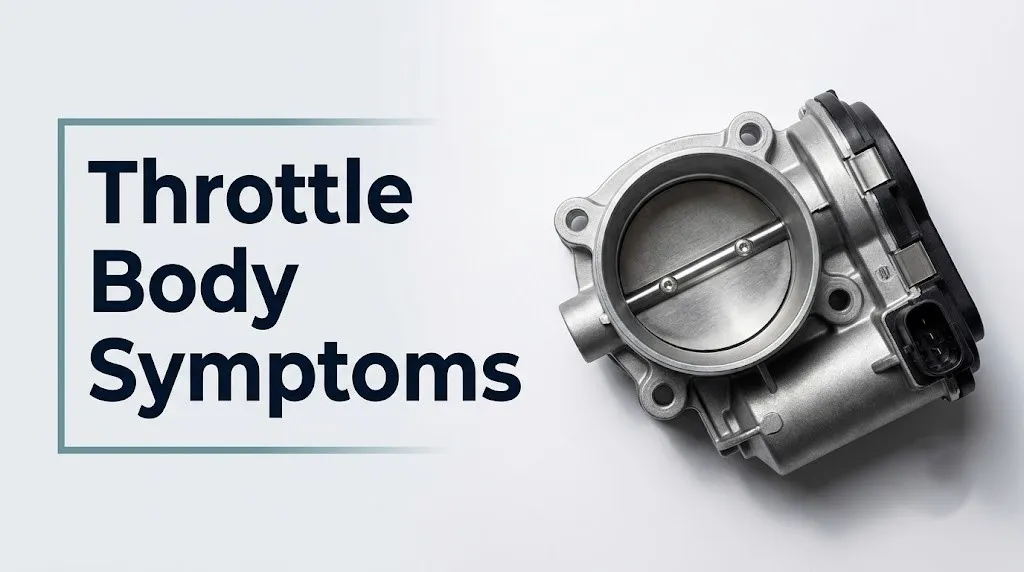
The throttle body sits between the air intake tract and the intake manifold. Its job is to control the volume of air entering the engine in response to driver pedal input. When it malfunctions, the engine receives the wrong amount of air for the fuel being delivered, which produces the performance symptoms drivers experience.
What makes throttle body symptoms diagnostically useful is that they cluster by mechanism. Symptoms involving idle quality (rough idle, stalling at rest) point to one set of component failures. Symptoms during acceleration (hesitation, stumble, poor response) point to a different failure pattern. Symptoms that appear as permanent warning codes point to specific sensor failures detectable with an OBD-II scanner.
| Symptom Category | Primary Mechanical Source | Urgency Level |
|---|---|---|
| Rough idle, stalling at rest | IAC valve, carbon buildup, dirty throttle bore | Monitor, schedule service |
| Hesitation, poor acceleration | TPS signal error, partial ETC motor failure | Schedule service promptly |
| Check engine light with codes | TPS, PPS, or ETC motor fault detected by ECM | Diagnose before next long drive |
| Limp mode activation | ECM failsafe from ETC fault | Do not drive on highway |
| Sudden stall while moving | Catastrophic ETC failure, throttle plate stuck closed | Stop safely, do not continue driving |
| Unintended acceleration | Throttle plate stuck open, ETC motor runaway | Emergency: stop safely immediately |
Older drivers and those with slower reaction times face a compounded risk when throttle body symptoms include unpredictable engine response. Unpredictable acceleration or deceleration demands faster corrective steering and braking inputs than a predictable mechanical failure, making these symptoms more dangerous for drivers whose neuromuscular response time is reduced by age or medical condition.
What Is a Throttle Body and How Does It Work
The throttle body is a valve assembly in the engine’s air intake system that controls the volume of air delivered to the intake manifold and ultimately to the combustion chambers, in direct response to driver pedal input and Engine Control Module commands.
In vehicles built after approximately 1995 and particularly after 2000, most throttle bodies are part of an electronic throttle control (ETC) system, also called drive-by-wire. There is no physical cable connecting the accelerator pedal to the throttle body. Instead, the pedal contains a pedal position sensor (PPS), which sends a voltage signal to the Engine Control Module (ECM). The ECM calculates the appropriate throttle plate opening angle and sends a command signal to a small DC electric motor mounted on the throttle body, called the electronic throttle control motor. That motor turns gears that physically open or close the throttle plate (a circular disk, sometimes called a butterfly valve) inside the throttle bore.
Think of the throttle body like a precision faucet for air. The ECM is the hand turning the faucet, responding to what the pedal tells it the driver wants. A TPS mounted on the throttle plate shaft confirms to the ECM that the plate moved to the commanded position. If the plate angle the TPS reports does not match what the ECM commanded, the ECM registers a fault and activates protective measures.
Pre-2000 vehicles with mechanical cable throttle systems have a simpler failure mode: the cable stretches, frays, or sticks. The symptoms overlap with ETC system failures in some ways, but the diagnostic process and repair options differ entirely.
Turbocharged engines place additional thermal stress on the throttle body because charge air temperature is elevated after the turbocharger compressor. This accelerates wear on the ETC motor and TPS potentiometer, making high-performance turbocharged vehicles statistically more prone to earlier throttle body component wear.
Symptoms of a Bad Throttle Body: Full Overview
A bad throttle body produces a cluster of symptoms that collectively point to disrupted air metering in the engine’s intake system, with each individual symptom reflecting a specific failure point in the throttle control chain.
The eight most reliably observed symptoms of a bad or failing throttle body are:
- Rough or irregular idle: engine speed fluctuates at rest, RPM gauge needle bounces rather than holding steady
- Unexpected engine stalling: engine dies at idle, at low speed, or when coming to a stop
- Hesitation or stumble during acceleration: engine pauses or stutters when the driver depresses the accelerator, rather than responding smoothly
- Poor acceleration: reduced power delivery at all speeds, vehicle feels sluggish even at full pedal depression
- Check engine light (malfunction indicator lamp): ECM has stored one or more throttle-related OBD-II fault codes
- Limp mode activation: vehicle enters reduced-power failsafe mode, typically limiting speed to 20 to 45 mph and restricting throttle opening
- Poor fuel economy: more fuel is consumed per mile because the engine is not receiving the correct air volume for clean combustion
- Black smoke or rich exhaust odor: visible exhaust darkening or fuel smell indicating a rich air-fuel mixture from incorrect air metering
According to SAE International technical standards for electronic throttle control systems, the ECM monitors TPS signal voltage continuously and compares it against PPS signal voltage multiple times per second. A plausibility mismatch between these two signals of more than a calibrated threshold value triggers an immediate diagnostic trouble code and ECM protective response.
Drivers of vehicles with high mileage, specifically those above 120,000 to 150,000 miles, are in a higher risk category for TPS wear-related symptoms because the potentiometer track inside the sensor develops resistive wear spots that produce intermittent voltage dropout, creating an irregular symptom pattern that comes and goes unpredictably.
Key Takeaway: A bad throttle body produces symptoms that cluster by mechanism: idle-related symptoms (rough idle, stalling) point to IAC valve or carbon buildup issues, while acceleration and code-related symptoms point to TPS or ETC motor failures. Knowing which cluster your symptoms fall into tells you which component to have evaluated first.
Rough Idle as a Throttle Body Symptom
Rough idle caused by throttle body problems occurs when the idle air control (IAC) valve or its equivalent bypass circuit fails to maintain the correct airflow volume to the engine at low throttle positions, producing irregular combustion rhythm that the driver experiences as a bouncing RPM needle and a vibrating engine at rest.
At idle, the throttle plate is nearly fully closed. The engine still needs a small, precisely metered amount of air to sustain combustion at the target idle speed, typically 600 to 800 RPM for most passenger vehicles. In older ETC systems, a separate IAC valve manages this bypass airflow. In more modern integrated systems, the ECM commands the ETC motor to hold the throttle plate at a precisely calibrated near-closed position to achieve the same result.
Carbon deposits and varnish residue accumulating on the throttle plate edges and the inner throttle bore wall disrupt this precision. The deposits create irregular airflow turbulence at low throttle positions. The ECM attempts to compensate by adjusting fuel trim and throttle position, but when the deposits are heavy enough, the compensation range is exceeded and idle quality degrades into the rough, hunting RPM pattern drivers notice.
Quick Tip:
- Rough idle that is worst when the engine is cold and improves as the engine warms suggests carbon buildup on the throttle plate, because deposits affect airflow more severely before thermal expansion opens up the throttle bore slightly
- Rough idle that is consistent regardless of engine temperature and accompanied by a stored OBD-II code suggests TPS signal error rather than simple carbon fouling
- Drivers of direct injection engines (common in vehicles from 2010 onward) experience throttle bore carbon buildup more rapidly because fuel is injected directly into the cylinder rather than the intake port, so fuel vapor does not wash the intake side of the throttle body
Engine Stalling from Throttle Body Failure
Engine stalling caused by throttle body failure occurs when the throttle plate closes fully or the IAC bypass circuit provides zero airflow to the engine at idle, dropping combustion below the minimum sustainable level and causing the engine to stop.
Stalling at rest while waiting at a traffic light is the most owner-reported pattern. The engine simply dies, the dashboard warning lights illuminate, and the driver must restart. This pattern typically reflects IAC valve failure or severe carbon buildup at the throttle plate edges. It is inconvenient and potentially embarrassing, but in a stationary vehicle it is not immediately dangerous beyond the traffic management risk.
The far more dangerous stalling pattern is the mid-motion stall: the engine dies while the vehicle is moving, even at low speed. When the engine stalls with the vehicle in motion, power braking assistance is lost because the vacuum brake booster relies on engine intake manifold vacuum. According to the National Safety Council (NSC), stopping distance increases measurably when brake booster vacuum is lost, because the driver must apply substantially more pedal force to achieve the same braking force. In panic braking situations, many drivers cannot generate enough pedal force without power assist to stop the vehicle in the expected distance.
A mid-motion stall also deactivates power steering on hydraulic power steering systems, requiring significantly more physical effort to steer. For drivers with reduced upper body strength, including elderly drivers and some drivers with musculoskeletal conditions, a simultaneous loss of power braking and power steering from a stall event creates a compounded loss-of-control risk.
Poor Acceleration and Hesitation from a Bad Throttle Body
Poor acceleration and hesitation from a bad throttle body occur when the throttle position sensor (TPS) provides inaccurate or delayed voltage signals to the ECM, causing the ECM to command a throttle plate position that does not match actual driver demand.
Picture the throttle position sensor as a translator. The pedal tells it what the driver wants, and the TPS tells the ECM what the throttle plate is doing. When the TPS develops a wear spot or voltage dropout, the message from plate position to ECM arrives corrupted. The ECM commands a certain fuel delivery based on what it thinks the throttle is doing, but the actual plate position is different. The combustion event that follows is mistimed or incorrectly fueled, producing the hesitation, stumble, or flat spot the driver feels during acceleration.
Hesitation typically appears as a 0.5 to 2 second delay between pedal depression and engine response, or as a momentary power loss followed by recovery. At highway speeds, this symptom is most dangerous during passing maneuvers and highway merge situations, where the driver depends on predictable power delivery to complete the maneuver within a safe time window.
The Insurance Institute for Highway Safety (IIHS) has documented that crash risk during highway merge and overtaking maneuvers is elevated by any factor that makes vehicle acceleration unpredictable, because these maneuvers require the driver to accurately estimate vehicle velocity relative to surrounding traffic in real time.
Young drivers with less experience managing vehicle instability may respond to unexpected hesitation during a highway merge by braking suddenly rather than managing the deceleration smoothly, creating an additional rear-end collision risk.
Key Takeaway: Hesitation during acceleration, particularly during highway merging or overtaking, is not just an annoyance when it is caused by TPS failure. It creates a velocity mismatch crash risk during maneuvers where predictable power delivery is required for safe completion.
Check Engine Light and Throttle Body OBD2 Codes
The check engine light (malfunction indicator lamp) illuminates when the ECM detects a throttle position sensor signal that falls outside its programmed acceptable voltage range or when TPS and PPS signals are implausible relative to each other, storing a specific OBD-II diagnostic trouble code.
The most commonly encountered throttle body-related OBD-II codes are:
| OBD-II Code | Description | What It Means in Plain Language |
|---|---|---|
| P0120 | Throttle position sensor A, circuit malfunction | TPS voltage is outside the expected 0.5V to 4.5V operating range |
| P0121 | TPS A, range/performance problem | TPS reading is within voltage range but implausible given other sensor inputs |
| P0122 | TPS A, circuit low input | TPS voltage is consistently below minimum threshold (possible TPS failure or wiring short to ground) |
| P0123 | TPS A, circuit high input | TPS voltage is consistently above maximum threshold (possible TPS failure or wiring short to power) |
| P2110 | Throttle actuator control system, forced limited RPM | ECM has detected ETC fault and restricted RPM to protect engine and ensure driver safety |
| P2112 | Throttle actuator control system, stuck closed | ETC motor or linkage has not opened throttle to commanded position |
Reading these codes requires an OBD-II scanner plugged into the diagnostic port located under the dashboard near the steering column on virtually all vehicles manufactured after 1996. Consumer-grade Bluetooth OBD-II scanners available for under $30 can read and clear these codes. However, clearing a code without addressing the underlying mechanical cause causes the code to return, often within one to two drive cycles.
Drivers of hybrid electric vehicles (HEVs) should note that throttle body function interacts with the hybrid drive management system in ways that produce additional fault codes beyond the standard P01xx and P21xx ranges. An ASE-certified technician with hybrid vehicle training should evaluate throttle body symptoms in HEVs rather than relying on standard OBD-II interpretation.
Limp Mode Symptoms from Throttle Body Failure
Limp mode (also called failsafe mode or reduced power mode) activates when the ECM detects a confirmed ETC system fault and intentionally restricts throttle opening to a fixed, limited position to prevent engine damage and maintain basic vehicle controllability.
The ECM’s limp mode response to a throttle body fault is a deliberate safety mechanism. When TPS and PPS signals become sufficiently implausible that the ECM can no longer trust the ETC motor is controlling the throttle plate correctly, it overrides normal throttle control and fixes the throttle plate at a safe limited opening angle, typically equivalent to approximately 15 to 20 percent of full throttle. This allows the vehicle to move under its own power at low speed for safety, while preventing any risk of unintended acceleration from a miscommanded wide-open throttle.
The driver experiences limp mode as a sudden dramatic loss of power, typically accompanied by a check engine light, a reduced power or ETC warning light on the instrument cluster, and an inability to accelerate beyond 20 to 45 mph regardless of pedal position. The throttle pedal may feel unresponsive above a certain level of depression.
The NHTSA Office of Defects Investigation has investigated limp mode activation in multiple vehicle models and found that while limp mode is protective in preventing unintended acceleration, it creates secondary safety risk when it activates unexpectedly during highway driving. A vehicle dropping from 70 mph to a self-imposed 25 mph limit while surrounded by highway traffic creates a rear-end collision hazard.
Drivers who experience sudden limp mode activation on a highway should activate hazard lights, move to the right shoulder immediately using available momentum, and call for towing assistance. Continuing to operate a vehicle in confirmed limp mode on any road with a posted speed limit above 35 mph creates crash risk from velocity mismatch.
Poor Fuel Economy as a Throttle Body Symptom
Reduced fuel economy caused by throttle body problems occurs when inaccurate throttle position sensor signals force the ECM to operate in open-loop fuel control mode or to apply excessive positive fuel trim corrections to compensate for incorrect air mass measurements.
Under normal operation, the ECM uses TPS voltage as a primary reference for calculating base fuel injection pulse width. When TPS signal quality degrades, the ECM cannot trust its base calculation. It falls back on oxygen sensor feedback (closed-loop fuel control) to correct the air-fuel mixture in real time. This feedback correction works adequately in mild cases but represents a less efficient operating mode that consumes more fuel per mile traveled.
The ECM tracks these corrections using short-term fuel trim and long-term fuel trim values. A long-term fuel trim value consistently above plus 10 to 15 percent indicates the engine is running lean and the ECM is adding fuel to compensate. A consistently negative long-term fuel trim suggests the opposite. Either extreme reflects an air metering problem in the throttle body or associated sensors.
Drivers who notice a sustained drop in fuel economy of 10 to 15 percent or more, without a change in driving pattern, and accompanied by any other throttle body symptom, have a pattern that warrants an OBD-II scan specifically looking at live fuel trim data rather than just checking for stored codes. Stored codes appear only when the fault crosses a specific threshold. Degraded fuel trim data appears earlier, before codes are set, and represents a useful early diagnostic indicator.
Drivers of vehicles with variable valve timing (VVT) systems should note that fuel trim anomalies can reflect both throttle body problems and VVT actuator issues, because both affect the engine’s volumetric efficiency and the ECM’s air-fuel calculation. An ASE-certified technician can differentiate these causes using live data stream analysis.
Key Takeaway: A sustained fuel economy drop of 10 percent or more, without any change in driving pattern, can be an early throttle body symptom appearing before stored OBD-II codes. Scanning live fuel trim data, not just stored codes, catches this pattern earlier.
Symptoms of a Dirty Throttle Body vs. a Failing One
A dirty throttle body and a failing throttle body produce overlapping symptoms but follow different severity and progression patterns that help distinguish them before any diagnostic testing.
A dirty throttle body accumulates carbon deposits and varnish from blow-by gases passing through the positive crankcase ventilation (PCV) system and from volatilized fuel residue in the intake tract. These deposits coat the throttle plate edges, the throttle bore inner wall, and the area around the IAC bypass port. The deposits narrow the effective airflow area at low throttle positions and create turbulent airflow where laminar flow is required for accurate air metering.
Dirty throttle body symptoms:
- Rough idle that is intermittent or worst after short trips (deposits build up more rapidly in stop-and-go driving patterns)
- Stalling that occurs primarily at warm idle, not when cold (thermal expansion reduces the effective seal of deposits)
- No stored OBD-II codes in most cases (the ECM can fuel-trim compensate for mild to moderate deposit-related air metering errors)
- Symptoms that respond to throttle body cleaning
Failing throttle body symptoms:
- Check engine light with stored TPS or ETC codes (P0120, P0121, P2110, P2112)
- Limp mode activation
- Erratic throttle response that worsens progressively over weeks
- Symptoms that do not improve after professional throttle body cleaning
- Intermittent symptom pattern that correlates with temperature (TPS potentiometers fail more severely when cold due to thermal contraction affecting the resistive track contact)
The distinction matters financially and practically. Throttle body cleaning costs roughly $50 to $100 in labor at most shops. Throttle body replacement on a drive-by-wire vehicle costs $150 to $400 for parts plus labor, depending on vehicle make and model. Replacing a unit that only needed cleaning wastes money. Cleaning a unit that has a failing TPS wastes time and leaves the underlying fault active.
Throttle Position Sensor Symptoms vs. Throttle Body Failure
Throttle position sensor failure and throttle body body failure produce similar observable symptoms because the TPS is a component mounted on the throttle body itself, but the repair distinction is important: a failed TPS on some vehicles can be replaced independently, while in others the TPS is integrated into the throttle body assembly and the entire unit must be replaced.
The TPS in a drive-by-wire system is typically a dual-track potentiometer or Hall-effect sensor. Dual-track designs use two separate resistive tracks that produce inverse voltage outputs as the throttle plate rotates. One track produces rising voltage as the throttle opens; the other produces falling voltage. The ECM continuously compares these two signals. If they are not inverse to each other within the calibrated tolerance, the ECM detects a sensor failure.
TPS-specific symptom patterns:
- Intermittent hesitation during acceleration that correlates with specific throttle opening angles (the worn spot on the potentiometer track)
- Symptoms that vary with temperature (more severe when cold, better when warm, because temperature affects electrical resistance)
- OBD-II codes P0120 through P0123 without P2110 or P2112 (suggesting sensor fault without full ETC motor involvement)
- Live data showing a TPS voltage that drops out briefly (a “drop-out” or “spike” visible in live data stream graphing)
The SAE International standard for electronic throttle control systems specifies that ETC system redundancy requirements mandate dual-track TPS design in all compliant systems precisely to enable the ECM to detect single-sensor failures before they produce loss of throttle control.
Drivers experiencing intermittent symptoms that resolve completely between occurrences, particularly those that correlate with temperature, have a pattern consistent with a failing TPS rather than a structurally failed throttle body, and should ask an ASE-certified technician to perform live TPS voltage monitoring during a test drive rather than relying on stored code review alone.
Can You Drive With a Bad Throttle Body
Whether you can safely drive with a bad throttle body depends entirely on which specific symptom or failure mode is present, ranging from cautiously drivable to actively unsafe for highway use.
| Symptom Pattern | Drive Decision | Rationale |
|---|---|---|
| Rough idle only, no codes, no stalling | Monitor, schedule service within 1 to 2 weeks | Engine functions adequately at speed; idle issue is performance not safety |
| Occasional hesitation, no codes | Avoid highway passing maneuvers, schedule service soon | Hesitation during overtaking creates crash risk |
| Check engine light, stored TPS codes only | Drive to shop only, avoid highways | Fault is confirmed by ECM; can worsen unpredictably |
| Limp mode active | Do not drive on highway; drive to nearest shop at low speed only | Speed restriction creates rear-end crash risk on highways |
| Stalling while vehicle is in motion | Do not drive until repaired | Mid-motion stall causes loss of power braking and steering |
| Unintended acceleration or stuck throttle | Stop immediately; do not drive | Constitutes an immediate vehicle safety emergency |
The clearest guidance: any throttle body symptom that involves the vehicle doing something the driver did not command (stalling without the driver’s intent, accelerating without full pedal depression, or entering limp mode spontaneously) removes the vehicle from the “safely drivable” category.
Pregnant drivers should apply a more conservative threshold. Any unexpected vehicle behavior that requires rapid corrective response creates abdominal impact risk if a crash results. A pregnant driver whose vehicle is displaying any active throttle body code or limp mode should arrange transportation to the shop rather than driving the vehicle themselves.
Key Takeaway: A throttle body symptom that involves the vehicle doing something without driver input, stalling, accelerating, or entering limp mode spontaneously, means the vehicle is no longer safely drivable on a highway. Drive only to the nearest repair shop and only at low speed if absolutely necessary.
Throttle Body Failure Safety Risks and Human Health Consequences
Throttle body failure creates specific vehicle behavior patterns that have caused documented crashes with serious injury consequences, and understanding these patterns is what separates an informed driver from one who continues driving a mechanically compromised vehicle until an accident happens.
The two most dangerous throttle body failure scenarios are stuck-open throttle plate producing unintended acceleration, and sudden mid-motion stall producing loss of braking effectiveness. Both have been subjects of formal NHTSA investigations.
NHTSA has received tens of thousands of consumer complaints related to unintended acceleration across multiple vehicle manufacturers since electronic throttle control systems became standard fitment. The agency’s investigations into electronic throttle control system design have resulted in multiple recalls affecting millions of vehicles across brands including Toyota, Honda, Ford, and others, specifically because of the crash and injury risk created by uncontrolled throttle plate position.
Human injury consequences specific to throttle body failure-related crashes:
- Traumatic brain injury (TBI): from frontal impact in unintended acceleration crashes where the vehicle strikes a fixed object or another vehicle
- Spinal cord injury: from high-energy rear-end impact in mid-motion stall scenarios where a following vehicle does not brake in time
- Thoracic trauma: from steering wheel and seatbelt loading during sudden deceleration or frontal impact
- Lower extremity fractures: from intrusion of the vehicle’s front structure into the footwell during frontal impact
The Insurance Institute for Highway Safety (IIHS) notes that occupant injury severity in any crash is primarily determined by crash speed and the direction of primary impact loading. Unintended acceleration crashes, which often produce frontal impacts at speeds above the driver’s intent, carry disproportionate injury severity relative to their initial vehicle speed.
Elderly drivers and those with pre-existing musculoskeletal conditions face a higher injury risk from the same crash forces because bone mineral density and connective tissue tensile strength decline with age, lowering the force threshold for fracture and soft tissue injury.
How to Diagnose a Bad Throttle Body
Diagnosing a bad throttle body follows a structured sequence, starting with the simplest and least expensive tests and progressing to professional diagnostic procedures for cases where simple testing is insufficient.
To diagnose a throttle body problem from initial observation to confirmed repair decision:
- Document all observable symptoms: note when each symptom occurs (cold start, warm idle, acceleration, highway), how frequently, and whether it correlates with weather or temperature, because this pattern information directs the diagnostic focus
- Read OBD-II codes: plug a consumer OBD-II scanner into the diagnostic port under the dashboard, read all stored codes, and photograph or write down every code present before clearing anything
- Look up codes against the throttle body code table: identify whether codes point to TPS circuit, ETC motor, or IAC valve
- Request live data streaming: if codes are present, connect the scanner during a test drive and observe live TPS voltage, PPS voltage, fuel trim values, and throttle position percentage to identify dropouts, spikes, or fuel trim excursions
- Visual inspection of the throttle body: with the engine off and air intake removed, visually inspect the throttle bore and plate for carbon deposit buildup, cracks in the throttle plate shaft seal, and physical damage to the housing
- Throttle plate resistance check: with an appropriate multimeter, test TPS voltage at idle and at progressively wider throttle openings while observing for dropouts or non-linear voltage progression, which indicates resistive track wear
- Professional evaluation if codes include P2110 or P2112: ETC motor and ECM testing requires factory-level diagnostic software or a professional scan tool; an ASE-certified mechanic with manufacturer-specific diagnostic capability should perform this evaluation
Vehicles under manufacturer warranty or extended powertrain warranty should be taken to a dealership service department for throttle body diagnosis, because warranty coverage for ETC system components may cover parts and labor costs entirely.
Throttle Body Cleaning vs. Replacement: What Your Symptoms Indicate
Whether a throttle body needs cleaning or replacement depends on whether the underlying cause is deposit accumulation (addressable by cleaning) or component failure of the TPS, ETC motor, or throttle plate shaft bearing (which requires replacement).
Throttle body cleaning is appropriate when:
- Symptoms are rough idle and occasional stalling without stored OBD-II codes
- Symptoms have developed gradually over months, correlating with increased stop-and-go driving
- Visual inspection of the throttle bore shows visible black carbon deposits on the plate edges and bore walls
- The vehicle is a direct injection engine with over 40,000 to 50,000 miles (a known high-risk interval for carbon buildup in these engines)
- Symptoms appeared shortly after extended low-mileage driving or short-trip use patterns
Throttle body replacement is appropriate when:
- OBD-II codes P0120, P0121, P0122, P0123, P2110, or P2112 are present
- Professional cleaning was performed and symptoms returned within two to four weeks
- Live data streaming shows TPS voltage dropouts or non-linear voltage progression
- Limp mode has activated more than once
- The throttle body is on a high-mileage vehicle (over 150,000 miles) where TPS track wear is likely extensive
One important procedural note: on most drive-by-wire vehicles, replacing the throttle body requires an ECM throttle body relearn procedure after installation. Without this recalibration, the ECM does not know the new unit’s throttle plate closed-position reference voltage, and the symptoms that prompted replacement may persist despite having a correctly functioning new unit. An ASE-certified technician with the appropriate scan tool for the vehicle’s make and model should perform this procedure after any throttle body replacement on drive-by-wire systems.
Emergency Safety: When to Stop Driving and Call for Help
Certain throttle body failure patterns require immediate action to protect your safety and the safety of other road users.
Stop driving the vehicle immediately and call for roadside assistance or 911 if:
- The engine accelerates without full pedal depression or continues to accelerate after the pedal is released (stuck-open throttle or ETC motor runaway)
- The vehicle enters limp mode spontaneously at highway speed and you cannot safely decelerate without creating a collision risk with following traffic
- The engine stalls while the vehicle is in motion on a road with posted speed above 25 mph
- Braking effort suddenly requires dramatically more pedal force than normal (indicating loss of vacuum brake booster assistance from a stall event)
- The accelerator pedal feels physically stuck, binding, or mechanically resistant
If the throttle is stuck open and the vehicle is accelerating without your input:
- Keep both feet engaged: shift the transmission to neutral to decouple the engine from the drivetrain
- Steer toward the right shoulder or a safe stopping area
- Apply the brakes firmly but progressively to bring the vehicle to a stop
- Once stopped, shut the engine off and do not restart it
- Call 911 if any occupant is injured or if stopping the vehicle created a traffic hazard
Call 911 immediately if any crash or collision results from a throttle body failure event. Any occupant experiencing head pain, neck pain, back pain, chest pain, difficulty breathing, or numbness after a crash requires emergency evaluation by an emergency medicine physician at the nearest emergency department.
Frequently Asked Questions About Throttle Body Symptoms
What are the most common symptoms of a bad throttle body?
The most common throttle body symptoms are rough or irregular idle, unexpected engine stalling, hesitation or stumble during acceleration, illuminated check engine light, and activation of limp mode.
These symptoms occur because the throttle position sensor, electronic throttle control motor, or idle air control valve is providing inaccurate signals to the Engine Control Module, causing incorrect air delivery to the engine.
The presence of OBD-II codes P0120, P0121, P2110, or P2112 alongside any of these performance symptoms confirms the throttle body or its sensors as the diagnostic focus.
Can a bad throttle body cause a car to stall?
A bad throttle body can cause a car to stall, either at idle or while the vehicle is in motion, when the throttle plate fails to maintain the minimum airflow required to sustain combustion at low engine speeds.
Stalling at rest most often reflects carbon buildup around the throttle plate or idle air control valve failure, while stalling during low-speed driving more often indicates a throttle position sensor fault or electronic throttle control motor failure.
A mid-motion stall is more dangerous than an idle stall because it causes simultaneous loss of power brake booster assistance and hydraulic power steering, increasing stopping distance and steering effort at the worst possible moment.
What does a throttle body code P0120 or P0121 mean?
P0120 means the Engine Control Module has detected that Throttle Position Sensor A circuit voltage is outside the expected operating range, indicating a sensor failure, a wiring fault, or a connector issue.
P0121 means the TPS voltage is within the acceptable range numerically but is not plausible compared to other engine inputs, such as the pedal position sensor reading, indicating a degraded or inaccurate sensor rather than a completely failed one.
Both codes indicate the vehicle should be evaluated by an ASE-certified technician with an OBD-II live data scanner before the next highway drive, because both fault patterns can worsen unpredictably.
How do I know if my throttle body needs cleaning or replacing?
A throttle body that needs cleaning typically shows rough idle and occasional stalling without stored OBD-II codes, with visible carbon deposits on the throttle plate and bore visible during inspection with the air intake disconnected.
A throttle body that needs replacement shows stored OBD-II codes in the P0120 to P0123 or P2110 to P2112 range, limp mode activation, or symptoms that persist or return quickly after professional cleaning.
An ASE-certified technician performing live TPS voltage monitoring during a test drive can definitively distinguish between deposit-related airflow disruption and electrical component failure before any parts are replaced.
Is it safe to drive with throttle body symptoms?
Driving safety with throttle body symptoms depends entirely on which symptom is present: rough idle alone is lower risk, while limp mode, mid-motion stalling, or hesitation during highway acceleration represents a confirmed safety hazard.
Any throttle body symptom that involves the vehicle doing something the driver did not intend, including stalling, accelerating unpredictably, or entering reduced power mode spontaneously, means the vehicle should not be driven on a highway until repaired.
NHTSA has issued recalls for electronic throttle control defects specifically because uncontrolled throttle plate behavior causes crashes with serious injury consequences.
How much does throttle body replacement cost in 2026?
Throttle body replacement cost in 2026 ranges from approximately $150 to $450 for the part alone, depending on vehicle make, model, and engine size, with labor adding $80 to $200 at most independent shops.
Drive-by-wire throttle body assemblies on European vehicles and high-performance applications can cost $400 to $800 for the part before labor, while domestic and Asian economy vehicles tend to fall at the lower end of the range.
The throttle body relearn procedure required after replacement on most drive-by-wire vehicles adds approximately 30 minutes to one hour of labor time and should be included in any professional replacement service.
The most practical takeaway from this guide is a simple decision tree. If your throttle body symptom involves the car behaving in a way you did not command, including stalling while moving, accelerating when you did not press the pedal fully, or entering limp mode on a highway, that vehicle is not safely drivable until an ASE-certified technician has diagnosed and repaired the specific failure.
If your only symptom is rough idle or occasional stumbling without stored codes, you have a window of days to a couple of weeks to schedule a service appointment. Use that time to read your OBD-II codes, document when symptoms occur, and prepare that information for the technician.
The connection between throttle body failure and human injury is real and documented by NHTSA. Treat these symptoms as the safety issue they are, not as a minor inconvenience to defer until the next oil change.