Crankshaft Position Sensor Symptoms 2026: Every Warning Sign Explained
Crankshaft position sensor symptoms include a check engine light, engine misfires, rough idle, hard starts, intermittent stalling, and a complete no-start condition. These symptoms occur because the crankshaft position sensor (CKP sensor) feeds the powertrain control module (PCM) the real-time rotational data it needs to trigger ignition coils and time fuel injection with each combustion cycle.
When that signal degrades or disappears, the PCM loses its reference for where each piston is in its cycle. According to the Society of Automotive Engineers (SAE) OBD-II standard J1979, loss or corruption of the CKP signal is one of the most reliably detected engine management faults, and it consistently produces a recognizable cluster of drivability symptoms before complete failure occurs.
This guide covers every established symptom with the underlying electrical and mechanical reason it happens, how symptoms differ between partial and complete sensor failure, how temperature and vehicle age affect the presentation, what your scan tool will show, and exactly when you should stop driving the vehicle.
Crankshaft Position Sensor Symptoms: What the Evidence Shows
The recognized symptoms of a failing crankshaft position sensor are check engine light illumination, engine misfires, rough idle, extended crank time, intermittent stalling, acceleration hesitation, tachometer irregularities, and in complete failure, a no-start condition.
These are not arbitrary warnings. Each one traces directly to a single root cause: the PCM cannot precisely time the ignition or fuel delivery events because the crank angle reference signal it depends on is corrupted, intermittent, or absent. Automotive engineers at OEM level design the entire combustion management system around a continuous, clean CKP signal. When that signal goes wrong, the effects ripple through every system the PCM manages.
The symptom pattern matters because it tells you something specific about how far along the failure is. Early-stage failure produces intermittent symptoms that come and go, often clearing completely between occurrences. Late-stage failure produces persistent symptoms that worsen progressively, eventually producing a vehicle that cranks but produces no spark and no injector pulse.
Key symptoms by failure stage:
| Failure Stage | Primary Symptom | Secondary Symptom | Driving Status |
|---|---|---|---|
| Early / Intermittent | Occasional misfire or brief rough idle | Check engine light (may clear itself) | Drive with caution, schedule prompt service |
| Moderate / Degrading | Consistent rough idle, hard start | P0335 or P0336 stored, reduced power | Limit driving, seek diagnosis within days |
| Severe / Near-complete | Frequent stalling, extended cranking | Tachometer dropout, no-start episodes | Do not drive on highways or long distances |
| Complete failure | Engine cranks but does not start | No RPM signal on scan tool | Vehicle is not driveable |
Older vehicles with high mileage wiring harnesses or a history of oil leaks near the crankshaft nose are at elevated risk for accelerated sensor degradation, since oil contamination disrupts both Hall effect element function and variable reluctance sensor magnetic field integrity.
What Does a Crankshaft Position Sensor Do
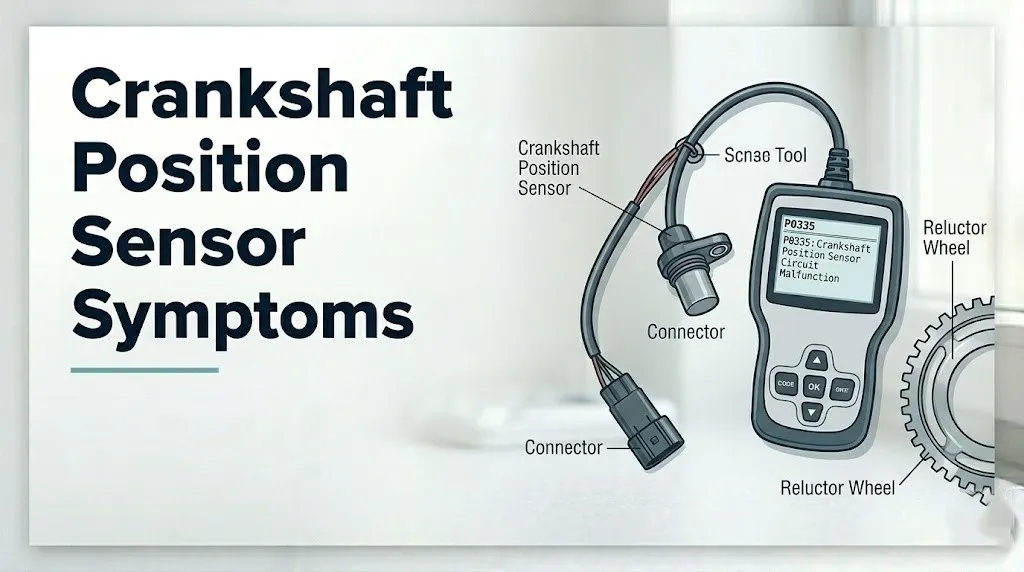
The crankshaft position sensor monitors the rotational position and speed of the crankshaft by reading the teeth of a reluctor wheel (also called a tone ring or trigger wheel) mounted directly to the crankshaft, and converts that information into an electrical signal the PCM uses to control ignition timing and fuel injection timing.
Think of the reluctor wheel like a clock face with evenly spaced teeth and one deliberate gap. As the crankshaft rotates, each tooth passes the CKP sensor and either alters a magnetic field (in a variable reluctance sensor) or interrupts a magnetic field to switch a transistor (in a Hall effect sensor). The resulting signal is a precise waveform the PCM reads as a series of timed pulses. The missing tooth or gap in the reluctor wheel tells the PCM exactly where top dead center (TDC) is on the reference cylinder.
The PCM uses this real-time positional data for three primary calculations. First, it determines when to trigger each ignition coil to fire the correct spark plug at the correct crank angle. Second, it calculates fuel injector pulse width and timing so fuel enters the cylinder at the right moment in the intake stroke. Third, it generates the engine speed (RPM) reading displayed on the tachometer.
Without an accurate CKP signal, all three of these calculations become unreliable simultaneously. That is exactly why a single failing sensor can produce such a wide range of symptoms at once.
- Hall effect sensors produce a clean digital square wave and are common in modern vehicles from approximately 1995 onward.
- Variable reluctance sensors produce an analog sine wave whose amplitude varies with engine speed; these are common in older designs and some truck applications.
- The testing procedure differs between these two types, so knowing which type your vehicle uses matters before any electrical diagnosis.
Vehicles using a combined CKP/CMP (crankshaft/camshaft position sensor) correlation system, such as those with variable valve timing, depend on both sensors simultaneously. Failure in either generates overlapping symptom patterns, which is a distinction addressed specifically in the CKP vs. CMP comparison section below.
Bad Crank Sensor Symptoms: The Full Diagnostic Picture
Bad crank sensor symptoms appear across multiple vehicle systems simultaneously because the CKP signal feeds several PCM functions at once, not just one.
The complete diagnostic picture of a failing CKP sensor includes:
- Check engine light (malfunction indicator lamp / MIL) illuminated with a stored OBD-II code
- Engine misfires, either random across multiple cylinders or clustered at specific RPM ranges
- Rough or fluctuating idle, where engine speed oscillates rather than staying steady
- Hard starting, requiring extended cranking before the engine fires
- Intermittent stalling, particularly at idle or during deceleration
- Acceleration hesitation, where the engine stumbles or bogs when throttle is applied
- Tachometer reading dropping to zero momentarily while the engine is running
- Reduced fuel economy, because the PCM defaults to enriched open-loop fuel delivery when it loses confidence in the CKP signal
- No-start condition, in complete sensor failure
The reduced fuel economy symptom is one the top-ranking competitor pages consistently miss. When the CKP signal is degraded rather than absent, the PCM does not completely lose timing reference. Instead, it loses confidence in the signal quality. The PCM often responds by retarding ignition timing as a protective measure and commanding richer fuel delivery, which reduces combustion efficiency and drops miles per gallon noticeably.
According to ASE (National Institute for Automotive Service Excellence) diagnostic training materials, a CKP signal fault is one of the most common reasons a vehicle passes the crank phase (the starter turns the engine over) but fails to achieve proper combustion. This presentation, cranks but won’t start, is the textbook endpoint of complete CKP sensor failure.
Drivers with older vehicles manufactured before 1996, before the OBD-II system became federally mandatory in the United States, may experience the same mechanical symptoms but without the check engine light guidance. On pre-OBD-II vehicles, diagnosis depends entirely on symptom pattern recognition and direct electrical testing.
Crankshaft Position Sensor Check Engine Light
A check engine light triggered by a CKP sensor fault means the PCM has detected a signal from the crankshaft position sensor circuit that falls outside the expected parameters for voltage, frequency, or timing.
The check engine light itself is the output of the OBD-II system, which continuously monitors sensor signal quality against baseline specifications built into the PCM’s calibration. The specific code stored alongside the MIL tells you which aspect of the CKP signal failed: circuit malfunction, range and performance deviation, circuit voltage low, circuit voltage high, or intermittent signal dropout.
What matters from a practical standpoint is that a check engine light related to the CKP sensor is not a minor advisory. It represents the PCM formally logging that the data it receives from this sensor cannot be trusted for accurate timing calculations. The engine management system has already been compromised by the time the light turns on.
The MIL behavior itself provides a diagnostic clue. A solid (non-flashing) check engine light indicates a stored fault that is present but not actively causing a misfire severe enough to damage the catalytic converter. A flashing or blinking check engine light indicates an active misfire event occurring right now that is rich enough to damage the catalytic converter through unburned fuel. A flashing check engine light while driving warrants pulling over safely and not driving the vehicle further until diagnosed.
Quick Tip:
- Retrieve the stored code with an OBD-II scanner before clearing it. The freeze frame data stored with the code shows the engine operating conditions (RPM, coolant temperature, throttle position) at the exact moment the fault was detected. This helps differentiate heat-related sensor failure from wiring faults.
- Some PCMs store multiple codes simultaneously when the CKP signal is corrupted. Companion codes for misfires (P0300-P0308), fuel trim deviation, and camshaft correlation faults can appear alongside P0335 or P0336.
- In vehicles with push-button start systems, a CKP fault code may disable the keyless start function entirely as a PCM safety response.
Key Takeaway: A check engine light from a CKP fault is not a warning to note and ignore. It means the timing brain of your engine is working with compromised data, and every mile driven that way adds unquantifiable risk of stall, no-start, or catalytic converter damage.
Crankshaft Position Sensor Misfire Symptoms
A misfiring engine caused by a failing crankshaft position sensor feels like a brief, sharp stumble or jerk, often with a noticeable loss of power, because the PCM is triggering ignition coils and fuel injectors at the wrong crank angle.
The ignition coil primary trigger signal depends entirely on the PCM knowing the precise crankshaft position at every moment. When the CKP signal drops out briefly, even for a fraction of a second, the PCM either misses an ignition trigger entirely or fires the coil at the wrong timing point. The result is an incomplete combustion event in one or more cylinders. Unburned fuel enters the exhaust stream and reaches the catalytic converter, where it combusts externally and can overheat the converter substrate.
CKP-related misfires have a distinct diagnostic pattern that separates them from misfires caused by worn spark plugs, failing ignition coils, or fuel delivery problems. A spark plug misfire is usually cylinder-specific and consistent. A CKP-related misfire tends to be random and multi-cylinder, meaning the PCM misfire counter (readable on a live scan tool) shows erratic events spread across multiple cylinders rather than accumulating on a single one.
According to ALLDATA diagnostic database technical service information, a P0300 random misfire code appearing alongside a P0335 or P0336 CKP fault is a strong diagnostic indicator that the misfire source is the sensor signal rather than individual cylinder components.
The misfire sensation also varies with engine load. At light throttle and steady highway cruising, the PCM can sometimes compensate partially for a degraded CKP signal using adaptive fuel trims, and the misfire may be barely perceptible. Under hard acceleration, when the PCM needs rapid, precise timing updates from the CKP sensor, the degraded signal produces more noticeable stumbling and power loss.
Drivers of vehicles with direct injection engines (GDI, TGDI systems) may notice more severe misfire symptoms from a given level of CKP signal degradation compared to port injection engines. Direct injection requires more precise injection timing because fuel is sprayed directly into the combustion chamber rather than the intake port, leaving less margin for timing error.
Crankshaft Position Sensor Rough Idle Symptoms
A rough idle from a crankshaft position sensor problem presents as an unsteady, shaking, or surging idle where the engine speed oscillates visibly on the tachometer instead of holding a stable RPM, because the PCM is receiving an inconsistent reference signal for timing.
At idle, the engine operates at low RPM and relatively low combustion pressure. This low-load condition is, counterintuitively, where CKP-related timing errors are most disruptive. At higher RPM, momentum and multiple rapid firing events partially mask individual timing errors. At idle, each combustion event is individually significant, and a single misfiring or mistimed cylinder creates a perceptible stumble.
The rough idle from a failing CKP sensor has a specific character. The engine may shake rhythmically or irregularly. The tachometer needle may fluctuate between, for example, 600 and 900 RPM rather than staying at a steady 750 RPM. The idle may feel worst immediately after a cold start and partially improve as the engine warms, or it may worsen as the engine reaches operating temperature in heat-sensitive sensor failures.
This temperature-dependency is an important diagnostic differentiator. According to Mitchell1 repair information technical data, a CKP sensor rough idle that worsens as engine temperature rises (heat soak pattern) is characteristic of a sensor whose internal electronics are thermally sensitive, a failure mode more common in sensors that have been exposed to oil leaks or excessive underhood heat.
Vehicles with idle air control (IAC) valves or electronic throttle bodies may produce a rough idle symptom pattern that superficially resembles a CKP fault but originates in the throttle management system instead. A live scan tool showing RPM fluctuation alongside an absence of stored CKP codes should prompt investigation of the throttle system before assuming CKP sensor failure.
| Rough Idle Source | Tachometer Behavior | Associated Code | Temperature Pattern |
|---|---|---|---|
| Failing CKP sensor | Erratic oscillation | P0335, P0336, P0300 | Often worse when hot |
| Dirty or failing IAC | Hunting, high idle | P0505, P0507 | Often worse when cold |
| Vacuum leak | High or unsteady idle | P0171, P0174 | Not temperature dependent |
| Worn spark plugs | Rhythmic miss | P030X (cylinder specific) | Not temperature dependent |
Bad Crankshaft Sensor Symptoms While Driving
Bad crankshaft sensor symptoms while driving include sudden brief power losses, unexpected engine stumbles during acceleration, intermittent tachometer drops to zero, and in more advanced failure, a complete engine stall while the vehicle is in motion.
These in-motion symptoms are the most safety-relevant presentation of CKP sensor failure, and they deserve more direct treatment than any competitor page currently provides. When the CKP signal drops out while the vehicle is traveling at speed, the PCM loses its timing reference instantly. The engine may stumble for a fraction of a second, or it may stall completely. The driver has no warning before it happens.
The acceleration hesitation symptom deserves specific attention. When you press the accelerator pedal and the engine hesitates, bogs momentarily, or surges rather than responding smoothly, the PCM may be receiving a degraded CKP signal at the exact moment it needs the most precise timing data, the transition from light to heavy load. Think of it like a conductor trying to lead an orchestra while the tempo clock cuts out intermittently. Every musician loses their cue at the same time.
The tachometer dropping to zero momentarily while driving is a particularly specific indicator of CKP signal loss. The engine RPM signal displayed on the tachometer is derived directly from the CKP sensor output. When the signal disappears for even a moment, the tachometer drops. If the engine is still running when the tachometer hits zero on the gauge, that is confirmation of a CKP signal dropout event, not a tachometer malfunction.
Drivers of rear-wheel drive trucks and vehicles with longitudinally mounted engines may find the CKP sensor more accessible and more exposed to road debris contamination than drivers of front-wheel drive vehicles. The sensor location on the engine block, bell housing, or oil pan rail varies by manufacturer, and location affects both symptom pattern (debris-related sensor impact can cause sudden sensor death rather than gradual degradation) and replacement difficulty.
Key Takeaway: A tachometer that drops to zero while the engine is running is one of the most specific in-vehicle indicators of a CKP signal dropout event, not a gauge problem, and it warrants immediate diagnostic evaluation.
Hard Start Symptoms Crankshaft Position Sensor
A hard start from a failing crankshaft position sensor means the engine cranks normally, the starter motor turns the engine over at its standard speed, but combustion either does not occur at all or occurs only after several seconds of cranking instead of within the first one to two revolutions.
This distinction matters. Hard start from a dead battery means the engine cranks slowly. Hard start from a CKP sensor fault means the engine cranks at normal speed but takes unusually long to fire. The PCM cannot confidently trigger the first ignition event until it receives enough CKP pulses to establish the crankshaft’s position. With a degraded or intermittent signal, this position-acquisition sequence takes longer than normal.
In a healthy engine, the PCM typically identifies crankshaft position within the first two to four reluctor wheel rotations after cranking begins. In a vehicle with a failing CKP sensor, the PCM may require ten or more rotations, or may never successfully acquire the reference position, resulting in a no-start outcome. The driver experiences this as the engine cranking for three, five, or even ten seconds before catching.
How to document your hard start symptoms accurately for a technician:
- Note the ambient temperature at the time of each hard start event (cold morning vs. after the engine has been running).
- Note how many seconds of cranking occurred before the engine started, or whether it failed to start at all.
- Note whether a hard start has ever been followed by a rough idle or misfire in the first minute of running.
- Note whether the hard start happens consistently every time, or only occasionally.
- Note whether the vehicle sits for a long time between start attempts, which helps separate CKP issues from fuel pressure bleed-down problems.
- Bring this documented pattern to your ASE-certified technician. It reduces diagnostic time and prevents misdiagnosis as a fuel pump or battery issue.
Older adults and drivers unfamiliar with the normal cranking characteristics of their specific vehicle may not recognize the hard start as abnormal until it progresses to a no-start. Vehicles with push-button start systems may make this harder to notice because the starter engagement is less audible and the cranking duration less visible to the driver.
Engine Stalling Crankshaft Position Sensor
Engine stalling caused by a failing crankshaft position sensor occurs when a CKP signal dropout during normal engine operation causes the PCM to lose its timing reference completely, immediately cutting ignition and fuel delivery, and the engine stops running abruptly.
This is the symptom that most directly affects driving safety. Unlike a rough idle or a hard start, a sudden engine stall while the vehicle is moving removes power steering assist (in hydraulic systems), reduces braking effectiveness (particularly in vehicles without electric vacuum pumps), and can create a dangerous traffic situation within seconds.
The stall from a CKP signal failure has a specific character: it is typically sudden and complete rather than gradual. The engine does not sputter and slow down the way it would with a fuel delivery problem. It cuts out abruptly. The vehicle may restart immediately, or it may require several minutes of waiting (particularly in heat-soak failure patterns) before the PCM will see a usable CKP signal again.
According to OEM service information for multiple vehicle platforms, a CKP sensor stall event is frequently misattributed to a failing crankshaft sensor when the actual fault is in the wiring harness between the sensor and the PCM. Chafed wiring insulation, a corroded connector pin, or a broken wire inside an otherwise intact harness sheath can produce identical stall patterns. A sensor replacement that does not resolve the stall symptom should immediately direct diagnosis toward the wiring harness and connector.
Vehicles with automatic transmissions that stall from a CKP fault may produce an additional symptom: the transmission may drop into a failsafe or limp-home mode because the PCM uses the CKP signal for torque converter lockup management. This appears as the transmission refusing to shift above a low gear even after the engine restarts.
Emergency Driving Safety: When to Stop the Vehicle Immediately
A vehicle that stalls unexpectedly in moving traffic creates a road safety emergency.
If your engine stalls while driving:
- Activate your hazard lights immediately.
- Shift to neutral and attempt a restart while allowing the vehicle to coast to the shoulder.
- If the engine will not restart, steer the vehicle fully off the road and onto the shoulder or a safe stopping area.
- Do not stop in a travel lane. A stalled vehicle in an active lane is a collision risk.
- Call for roadside assistance. Do not attempt to restart and drive a vehicle that has stalled from a suspected CKP fault until the fault is diagnosed and repaired.
These steps apply any time a vehicle stalls unexpectedly, regardless of the suspected cause.
Crankshaft Position Sensor Intermittent Failure Symptoms
Intermittent crankshaft position sensor failure is the most diagnostically challenging presentation because the sensor functions normally most of the time, symptoms appear unpredictably and then resolve on their own, and a standard scan tool may show no stored codes at all between failure events.
This is where the real-world driving experience diverges most from what the top-ranking competitor pages describe. Most CKP sensor articles describe failure as if it is a steady-state condition. In reality, the majority of failing CKP sensors go through an intermittent phase that can last weeks or months before reaching complete failure. During this phase, a driver may experience a single brief stall, one hard start episode, or a momentary rough idle, and then drive the vehicle normally for days or weeks with no recurrence.
The mechanism behind intermittent failure is primarily thermal and physical. Hall effect sensors contain semiconductor elements that can develop intermittent contact failures inside the sensor body, functioning normally at one temperature range and losing output at another. Variable reluctance sensors can develop internal winding faults that only produce signal dropout under vibration or at specific temperatures. Connector corrosion can cause intermittent contact loss that clears on its own as the connection flexes.
Diagnosing an intermittent CKP sensor fault requires a different approach than diagnosing a steady-state failure:
- Connect a professional-grade scan tool capable of recording live data and leave it in logging mode during normal driving.
- Look specifically for the RPM signal dropping to zero momentarily while the engine is running. Even a single logged dropout event that is invisible to the driver is a confirmable diagnostic indicator.
- Check the freeze frame data from any stored P0335/P0336/P0339 code carefully. The P0339 code (CKP sensor circuit intermittent) specifically indicates a signal dropout event rather than a steady-state fault.
- Inspect the wiring harness from the sensor to the PCM connector visually, paying attention to areas where the harness runs near exhaust components or heat shields, as thermal cycling accelerates insulation degradation.
- Request a scope waveform test from a technician rather than a simple voltage test. A scope captures the actual signal shape over time and will reveal signal dropouts or waveform irregularities that a static multimeter test misses entirely.
Drivers who have experienced a single unexplained stall that did not recur should treat it as an intermittent failure event requiring diagnosis, not a random anomaly to dismiss.
Key Takeaway: An intermittent CKP fault that produces a single brief stall and then disappears is still a progressive mechanical failure, not a one-time glitch. It will worsen. The P0339 code and a recorded RPM dropout on a live data log are the two most specific indicators of this failure mode.
Bad Crankshaft Sensor Symptoms Hot Engine
A crankshaft position sensor that fails specifically when the engine is hot, and then allows the engine to restart normally after the vehicle sits and cools for 20 to 30 minutes, is exhibiting a heat soak failure pattern, which is one of the most specific and diagnostically useful symptom signatures in engine management diagnostics.
This pattern occurs because the internal semiconductor element in a Hall effect CKP sensor has a temperature coefficient. As the element heats beyond its functional threshold, its output signal degrades or disappears. Once the underhood temperature drops after the engine is shut off, the element recovers enough to function again. This is why the vehicle restarts normally after cooling, only to fail again after the next extended drive.
Think of it like a light dimmer switch whose internal rheostat only sticks at high temperature. It works fine when cool, malfunctions when hot, and returns to normal after it cools down. The component is genuinely failing, but it only shows that failure under the thermal stress it encounters during real operation.
The heat soak pattern is also common with wiring harness faults located near exhaust manifolds or heat shields, where thermal cycling causes insulation to crack and intermittent contact faults to appear only at operating temperature.
Vehicles at elevated risk for heat-soak CKP failures:
- High-mileage vehicles with original CKP sensors that have experienced years of thermal cycling
- Vehicles with a history of oil leaks from the front crankshaft seal, which deposits oil on the sensor body and alters its thermal properties
- Vehicles where a previous technician routed the CKP wiring harness too close to the exhaust manifold during an unrelated repair
- Trucks and SUVs with high underhood temperatures from towing or sustained heavy-load operation
If your vehicle consistently stalls or loses power during long drives or after the engine has been at operating temperature for 30 minutes or more, and restarts without issue after 20 to 30 minutes of cooling, bring this specific pattern to an ASE-certified technician and request a heat-related sensor and harness inspection before any replacement is performed.
Crankshaft Sensor No Start Condition
A no-start condition caused by a failed crankshaft position sensor means the engine cranks normally, the starter motor engages, the battery voltage is adequate, and every other system appears functional, but the engine produces no combustion because the PCM has no CKP signal and therefore triggers no spark and no fuel injection.
This is the endpoint of the CKP failure progression. The PCM has a built-in logic response to total CKP signal loss: it disables the ignition and fuel systems entirely. Without a crank position reference, firing an ignition coil at random would risk engine damage. The PCM makes the conservative choice and produces nothing, which is why the vehicle cranks strongly but refuses to start.
Confirming that a no-start is caused by a CKP failure rather than another cause requires a systematic elimination process:
- Connect a scan tool and attempt to read live data while cranking. If the RPM value on the scan tool shows zero or no reading during cranking, the PCM is receiving no CKP signal. This is the most direct confirmation available without specialized equipment.
- Check for spark at any spark plug by removing one plug, connecting it to its coil wire, grounding it against the engine block, and cranking. No spark during cranking, combined with no RPM reading on the scan tool, confirms the ignition system is not triggering, consistent with a CKP fault.
- Note that no-start conditions from a failed CKP sensor will almost always produce a stored P0335 or P0336 code, provided the PCM has enough power to log it.
No-start conditions that are not accompanied by any stored CKP codes, and where the scan tool shows a normal RPM reading during cranking, are unlikely to be caused by the CKP sensor. In those cases, diagnosis should redirect to fuel delivery, ignition coil failure, or mechanical engine compression issues.
Drivers over 65 years old and those unfamiliar with OBD-II diagnostics are most likely to misattribute a CKP no-start to the battery or starter, particularly because the strong cranking sound contradicts the expectation of a starting problem. A vehicle that cranks strongly but won’t fire always warrants specific CKP sensor and ignition system diagnosis before battery or starter replacement is recommended.
Crankshaft Position Sensor OBD Codes P0335 and P0336
P0335 and P0336 are the two primary OBD-II diagnostic trouble codes associated with crankshaft position sensor failure, defined by the SAE J1979 standard as circuit malfunction and range/performance fault codes respectively for the CKP sensor circuit.
P0335: Crankshaft Position Sensor A Circuit Malfunction means the PCM detected no signal, or a signal so corrupted it could not be processed, from the CKP sensor primary circuit. This is the code most commonly associated with complete or near-complete sensor failure, wiring harness breaks, or connector failure.
P0336: Crankshaft Position Sensor A Circuit Range/Performance means the PCM is receiving a signal from the CKP sensor, but the signal characteristics (frequency, voltage, timing relative to TDC) are outside the expected parameters. This code is more commonly associated with a degraded sensor producing an incorrect waveform, a reluctor wheel tooth that is damaged or missing, or an incorrect sensor air gap.
| OBD-II Code | Formal Description | Most Common Cause | Symptom Pattern |
|---|---|---|---|
| P0335 | CKP Sensor A Circuit Malfunction | Complete sensor failure, broken wire, connector fault | No-start or severe stall |
| P0336 | CKP Sensor A Range/Performance | Degraded sensor, reluctor damage, wrong air gap | Misfires, rough idle, intermittent stall |
| P0337 | CKP Sensor A Circuit Low | Short to ground in sensor or harness | Persistent no-start, no RPM reading |
| P0338 | CKP Sensor A Circuit High | Open circuit, sensor power supply fault | No-start, scanner shows no RPM during crank |
| P0339 | CKP Sensor A Circuit Intermittent | Heat-related or vibration-related dropout | Intermittent stall, occasional hard start |
Some vehicles use a dual CKP sensor system with a “Sensor A” and “Sensor B” designation. In these systems, the B circuit codes are P0385 through P0389, following the same pattern as the A circuit codes. Technicians working on vehicles with variable valve timing systems (VVT) should note that P0016 and P0017, crankshaft-camshaft correlation codes, frequently appear alongside CKP codes when the CKP signal is corrupted.
A P0336 code accompanied by a P0016 correlation code on a vehicle with a recently replaced timing chain warrants specific inspection of the reluctor wheel alignment and timing chain stretch before the CKP sensor itself is replaced.
Key Takeaway: P0335 points to a circuit that has failed completely. P0336 points to a circuit producing a bad signal. Both require diagnosis before sensor replacement, because a bad wiring harness or damaged reluctor wheel will produce the same codes and same symptoms as a failed sensor, and replacing only the sensor will not resolve them.
Crankshaft Position Sensor vs Camshaft Position Sensor Symptoms
The symptoms of a failing crankshaft position sensor and a failing camshaft position sensor (CMP sensor) overlap significantly, both can produce misfires, rough idle, hard starts, and check engine lights, but the distinguishing features lie in the severity pattern, specific OBD codes, and which engine management functions are most affected.
The CKP sensor provides the foundational timing reference. Without it, the PCM cannot reliably manage ignition or fuel delivery at all. CMP sensor failure, by contrast, disrupts the PCM’s ability to differentiate which stroke each cylinder is on. In an engine with sequential fuel injection and coil-on-plug ignition, losing the CMP signal causes the PCM to switch from sequential (firing each cylinder in precise order) to batch or group fire mode, which is less efficient but still allows the engine to run.
The practical consequence is that CMP sensor failure rarely causes a complete no-start on its own. CKP sensor failure frequently does.
| Feature | CKP Sensor Failure | CMP Sensor Failure |
|---|---|---|
| No-start outcome | Common | Rare |
| Primary OBD codes | P0335, P0336, P0339 | P0340, P0341, P0345 |
| Idle quality impact | Severe | Moderate |
| Fuel economy impact | Noticeable | Mild to moderate |
| VVT system impact | Indirect | Direct |
| Heat-soak pattern | Common | Less common |
| Correlation code trigger | P0016, P0017 (CKP/CMP mismatch) | P0016, P0017 (same codes) |
One important overlap: both sensors can produce the P0016 and P0017 correlation codes simultaneously when the PCM detects a mismatch between the two signals. On vehicles with variable valve timing, this correlation code appearing alone (without a primary CKP or CMP code) is more likely to indicate a timing chain or VVT actuator problem than a sensor failure.
Vehicles that develop both a CKP and a CMP fault simultaneously are almost always experiencing a wiring harness or PCM power supply problem rather than two concurrent sensor failures. Two sensors rarely fail at exactly the same time under normal conditions.
How to Test a Crankshaft Position Sensor
Testing a crankshaft position sensor properly requires either a digital multimeter (for resistance and power supply checks) or a digital storage oscilloscope (for waveform analysis), with the specific test procedure varying depending on whether the sensor is a Hall effect type or a variable reluctance type.
A scan tool live data check is the appropriate first step before any hands-on electrical testing. Pull the RPM reading while cranking. If the scanner shows zero RPM during cranking, the PCM is receiving no useful CKP signal. This result alone narrows the diagnostic field significantly, though it does not yet distinguish between sensor failure and wiring harness failure.
For a variable reluctance (passive) CKP sensor:
- Disconnect the sensor connector with the ignition off.
- Set a digital multimeter to resistance (ohms) mode.
- Measure resistance across the two signal terminals. Most variable reluctance CKP sensors measure between 200 and 1,000 ohms; the specific specification is in the vehicle’s factory service manual.
- A reading of zero ohms indicates a shorted winding. An infinite (OL) reading indicates an open (broken) winding. Both indicate sensor failure.
- Wiggle the sensor body and wiring while measuring. A resistance reading that fluctuates under physical movement indicates an internal contact fault that may not show on a static test.
For a Hall effect (active) CKP sensor:
- With the sensor connected and the ignition on (engine not running), use a multimeter to verify the sensor receives the correct reference voltage, typically 5 volts or 12 volts depending on the PCM design, on the power supply terminal.
- Connect an oscilloscope to the signal output terminal.
- Crank the engine and observe the waveform. A healthy Hall effect CKP sensor produces a clean, consistent square wave pattern with equal tooth-gap timing.
- Signal dropouts (sections of the waveform that go flat), irregular tooth spacing in the waveform, or a waveform with rounded rather than sharp transitions indicate sensor element degradation.
The oscilloscope waveform test is the most specific CKP sensor test available outside of dealer-level diagnostic equipment. An ASE-certified automotive electrical diagnostic technician can perform this test in 15 to 30 minutes and produce a definitive result.
Can You Drive with a Bad Crankshaft Position Sensor
Whether you can drive with a bad crankshaft position sensor depends entirely on the failure stage: a sensor producing intermittent mild symptoms is a different risk profile from one that has caused a highway stall or is producing daily hard starts.
A vehicle showing only a stored P0335 or P0336 code with no active drivability symptoms can technically be driven short distances to a repair facility, but it should not be driven on highways, at night, or in heavy traffic, because the progression from intermittent fault to complete failure can occur without warning.
A vehicle that has already stalled once while in motion should not be driven at all until the fault is diagnosed and repaired. The risk is not mechanical damage to the engine. The risk is a stall at 60 mph in traffic, with the attendant loss of power steering and reduced brake boost, in a situation where the driver has no warning and no preparation time.
Driving risk assessment by symptom severity:
| Current Symptom | Short-Distance Drive to Shop | Highway Driving | Long-Distance Driving |
|---|---|---|---|
| Check engine light only, no drivability symptoms | Low risk, acceptable | Moderate risk, avoid | High risk, avoid |
| Intermittent rough idle or mild misfire | Moderate risk | High risk, avoid | Avoid entirely |
| One prior stall event while driving | High risk | Do not drive | Do not drive |
| Hard start on most attempts | Moderate risk | High risk | Avoid entirely |
| Complete no-start | Not applicable (vehicle is not driveable) | Not applicable | Not applicable |
The repair timeline also matters. A crankshaft position sensor on most vehicles is a relatively accessible component, and OEM-quality replacement sensors are widely available. The SAE-standardized OBD-II system means the diagnostic process is well-defined. Delaying repair on a known CKP fault for weeks in hopes the symptom resolves is not a sound decision, the sensor does not self-heal, and the wiring and harness problems that sometimes accompany CKP faults tend to worsen with continued thermal cycling.
Some vehicles require a CKP sensor relearn procedure after sensor replacement, where the PCM must relearn the exact position of the reluctor wheel missing tooth relative to TDC. Skipping this procedure on vehicles that require it can produce a check engine light and rough running even with a brand-new sensor installed. An ASE-certified technician will know whether your specific vehicle requires this step and have the scan tool capability to perform it.
Frequently Asked Questions About Crankshaft Position Sensor Symptoms
What are the most common symptoms of a bad crankshaft position sensor?
The most common crankshaft position sensor symptoms are a check engine light with a stored P0335 or P0336 code, engine misfires, rough idle, hard starting, and intermittent stalling.
In complete sensor failure, the engine cranks normally but produces no combustion because the PCM receives no timing reference and disables spark and fuel delivery entirely.
A tachometer reading that drops to zero momentarily while the engine is running is one of the most specific in-vehicle indicators of a CKP signal dropout event.
Can a bad crankshaft position sensor cause a car not to start?
Yes, complete crankshaft position sensor failure is a well-established cause of a no-start condition where the engine cranks strongly but will not fire.
The PCM requires the CKP signal to trigger ignition coils and fuel injectors; without it, neither system activates, producing a strong crank with no combustion.
A scan tool showing zero RPM during cranking, combined with a stored P0335 code, is strong confirmation that the CKP sensor or its circuit is the source of the no-start condition.
What OBD code does a bad crankshaft sensor trigger?
A failing crankshaft position sensor most commonly triggers P0335 (circuit malfunction), P0336 (range/performance), P0337 (circuit low), P0338 (circuit high), or P0339 (circuit intermittent), as defined by the SAE J1979 OBD-II standard.
P0335 indicates the PCM is receiving no usable signal, while P0336 indicates the signal is present but outside expected parameters.
Additional companion codes such as P0300 (random misfire) or P0016 (crankshaft-camshaft correlation fault) frequently appear alongside CKP codes.
How do I know if my crankshaft sensor is failing intermittently?
The key indicators of an intermittent CKP sensor failure are brief, unpredictable stalls or rough idle episodes that resolve on their own, a stored P0339 code, or a scan tool live data log showing momentary RPM dropouts during otherwise normal driving.
Because intermittent faults do not always produce stored codes, connecting a scan tool capable of recording live data and looking specifically for RPM signal dropouts while driving is the most reliable way to capture the fault.
A single unexplained stall that did not recur is enough justification for a professional CKP sensor and wiring harness inspection, not a reason to dismiss the event.
Can I drive with a bad crankshaft position sensor?
Short-distance driving to a repair facility is acceptable with a stored CKP code and no active drivability symptoms, but highway driving, long trips, and night driving should be avoided until the fault is repaired.
Any vehicle that has already stalled while in motion from a suspected CKP fault should not be driven further until diagnosed, because the stall can recur without warning at any speed.
The repair cost and availability of CKP sensors make this a straightforward fix that does not warrant weeks of driving through a known fault.
What is the difference between a bad crankshaft sensor and a bad camshaft sensor?
A failing crankshaft position sensor disrupts the foundational timing reference the PCM uses for all ignition and fuel injection events, which is why it frequently causes a complete no-start condition.
A failing camshaft position sensor disrupts sequential firing order management, which causes misfires and rough running but rarely a complete no-start, because the PCM can switch to a less precise batch-fire mode.
The primary distinguishing codes are P0335/P0336 for CKP failure and P0340/P0341 for CMP failure; a P0016 crankshaft-camshaft correlation code appearing alongside either primary code narrows the diagnosis further.
Closing
A failing crankshaft position sensor follows a predictable progression from intermittent signal dropouts through worsening drivability symptoms to a complete no-start. The earlier in that progression you identify it, the more control you have over when and how the repair happens, rather than having the vehicle decide for you by stalling in traffic.
Connect a scan tool to confirm the specific OBD code, document the exact symptom pattern including when symptoms occur and whether they change with engine temperature, and bring that information to an ASE-certified technician. Request a live data RPM check and a scope waveform test rather than a simple sensor swap. On vehicles requiring a post-replacement relearn procedure, confirm that step is included in the repair.
You now have a complete picture of every crankshaft position sensor symptom, the electrical mechanism behind each one, how to read the OBD codes, and exactly when the risk level means you stop driving and call for help. That information belongs in your hands, not discovered for the first time on the side of a highway.