Bad EGR Valve Symptoms: All Signs and What They Mean 2026
Bad EGR valve symptoms include rough idle, engine knock under load, stalling or hesitation during acceleration, poor fuel economy, a check engine light with specific stored trouble codes, and a failed emissions inspection, but which combination of symptoms you experience depends entirely on whether the valve has failed stuck open, stuck closed, or intermittently, a distinction no symptom article adequately explains. Understanding the specific failure mode behind each symptom is the difference between correctly diagnosing an EGR valve problem and chasing unrelated engine faults for weeks.
The EGR (Exhaust Gas Recirculation) valve is a federally mandated emissions component regulated under EPA Tier 3 emissions standards. It is present in virtually every petrol-powered vehicle sold in the United States since the 1970s and every diesel vehicle since the late 1990s, making EGR valve failure one of the most commonly encountered emissions-related check engine codes in professional repair shops today.
This article covers every named symptom of EGR valve failure with the specific mechanical and chemical mechanism behind each, distinguishes stuck-open from stuck-closed failure patterns, covers EGR cooler failure as a separate and more serious failure mode, addresses diesel versus gasoline system differences, names the OBD-II diagnostic codes involved, and explains exactly when a bad EGR valve warrants a tow rather than a drive-to-the-shop.
What Is an EGR Valve and What Does It Do
The EGR valve (Exhaust Gas Recirculation valve) is an emissions control component that routes a controlled percentage of exhaust gas from the exhaust manifold back into the intake manifold, diluting the incoming air-fuel charge with inert combustion products to reduce peak combustion temperature and thereby limit the formation of nitrogen oxides (NOx).
NOx forms when combustion temperature exceeds approximately 1,370°C (2,500°F) in the presence of atmospheric nitrogen. At this temperature, the nitrogen and oxygen molecules in the air dissociate and recombine into nitric oxide (NO) and nitrogen dioxide (NO2), collectively called NOx, which are regulated pollutants that contribute to ground-level ozone and smog formation. By introducing 5 to 25% exhaust gas into the intake charge (depending on engine load and speed, as commanded by the engine control module / ECM), the EGR system displaces a portion of the fresh air-fuel mixture with inert CO2 and water vapor. This dilution absorbs heat during combustion without contributing to the combustion reaction, lowering the peak temperature below the NOx formation threshold.
Think of the EGR valve as the equivalent of a controlled-flow mixing valve in a plumbing system, except instead of mixing hot and cold water, it mixes inert exhaust with fresh combustion air. The valve opens precisely when needed (moderate load, cruise conditions) and closes precisely when not needed (idle, full throttle). When the valve sticks in the wrong position or fails to respond to ECM commands, it disrupts this carefully calibrated mixing strategy with predictable consequences.
Modern EGR systems use three primary valve designs. Vacuum-operated EGR valves (common in pre-2000 vehicles) use engine vacuum to open the valve against a spring return. Electronic EGR valves with a solenoid or stepper motor (dominant from the mid-1990s onward) receive direct electrical commands from the ECM and can be precisely position-controlled. High-pressure EGR systems (used in diesel applications) route exhaust before the turbocharger, while low-pressure EGR systems route exhaust after the diesel particulate filter (DPF), each with different contamination and failure profiles.
Vehicles operated primarily in stop-and-go city traffic accumulate carbon deposits in the EGR valve more rapidly than highway vehicles, because frequent cold starts produce more exhaust condensate and unburned hydrocarbons that polymerize into deposits on the valve’s cooler surfaces.
Bad EGR Valve Symptoms: The Full Picture
The full picture of bad EGR valve symptoms spans check engine light illumination, rough idle, stalling, hesitation on acceleration, engine knock, reduced fuel economy, and failed emissions testing, but the specific combination of symptoms depends on which failure mode is present: stuck open, stuck closed, intermittent, or mechanically obstructed.
No single symptom definitively identifies EGR valve failure. A rough idle can come from a vacuum leak, misfiring spark plugs, a dirty mass airflow sensor, or a failing fuel injector. Engine knock can come from fuel octane mismatch, carbon deposits on piston tops, a failing knock sensor, or timing system wear. The EGR valve becomes the primary suspect when symptoms correlate specifically with load conditions: rough idle and stalling at low RPM suggest stuck-open failure, while knock and poor emissions performance under moderate load suggest stuck-closed failure.
According to SAE International technical documentation on EGR system performance, EGR valve mechanical failure is among the top five causes of engine-related OBD-II check engine light events in vehicles with over 75,000 miles. The check engine light is typically the first indicator, appearing before drivability symptoms become noticeable in most electronically monitored EGR systems.
All symptoms of bad EGR valve by failure type:
| Symptom | Which Failure Mode | Mechanism | Urgency |
|---|---|---|---|
| Rough idle / stalling | Stuck open | Excessive exhaust dilution at idle reduces O2 and combustion completeness | Moderate; schedule diagnosis |
| Engine knock under load | Stuck closed | No EGR dilution allows combustion temps to exceed detonation threshold | Moderate to high; address promptly |
| Poor fuel economy | Either | Disrupted combustion efficiency from incorrect EGR rate | Low to moderate; monitor |
| Check engine light | Either | ECM detects EGR flow deviation from commanded rate | Moderate; read codes first |
| Failed emissions test | Stuck closed predominant | Elevated NOx from high combustion temps | Moderate; repair before re-test |
| Hesitation on acceleration | Stuck open | Excessive exhaust dilution reduces power output | Moderate; affects drivability |
| White smoke (diesel) | EGR cooler failure | Coolant entering intake manifold and combustion chamber | High; do not drive; tow |
Check Engine Light and EGR Valve Fault Codes
The check engine light (formally the malfunction indicator lamp, or MIL) illuminates when the ECM detects that the EGR system’s actual performance deviates from the commanded performance beyond a calibrated threshold, storing a specific OBD-II diagnostic trouble code (DTC) that identifies the nature of the deviation.
The most important thing a driver can do when the check engine light appears is retrieve the stored DTC before drawing any conclusions about which component has failed. An EGR-related code and a non-EGR code both illuminate the same light identically. Only reading the stored code separates them. An inexpensive OBD-II scan tool (available for under $30 at most auto parts retailers) reads the code from the vehicle’s OBD-II port, located under the driver’s side dashboard in virtually all vehicles sold in the United States after 1996.
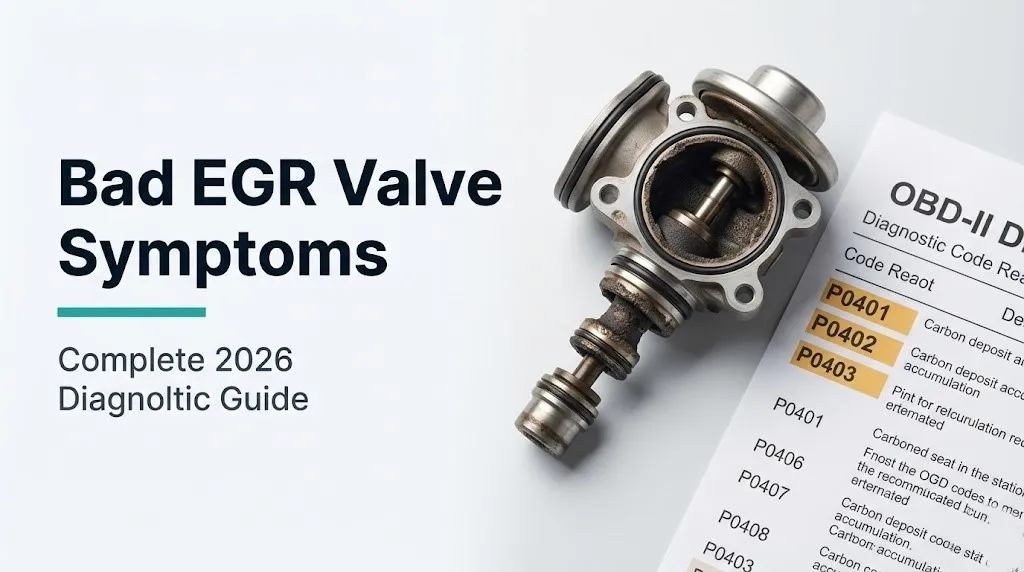
The specific OBD-II codes associated with EGR system faults, as defined by the SAE J1979 standard:
- P0400: EGR flow malfunction (general EGR system fault, broad category)
- P0401: EGR flow insufficient (the ECM commanded EGR open but flow was lower than expected, suggesting blockage or stuck-closed valve)
- P0402: EGR flow excessive (EGR flow detected when the ECM commanded the valve closed, suggesting stuck-open valve)
- P0403: EGR circuit malfunction (electrical fault in the EGR valve solenoid or wiring circuit)
- P0404: EGR circuit range/performance (valve position feedback does not match commanded position)
- P0405: EGR sensor A circuit low (position sensor or differential pressure sensor signal is below expected range)
- P0406: EGR sensor A circuit high (position sensor signal is above expected range)
P0401 and P0402 are flow-related codes pointing toward a mechanical valve problem (blockage, stuck position). P0403 through P0406 are electrical codes pointing toward sensor or wiring problems that may not require valve replacement at all. A P0403 code with an otherwise functional valve may resolve with a wiring repair or connector cleaning.
Vehicles manufactured before 1996 with OBD-I diagnostic systems store manufacturer-specific codes rather than standardized OBD-II codes. These require a manufacturer-specific scan tool or the vehicle’s built-in diagnostic access procedure (flashing the check engine light in a code-pattern sequence) to retrieve.
Key Takeaway: Read the OBD-II code before replacing the EGR valve. A P0403 or P0405 code points to a wiring or sensor fault that does not require a new valve, while a P0401 or P0402 code points toward the valve or its passage as the mechanical problem.
Rough Idle as a Symptom of a Bad EGR Valve
A rough idle caused by a bad EGR valve occurs specifically when the valve has failed in the stuck-open or partially open position, allowing exhaust gas to enter the intake manifold during idle conditions when the ECM has commanded the valve fully closed.
At idle, the engine is running at its lowest load condition. The air-fuel charge admitted through the throttle body is precisely calibrated by the ECM to maintain stable combustion at 700 to 900 RPM. The EGR valve is commanded closed at idle because exhaust gas dilution at this low-load condition would reduce oxygen concentration too far below the stoichiometric ratio (approximately 14.7:1 air-to-fuel for gasoline), producing incomplete combustion, misfires, and RPM instability.
When the valve stays partially open due to a stuck pintle or carbon deposit preventing full closure, exhaust gas continuously enters the intake manifold regardless of ECM command. The incoming charge is diluted with inert CO2 and water vapor that displace fresh oxygen. The combustion in one or more cylinders becomes incomplete, producing random misfires. The engine management system detects the RPM instability and attempts to compensate through fuel trim adjustments, but if the dilution is severe enough, it cannot fully compensate. The driver feels this as an unstable, shuddering idle that may resolve or worsen depending on engine temperature and load.
According to ASE Engine Performance (A8) certification curriculum, rough idle accompanied by a P0402 code (EGR flow excessive when valve should be closed) is one of the most reliable symptom-code combinations indicating a stuck-open or contaminated EGR valve that cannot achieve full closure.
Vehicles with direct-injection gasoline engines (GDI engines, found in most vehicles since approximately 2010) are more prone to EGR-related rough idle than port-injection engines because GDI engines lack the fuel washing of intake ports that port injection provides. Without fuel washing, carbon deposits accumulate faster on intake valves and EGR passages, increasing the probability that the EGR valve develops sticking before high mileage would otherwise predict.
Engine Knock From a Failing EGR Valve
Engine knock caused by a bad EGR valve occurs when the valve has failed stuck closed or severely blocked, preventing exhaust gas recirculation during moderate load and cruise conditions where the ECM has commanded the valve open, allowing peak combustion temperatures to rise above the threshold for end-gas detonation.
Detonation (knock) occurs when unburned fuel-air mixture in the end-gas zone of the combustion chamber spontaneously ignites before the spark plug-initiated flame front reaches it. This autoignition creates a pressure spike that collides with the advancing flame front, producing the characteristic pinging or knocking sound. In a properly functioning engine with an active EGR system, recirculated exhaust gas absorbs heat during compression and combustion, keeping peak temperatures below the detonation threshold. When EGR flow stops because the valve is stuck closed, the thermal buffer disappears.
The engine’s knock sensor (a piezoelectric sensor mounted on the engine block that detects vibration frequencies characteristic of detonation) signals the ECM, which retards ignition timing to reduce the likelihood of continued knock. This timing retard reduces engine output and fuel efficiency simultaneously. The driver experiences this as reduced power, particularly under acceleration from cruise speed, combined with the audible knock sound if the timing retard is insufficient to suppress all detonation events.
According to SAE International published research on EGR system effects on knock margins, the exhaust gas dilution provided by a correctly functioning EGR system increases the resistance to knock by reducing the reactivity and temperature of the end-gas zone, allowing the use of slightly more aggressive ignition timing for improved efficiency. When EGR flow is eliminated by valve failure, the knock margin shrinks, and the ECM must compensate by retarding timing.
Sustained knock without ECM correction risks piston crown erosion, spark plug damage, and over time, connecting rod bearing damage from the abnormal pressure spikes. Drivers who notice knock symptoms should have the EGR system diagnosed promptly rather than continuing to operate the vehicle under load.
Poor Fuel Economy From a Bad EGR Valve
Poor fuel economy from a bad EGR valve is produced through two distinct mechanisms depending on the failure mode, with stuck-open failure reducing combustion efficiency at idle and light load, and stuck-closed failure forcing ignition timing retard at cruise and moderate load conditions.
Neither failure mode produces a dramatic, immediately obvious fuel economy reduction. The typical driver will notice a gradual decline of approximately 2 to 5 miles per gallon over weeks or months of EGR-related fuel economy loss, rather than a sudden drop. This gradual onset is one reason EGR-related fuel economy decline is often attributed to other causes (tire pressure, seasonal fuel blend changes, driving habit changes) before the check engine light appears or the problem is diagnosed.
With stuck-open failure: at idle and light load conditions where the valve should be closed, excess exhaust gas dilution forces the ECM to inject additional fuel to compensate for the lean mixture and maintain stable combustion. These additional small fuel enrichments accumulate across thousands of idle and light-load cycles, reducing overall fuel efficiency. Long-distance idle time (common in commercial truck drivers, fleet vehicle operators in urban environments, or drivers who warm up their vehicles extensively in winter months) produces more pronounced EGR-related idle fuel economy loss than the average passenger car driver would experience.
With stuck-closed failure: the ECM retards ignition timing to prevent knock, as described in the preceding section. Retarded timing means the combustion pressure peak occurs later in the piston’s downstroke than optimal, reducing the mechanical work extracted from each combustion event. This directly translates to more fuel required to produce the same power output and travel the same distance.
Vehicles operated primarily on highway driving at consistent moderate loads (approximately 40 to 70% throttle) experience the stuck-closed efficiency penalty most noticeably, while city drivers experience the stuck-open idle enrichment penalty most noticeably.
Key Takeaway: A stuck-open EGR valve hurts fuel economy most at idle and low load, while a stuck-closed EGR valve hurts it most on the highway under cruise conditions. Knowing which pattern matches your driving will help you describe the problem accurately to a mechanic.
Failed Emissions Test From EGR Valve Failure
A failed emissions inspection caused by a bad EGR valve is the direct result of elevated nitrogen oxide (NOx) emissions in the exhaust stream, which occurs when the valve is stuck closed and no longer diluting the combustion charge with inert exhaust gas at the moderate load conditions where NOx formation is greatest.
The legal basis for EGR system monitoring is the EPA OBD-II emissions monitoring requirement, which mandates that vehicles monitor the performance of all emissions-relevant systems and illuminate the malfunction indicator lamp when deviations are detected. A vehicle with a stored EGR-related check engine code will fail an OBD-II readiness emissions test in most U.S. states before the tailpipe emissions are even measured, because inspectors scan the OBD-II system for active trouble codes and readiness monitors as part of the inspection procedure.
In states that conduct both OBD-II readiness testing and tailpipe exhaust concentration measurement (using a tailpipe probe and gas analyzer), a vehicle with a stuck-closed EGR valve producing elevated NOx may fail the NOx concentration limit even if no check engine light is currently present. This is because the ECM’s timing retard strategy partially suppresses NOx formation but typically cannot reduce it to within the legal limit without functioning EGR flow.
Drivers who have recently cleared their check engine light codes before an emissions test should be aware that OBD-II readiness monitors (the system self-tests that confirm all monitored systems have completed their diagnostic cycles) reset along with the codes. A vehicle with cleared codes and incomplete readiness monitors will fail the inspection for “not ready” status, regardless of whether any codes are currently stored. The monitors require a specific drive cycle, which varies by manufacturer, to complete after a code clear.
Vehicles operating with a known EGR fault should have the fault corrected before attempting an emissions re-inspection. Driving the standard OBD-II drive cycle (which typically requires a cold start, idle period, city driving, and highway cruise segment in a specific sequence) allows the readiness monitors to complete before the re-test.
Stalling and Hesitation From a Faulty EGR Valve
Stalling and hesitation caused by a faulty EGR valve result from excessive exhaust gas entering the intake manifold during low-load and acceleration transitions, diluting the incoming charge to the point where the air-fuel ratio falls too far outside the range for stable combustion or smooth throttle response.
Stalling typically occurs at idle or during the transition from idle to low throttle, such as releasing the brake at a stop sign and applying light throttle. At these precise moments, the engine is transitioning from the idle condition (where EGR is commanded closed) to a light-load condition (where EGR begins to open slightly). If the valve is already partially open from a stuck or contaminated position, the transition adds additional exhaust dilution on top of the already-excessive idle dilution, pushing the combustion mixture below the lean misfire limit. The engine stumbles and may stall completely.
Hesitation during acceleration occurs by the same mechanism during the brief period between light throttle and the point where the throttle opening is large enough to admit sufficient fresh air to overcome the exhaust dilution. The power deficit during this transition feels like the engine is “reluctant” to respond to the accelerator, producing the characteristic hesitation or stumble that drivers describe as the car “surging” or “not pulling properly” when leaving a stop.
Quick Tip:
- A stall that occurs specifically when releasing the brake and applying gentle throttle from a stopped position, without stalling at a fully held idle, is a characteristic pattern for stuck-open EGR valve. A stall from a cold engine that clears when the engine warms up is less specific to EGR and more likely a different air-fuel management issue.
- Drivers of high-mileage vehicles (over 100,000 miles) with city-dominant driving patterns are most likely to experience EGR stalling as the primary presenting symptom, because urban stop-and-go driving cycles are where the stuck-open EGR valve causes the most disruptive dilution events.
- Hesitation on acceleration that improves or disappears at higher RPM (above 2,500 RPM) is consistent with EGR involvement, because at higher RPM and load the ECM commands the valve more fully open anyway, making the stuck-open position less of a deviation from commanded behavior.
Stuck Open EGR Valve Symptoms vs. Stuck Closed Symptoms
A stuck-open EGR valve and a stuck-closed EGR valve produce opposite and distinct symptom patterns that help pinpoint the specific failure mode before any diagnostic testing: stuck-open failures dominate at idle and low load (rough idle, stalling, hesitation), while stuck-closed failures dominate at cruise and moderate load (engine knock, elevated NOx, failed emissions, reduced highway power).
Understanding this distinction is the single most practically useful piece of information in this entire article. The EGR valve is a bidirectional control: it opens and closes on ECM command throughout the drive cycle. When it can no longer respond correctly to those commands, the symptoms that result depend entirely on where in the drive cycle the valve has stopped responding.
A stuck-open valve is most commonly produced by carbon deposit accumulation on the valve pintle and seat that prevents the valve spring (in vacuum-operated designs) or return mechanism (in electronic designs) from achieving full closure. The valve sits partially or fully open at all times. The ECM detects excessive flow when commanding closure (P0402 code) and attempts to compensate, but mechanically cannot force the valve closed.
A stuck-closed valve is most commonly produced by carbon deposit accumulation in the EGR passage itself (the internal channel connecting the exhaust and intake manifolds), blocking flow even when the valve is commanded open and functioning electrically. The ECM detects insufficient flow when commanding opening (P0401 code).
| Feature | Stuck-Open EGR | Stuck-Closed EGR |
|---|---|---|
| Primary symptom trigger | Idle and low-load conditions | Cruise and moderate-load conditions |
| Most recognizable symptom | Rough idle, stalling, hesitation | Engine knock, elevated NOx, poor highway power |
| Most likely OBD-II code | P0402 (excessive flow when commanded closed) | P0401 (insufficient flow when commanded open) |
| Most common mechanical cause | Carbon on valve pintle/seat | Carbon in EGR passage blocking flow |
| Emissions test result | May pass or fail depending on severity | More likely to fail NOx limits |
| Urgency | Moderate; drivability affected | Moderate to high; engine knock risks component damage |
Key Takeaway: If your symptoms are worst at idle and include stalling, you likely have a stuck-open EGR valve with a P0402 code. If your symptoms are worst under highway driving with engine knock, you likely have a stuck-closed or blocked EGR with a P0401 code. These are different problems requiring different repairs.
Clogged and Dirty EGR Valve Symptoms From Carbon Buildup
Clogged and dirty EGR valve symptoms are produced by the progressive accumulation of carbon deposits inside the EGR valve body, on the valve pintle and seat surfaces, and within the EGR passage walls, reducing the valve’s ability to open or close to the ECM-commanded position.
Carbon deposit formation in EGR systems follows a specific chemical sequence. Exhaust gas passing through the EGR circuit contains unburned hydrocarbons, water vapor, exhaust soot (fine carbon particles), and engine oil vapor that bypasses the piston rings. As this hot, contaminated gas passes through the EGR cooler and into the relatively cooler EGR valve body and passage, it undergoes thermal condensation: heavier hydrocarbon fractions drop out of the gas stream and coat the metal surfaces. Over thousands of heat cycles, these condensed hydrocarbons polymerize and oxidize into hard, tar-like carbon deposits that bind to the metal surfaces and progressively reduce the internal cross-section of the EGR passage and the clearance between the valve pintle and seat.
A fully clogged EGR passage can reduce EGR flow to near zero even with the valve fully open, producing a stuck-closed symptom pattern (P0401, engine knock, elevated NOx) without any mechanical fault in the valve actuator itself. In this case, cleaning the passage is the correct repair, not valve replacement.
Symptoms specific to progressive carbon buildup (as opposed to sudden electrical failure) tend to develop gradually over months rather than appearing suddenly. An owner of a high-mileage vehicle may notice gradually worsening rough idle over two to three oil change intervals before a check engine light appears. This progressive onset pattern is clinically distinct from sudden EGR valve electrical failure, which typically produces an immediate check engine light with minimal drivability symptoms before the light appears.
EGR cleaning methods range from chemical solvent sprays (effective for mild deposits on accessible valves), to walnut shell blasting (a specialized shop procedure using pressurized walnut shell media to blast carbon from intake ports, valves, and EGR passages), to physical disassembly and manual scraping. The appropriate method depends on the accessibility of the EGR system, the degree of deposit accumulation, and whether the valve pintle mechanism itself has been mechanically damaged by prolonged carbon contact.
EGR Cooler Failure Symptoms
EGR cooler failure produces a distinct symptom pattern separate from EGR valve failure: white exhaust smoke, unexplained coolant loss with no external leak, sweet-smelling exhaust, and in severe cases, intake manifold sludge or hydrostatic lock, which is a potentially engine-destroying condition that occurs when coolant fills a combustion chamber.
The EGR cooler is a heat exchanger that routes recirculated exhaust gas through a series of internal tubes surrounded by engine coolant. Its purpose is to lower exhaust gas temperature before it enters the intake manifold, increasing the density of the cooled exhaust and maximizing its charge-dilution effectiveness. EGR coolers are common on diesel engines (where exhaust temperatures and EGR flow rates are high) and increasingly on turbocharged gasoline engines.
When the EGR cooler’s internal tubes crack from thermal fatigue, corrosion from acidic coolant chemistry, or external damage, engine coolant crosses into the exhaust gas stream. This coolant is then drawn into the intake manifold with the recirculated exhaust and eventually enters the combustion chamber, where it vaporizes and exits through the exhaust as white steam-like smoke. The characteristic sweet smell of ethylene glycol (the primary component of engine coolant) in the exhaust distinguishes EGR cooler failure from other sources of white smoke.
Do not continue operating a diesel vehicle if the coolant level is dropping rapidly and white smoke is continuous from the exhaust. Coolant accumulating in one or more combustion chambers during an engine shutdown period can fill the chamber completely. When the starter motor attempts to compress the incompressible liquid on the next cold start, the connecting rod cannot complete its compression stroke and may bend or fracture. This is called hydrostatic lock, and it converts a cooler replacement repair into a complete engine rebuild or replacement.
Tow the vehicle to an ASE-certified diesel engine repair facility rather than attempting to drive it or restart it after coolant smoke has been observed.
EGR Sensor Symptoms and Position Sensor Failure
EGR sensor failure, most commonly involving the EGR position sensor (which monitors valve travel distance and reports actual position back to the ECM) or the EGR differential pressure sensor (which measures the pressure drop across the EGR flow passage as a surrogate for flow rate), produces check engine light codes and drivability symptoms that closely mimic mechanical valve failure but have a different repair solution.
The EGR position sensor is typically a linear or rotary potentiometer that converts valve stem travel into a voltage signal. When this sensor fails or its signal wire develops an intermittent open or short, the ECM receives incorrect position feedback and may command incorrect EGR duty cycles in response, producing symptoms similar to a mechanically stuck valve. However, the underlying cause is electrical, not mechanical. Replacing the valve without testing the sensor circuit first is a common and expensive diagnostic error.
The differential pressure sensor (also called a Delta-P sensor) measures the pressure difference between the upstream (exhaust side) and downstream (intake side) of the EGR system to calculate flow rate. A failed Delta-P sensor produces incorrect flow readings that trigger P0401 (insufficient flow) or P0402 (excessive flow) codes even when the EGR valve and passage are mechanically clean and functional.
To distinguish sensor failure from mechanical valve failure:
- Read the stored OBD-II code and check whether it is a flow code (P0401/P0402) or a circuit code (P0403/P0404/P0405/P0406). Circuit codes strongly suggest sensor or wiring faults.
- Use a bidirectional scan tool (available at most professional shops but not basic consumer OBD-II readers) to command the EGR valve open while monitoring live position sensor data. If the commanded position and reported position diverge significantly, the position sensor or its circuit is the likely fault.
- Inspect the EGR sensor wiring harness and connector for corrosion, cracking, or heat damage before condemning the sensor itself. Connector corrosion is a documented cause of false EGR circuit codes in vehicles operating in high-humidity or road salt environments.
Bad EGR Valve Symptoms in Diesel vs. Gasoline Engines
Bad EGR valve symptoms in diesel engines differ from gasoline engine symptoms in three specific ways: diesel EGR systems accumulate carbon deposits faster, diesel EGR failures more commonly involve EGR cooler failure as a concurrent or primary fault, and black smoke (from running rich due to EGR disruption) is a diesel-specific symptom not typically seen in gasoline applications.
Diesel exhaust contains substantially higher particulate matter (soot) concentrations than gasoline exhaust. This soot-laden exhaust passes through the EGR circuit and deposits much more aggressively on EGR valve surfaces and passage walls than gasoline exhaust does. According to SAE International published technical data on diesel EGR systems, soot accumulation rates in diesel EGR passages are sufficiently high that EGR valve cleaning intervals of 60,000 to 80,000 miles are recommended in diesel applications under severe duty cycles, while gasoline EGR systems may not require cleaning until 100,000 to 150,000 miles or later.
Diesel vehicles with failing EGR systems may also produce black or dark grey smoke from the exhaust under acceleration, reflecting an air-fuel ratio disruption from excessive exhaust dilution of the intake charge, which reduces available oxygen below the diesel combustion stoichiometry threshold. Gasoline engines manage air-fuel ratio through closed-loop lambda control that largely prevents this visible smoke manifestation.
Gasoline EGR symptoms differ from diesel in that gasoline applications rarely experience EGR cooler-related coolant ingestion as a clinical concern, because most naturally aspirated gasoline EGR systems do not use a cooler. Turbocharged gasoline applications with EGR coolers (increasingly common in post-2015 vehicles pursuing fuel efficiency improvements) share some diesel EGR cooler failure risk, but the lower soot content of gasoline exhaust means the cooler tubes in gasoline applications are less prone to internal soot fouling.
Owners of diesel trucks (Ford Power Stroke 6.0L and 6.4L, Duramax LB7 through LML, and Cummins 6.7L are the most commonly documented diesel EGR failure platforms in professional repair literature) should treat any combination of coolant loss and white smoke as a priority inspection item, with immediate engine shutdown rather than continued operation.
Key Takeaway: Diesel EGR systems fail faster, accumulate soot more aggressively, and carry a much higher risk of EGR cooler failure with coolant ingestion than gasoline EGR systems. A white smoke and coolant loss combination in a diesel is a tow-it-in situation, not a drive-it-in situation.
How to Diagnose a Bad EGR Valve
Diagnosing a bad EGR valve follows a structured sequence from code retrieval through functional testing, with each step narrowing the fault from the EGR system generally toward the specific failed component.
To diagnose a bad EGR valve systematically:
- Retrieve stored OBD-II codes using an OBD-II scan tool from the vehicle’s diagnostic port (under driver’s side dashboard). Record every stored code and freeze frame data (the engine operating conditions when the code set). This is step one, never skipped.
- Identify the code category: flow codes (P0401, P0402) suggest mechanical valve or passage issues; circuit codes (P0403-P0406) suggest electrical, sensor, or wiring issues. Address electrical issues before assuming mechanical valve failure.
- Inspect the EGR valve wiring harness and connector for corrosion, cracks, heat damage, and bent pins. Clean corroded connectors with electrical contact cleaner and re-test before proceeding. A clean connector sometimes resolves circuit codes without any parts replacement.
- Perform a visual inspection of the EGR valve body by removing the air intake duct and inspecting the intake manifold area for carbon buildup, oily residue, or coolant residue (which would suggest an EGR cooler failure). A heavily carboned EGR valve body visible through the intake port indicates significant deposit accumulation.
- Perform a functional test using a bidirectional scan tool or a vacuum pump (for vacuum-operated valves): command the valve open and observe whether engine RPM drops significantly (indicating the valve opened and introduced exhaust gas). If RPM does not change, the valve is either stuck, the passage is blocked, or the actuator has failed.
- Inspect the EGR cooler (if equipped) for coolant loss, sweet-smelling residue in the intake manifold, or white deposit staining at the EGR cooler outlet connection. A pressure test of the cooling system with the EGR cooler isolated can confirm an internal cooler leak.
Vehicles owned by drivers who conduct frequent oil changes with quality oil and who primarily drive highway miles are less likely to present with severe EGR carbon accumulation at equivalent mileage than vehicles with extended oil change intervals and city-dominant driving patterns.
Can You Drive With a Bad EGR Valve
You can drive short distances with most bad EGR valve conditions, but the safety and mechanical risk of doing so depend specifically on which failure mode is present and how severely it affects engine performance.
With a stuck-open EGR valve producing rough idle and stalling: the vehicle can typically be driven to a repair facility with care, but stalling at low-speed stops and hesitation during acceleration create traffic safety concerns, particularly in urban stop-and-go conditions. A vehicle that stalls during a left turn across traffic or at a busy intersection creates a real safety hazard. Scheduling repair within the week rather than driving indefinitely is the appropriate response.
With a stuck-closed EGR valve producing engine knock: continued driving under load risks accelerating piston crown erosion, spark plug damage, and bearing wear from sustained knock events. Short-distance, gentle-throttle driving to reach a repair facility is acceptable. Highway driving at sustained moderate to high throttle while knock is active is not acceptable, because it compounds the detonation-related mechanical wear with each mile.
Driving with an active emissions failure (check engine light with EGR-related code stored) is legal in most U.S. states but will produce a failed inspection result at the next required emissions test. Some states have provisions for registration denial after a failed emissions test, meaning continued driving with an unrepaired EGR fault can eventually prevent vehicle registration renewal.
The one scenario in which driving with a bad EGR condition is absolutely unacceptable is EGR cooler failure with active coolant loss and white smoke. Driving in this condition risks hydrostatic lock and catastrophic engine damage on the next cold start. The vehicle should be shut off and towed to an ASE-certified diesel engine repair facility.
Warning: When to Stop Driving Immediately
Certain symptoms associated with EGR system failure require immediate vehicle shutdown. Do not continue driving if these conditions appear.
Pull over immediately and do not restart the engine if:
- White smoke is continuously exiting the exhaust combined with a dropping coolant level: this indicates coolant is entering the combustion chambers through a failed EGR cooler, and restarting the engine risks hydrostatic lock, which can bend or fracture connecting rods and destroy the engine in a single start attempt
- The engine stalls repeatedly in traffic and will not restart reliably: continued attempts to drive a vehicle that is stalling unpredictably create a road safety hazard and should prompt a tow rather than repeated roadside restart attempts
- Engine knock is severe and continuous even at light throttle: sustained detonation without ECM correction (which can occur if the knock sensor has also failed) causes accelerating piston and bearing damage with each minute of operation
- Any combination of white smoke, coolant loss, and rough running in a diesel vehicle: diesel EGR cooler failure can progress rapidly and the consequences of continued operation are catastrophic
Have the vehicle towed to an ASE-certified engine performance technician rather than driving it under any of the above conditions. These presentations can indicate EGR cooler failure with coolant ingestion, which can destroy a diesel engine in a single cold start, requiring engine rebuild or replacement rather than a cooler replacement.
Frequently Asked Questions About Bad EGR Valve Symptoms
What are the most common symptoms of a bad EGR valve?
The most common bad EGR valve symptoms are check engine light illumination with stored OBD-II codes (most frequently P0401 or P0402), rough idle, engine knock under load, hesitation during acceleration, poor fuel economy, and a failed emissions inspection.
Which specific symptoms appear depends on the failure mode: a stuck-open valve primarily causes rough idle and stalling, while a stuck-closed or blocked valve primarily causes engine knock and elevated NOx emissions.
The check engine light is typically the first indicator, as the ECM monitors EGR flow and triggers the light when actual flow deviates from commanded flow beyond a calibrated threshold.
Can a bad EGR valve cause a car to stall?
Yes, a bad EGR valve can cause stalling, specifically when the valve has failed stuck in the open or partially open position during idle and low-load conditions.
The stuck-open valve allows exhaust gas to continuously dilute the intake charge during idle when the ECM has commanded the valve closed, reducing oxygen concentration below the threshold for stable combustion and producing stalls most commonly during low-speed throttle transitions from a stop.
A stall pattern that occurs specifically when releasing the brake and applying light throttle from a stopped position, or during low-speed maneuvers, is a characteristic presentation of stuck-open EGR valve failure.
What does a stuck open EGR valve feel like?
A stuck-open EGR valve produces rough idle, engine shuddering at low RPM, stalling at stops or during low-speed transitions, and hesitation when applying light throttle from idle.
These symptoms are most pronounced at idle and low engine speed because the ECM commands the EGR valve closed at those conditions; the stuck-open valve is therefore delivering exhaust gas when no exhaust dilution is commanded, maximizing the disruption to combustion stability.
Symptoms typically improve or disappear at higher RPM and moderate throttle because the ECM commands the EGR valve open anyway at those conditions, making the stuck-open position less of a deviation from what the engine management system expects.
What OBD-II codes indicate an EGR valve problem?
The OBD-II codes most directly associated with EGR valve problems are P0400 (general EGR flow malfunction), P0401 (insufficient EGR flow), P0402 (excessive EGR flow), P0403 (EGR circuit malfunction), P0404 (EGR circuit range/performance), P0405 (EGR sensor circuit low), and P0406 (EGR sensor circuit high).
P0401 and P0402 are mechanical flow codes that suggest a valve or passage problem, while P0403 through P0406 are electrical codes that suggest a wiring, connector, or sensor fault that may not require valve replacement.
Reading the specific stored code before purchasing any parts is the most cost-effective diagnostic step, because an electrical circuit code repaired with a wiring fix costs a fraction of an unnecessary valve replacement.
Can you clean an EGR valve instead of replacing it?
Yes, EGR valve cleaning is an effective repair for carbon-blocked valves and passages when the valve’s electrical actuator and position sensor are still functional.
Cleaning methods include aerosol EGR cleaner sprays for accessible valves with mild deposits, professional walnut shell blasting for heavily carboned intake systems and EGR passages, and manual disassembly and scraping for direct-access valve bodies.
Replacement is necessary when the valve’s actuator motor, solenoid, or position sensor has failed electrically, when the valve body is mechanically damaged, or when cleaning does not restore acceptable flow as confirmed by post-cleaning functional testing with a scan tool.
Is it safe to drive with a bad EGR valve?
Driving short distances with a stuck-open or stuck-closed EGR valve to reach a repair facility is generally acceptable, provided the vehicle is not stalling in traffic and engine knock is not severe.
Driving with a diesel EGR cooler failure that is producing white smoke and dropping coolant level is not safe and should not be attempted, because the risk of hydrostatic lock from coolant pooling in the combustion chamber can destroy the engine on the next cold start.
Any stalling during traffic maneuvers, severe and continuous engine knock, or rapid coolant loss combined with white exhaust smoke are conditions that warrant immediate engine shutdown and towing rather than continued driving.
Closing
The single most useful step you can take when bad EGR valve symptoms appear is to read the stored OBD-II code before drawing any conclusions about which part needs replacing. The code separates a flow problem (valve or passage) from an electrical problem (sensor or wiring), and that distinction determines whether you need a valve replacement, a passage cleaning, or a wiring repair.
Take the code, your symptom description (particularly whether symptoms are worst at idle or under highway load), and a note of your vehicle’s mileage and driving pattern to an ASE-certified Engine Performance (A8) technician. That information makes the diagnosis faster and more accurate.
If your diesel vehicle is producing white smoke with coolant loss, shut it off now and have it towed. The cost difference between a timely EGR cooler replacement and an engine rebuild after hydrostatic lock is not a risk worth taking.