Bad Fuel Pressure Sensor Symptoms: 15 Warning Signs 2026
Fuel pressure sensor symptoms appear when the fuel rail pressure sensor (FRPS) begins sending inaccurate voltage data to the engine control unit (ECU), causing the engine management system to calculate and deliver the wrong amount of fuel. The result is a cascade of performance problems ranging from rough idling and difficult starting to complete engine stall at highway speed.
According to the Society of Automotive Engineers (SAE), the fuel rail pressure sensor is one of the most data-critical sensors in a modern engine management system. Every fuel injection calculation the ECU makes depends on accurate real-time pressure readings from this sensor. When those readings drift or fail entirely, no other sensor in the system can fully compensate. The Environmental Protection Agency’s OBD-II diagnostic standards (40 CFR Part 86) require that 1996-and-newer U.S.-market vehicles detect and report fuel system faults precisely because undetected fuel delivery errors affect both emissions performance and vehicle safety.
This article covers every documented symptom of a failing fuel pressure sensor, explains the specific electronic and mechanical mechanism behind each one, distinguishes between high-reading and low-reading failure modes, compares FRPS failure to fuel pump failure, provides the exact OBD-II diagnostic trouble codes involved, and gives you a clear framework for deciding whether your vehicle is safe to drive or needs a tow.
Fuel Pressure Sensor Symptoms: What They Tell You
Fuel pressure sensor symptoms are the set of performance problems a vehicle develops when its fuel rail pressure sensor sends incorrect voltage signals to the ECU, disrupting the engine’s ability to calculate accurate fuel delivery.
Think of the fuel pressure sensor as the ECU’s eyes inside the fuel rail. The ECU cannot directly feel how much pressure is in the fuel rail. It relies entirely on the sensor’s voltage output. When that sensor tells the ECU the wrong number, the ECU responds rationally to false data, and every downstream calculation goes wrong. The result is not a single dramatic failure but a pattern of progressively worsening performance problems.
Fuel pressure sensor symptoms typically emerge in one of three patterns. The first is intermittent: symptoms appear and disappear with no obvious trigger, often worse when the engine is cold or when fuel rail pressure fluctuates under load. The second is progressive: symptoms become gradually more frequent and severe over days or weeks as the sensor degrades. The third is sudden: the sensor fails completely and symptoms appear all at once, often triggering a check engine light and immediate performance loss.
Older vehicles with return-style fuel systems may show different symptom patterns than newer vehicles with returnless fuel systems, because the pressure regulation strategy differs. In a return-style system, a mechanical fuel pressure regulator controls rail pressure and the sensor monitors it. In a returnless system, common in modern vehicles, the ECU uses the sensor reading to actively control fuel pump output. In the returnless design, sensor error directly affects pump behavior, which can amplify symptoms significantly.
Key Takeaway: A failing fuel pressure sensor does not fail in one dramatic moment. It sends progressively worse data to the ECU, and the symptoms follow the quality of that data downward.
What Does a Fuel Pressure Sensor Do?
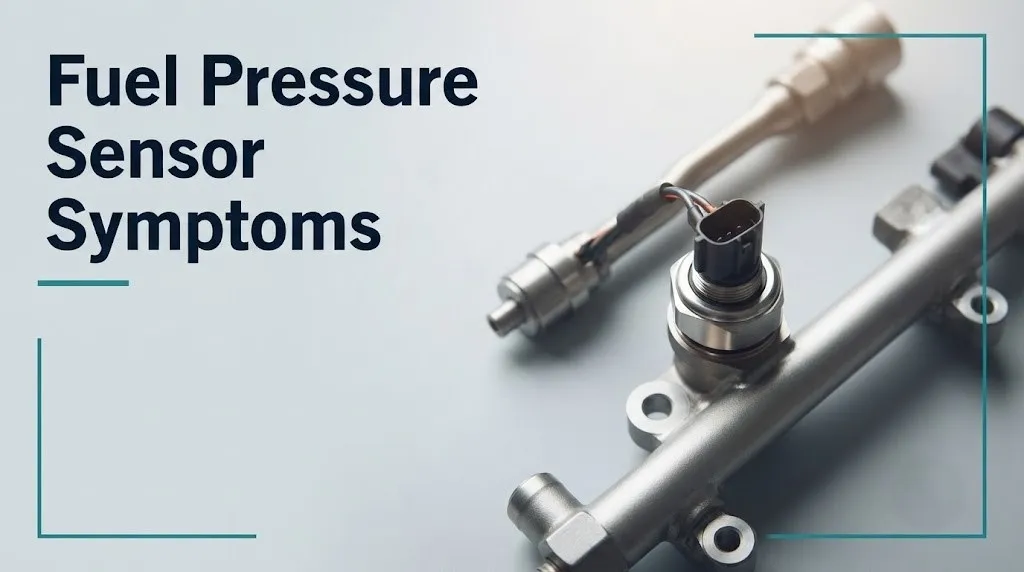
A fuel pressure sensor, also called a fuel rail pressure sensor, continuously measures the pressure of fuel inside the fuel rail and transmits that measurement to the ECU as a variable voltage signal, typically ranging from 0.5 volts at minimum pressure to 4.5 volts at maximum pressure.
The sensor itself is a piezoresistive device. Inside the sensor housing, a thin silicon diaphragm deflects in response to fuel pressure. That deflection changes the electrical resistance of a measurement circuit bonded to the diaphragm, which changes the output voltage proportionally. The ECU reads this voltage several hundred times per second during engine operation and uses the value to calculate injector pulse width (how long each injector stays open per firing cycle, measured in milliseconds).
The ECU references the fuel pressure sensor reading alongside data from the mass airflow (MAF) sensor, the manifold absolute pressure (MAP) sensor, the throttle position sensor (TPS), and the oxygen sensors to build a complete picture of how much fuel the engine needs. If the FRPS reading is off by even a few percent, the injector pulse width calculation shifts, and the air/fuel mixture deviates from the stoichiometric target of 14.7 parts air to 1 part fuel for gasoline engines.
The sensor connects to the ECU through a three-wire harness: one wire carries a 5-volt reference signal from the ECU, one carries the variable signal voltage back to the ECU, and one is the ground return. Corrosion, breaks, or shorts in any of these three wires can produce symptoms that exactly mimic internal sensor failure, which is why proper diagnosis requires testing the wiring circuit before condemning the sensor itself.
Bad Fuel Pressure Sensor Symptoms: The Complete List
A bad fuel pressure sensor produces a specific, recognizable pattern of symptoms tied directly to the ECU receiving inaccurate fuel pressure data.
Every symptom on this list traces back to one central problem: the ECU is making decisions based on a number that doesn’t reflect reality. The symptoms listed below represent the full clinical picture documented by ASE-certified technicians and described in technical service bulletins across major vehicle manufacturers.
Complete symptom list, ordered from most common to least common:
- Check engine light illuminated (present in virtually all cases of sensor fault)
- Rough or unstable idle at operating temperature
- Engine hesitation or stumbling during acceleration
- Hard starting, especially when the engine is cold
- Engine misfires (one or more cylinders firing incorrectly)
- Reduced power under load (noticeable when merging or climbing grades)
- Poor fuel economy (measurable drop, often 10 to 20 percent in documented cases)
- Engine stalling at idle or at low speed
- Engine stalling at highway speed (less common, but the most dangerous presentation)
- Black exhaust smoke (indicates persistent fuel-rich running condition)
- Difficulty restarting after a warm engine shut-off
- Long crank time before engine fires
- Surging idle speed (RPM hunting up and down)
- Fuel smell from exhaust (from unburned fuel in rich running condition)
- No-start condition (in complete sensor circuit failure)
Drivers over age 65 and those with limited mechanical experience may attribute early symptoms (rough idle, slightly harder starting) to general vehicle aging. This is a documented pattern: early FRPS symptoms are easily normalized, which delays diagnosis and allows progressive damage to the catalytic converter and oxygen sensors from prolonged rich running conditions.
Symptoms of a Bad Fuel Pressure Sensor You Shouldn’t Ignore
The symptoms of a bad fuel pressure sensor that carry the greatest diagnostic urgency are those that indicate the ECU has lost reliable fuel pressure data entirely, rather than receiving slightly inaccurate data.
Four symptoms in particular indicate a situation beyond routine performance degradation. First, an engine stall that occurs at highway speed and prevents immediate restart is not a minor inconvenience. It represents a complete loss of fuel delivery calculation, and it creates a genuine road safety hazard for the driver and surrounding traffic. Second, a no-start condition after a previously normal engine shut-off, when the battery is known to be good and the starter cranks normally, points strongly to a fuel system fault where the FRPS is a primary suspect. Third, sustained black exhaust smoke indicates the engine is running severely rich (too much fuel relative to air), which at sufficient duration begins destroying the catalytic converter by overwhelming its capacity to oxidize excess hydrocarbons. Catalytic converter replacement adds $1,000 to $3,000 or more to the total repair cost. Fourth, a fuel smell from the exhaust in combination with any of the other listed symptoms indicates unburned fuel is passing through the exhaust system, a condition that carries a fire risk if the catalytic converter reaches excessive temperature.
Quick Tip:
- If you smell fuel from the exhaust and the check engine light is on, do not continue driving. Shut the engine off and contact a tow service.
- A drop in fuel economy of more than 10 percent combined with rough idle is one of the earliest diagnostic patterns pointing to FRPS degradation.
- Older vehicles (pre-2010) are more likely to show wiring harness corrosion as the root cause rather than internal sensor failure.
Key Takeaway: Black exhaust smoke and highway stalling are the two symptoms that make a bad fuel pressure sensor a safety-critical problem rather than just a performance inconvenience.
Check Engine Light and Fuel Pressure Sensor Connection
A failing fuel pressure sensor almost always triggers the check engine light because the ECU detects that the sensor’s voltage output has moved outside the expected range or has become inconsistent with other sensor readings.
The OBD-II system monitors the fuel pressure sensor’s signal voltage continuously. When the voltage drops below approximately 0.2 volts or rises above approximately 4.8 volts, the ECU recognizes a circuit fault. When the voltage reads within the normal range but doesn’t match the expected pressure given the engine’s operating conditions (cross-checked against MAF, MAP, and injector duty cycle data), the ECU logs a range or performance fault. Both types of fault set a diagnostic trouble code and illuminate the malfunction indicator lamp (MIL), which is the check engine light.
According to OBD-II standards established by the EPA under 40 CFR Part 86, the check engine light must illuminate within two consecutive drive cycles when a fuel system fault is detected and confirmed. This means a check engine light related to a fuel pressure sensor fault will typically appear within one to two days of the fault becoming consistent, not immediately on the first occurrence.
A critical practical point: the check engine light appearing for a fuel pressure sensor fault does not mean the engine will stop running immediately. Many vehicles will continue to operate in a degraded mode using fallback fuel pressure values stored in the ECU’s programming. This fallback mode is what allows the engine to run despite bad sensor data. However, it also means the engine is running on estimated rather than measured pressure, and performance will be noticeably compromised.
| Check Engine Light Behavior | What It Suggests |
|---|---|
| Steady MIL, no performance change | Early sensor signal drift, ECU using fallback values |
| Steady MIL with rough idle | Confirmed sensor fault affecting fueling calculation |
| Flashing MIL with misfires | Active misfire causing potential catalytic converter damage |
| MIL on with stalling | Severe fuel delivery disruption, stop driving |
Vehicles equipped with a turbocharger may show a more aggressive check engine light response to fuel pressure sensor faults because turbocharged engines require higher and more precisely maintained fuel rail pressure than naturally aspirated engines. The tolerance for sensor error is narrower.
Rough Idle Caused by a Failing Fuel Pressure Sensor
A failing fuel pressure sensor causes rough idle by forcing the ECU to calculate injector pulse width based on inaccurate pressure data, resulting in some cylinders receiving too much fuel and others too little on a cycle-by-cycle basis.
The idle condition is particularly revealing because it’s when fuel delivery requirements are at their most precise and lowest. At idle, the engine may only need injector pulse widths of one to two milliseconds. A small percentage error in fuel pressure reading produces a relatively larger absolute error in delivered fuel mass at these short pulse widths than it does at the longer pulse widths used under load. This is why rough idle is one of the earliest symptoms of FRPS degradation: the sensor’s error matters most when margins are tightest.
According to the Bosch Automotive Handbook, a piezoresistive fuel pressure sensor operating at the correct temperature and pressure range maintains a linearity accuracy within 1 percent of full scale under normal operating conditions. When the sensor begins to drift due to internal diaphragm fatigue, contamination from fuel additives, or seal degradation, linearity error can reach 5 to 15 percent, which the ECU will partially compensate for through fuel trim adjustments. When sensor error exceeds the ECU’s fuel trim authority (typically plus or minus 25 percent), the compensation capacity is exhausted and rough idle becomes constant.
A rough idle caused by a bad FRPS typically varies with engine temperature. It’s often worse when the engine is cold (below operating temperature) because cold fuel is denser and behaves differently under pressure, which amplifies any measurement inaccuracy. Once the engine reaches full operating temperature, the idle may partially smooth as the ECU’s long-term fuel trim (LTFT) corrections partially compensate. This temperature-dependent pattern is a useful distinguishing feature: a rough idle that improves noticeably after 5 to 10 minutes of warm-up but never becomes fully smooth is a strong indicator of a sensor or fuel delivery problem rather than a spark plug or ignition coil fault.
Hard Start Symptoms of a Bad Fuel Pressure Sensor
A bad fuel pressure sensor causes hard starting because the ECU relies on the sensor’s initial startup reading to calculate the prime fuel pulse delivered before and during cranking, and an inaccurate reading means the engine receives either too little or too much fuel at the critical moment of ignition.
During cold starts, the ECU checks the fuel pressure sensor reading immediately after the ignition is switched on (before cranking). This pre-crank reading tells the ECU whether the fuel rail is pressurized and ready. If the sensor reports lower pressure than is actually present, the ECU may command an extended prime pulse or repeated short pulses, resulting in an over-rich start condition and a flooded-like symptom. If the sensor reports higher pressure than is actually present, the ECU may skip or shorten the prime pulse, leaving the engine starved for fuel at startup.
Hard starting caused by a faulty FRPS has two distinct presentations:
- Lean hard start: Engine cranks for three to five seconds or longer before firing. May fire briefly and then stall before catching properly. The engine feels like it has to “hunt” for fuel before it catches.
- Rich hard start: Engine fires quickly but runs rough for 15 to 30 seconds at startup. May produce a brief puff of black smoke from the exhaust on initial startup.
Drivers in cold climates often misattribute lean hard start symptoms to battery weakness or extreme cold, because cold temperatures both reduce battery cranking power and increase fuel delivery requirements simultaneously. If hard starting worsens after the battery has been tested and confirmed healthy, the fuel pressure sensor should be a priority diagnostic target. According to technical service bulletin data compiled across major manufacturers, fuel pressure sensor faults are among the top five causes of extended cranking time in vehicles with more than 80,000 miles on the odometer.
Engine Stalling From Fuel Pressure Sensor Failure
Engine stalling from a failing fuel pressure sensor occurs when the ECU receives a pressure reading so far outside the expected range that it can no longer calculate a viable injector pulse width, causing it to shut down fuel delivery or deliver insufficient fuel to sustain combustion.
This is the most dangerous symptom on the list. Stalling at a traffic light is an inconvenience. Stalling at 65 miles per hour on an interstate is a vehicle safety emergency.
The stall mechanism works in one of two ways. In the first, the sensor delivers a signal voltage that drops suddenly to near zero, which the ECU interprets as catastrophically low fuel pressure. The ECU may enter a protective shutdown mode, cutting fuel delivery to protect the engine from running lean at high speed. The engine dies. In the second scenario, the sensor delivers an erratically fluctuating signal. The ECU cannot stabilize its fuel calculation, the air/fuel mixture becomes inconsistent cylinder to cylinder, and the combined misfire load becomes sufficient to stall the engine.
Stall pattern and urgency level:
| Stall Pattern | Urgency Level | Recommended Action |
|---|---|---|
| Stalls at idle, restarts immediately | Moderate | Schedule repair within one week |
| Stalls at idle, takes 30 seconds or more to restart | High | Repair within 48 hours |
| Stalls under light acceleration | High | Do not drive on highways. Repair within 48 hours. |
| Stalls at highway speed | Emergency | Do not drive. Contact roadside assistance for a tow. |
| Stalls and will not restart | Emergency | Do not drive. Contact roadside assistance for a tow. |
Drivers who have already experienced one highway-speed stall should not continue driving the vehicle under any circumstances until the fuel pressure sensor and related wiring have been tested and confirmed. A second stall at highway speed, depending on traffic and road conditions, can result in a serious collision.
Key Takeaway: One stall at highway speed from a suspected fuel pressure sensor fault means the vehicle should be towed to a repair facility, not driven there.
High Reading vs. Low Reading: What Each Symptom Pattern Means
A failing fuel pressure sensor can fail in two electrically distinct directions: it can report pressure that is too low (low-signal failure) or pressure that is too high (high-signal failure), and each failure direction produces a different symptom pattern that experienced diagnosticians use to narrow the fault before testing begins.
Low-signal failure (sensor reports pressure lower than actual):
The ECU believes fuel pressure is insufficient. It responds by commanding the fuel pump to work harder (in returnless systems) and by enriching the fuel mixture to compensate for what it perceives as inadequate delivery pressure. The real-world result is an engine running rich. Symptoms include black exhaust smoke, poor fuel economy, a fuel smell from the exhaust, rough idle, and fouled spark plugs. OBD-II code P0087 (fuel rail/system pressure too low) is frequently associated with this failure pattern when the sensor is reporting low to the ECU, though P0087 can also indicate an actual low-pressure condition from the fuel pump.
High-signal failure (sensor reports pressure higher than actual):
The ECU believes pressure is too high and responds by shortening injector pulse widths to reduce fuel delivery. The real-world result is an engine running lean. Symptoms include hesitation during acceleration, lean misfires, rough idle, poor throttle response, and in severe cases, hard starting and stalling from fuel starvation. OBD-II code P0088 (fuel rail/system pressure too high) can accompany this pattern when the sensor signal is elevated.
| Failure Direction | ECU Response | Primary Symptoms | Associated OBD Code |
|---|---|---|---|
| Sensor reads low (under-reporting) | Enriches mixture, increases pump command | Black smoke, poor economy, fuel smell, rich misfires | P0087, P0192 |
| Sensor reads high (over-reporting) | Leans mixture, shortens injector pulse | Hesitation, lean misfire, hard start, stalling | P0088, P0193 |
| Intermittent signal | Fluctuating mixture, unstable fuel trim | Surging idle, intermittent stalling, inconsistent performance | P0191, P0194 |
| No signal (open circuit) | Defaults to fallback pressure value | Rough idle, reduced power, check engine light | P0190, P0193 |
Diesel vehicles with common rail injection systems are particularly vulnerable to high-signal failure patterns because common rail systems operate at pressures up to 2,000 bar (approximately 29,000 PSI), meaning a small sensor error translates to a massive absolute pressure miscalculation.
Fuel Rail Pressure Sensor Symptoms vs. Fuel Pump Failure
Fuel rail pressure sensor symptoms and fuel pump failure symptoms overlap substantially because both problems affect actual or reported fuel pressure at the rail, making them one of the most commonly confused diagnostic pairs in engine management diagnosis.
The overlap exists because a failing fuel pump produces genuinely low fuel rail pressure, while a failing FRPS reports false pressure to the ECU. The ECU’s response to both conditions can look identical from the driver’s seat.
Distinguishing the two:
The most reliable differentiating step is connecting a scan tool and reading live FRPS signal data while simultaneously measuring actual fuel rail pressure with a mechanical fuel pressure gauge installed at a fuel rail test port or Schrader valve.
- If the scan tool shows low fuel pressure and the mechanical gauge confirms low pressure: the fuel pump is the likely cause, not the sensor.
- If the scan tool shows low or erratic fuel pressure but the mechanical gauge shows normal or high pressure: the fuel pressure sensor is reporting false data, confirming sensor or wiring fault.
- If both the scan tool and the mechanical gauge show normal pressure but symptoms persist: the fault may be intermittent or the ECU is operating on stored fallback data.
Symptom comparison:
| Symptom | Fuel Pressure Sensor Fault | Fuel Pump Failure |
|---|---|---|
| Worse at high fuel demand (full throttle) | Possible | Consistently yes |
| Worse at idle | Often yes (low-pressure failure mode) | Sometimes |
| Associated with fuel pump noise change | No | Often yes (whining, grinding) |
| Mechanical gauge shows low pressure | No | Yes |
| Live scan data shows low pressure | Yes (false reading) | Yes (real reading) |
| Responds to fuel pressure regulator replacement | No | Sometimes |
| OBD code P019x present | Yes | Rarely |
Vehicles with high mileage (above 120,000 miles) are statistically more likely to have both a degraded fuel pump and a degraded fuel pressure sensor simultaneously, because both components age together in the fuel system. In these cases, replacing only the sensor without testing the pump may result in continued symptoms and a return visit.
Symptoms of a Bad Fuel Rail Pressure Sensor by Vehicle Type
The symptoms of a bad fuel rail pressure sensor vary meaningfully by vehicle fuel system design, and understanding which system your vehicle uses helps you interpret your symptom pattern more accurately.
Gasoline direct injection (GDI) engines:
GDI engines operate at fuel rail pressures between 500 and 2,500 PSI (35 to 175 bar) at the high-pressure pump, compared to 35 to 65 PSI in port-injected systems. The GDI system actually has two pressure sensors: a low-pressure sensor monitoring the low-pressure pump circuit and a high-pressure sensor on the high-pressure fuel rail. A failing high-pressure FRPS in a GDI engine produces more dramatic symptoms than in a port-injection vehicle, because the pressure margin being reported incorrectly is enormous. Symptoms in GDI vehicles often include severe hesitation at full throttle, cold-start misfires, and more aggressive check engine light behavior.
Port fuel injection (PFI) engines:
Port-injected engines operate at lower rail pressures (35 to 65 PSI). FRPS failure in PFI systems tends to produce more gradual symptom onset. Rough idle and slight fuel economy degradation often precede more dramatic symptoms by weeks.
Turbocharged gasoline engines:
Turbo engines require higher fuel pressure at high load to compensate for the increased air charge the turbocharger delivers. A failing FRPS in a turbocharged engine may show no symptoms at light throttle (when fuel demand is modest) but produce severe hesitation, misfire, or stall under boost conditions when the pressure reporting error becomes functionally catastrophic.
Diesel common rail engines:
Common rail diesel systems operate at pressures up to 30,000 PSI. A failing FRPS in a diesel system can produce symptoms including excessive black smoke, hard starting (especially cold starting), loss of power under load, and in severe cases, ECU-commanded limp mode that limits engine speed to protect the injection system from operating at unverified pressure levels.
OBD-II Codes and Diagnostic Symptoms for Fuel Pressure Sensor
The specific OBD-II diagnostic trouble codes associated with fuel pressure sensor failure allow a technician to pinpoint whether the fault is a circuit issue, a range issue, or an intermittent problem, each of which suggests a different diagnostic pathway.
According to the EPA’s OBD-II regulations governing all 1996-and-newer U.S. market vehicles, the powertrain control module must detect and report fuel pressure sensor faults within two drive cycles of the fault becoming consistent. The following codes are directly associated with FRPS faults:
| OBD-II Code | Description | Most Likely Cause |
|---|---|---|
| P0087 | Fuel rail/system pressure too low | Low actual pressure or sensor under-reporting |
| P0088 | Fuel rail/system pressure too high | Regulator fault or sensor over-reporting |
| P0190 | Fuel rail pressure sensor circuit malfunction | Open or shorted circuit in sensor wiring |
| P0191 | Fuel rail pressure sensor range/performance | Sensor reading inconsistent with other engine data |
| P0192 | Fuel rail pressure sensor circuit low input | Signal voltage below minimum threshold (near 0V) |
| P0193 | Fuel rail pressure sensor circuit high input | Signal voltage above maximum threshold (near 5V) |
| P0194 | Fuel rail pressure sensor circuit intermittent | Unstable signal, often wiring or connector issue |
P0190 and P0191 are the codes most commonly seen with internal sensor degradation where the sensor is still producing a signal but the signal no longer accurately reflects actual pressure. P0192 and P0193 are more commonly produced by wiring faults (open circuit, short to ground, short to voltage) than by internal sensor failure. P0194 strongly suggests a loose or corroded connector rather than sensor failure.
When reading live data with a scan tool, a healthy fuel pressure sensor at idle on a port-injected gasoline engine should report a stable reading between 35 and 65 PSI. Any reading that fluctuates by more than 5 PSI at stable idle, reads below 30 PSI, or reads above 75 PSI at idle warrants further investigation.
How to Test a Fuel Pressure Sensor
Testing a fuel pressure sensor correctly requires both an OBD-II scan tool capable of reading live data and a mechanical fuel pressure gauge, because scanner data alone cannot distinguish between a bad sensor and an actual fuel pressure problem.
The following sequence represents the standard diagnostic approach used by ASE-certified technicians:
- Retrieve stored OBD-II codes. Connect a scan tool to the OBD-II port (located under the driver’s side dashboard, standardized on all 1996-and-newer U.S. vehicles). Record all stored codes and freeze frame data. Note any P019x codes specifically.
- Read live FRPS data. With the engine running at idle, observe the fuel pressure sensor’s live data reading on the scan tool. Record the value at idle, at 2,000 RPM, and at 3,000 RPM.
- Install a mechanical fuel pressure gauge. Locate the fuel rail’s Schrader valve or test port. Install a calibrated mechanical fuel pressure gauge. Compare its reading to the scan tool’s live data reading at the same engine conditions.
- Check for signal voltage at the sensor connector. With the sensor connector disconnected and the ignition on (engine off), use a multimeter to verify 5 volts of reference voltage at the reference wire and confirmed ground continuity at the ground wire. If reference voltage is absent or ground is open, the wiring harness is the fault, not the sensor.
- Check the signal wire response. With the sensor reconnected and the ignition on, probe the signal wire and confirm it reads between 0.5 and 0.7 volts at zero engine pressure. Disconnect the sensor briefly: the signal voltage should jump toward the 5-volt reference if the circuit is intact. If it does not respond appropriately, confirm wiring continuity before replacing the sensor.
- Compare results. If the mechanical gauge and the scan tool live data agree and readings are within spec, the FRPS is reporting accurately and the fault is elsewhere. If the readings disagree significantly (more than 5 to 10 PSI), the sensor is misreporting.
Owners without access to a scan tool or mechanical pressure gauge should not attempt to diagnose this fault by symptoms alone. Take the vehicle to an ASE-certified automotive technician or ASE Master Technician, describe the specific symptoms and any codes already retrieved, and request a fuel pressure sensor circuit test rather than an immediate sensor replacement.
Key Takeaway: A scan tool alone is not sufficient to diagnose a fuel pressure sensor fault. Mechanical pressure gauge comparison is necessary to confirm whether the sensor is misreporting real pressure or whether the pressure itself is genuinely low.
Emergency Symptoms: When to Stop Driving Immediately
Certain fuel pressure sensor failure presentations create immediate vehicle safety risks. Do not continue driving if you experience any of the following.
Stop driving and contact roadside assistance or a tow service immediately if your vehicle:
- Stalls at highway speed and does not restart within 30 seconds of initial cranking. This presentation indicates a complete fuel delivery failure. A vehicle that stalls at speed and cannot restart has no safe path to a repair facility under its own power.
- Stalls repeatedly under acceleration, especially at higher speeds. Repeated stalling under load indicates the fuel system cannot sustain combustion under demand. This condition makes the vehicle unsafe for highway travel.
- Produces a strong, persistent fuel smell from the exhaust combined with rough running and a check engine light. This combination indicates a severe rich running condition that is overloading the catalytic converter. Continued driving risks catalytic converter fire.
- Shows a flashing check engine light (not steady, but flashing). A flashing check engine light in any OBD-II vehicle indicates an active misfire severe enough to damage the catalytic converter. This is a stop-immediately instruction from the vehicle’s own diagnostic system.
- Loses power suddenly under load without stalling. Sudden power loss under full throttle at highway speed can cause loss of vehicle control in traffic. This symptom warrants immediate safe lane change, deceleration, and roadside stop.
Call your roadside assistance service or a tow service. Do not drive a vehicle displaying these symptoms to a repair shop, even if the shop is nearby. These presentations indicate an active fuel system failure with a documented safety risk. An ASE-certified automotive technician or ASE Master Technician should evaluate the vehicle on a lift before it is driven again.
Fuel Pressure Sensor Replacement Cost and Repair Urgency 2026
Fuel pressure sensor replacement in 2026 costs between $150 and $400 at most independent repair shops and dealerships in the United States, with the sensor itself typically priced between $20 and $120 for OEM-equivalent or OEM parts, and labor accounting for the remaining cost.
Labor time for fuel pressure sensor replacement is typically 30 minutes to one hour on most modern vehicles, because the sensor is usually accessible at the fuel rail without major disassembly. On some GDI engines with a high-pressure fuel rail tucked beneath an intake manifold or within a complex engine bay, labor time may extend to two to three hours. Dealership rates in major U.S. metropolitan areas in 2026 typically range from $130 to $180 per hour, while independent shops average $85 to $130 per hour.
Repair urgency framework:
| Symptom Severity | Urgency Level | Recommended Timeline |
|---|---|---|
| Check engine light only, no performance symptoms | Low | Diagnose and repair within two to four weeks |
| Rough idle or mild performance decline with check engine light | Moderate | Diagnose and repair within one to two weeks |
| Hard start, reduced power, poor fuel economy | Moderate-High | Diagnose and repair within one week |
| Stalling at idle or low speed, recurring misfires | High | Repair within 48 hours. Limit driving to essential trips only. |
| Stalling at highway speed, no-start, flashing MIL | Emergency | Do not drive. Tow to repair facility immediately. |
One important caution on parts selection: aftermarket fuel pressure sensors from low-cost suppliers have a documented pattern of early failure, sometimes within 10,000 to 20,000 miles. OEM-quality sensors from the original manufacturer or from Tier 1 automotive suppliers (Bosch, Delphi, Denso, Continental) are consistently recommended over low-cost alternatives by ASE-certified technicians, even at a higher upfront cost. The labor cost of a repeat replacement within a short period often exceeds the price difference between an OEM-quality sensor and a low-cost part.
Frequently Asked Questions About Fuel Pressure Sensor Symptoms
What are the most common symptoms of a bad fuel pressure sensor?
The most common symptoms of a bad fuel pressure sensor are a check engine light, rough idle, engine hesitation during acceleration, hard starting, and reduced fuel economy.
These symptoms occur because the ECU receives an inaccurate fuel pressure reading and calculates incorrect injector pulse widths, resulting in a fuel mixture that deviates from the stoichiometric target of 14.7:1 for gasoline engines.
If you experience rough idle and a check engine light together, have the vehicle scanned for OBD-II codes in the P019x range before assuming the cause.
Can a bad fuel pressure sensor cause a no-start condition?
A bad fuel pressure sensor can cause a no-start condition when the sensor circuit fails completely, sending a signal the ECU interprets as a catastrophic pressure loss.
In this scenario, the ECU may default to a minimal or zero injector pulse width, delivering insufficient fuel for combustion to begin.
The vehicle will crank normally (the starter and battery are functioning), but the engine will not fire, which distinguishes this from a battery or starter fault.
How do I know if my fuel pressure sensor or my fuel pump is bad?
The most reliable way to distinguish a bad fuel pressure sensor from a failed fuel pump is to compare scan tool live data against a mechanical fuel pressure gauge reading simultaneously.
If the scan tool shows low pressure but a mechanical gauge installed at the fuel rail confirms normal pressure, the sensor is misreporting, confirming a sensor or wiring fault.
If both the scan tool and the mechanical gauge show genuinely low pressure, the fuel pump is the more likely cause.
What OBD-II codes are associated with a bad fuel pressure sensor?
The OBD-II codes directly associated with fuel pressure sensor faults are P0087, P0088, P0190, P0191, P0192, P0193, and P0194.
P0190 through P0194 are specifically sensor circuit codes, while P0087 and P0088 indicate pressure level faults that may or may not involve sensor error.
An ASE-certified automotive technician will use these codes alongside live data and a mechanical pressure test to determine whether the fault is inside the sensor, in the wiring harness, or in the fuel delivery system itself.
Is it safe to drive with a bad fuel pressure sensor?
Driving with a bad fuel pressure sensor is conditionally safe for short, low-speed trips when the only symptom is a check engine light with mild performance changes, but it is not safe when stalling, significant power loss, or a flashing check engine light is present.
A vehicle that has stalled at highway speed should not be driven again until the fuel pressure sensor and fuel delivery circuit have been tested and the fault confirmed and repaired.
Contact a tow service rather than attempting to drive a vehicle with active stalling symptoms to a repair facility.
How much does it cost to replace a fuel pressure sensor in 2026?
Fuel pressure sensor replacement costs between $150 and $400 at most repair shops in 2026, depending on the vehicle make and model, sensor part cost, and local labor rates.
The sensor part itself typically costs $20 to $120 for OEM-quality components, with labor adding $60 to $200 depending on accessibility and shop rate.
Choosing an OEM or Tier 1 supplier sensor (Bosch, Denso, Delphi, Continental) over a low-cost aftermarket part reduces the risk of early re-failure and repeat repair costs.
Closing
A bad fuel pressure sensor is not always obvious from the driver’s seat, but the pattern it leaves is recognizable: performance problems that are worse at idle than under load, a check engine light with codes in the P019x range, and a fuel economy drop that doesn’t correlate with any change in driving habits. Catching it early, before a catalytic converter is damaged or a highway stall occurs, is genuinely worth the cost of a scan tool reading and a fuel pressure gauge comparison.
The single most actionable step after recognizing these symptoms is to have an ASE-certified automotive technician perform a side-by-side mechanical pressure gauge and live scan data comparison. That test takes less than 30 minutes and definitively distinguishes a sensor fault from a fuel pump problem.
If you’ve already experienced one stall at highway speed, the decision is made for you. Arrange a tow, not a drive, to the nearest qualified repair facility.