2 Year Molar Symptoms: Full 2026 Guide and Red Flag Signs
2 year molar symptoms include gum swelling and tenderness, increased drooling, biting and chewing on objects, irritability, disrupted sleep, reduced appetite, and ear pulling, all produced by the eruption of the second primary molars through the back of the gingival mucosa between approximately 23 and 33 months of age. These are the largest and last of the baby teeth to emerge, and they produce more intense symptoms than earlier teeth because of their greater surface area pushing through a thicker section of gum tissue.
According to the American Academy of Pediatric Dentistry (AAPD), the second primary molars are the final teeth in the primary dentition sequence to erupt, completing the full set of 20 baby teeth. Because these molars are wider than any previously erupted tooth, the eruption process involves more extensive osteoclast-mediated alveolar bone resorption and a broader inflammatory response in the overlying gum tissue, which is exactly why parents consistently report that this teething phase is harder than earlier ones.
This article explains what’s actually happening biologically when those molars come in, why each symptom occurs at the anatomical and physiological level, how to distinguish normal teething discomfort from signs of illness, and which specific presentations warrant a call to your child’s primary care pediatrician or board-certified pediatric dentist.
2 Year Molar Symptoms: What Parents Need to Know
2 year molar symptoms are the behavioral and physical signs produced when the second primary molars push through the gingival mucosa at the back of a toddler’s upper and lower jaw, typically between 23 and 33 months of age, producing a predictable pattern of gum pain, drooling, irritability, and sleep disruption.
The second primary molars are not just another set of teeth arriving in sequence. They are the widest teeth in the primary dentition, with two cusps on the lower molars and three on the upper, and they require more bone resorption ahead of the erupting crown than any previously erupted baby tooth. That wider footprint means a broader area of gum compression and a correspondingly broader inflammatory response.
Here is the full symptom picture with the mechanism behind each:
| Symptom | Underlying Mechanism | Expected Duration |
|---|---|---|
| Gum swelling and redness | PGE2/IL-1β inflammatory cascade in mucoperiosteum | Weeks before through days after eruption |
| Increased drooling | Brainstem salivatory nuclei stimulated by V3 gingival pressure | Throughout active eruption phase |
| Biting and chewing objects | Counter-pressure on inflamed gum reduces PGE2 pain signal | Throughout active eruption phase |
| Irritability and fussiness | Pain sensitization lowering behavioral tolerance threshold | Weeks before through days after eruption |
| Night waking | PGE2-mediated pain sensitization disrupting sleep transitions | Peaks during active gum penetration |
| Reduced appetite | Gum pain amplified by chewing pressure and food contact | Variable; improves after eruption |
| Ear pulling | Referred pain through auriculotemporal branch of V3 | During peak gum inflammation |
| Mild temperature elevation (below 38.9°C / 102°F) | Systemic PGE2 from local gingival inflammation | Days around active eruption |
| Drool rash on chin/cheeks | Continuous skin contact with increased saliva | Throughout increased drooling phase |
According to the American Academy of Pediatrics (AAP), the symptoms of teething are limited to the local area of the erupting tooth and its immediate surroundings. Any symptom that seems disproportionate to the expected teething pattern, especially high fever, requires evaluation to rule out a coincidental illness.
Children with prior medical histories of difficult or delayed teething for their earlier teeth tend to have more noticeable second molar symptoms than those who teethed easily. Conversely, children who barely noticed their first molars or canines often have comparably mild second molar symptoms, suggesting individual variation in gingival inflammatory sensitivity plays a meaningful role.
What Are 2 Year Molars and When Do They Erupt
2 year molars are the second primary molars, the last of the 20 baby teeth to emerge, positioned at the very back of the upper and lower jaws behind the first primary molars that arrived at approximately 13 to 19 months of age.
In dental terminology, the second primary molars are identified as teeth A and I in the upper jaw and teeth K and T in the lower jaw under the Universal Numbering System. These four teeth erupt in pairs, typically the lower second molars slightly before the upper ones, though the sequence varies between individual children. The eruption timing range recognized by the American Dental Association (ADA) is 23 to 33 months for the lower second primary molars and 25 to 33 months for the upper second primary molars.
Think of the erupting second molar like a wide blunt wedge pressing upward through several millimeters of firm gum tissue. Unlike a narrow lateral incisor, which pushes through a relatively narrow window of gum, the second molar’s broad crown has to displace a much larger section of tissue to reach the surface. That larger displacement area is the direct anatomical reason why second molar teething typically produces more discomfort than incisor teething.
The second molars are positioned far enough back in the jaw that parents may not be able to see them easily when their child opens their mouth. A quick visual or fingertip check along the back gum ridge can confirm whether a swollen, red pad of gum tissue is present behind the first molar, which is the reliable early sign that the second molar is approaching the surface.
Children born prematurely should have their dental development assessed against their corrected age rather than their chronological age. A child born 10 weeks early may have their second primary molars emerge 10 to 12 weeks later than a full-term child of the same chronological age. If teeth have not appeared within the expected range when corrected age is accounted for, a board-certified pediatric dentist should assess eruption progress.
How 2 Year Molar Eruption Causes Symptoms
Every symptom of 2 year molar teething traces back to a specific biological event: the dental follicle surrounding the molar crown releasing inflammatory signaling molecules that drive osteoclast-mediated bone resorption ahead of the crown and prostaglandin E2 (PGE2) and interleukin-1 beta (IL-1β) production in the overlying mucoperiosteum as the crown compresses gum tissue from below.
The dental follicle is a sac of specialized cells surrounding the developing molar crown while it is still deep within the jaw. These cells produce RANKL (receptor activator of NF-kB ligand), a signaling molecule that activates osteoclasts (bone-resorbing cells) in the alveolar bone ahead of the erupting crown. Without this active bone resorption, the crown has nowhere to go. As the crown ascends through the resorbed bone pathway, it eventually contacts the mucoperiosteum, the combined mucosal and periosteal tissue that forms the gum surface.
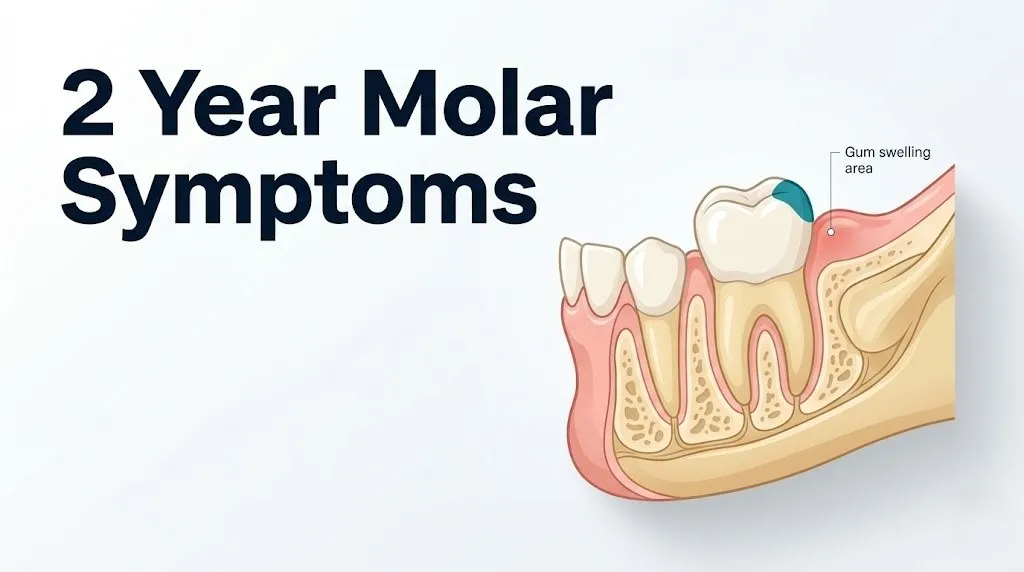
When the crown presses against the mucoperiosteum, tissue macrophages and fibroblasts in that compressed tissue release PGE2 and IL-1β. PGE2 is a prostaglandin, a lipid-derived signaling molecule produced by the COX-2 enzyme in activated cells. It does two things simultaneously: it sensitizes the nociceptors (pain receptors) in the gingival tissue, producing the characteristic gum tenderness and soreness; and it acts as an endogenous pyrogen by crossing the blood-brain barrier and stimulating the hypothalamus to slightly elevate the body’s temperature setpoint.
This is the biological reason that toddlers getting their 2 year molars may have a mildly elevated temperature during the days when the crown is actively penetrating the gum tissue. The PGE2 load from local gingival inflammation is real but limited. It is enough to raise the temperature slightly, typically to no more than 38.3°C (101°F). It is not enough to produce the high fevers associated with viral or bacterial infections, which involve systemic IL-6 and TNF-alpha surges from widespread immune activation.
Key Takeaway: Every 2 year molar symptom traces back to PGE2 and IL-1β release from compressed gum tissue as the wide molar crown pushes through. Understanding that root mechanism explains why the symptoms are predictable, time-limited, and localized.
Gum Swelling and Pain From 2 Year Molars
Gum swelling and tenderness at the back of the jaw are the most consistent and anatomically direct 2 year molar symptoms, produced when the broad crown of the second primary molar compresses the overlying mucoperiosteum, triggering a localized inflammatory response that makes the gum visibly red, puffy, and sensitive to touch.
Running a clean fingertip along the gum ridge behind your toddler’s first molar will often reveal a firm, raised, sometimes bluish-red pad of tissue. That puffiness is the mucoperiosteum being compressed from below and responding with histamine-mediated vascular dilation (widening of local blood vessels) and plasma protein extravasation (fluid leaking out of vessels into the tissue). The same mechanism produces the swollen, red gums seen in any inflammatory condition: increased blood flow and tissue fluid make the area look puffy and feel warm.
Some children develop a specific condition called an eruption cyst (also called an eruption hematoma): a blue or blue-purple fluid-filled swelling over the crown of the erupting molar. This looks alarming but is almost always benign. The cyst forms when blood and fluid collect between the erupting crown and the overlying gum flap. In the majority of cases, it resolves on its own as the crown breaks through the surface. A board-certified pediatric dentist should evaluate an eruption cyst that is expanding rapidly, is associated with fever or pus, or has not resolved within 2 weeks of the expected eruption date.
Gum pain from the second molars is typically worse than from earlier teeth not just because of the tooth’s size but because of the location. The back of the mouth has a denser network of nociceptive nerve fibers from the mandibular branch of the trigeminal nerve (V3) that innervates the posterior molar regions of both the upper and lower jaw.
Children with a history of iron deficiency anemia may experience more intense gum inflammation responses during teething because iron deficiency impairs normal immune regulatory function, allowing inflammatory cytokine cascades to run less efficiently controlled. Parents of toddlers with known iron deficiency who are entering the second molar phase should discuss symptom management with their child’s primary care pediatrician before the teething phase begins.
Drooling and Biting Symptoms of 2 Year Molars
Increased drooling and the urge to bite or chew on hard objects are characteristic 2 year molar symptoms produced by two distinct physiological pathways: excess saliva generation from brainstem salivatory nuclei stimulation, and a pain-modulating behavior in which counter-pressure on the inflamed gum temporarily reduces the intensity of the PGE2-mediated pain signal.
The drooling mechanism works through the peripheral nervous system. Pressure from the erupting crown on the gingival nociceptors sends afferent signals through the mandibular division of the trigeminal nerve (V3) to the brainstem’s superior and inferior salivatory nuclei. These nuclei, part of the parasympathetic autonomic nervous system, respond to oral sensory stimulation by increasing their output to the submandibular, sublingual, and parotid salivary glands, producing more saliva than usual. At age 2, toddlers’ swallowing is more developed than at 6 months, but the sudden volume increase in saliva production can still exceed their swallowing rate, particularly during periods of excitement, distraction, or sleep.
The excess drool that runs down the chin and cheeks can produce a drool rash (perioral contact dermatitis): red, rough, sometimes slightly raised skin around the mouth, chin, and cheeks from continuous moisture contact breaking down the skin’s lipid barrier. Gentle application of a fragrance-free barrier cream (zinc oxide-based, not prescribed) to the chin and cheeks can protect the skin during the peak drooling phase.
Biting and chewing on objects during second molar teething reflects a phenomenon well-recognized in pain neuroscience: counter-pressure (compression) on an inflamed sensory area partially activates the gate control mechanism in the dorsal horn of the spinal cord and brainstem, temporarily reducing the salience of the pain signal. Parents observe their toddlers biting teething rings, the sides of their crib, their own fingers, or soft toys. This is not destructive behavior. It is a physiologically rational response to gum discomfort.
2 Year Molar Symptoms and Sleep Disruption
Sleep disruption, including difficulty falling asleep, increased night waking, and shortened naps, is one of the most consistently reported and most practically challenging 2 year molar symptoms for parents, produced when PGE2-mediated pain sensitization lowers the arousal threshold during the lighter sleep stages that occur several times each night.
Toddler sleep architecture involves cycling through non-REM and REM sleep stages approximately every 45 to 60 minutes. During the transitions between sleep cycles, toddlers naturally pass through a lighter arousal state. In a toddler without gum pain, these arousal moments are brief and the child re-enters deep sleep without fully waking. In a toddler with active molar inflammation, the lowered pain threshold during these arousal transitions means the gum discomfort is enough to pull them into full wakefulness, producing the pattern parents recognize as “waking every hour.”
According to research cited by the American Academy of Pediatrics, teething-related sleep disruption typically peaks during the 3 to 5 days when the molar crown is actively penetrating the mucoperiosteum, which is the period of maximum tissue compression and PGE2 release. Sleep disruption that preceded full crown emergence by weeks and persists more than 2 weeks after the tooth visibly breaks through the gum warrants evaluation by the child’s primary care pediatrician to rule out other causes of sleep disruption in toddlers (obstructive sleep-disordered breathing, separation anxiety, developmental night waking unrelated to teething).
Maintaining consistent sleep routines during the 2 year molar phase is clinically important even when teething makes nights harder. Disrupting the established sleep schedule in response to teething (bringing the child into the parent’s bed every night, extending nap duration to compensate) can establish habitual patterns that persist beyond the teething period and are more difficult to resolve than the teething itself.
Children with pre-existing sleep difficulties before the second molar phase will likely experience more severe sleep disruption during teething than children with well-established sleep patterns, because their baseline arousal threshold is already lower. A board-certified pediatric sleep specialist consultation is appropriate if sleep disruption is severe and does not improve within 2 weeks of confirmed molar emergence.
Key Takeaway: Peak 2 year molar sleep disruption lasts approximately 3 to 5 days during active crown penetration through the gum. If waking persists for more than 2 weeks after the tooth is visibly through, another cause of the sleep disruption should be evaluated.
2 Year Molar Symptoms and Refusing to Eat
Refusal to eat during 2 year molar teething occurs because chewing pressure on food directly amplifies the PGE2-mediated pain signal in the compressed gingival tissue at the back of the jaw, making every bite of food that contacts the swollen molar region painful in a way that toddlers quickly learn to avoid.
The posterior molar region is where most chewing force is applied to food. Chewing activates the masseter muscle and medial pterygoid muscle, generating bite forces that compress both the food and the surrounding gum tissue. When the second molar site is acutely inflamed, even moderate chewing pressure is enough to sharply increase the pain signal, which children express by pushing food away, refusing to open their mouth, crying when offered food, or accepting only liquids.
This feeding refusal is self-limiting: it resolves when the crown fully breaks through the gum surface and compression pressure normalizes. However, it matters clinically because a toddler who refuses solid food for more than 24 hours, particularly if they are also refusing liquids, is at risk of dehydration, which in a child of this size and weight can develop more quickly than in an older child or adult.
Signs of adequate hydration in a toddler include: wet diapers at least every 6 to 8 hours, moist lips and mouth mucosa, and normal skin turgor (skin returns to normal immediately when gently pinched). A toddler who refuses both solids and liquids for more than 12 hours, who has significantly decreased wet diapers, or whose lips and mouth look dry should be evaluated by their primary care pediatrician the same day.
Soft, cold foods during the teething phase are clinically rational choices because cold temperatures temporarily vasoconstrict local blood vessels, reducing the vascular component of gum inflammation and temporarily blunting PGE2-mediated sensitization. Foods such as cold yogurt, chilled pureed fruit, or cold soft cheese apply minimal chewing pressure to the back molar area while providing caloric and nutritional intake during the days of peak discomfort.
Ear Pain and Ear Pulling During 2 Year Molar Teething
Ear pulling and apparent ear pain during 2 year molar teething occur because the auriculotemporal nerve, a branch of the mandibular division (V3) of the trigeminal nerve (cranial nerve V), carries sensory signals from both the posterior lower molar gum region and the external auditory canal and preauricular area, causing the brain to interpret molar pain as originating partly from the ear.
This is referred pain: pain felt in a location other than where the causing stimulus is located. It happens because two anatomically distinct areas share the same sensory nerve. The auriculotemporal nerve carries sensory input from the skin over the temporal region, the external auditory meatus (ear canal), the tympanic membrane (eardrum), and the preauricular skin, while its branches also supply the gingival tissue surrounding the posterior mandibular molars. When intense gingival inflammation from an erupting second molar activates V3 fibers in the molar region, the brain’s sensory cortex, which maps pain to body locations based on which nerve fibers are activated, interprets some of that signal as coming from the ear.
The practical result is a toddler who tugs at one or both ears repeatedly during the second molar phase without any ear infection. This ear-pulling is a reliable clinical feature of second molar teething rather than a sign of otitis media (middle ear infection) when it occurs in isolation without fever above 38.9°C (102°F), ear discharge, or marked changes in behavior beyond what the teething context would explain.
Distinguishing teething-related ear pulling from otitis media is covered in its own section below. The relevant point here is that ear pulling alone during the 23 to 33 month window does not constitute automatic evidence of an ear infection. It is a physiologically explainable symptom of second molar eruption through the trigeminal nerve’s referred pain architecture.
Toddlers with a personal history of recurrent otitis media (three or more ear infection episodes in 6 months, or four or more in one year, per AAP clinical guidelines) should be evaluated by their primary care pediatrician any time ear pulling is accompanied by fever or behavioral change beyond typical teething fussiness, given that their baseline ear infection risk is higher than average.
Fever During 2 Year Molar Teething
A mild temperature elevation below 38.3°C (101°F) during active 2 year molar teething is a physiologically explainable response to the localized prostaglandin E2 (PGE2) release from inflamed gingival tissue entering the systemic circulation and acting on the hypothalamic thermoregulatory center. True high fever above 38.9°C (102°F) is not caused by teething and indicates a coincidental illness requiring evaluation.
This distinction matters more than any other in the clinical picture of 2 year molar teething. The PGE2 produced by gingival inflammation during molar eruption is locally generated and modest in systemic quantity. It can produce a mild temperature elevation of perhaps 0.3 to 0.5 degrees Celsius above normal baseline. It cannot produce the pyrogenic load necessary for a temperature above 38.9°C, which requires systemic IL-6 and TNF-alpha activation from widespread immune activation (as occurs during viral or bacterial infection).
Multiple prospective studies have confirmed this clinical reality. A well-cited 2011 study published in Pediatrics (the official journal of the American Academy of Pediatrics) by Wake et al. followed children through their teething period with daily symptom tracking and thermometer readings. The study found statistically modest elevations in body temperature associated with teething, but temperatures consistently remained below the clinical threshold for fever (38.0°C). The researchers concluded that teething does not cause true fever and that high fever during the teething period indicates a coincidental illness.
The American Academy of Pediatrics states clearly that teething does not cause fever above 38.9°C (102°F) and that parents should not attribute high fever to teething without seeking evaluation. Any fever above 38.9°C in a toddler, regardless of whether they are currently teething, warrants a same-day call to the child’s primary care pediatrician.
Children with known inflammatory conditions (juvenile idiopathic arthritis, inflammatory bowel disease) or those on medications that affect fever responses may have atypical temperature patterns during teething that are harder to interpret, and their primary care pediatrician should be consulted for individualized guidance on fever thresholds during teething.
Key Takeaway: Teething cannot cause a fever above 38.9°C (102°F). A temperature that high during teething is a coincidental illness, not a teething symptom, and needs same-day pediatrician evaluation.
Diarrhea and Runny Nose During 2 Year Molar Teething
Diarrhea and runny nose are frequently reported alongside 2 year molar symptoms by parents, but the clinical evidence does not support teething as a direct physiological cause of either, and both should be evaluated as potential signs of coincidental illness rather than attributed to teething without further consideration.
The apparent association between teething and loose stools has a plausible indirect explanation: increased saliva production during teething means toddlers swallow more saliva than usual, and some researchers have proposed that this extra fluid volume reaching the intestinal tract could transiently soften stool consistency. Research cited in Pediatric Dentistry found that parents reported mild loose stools more frequently during teething periods, but the stools described were softer than normal rather than truly watery, frequent, or associated with vomiting. Genuine diarrhea (watery stools occurring 3 or more times in 24 hours) is not a recognized physiological consequence of tooth eruption and is more consistent with a gastrointestinal viral infection (rotavirus, norovirus) or dietary reaction.
Runny nose during teething is similarly more likely explained by coincident viral upper respiratory infection than by any direct teething mechanism. Toddlers aged 23 to 33 months are in a developmental period of heightened viral exposure, particularly if they attend daycare or have older siblings in school. A mild clear nasal discharge for one to two days with no other symptoms can coincide with teething without being caused by it, but persistent, colored, or thick nasal discharge suggests a distinct upper respiratory infection.
The practical guidance: if your toddler has loose stools or a runny nose during the second molar phase without any other symptoms, monitor closely but do not assume teething explains everything. If the diarrhea is watery and frequent, or the runny nose progresses to thick green or yellow discharge with fever, contact the child’s primary care pediatrician for evaluation rather than attributing the symptoms to the teeth.
How Long Do 2 Year Molar Symptoms Last
2 year molar symptoms last from several weeks before the crown breaks through the gum surface to several days after full emergence, with the peak intensity of symptoms occurring during the approximately 3 to 7 days when the crown is actively penetrating the mucoperiosteum.
The full eruption timeline unfolds in three phases. In the pre-emergence phase, which can begin 4 to 8 weeks before the molar becomes visible, the crown is approaching the mucoperiosteum from below and starting to compress it. Symptoms during this phase are often intermittent: a day of significant fussiness, then a day of relative calm, then another difficult day. Many parents find this phase confusing because the symptom pattern is inconsistent and no tooth is yet visible.
During the active penetration phase (approximately 3 to 7 days), the crown breaks through the mucoperiosteum and a visible ridge or bump of white or pearl-colored tooth appears at the back gum. Symptoms during this phase are most intense: gum pain is at its peak, sleep disruption is most frequent, feeding refusal is most pronounced, and any temperature elevation is most likely to occur now.
During the post-emergence phase (several days to 2 weeks after the crown tip appears), the tooth continues to rise to its full height in the dental arch. Symptoms diminish progressively as compression on the mucoperiosteum resolves and PGE2 production decreases.
| Phase | Duration | Symptom Intensity | Action Needed |
|---|---|---|---|
| Pre-emergence (intermittent symptoms) | 4 to 8 weeks | Mild to moderate, variable | Home management; confirm teething source |
| Active penetration (peak symptoms) | 3 to 7 days | Moderate to severe | Home management; monitor temperature |
| Post-emergence (resolving symptoms) | Several days to 2 weeks | Mild, progressively improving | Resume normal routine; monitor for continued teeth |
The full second molar eruption sequence includes all four second molars (two upper, two lower), and they rarely all erupt simultaneously. The total duration of the second molar teething period across all four teeth can span several months, though any individual tooth’s symptom window is much shorter.
Children who appear to have no symptom-free intervals across a several-month period during this developmental window may have another reason for persistent irritability, sleep disruption, or behavioral change, and their primary care pediatrician should be involved in reviewing the clinical picture.
2 Year Molars vs Ear Infection: How to Tell the Difference
Distinguishing 2 year molar teething from an ear infection (otitis media) requires comparing the specific symptom combinations, temperature levels, and behavioral patterns, because both can produce ear pulling and fussiness in a toddler of this age, but an ear infection produces a distinct clinical picture that teething does not.
Here is a structured comparison of the two presentations:
| Feature | 2 Year Molar Teething | Acute Otitis Media (Ear Infection) |
|---|---|---|
| Ear pulling | Yes, typically bilateral | Yes, often unilateral (one ear) |
| Fever | Below 38.3°C (101°F) if present | Often 38.3°C to 39.4°C (101°F to 103°F) or higher |
| Gum redness and swelling at back of jaw | Yes, visible | Not present |
| Discharge from ear canal | Not present | May be present if tympanic membrane perforates |
| Pain worse when lying flat | Not typical | Yes; Eustachian tube drainage worsens lying down |
| Response to cold or counter-pressure on jaw | Often temporarily improves | Does not improve with jaw counter-pressure |
| Disrupted sleep | Yes, from pain sensitization | Yes, typically more severe and prolonged |
| Associated symptoms | Drooling, biting, drool rash | Runny nose preceding or concurrent, may vomit |
| Duration without treatment | Self-limiting with tooth emergence | Does not self-resolve without appropriate treatment |
The single most clinically useful distinguishing feature is the fever level. A child who is pulling at their ear with a temperature above 38.9°C (102°F), who has no visible gum swelling at the back of the jaw, and who recently had a runny nose or upper respiratory infection is far more likely to have otitis media than a teething reaction.
The only way to definitively confirm or rule out otitis media is a physical examination of the tympanic membrane through a pneumatic otoscope by a primary care pediatrician or pediatric emergency medicine physician. A parent cannot rule out otitis media at home, and it should not be assumed to be absent in a toddler with significant ear-directed behavior and fever. Any toddler with ear pulling plus fever above 38.9°C (102°F) should be evaluated by their primary care pediatrician the same day.
How to Soothe 2 Year Molar Pain
Soothing 2 year molar pain involves approaches that either reduce the PGE2-mediated gingival inflammation directly, temporarily blunt pain signal transmission through counter-pressure or cold temperature, or provide appropriate systemic pain relief through pediatrician-directed analgesic use.
Evidence-supported and safe approaches for 2 year molar symptom relief:
- Cold teething rings (chilled, not frozen): Cold temperatures cause vasoconstriction in the gingival blood vessels, temporarily reducing the vascular component of inflammation and numbing local nociceptors. Frozen teething rings are too hard and can injure soft gum tissue and developing teeth. Refrigerated rings (not frozen) are clinically appropriate.
- Chilled soft foods: Cold yogurt, chilled applesauce, or cold silicone feeder pouches with frozen pureed fruit provide nutritional intake while delivering the same temperature-based pain relief. These are preferable to teething biscuits during active gum inflammation because biscuits require posterior chewing.
- Gentle gum massage: Using a clean finger or a clean silicone finger-brush to apply firm, gentle counter-pressure to the swollen gum area temporarily activates the gate control mechanism in sensory processing, reducing pain signal intensity. This is the physiological basis for the same relief that biting a teething ring provides.
- Age-appropriate oral analgesics (pediatrician-directed): Acetaminophen is appropriate for children over 6 months at weight-appropriate doses per the pediatrician’s guidance. Ibuprofen is appropriate for children over 6 months at weight-appropriate doses per the pediatrician’s guidance and has the advantage of COX-2 inhibition, which directly reduces PGE2 production rather than simply masking pain perception. Both should be used at the minimum effective dose and only when symptoms are clearly interfering with sleep or eating, per AAP guidance.
Do not use: benzocaine-containing topical teething gels (products such as Orajel Baby and similar). The U.S. Food and Drug Administration (FDA) issued a safety warning advising against the use of benzocaine-containing oral products in children under 2 years of age due to the risk of methemoglobinemia, a rare but life-threatening condition in which benzocaine’s metabolites reduce the blood’s oxygen-carrying capacity. Call Poison Control at 1-800-222-1222 immediately if a child under 2 has ingested or been exposed to a significant amount of benzocaine-containing teething gel.
Children with glucose-6-phosphate dehydrogenase (G6PD) deficiency, an inherited red blood cell enzyme deficiency more prevalent in children of African, Mediterranean, Middle Eastern, and Southeast Asian ancestry, are at elevated risk of methemoglobinemia from benzocaine exposure and should absolutely never receive benzocaine-containing products.
Key Takeaway: The FDA advises against benzocaine-containing teething gels for children under 2 due to methemoglobinemia risk. Cold teething rings and pediatrician-directed acetaminophen or ibuprofen are the safe alternatives for 2 year molar pain.
When to Call the Pediatrician or Pediatric Dentist
When to call the pediatrician during 2 year molar teething: any fever above 38.9°C (102°F), refusal of both solids and liquids for more than 12 hours, any ear discharge, rash extending beyond the chin or cheeks, or behavioral changes that seem disproportionate to or inconsistent with the expected teething pattern.
Here is a structured guide to the appropriate level of response for each clinical scenario:
| Symptom | Response | Provider |
|---|---|---|
| Mild gum redness, fussiness, drooling | Home management | None needed |
| Mild temperature elevation below 38.3°C (101°F) | Monitor; home comfort measures | None immediately; call if rising |
| Fever 38.3°C to 38.9°C (101°F to 102°F) | Call pediatrician within the day to discuss | Primary care pediatrician |
| Fever above 38.9°C (102°F) | Same-day evaluation | Primary care pediatrician |
| Refusal of liquids for more than 12 hours | Same-day evaluation | Primary care pediatrician |
| Ear discharge | Same-day evaluation | Primary care pediatrician |
| Rash spreading to neck, trunk, or limbs | Same-day evaluation | Primary care pediatrician |
| Blue-purple gum swelling (eruption cyst) expanding | Within 1 to 2 days evaluation | Board-certified pediatric dentist |
| No second molars visible by 36 months | Scheduled evaluation | Board-certified pediatric dentist |
| Symptoms persisting more than 2 weeks after tooth visible | Scheduled evaluation | Primary care pediatrician |
When to call the pediatric dentist specifically during the second molar phase: second molars not appearing by 36 months of age (which may indicate delayed eruption, impaction, or another developmental concern), an eruption cyst that is enlarging rather than stabilizing or shrinking, visible tooth decay on any primary teeth visible in the mouth at the time of teething, or any concern about the position or spacing of the erupting second molars.
The American Academy of Pediatric Dentistry (AAPD) recommends that all children have their first dental visit by age 1 and see a board-certified pediatric dentist every 6 months from that point forward. A child reaching the second molar phase without an established dental home is overdue for a first dental visit, and the second molar teething period is a reasonable clinical prompt to establish that care.
Red Flags During 2 Year Molar Teething
Certain presentations during 2 year molar teething require immediate medical evaluation and should not be attributed to teething without professional assessment. Do not wait to see if these resolve on their own.
Contact your child’s primary care pediatrician immediately or go to the nearest emergency room if your toddler shows:
- Fever above 40°C (104°F): This level of fever in a toddler requires same-day emergency evaluation regardless of teething status. It indicates a serious illness and not a teething response.
- Difficulty breathing, swollen tongue, or hives following application of any teething product: These signs indicate a possible allergic reaction. Call 911 immediately.
- Signs of dehydration: Dry mouth and lips, no wet diaper for more than 8 hours, no tears when crying, sunken eyes, or lethargy. Dehydration in toddlers progresses rapidly and requires same-day evaluation.
- Ear discharge (fluid draining from the ear canal): This indicates possible tympanic membrane perforation from otitis media, which requires same-day evaluation and treatment, not home monitoring.
- Rash spreading beyond the face and chin: Widespread rash with fever during what you believe is a teething phase can indicate viral infections including roseola, hand-foot-and-mouth disease, or other illness. Requires same-day pediatrician evaluation.
- Marked limpness, extreme lethargy, or inconsolable crying lasting more than 3 hours: These behavioral presentations in a toddler indicate illness beyond teething discomfort.
- Any ingestion of benzocaine-containing teething gel: Call Poison Control at 1-800-222-1222 immediately. Do not wait for symptoms.
These presentations in a toddler during what appears to be a teething phase require pediatric evaluation by a primary care pediatrician or pediatric emergency medicine physician, not continued home management.
Frequently Asked Questions About 2 Year Molar Symptoms
What are the first signs of 2 year molars coming in?
The first signs of 2 year molars coming in are typically increased drooling, fussiness, and biting or chewing on objects in the weeks before the tooth becomes visible, as the approaching crown begins compressing the mucoperiosteum from below.
Running a clean finger along the back gum ridge behind the first molar will often reveal a firm, slightly swollen, reddish pad of gum tissue that is tender to the touch, which is the reliable early physical sign of an erupting second primary molar.
The intermittent nature of early symptoms, good days followed by bad days, is characteristic of the pre-emergence phase and distinguishes it from the more consistent peak symptoms of active gum penetration.
Can 2 year molars cause a fever?
A mild temperature elevation below 38.3°C (101°F) can occur during 2 year molar teething from the systemic effects of prostaglandin E2 released locally during gingival inflammation.
True fever above 38.9°C (102°F) is not caused by teething, according to the American Academy of Pediatrics and a 2011 prospective study published in Pediatrics, and indicates a coincidental illness rather than a teething response.
Any fever above 38.9°C (102°F) in a toddler, even during a confirmed teething phase, warrants a same-day call to the child’s primary care pediatrician.
How long do 2 year molar symptoms last?
The most intense 2 year molar symptoms, particularly sleep disruption, gum pain, and feeding refusal, peak during the 3 to 7 days when the crown is actively breaking through the gum surface.
Milder intermittent symptoms can begin 4 to 8 weeks before the tooth becomes visible and continue for several days to 2 weeks after the crown tip first appears at the gum surface.
Because all four second primary molars (two upper, two lower) rarely erupt simultaneously, the overall second molar teething period can span several months, though each individual tooth’s peak symptom window is much shorter.
Why is my 2 year old pulling at their ear during teething?
Ear pulling during 2 year molar teething is caused by referred pain through the auriculotemporal nerve, a branch of the mandibular division of the trigeminal nerve (V3), which carries sensory signals from both the posterior lower molar region and the external ear canal.
When intense gingival inflammation from an erupting second molar activates the V3 nerve fibers in the molar region, the brain interprets some of that pain signal as originating from the ear, producing the sensation that leads toddlers to pull at their ears.
Ear pulling without fever above 38.9°C (102°F), without ear discharge, and with visible gum swelling at the back of the jaw is most consistent with referred molar teething pain rather than an ear infection.
How do I know if my toddler has an ear infection or is just teething?
The most clinically reliable distinguishing features are fever level and ear discharge: teething does not cause fever above 38.9°C (102°F) or any discharge from the ear canal, while otitis media often does.
A toddler pulling at one ear (more than both ears equally) with fever above 38.9°C (102°F) and a recent history of runny nose is far more likely to have an ear infection than a teething reaction.
Only a physical examination of the tympanic membrane by a primary care pediatrician using a pneumatic otoscope can definitively confirm or rule out otitis media, and this evaluation should not be deferred if the child has fever above 38.9°C (102°F) regardless of active teething.
What helps with 2 year molar pain at night?
The most evidence-supported approach for nighttime 2 year molar pain is a dose of acetaminophen or ibuprofen (at pediatrician-recommended weight-based dosing) given approximately 30 minutes before the child’s bedtime during the 3 to 7 days of peak gum penetration symptoms.
A chilled (not frozen) teething ring offered before bed provides temporary PGE2-blunting cold vasoconstriction in the gingival tissue, which may reduce the pain signal enough to help the child fall asleep more easily.
Maintaining the established bedtime routine as consistently as possible during the teething phase reduces the risk of sleep pattern disruption persisting beyond the teething period itself.
Moving Forward With Confidence
The 2 year molar phase is genuinely harder than most earlier teething stages, and the reason is specific: these are the widest teeth in the primary dentition pushing through the thickest gum tissue your child has had to accommodate. The symptoms are predictable, the mechanism is understood, and the peak discomfort is time-limited to approximately 3 to 7 days per tooth.
The most practical things you can do right now are to confirm the source (a fingertip check of the back gum ridge), provide cold comfort measures during the day, consider pediatrician-guided analgesics for the nights of peak pain, and take temperature twice daily during the active phase so you have a clear number if you need to call your doctor.
If your toddler’s temperature rises above 38.9°C (102°F) at any point during this phase, treat it as a potential illness requiring same-day pediatrician contact, not as a teething symptom. That one data point is what separates a teething week from an illness that needs treatment.