Bad CV Axle Symptoms: Complete 2026 Warning Signs Guide
Bad CV axle symptoms include clicking or popping noises when turning, vibration during acceleration, grease splattered on the inside of the wheel, and increasingly rough or unpredictable steering feel. These symptoms follow a predictable mechanical progression that starts with a cracked rubber boot and ends, without repair, in complete axle failure.
According to the National Highway Traffic Safety Administration (NHTSA), drivetrain component failures including axle and CV joint failures are among the documented mechanical causes of loss-of-vehicle-control incidents on public roads. That makes early recognition of bad CV axle symptoms a genuine safety matter, not just a repair budget consideration.
This article covers every symptom pattern associated with CV axle and CV joint failure, explains the specific mechanical reason each symptom occurs, distinguishes between inner and outer joint failure presentations, and gives you a clear, direct framework for deciding whether your vehicle is safe to drive today.
Bad CV Axle Symptoms: The Short Answer
Bad CV axle symptoms are: clicking or popping noises during turns, vibration or shaking during acceleration, grease on the inner edge of the tire or wheel, clunking when shifting from drive to reverse, and visible cracks or tears in the rubber CV boot.
These are not subtle sensations that require a trained ear. By the time a CV joint has deteriorated enough to produce consistent noise or vibration, the damage is real and progressing. The symptoms tend to be most obvious under specific driving conditions: slow turns, hard acceleration from a stop, or highway cruising at 65 to 75 mph.
Understanding which symptom appears under which condition tells you whether the inner joint, the outer joint, or both are involved. That distinction matters for diagnosis and for determining how urgently the vehicle needs professional attention.
Here is a quick-reference overview of the primary symptoms and the conditions that produce each one:
| Symptom | When It Occurs | Which Joint Is Likely Involved |
|---|---|---|
| Clicking or popping | During slow turns with acceleration | Outer CV joint (Rzeppa type) |
| Clunking when accelerating | From a stop or during hard acceleration | Inner CV joint (tripod type) |
| Vibration under acceleration | 30 to 65 mph, worsens with speed | Inner or outer joint, advanced wear |
| Vibration at highway speed | Constant at 60 to 75 mph | Inner joint or unbalanced shaft |
| Grease on inner wheel rim | Visible as dark splatter on wheel | CV boot failure, either joint |
| Turning resistance or pulling | During full-lock or near-full-lock turns | Outer joint, advanced failure |
Drivers of high-mileage front-wheel-drive vehicles are the most commonly affected group. Consumer Reports reliability data shows CV axle issues are disproportionately frequent in front-wheel-drive vehicles with more than 100,000 miles, particularly those driven in northern climates where road salt accelerates rubber boot degradation.
What Is a CV Axle and How Does It Work
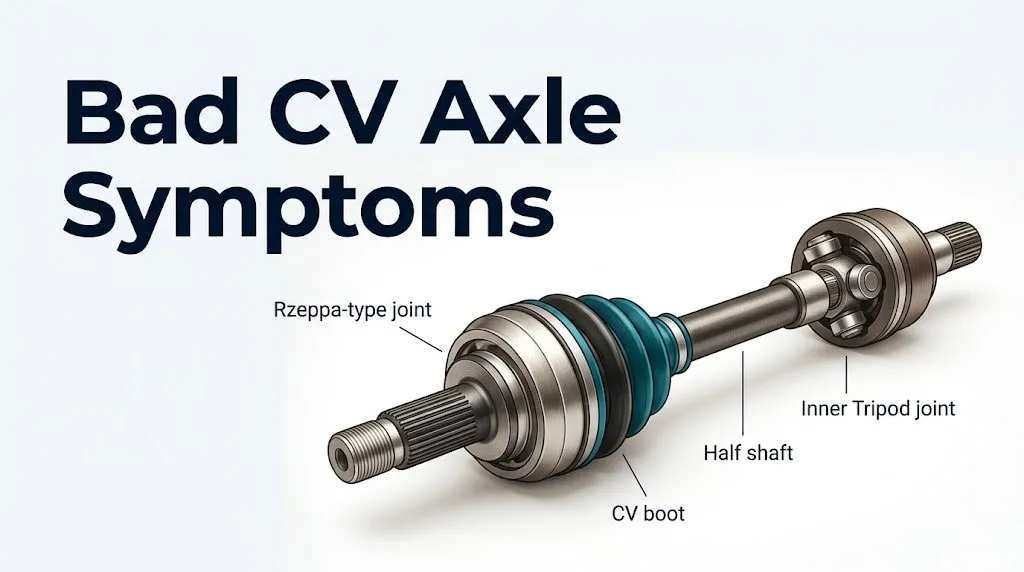
A CV axle (constant velocity axle) is the half-shaft assembly that transfers rotational power from the transmission output shaft to the wheel hub, maintaining a constant rotational speed regardless of the steering angle or suspension position.
Think of the CV axle like a telescoping arm at a factory robot. The arm has to deliver the same rotational force to a moving target (the wheel) that is simultaneously turning side to side and bouncing up and down. A rigid shaft could not do this without shuddering violently every time the wheel changed angle. The CV joint solves that problem with a cleverly engineered ball-bearing assembly that lets the shaft transmit torque through angles of up to 50 degrees without interruption.
Each complete CV axle assembly contains two CV joints: one at each end of the half shaft. The outer CV joint connects the shaft to the wheel hub at the steering knuckle side. The inner CV joint connects the shaft to the transmission output shaft or differential. Both joints are packed with molybdenum disulfide-based grease and sealed inside a flexible rubber or thermoplastic elastomer CV boot held in place by metal boot clamps.
The boot is the most vulnerable component in the assembly. Road debris, temperature cycling, and age cause the rubber to crack or tear. When the boot fails, grease escapes and road contamination enters the joint. Metal-on-metal contact without lubrication is what drives every downstream symptom on this list.
Front-wheel-drive vehicles have two CV axle assemblies (one per driven front wheel). All-wheel-drive vehicles have four (one per wheel). Rear-wheel-drive vehicles with independent rear suspension also have rear CV axles, though these experience lower articulation angles during normal driving and tend to last longer.
Symptoms of a Bad CV Axle: The Full Picture
The symptoms of a bad CV axle follow a consistent mechanical sequence that progresses from early and subtle to advanced and dangerous if the joint is not repaired.
Early symptoms are often noise-only: a faint click during a tight turn that the driver might initially dismiss as road noise or a loose trim panel. This is the stage where repair costs the least and the repair window is widest. Most drivers do not recognize the symptom at this stage.
Intermediate symptoms add vibration to the noise. The joint now has enough bearing clearance (measurable looseness inside the ball cage) that it cannot transmit torque smoothly. Vibration during acceleration, particularly between 30 and 50 mph, is the clearest intermediate-stage marker. This stage still allows normal low-speed driving to a mechanic, but highway speeds are no longer advisable.
Advanced symptoms include persistent grinding, visible grease contamination of the wheel, and a steering pull or hesitation under load. At this stage, the joint’s ball bearings and races are significantly worn, and complete joint seizure or structural fracture is possible within weeks to months of consistent driving.
Full-failure symptoms are sudden. A loud bang, immediate loss of power delivery to the affected wheel, and a sudden change in steering feel or vehicle tracking can indicate that the joint has fractured or the axle shaft has separated. This is a driving emergency.
| Progression Stage | Symptoms | Safe to Drive? |
|---|---|---|
| Early | Faint clicking on tight turns only | Yes, but book inspection within 1 week |
| Intermediate | Clicking on any turn, mild vibration | Low-speed local driving only; no highway |
| Advanced | Grinding, visible grease, persistent vibration | No. Mechanic same day |
| Full failure | Bang, loss of power, handling change | Pull over immediately. Do not drive |
Older drivers and those who drive infrequently may not notice early clicking because they take fewer tight turns at low speeds, which is the exact driving condition that makes early outer joint symptoms audible. Younger, urban drivers who navigate parking garages and tight intersections daily tend to catch the symptom earlier.
Key Takeaway: CV axle failure follows a four-stage progression from faint clicking to complete joint separation. Catching it at stage one or two keeps repair costs low and keeps you safely on the road. Reaching stage four without repair can cause sudden loss of vehicle control.
Clicking Noise When Turning: What It Means
A clicking or popping noise that appears specifically during turns at low speed is the most recognized symptom of a bad CV axle, and it points directly to the outer CV joint of the affected axle.
The outer CV joint is a Rzeppa-type joint, named for its inventor Alfred Rzeppa. It uses a set of six steel ball bearings seated in a spherical cage and two matching grooved races (an inner race and an outer race). During straight-line driving, the articulation angle through the joint is minimal and the balls roll smoothly in their grooves. During a turn, the articulation angle increases proportionally to how sharp the turn is. At full steering lock (parallel parking, tight U-turns), the articulation angle can reach 45 to 50 degrees.
When the joint’s grease has been expelled through a torn boot and the bearing surfaces have worn, the balls develop measurable clearance within their grooves. At high articulation angles, that clearance allows the balls to impact the cage and race edges with each rotation of the shaft. One click per rotation of the joint equals roughly one click per foot of travel during a slow, sharp turn. The result is the characteristic rhythmic popping sound that drivers describe as “a clicking that gets faster as I speed up in a turn.”
The louder and more frequent the clicking, the more worn the joint. A faint click only during maximum steering lock suggests early wear. A click that appears even during moderate turns (changing lanes, gradual highway curves) suggests advanced outer joint wear.
To identify which side is affected:
- Drive slowly in a large, empty parking lot.
- Turn the steering wheel fully to the right and complete a slow circle.
- Listen for clicking. Note which side of the vehicle the noise originates from.
- Repeat the circle turning fully to the left.
- The clicking will be louder or exclusive to the turn that places the failed joint under maximum articulation load. If it clicks louder during a right turn, the left outer CV joint is typically the failed component. If it clicks louder during a left turn, the right outer joint is more likely.
This test works best on dry pavement at 5 to 10 mph. Drivers with hearing impairment may ask a passenger to listen from the passenger seat. Vehicles with active noise cancellation or heavy sound insulation (many newer luxury sedans and electric vehicles) may muffle the click to the point where it is only detectable from outside the vehicle.
Car Vibration and Shaking From a Bad CV Joint
Vibration during acceleration is the signature symptom of an inner CV joint that has passed its early-failure stage, though advanced outer joint wear can also contribute.
The inner CV joint is typically a tripod-type joint (also called a tulip or tri-pot joint). It uses three roller bearings mounted on a spider-shaped yoke that slides within a tulip-shaped housing. This design allows both rotational torque transfer and axial movement (the in-and-out telescoping that accommodates suspension travel). When the tripod joint’s needle bearings and yoke wear, the joint can no longer absorb axial load smoothly. The result is a periodic stick-slip motion as the joint rotates under load, which the driver experiences as vibration.
The vibration typically appears at speeds between 30 and 65 mph during active acceleration. It may improve slightly at steady cruise speed when the drivetrain is under lighter load. It worsens during uphill driving, towing, or any condition that increases torque demand.
According to SAE International drivetrain failure analysis literature, vibration amplitude from a failing inner CV joint tends to correlate with torque load rather than vehicle speed alone. This means a driver pulling a loaded trailer will feel the vibration at lower speeds than the same driver on a flat, unloaded highway run.
The vibration from a bad CV joint needs to be distinguished from other common causes of vehicle vibration. Tire imbalance produces vibration at specific speed ranges (typically around 65 to 70 mph) that improves sharply above or below that speed. Wheel bearing failure produces a droning or humming vibration that correlates primarily with vehicle speed and may change with lane changes. CV joint vibration is most pronounced under acceleration and may partially resolve at constant cruise speed.
Quick Tip:
- If vibration appears only during acceleration and disappears at steady cruise speed, suspect an inner CV joint first.
- If vibration is constant regardless of acceleration and correlates with speed, suspect wheel bearing or tire imbalance.
- Drivers of all-wheel-drive vehicles with more than 80,000 miles should note that AWD systems can mask CV joint vibration symptoms because torque is distributed across four axles rather than two, reducing the vibration amplitude from any single failing joint.
Grease on the Inside of Your Wheel: CV Boot Failure Explained
Finding dark, greasy splatter on the inner edge of a tire or wheel rim is a direct indicator of CV boot failure, and it is the most visually obvious sign that the underlying CV joint is at risk of imminent damage.
The CV boot is a pleated rubber or thermoplastic elastomer sleeve, roughly four to six inches long, that seals the CV joint housing. It is held in place at both ends by metal boot clamps. Its only job is to keep the molybdenum disulfide-based grease inside the joint and keep road contamination out. That grease is not just a lubricant: it is the only thing preventing metal-to-metal contact between the ball bearings and their races during the tens of millions of rotations the joint completes across the axle’s service life.
When the boot cracks, tears, or loses a clamp, centrifugal force throws grease outward with every rotation of the axle. It lands on the inner wheel rim, the inner wheel well, and the inside face of the tire. Fresh CV grease is typically dark grey or black and has a thick, greasy consistency. Seeing this splatter pattern means the boot has already failed and grease loss has already begun.
The critical clinical question is how long the boot has been torn. A boot that failed recently may have lost only a small amount of grease. A boot that has been torn for months may have expelled most of the joint’s grease, leaving the bearing surfaces running dry.
To perform a basic visual inspection:
- Park on a flat surface and allow the vehicle to cool for 15 minutes.
- Turn the steering wheel to full lock in one direction to expose the outer CV joint boot.
- Visually inspect the boot for cracks, tears, splits, or missing clamp sections.
- Look at the inner wheel rim and tire sidewall for dark grease splatter.
- Repeat with the wheel turned to full lock in the opposite direction.
A torn boot without joint noise may still allow repair of just the boot (a less expensive option). A torn boot combined with clicking or vibration means the joint has already been contaminated and damaged. In that case, full axle replacement is the standard of care recommended by ASE-certified mechanics, not boot-only repair.
Vehicle owners in states where road salt is heavily applied during winter months (including much of the northern United States and Canada) should know that boot rubber degrades faster under repeated salt and freeze-thaw exposure. Boots on these vehicles may crack as early as 60,000 to 80,000 miles, compared to 100,000 to 120,000 miles in milder climates.
Key Takeaway: Grease on the inner wheel rim is a visible early warning that the CV boot has already failed. The presence of grease splatter alone tells you the clock is running on joint contamination. Clicking or vibration alongside the grease means damage has already begun.
Bad CV Joint Sounds: What Each Noise Tells You
Different sounds from a failing CV joint carry specific diagnostic meaning, and distinguishing between them can help you give your mechanic an accurate description before the vehicle is even on the lift.
A CV joint in early failure produces a crisp, rhythmic click or pop that is localized, directional, and appears only under specific driving conditions. As the joint wears further, the quality of the sound changes. Understanding those changes is practically useful.
Here is what each sound pattern typically indicates:
- Clicking or popping during slow turns: Outer CV joint, early to intermediate failure. Most common symptom. Louder when turning in the direction that places the failed joint at maximum articulation angle.
- Clunking when shifting from park to drive, or drive to reverse: Inner CV joint with significant wear. The momentary torque reversal as the drivetrain engages in a new direction causes the worn joint to impact its housing. This is an intermediate-to-advanced symptom.
- Grinding during acceleration: Advanced outer or inner joint wear. The ball bearings or tripod rollers are no longer rolling smoothly in their races. Metal-on-metal contact is occurring. This is urgent.
- Knocking during hard acceleration from a stop: Inner joint with backlash (excessive play within the joint). The high torque demand of launching from a standstill overwhelms the worn joint’s ability to transmit power smoothly.
- Humming or droning at highway speed: Less characteristic of CV joint failure specifically. More suggestive of wheel bearing degradation. However, a severely worn inner joint can produce a tonal vibration at highway speeds that resembles bearing noise.
- Sudden bang or clunk followed by loss of power: Joint fracture or axle separation. This is a driving emergency. Pull off the road immediately.
According to ASE certification training materials, the single most diagnostic question to ask during a preliminary CV joint noise assessment is: “Does the noise change when you turn the steering wheel slightly in one direction?” A noise that gets louder with a small steering input and quieter when you straighten the wheel is almost always a CV joint. A noise that does not change with steering input is more likely a wheel bearing or tire-related issue.
Electric vehicle (EV) owners and hybrid drivers should note that the near-silent cabin of these vehicles makes CV joint sounds dramatically more audible at lower failure stages. EV drivers frequently catch CV joint clicking earlier than drivers of combustion-engine vehicles simply because there is no engine noise masking the sound. This is an advantage: earlier detection leads to less joint damage and lower repair costs.
Inner CV Joint Failure Symptoms
Inner CV joint failure produces a distinct set of symptoms that differ from outer joint failure, and recognizing this difference helps narrow the diagnosis before any professional inspection.
The inner CV joint sits at the transmission or differential end of the half shaft. In most front-wheel-drive and all-wheel-drive vehicles, this joint is a tripod-type joint: three roller assemblies mounted on a trident-shaped spider that slides within a cup-shaped housing. This sliding action accommodates the vertical suspension travel that occurs every time the wheel hits a bump or dip. When the tripod joint’s needle bearings and sliding surfaces wear, the joint cannot absorb these axial forces smoothly.
Key symptoms of inner CV joint failure:
- Vibration during acceleration: The most consistent inner joint symptom. Appears at 30 to 60 mph under load and improves at steady cruise speed.
- Clunking when accelerating from a stop: The high torque demand of a standing start overwhelms the worn joint, causing impact noise within the housing.
- Shuddering at low speeds under hard acceleration: Distinct from clicking. Feels like the vehicle is momentarily hesitating or skipping forward.
- Vibration that worsens on uphill grades: Increased torque demand under load amplifies the symptom from a worn inner joint.
- Clunking during gear engagement (drive to reverse): Torque reversal causes the worn spider and housing to impact each other.
Because the inner joint does not reach the extreme articulation angles of the outer joint during turns, it does not produce the classic clicking-during-turns pattern. Drivers who notice vibration under acceleration but no clicking should prioritize inner joint inspection.
According to Consumer Reports long-term reliability data, inner CV joint wear tends to occur at higher mileage than outer joint wear in most front-wheel-drive vehicles, often presenting between 120,000 and 150,000 miles under normal driving conditions. However, vehicles used for frequent towing, off-road driving, or aggressive acceleration from stops can develop inner joint wear significantly earlier.
High-torque vehicles (pickup trucks with front-wheel assist, high-performance front-wheel-drive vehicles, electric vehicles with instant torque delivery) are at elevated risk for earlier inner joint wear due to the higher peak torque loads transmitted through the tripod assembly.
Outer CV Joint Failure Symptoms
Outer CV joint failure is the most common CV axle problem, accounting for the majority of CV-related repair visits according to professional mechanic service platforms including YourMechanic. It is characterized primarily by the clicking or popping noise during turns described in the earlier section, but the outer joint produces several additional symptoms as failure advances.
The outer CV joint is a Rzeppa-type joint positioned at the wheel hub end of the axle. It operates at higher articulation angles than the inner joint because it must accommodate both suspension travel and full steering lock. These higher angles place greater cyclic stress on the ball bearings and their races, which is why outer joint wear tends to precede inner joint wear in most vehicles.
Full outer CV joint failure symptoms:
- Clicking or popping during any turn: Progresses from occurring only at full lock to occurring even during moderate turns as wear advances.
- Clicking during straight-line driving at advanced failure stages: Indicates severe bearing wear. The joint is now noisy even at low articulation angles.
- Vibration during turns: Distinct from the vibration-under-acceleration pattern of inner joint failure. Outer joint vibration during turns indicates advanced wear.
- Pulling or wandering during acceleration: A severely worn outer joint can cause uneven torque delivery to the wheel hub, producing a brief pull in one direction during hard acceleration from a stop.
- Visible joint play on lift inspection: An ASE-certified mechanic will detect measurable angular play in the joint by hand when the vehicle is on a lift.
- Grease contamination of hub and rotor: Advanced outer joint failure from a blown boot will contaminate the wheel bearing, brake rotor, and brake pads with CV grease.
Brake contamination from outer CV boot grease is a secondary safety concern that top-ranking competitor pages do not address. CV grease on brake rotors and pads dramatically reduces braking friction efficiency. Drivers who notice both clicking during turns and a change in braking feel (sponginess, pulling during braking) should treat this as an urgent combined mechanical failure requiring same-day professional evaluation.
Key Takeaway: Outer CV joint failure produces clicking during turns. Inner CV joint failure produces vibration and clunking during acceleration. Most vehicles develop outer joint symptoms first. If you have both patterns simultaneously, both joints may need replacement.
Bad Front Axle Symptoms
Bad front axle symptoms in front-wheel-drive vehicles present more clearly than in other drivetrain configurations because the front axles handle both power delivery and steering simultaneously, placing the CV joints under combined rotational and angular stress that maximizes symptom expression.
In a front-wheel-drive (FWD) vehicle, the two front half shafts transmit all engine torque to the road surface. Every steering input, acceleration demand, and suspension movement passes through the front CV joints. This dual workload is why front CV axles wear faster and produce more noticeable symptoms sooner than rear axles in most configurations.
Front axle symptoms specific to FWD vehicles include:
- Torque steer during hard acceleration: A vehicle that pulls sharply to one side during hard acceleration from a stop may have an advanced inner CV joint failure on one side. The worn joint cannot transmit torque evenly, creating unequal power delivery between the two front wheels.
- Steering shimmy after a bump: A severely worn outer CV joint can transmit axial shock back through the steering linkage when the wheel hits a pothole or bump. Drivers notice this as a brief shudder or shimmy in the steering wheel.
- Hesitation during cornering acceleration: Turning while applying moderate throttle (a common situation in city driving) places both joints under simultaneous load. Advanced joint wear makes this feel rough or hesitant rather than smooth.
According to AAA vehicle maintenance guidance, front CV axle issues are among the most common drivetrain-related repairs on FWD vehicles in the United States, with front-wheel-drive vehicle owners more likely to require CV axle replacement between 80,000 and 150,000 miles compared to AWD or RWD vehicle owners under equivalent driving conditions.
Drivers of front-wheel-drive vehicles with limited-slip differentials (increasingly common on performance-oriented FWD vehicles) should note that higher torque loads through the front axles can accelerate both inner and outer joint wear compared to standard open-differential FWD systems.
Bad Rear CV Axle Symptoms
Bad rear CV axle symptoms follow the same mechanical logic as front axle symptoms but present differently because rear axles in most configurations do not handle steering. This makes the symptoms subtler and sometimes harder to localize without a lift inspection.
Vehicles with independent rear suspension (IRS) use rear CV axles to deliver power to the rear wheels while accommodating suspension travel. This includes most all-wheel-drive vehicles, most rear-wheel-drive sports cars and performance sedans, and many modern crossover SUVs. Vehicles with solid rear axles (traditional trucks and older body-on-frame SUVs) do not use CV axles at the rear; they use U-joint assemblies instead.
Rear CV axle symptoms:
- Vibration during acceleration: Similar to inner front joint vibration, but felt more through the rear seat and chassis than through the steering wheel. This distinction helps localize the symptom to the rear drivetrain.
- Clunking from the rear during acceleration or deceleration: Worn rear inner CV joint impacting its housing under torque load or torque reversal.
- Clicking from the rear during turns: Less common than at the front because rear steering articulation angles are smaller (most rear axles do not turn during normal driving). When present, suggests significant outer rear joint wear.
- Vibration worsening under heavy load: Rear CV joint wear is amplified in AWD vehicles during off-road use, towing, or any condition that increases rear torque demand.
AWD vehicle owners should be particularly attentive to rear CV axle symptoms. Because AWD systems distribute torque among all four axles, a failing rear axle may not produce the same intensity of vibration as a failing front axle would in a FWD vehicle. The symptom is real but dampened by the torque-sharing architecture. An ASE-certified mechanic performing a road test specifically designed to load the rear drivetrain (full-throttle acceleration from a stop in four-wheel-drive mode) can often isolate rear axle symptoms that are otherwise subtle during normal driving.
How Bad CV Axle Symptoms Get Worse Over Time
Understanding the timeline of CV axle deterioration is practically important: it determines whether you can safely drive to an appointment next week or need to act today.
The deterioration sequence begins with boot failure. Once the boot cracks or tears, the timeline to joint damage depends on three factors: how much grease was lost before you noticed, how much contamination entered the joint, and what your typical driving pattern looks like. A driver who takes tight turns frequently and drives in wet, dirty conditions degrades a contaminated joint far faster than a driver who commutes on straight highways in dry conditions.
Here is the typical progression timeline based on professional mechanic experience and drivetrain engineering data:
| Stage | Time From Boot Failure | Symptoms | Cost Implication |
|---|---|---|---|
| Boot torn, grease still present | 0 to 2 months | None or very faint click | Boot replacement only (least expensive) |
| Grease partially expelled, bearing contaminated | 1 to 4 months | Clicking during tight turns | CV axle replacement recommended |
| Bearing surfaces worn, measurable play | 3 to 8 months | Clicking during any turn, mild vibration | Full axle replacement required |
| Advanced bearing wear, cage deforming | 6 to 18 months | Grinding, vibration, grease on wheel | Urgent replacement; no highway driving |
| Joint fracture or separation | Variable, accelerated by high torque/speed | Sudden bang, loss of power | Emergency situation; pull over immediately |
The progression timeline accelerates significantly in specific circumstances. Frequent towing, aggressive acceleration, off-road driving, and high-mileage use all shorten the time between each stage. Climate matters too: road salt, freeze-thaw cycling, and extended cold starts in northern climates degrade both boot rubber and joint grease more rapidly.
Drivers over 70, who may have lower vibration sensitivity than younger drivers due to age-related changes in proprioception and tactile perception, should ask a trusted passenger to monitor for noise and vibration patterns they might not notice themselves. Similarly, drivers with neuropathy or reduced sensation in their hands may not feel subtle steering wheel vibration, making periodic visual inspections of the CV boots particularly important.
Key Takeaway: The window between a torn boot and a fully failed joint varies from weeks to months depending on driving conditions. Acting when you have noise but no grinding keeps repair costs dramatically lower than waiting until the joint seizes or separates.
Can You Drive With a Bad CV Axle
Whether you can drive with a bad CV axle depends entirely on which stage of failure you are in. The answer ranges from “yes, but book an appointment this week” to “pull over immediately.”
Here is a direct breakdown by symptom stage:
| Your Current Symptoms | Can You Drive? | What You Should Do |
|---|---|---|
| Torn boot, no noise yet | Yes | Schedule axle inspection within 1 week |
| Faint clicking only on full-lock turns | Yes, locally | Schedule mechanic appointment within days; avoid highway |
| Clicking on all turns, no vibration | Low-speed local driving only | Book same-day or next-day appointment |
| Clicking plus vibration during acceleration | No highway driving | Mechanic today |
| Grinding, persistent vibration, grease on wheel | Do not drive normally | Tow to mechanic or drive at very low speed to nearest shop |
| Sudden bang, loss of acceleration, steering change | Pull over immediately | Do not drive. Call for tow. |
The most common mistake drivers make is continuing to drive normally with intermediate symptoms because the vehicle still feels “driveable.” A CV joint at the grinding stage can fracture under high-torque demand (highway entrance ramp, hard acceleration at an intersection) with essentially no additional warning. The result is a sudden loss of power to the affected wheel, which in a front-wheel-drive vehicle can produce an immediate steering pull and loss of directional control.
The NHTSA documents vehicle loss-of-control incidents where drivetrain component failures were identified as contributing factors. While complete axle separation is not a daily occurrence, the consequences when it does happen at highway speed are severe enough that the risk-versus-inconvenience calculation is straightforward: do not drive at highway speeds with advanced CV axle symptoms.
Short, low-speed trips to a mechanic with grinding-stage symptoms are generally considered acceptable by automotive professionals if towing is not immediately available. But that is a practical concession to logistics, not a statement that the vehicle is safe.
How to Tell If Your CV Axle Needs Replacement
Determining whether your CV axle needs replacement (versus boot-only repair, or simply monitoring) requires combining your symptom pattern with either a visual home inspection or a professional lift inspection.
Boot-only repair is only appropriate when the boot is torn or cracked but the joint itself has not yet been contaminated or worn. If any clicking, vibration, or clunking is present alongside the torn boot, the joint is already damaged. In that case, ASE-certified mechanics universally recommend full axle replacement rather than boot-only repair, because replacing just the boot on a damaged joint will not correct the underlying bearing wear.
To assess your situation before calling a mechanic:
- Park on a flat surface and set the parking brake firmly.
- Turn the steering wheel to full lock in one direction. Look at the exposed outer CV boot for cracks, tears, splits, or grease residue on the boot exterior.
- Check the inner wheel rim and tire sidewall for dark grease splatter.
- Start the engine and, with a trusted helper standing safely to the side (never directly in the vehicle’s path), accelerate gently from a stop while turning full lock in each direction. Listen for clicking.
- Drive at low speed (20 to 30 mph) in a straight line and accelerate moderately. Note any vibration through the steering wheel or floor.
- Note whether any clunking occurs when shifting from drive to reverse in a flat parking lot.
- Report all findings to your mechanic with specific descriptions of when each symptom occurs.
An ASE-certified mechanic will confirm the diagnosis by road-testing the vehicle with attention to your reported symptom conditions, placing the vehicle on a lift to visually inspect both boots, and manually checking for joint play by gripping the axle shaft and testing for angular movement. A joint with measurable play by hand has advanced wear and needs replacement.
Replacement cost varies by vehicle make, joint location, and whether OEM or aftermarket parts are used. As a general reference, front CV axle replacement typically ranges from $300 to $800 per axle at independent repair shops in the United States as of 2026, with dealer pricing often higher. Some technicians recommend replacing both front axles simultaneously if one fails and the vehicle has more than 100,000 miles, since both joints have been exposed to the same mileage-related wear conditions.
Emergency Symptoms: When to Pull Over Immediately and Call for a Tow
Certain symptoms associated with bad CV axle failure require you to stop driving immediately. Do not wait to see if these resolve on their own.
Pull over safely and call for a tow immediately if you experience:
- A sudden loud bang or crack from the drivetrain followed by loss of acceleration response in one wheel
- Sudden, unexpected pulling of the vehicle to one side during normal forward driving (not during braking)
- A dragging, scraping, or grinding sensation that was not present previously and appeared suddenly while driving
- Complete loss of power delivery to the driven wheels despite the engine running normally
- A vibration so severe that the steering wheel is difficult to hold and control at any speed
- Any combination of the above symptoms accompanied by a change in how the vehicle tracks or steers
Do not continue driving if any of the above symptoms appear. These presentations can indicate complete joint fracture or axle shaft separation. At highway speeds, sudden loss of power delivery to a driven wheel can cause immediate loss of directional control. This is not a “drive slowly to the nearest shop” situation. Activate your hazard lights, pull to the shoulder or a safe parking area, and contact a towing service.
For general vehicle safety concerns and breakdown assistance resources, AAA and equivalent roadside assistance services provide towing to the nearest qualified repair facility.
Frequently Asked Questions About Bad CV Axle Symptoms
What does a bad CV axle sound like?
A bad CV axle most commonly sounds like a rhythmic clicking or popping that appears during turns, especially slow, sharp turns at full steering lock.
As the joint wears further, the sound may progress to a grinding or clunking noise during acceleration, gear engagement, or straight-line driving at advanced failure stages.
The clicking from an outer CV joint typically gets faster as vehicle speed increases during a turn, which helps distinguish it from a loose trim panel or suspension rattle.
Can a bad CV axle cause vibration at highway speed?
Yes, a worn inner CV joint can cause vibration at highway speed, typically between 30 and 65 mph, that is most pronounced during active acceleration.
The vibration occurs because a damaged tripod-type inner joint cannot absorb axial forces smoothly under load, producing a periodic stick-slip motion that travels through the drivetrain and floor of the vehicle.
Vibration that changes only with acceleration intensity (rather than with speed alone) is more consistent with CV joint failure than with tire imbalance or wheel bearing wear.
How long can you drive on a bad CV axle before it breaks?
There is no reliable fixed timeline. A vehicle with a torn boot but no joint noise may be driven for weeks to months before joint failure occurs. A vehicle with grinding and vibration may fail within days of continued use.
Driving pattern matters significantly: frequent hard acceleration, tight turns, high-mileage use, and off-road conditions accelerate joint deterioration.
The only safe approach is to treat any grinding, persistent vibration, or visible grease contamination as requiring immediate professional evaluation rather than continued monitoring.
What does a torn CV boot look like?
A torn CV boot appears as a split, crack, or hole in the pleated rubber sleeve surrounding the CV joint, often with dark grey or black grease smeared on the exterior of the boot and on nearby components.
Turning the steering wheel to full lock exposes the outer CV boot for visual inspection and is the easiest way to check without a lift.
Fresh grease on the inner wheel rim or tire sidewall is often the most visible sign of boot failure, even when the boot tear itself is small.
Is a clicking CV joint dangerous to drive on?
A joint that clicks only during full-lock, low-speed turns is generally considered safe for limited local driving but should be inspected by an ASE-certified mechanic within days.
A joint that clicks during any turn, or produces grinding, vibration, or clunking during normal driving, poses a real risk of sudden failure and should not be driven at highway speeds.
Complete joint fracture can occur without additional warning once the bearing surfaces are severely worn, making early repair the only reliable way to avoid a roadside emergency.
What is the difference between inner and outer CV joint failure symptoms?
Outer CV joint failure produces clicking or popping sounds specifically during turns, most pronounced at low speeds during sharp or full-lock turns, because the outer joint reaches higher articulation angles during steering inputs.
Inner CV joint failure produces vibration and clunking during acceleration or gear engagement, rather than during turns, because the inner joint is the tripod-type joint that handles axial load under torque demand.
A vehicle with clicking during turns points to the outer joint. A vehicle with vibration and clunking during acceleration points to the inner joint. Some vehicles with advanced wear present with both patterns simultaneously.
A Practical Path Forward
Bad CV axle symptoms follow a predictable mechanical sequence from a cracked boot to a failed joint. The sounds and sensations are specific enough that, with the right framework, you can identify which joint is failing, how advanced the failure is, and whether your vehicle is safe to drive to a shop or needs a tow.
If your only symptom is a faint click during a full-lock parking lot maneuver, book an inspection with an ASE-certified mechanic within the next week. If you have clicking during any turn plus vibration during acceleration plus grease on your wheel rim, stop highway driving today and call a mechanic for same-day evaluation.
The repair window between “early clicking” and “complete joint failure” is real, but it does not stay open indefinitely. Act while the symptom is still noise-only, and you keep the repair straightforward and relatively affordable. Wait until you hear grinding, and the joint, the wheel bearing, and potentially the brake system may all require attention at once