All Shoulder Labrum Tear Symptoms, Signs and Red Flags
Shoulder labrum tear symptoms include deep shoulder pain, a catching or clicking sensation inside the joint, shoulder instability or a feeling that the arm might “give out,” weakness with overhead activities, and reduced range of motion, all produced by the torn fibrocartilaginous ring that stabilizes the glenohumeral joint failing to contain the humeral head properly. The symptom pattern you experience depends heavily on where in the labrum the tear occurred and whether it happened suddenly from trauma or gradually from repetitive stress.
According to the National Institute of Arthritis and Musculoskeletal and Skin Diseases (NIAMS), shoulder injuries are among the most frequent musculoskeletal complaints in both athletes and non-athletes, with labral pathology identified as a primary source of shoulder instability in adults under 40. Research published in the Arthroscopy: Journal of Arthroscopic and Related Surgery has shown that diagnostic accuracy for labral tears on physical examination alone reaches only 40 to 60 percent, making the combination of symptom recognition and appropriate imaging evaluation genuinely important.
This guide covers every clinically documented shoulder labrum tear symptom with the physiological mechanism behind each one, explains how symptoms differ by tear type and population, walks through how orthopedic specialists confirm the diagnosis, and tells you specifically when your symptom pattern warrants urgent evaluation versus a scheduled appointment.
What Is a Shoulder Labrum Tear and How Does It Happen
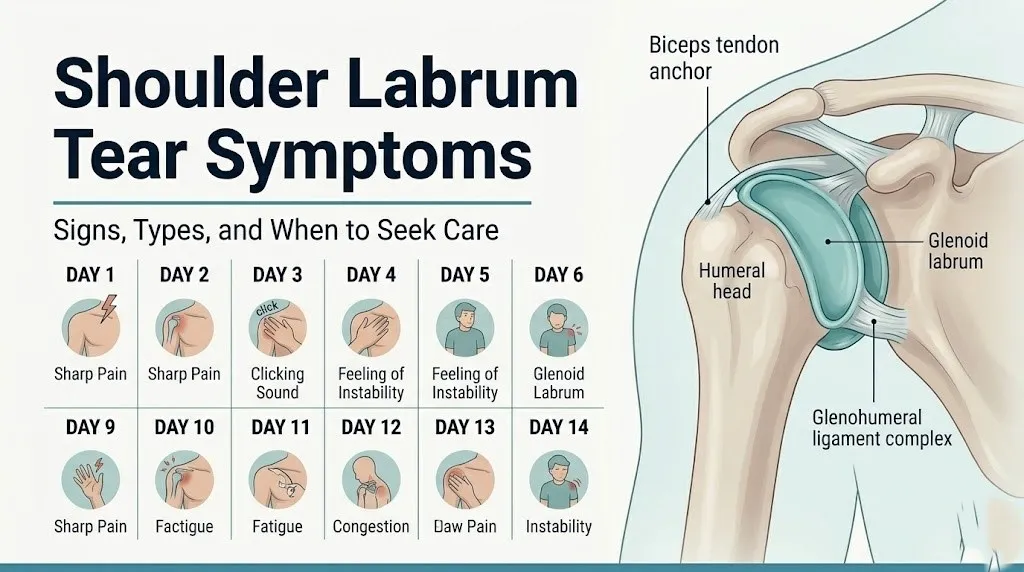
A shoulder labrum tear is a disruption of the glenoid labrum, the fibrocartilaginous rim that lines the edge of the glenoid fossa of the scapula, deepening the shallow shoulder socket and anchoring the ligaments and biceps tendon that stabilize the glenohumeral joint.
The glenoid fossa, without the labrum, is roughly as deep as a flattened golf tee. The labrum effectively deepens that socket by approximately 50 percent, increasing the contact area between the humeral head and the glenoid from about 25 percent to 75 percent of the humeral head’s surface area. It also creates a suction-cup effect through negative intra-articular pressure that resists humeral head displacement. When it tears, that depth, that ligament anchor, and that suction mechanism are all compromised simultaneously.
Labral tears occur through two distinct mechanisms. Traumatic tears result from a single high-force event: a fall onto an outstretched arm, a collision in contact sports, or a glenohumeral dislocation. Degenerative tears result from repetitive microtrauma over months to years, particularly in overhead athletes whose arm regularly passes through the provocative positions that stress the superior and posterior labrum.
The three most clinically important labral tear subtypes are:
- SLAP lesion (superior labrum anterior to posterior): Tear of the superior labrum at the biceps tendon anchor point, extending anteriorly and posteriorly from the 12 o’clock position on the glenoid
- Bankart lesion: Tear of the anterior-inferior labrum at the 5 to 7 o’clock position, typically from anterior glenohumeral dislocation
- Posterior labral tear (reverse Bankart): Tear of the posterior labrum at the 7 to 11 o’clock position, from posterior directed force or posterior instability
The location of the tear determines the direction of instability, the position of provocative pain, and the specific physical examination tests that will be positive.
Quick Tip:
- A single shoulder dislocation in a person under 25 carries a recurrence risk above 80 percent, per data from the American Journal of Sports Medicine, because the Bankart lesion created by the dislocation is rarely repaired without surgical intervention
- Overhead athletes with insidious onset deep shoulder pain at the end of their throwing motion should suspect a SLAP lesion rather than a Bankart lesion
- Women with generalized joint hypermobility may develop multidirectional labral fraying without a single traumatic event
Shoulder Labrum Tear Symptoms Overview
The primary symptoms of a shoulder labrum tear are deep joint pain that is difficult to localize precisely, mechanical symptoms including clicking, catching, or locking, shoulder instability ranging from a vague sense of looseness to frank repeated dislocation, weakness with overhead or behind-the-back positions, and a reduction in active range of motion compared to the unaffected side.
These symptoms share a common mechanism: the torn labral tissue disrupts the glenohumeral joint’s structural architecture. The inferior glenohumeral ligament complex (IGHLC), which is the primary restraint against anterior shoulder dislocation when the arm is in the 90-degree abduction and external rotation position, attaches directly to the anteroinferior labrum. A Bankart tear therefore destabilizes this ligament’s foundation, producing the instability that is the hallmark symptom.
The following table presents the full symptom spectrum by clinical significance:
| Symptom | Labral Tear Subtype Most Associated | Physiological Mechanism | Clinical Significance |
|---|---|---|---|
| Deep aching shoulder pain | All subtypes | Nociceptor activation in torn fibrocartilage and inflamed joint capsule | Most common presenting symptom |
| Clicking or catching sensation | SLAP, posterior tear | Torn labral flap catching against glenoid articular cartilage | High specificity for mechanical pathology |
| Anterior instability / apprehension | Bankart lesion | Loss of IGHLC anchor, anterior humeral head translates at 90/ER position | Strongly suggests anterior labral pathology |
| Pain at end-range overhead | SLAP lesion | Biceps tendon anchor tension on torn superior labrum | Characteristic SLAP presentation |
| Posterior shoulder pain under load | Posterior labral tear | Posterior capsular tension on torn posterior labrum | Common in contact sport athletes |
| Weakness with overhead lifting | SLAP, rotator cuff involvement | Biceps anchor instability, reflex inhibition of rotator cuff | May indicate combined pathology |
| Reduced internal rotation | Posterior labral tear | Posterior capsular contracture from chronic posterior instability | Often misdiagnosed as impingement |
| Night pain | Advanced or inflamed tears | Positional loading of the glenohumeral joint capsule during sleep | Suggests significant synovial inflammation |
People taking nonsteroidal anti-inflammatory drugs (NSAIDs) for other conditions may experience partial masking of the pain component while the mechanical symptoms (clicking, instability) remain unchanged. This can delay recognition of the labral tear as the primary source.
Pain Location and Character in a Shoulder Labrum Tear
Pain from a shoulder labrum tear is characteristically located deep inside the joint, often described by patients as “in the back of the socket” or “in the center of the shoulder,” and is distinctly different from the superficial, more diffuse pain of rotator cuff tendinopathy or acromial impingement.
The specific pain location varies by tear type. Anterior labral tears (Bankart lesions) produce pain at the front of the shoulder that is reproduced when the arm is brought to the 90-degree abduction and external rotation position, the “late cocking” position of a throwing motion. Superior labral (SLAP) tears produce pain in the deep superior aspect of the shoulder, often described as inside the top of the joint, that worsens with overhead reaching, pulling down from an overhead grip, or decelerating the arm from a throw.
Pain character in labral tears tends to be intermittent rather than constant in early stages. It is often provoked by specific movements rather than present at rest. According to a systematic review published in the American Journal of Sports Medicine examining physical examination findings in labral tears, the pain provoked by the O’Brien’s active compression test (specifically, pain deep inside the joint rather than at the acromioclavicular joint) has a sensitivity of approximately 47 to 100 percent and specificity of 11 to 98 percent for SLAP lesions, with variability dependent on examiner technique.
To describe shoulder pain accurately to your orthopedic specialist or primary care physician:
- Note whether pain is deep inside the socket versus near the surface of the shoulder
- Identify the arm position that reproduces it most reliably (overhead, arm behind the back, arm at 90 degrees externally rotated)
- Rate the pain on the Visual Analog Scale (VAS) from 0 to 10 both at rest and during the provocative movement
- Note the onset: did it follow a single trauma, or did it develop gradually over weeks to months
- Record whether the pain radiates down the arm or whether it stays localized in the shoulder
Older adults over 60 may perceive labral tear pain differently than younger patients because concurrent rotator cuff tendinopathy or glenohumeral osteoarthritis contributes an overlapping aching quality that obscures the sharp, position-specific quality more typical of isolated labral tears in younger individuals.
Key Takeaway: Deep joint pain reproduced specifically when the arm is in the overhead or 90-degree-abduction-plus-external-rotation position, rather than diffuse surface-level shoulder aching, is the clinical hallmark that distinguishes labral tear pain from rotator cuff impingement in the office setting.
Clicking, Catching, and Popping Sensation from a Labral Tear
The clicking, catching, and popping sensations produced by a shoulder labrum tear occur when the torn, unstable margin of the fibrocartilaginous labrum intermittently catches against the articular surface of the glenoid or the humeral head as the joint moves through its arc of motion.
Think of the torn labral flap like a frayed edge on a round door seal. When the door closes normally, the seal is smooth and flush. When the edge is torn and displaced, it catches every time the door closes under pressure. The glenohumeral joint works identically: the humeral head rotating over a torn labral flap produces a palpable, sometimes audible click or pop as the flap is momentarily compressed and then released.
Not all shoulder clicking indicates a labral tear. Benign physiological clicking from gas bubble cavitation in the joint fluid is common and painless. The distinguishing feature is whether the clicking is painful. A 2021 systematic review published in Arthroscopy: Journal of Arthroscopic and Related Surgery found that painful clicking or catching in the shoulder has a positive predictive value significantly higher for intra-articular pathology (including labral tears) than for extra-articular or benign causes, particularly when accompanied by instability symptoms.
The catching sensation differs from clicking in character. Clicking is a brief, sharp sound or feeling. Catching is a sensation that the joint has momentarily “snagged,” with resistance to continued movement. In some labral tears, the displaced labral flap can produce a frank locking sensation where the shoulder temporarily resists further rotation until the flap is repositioned by shifting the arm. This locking pattern is an important distinguishing feature that warrants prompt orthopedic evaluation.
Adolescent athletes between the ages of 15 and 25 who report painful clicking during throwing, swimming, or gymnastics should have this symptom evaluated by a sports medicine physician or board-certified orthopedic surgeon rather than dismissed as normal adolescent joint noise, because this age group has a high rate of SLAP tears from repetitive overhead loading that are amenable to early intervention.
Shoulder Instability as a Labrum Tear Symptom
Shoulder instability from a labral tear occurs when the torn labrum no longer provides the structural anchor for the inferior glenohumeral ligament complex (IGHLC), the primary capsuloligamentous restraint against anterior shoulder dislocation, allowing the humeral head to translate excessively in the direction of the tear.
The direction of instability is directly determined by the tear location. Anterior labral tears (Bankart lesions) produce anterior instability: the sensation that the arm might slip forward out of the socket, particularly when reaching overhead or behind the head. Posterior labral tears produce posterior instability: a sense of the arm slipping backward, typically provoked by the arm forward-flexed at 90 degrees and internally rotated, the position used in a push-up or a bench press.
Instability symptoms range along a spectrum:
- Apprehension: A feeling of anxiety or guarding when the arm is placed in the provocative position, without actual dislocation occurring. This is the mildest form of instability symptom.
- Subluxation: The humeral head partially slides over the glenoid rim and then reduces spontaneously. Patients often describe this as the shoulder “going out” and “coming back.”
- Dislocation: Complete displacement of the humeral head from the glenoid fossa, requiring external reduction. This is the most severe form and is always a medical evaluation event.
According to the American Academy of Orthopaedic Surgeons (AAOS), anterior glenohumeral dislocation accounts for approximately 95 percent of all shoulder dislocations, and the vast majority of these create a Bankart lesion at the anteroinferior glenoid labrum. Recurrence rates following a first-time dislocation are highest in patients under 20 years of age, with research in the Journal of Bone and Joint Surgery documenting recurrence rates above 85 percent in this age group managed non-operatively.
Patients with generalized joint hypermobility syndrome or Ehlers-Danlos syndrome (hypermobile type) may experience multidirectional shoulder instability from labral fraying rather than a discrete directional tear, producing instability in multiple directions simultaneously and a more complex clinical picture.
Shoulder Weakness and Reduced Range of Motion in Labral Tears
Shoulder weakness and reduced range of motion from a labral tear result from two distinct mechanisms: direct mechanical compromise of the biceps tendon anchor in SLAP tears, and reflexive inhibition of the rotator cuff muscles from pain signaling within the glenohumeral joint capsule.
In a SLAP lesion, the long head of the biceps brachii tendon inserts directly into the superior labrum and supraglenoid tubercle. When the superior labrum tears, the biceps anchor becomes unstable. The biceps, normally a secondary stabilizer of the glenohumeral joint during forearm supination and elbow flexion under load, cannot generate full force without a stable labral origin. Patients typically report weakness when lifting objects from a low position to overhead, or when performing pulling movements such as a lat pulldown or a climbing motion.
Reflexive inhibition is the second, often underappreciated mechanism. Pain within the glenohumeral joint activates articular nociceptors that send inhibitory signals to the spinal motor neurons controlling the rotator cuff muscles. This is the same mechanism that produces quadriceps weakness in a knee with a joint effusion: the pain signal actively reduces muscle activation to protect the joint. A labral tear that produces significant synovial irritation therefore causes rotator cuff weakness even in the absence of any direct rotator cuff pathology.
The National Institute of Arthritis and Musculoskeletal and Skin Diseases (NIAMS) notes that weakness perceived by the patient as a loss of shoulder strength frequently reflects joint-level pain inhibition rather than true muscle damage, and that strength typically normalizes once the underlying labral pathology is addressed.
Reduced internal rotation measured clinically is a specific finding associated with posterior labral tears and posterior capsular contracture. A deficit of more than 20 degrees of internal rotation compared to the contralateral shoulder, measured with the arm at 90 degrees of abduction, is a clinically meaningful finding that sports medicine physicians use to identify posterior shoulder pathology in throwing athletes, per established clinical assessment protocols from the American Orthopaedic Society for Sports Medicine (AOSSM).
Key Takeaway: Weakness localized specifically to overhead lifting and pulling movements, combined with deep joint pain rather than surface-level shoulder aching, points toward biceps anchor instability from a SLAP lesion rather than isolated rotator cuff tendinopathy.
Shoulder Labrum Tear Symptoms at Night and with Rest
Shoulder labrum tear symptoms at night and during rest occur when the glenohumeral joint’s resting position loads the torn labral tissue or inflamed joint capsule, producing pain that is distinct from the activity-provoked pain that characterizes early-stage tears.
Nighttime shoulder pain from a labral tear typically worsens when the person lies on the affected shoulder, because body weight compresses the glenohumeral joint and increases intra-articular pressure against the torn labral tissue. It also occurs when lying on the opposite side with the affected arm resting across the body, because this position places the glenohumeral capsule in a stretched orientation that tensions the torn tissue.
The presence of nighttime pain that disrupts sleep is an important escalation marker. Early-stage labral tears typically produce pain only with specific movements and are comfortable at rest. The emergence of rest pain or nighttime pain indicates one of three things: the tear has progressed in size, a synovial inflammatory response has developed around the tear, or a secondary complication such as a labral cyst (paralabral cyst) has formed from joint fluid extruding through the tear into the periarticular soft tissue.
Paralabral cysts deserve specific mention because they can compress the suprascapular nerve as it passes through the spinoglenoid notch adjacent to the posterior glenoid, producing a pattern of progressive external rotation weakness and posterior shoulder pain that may not be recognized as labral in origin without MRI imaging. A 2020 study published in Arthroscopy: Journal of Arthroscopic and Related Surgery documented suprascapular nerve compression from paralabral cysts in a subset of posterior labral tear patients who presented primarily with weakness and posterior pain rather than instability.
Women in the third trimester of pregnancy and in the early postpartum period are at elevated risk for worsening labral tear symptoms during sleep due to the combined effects of hormonally mediated ligamentous laxity (driven by relaxin produced by the corpus luteum and placenta) and the altered sleep positions necessitated by body habitus. A pregnant person with worsening shoulder instability symptoms should discuss this with their obstetrician-gynecologist and a sports medicine physician experienced in perinatal musculoskeletal care.
SLAP Tear Symptoms Versus Bankart Lesion Symptoms
SLAP tear symptoms and Bankart lesion symptoms share some features (deep joint pain, mechanical clicking, shoulder dysfunction) but differ in pain location, instability direction, provocative positions, and the activities that most reliably reproduce them.
A SLAP tear involves the superior labrum at the biceps tendon anchor. Its defining symptom is pain at the top of the shoulder socket that is reproduced by overhead activities, particularly the late-cocking and deceleration phases of throwing, overhead pressing, and pulling from an overhead grip. Instability from a SLAP tear, when present, tends to produce a sense of “dead arm” (sudden transient weakness and heaviness in the arm during throwing), not the frank apprehension of forward dislocation.
A Bankart lesion involves the anteroinferior labrum. Its defining symptom is anterior shoulder apprehension: the sense that the arm will slip forward when placed at 90 degrees of abduction and maximum external rotation. This is the position most people recognize as the “arm cocked to throw” position or the position when reaching into a back seat. Frank dislocation events are far more common with Bankart lesions than with isolated SLAP tears.
| Feature | SLAP Tear | Bankart Lesion |
|---|---|---|
| Tear location | Superior glenoid (12 o’clock) | Anteroinferior glenoid (5-7 o’clock) |
| Primary symptom | Deep pain with overhead activity | Anterior apprehension at 90°/ER |
| Instability pattern | Dead arm sensation; subtle subluxation | Anterior subluxation or dislocation |
| Provocative position | Overhead reach, late throwing phase | 90° abduction + external rotation |
| Most common cause | Repetitive overhead loading, FOOSH | Anterior dislocation, FOOSH |
| Best physical exam test | O’Brien’s, biceps load test II | Apprehension test, relocation test |
| Key imaging finding | Superior labral detachment on MRA | Anteroinferior labral avulsion on MRA |
| Common population | Overhead athletes, age 20-40 | Contact sport athletes, young adults |
FOOSH: fall on outstretched hand
Posterior labral tears share some symptoms with SLAP tears (deep posterior pain, posterior apprehension under axial load) but are distinguished by pain provoked by the arm forward-flexed at 90 degrees and internally rotated under compressive load, the position that reproduces the posterior apprehension test, rather than the overhead position that reproduces SLAP symptoms.
Early Signs of a Shoulder Labrum Tear
The early signs of a shoulder labrum tear are often subtle enough that people attribute them to muscle soreness, minor strains, or overuse, delaying evaluation for months. Recognizing the specific early pattern changes that trajectory.
Early-stage labral tears typically present with three features that distinguish them from simple muscular shoulder pain. First, the pain is position-specific rather than diffuse: it occurs in a consistent, identifiable arm position (overhead reach, behind-the-back reach, or the arm cocked in throwing position) and not uniformly across all shoulder movements. Second, a new clicking or catching sensation develops inside the joint that was not previously present. Third, the person notices subtle loss of confidence in the shoulder, described as a vague sense that the shoulder “doesn’t feel right” or “might give way,” even without an actual instability event.
Early signs that distinguish a labral tear from a simple shoulder muscle strain:
- Pain that is deep inside the joint rather than localized to a specific muscle belly or tendon
- Clicking or catching that is painful (not just audible and painless)
- Position-specific pain that is consistently reproducible rather than variable
- Symptom onset linked to a specific trauma event or to a period of unusually high overhead loading
- Persisting beyond three weeks without improvement despite relative rest
Mayo Clinic clinical guidance on shoulder injury assessment states that shoulder pain persisting beyond four to six weeks without a clear diagnosis and without improvement warrants clinical evaluation, as labral pathology is frequently missed on initial assessment when imaging is not performed.
Adolescent athletes aged 13 to 18 in overhead sports (baseball, softball, volleyball, swimming) should be evaluated by a sports medicine physician when early signs appear, because this age group has open physes that create specific labral stress patterns and because early diagnosis in this group is associated with better non-surgical outcomes when appropriate activity modification is implemented promptly.
Key Takeaway: Position-specific deep joint pain that is consistently reproducible in the same arm position, combined with new painful clicking and a vague sense of joint instability, is the early labral tear triad that warrants clinical evaluation within four to six weeks of symptom onset, not months later.
Acute Versus Chronic Shoulder Labrum Tear Symptoms
Acute and chronic shoulder labrum tear symptoms follow distinctly different clinical patterns in onset, character, severity, and urgency, and recognizing which pattern you are experiencing determines the appropriate response timeline.
An acute labral tear follows a high-force event: a dislocation, a fall, a collision, or an eccentric load failure during lifting. Symptoms appear immediately or within hours: severe pain, a sense that the shoulder has “popped out” or shifted, rapid swelling from a hemarthrosis (bleeding into the joint space), and a significant reduction in active range of motion from muscle guarding. The arm may feel heavy, weak, or numb in the acute phase from the combined effects of pain inhibition, swelling, and, in some cases, axillary nerve stretch injury at the time of dislocation.
A chronic labral tear develops insidiously over months of repetitive loading. The onset is typically described as a gradual worsening of shoulder discomfort that the person initially attributed to muscle fatigue or soreness. There is no single memorable injury event. Clicking and catching develop progressively. Instability symptoms may not appear until the tear has reached a size that compromises the glenohumeral ligament attachment meaningfully.
| Feature | Acute Labral Tear | Chronic Labral Tear |
|---|---|---|
| Onset | Immediate, post-traumatic | Gradual over weeks to months |
| Pain severity at onset | Severe (7-10/10 VAS) | Mild to moderate (3-6/10 VAS) |
| Swelling (hemarthrosis) | Present, often visible | Absent or minimal |
| Neurovascular symptoms | May include axillary nerve stretch | Absent unless paralabral cyst forms |
| Instability pattern | Frank dislocation or subluxation | Apprehension, subtle subluxation |
| Urgency of evaluation | Urgent (within 24-48 hours for first dislocation) | Prompt but not emergent (within 2-4 weeks) |
| Imaging sequence | X-ray first to rule out fracture, then MRA | MRA as primary advanced imaging |
| Most likely subtype | Bankart lesion | SLAP lesion, posterior labral tear |
A first-time acute anterior shoulder dislocation in a person under 25 should be evaluated by a board-certified orthopedic surgeon within one to two weeks of reduction, because the evidence base from the Journal of Bone and Joint Surgery strongly supports that early surgical stabilization in young first-time dislocators significantly reduces the recurrence rate compared to non-operative management.
Shoulder Labrum Tear Symptoms in Overhead Athletes
Overhead athletes, including baseball pitchers, softball players, volleyball players, swimmers, gymnasts, and tennis players, experience a distinct pattern of shoulder labrum tear symptoms shaped by the specific biomechanical demands of their sport and the repetitive loading applied to the superior and posterior glenoid labrum.
The throwing motion applies the highest documented stresses to the glenohumeral joint of any athletic motion studied. During the late-cocking phase, the shoulder reaches approximately 90 degrees of abduction and maximal external rotation, placing a strong distraction force on the anterosuperior labrum. During the deceleration phase, a powerful posterior capsular compressive force loads the posterior labrum. Repeated thousands of times per season, this stress pattern produces internal impingement: the posterior superior labrum and the undersurface of the rotator cuff are compressed between the posterior glenoid rim and the greater tuberosity at the extreme of the late-cocking position.
Symptoms specific to overhead athletes with labral tears include:
- Loss of throwing velocity that is not explained by muscle fatigue
- Pain specifically at the “late cocking” phase or “release” phase of the throw (not throughout the motion)
- “Dead arm syndrome”: transient sudden loss of arm speed and control during a throw, followed by recovery
- Posterior shoulder tightness after throwing sessions that does not resolve with standard warm-up
- Loss of external rotation range (from posterior capsular tightness) measured as more than 20 degrees deficit compared to the non-dominant arm
A 2022 study published in the American Journal of Sports Medicine examining competitive baseball pitchers found that posterior internal impingement and associated posterior labral pathology was present in a clinically meaningful proportion of pitchers reporting chronic posterior shoulder pain, with MRA identifying posterior labral fraying in many cases where standard MRI without contrast failed to demonstrate the tear.
Female overhead athletes deserve specific mention. Research has found an association between low-estrogen phases of the menstrual cycle and reduced shoulder ligament stiffness from estrogen receptor-mediated collagen remodeling in ligament fibroblasts, potentially increasing vulnerability to labral injury at these cycle phases. This finding, from emerging research rather than established clinical guideline, represents a growing area of sports medicine investigation.
Shoulder Labrum Tear Symptoms in Older Adults and Non-Athletes
Shoulder labrum tear symptoms in older adults and non-athletes differ from the overhead-athlete presentation in mechanism, location, severity, and the degree to which they overlap with other common shoulder conditions that increase in prevalence with age.
In adults over 40, labral tears are more frequently degenerative rather than traumatic: the fibrocartilage frays gradually as part of the normal aging process and the cumulative effect of decades of glenohumeral loading. Degenerative labral fraying in this age group often co-occurs with rotator cuff tendinopathy, subacromial bursitis, and early glenohumeral osteoarthritis, producing a symptom pattern that does not have the clean directional instability or position-specific pain of a discrete traumatic tear in a younger patient.
Symptoms in older adults are more likely to include:
- Diffuse deep aching rather than sharp positional pain
- Reduced active range of motion in multiple planes (internal rotation, external rotation, and overhead elevation) rather than one specific provocative position
- Night pain and difficulty sleeping on the affected side
- Grinding sensation (from concurrent glenohumeral cartilage changes) in addition to or instead of clean clicking
- Weakness attributed to rotator cuff involvement rather than biceps anchor instability
A significant clinical challenge in this population is that degenerative labral findings on MRI are present in a high proportion of asymptomatic older shoulders. A 2018 systematic review published in the Journal of Bone and Joint Surgery examining asymptomatic shoulders in adults over 40 found labral abnormalities in a clinically notable proportion of subjects with no shoulder complaints, meaning that a labral finding on imaging in an older adult must be correlated carefully with the physical examination to confirm it as the symptom source.
Older adults on anticoagulant therapy (warfarin, direct oral anticoagulants) who sustain a fall on an outstretched arm should be evaluated by a primary care physician or emergency medicine physician promptly, because hemarthrosis from an acute labral tear may be more severe and slower to resolve in the setting of impaired coagulation.
Key Takeaway: In adults over 40, labral tear symptoms rarely present as clean isolated instability; the dominant picture is diffuse deep aching, nighttime pain, and grinding, usually with concurrent rotator cuff and cartilage changes that require MRA to differentiate from isolated degenerative labral fraying.
How to Tell If Shoulder Pain Is a Labrum Tear or Something Else
Distinguishing labral tear shoulder pain from other common shoulder conditions, particularly rotator cuff tendinopathy, subacromial impingement syndrome, acromioclavicular (AC) joint arthritis, and adhesive capsulitis (frozen shoulder), requires attention to specific clinical features that each condition produces through a distinct anatomical mechanism.
Rotator cuff tendinopathy produces pain at the outer aspect of the shoulder, at the supraspinatus insertion on the greater tuberosity, and is worsened by abduction between 60 and 120 degrees (the subacromial arc). Labral tear pain is deeper, inside the socket, and is typically worst at the extreme of a specific arc rather than through the mid-range.
AC joint arthritis produces pain at the top of the shoulder at the AC joint itself, directly palpable at the junction of the clavicle and acromion. This is a surface-level, precisely localizable pain that is worsened by horizontal adduction (cross-body reach). Labral pain is not surface-palpable and is not specifically worsened by horizontal adduction unless the posterior labrum is involved.
Adhesive capsulitis produces a global loss of both active and passive range of motion in a characteristic pattern: external rotation is lost first, then abduction, then internal rotation. Labral tears, by contrast, typically preserve passive range of motion (a physical therapist can move the arm through its full arc) while producing pain and mechanical symptoms at specific points within that arc.
| Condition | Pain Location | Passive ROM | Provocative Position | Instability | Mechanical Click |
|---|---|---|---|---|---|
| Labral tear | Deep inside socket | Preserved | Specific arc (varies by tear type) | Variable | Present if flap tear |
| Rotator cuff tendinopathy | Outer shoulder, greater tuberosity | Preserved | 60-120° arc, overhead | Absent | Absent |
| AC joint arthritis | Top of shoulder, AC joint | Preserved | Horizontal adduction | Absent | Absent |
| Adhesive capsulitis | Diffuse, deep | Globally restricted | All planes limited | Absent | Absent |
| Glenohumeral OA | Deep, variable | Variably restricted | End-range all planes | Absent | Grinding quality |
People with diabetes mellitus have an elevated risk of adhesive capsulitis, with the American Academy of Family Physicians (AAFP) noting that diabetic individuals develop frozen shoulder at a rate approximately five times higher than the general population, which makes the distinction between adhesive capsulitis and a labral tear especially important in this population group.
Physical Exam Tests Used to Identify a Shoulder Labrum Tear
Physical examination tests for shoulder labrum tears are designed to mechanically stress the torn labral tissue by placing the glenohumeral joint in positions that reproduce the abnormal humeral head movement or biceps anchor tension that the tear permits.
The most clinically studied tests for labral tears include:
O’Brien’s active compression test: The examiner places the arm at 90 degrees of forward flexion with 15 degrees of horizontal adduction and full internal rotation (thumb pointing down). The patient resists a downward force. The test is repeated with the forearm supinated (thumb up). A positive result for SLAP pathology is pain deep inside the joint in the thumb-down position that is relieved or absent in the thumb-up position.
Anterior apprehension and relocation test: The examiner places the arm at 90 degrees of abduction and slowly applies external rotation. Apprehension (not just pain) is a positive result, indicating anterior instability. The relocation test confirms: posterior pressure on the humeral head reduces the apprehension. This test sequence is the most reliable clinical test for Bankart lesion pathology.
Biceps load test II: The arm is placed at 120 degrees of abduction and maximally externally rotated. The patient attempts elbow flexion against resistance. Pain deep in the shoulder is a positive result for SLAP lesion.
| Test | Target Tear Type | Sensitivity | Specificity | Source |
|---|---|---|---|---|
| O’Brien’s active compression | SLAP lesion | 47-100% | 11-98% | American Journal of Sports Medicine |
| Apprehension + relocation | Bankart lesion | 72-81% | 93-98% | Arthroscopy |
| Biceps load test II | SLAP lesion | 90% | 97% | Arthroscopy |
| Crank test | SLAP lesion | 46-91% | 56-93% | Various |
| Posterior apprehension | Posterior tear | 63-76% | Variable | Arthroscopy |
The wide sensitivity ranges for O’Brien’s test reflect examiner-technique variability documented across multiple studies. A single positive physical examination test is insufficient to confirm a labral tear diagnosis. The clinical standard, per AAOS guidelines, is to combine multiple positive examination tests with appropriate imaging before proceeding to surgical planning.
People who have had prior shoulder surgery or who have significant rotator cuff pathology should inform their examining physician before these tests are performed, because prior surgery alters the glenohumeral anatomy and can produce false-positive or false-negative results on standard labral examination tests.
MRI and Imaging for Diagnosing a Shoulder Labrum Tear
Magnetic resonance arthrography (MRA), which involves injection of dilute gadolinium contrast directly into the glenohumeral joint before MRI scanning, is the imaging standard for diagnosing shoulder labrum tears, with significantly higher diagnostic accuracy than standard MRI without contrast.
The reason MRA outperforms standard MRI for labral tears is mechanical. The labrum is a thin fibrocartilaginous structure tightly apposed to the glenoid rim. On standard MRI, the labrum may appear normal because the torn edges are held in close apposition by surface tension or mild scar tissue. Intra-articular gadolinium contrast acts as a fluid distractor: it separates the torn edges of the labrum, makes the tear margins hyperintense on T1-weighted sequences, and fills paralabral cysts that would otherwise appear as ambiguous soft tissue signals.
According to a systematic review published in the American Journal of Sports Medicine examining diagnostic accuracy of shoulder imaging, MRA demonstrates a pooled sensitivity of approximately 88 percent and specificity of approximately 93 percent for SLAP lesions, compared to standard MRI sensitivity of approximately 66 percent and specificity of approximately 82 percent for the same pathology.
The imaging sequence for suspected labral tears typically proceeds as follows:
- Plain X-ray (anteroposterior, scapular Y, and axillary views) to rule out fracture, significant glenohumeral arthritis, and Hill-Sachs lesion (humeral head compression fracture from dislocation)
- Standard MRI without contrast if the clinical suspicion is low or if the goal is to assess the rotator cuff and other soft tissues simultaneously
- MRA (gadolinium-enhanced intra-articular injection plus MRI) when clinical suspicion for labral tear is moderate to high based on history and physical examination
- Diagnostic arthroscopy when MRA is inconclusive and clinical symptoms strongly suggest labral pathology
People with implanted devices (pacemakers, cochlear implants, certain metallic joint replacements) may have contraindications to MRI. In these cases, CT arthrography (computed tomography with intra-articular contrast) provides an alternative imaging approach with comparable accuracy for bony labral lesions and calcified labral pathology. Board-certified radiologists with subspecialty training in musculoskeletal imaging should review all shoulder MRA studies for the highest diagnostic accuracy.
Key Takeaway: Standard MRI alone misses a clinically meaningful proportion of labral tears; if your symptoms strongly suggest a labral injury and your standard MRI is reported as negative, ask your orthopedic surgeon specifically whether MRA with intra-articular gadolinium contrast has been considered.
When to See a Doctor for Shoulder Labrum Tear Symptoms
The appropriate timeline for medical evaluation of shoulder labrum tear symptoms depends on the nature of the presenting symptoms, the mechanism of injury, and whether the situation involves a potentially reducible versus irreducible dislocation or neurovascular compromise.
Seek evaluation from a board-certified orthopedic surgeon specializing in shoulder and elbow, or from a sports medicine physician with shoulder subspecialty experience, under these circumstances:
- Any first-time shoulder dislocation event: evaluation within one to two weeks of emergency reduction, bringing all imaging performed at the emergency department
- Painful clicking or catching inside the shoulder joint persisting more than four weeks without improvement
- Shoulder instability (apprehension, subluxation sensation) occurring in two or more separate events
- Shoulder weakness with overhead activities that is progressively worsening over four or more weeks
- Nighttime shoulder pain disrupting sleep on more than four nights per week
- Failure to improve with four to six weeks of physical therapy specifically addressing glenohumeral stability
When to see your primary care physician first: if symptoms are mild, no instability has occurred, and the clinical picture is not clearly consistent with a discrete labral tear, a primary care physician can perform initial clinical assessment, order standard X-ray and MRI, and refer to orthopedic surgery if imaging or examination findings warrant it.
The following presentation pattern warrants same-day emergency evaluation at an emergency department:
- Visible shoulder deformity suggesting locked dislocation
- Complete inability to move the arm combined with severe pain
- Numbness or paresthesia down the arm or hand following a shoulder injury
- Absent or reduced radial pulse at the wrist following a shoulder dislocation
These presentations can indicate irreducible glenohumeral dislocation, axillary nerve injury, or axillary artery compromise, all of which require emergency orthopedic evaluation and cannot be managed at an urgent care clinic.
When to Go to the Emergency Room for Shoulder Symptoms
Certain symptoms associated with a shoulder injury and possible labral tear require immediate emergency evaluation. Do not wait to see if these resolve on their own.
Go to the nearest emergency room immediately if you experience:
- Visible deformity of the shoulder with the arm held in an abnormal fixed position (acute anterior or posterior glenohumeral dislocation that has not self-reduced)
- Numbness, tingling, or loss of sensation down the arm, hand, or fingers following a shoulder injury (indicates possible axillary nerve or brachial plexus involvement)
- Loss of grip strength or inability to move the fingers following a high-force shoulder impact (neurovascular compromise from the dislocation event)
- A shoulder that “popped out” and will not go back in despite gentle self-manipulation attempts (irreducible dislocation requiring sedation-assisted reduction)
- Shoulder injury associated with a visible open wound over the shoulder joint (open joint injury, which carries infection risk)
- Severe bruising and swelling developing within minutes of a shoulder injury, particularly in a person on anticoagulant therapy (hemarthrosis requiring evaluation)
These presentations can indicate glenohumeral dislocation with neurovascular compromise, irreducible dislocation, or axillary vessel injury, and require emergency orthopedic assessment, not an urgent care appointment or a wait-and-see approach.
Frequently Asked Questions About Shoulder Labrum Tear Symptoms
What does a shoulder labrum tear feel like?
A shoulder labrum tear typically feels like deep joint pain inside the shoulder socket that is provoked by specific arm positions, accompanied by a catching or clicking sensation inside the joint.
The pain differs from rotator cuff pain by being deep and position-specific rather than diffuse and surface-level, and many people also report a vague sense that the shoulder might “give way” or “pop out.”
Some people notice the symptoms only during specific activities such as overhead reaching, throwing, or reaching behind the back, rather than constantly throughout the day.
Can a shoulder labrum tear heal on its own without surgery?
Some shoulder labrum tears, particularly partial tears without significant instability and certain SLAP tears in patients over 40, can improve with physical therapy focused on rotator cuff and scapular stabilizer strengthening.
The peripheral zone of the glenoid labrum has better vascularity and some intrinsic healing capacity, while central tears and complete avulsions have limited healing potential without surgical repair.
A board-certified orthopedic surgeon specializing in shoulder and elbow should determine whether non-operative management is appropriate based on tear type, tear location, patient age, activity demands, and the presence or absence of instability.
How do I know if my shoulder pain is a labrum tear or a rotator cuff tear?
Labral tear pain is typically deep inside the joint socket and provoked by specific positions such as the arm cocked overhead or at 90 degrees of external rotation, while rotator cuff pain is usually felt at the outer shoulder and worsened through the 60-to-120-degree arc of abduction.
Shoulder instability, clicking, or a catching sensation inside the joint strongly favor labral pathology over isolated rotator cuff tendinopathy.
MRA imaging and a physical examination by a board-certified orthopedic surgeon or sports medicine physician is the accurate way to differentiate the two conditions, as they can co-occur in the same shoulder.
What is a SLAP tear and how is it different from a Bankart lesion?
A SLAP tear is a tear of the superior labrum at the biceps tendon anchor point, running from the anterior to the posterior glenoid at the 12 o’clock position, while a Bankart lesion is a tear of the anteroinferior labrum at the 5 to 7 o’clock position typically caused by anterior shoulder dislocation.
SLAP tears produce pain during overhead activities and the late-cocking phase of throwing, while Bankart lesions produce anterior apprehension when the arm is at 90 degrees of abduction and external rotation.
These two tear types require different physical examination tests, produce different instability patterns, and in surgical cases, are repaired through different arthroscopic techniques.
Can a shoulder labrum tear get worse if left untreated?
A shoulder labrum tear can worsen over time if the underlying mechanism causing it continues, particularly in overhead athletes who continue training without modification.
An untreated Bankart lesion that produces recurrent anterior dislocations can lead to progressive glenoid bone loss, a complication called glenoid bone deficiency, which significantly complicates surgical repair and reduces surgical outcomes compared to early intervention.
According to research published in the Journal of Bone and Joint Surgery, each recurrent dislocation episode accelerates bony erosion of the anteroinferior glenoid rim, which is a strong argument for early orthopedic evaluation after a first traumatic labral tear with instability.
What type of doctor should I see for a possible shoulder labrum tear?
The appropriate specialist for evaluation of a possible shoulder labrum tear is a board-certified orthopedic surgeon with subspecialty training in shoulder and elbow surgery, or a sports medicine physician with extensive experience in shoulder instability evaluation.
If your primary care physician or family medicine physician performs the initial evaluation, request a referral to orthopedic surgery when instability symptoms, painful mechanical clicking, or overhead weakness are present alongside shoulder pain.
Bring any imaging already performed (X-ray, MRI) to your orthopedic appointment along with a written description of the specific arm positions that reproduce your symptoms and the mechanism of your original injury.
Closing
The symptom pattern of a shoulder labrum tear is specific enough to recognize if you know what to look for. Deep joint pain in a consistent, reproducible arm position. Painful clicking or catching inside the socket. A sense that the shoulder might give way. These three features together warrant evaluation, not prolonged self-management.
The most important thing to act on: if you have experienced a shoulder dislocation, even one that “popped back in” on its own, see a board-certified orthopedic surgeon specializing in shoulder and elbow within one to two weeks. The recurrence rate for untreated first-time dislocations in young adults is well above 80 percent, and each recurrence carries the risk of progressive joint damage that makes surgical repair more complex.
Your shoulder is the most mobile joint in your body. It stays that way because of a precise architecture of bone, labrum, ligament, and muscle working together. Understanding which part of that architecture has failed is the first step toward the right evaluation and the right plan.